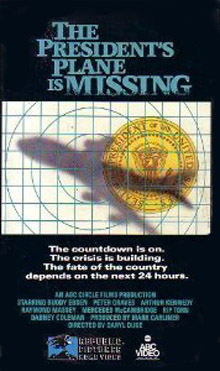
President Jeremy Harris (Tod Andrews) has a lot on his plate. With America and China inching closer and closer to war, Secretary of State Freeman Sharkey (Raymond Massey) is advocating for diplomacy while National Security Advisor George Oldenburg (Rip Torn) feels that America must be more aggressive and ready to launch the first nuclear missile. Of course, no one pays much attention to Vice President Kermit Madigan (Buddy Ebsen). Kermit is viewed with such contempt that he’s never even been given a briefing on what’s going on with China. However, when Air Force One crashes in the California desert and the President cannot be definitively identified as one of the bodies found in the wreckage, Vice President Madigan finds himself with a very difficult decision to make.
That’s quite a crisis. Personally, though, I’m more interested in how the United States ended up with Secretary of State named Freeman Sharkey. I mean, that’s just an amazing name for a diplomat. Why didn’t they elect that guy President? No one messes with Sharkey!
The majority of 1973’s The President’s Plane Is Missing follows a reporter named Mark Jones (Peter Graves) as he tries to get to the bottom of what has happened to President Harris. As usual, Graves is likably stoic. Mark Jones doesn’t show much emotion but, at the very least, he does seem to be trying to do a good job as an old school journalist. What’s interesting is that Mark has an editor (played by Arthur Kennedy) who is constantly yelling at him and threatening to fire him. There’s something very odd about seeing Peter Graves taking order from someone who isn’t intimidated by him.
Mark Jones does learn the truth about why the President has gone missing and he also learns why he, as the reporter assigned to follow the President, wasn’t allowed to board Air Force One when it initially took off. Unfortunately, the solution is a bit anti-climatic. In fact, it’s so anti-climatic that it’s actually kind of annoying. All of the drama ultimately feels rather unnecessary and pointless.
By today’s standards, The President’s Plane Is Missing is a bit on the dull side. There are so many obvious plot holes that I get the feeling that it was probably a bit boring when it originally aired in 1973 as well. The most interesting thing about the film is that it was directed by Daryl Duke, who also directed Payday, a harrowing film about a self-destructive country-western singer. Rip Torn, the star of Payday, appears here as a calm and collected intellectual who advocates for nuclear war without a hint of ambivalence. Torn is a bit miscast as a man without emotions but it’s still always nice to see him in a film.
Who gives the best performance in The President’s Plane Is Missing? Believe it or not, Buddy Ebsen. Ebsen is totally believable as the vice president who, after years of being ignored, is suddenly thrust into a position of power. I’d vote for Kermit Madigan but only if he wasn’t running against Freeman Sharkey.
2020’s Hard Luck Love Story tells the tale of a man named Jesse (Michael Dorman).
Jesse is a drifter, heading from town to town and staying in cheap motels. He plays the guitar and sings to himself. He goes to pool halls and hustles people out of their money, earing him the enmity of a heavily tattooed redneck named Rollo (Dermot Mulroney). He drinks when he’s alone. He drinks when he’s with other people. On the one hand, he’s a pool hustler who makes his living by cheating other people. On the other hand, he’s the type who will hug strangers and give them all of his money. Jesse’s not really a bad guy but he’s someone who, as fate would have it, seems to live in a world that’s dominated by frequently bad people. When Jesse has enough money to afford some beer and some cocaine, he calls his ex-girlfriend, Carly (Sophia Bush), to his hotel. Over the course of a night, we get to know them. Neither one is quite who we originally assumed. Jesse makes a lot of mistakes and he has a talent for angering even the people who try to help him but it’s impossible not to like him. Some of that is due to Michael Dorman’s charismatic performance. Even more of it is because everyone has known someone like Jesse, the well-meaning guy who just has a talent for screwing up.
Hard Luck Love Story is a piece of Americana, one that captures the atmosphere of small towns struggling to survive, dive bars full of broken dreams, and rain-slicked nights when it seems like just about anything can happen. It captures life on the fringes with empathy and a sense of humor. Jesse and Carly may be the heart of the story but the film is full of interesting characters, the types who you could only find in the small cities of Middle America. I particularly liked Zach (Brian Sacca), the bearded cop who goes from being intimidating to being likable in his own dorky way.
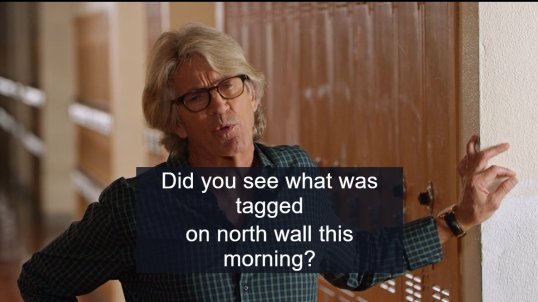
Eric Roberts has a small role in this film. He plays Skip, an associate of Carly’s. Roberts doesn’t have a lot of screentime but he makes the most of it. There’s a tendency to be dismissive of the roles that Roberts does nowadays. In his autobiography, Roberts is himself fairly dismissive of a lot of them. But, in Hard Luck Love Song, he gets a chance to create an actual character and he definitely makes an impression. He’s not just Eric Roberts doing a cameo. Instead, he’s very much a part of the film’s world.
Hard Luck Love Song is an engrossing trip through the parts of America that tend to get overlooked by other films. The film is based on an alt-country song and it hits all the right notes.
Previous Eric Roberts Films That We Have Reviewed:
“May they believe. And may they laugh at their passions. For what they call passion is not really the energy of the soul, but merely friction between the soul and the outside world.” — the Stalker
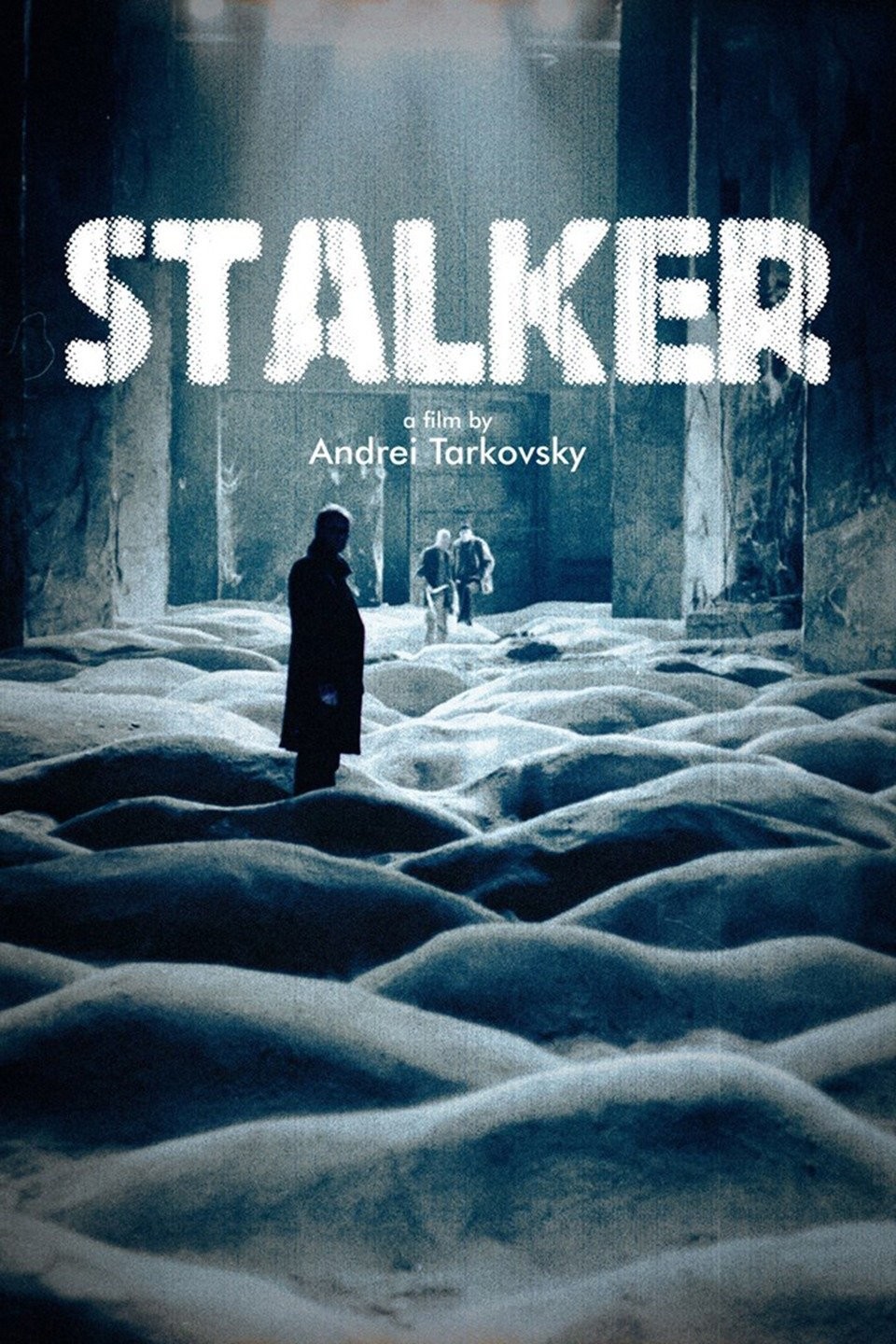
Stalker is one of those films that feels less like a story you’re watching and more like a place you’re slowly drowning in. Directed by Andrei Tarkovsky in 1979, it’s a slow‑burn sci‑fi parable that spends most of its runtime trudging through damp, ruined spaces while three men argue about faith, desire, and whether any of it really matters. It’s not a movie you “get” on first watch; it’s the kind that lingers in your head for days, nudging you to rethink what you thought you wanted from life, and from cinema itself.
The basic setup sounds like genre bread‑and‑butter: a mysterious forbidden area called “The Zone” is guarded by the state, and only a few people—called “stalkers”—can safely guide visitors through it to a fabled Room that can grant a person’s deepest wish. Our guide is simply called the Stalker, played by Alexander Kaidanovsky with a mixture of haunted reverence and exhausted humility. He leads two men into the Zone: a jaded Writer who’s lost his inspiration and a cynical Scientist, each with their own idea of what they’re hoping to find. The tension in Stalker doesn’t really come from the physical danger of the Zone, though it’s full of traps and inexplicable phenomena; it comes from watching these three slowly peel open their own lies to themselves.
Tarkovsky’s visual strategy is almost perversely patient. He lingers on long, static shots of corroded metal, flooded tunnels, and overgrown railway tracks, while the camera glides in smooth, hypnotic movements that feel both weightless and heavy. The Zone is shot in a washed‑out sepia‑like palette, which makes it look like a half‑remembered dream or a charcoal sketch of a ruined world. The real world outside the Zone, in contrast, is the one that’s actually in sepia, while the Zone itself briefly shifts into color. This flip is a quiet but brutal joke: the thing everyone fears and wants to escape from—the decaying, post‑industrial wasteland—is actually more vivid and alive than the “safe” world, which feels duller, flatter, and spiritually dead. The longer you stay inside Stalker, the more you start to suspect that the Zone is less a physical location and more a mirror for the characters’ inner lives.
The central idea driving the film is the Room: the chamber that supposedly grants desires. The Writer and the Scientist have different theories about what the Room is doing. The Writer thinks it can expose the truth of what people really want, not what they claim to want. The Scientist rattles off more technical explanations, wondering if the Room is some kind of psychic field or natural anomaly. The Stalker, meanwhile, approaches it with a kind of religious awe; he believes the Room is a kind of judgment, a place where the universe reaches inside and shows you the core of your being. The film deliberately keeps the mechanics vague, so the focus stays on the question of human desire itself. It asks, in a very quiet way: what if the thing you want most is the thing that would actually destroy you—or worse, is the thing you’re too afraid to admit?
This is where the echoes of Dune start to creep in, even if Tarkovsky never admits it directly. Frank Herbert’s Dune is built around similar ideas: a mystical, hostile landscape (Arrakis) that tests and reshapes whoever tries to cross it, and a system of belief that promises transcendence if you’re willing to face the full, terrifying complexity of yourself. Both stories center on a guide figure—Stalker in the Zone, Paul Atreides in the Fremen’s desert—who leads outsiders into a place that follows its own rules and punishes arrogance. In Dune, the desert is a kind of crucible for destiny; in Stalker, the Zone is a crucible for the soul. The difference is that Herbert leans into prophecy and chosen‑one narrative, while Tarkovsky keeps the prophecy hazy and even mocks the men who fetishize it. The Zone doesn’t care about “chosen” people; it just quietly reflects what’s already there.
The payoff of Stalker is also the opposite of a heroic fantasy. In Dune, the protagonist’s journey to the heart of the desert culminates in a decisive, mythic confrontation that rewrites the future of an empire. In Stalker, the group actually reaches the Room, but the film refuses a conventional resolution. Instead, they argue about whether they’re even capable of deserving what they desire. The Scientist, who claims he wants to protect humanity from the Room’s power, is exposed as someone who fears losing control of his own fate. The Writer, who thinks he wants “truth” or “inspiration,” is quietly terrified that the Room might reveal how shallow his motives really are. The Stalker, in his idealism, is the closest to pure faith, but that faith is also fragile, constantly battered by the cynicism of the men he’s guiding. The Room doesn’t magically fix anyone; it just sits there, neutral, until the characters decide if they’re willing to confront the consequences of their own hearts.
Another way Stalker feels Dune‑adjacent is in its treatment of desire as a kind of test. Both works suggest that the deepest desires of human beings are not just personal wishes but political and moral statements. In Dune, the messianic fantasies of the Fremen and the machinations of the Empire reveal how easily spiritual yearning can be weaponized. In Stalker, the possibility of the Room is already politicized by the state that tries to seal it off, and by the figures who claim to want to “use” it for the greater good. The film’s closest hint at Herbert‑style mythology is in the legend of Porcupine, the Stalker’s mentor who supposedly used the Room to wish for riches and then hanged himself out of guilt. That story, told by the Writer, suggests that the Room doesn’t just grant desire—it interprets it, exposing the gap between what people say they want and what they secretly crave. It’s a more intimate, less epic version of the Bene Gesserit’s manipulation of destiny.
Philosophically, Stalker is far more pessimistic about human nature than Dune ever is. Herbert’s universe is full of grand schemes, hidden lineages, and cosmic prophecies; Tarkovsky’s world is modest, shabby, and claustrophobic. The film’s conversations are long, meandering, and sometimes self‑indulgent, but they also reveal the quiet desperation of people who feel spiritually stuck. The Writer confesses he’s tired of being celebrated for his work, the Scientist quietly fears being obsolete, and the Stalker agonizes over whether his faith is just a delusion that keeps him from a normal life. Their journey through the Zone is framed as a kind of pilgrimage, but the film undercuts the idea that pilgrimage guarantees enlightenment. The final scenes, returning to the Stalker’s home and his sickly daughter, complicate the idea of “fulfillment” even further. The Zone may have changed them, but it doesn’t heal them in the way a simpler hero’s‑journey narrative would pretend it does.
Tarkovsky’s approach to pacing and atmosphere also feels like a spiritual cousin to the way later sci‑fi filmmakers try to balance spectacle with contemplation. Directors like Denis Villeneuve, who has openly admired Stalker, use long, slow shots and carefully composed landscapes to give weight to inner psychological states. Dune (2021) and Dune: Part Twoborrow from Tarkovsky’s bag of tricks—long silences, oppressive sound design, and an almost religious reverence for the environment—but they still wrap that atmosphere around a more conventional plot and character arc. Stalker, by contrast, barely clings to plot at all. It’s closer to a walking meditation, where the real action is happening in the pauses between lines of dialogue, in the way the camera hovers over a puddle or a rusted pipe as if it’s discovering something sacred in the mundane.
In the end, Stalker feels less like a straightforward sci‑fi film and more like a religious parable wearing the costume of genre. It asks the same questions that Dune subtly raises—what do we truly want, what are we willing to sacrifice for it, and how much do we actually understand ourselves—but it answers them with hesitation, doubt, and a kind of exhausted tenderness. The Zone isn’t a promised land; it’s a confession booth. The Room isn’t a magic button; it’s a mirror. And the Stalker himself isn’t a fearless explorer, but a broken man who keeps leading others into the dark because he can’t stop believing that, somewhere in that darkness, there might be a flicker of grace that could make it all worth it. If Dune is about the myth of destiny, Stalker is about the fragile, uncertain labor of faith in a world that keeps looking more like a ruined factory than a cathedral.
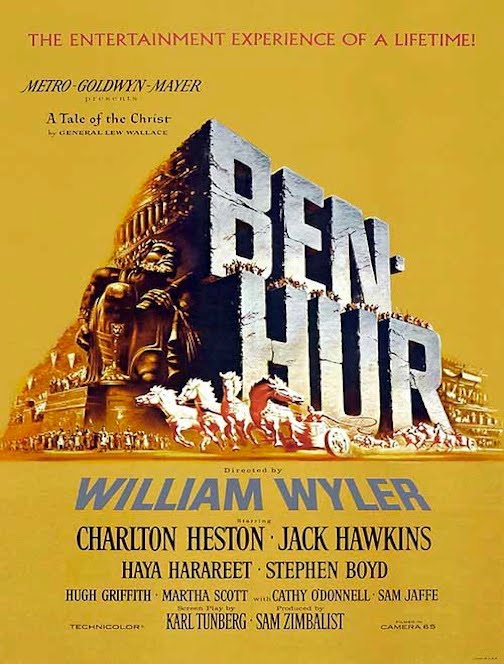
Today’s scene that I love comes from 1959’s Ben-Hur. The chariot race was one of the great action sequences of its era and its influence is still felt to this day. Rumor has it that Mario Bava was among the crew that helped to shoot the chariot race. Personally, I choose to believe that even if I can’t prove it!
4 Shots From 4 Films is just what it says it is, 4 shots from 4 of our favorite films. As opposed to the reviews and recaps that we usually post, 4 Shots From 4 Films lets the visuals do the talking!
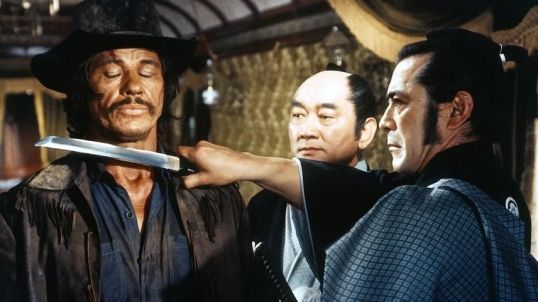
106 years ago today, the great Japanese actor Toshiro Mifune was born in Qingdao, Shandong, China, which was under Japanese occupation at the time. After working as a photographer and as an assistant cameraman, Mifune made his acting debut in 1947, playing a bank robber in Snow Trail.
Mifune would go on to become an international superstar, appearing in hundreds of films before his death in 1997. Sixteen of those films would be directed by Akira Kurosawa and Mifune’s performances in Kurosawa’s yakuza and samurai films would go on to inspire actors the world over. When Sergio Leone adapted Yojimbo into A Fistful of Dollars, Clint Eastwood based his performance on Mifune’s performance in the original. George Lucas would later create the character of Obi-Wan Kenobi with Mifune in mind.
In honor of the man and his career, here are
4 Shots From 4 Films
Drunken Angel (1948, directed by Akira Kurosawa)
Throne of Blood (1957, directed by Akira Kurosawa)
In December of 2021, I was nearly attacked in a Target.
This was nearly two years into the COVID pandemic and the world was slowly reopening. (Since I live in Texas, my world reopened earlier than everyone else’s. Despite the predictions of folks up north, who were almost gleeful in their predictions that Texas would be wiped out by people coughing on each other at football games, we survived.) In 2020, my sisters and I couldn’t really celebrate Christmas the way we usually did because everything was closed. In 2021, we were l0oking forward to making up for lost time.
What I was not looking forward to was wearing a mask. Due to an ambitious politician named Clay Jenkins who was hoping to ride the COVID pandemic into the governor’s mansion, Dallas County still had a mask mandate. The mandate was unenforceable due to Governor Abbott’s executive order but still, a lot of people in Dallas were masking up. Sitting in the parking lot of Target, I told my three older sisters that I was not going to wear a mask inside the store. I have asthma. Having to wear a mask was more than just an inconvenience for me. Wearing a mask made it difficult for me to breathe and, given that more and more health authorities were starting to admit that masks didn’t make any difference as far as the spread of the disease was concerned, I didn’t see why I should have to unnecessarily suffer. My sisters said that they understood and that they would have my back if anyone said anything to me about my maskless state. “But no one will,” my sister Megan assured me.
As soon as I stepped into the store, I heard it.
“GET A MASK ON HER!”
It wasn’t a store manager or a cop or any other sort of authority figure yelling. It was an overweight, middle-aged woman riding around the store on her little scooter. Apparently, she spotted me as soon as I entered the store and immediately started driving herself in my direction, yelling the entire time. I couldn’t really understand the majority of what she yelled but I did manage to make out words like “Mask,” “kill all of us,” “selfish,” and a few others that I can’t repeat during Lent.
Again, because of Lent, I can’t tell you what my older sister Melissa said in response to her. My sisters, all three of whom had been masked up, removed their masks in solidarity. I wish I could say that the entire store applauded but most people were just trying to avoid looking at the fat banshee on her scooter.
Even after my sisters removed their masks, the woman continued to focus her anger on me, still yelling as I walked past her. (I attempted to smile politely at her, which did not help the situation.) Eventually, her voice faded away. She either left the store or found someone else to yell at.
I tell this story to illustrate one point. The COVID pandemic was a very strange time. One can both acknowledge the very real tragedy of COVID while also acknowledging that quite a few people fell down the doom rabbit hole and allowed themselves to be driven mad by the constant drumbeat of government officials, members of the media, and other commentators telling us that everyone was going to die unless we wore masks and maintained a distance of 6 feet from each other. Due to the COVID pandemic, businesses were forced to shut down. People lost their jobs. Families were not allowed to comfort each other. In many states, students were not allowed to go to school. To doubt any element of the government’s response to COVID meant running the risk of being listed as a “conspiracy theorist.” Blue states started to gleefully keep track of how many died in red states. Red states started to keep track of how many civil liberties were suspended by the blue states. (We all should have been keeping track of their number of politicians who violated their own mandates and simply shrugged off the outrage.) We were constantly told that we were in a war against the virus but if felt more as if the country was actually at war with itself and a lot of people seemed to be happy with that.
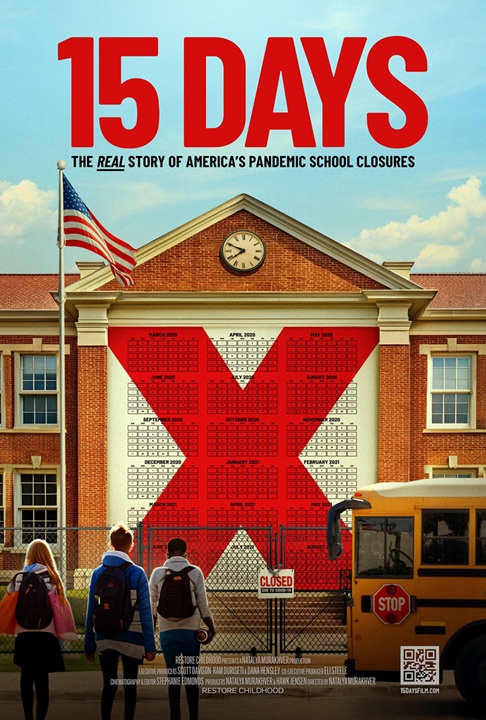
The documentary 15 Days opens with clips from a zoom meeting, in which Jane Fonda, Randi Weingarten, and a host of others discuss the pandemic as an opportunity to bring about social change. The documentary goes on to document how the school shutdowns went from being “15 days to slow the spread,” to nearly two years of remote learning. Parents discuss going from trusting the government and wanting to do the right thing to the growing disillusionment of realizing that “15 Days to Slow The Spread” was, from the start, an empty slogan. Epidemiologists who opposed the school closings discuss being censored and dismissed as “fringe extremists.” Student athletes talk about losing out on college scholarships. We learn about the struggles of doing remote learning. We learn how some students merely disappeared from the system.
As you probably already guessed, 15 Days has a political agenda and, as such, it won’t be for everyone. Certain parts of it were certainly not for me. (Personally, I think the film lets the Trump administration off too easily when it comes to the federal government’s COVID response.) But that doesn’t change the fact that 15 Days shows just how much damage was done to an entire generation by the senseless and largely partisan-driven decision to shut down the schools in so many states. In between clips of people claiming that “kids are resilient,” we get interviews with actual kids who lost two years of not just education but also social development to the shutdowns. The contrast between what we were told was happening with remote learning and what actually happened is stark. The director, a disillusioned and self-described “progressive Democrat” named Natalya Murakhver compares America during the pandemic to the totalitarian government that her family fled when she was a child and it’s hard not to feel that she has a point.
You may or may not agree with the film’s politics but, with each passing day, it becomes more and more obvious how screwed up the federal government’s response to the COVID pandemic truly was. Documentaries like this are important because right now, the gaslighting we’re seeing about what really happened in 2020 and 2021 is incredible. Neighbors turned against neighbor (or shopper, as they case may be). And an entire generation lost two of the most important developmental years of their lives.
When Charlotte (Jessica Morris) meets a younger man named Chris (Philip McElroy), she is both flattered and amused when he asks her out. “You’re a little young for me,” Charlotte says. However, Charlotte’s friend, Maddie (Akari Endo), insists that Charlotte really does need to get out more so Charlotte meets up with Chris for drinks. One things leads to another and soon, Charlotte is having sex with Chris in her classroom!
(Charlotte is an English teacher, along with being a struggling romance novelist.)
The next day, as Charlotte teachers her class, she is shocked when Chris shows up. “What are you doing here?” Charlotte asks. Chris reveals that he’s a new student and Charlotte is now his English teacher!
2018’s The Wrong Teacher is one of the many “Wrong” films that David DeCoteau directed for Lifetime. This one follows the usual pattern. Chris isn’t ready to let go of his one night of passion with the teacher. When he discovers that Charlotte is getting back together with her ex-boyfriend (Jason-Shane Scott), he snaps. Soon, people are getting shot and hit with baseball bats and videos of Chris and Charlotte going at it in the classroom are showing up on the school’s twitter page. Vivica A. Fox is alarmed that Charlotte could be so foolish. Charlotte declares, “You messed with the wrong teacher!” Thanks to some last minute strangeness that sees Charlotte adopting a Southern accent, The Wrong Teacher is enjoyably over the top.
As for Eric Roberts, he plays the assistant principal. He’s a bit burned-out. He’s easily annoyed. He doesn’t want any scandalous behavior in his school. He’s Eric Roberts and he makes the most of his three scenes. Eric even stands up and walks in this movie. He only does that when he’s particularly invested in a role. The Wrong Teacher? More like The Right Vice Principal.
Previous Eric Roberts Films That We Have Reviewed:
Today is Christopher Walken’s 83rd birthday so it seems appropriate to share a Walken scene that I love. Without further ado, here is the classic gold watch speech from the 1994 film, Pulp Fiction:
4 Or More Shots From 4 Or More Films is just what it says it is, 4 shots from 4 of our favorite films. As opposed to the reviews and recaps that we usually post, 4 Shots From 4 Films lets the visuals do the talking!
Today, we pay tribute to the year 1975. It’s time for….
4 Shots From 4 1975 Films
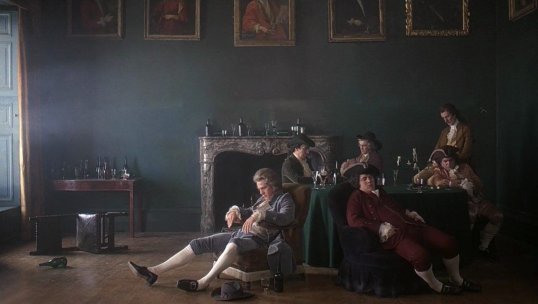
Barry Lyndon (1975, dir by Stanley Kubrick, DP: John Alcott)
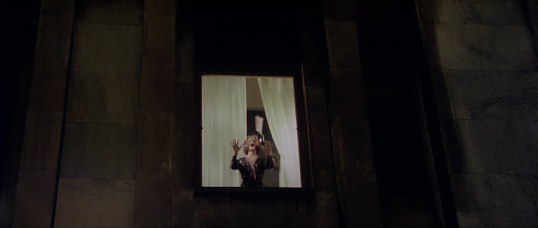
Deep Red (1975, dir by Dario Argento, DP: Luigi Kuveiller)
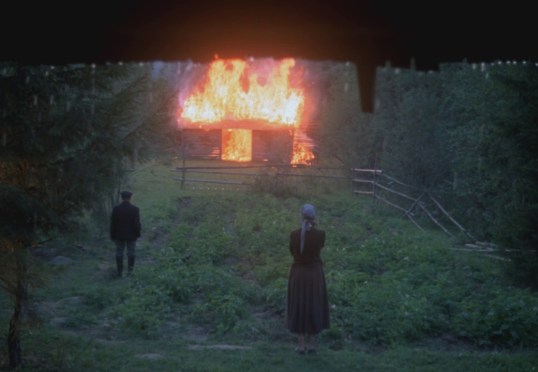
Mirror (1975, dir by Andrei Tarkovsky, DP: Georgy Rerberg)
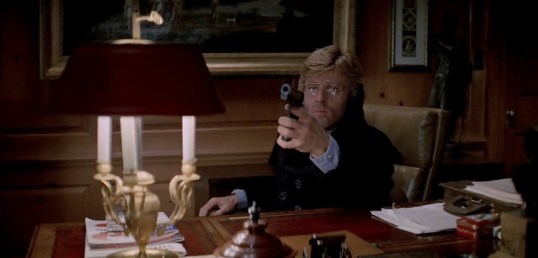
Three Days Of The Condor (1975, dir by Sydney Pollack, DP: Owen Roizman)
“We came here for a rescue mission, and now we’re just something on the menu.”— said by someone, maybe.
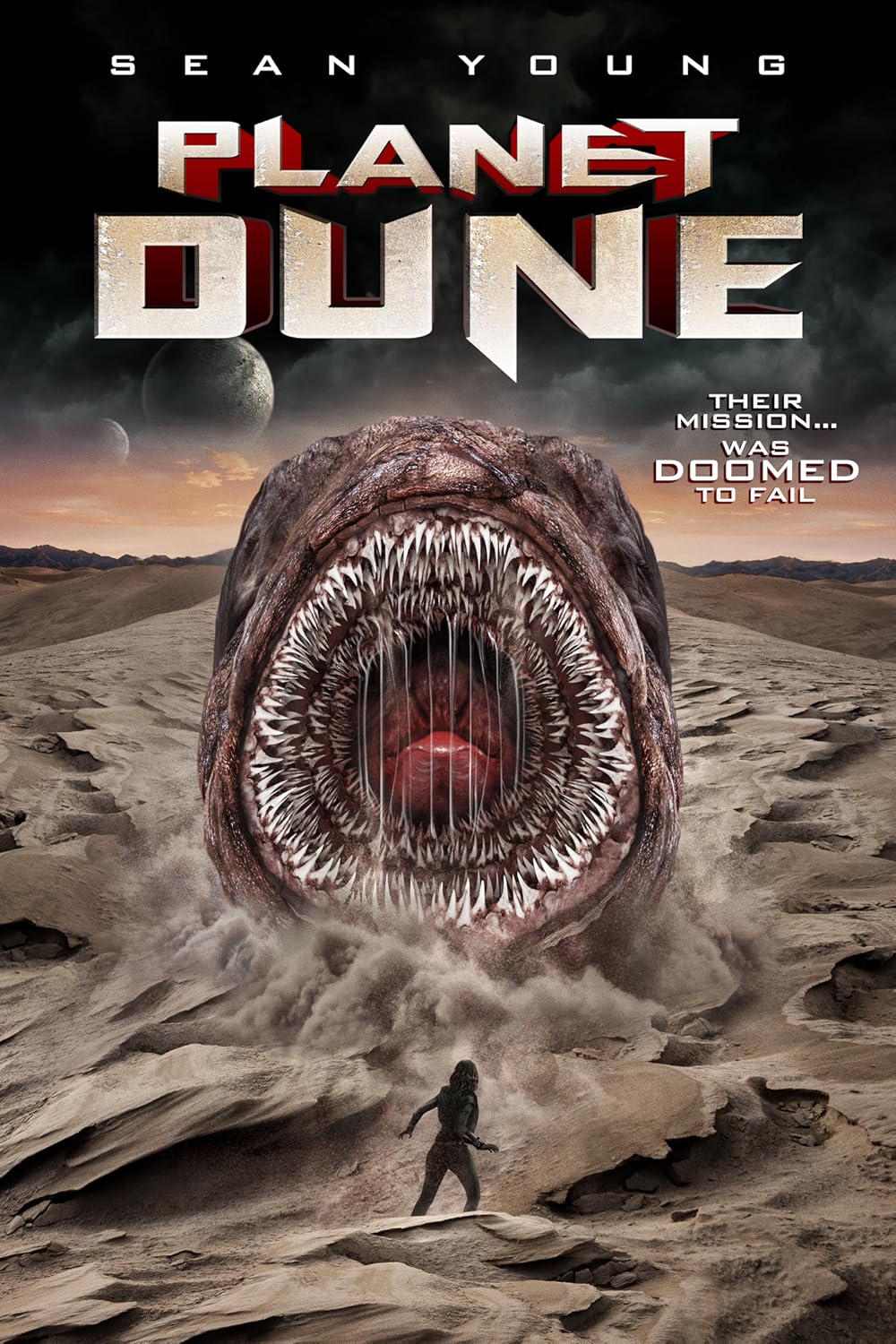
Planet Dune is a scrappy, low‑budget sci‑fi creature feature that knows exactly what it is, and that self‑awareness helps it go down easier. It is not a polished prestige production, but it does deliver a simple survival story, some intentionally goofy monster‑movie energy, and enough visual invention to keep genre fans from completely checking out. It also practically announces itself as another in‑name‑only knock‑off in the vein of The Asylum’s mockbuster factory, clearly trying to ride the coattails of Denis Villeneuve’s Dune: Part One. The timing, the desert‑planet setting, the sand‑worm menace, and the threadbare plot all feel calculated to cash in on the renewed mainstream buzz around the Dune name, rather than to build something original.
From the start, Planet Dune leans hard into its B‑movie identity. The setup is straightforward: a rescue mission heads to a desert planet, only to find itself trapped in a fight for survival against giant sand worms. That premise is thin, but the movie understands the appeal of the concept and does not waste time pretending to be deeper than it is. The result is a film that moves quickly, stays focused on its basic threat, and mostly avoids getting bogged down in overcomplicated mythology. At the same time, every decision feels like a stripped‑down version of choices made in Villeneuve’s Dune—just without the budget, scope, or attention to subtext. It’s the kind of project that exists because someone saw a big‑budget, heavily marketed Dune release and realized they could slap a vaguely similar title on a sand‑worm actioner and sell it to undiscerning genre fans.
What works best is the movie’s commitment to its own absurdity. The sand worms are the obvious attraction, and the film uses them as a constant source of danger rather than saving them for a single big reveal. That gives the story a pulpy urgency, and in a movie like this, momentum matters more than subtlety. The effects are clearly on a modest budget, but they are used with a certain charm, and the film often benefits from embracing cheapness instead of trying to hide it. That kind of approach can make a low‑budget creature feature feel more fun than fake grandeur ever could, even if it never comes close to matching the visual or thematic richness of Villeneuve’s work.
There is also a strange meta‑layer in the casting of Sean Young, who played Chani in David Lynch’s Dune (1984). Her presence turns Planet Dune into a weird echo chamber of the Dune universe: it’s a cheap, micro‑budget knock‑off trading on the name and imagery of a franchise, while also bringing in a legacy face from one of the older big‑screen adaptations. That gives the film a faintly nostalgic, almost self‑aware vibe, as if it’s winking at fans who know the history of Dune on screen, even while it rushes through a script that’s functionally just a monster‑survival thriller with a desert‑planet paint job. It’s a choice that underscores how this movie is less about telling its own story and more about trading on the weight of other people’s Dune work.
The pacing is also one of the movie’s stronger points. A lot of smaller sci‑fi films spend too much time explaining the world or padding out the runtime with empty dialogue, but Planet Dune keeps things relatively lean. It gets in, sets up the threat, and lets the characters deal with one problem after another. That makes it easier to forgive some of the rough edges, because the film does at least understand that the audience is here for monster attacks, not a lecture on space politics. Compared with Villeneuve’s slow‑burn world‑building and political maneuvering, Planet Dune feels like a stripped‑down amusement‑park version of the same concept: same core idea, none of the fuss.
That said, the movie is not above criticism. The biggest issue is that the characters are more functional than memorable. They do what the plot requires, but they are not written with enough personality to make every relationship or loss land with real weight. When the film pauses for emotional beats, those moments can feel undercooked because the script has not given the cast enough room to become more than survival‑movie placeholders. In a genre piece like this, that does not automatically sink the experience, but it does limit the impact, especially when viewers are already thinking of how Villeneuve’s Dune strained and expanded its characters across multiple films.
The performances are mixed in the way you would expect from a project like this. Nobody seems to be phoning it in, and that effort matters, but the material does not always give them much to build on. Some scenes benefit from the actors treating the material seriously, while others feel a little stiff because the dialogue is plainly there to move people from one danger zone to the next. The movie works best when it leans into the adventure and stops pretending it is a character drama. Sean Young gives a more grounded presence, but even that can’t fully offset how thin the script is; her casting feels more like a symbolic nod to Dune’s cinematic history than a way to deepen this particular story.
Visually, Planet Dune has the same plus‑and‑minus quality common to many independent sci‑fi films. The desert setting gives the movie a strong sense of scale, and even when the effects are rough, the barren environment helps sell the idea of isolation. At the same time, there are moments where the limitations are obvious, and the production does not always disguise them elegantly. Still, the film’s look is consistent enough that it rarely becomes distracting in a way that breaks the whole experience. Compared with Villeneuve’s meticulously composed frames and sweeping desert vistas, Planet Dune feels like a backyard‑budget cousin: same basic palette, significantly smaller scale.
There is also a pleasant lack of pretension here. Some genre movies try to compensate for weak writing by becoming self‑important, but Planet Dune seems content to be a monster chase with a space wrapper. That honesty is refreshing. It does not make the movie great, but it does make it easier to enjoy on its own terms. If you approach it like a serious epic, it will probably disappoint you, especially with the memory of Villeneuve’s Dune still fresh in your mind. If you approach it like a scrappy midnight movie—one that exists mainly because someone saw Dune in theaters and figured they could sell a knock‑off soundtrack on the same name—it has a better shot at working.
The film’s weaknesses are still hard to ignore. The story is very familiar, and viewers who have seen enough desert‑planet sci‑fi will recognize the beats immediately. There is also some repetition in how the danger is staged, and not every sequence feels equally inspired. A tighter script and a stronger sense of character could have lifted the whole thing a few notches. As it stands, Planet Dune is more effective as a mood piece and monster showcase than as a fully satisfying drama. It never reaches for the political, religious, or ecological weight of Villeneuve’s Dune, and it never really tries; it’s closer to a DVD‑rack detour for genre fans who just want sand worms and a vaguely Dune‑adjacent name.
What saves it is that it rarely feels cynical. Even when it is clumsy, it is trying to entertain rather than impress. That gives the movie a bit of personality, and personality goes a long way in low‑budget genre cinema. The casting of Sean Young, the desert‑planet premise, and the obvious Dune name‑play all point to a project that knows exactly what it is: a small‑scale, opportunistic creature feature that wants to surf the wave of a bigger franchise without the heavy lifting. It may not be the kind of film that wins over skeptical viewers, but it is also not a total write‑off. For viewers in the mood for a cheap, goofy, sandworm‑infested sci‑fi ride—one that openly trades on the legacy of both Villeneuve’s and Lynch’s Dune—Planet Dune gets the job done on its own very modest terms.
 President Jeremy Harris (Tod Andrews) has a lot on his plate. With America and China inching closer and closer to war, Secretary of State Freeman Sharkey (Raymond Massey) is advocating for diplomacy while National Security Advisor George Oldenburg (Rip Torn) feels that America must be more aggressive and ready to launch the first nuclear missile. Of course, no one pays much attention to Vice President Kermit Madigan (Buddy Ebsen). Kermit is viewed with such contempt that he’s never even been given a briefing on what’s going on with China. However, when Air Force One crashes in the California desert and the President cannot be definitively identified as one of the bodies found in the wreckage, Vice President Madigan finds himself with a very difficult decision to make.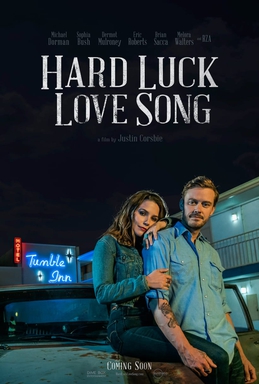



 Through the Shattered Lens