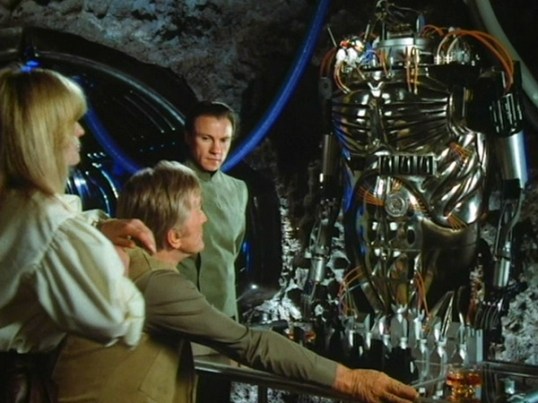
This film was produced as a direct result of the box office success of I Was A Teenage Werewolf. Just as in Teenage Werewolf, Whit Bissell plays a mad scientist who makes the mistake of trying to play God. (He also makes the mistake of keeping an alligator in his lab but that’s another story.) The end result …. Teenage Frankenstein!
The makeup on the Teenage Frankenstein is probably the best thing about this film. If nothing else, this film features a monster who actually looks like he was stitched together in a lab.
Since we’ve been talking a lot about the original Little Shop of Horrors today, it’s only appropriate to share a scene from the remake for today’s scene of the day.
From 1986’s Little Shop of Horrors, here is Steve Martin performing Dentist! Because there’s nothing scarier than going to the dentist, right?
Today’s horror song of the day comes from the 1979 film, Beyond The Darkness.
This film’s soundtrack, courtesy of Goblin, was so acclaimed that it later turned up in several other Italian horror film, usually without anyone bothering to clear it with Goblin ahead of time.
This October, I’m going to be doing something a little bit different with my contribution to 4 Shots From 4 Films. I’m going to be taking a little chronological tour of the history of horror cinema, moving from decade to decade.
Today, we begin the 2010s!
4 Shots From 4 Horror Films
The Wolfman (2010, dir by Joe Johnston)
Insidious (2010, dir by James Wan)
Let Me In (2011, dir by Matt Reeves)
The Cabin In The Woods (2012, dir by Drew Goddard)
On July 3rd, 1954, Marilyn Sheppard was murdered in her bedroom.
The wife of a prominent neurosurgeon, Marilyn Sheppard was bludgeoned to death in her own bedroom. Her husband, Sam Sheppard, claimed that he had fallen asleep on a downstairs couch and was woken up by the sound of his wife screaming. Sheppard said that, when he ran upstairs to the bedroom, he saw a bushy-haired man in the shadows. The man hit Sheppard, knocking him out. When Sheppard came to, he saw the man fleeing the house and chased after him. The two fought outside and again, Sheppard was knocked out.
The police did not believe Sam Sheppard’s story and, after days of headlines that flat out accused him of being the murderer, he was arrested and charged with murdering his pregnant wife. The press had a field day with the story and the trial was frequently described as being a circus. Sheppard’s case was damaged by the revelation that he had cheated on his wife multiple times. Contemporary accounts of the trial portrayed Sheppard as being cocky and arrogant. As the jury was not sequestered, they saw every tabloid headline about Sheppard. After deliberating for four days, the jury found Dr. Sam Sheppard guilty of murdering his wife. He was sentenced to prison.
Sheppard would stay in prison until 1966. During that time, his mother committed suicide, his father died of an ulcer, and his former father-in-law also chose to end his own life. Sheppard’s original attorney died in 1961 and his appeals were taken over by a young lawyer named F. Lee Bailey. In 1966, Bailey argued before the U.S. Supreme Court that Sheppard was denied due process due to the jury not being sequestered. The Supreme Court agreed and granted Sheppard a new trial. This time, with the flamboyant Bailey defending him, Sheppard did not testify and the defense focused on the lack of any real evidence that would suggest Sheppard had lied about the Bushy-haired Man. Sheppard was acquitted.
Today, if Sam Sheppard is remembered, it’s for inspiring The Fugitive, a show about a doctor wrongly accused of murder. (The show aired while Sheppard was still in prison.) The majority of online posts and articles that I’ve read about Sam Sheppard have always focused on the retrial and usually end with Sheppard leaving prison. It’s rare that Sheppard’s life after prison is discussed, That’s probably because it’s a very sad story.
Sheppard may have been acquitted but he had also just spent 12 years in prison and he came out a changed man. Sheppard tried to return to practicing medicine but his surgical skills had deteriorated to the extent that two of his patient died after he nicked an artery. Facing multiple wrong death suits, he resigned from the only hospital that had been willing to give him a job. He became a professional wrestler and was known as “Killer” Sam Sheppard at some of his matches. He was also an alcoholic. Less than four years after getting out of prison, he was dead at the age of 46.
1998’s My Father’s Shadow: The Sam Sheppard Story features Peter Strauss as Dr. Sheppard and Henry Czerny as his namesake son. The film alternates between flashbacks to Dr. Sheppard’s life and scenes set in the 90s that focus on his son’s attempts to definitively clear his father’s name. The film suggests that the murder was actually committed by Richard Eberling (John Colicos), who worked as a handyman and a window washer at the Sheppard home and who, when he was arrested for burglary several years after the murder, was discovered to have some of Marilyn Sheppard’s jewelry in his possession. In the 80s, Eberling was convicted of murdering another one of his clients. Eberling himself died in prison, the same year that this movie aired.
It’s a big story and My Father’s Shadow tries to do a lot in just 90 minutes. Sometimes, it tries to do too much. The flashbacks are occasionally a bit difficult to keep track of. Sam Sheppard’s son goes from being a military school brat to a long-haired hippy so suddenly that, from a narrative point of view, it’s a bit distracting. Overall, though, this is an effective look at an interesting story and it features two excellent performances from Strauss and Czerny. It may not be the definitive telling of Sam Sheppard’s story but it’s a good place to start.
“It’s not just the darkness out there… it’s the darkness in here.” — Sheriff Daniel Carter
Steven Kostanski and Jeremy Gillespie’s The Void is a grisly, atmospheric plunge into Lovecraftian cosmic horror and John Carpenter-inspired body horror, set within a nearly abandoned rural hospital shrouded in eerie blue light and creeping shadows. The film expertly conjures anxiety and dread, as fragile boundaries between dimensions begin to dissolve, threatening to swallow all inside.
At the heart of the story is Deputy Sheriff Daniel Carter (Aaron Poole), whose weighty grief and fractured relationships drive his reluctant heroism. He stumbles upon a bloodied man and brings him to the hospital staffed by his estranged wife, Allison Fraser (Kathleen Munroe), a focused nurse haunted by their broken family. Dr. Richard Powell (Kenneth Welsh) looms as the villainous architect of the unfolding nightmare, his obsession with conquering death fueled by personal tragedy, twisting him into a leader of occult horrors.
The supporting characters—Vincent and Simon, survivors hardened by trauma; Maggie, a pregnant woman caught in the web of cosmic corruption; and Kim, a vulnerable young intern—saturate the siege narrative with survival-driven urgency. Though less developed than the leads, they embody the raw desperation and existential threat pervading the hospital.
The Void wears its influences on its sleeve, drawing heavily from the siege tension of John Carpenter’s Assault on Precinct 13 alongside the paranoia and isolation of The Thing. These classic Carpenter motifs—claustrophobic settings, unrelenting external threat, and mistrust among survivors—penetrate the film’s fabric, amplified by a synthesizer-driven score nodding to Carpenter’s sonic signature. The nightmarish body horror, occult elements, and grotesque practical effects owe much to Stuart Gordon’s work adapting Lovecraft’s stories, blending visceral horror with cosmic dread.
Yet, while the homage is clear and affectionate, the film sometimes falters by blending these iconic elements into a decoction that resists full cohesion. Instead of synthesizing the inspirations into an innovative whole, it assembles a patchwork—rich in style and atmosphere but struggling to commit to a coherent, fresh narrative. The mixture of Carpenter’s claustrophobic siege, Gordon’s visceral mythos, and the cultist horror trope occasionally feels like pastiche rather than a confident new voice.
The technical craftsmanship shines throughout. Practical effects—from mutated creatures to grotesque body transformations—are lovingly crafted and tactile, restoring a physicality often lost in digital horror. The cinematography and lighting accentuate the oppressive mood, favoring muted colors punctuated by blood-red and luminous blues, thinking as much about shadows as solid objects.
However, the film’s narrative and character work often leave something to be desired. While Carter’s arc of guilt and reluctant heroism is thematically resonant, key emotional beats suffer from underdevelopment, with his relationships, particularly with Allison, only superficially explored. Dialogue oscillates between exposition-heavy and clipped, hindering audience connection with the cast amid the unrelenting terror. The supporting characters serve primarily functional roles, their deeper motivations and backstories sacrificed for the sake of grim spectacle and escalating horror.
The climax descends into surreal, fragmented sequences that evoke fever dreams more than narrative resolution. This abstract finale, while visually striking, challenges viewers seeking clarity and can be polarizing: some will appreciate the cosmic horror tradition of unsolvable mysteries, while others may experience frustration with the loose plotting and ambiguity. Pacing reflects these shifts—building steadily in the opening act before devolving into frenetic, disjointed bursts that occasionally undermine tension.
Despite these narrative and pacing flaws, The Void remains a memorable experience for lovers of practical effects and cosmic horror texture. It’s a film rich with unsettling imagery and mood, capturing a form of existential terror that goes beyond cheap scares. The filmmakers’ love for classic horror runs deep, even if the resulting fusion occasionally feels like homage without full reinvention.
Ultimately, The Void is a dark, unsettling trip into the unknowable—a sonic and visual descent into a hellish siege where logic unravels and time shatters. It’s a film that prizes atmosphere and physical monstrosity over smooth storytelling, inviting viewers to surrender to dread rather than demand explanation. For fans of Carpenter’s minimalist tension, Gordon’s visceral adaptations, and the tactile nightmares of 80s horror, The Void offers a rewarding, though imperfect, journey into the cosmic abyss—an evocative invocation of terror where humanity is both survivor and prey.
No title card; so, I used this as the title card. *sigh* This AI short gave me a little jump. It did have some suspense; so, I won’t feed the creator to the sharks. Sorry Sharks.
Woman alone brushing her teeth, but there is a malevolent force in there with her. The bathroom is by definition private and you’re almost always vulnerable. The film has some suspense and payoff. It is worth watching.
“So it’s a fucking coin toss? That’s what 50 billion dollars buys us?” — Secretary of Defense Reid Baker
The end of the Cold War was supposed to close a chapter of fear. With the superpowers stepping back from the brink, the world briefly believed it had entered an era of stability. Yet that promise never held. The weapons remained, the rivalries adapted, and the global machinery of deterrence continued to hum beneath the surface. Kathryn Bigelow’s A House of Dynamite faces this reality head-on, transforming the mechanics of modern nuclear defense into something unnervingly human. On the surface, it plays as a high-tension political technothriller, but beneath that precision lies a deeply existential horror film—one built not on shadows or monsters, but on daylight, competence, and the narrow margins of human fallibility.
The premise is piercingly simple. An unidentified missile is detected over the Pacific. Analysts assume it’s a test or a glitch—another false alarm in a world overflowing with them. But within minutes, as conflicting data streams converge, what seemed routine begins to look real. The film unfolds in real time over twenty excruciating minutes, charting the reactions of those charged with interpreting and responding to the potential catastrophe. Bigelow divides the film into three interwoven perspectives: the White House Situation Room, the missile intercept base at Fort Greely, and the President’s mobile command aboard Marine One. The structure allows tension to grow from every direction at once, each perspective magnifying the other until the screen feels ready to collapse under its own pressure.
Capt. Olivia Walker (Rebecca Ferguson), commanding officer of the Situation Room, anchors the story with calm professionalism that gradually frays into disbelief. Ferguson’s performance is clear-eyed and tightly modulated—precise, disciplined, and quietly devastating. She stands as the rational center inside chaos, her composure the last gesture of control in a world that no longer follows reason.
Over her is Adm. Mark Miller (Jason Clarke), Director of the Situation Room, who represents the institutional embodiment of confidence. Clarke plays him with methodical restraint, a man who trusts procedure long after it stops earning trust. Miller’s authority is both comforting and horrifying: a portrait of leadership built on ritual rather than certainty.
At Fort Greely, Anthony Ramos brings an intimate immediacy as the officer charged with the missile intercept. His scenes hum with kinetic dread—the physical execution of decisions made thousands of miles away. Through him, the film captures the most primal kind of fear: acting when hesitation could mean extinction, knowing that success and failure are separated only by chance.
The President, portrayed by Idris Elba, spends much of the crisis in motion—first within the cocoon of the presidential limousine, and later, aboard Marine One as it carves through blinding daylight. Elba gives a performance of subtle, steady erosion. At first, he embodies unshakeable calm, a figure of poise and authority; but as the situation deepens, his steadiness wanes. Words become shorter, pauses longer. Every decision carries consequences too vast for resolution. It is a measured, understated portrait of power giving way to human uncertainty.
Bigelow’s direction is stripped of ornament and focused on precision. Barry Ackroyd’s cinematography heightens the claustrophobia of command centers—the sterile light, the reflective glass, the sense that every surface observes its occupants—while his exterior scenes pierce with harsh brightness, suggesting that no sanctuary exists under full exposure. Kirk Baxter’s editing maintains an unrelenting pulse, cutting with mathematical precision while preserving the eerie stillness of the moments where no one dares to speak.
A House of Dynamite also shows how even with the most competent experts—military, intelligence, and political—working to manage an escalating crisis, there is no path to victory. The professionals at every level stop seeking to prevent the worst and instead focus on saving what they can when the worst becomes inevitable. The film’s scariest revelation is not the potential for destruction, but the paralysis that intelligence creates. If the brightest, most disciplined people in the world cannot find an answer, what happens when power falls into the hands of those less prepared or less rational? In its quiet way, the film poses that question that we see more and more each day on the news and on social media and we are left with silence and realization of the horror of it all.
Despite its precision, the film isn’t without flaws. Bigelow’s triptych structure—cutting between the three perspectives—works brilliantly to escalate tension, yet the repetition of similar beats slightly blunts the impact. Each segment revisits the same crisis rhythms—a data discrepancy, an argument over authority, another uncertain update—sometimes slowing the natural momentum. While the repetition underlines the futility of bureaucratic systems in chaos, the transitions don’t flow as fluidly as the rest of the film’s airtight craftsmanship. The result is a film that is gripping overall, occasionally uneven in rhythm, but never less than absorbing.
When the final minutes arrive, Bigelow declines to deliver resolution. No mushroom clouds, no catharsis. The President sits in Marine One, head down with the weight of the world on his shoulders as he contemplates his options in the Black Book (options in how to retaliate) and knowing that he has no good choices in front of him. The world remains suspended between survival and oblivion, and the silence that follows feels heavier than sound. The ending resists closure because endings, in the nuclear age, are an illusion—the fear continues no matter what happens next.
In a year crowded with strong horror releases—Sinners, Weapons, The Long Walk and Frankenstein among them—A House of Dynamite stands apart. Dressed in the crisp realism of a technothriller, it’s a horror film defined by procedure, light, and silence. Bigelow builds terror from competence, from the steady voices and confident gestures of people trying to manage the unmanageable. This is not the chaos of fiction but the dread of reality, a reminder that the systems meant to preserve and protect might one day fail to deliver on its promise. For all its precision and restraint, A House of Dynamite shakes in the memory long after it ends—the year’s most quietly terrifying film.
Nuclear Close Calls: The situation and question brought up in the film has basis in history as there has been many instances of close calls and false alarms. The film itself doesn’t confirm that the missile detonated, but the implications in past confirmed events just shows how close the world has been to a completed catastrophe.
Whenever it’s time to share this film for Horrorthon, I have a little story that I like to tell:
Enter singing.
Little Shop.…Little Shop of Horrors.…Little Shop.…Little Shop of Terrors….
When I was 19 years old, I was in a community theater production of the musical Little Shop of Horrors. Though I think I would have made the perfect Audrey, everybody always snickered whenever I sang so I ended up as a part of “the ensemble.” Being in the ensemble basically meant that I spent a lot of time dancing and showing off lots of cleavage. And you know what? The girl who did play Audrey was screechy, off-key, and annoying and after every show, all the old people in the audience always came back stage and ignored her and went straight over to me. So there.
Anyway, during rehearsals, our director thought it would be so funny if we all watched the original film. Now, I’m sorry to say, much like just about everyone else in the cast, this was my first exposure to the original and I even had to be told that the masochistic dentist patient was being played by Jack Nicholson. However, I’m also very proud to say that — out of that entire cast — I’m the only one who understood that the zero-budget film I was watching was actually better than the big spectacle we were attempting to perform on stage. Certainly, I understood the film better than that screechy little thing that was playing Audrey.
The first Little Shop of Horrors certainly isn’t scary and there’s nobody singing about somewhere that’s green (I always tear up when I hear that song, by the way). However, it is a very, very funny film with the just the right amount of a dark streak to make it perfect Halloween viewing.
So, if you have 72 minutes to kill, check out the original and the best Little Shop of Horrors….
I was hoping that he might be, even though his name didn’t appear in the credits. Quite a few cast members from the first two films return for the third film. David A.R. White is back as Josh McManus, the former super soldier who now drives his souped-car through the wastelands of America. Bruce Marchiano is back, credited as the Stranger though we all know he’s actually Jesus. (Since Marchiano appeared in all three films, I can only assume the RevelationRoad films all take place in the same cinematic universe as TheEncounter films and Sarah’sChoice.) Brian Bosworth shows up briefly.
But there is no Eric Roberts. Not even Eliza Roberts appears in this film! It’s a shame and they are both missed.
However, Kevin Sorbo does show up.
Kevin Sorbo plays Honcho, a bandit leader who lives in the wastelands and who is worshipped by those who follow him. Honcho occasionally speaks with an Australian accent. Occasionally, the accent slips or disappears all together. At first, I thought this was a case of bad editing, bad dubbing, or maybe Sorbo not really being that into the character. However, there’s actually a rather clever moment in which Honcho tells Josh that he’s not actually from Australia. He just speaks with the accent because it impresses his followers. Without the accent, he’s just some guy who used to work at a gas station. With the accent, he’s a warlord.
It’s a moment that made me laugh, largely because it’s true. People love and fear accents. If you’ve got a posh British accent, most Americans will assume that you’re planning a heist of some sort and that Sylvester Stallone or Harrison Ford is somewhere nearby, trying to stop you. If you’ve got an Australian accent, the assumption amongst Americans is that you can survive harsh conditions, handle your alcohol, and jump out of a plane without a second thought.
However, Sorbo’s fake Australian accent also pays a sort of homage to the MadMax films. The RevelationRoad trilogy was obviously envisioned as being a faith-based version of the Mad Max films, with David A.R. White cheerfully stepping into the somber shoes of Mel Gibson and Tom Hardy. Using MadMax as a model for a faith-based apocalypse film actually isn’t that bad of an idea. Indeed, Gibson’s style of beatific madness opens up the original Mad Max trilogy to a similar interpretation. Unfortunately, RevelationRoad3 is at time a bit too faithful to the MadMax films, to the extent that it struggles to establish an identity outside of the films that inspired it. That’s one reason why Kevin Sorbo’s character stands out. He’s a character who genuinely surprises us.
As for the plot of RevelationRoad3, it finds Josh being sent on a mission to find The Shepherd (Robert Gossett), a mysterious figure who is gathering together a religious flock in the desert despite the fact that the new world government has outlawed things like religion and individual freedom. While Josh’s wounded companion waits in a town ruled over by Mayor Drake (James Denton), Josh searches the desert and occasionally sees a mysterious rider on a horse. The film mixes action and theology and the results are definitely mixed, with a few well-done chase scenes mixed with a lot of scenes of people talking. That said, at its best, TheBlackRider achieves a sort of desolate grandeur.