4 Or More Shots From 4 Or More Films is just what it says it is, 4 shots from 4 of our favorite films. As opposed to the reviews and recaps that we usually post, 4 Shots From 4 Films lets the visuals do the talking!
Today, the Shattered Lens wishes a happy birthday to one of our favorite directors, David Cronenberg! Cronenberg has a new film coming out later this year, one that we’re all looking forward to. Crimes of the Future (which shares its name with one of Cronenberg’s early, experimental films) will be Cronenberg’s first film since 2014’s Map of the Stars and it will also reunite him with Viggo Mortensen.
For now, here are….
4 Shots From 4 David Cronenberg Films
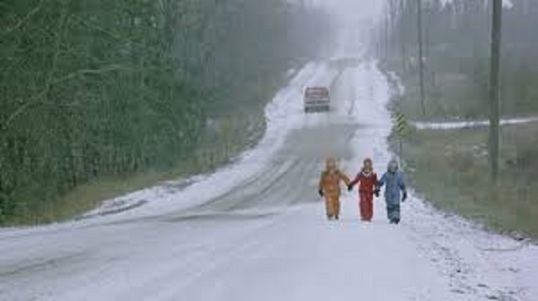
The Brood (1979, dir by David Cronenberg, DP: Mark Irwin)
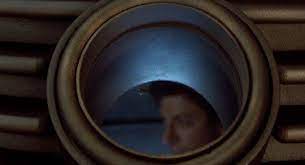
The Fly (1986, dir by David Cronenberg, DP: Mark Irwin)
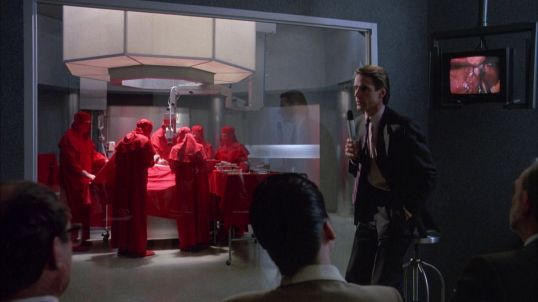
Dead Ringers (1988, dir by David Cronenberg, DP: Peter Suschitzky)
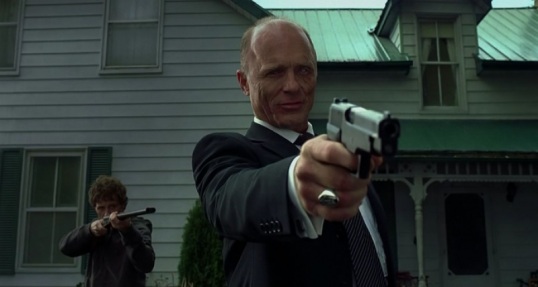
A History of Violence (2005, dir by David Cronenberg, DP: Peter Suschitzky)
Before I say anything else, I should admit that I fully understand why some of you are going to say that the 1978 science fiction film, Laserblast, is not a spring break film.
First off, it takes place not on the beach but in the desert. There is a scene that takes place at a pool but it’s one of those cheap pools that all of the desert towns have.
Secondly, the film itself doesn’t take place during the spring. It takes place during the summer, when the sun is bright and harsh. The teenagers in the film might not be in school but that’s just because it’s their summer vacation.
I get it.
But, as far as I’m concerned, Laserblast is spiritually a spring break film, even if it isn’t technically one. I mean, just look at the film’s hero, Billy. As played by the very handsome Kim Milford, Billy is a mellow guy with blonde hair, stoned eyes, and the attitude of someone who can say, “Right on!” and make you believe that everything will be right and on. Billy even drives a totally 70s van. Everything about Billy and his girlfriend, Kathy Farley (Rainbeaux Smith), screams Malibu. Even in the desert and in the summer, they are the ideal spring break couple.
Billy, of course, gets in some trouble over the course of the film. He stumbles across a space gun in the desert. Billy doesn’t know what we know, that the space gun was accidentally left there by two adorable claymation aliens who previously visited Earth so that they could kill the gun’s owner. Billy just thinks it’s a cool gun. Soon, Billy is blowing up the town and turning into a green-skinned monster. Billy even blows up a sign that’s advertising Star Wars, which is made doubly interesting by how much Kim Milford resembles Mark Hamill. (The same year that Laserblast came out, Hamill and Milford acted opposite each other in Corvette Summer, with Milford’s mellow confidence providing a nice counter to Hamill’s somewhat hyperactive earnestness.) Much like a drunk spring breaker who ends up vomiting into the ocean, Billy has found something that he enjoys and he’s allowing it to take over his life. The space gun represents every vice and addiction that’s out there to tempt people into risking their lives and their sanity and their totally 70s van. (We don’t see much of the inside of the van but I’m willing to bet that it has shag carpeting and a strobe light.) The spring breakers inThe Real Cancun spent their week drinking themselves into a stupor. Billy, on the other hand, spends a week blowing stuff up and turning into a monster. Of course, that’s the great thing about spring break. How you spend your time is your business.
Laserblast is a low-budget film, one that is often listed as being one of the worst films ever made. Myself, I love the film because I think the aliens are cute and I enjoy Kim Milford’s performance as Billy. Actually, for a film that didn’t cost much to make, Laserblast has a surprisingly impressive cast. Technically, it’s not a shock to see Roddy McDowall in the film, since McDowall apparently accepted every role that he was offered in the 70s. But Roddy’s trademark neurotic eccentricity is still welcome in the small role of Billy’s doctor. The great character actor Dennis Burkley shows up as a fascist deputy. Gianni Russo, who played Carlo Rizzi in The Godfather, plays a government agent who shows up from out of nowhere and who wears a cream-colored suit that makes him look like a wedding DJ. Keenan Wynn, who also apparently accepted any role he was offered in the 70s, plays Rainbeaux Smith’s drunk grandfather. Best of all, Eddie Deezen, who was best known for playing stereotypical nerd characters in films like Grease, shows up as a bully named Froggy! After getting bullied by Eddie Deezen, who wouldn’t pick up the first space gun they found and start blasting rocks?
Laserblast is fun, just like spring break. I like it, just like spring break. So does Arleigh so be sure to check out his review, as well!
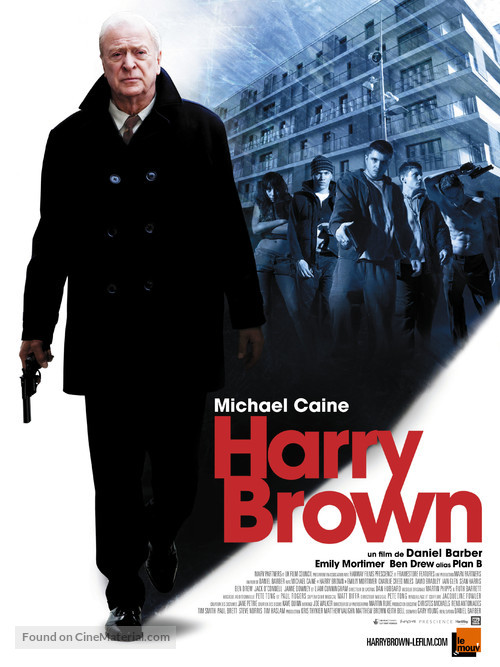
Today, we wish a happy 89th birthday to Michael Caine!
For longer than I’ve been alive, Michael Caine has been a star. He’s one of the last surviving icons of the British cultural invasion of the 1960s, a venerable actor who went from being Alfie to being Carter to being Scrooge to being Alfred Pennywise without missing a step. In many ways, he was the cockney Jack Nicholson, a working class actor with his own very identifiable style who still managed to play a wide variety of different characters. Like Nicholson, there have been frequent reports that Caine has retired from acting and, if anyone has earned the right to enjoy their retirement, it’s Michael Caine. Caine himself has said that he doesn’t ever see himself fully retiring from acting and he’s already proven that, even in his twilight years, he’s still as capable of giving a good performance as he was when he first started acting.
Take Harry Brown, for example.
Michael Caine was 76 when he played the title role in this violent British thriller. Harry is a former Royal Marine who, now elderly and suffering from emphysema, lives on a London council estate that has been taken over by a gang of violent drug dealers. The nearby underpass is so dangerous that even Harry is scared to walk under it. Because Harry has to take an alternate route to the hospital to avoid all of the gangs, his wife dies without Harry being at her side. When his only friend is then killed while trying to stand up to the dealers, Harry snaps. Harry starts tracking down and killing the dealers and the gang members who have made retirement so unbearable for him. Detective Frampton (Emily Mortimer) suspects that Harry is the vigilante but, before she can move to stop him, both she and Harry are targeted by the local drug lord, who turns out to be someone who Harry never suspected.
Harry Brown is really just an updated version of Death Wish, set in London instead of New York. It has its share of good action scenes and director Daniel Barber does a good job making London look like the worst place on Earth but, ultimately, it’s as predictable and heavy-handed as any of the films Michael Winner made with Charles Bronson. What makes Harry Brown special is not the script but instead the presence of Michael Caine, giving one of his best and most heartfelt performances and making the movie work, even when the story tries to sabotage him. Caine brings an appropriate amount of righteous fury to the role but he also plays the role with a lot of heart. Harry would much rather be enjoying his twilight years in peace but he feels that he was one last mission to pursue. He would rather die protecting his friends and his neighbors than live his life in fear. Harry also knows that, because he’s old, everyone underestimates him. That’s a mistake that he uses to his advantage.
Harry Brown is like many Michael Caine films in that the main reason to watch it is because it’s a Michael Caine film. At the time he made the film, he said that he expected Harry Brown would be his last lead role. It wasn’t. Just like Harry Brown, Michael Caine still has more to show the world.
Last night, the Directors Guild of America awarded their top prize to Jane Campion and The Power of the Dog. This is definitely good news for the film, as far as the Oscars are concerned. With West Side Story now on HBO and so many people rediscovering how important a director Steven Spielberg really is, it seemed as if the momentum may have been shifting. But, thanks to the DGA and the recent controversy over Sam Elliott’s comments about the film, The Power of the Dog is once again the front runner.
(To be honest, as far as Spielberg is concerned, it wouldn’t surprise me if a lot of Academy voters are currently of the “In just a few month, he’s going to get another chance with The Fabelmans” mindset.)
Here are the film winners from the DGA:
NARRATIVE FEATURE FILM
Paul Thomas Anderson – Licorice Pizza
Kenneth Branagh – Belfast Jane Campion – The Power of the Dog
Steven Spielberg – West Side Story
Denis Villeneuve – Dune
FIRST TIME NARRATIVE FEATURE FILM Maggie Gyllenhaal – The Lost Daughter
Rebecca Hall – Passing
Tatiana Huezo – Prayers For The Stolen
Lin Manuel-Miranda – Tick, Tick…BOOM!
Michael Sarnoski – Pig
Emma Seligman – Shiva Baby
DOCUMENTARY
Jessica Kingdon – Ascension Stanley Nelson – Attica
Raoul Peck – Exterminate All The Brutes
Questlove – Summer of Soul
Elizabeth Chai Vasarhelyi & Jimmy Chin – The Rescue
In 2021’s Aileen Wuornos: American Boogeywoman, Peyton List stars at Aileen, who prefers to be called Lee. Lee has fled an unpleasant and abusive home in Michigan and she has made her way down to Florida. With no money and no formal education, she’s been forced to make a living as a truck stop prostitute. However, on July 4th, 1976, she happens to stumble across a party on the beach. She befriends Jennifer (Lydia Hearst), who invites Lee to stay at her beach house. Though Lee quickly overstays her welcome, she does meet Jennifer’s widowed father, Lewis Fell (Tobin Bell). Lewis is enchanted by Lee’s crude but enthusiastic personality. Lee is enchanted by Lewis’s money. Soon, they’re married. But when Lewis’s daughter and friends start to dig into Lee’s mysterious past, Lee resorts to murder to protect her secrets.
The idea of making a movie about future serial killer Aileen Wournos hanging out around the Florida beach and marrying the kindly president of a yacht club may sound like an unlikely one but when has that ever stopped anyone? Oddly enough, American Boogeywoman is loosely based on the truth. Before she became the fraggle-toothed serial killer who was immortalized in two Nick Broomfield documentaries and by Charlize Theron in Monster, Aileen Wournos was briefly married to a yacht club president named Lewis Fell. The marriage was even announced in the society pages. Of course, the marriage didn’t last long. Aileen was accused of striking Lewis with his own cane and the two of them ended up getting a divorce. That said, it would appear that the majority of American Boogeywoman was fictionalized. Aileen was never accused of murdering anyone before she started the killing spree that eventually landed her on Florida’s crowded death row. In the film, Aileen also claims to have murdered her own brother after he suddenly turned up in a cheap Florida motel and demanded money. In real life, Aileen’s brother died in Michigan, long after Aileen had cut off contact with her family.
The film opens with Aileen already on death row, talking to a documentarian about her marriage. Occasionally, throughout the film, the documentarian will interrupt Aileen’s story and he’ll point out that what she’s saying doesn’t really make sense. (For instance, he points out that there’s no way that Aileen’s brother could have died in both Florida and Michigan.) For the most part, Aileen shrugs off his comments but the character of the documentarian is an important one. His character serves to comment on the strange nature of fame and crime in America. Aileen Wournos may be an unbalanced killer but she’s also a celebrity. She’s enough of a celebrity, the film tells us, that even after her death, two films will be made about her. One of those films will win an Oscar. The other film will be American Boogeywoman. At its heart, American Boogeywoman is an examination of the morbid streak that secretly runs through American culture. As such, it is slightly more interesting than the typical serial killer exploitation film.
American Boogeywoman was directed by Daniel Farrands, who has recently made a career out of directing somewhat distasteful true crime thrillers. His most famous film, The Haunting of Sharon Tate, is surprisingly effective. His worst film, The Murder of Nicole Brown Simpson, is perhaps one of the most offensive films made over the past decade. Farrands is not a bad director but his choice in material will always be problematic for many viewers. American Boogeywoman is one of his better films, if just because it has enough self-awareness to realize how ludicrous it all is.
The beach is a beautiful and fun place and the perfect location to celebrate a spring or summer break. But beware of getting carried away with your youthful revelries because it can lead to complications that will follow you into the fall. And those complications can be deadly….
BLEH!
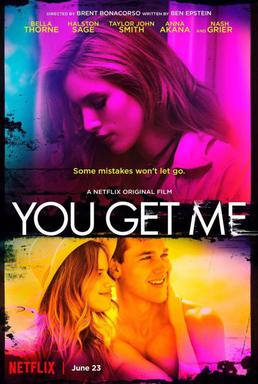
Okay, sorry for all the drama. I’m just trying to make myself feel some sort of enthusiasm for reviewing the 2017 Netflix film, You Get Me. You Get Me is technically not a spring break movie but it does take place on the beach and it does feature a moderate amount of drinking, drug-taking, and partying so, it’s close enough. It also features a cast of 20-something actors cast as high school students. Some are more believable than others.
Basically, dumb and dull teenager Tyler (Taylor John Smith) is having the best summer of his life because he has a girlfriend named Ali (Halston Sage), who he is totally in love with. (Ali could probably do better but whatever. Everyone makes mistakes in high school.) Tyler is also frustrated because Ali wants to wait before having sex with him and she also doesn’t understand why Tyler has been so hesitant to introduce her to his dysfunctional family. When Tyler goes to a party and runs into a guy from Ali’s past, he learns that Ali used to be much wilder. Angry that Ali hasn’t been honest with him, big dumb Tyler gets drunk and runs off with Holly (Bella Throne), a girl who he has only known for an hour. They go dancing. Holly offers Tyler a pill. Tyler isn’t sure he’s ready for that. “You swallow, I swallow,” Holly tells him. Tyler and Holly spend a passionate weekend together but, afterwards, Tyler and Ali get back together, with Ali promising that she’ll tell Tyler everything about her past. “No more secrets,” Tyler agrees, despite the fact that he’s now keeping a secret of his own.
Fortunately, Holly was only visiting for the summer and it’s not like Tyler will ever see her again so …. OH MY GOODNESS, LOOK WHO JUST SHOWED UP AT TYLER’S HIGH SCHOOL! Holly now goes to the same school as Tyler and her new best friend is Ali! Tyler asks Holly not to tell Ali anything about their weekend together. Holly, however, has stopped taking her meds (seriously, that’s a plot point) and has decided that if she can’t have Tyler, no one will. Soon, Holly is claiming to be pregnant and serving peanut-laced smoothies to people with food allergies. Have you ever noticed how people in movies like this always have a best friend who suffers from a food allergy?
I’m probably making You Get Me sound more fun than it actually is. It’s actually an extremely bland movie and a surprisingly tame one. At her best, Bella Thorne is less an actress and more an agent of chaos. She gets a few opportunities to be enjoyably evil in You Get Me but the script, for whatever reason, often seems to be more concerned with boring old Tyler. Perhaps if Taylor John Smith and Halston Sage had at least a little bit of romantic chemistry, we would care about what happens to Tyler and Ali but they don’t. Since they don’t really seem to be that into each other, it’s a little bit hard to get upset when Holly comes between them.
The beach, I will say, looked lovely. And I really liked Holly’s house. And, as I mentioned earlier, there were a few moments when Bella Thorne’s demented performance brought some life to the anemic proceedings. But, for the most part, You Get Me is forgettable. It did not get me.
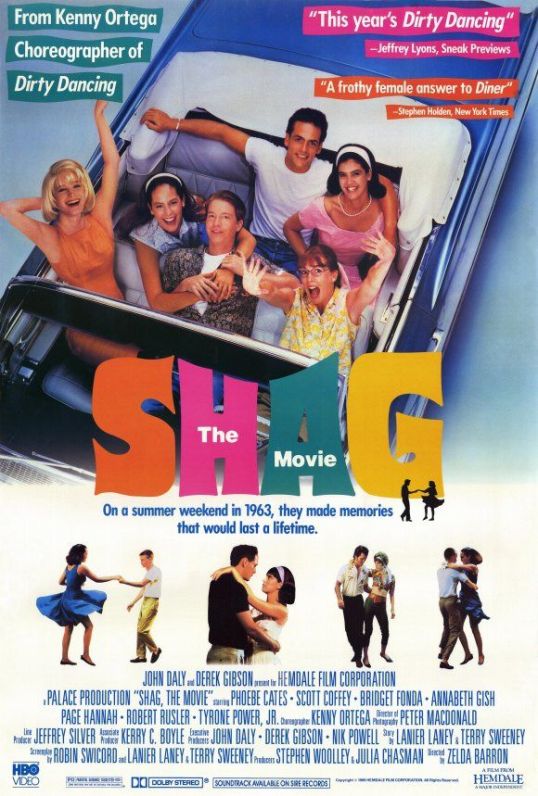
Welcome to Myrtle Beach, South Carolina, the setting of the 1989 film, Shag: The Movie!
We know that we’re in South Carolina because everyone is speaking with the type of overbaked Southern accents that you only hear in the movies. And you know it’s the beach because of all the sand, the bathing suits, and the spring breakers. Everyone’s listening to that rock and roll music. Everyone’s dancing. There’s a lot of Confederate flags around, mostly because the movie was made in the 80s and it’s taking place in the South. If the movie were made today, it would probably take place in New Jersey and everyone would be debating whether or not Christopher Columbus was a hero or not.
Though the movie was made in 1989, it takes place in 1963. We know that the movie takes place in 1963 because everyone in the movie keeps mentioning how it’s 1963. One character mentions having sexual fantasies about President Kennedy, which scandalizes all of her friends. Another character won’t stop talking about how much he enjoyed Paul Newman’s performance in The Hustler. (The Hustler came out in 1961, though, so I think the dude needs to get with the times and watch Tom Jones.) Everyone’s dancing the Shag. Of course, since this is a film about how innocent the world was in 1963, there’s no talk of the growing American presence in Vietnam or anything like that. This is the 1963 of the popular imagination, the 1963 that one visualizes after watching a hundred movies about spring break in the early 60s.
Anyway, Shag follows four friends as they have a wild week in Myrtle Beach. They’re recent high school graduates. Melaina (Bridget Fonda) is the wild preacher’s daughter. Louanne (Paige Hannah) is the responsible one, who wears horn-rimmed glasses. Pudge (Annabeth Gish) is the friend who needs better friends or, at the very least, friends who won’t give her a cruel nickname. Carson (Phoebe Cates) is the responsible girl who is about to marry the level-headed Harley (Tyrone Power, Jr.) After telling their parents that their going to Ft. Sumter to learn about the Civil War, they instead head down to Myrtle Beach. Melania enters a beauty contest. Pudge enters a shag contest with Chip (Scott Coffey). Carson finds herself tempted by Chip’s friend, the Yale-bound Buzz (Robert Rusler). And Louanne is tempted by Harley, who eventually comes to Myrtle Beach himself to try to understand why Carson is being so irresponsible.
There aren’t really many surprising moments to be found in Shag. From the minute that we first see Carson trying on her wedding dress, we know that there’s no way she’s still going to be engaged by the time the movie comes to its conclusion. By that same token, we also know that Melaina is not going to be as wild as she tries to present herself as being and that Pudge is going to find her confidence and that Louanne is eventually going to let her hair down, if just for a few minutes. It’s a predictable movie but the cast is likable and there’s a lot of dancing, which is always a plus as far as I’m concerned. Admittedly, Cates and Rusler are a bit bland as the main couple. Instead, Annabeth Gish and Scott Coffey are the cast stand-outs. I also have to say that I really liked the performance of Tyrone Power, Jr. Harley is kind of a thankless role but Power manages to make him at least a little sympathetic. At the very least, Carson doesn’t come across like a fool for considering him as a possible husband.
Shag is a likeable film, even if it’s not exactly groundbreaking. And did I mention that there’s dancing?
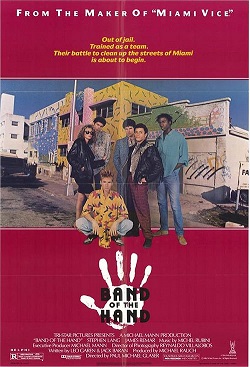
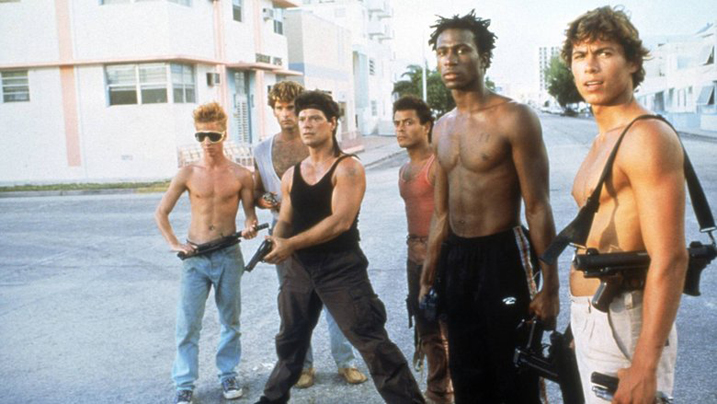
This place is Florida. The time is the 80s. Five juvenile delinquents have been given a chance to earn their freedom. All they have to do is go down to the Everglades and train with Indian Joe (Stephen Lang), a no-nonsense Vietnam veteran who is determined to teach them not only survival sills but also how to work together as a team. But Joe is interested in more than just reforming a group of youthful troublemakers. He wants to turn them into a crime-fighting team who can help clean up the most dangerous neighborhood in Miami. When Joe and delinquents move into and refurbish a previously condemned building, they get the attention of both the local drug kingpin (James Remar) and his main enforcer (Laurence Fishburne).
Band of the Hand is very much a film of its time, not only in its fashion and music choices but also in its full-on embrace of the war on drugs and the idea that the best way to clean up the streets is for vigilantes to do it on their own. The film was produced by Michael Mann and, as directed by former Starsky and Hutch star Paul Michael Glaser, the film has the look of an episode of Miami Vice. That might be because the film itself was originally meant to be a pilot for a television show. When the networks passed on it, it was released to theaters instead and advertised as being “from the maker of Miami Vice.” The movie never escapes its television origins. Things start strong in the Everglades, with Lang proving himself to be a master of glowering and the young delinquents struggling to not only survive Lang’s training but also resist the temptation to kill each other. It’s less interesting once the action moves to Miami and it becomes Death Wish 3 without the blood or Charles Bronson. The scenes with the young men goofing around are an awkward fit with the scenes of Remar and Fishburne terrorizing the neighborhood.
Band of the Hand is still worth watching if you want to see some familiar faces early in their careers. John Cameron Mitchell and Leon both score early roles as two of the delinquents-turned-crime fighters and Lauren Holly plays the romantic interest who is inevitably ends up with the bag guys. James Remar was always a good villain and Laurence Fishburne channels both his previous performance in Death Wish II and his future performance in King of New York. It’s a good cast, even if no one really breaks free from the production’s television origins.
The idea of creating a show about a special unit of young crime fighters who battle drug pushers was one that Mann didn’t abandon. The final episode of Miami Vice was essentially an unsold pilot that followed many of the same plot beats as Band Of the Hand. (It also didn’t lead to a television series, though some might argue that 21 Jump Street took the same idea and ran with it.) As for director Paul Michael Glaser, he would later do a much better job with The Running Man.
This 2003 film tells the story of 16 good-looking and not particularly intelligent college students who go to Cancun for spring break. For 8 days, they all live in the same beach house and they get to know each other. They drink. They flirt. A few of them hook up but perhaps not as many as you would expect. The dorky virgin dude says that he just wants to see “boobies” and then gets drunk off of one shot. Two platonic friends debate whether they should take their relationship to the next level. The women wear bikinis. The men wear speedos. There are bare boobs and behinds galore. Snoop Dogg makes a special guest appearance. One spring breaker get stung by a jelly fish so her new roommate pours a cup of urine on her ankle. Good thing he had already had ten beers that morning! What fun!
If this sounds like a typical spring break film, that’s because it is a typical spring break film but with one big difference. It was produced by the people behind MTV’s The Real World and, as such, the 16 spring breakers are sold as being real people who are spontaneously acting like a bunch of movie characters. In 2003, reality tv was still a relatively exotic concept and this film was an attempt to take the genre’s cheap aesthetic to the cinematic level. Even more importantly, it was an attempt to duplicate the success of Girls Gone Wild, without actually admitting to being inspired by that sleazy enterprise. As such, there’s a lot of nudity but there’s a strange lack of actual sex. There’s a lot of drinking but there’s not much drunkenness. It’s an oddly tame look at spring break, one that promises debauchery but which doesn’t deliver anything that would have kept the film out of theaters or off the cable networks. I got more wild on my spring breaks than anyone in this film and I don’t even drink.
The film’s “stars” are all pretty bland and it’s not a surprise that, with one exception, none of them have appeared in anything other than The Real Cancun. (That one exception is Laura Ramsey, who went on to have a somewhat busy acting career after appearing as herself in this film.) The film manages to make nudity boring. Seen today, The Real Cancun works best as a time capsule, largely because it was filmed at a time when there was no social media and, even more importantly, no phones. Everyone is attracted to the crew and their bulky film cameras because there aren’t any other cameras around to record them and make them famous. Today, anyone can make their own Real Cancun and post it to YouTube. In 2003, if you wanted a shot at that type of fame, you had to audition and be selected to appear in a “documentary.”
Apparently, The Real Cancun was meant to be the first part of a Real World cinematic franchise. The first Jackass film had come out the previous year so MTV was enthusiastic about producing cheap reality movies. However, The Real Cancun was such a huge flop at the box office that it killed those plans. There would be other Jackass films, of course. But the Real World Cinematic Universe imploded as soon as it began. And for that, we should probably be thankful.
Now streaming on Shudder, The Scary of Sixty-First is a weird little movie.
Two friends who don’t really seem to like each other that much, Noelle (Madeline Quinn) and Addie (Betsey Brown), move into a fully furnished Manhattan apartment. The apartment, they are told, has been uninhabited for a few years. The realtor asks them not to play the piano. One of the mattresses is stained with blood. Hidden amongst the surprisingly ornate furniture are mystical books and mysterious cards. It’s kind of a creepy place but it’s also in Manhattan and it’s affordable.
Addie, we’re told, has a history of mental instability and a difficult relationship with her family. (Noelle, at one point, refers to Addie’s father as being a pedophile.) Addie also has an idiot boyfriend named Gary (Mark Rapaport, who also produced the film). Gary may be a little bit slow but he has his standards and when Addie starts to speak in a strange voice and ask him to take part in some truly perverse role play, he freaks out.
Meanwhile, Noelle meets a mysterious person who is only referred to as being The Girl (played by the film’s director, Dasha Nekrasova). The Girl is hooked on speed and conspiracy theories. The Girl explains that Noelle and Addie’s apartment was once used by Jeffrey Epstein and Ghislaine Maxwell. The Girl says that she’s investigating their crimes but her investigation mostly seems to consist of watching YouTube videos and walking around New York. Within hours of meeting each other, Noelle and the Girl are lovers but when The Girl tries to demonstrate why Epstein couldn’t possibly have hanged himself, Noelle appears to deliberately hesitate before saving the Girl’s life. Later, as they walk around New York, the Girl spots a woman who she claims is Ghislaine Maxwell.
As for Addie, she’s having nightmares and when she’s not dreaming, she’s sleepwalking and doing even more. She’s also becoming obsessed with the British Royal Family. She’s especially interested in Prince Andrew….
“Epstein didn’t kill himself,” as the saying goes and one reason why people are still saying that years after Jeffrey Epstein’s death is because it’s obvious that, whether he killed himself or not, he still took a lot of secrets with him to the grave. I’m a student of conspiracy theories but I wouldn’t call myself a believer. I tend to assume that most of what happens in the world is due to random fate as opposed to the unseen hand of some secret organization. That said, I totally accept that there’s a very good chance that Jeffrey Epstein was murdered on the orders of the rich and powerful people who he previously flew to his private island. One reason why The Scary of Sixty-First works is because, as bizarre as the film gets, it’s still dealing with a conspiracy theory that even most skeptics find to be plausible.
And indeed, it’s a bizarre film, one that plays out like a filmed dream. Little about the film makes sense and, at the end of it, you’re still left with a lot of unanswered questions but then again, that’s a feeling that will be familiar to anyone who has ever gone down a conspiracy rabbit hole. Are Noelle and Addie truly being possessed by evil auras of Epstein and Maxwell or are they just allowing their own paranoia to drive them mad? Much like a dream, the answers are there but they’re hidden. It’s a film that many people will find to be distasteful but, at its best, it captures the speed-fueled logic of the modern conspiracy theorist. It’s a jolt of psychosis captured on a film. The apartment becomes a metaphor for both the sins of the past and the uncertainty of the present.
Understandably, many will find the film to be distasteful and it often is. But, at the same time, The Scary on Sixty-First captures the atmosphere and the paranoia of our current cultural moment. After all, Epstein didn’t kill himself.




 Through the Shattered Lens