4 Shots From 4 Films: Special Sam Fuller Edition


4 Or More Shots From 4 Or More Films is just what it says it is, 4 shots from 4 of our favorite films. As opposed to the reviews and recaps that we usually post, 4 Shots From 4 Films lets the visuals do the talking!

On this date, 110 years ago, Samuel Fuller was born in Massachusetts.  Before he became a filmmaker, Fuller was a crime reporter and a pulp novelist.  His films were often melodramatic and unapologetically sordid.  They were also often dismissed when they were initially released but almost all of them were subsequently rediscovered by audiences who appreciated Fuller’s striking visuals and the often subversive subtext to be found underneath the surface of his genre films.

Today, we celebrate Fuller’s legacy with….

4 Shots From 4 Sam Fuller Films

Pickup on South Street (1953, dir by Samuel Fuller, DP: Joseph MacDonald)

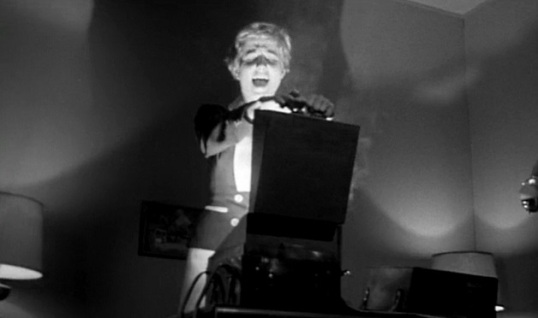
Shock Corridor (1963, dir by Samuel Fuller, DP: Stanley Cortez)

The Naked Kiss (1964, dir by Samuel Fuller, DP: Stanley Cortez)

The Big Red One (1980, dir by Samuel Fuller, DP: Adam Greenberg)

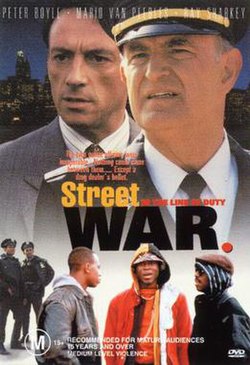
In the Line of Duty: Street War (1992, directed by Dick Lowry)


Street War, the fifth In The Line of Duty movie to be produced by NBC, takes place in Brooklyn.  Raymond Williams (Mario Van Peebles) and Robert Dayton (Michael Boatman) are two uniformed officers trying to keep the peace in the projects.  When Raymond is shot and killed in a stairwell, everyone knows that drug dealer Justice Butler (Courtney B. Vance) was responsible but no one can prove it.

The case is assigned to two detectives, Dan Reilly (Peter Boyle) and Victor Tomasino (Ray Sharkey).  Reilly is a veteran cop who is just a few months away from retirement.  Tomasino is the son of a “made man” who can’t understand why the drug lords in Brooklyn aren’t as interested in keeping the peace as the old Mafiosos were.

When Justice leaves Brooklyn so that he can hide out with his family in South Carolina, Reilly and Dayton follow him down there and discover that people in South Carolina distrust the cops just as much as people in Brooklyn.  Meanwhile, back in Brooklyn, Justice’s second-in-command, Prince (Morris Chestnut), tries to keep an all-out war from breaking out.

Prince and Tomasino take turns narrating the movie.  Prince talks about the reality of trying to restart your life after doing time in prison while Tomasino complains that “the animals” have taken over the city.  (Because this was made for television, “Animals” is Tomasino’s go-to label for anyone he dislikes.  Anyone with any experience with the police will know what word he is actually thinking.)  While Chestnut gives a restrained and thoughtful performance, Ray Sharkey shouts his lines and snarls whenever he’s onscreen.  Though it’s not always evident in this movie, Sharkey started out as a talented actor who played small roles in several independent films before starring in The Idolmaker.  Unfortunately, Sharkey was also a heroin addict whose once promising career was derailed by a series of arrests and jail sentences.  He looks thin and tired in Street Wars and, one year after the film aired, he would die of complications from AIDS.

With Sharkey yelling his lines, it falls on Peter Boyle to play the voice of reason in Street War.  Dan Reilly is a cliché, the weary cop who still wants to make the world a better place and who is just a few days away from retirement.  But Boyle does a good job playing him and brings his own natural gravitas to the movie.

Dick Lowry, who directed the first three In The Line of Duty movies, returns for this one and he keeps the action moving.  Street War is significantly more violent than the previous movies, with even two children getting shot onscreen.  The story itself is a predictable and Tomasino’s casual racism can be hard to take (even if he does eventually called out about it) but, thanks to the performances of Boyle, Boatman, Chestnut, and Vance, Street War is an improvement on Mob Justice and an adequate entry in the series.

Street War would be followed by two movies about FBI sieges, The Siege at Marion and Ambush in Waco.  Since I’ve already reviewed both of those, I will be moving onto In the Line of Duty: The Price of Vengeance tomorrow.

A Blast From The Past: Lucy (dir by Paul Glickman)


In the picture above, you can see Lucy (played by Olga Soler), the title character of the 1975 educational short, Lucy.  Lucy is 15 years old and she spends almost all of her time with her boyfriend, Joe (Michael D’Emidio).  As Lucy herself explains her narration (which is provided by an actress named Marilyn Gold), her entire life revolved around Joe.  Since Joe dropped out of school, Lucy dropped out of school too.  Since Joe wanted to spend all of his time walking around New York City, Lucy did the same.  They thought they were in love.  One discreet sex scene later and Lucy’s pregnant!

Lucy is a bit different from some of the other educational films that I’ve seen about teenage pregnancy.  Though initially shocked and angered, Lucy’s parents are eventually supportive.  Joe doesn’t run away but instead promises to do whatever he can to help, though Lucy ruefully acknowledges that it won’t be much as Joe doesn’t even have a high school diploma.  Though a friend offers to help Lucy get an abortion, Lucy decides to have her baby and social services shows up to help her.  At the end of the film, Lucy is still not sure whether she’s going to keep her baby or give it up for adoption.  She just knows that her life will never be the same.  Compared to just about every other educational film that I’ve seen about this subject, Lucy takes a rather low-key and matter-of-fact approach to its story.  It’s well-made but rather depressing.

It’s also a rather obscure film.  I couldn’t find much about the film on the IMDb.  Is the Paul Glickman who is credited as the film’s director the same Paul Glickman who edited some of Larry Cohen’s best films?  Who knows?

Now, I know I’ve probably made this film sound really depressing to sit through but there is a dance scene towards the start of the film.  That helps.

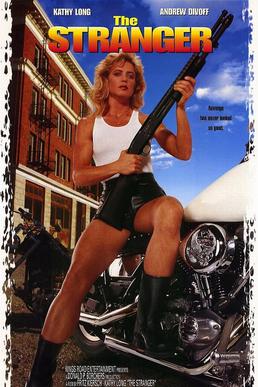
Film Review: The Stranger (dir by Fritz Kiersch)


In the desert of Arizona, there sits a town.

That town is named Lakeview, despite the fact that there is no lake nearby.  There aren’t many buildings in the town.  There’s a service station.  There’s a diner.  There’s a sheriff’s office.  There’s a general store.  There are a few houses.  Lakeview is a place that people rarely visit and which no one can escape.

There is a sheriff.  His name is Cole (Eric Pierpoint) and he spends most of his days in an alcoholic stupor.  He’s been depressed ever since his girlfriend, Bridget, was murdered.  Now, Bridget’s younger sister, Gordet (Robin Lyn Heath), is living like a feral animal while the local shopkeeper, Sally (Ginger Lynn Allen), is determined to have Cole for herself.  Cole’s deputy (Ash Adams) is in love with Sally and wants Cole’s job for his own.  That’s a lot of drama for a small town.

Of course, the real drama in Lakeview comes from the fact that the town is run by a group of bikers!  The head biker is named Angel (Andrew Divoff).  By terrorizing the citizens, Angel and his gang make their own wishes come true without ever asking anyone else if that’s something they would be interested in.  Cole is too drunk and depressed to stand up to them.  The other townspeople are …. well, I don’t know what their problem is.  One assumes that they have to be tough, as they’re living in a harsh and inhospitable desert.  But none of them them are willing to stand up for themselves.  Maybe they’ve recently moved to Arizona from California and they’re not used to the idea of self-defense.  But, for whatever reason, Angel controls Lakeview.

But then the Stranger (Kathy Long) rides up on her motorcycle.  Dressed in black leather and wearing a corset that looks like it would actually be really uncomfortable in the desert heat, The Stranger has no name but she does know how to kick ass.  She has come to kill all the members of Angel’s gang.  Unfortunately, the majority of the gang is out-of-town when The Stranger arrives.  So, the Stranger waits in Lakeview and kills who she can.  The townspeople, led by Sally, want her to leave before things get too violent.  Meanwhile, Cole comes out of his drunken stupor just long enough to notice that the Stranger looks a lot like his dead girlfriend….

1995’s The Stranger was an attempt to a modern-day spaghetti western, with a woman playing the type of mysterious figure who would traditionally have been played by Clint Eastwood or Charles Bronson.  That, in itself, is a pretty good idea.  Unfortunately, The Stranger itself is abysmally paced and the filmmakers seem to have overlooked that, in the best spaghetti westerns, the silent, nameless heroes were usually paired with a more talkative (and often much more amusing) partner.  The Good, The Bad, and the Ugly had Eli Wallach.  Once Upon A Time In The West had Jason Robards.  In The Stranger, there’s not really anyone around to fill that role.  (Cole is too full of self-pity to be amusing.  Gordet spends most of the movie running from one abandoned car to another.)  As such, The Stranger becomes fairly grim and slow.  Things are only livened up when The Stranger beats people up.  Kathy Long was a kickboxing champion and she’s strong enough in the action scenes that it makes up for the fact that she doesn’t have a particularly compelling screen presence.  She and Eric Pierpoint also have next to no romantic chemistry, making the whole question of whether or not she’s Bridget’s ghost seem a bit moot.

The best reason to see the film is to watch Andrew Divoff play Angel.  Divoff is always a good villain and he’s memorably unhinged in The Stranger.  Unfortunately, he’s not in the film as much as the viewer might hope.  Watching the film, I half expected the Wishmaster to ask if I wanted Andrew Divoff’s role to be larger.  I would have said no while thinking yes.  You know how that Wishmaster is.

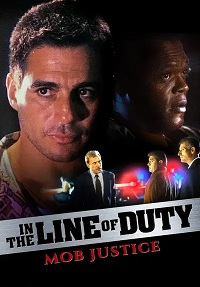
In The Line of Duty: Mob Justice (1991, directed by Peter Markle)


The fourth of NBC’s In The Line of Duty movies, Mob Justice opens with the murder of an undercover DEA agent by a low-level gangster who has just been released from prison.  While the gangster goes into hiding, the DEA mobilizes and starts to make life so difficult for all of the other mobsters in New York that soon, the Mafia is as determined to get justice as law enforcement.

This was the first In The Line Of Duty film not be directed by Dick Lowry.  Lowry’s fast-paced style is missed as Mob Justice takes forever to get going and regularly gets bogged down with scenes lifted from other mafia movies.  The old mobsters talk about the importance of family, play cards in the backroom, and eat big dinners.  Opera blares on the soundtrack when the DEA starts to harass them.  For a movie that is supposed to honor the work and the sacrifice of federal law enforcement, the DEA actually comes across as being thoroughly incompetent in Mob Justice.  A dumb mistake leads to the first murder.  A series of other misjudgments lead to the Mafia dispensing the own type of violent justice before the DEA can arrest their man.

The most interesting thing about Mob Justice is the cast.

The trigger-happy gangster is played by Tony Danza, who I guess was trying to prove himself as a dramatic actor after spending years on Taxi and Who’s The Boss but who still comes across like Tony Micelli having a bad day.  His best friend is played Nicholas Turturro, who later played a straight arrow detective on NYPD Blue.  Frank Vincent and Leonardo Cimino plays the mob bosses who knows that murdering a federal agent is bad for business.

The head of the investigation is played by Ted Levine, who has had a long career but will always be remembered as the killer from The Silence of the Lambs.  Working under him is Dan Lauria, who a generation will instantly recognize as being the long-suffering and frequently angry father from The Wonder Years.  You know that this is a big case is Buffalo Bill and Jack Arnold are working together.  (Dan Lauria actually appeared in several In The Line of Duty films, always playing different characters.)

And finally, the murdered DEA agent is played by none other than Samuel L. Jackson.  It’s never a good thing when the best actor in a movie is killed off after the first fifteen minutes.

The cast is great but Mob Justice is forgettable.  The main problem is that, after Jackson is taken out of the picture, the rest of the movie is just Danza hiding in different apartments while Levine and Lauria annoy Frank Vincent.  Danza’s murderer is never smart nor interesting enough to be a compelling antagonist and there’s never any doubt that, one way or another, he will pay for his stupidity.  There is one memorable scene where Danza freaks out while wearing a blonde wig but otherwise, Mob Justice doesn’t leave much of an impression.

Film Review: Running Red (dir by Jerry P. Jacobs)


I have to admit that I feel a little bit cheated by the 1999 film, Running Red.

I figured that, with a name like Running Red, the film would be about a redhead who did a lot of running.  Since I am a redhead that does a lot of running, I figured that I would be able to relate to this film.  Unfortunately, while it’s true that the film does feature a redhead, she doesn’t get to do much running.  In fact, she doesn’t really get to do much of anything.  Katherine (Angie Everhart) is mostly just there to support her husband, except for those moments that she thinks he’s cheating on him because he’s lied to her about being a former mercenary.

Her husband, who is played by Jeff Speakman, goes by the name of Greg.  He’s got a beard and he sells real estate and he has to go on a lot of business trips.  However, before he grew the beard, Greg’s name was Grigori and he was apparently a Russian even though, even in the flashbacks that open the film, he never had a Russian accent.  Grigori was a part of some sort of weird Russian military unit but he grew disgusted with the ruthlessness of the unit’s leader, Alexi (Stanley Kamel).  After one particularly brutal mission, Grigori dropped his submachine gun to the ground.  In the movie, this is shown to us in slow motion so we know what that this isn’t just a standard shot of a soldier carelessly dropping a loaded weapon.  No, this shot is significant.  This is the …. SLO MO OF DISILLUSIONMENT!

Anyway, a few years pass and Grigori is now Greg and he’s married to Katherine and they have a daughter.  When two meth addicts steal Greg’s SUV (with his daughter in the backseat), Greg promptly steals an ambulance and chases them down.  Using his Russian combat training, Greg beats up the two men.  He thinks that no one has seen him but it just so happens that some old busy body was outside with a video camera.  Greg makes the news!

Unfortunately, the news report is seen by Alexi.  Alexi tracks Greg down and demands that Greg help him out with a few more missions.  Wishing to protect his family, Greg agrees.  He winds up not only lying to his wife about why he suddenly has to go to Detroit but he also misses her high school reunion!  (She even had her old cheerleading outfit cleaned for the special occasion.)  Greg really should know better than to lie to a redhead.  He also should have known better than to think Alexi was ever going to leave him alone.  Greg soon discovers that Alexi isn’t going to be satisfied with just a few missions.  In fact, Alexi wants Greg to assassinate a city councilman who either supports or opposed the construction of a stadium.  To be honest, I kind of had a hard time keeping straight how everyone felt about the stadium.

It may seem as if the filmmakers weren’t that concerned with coming up with a coherent plot and that’s because they weren’t.  The entire film has a make-it-up-as-you-along feel to it.  That makes the plot impossible to follow but it also leads to a few moments that are so over-the-top and weird that you can’t help but kind of love then.  At one point, Jeff Speakman steals a bus and uses it for a high-speed chase.  A little later, he ends up getting into multiple fights on a luxury yacht.  I’m not sure who he was fighting or why they were fighting but it really didn’t matter.  All that matters is that most of the fights were well-choreographed and the action was quick-paced and didn’t have too many slow spots.  Jeff Speakman was a professional martial artist.  Judging by this film, he couldn’t act worth a damn but he could throw a convincing punch and he looked good hitting people.  It’s best not to demand too much from a film like this.  After all, Running Red never said it was going to be anything other than a silly action movie.

That said, I’m a bit disappointed that Katherine didn’t get to do more because, as played by Angie Everhart, she had the potential to be an interesting character and, like me, she was lucky enough to be one of the 2% of the population that has naturally red hair.  That said, Running Red is both frequently dumb and often entertaining.  It delivers what the majority of viewers will be watching it for (i.e., mindless action) and there’s something to be said for a film that is at peace with what it is.

On a personal note (and yes, I’m aware that it’s kind of silly for me to say that when all of my reviews are, more or less, personal notes), I watched Running Red on YouTube as a part of this week’s #MondayActionMovie live tweet.  The version that I saw featured French opening credits and the first few minutes of dialogue were also in French before abruptly switching over to English.  I have to admit that I was a little disappointed when everyone suddenly started speaking English.  I was looking forward to tweeting along in French!  Oh well!

Scenes I Love: Billy Jack Defends Children And Other Living Things


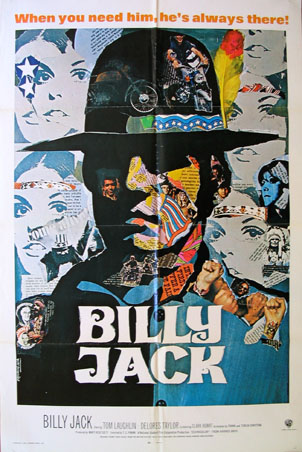
Today would have been the 91st birthday of Tom Laughlin, the independent film pioneer who gave the world Billy Jack.

In honor of the day of his birth, here’s a scene that I love from Billy Jack.  The townspeople think that they can get away with humiliating the students from the Freedom School.  Well, Billy Jack’s got something to say about that and, as always, it starts with him taking off his shoes.

In The Line of Duty: Manhunt in the Dakotas (1991, directed by Dick Lowry)


On February 13th, 1983, a group of U.S. Marshals attempted to arrest a man named Gordon Kahl in North Dakota.  Kahl was an outspoken tax resistor.  He had already served time in Leavenworth for refusing to pay his taxes.  When he was released, he continued to refuse to pay and, in violation of his parole, started to attend meetings of the Posse Comitatus, an organization that refused to recognize the authority of any government above the county level.  Because Kahl was so prominent in anti-government circles, the plan was to make an example out of him by arresting him as he left a Posse Comitatus meeting.  Instead, Kahl,  his son, and an associate opened fire on the U.S. Marshals, killing two of them.  Kahl escaped and, for several months, was the subject of an FBI manhunt.

To make clear, Gordon Kahl was not a good man.  Gordon Kahl was a white supremacist and an anti-Semitic conspiracy theorist who was a follower of the Christian Identity movement.  While Kahl’s supporters claimed that Kahl originally fired on the marshals in self-defense, eyewitnesses testified that Kahl personally executed one marshal after he had already been wounded and was no longer a threat.  Gordon Kahl was no hero but, at a time when many farmers were struggling financially and felt helpless as they watched the banks and the government seize their land, many locals did sympathize with him.  The government’s attempt to publicly arrest Kahl and make an example out of him was seen as a classic example of government overreach.  The government was so eager to catch Kahl and Kahl was initially so successful in eluding them that Gordon Kahl became a folk hero.  When Kahl was discovered hiding out in an Arkansas farmhouse, it led to Kahl killing another deputy and the the government firing over a thousand rounds into the house before eventually setting it on fire.  In their effort to capture Gordon Kahl, the government behaved just as destructively as Kahl always said they would.

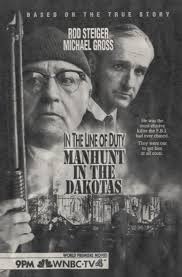
The hunt for Gordon Kahl served as the basis for the third of NBC’s In The Line of Duty films, Manhunt in the Dakotas.  Rod Steiger played Gordon Kahl.  Michael Gross, fresh off of playing a tax resistor in Tremors, played the FBI agent who headed up the manhunt.  Dick Lowry, director of the previous two installments of In The Line of Duty, returned to direct.

Manhunt in the Dakotas is a fair and even-handed look at the search for Gordon Kahl.  The film doesn’t shy away from Kahl’s racism and his paranoia but, at the same time, it also shows why many people instinctively distrust anyone who says that he’s from the government.  The film shows why so many supported Kahl without supporting Kahl itself.  Gross’s FBI agent may start out as rigid and by-the-book but he quickly learns that’s not the best way to get people to answer his questions.  Having come to understand why the people of the Dakotas don’t trust the government, he can only helplessly watch as the government does everything in its power to make Kahl’s paranoid claims seem plausible.  The FBI agent is determined to bring Gordon Kahl in alive but Kahl would rather be a martyr and it seems that the rest of law enforcement is all too happy to help Kahl achieve that.  Other than a few scenes were he indulges in his tendency to overact, Steiger gives a convincing performance as Kahl and he is well-matched by Michael Gross as the agent who comes to realize that there’s more to enforcing the law than giving orders and threatening to send people to prison.

Manhunt in the Dakotas would be followed by In The Line of Duty: Mob Justice, which I will review tomorrow.

Film Review: Fortress: Sniper’s Eye (dir by Josh Sternfeld)


Fortress: Sniper’s Eye is a sequel to the 2021 film, Fortress.

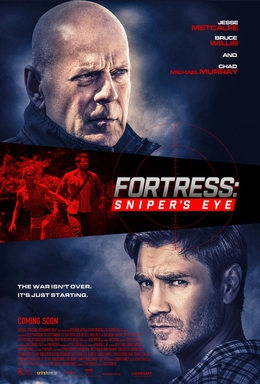
If you haven’t seen Fortress, the plot goes something like this.  A group of mercenaries take over a resort that is populated by retired spies.  Robert Michaels (Bruce Willis) and his son, Paul (Jesse Metcalfe), have to set aside their difference and work together to defeat Frederick Balzary (Chad Michael Murray).

Meanwhile, the plot of Fortress: Sniper’s Eye goes something like this.  A group of mercenaries take over a now-closed resort that was once populated by retired spies.  Robert Michaels (Bruce Willis) and his son, Paul (Jesse Metcalfe), have to continue to set aside their difference and work together to defeat Frederick Balzary (Chad Michael Murray).

Now, to the film’s credit, Sniper’s Eye does admit that it’s largely recycling the plot of the first film.  When Balzary and his henchmen show up for a second time, Paul exclaims, “Didn’t any of you die!?”  It’s a funny line and one that shows that Sniper’s Eye is aware that it’s all a bit ludicrous.  Whatever other faults the film may have, you can’t complain that it’s not self-aware.

Unfortunately, when Balzary and his people invade for the second time, Paul is hosting a gathering with his fiancée and his future mother-in-law.  They’re all taken hostage.  Because Robert was wounded while rescuing Balzary’s wife from some killer Russians, he spends most of the the movie providing encouragement from a hospital bed.  Fortunately, towards the end of the movie, he is able to get out of bed and help out his son.  Paul is obviously happy to see his father and the viewers are happy to see Bruce Willis actually doing some action stuff.

Needless to say, Willis is going to be the main attraction for most viewers.  (I imagine a few One Tree Hill fans will be watching for Chad Michael Murray.)  Sniper’s Eye was one of the film that Willis completed before announcing his retirement from acting.  Knowing what we now know about Willis’s health and the conditions under which he made his final films, watching something like Fortress: Sniper’s Eye can feel awkward.  I cringed when I saw Willis in the hospital bed, looking tired and talking about how he was getting too old to play the hero.  At that moment, it felt as if the character and the actor became the same and it was a bit difficult to watch.

That said, Bruce Willis gives a convincing performance in Fortress: Sniper’s Eye.  He may not have the same charismatic swagger that he had when he was healthy but Willis does still look credible sneaking down a hallway while carrying a gun.  Even though the action scenes all use a rather obvious stunt double, Willis is still convincing in his role.

As for the rest of the film, the pacing is abysmal and the performances are uneven, with Jesse Metcalde making a bland hero and Chad Michael Murray going overboard as the main villain.  This is another film with a jumbled timeline so I feel sorry for anyone who is looking away from the screen whenever the “Two weeks later” title card flashes by.  On the plus side, the resort scenery was nice to look at and Natali Yura gave a convincing performance as Balzary’s wife.  As far as Bruce Willis’s later films are concerned, Fortress: Sniper’s Eye is superior to American Siege but comes in far below both Gasoline Alley and A Day To Die.

4 Shots From 4 Films: Special Robert Aldrich Edition


4 Or More Shots From 4 Or More Films is just what it says it is, 4 shots from 4 of our favorite films. As opposed to the reviews and recaps that we usually post, 4 Shots From 4 Films lets the visuals do the talking!

On this date, 104 years ago, Robert Aldrich was born in Cranston, Rhode Island.  The first cousin of New York Governor and Vice President Nelson Rockefeller, Robert Aldrich eschewed business and politics to pursue a career in film.  Though his wonderfully melodramatic films were often undervalued when first released, Aldrich is now seen as one of the most influential filmmakers of all time.  Tarantino loves him.

In honor of Aldrich’s career and legacy, here are….

4 Shots From 4 Robert Aldrich Films

Kiss Me Deadly (1955, dir by Robert Aldrich, DP: Ernest Laszlo)

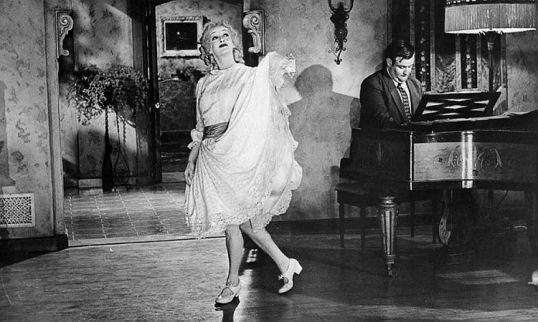
What Ever Happened To Baby Jane? (1962, dir by Robert Aldrich, DP: Ernest Haller)

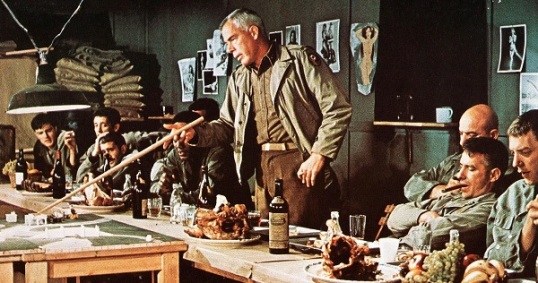
The Dirty Dozen (1967, dir by Robert Aldrich, DP: Edward Scaife)

Hustle (1975, dir by Robert Aldrich, DP: Joseph Biroc)