As some of our regular readers undoubtedly know, I am involved in a few weekly live tweets on twitter. I host #FridayNightFlix every Friday, I co-host #ScarySocial on Saturday, and I am one of the five hosts of #MondayActionMovie! Every week, we get together. We watch a movie. We tweet our way through it.
Tonight, at 9 pm et, Tim Buntley will be hosting #ScarySocial! The movie? 2014’s Exists!
If you want to join us this Friday, just hop onto twitter, start the movie at 9 pm et, and use the #ScarySocial hashtag! I’ll be there tweeting and I imagine some other members of the TSL Crew will be there as well. It’s a friendly group and welcoming of newcomers so don’t be shy.
4 (or more) Shots From 4 (or more) Films is just what it says it is, 4 (or more) shots from 4 (or more) of our favorite films. As opposed to the reviews and recaps that we usually post, 4 (or more) Shots From 4 (or more) Films lets the visuals do the talking.
Happy birthday to Baltimore’s own Barry Levinson!
4 Shots From 4 Barry Levison Films
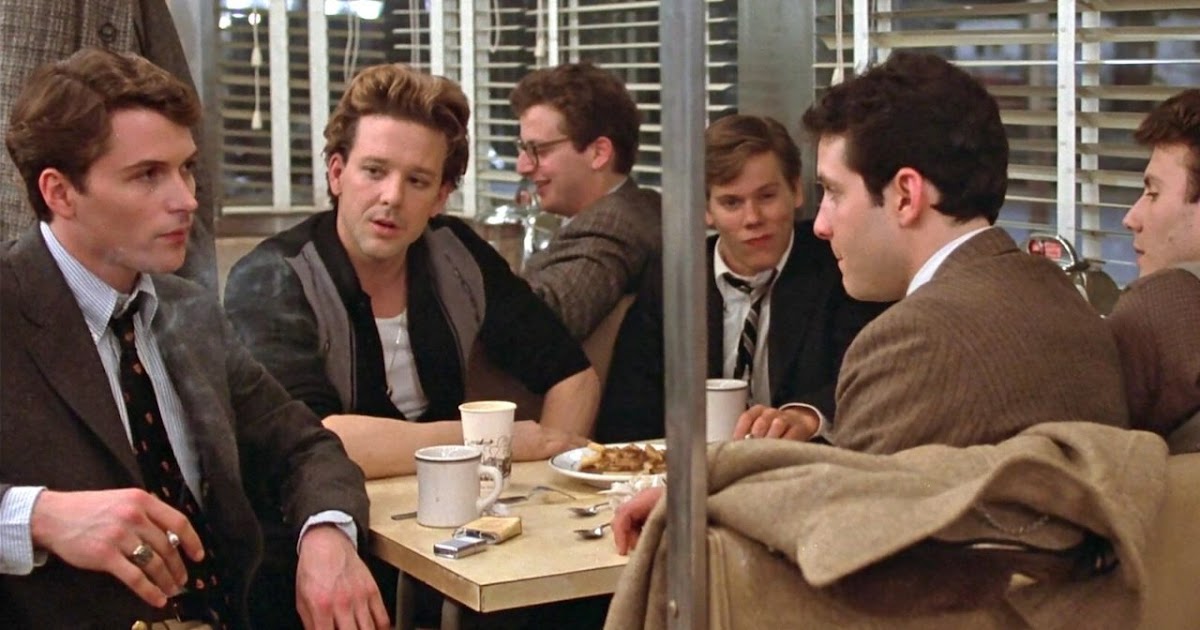
Diner (1982, directed by Barry Levison, DP: Peter Sova)
The Natural (1984, directed by Barry Levinson, DP: Caleb Deschanel)
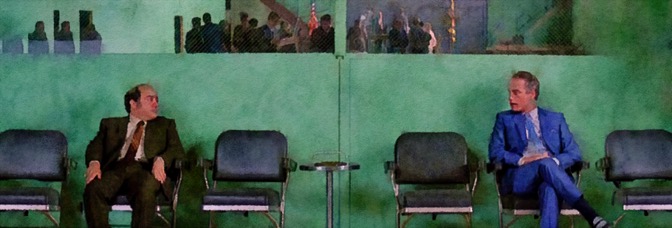
Tin Men (1987, directed by Barry Levinson, DP: Peter Sova)
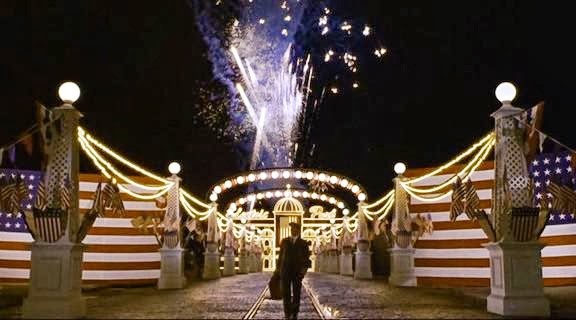
Avalon (1990, directed by Barry Levinson, DP: Allen Daviau)
That’s the question at the heart of the 1975 film, The Man In The Glass Booth.
When we first meet Arthur Goldman (Maximilian Schell), he is a wealthy businessman who lives in a Manhattan high-rise and who appears to rarely leave the safety of his penthouse. He is waited on by two assistants, Jack (Henry Brown) and Charlie (Lawrence Pressman), both of whom he talks to and treats as if they are members of his own family. His most frequent visitor is his psychiatrist, Dr. Weissburger (Robert H. Harris), who frequently stops by and asks Arthur if he’s been taking his medication.
Arthur Goldman is a man who loves to talk. Indeed, the first hour of the film feels almost like a nonstop monologue on the part of Goldman, with just occasional interjections from the other characters. Goldman was born in Germany. He talks about how, when he was young, he and his family were sent to a concentration camp and it was there that he witnessed the murder of his father by the camp’s sadistic commandant, Dorff. Dorff is one of the many Nazis who disappeared to South America at the end of the war.
When Goldman spots a car that always seems to be parked across the street from his building, he becomes paranoid. He says that he’s being watched and even suggests that Dorff has come to capture him. Instead, it turns out that Mossad come for him. As the agents explain it to Charlie, dental records prove that Arthur Goldman is actually Commandant Dorff. Goldman/Dorff is taken back to Israel to stand trial for his crimes.
Are Arthur Goldman and Dorff the same man? Once in Israel, Goldman tells anyone who will listen that he is Dorff and that he feels no guilt for his actions. He insists on being allowed to wear his SS uniform during the trial. Because of threats to his safety, a booth made of bullet-proof glass has been placed in the courtroom. As the trial commences, The Man in the Glass Booth continues to rant and rave and declare his guilt. However, the prosecutor (Lois Nettleton) comes to doubt that the man is who he says he is.
The Man In The Glass Booth is based on a novel and play by Robert Shaw. (The same year that The Man In The Glass Booth was released, Shaw played Quint in Jaws.) The film was produced as a part of an experiment called American Film Theatre, in which well-known plays would be adapted to film and then would be shown at 500 participating movie theaters in America. Each production would only be shown four times at each theater and subscriptions were sold for an entire “season” of films. It sounds like an interesting experiment and the type of thing that I would have enjoyed if I had been around back then. Today, of course, these productions would have just premiered on a streaming service.
The Man In The Glass Booth is a film that very much feels like a filmed play. There are only three locations — Goldman’s penthouse, his cell, and the courtroom where he is put on trial. The three act structure is very easy to spot. Maximilian Schell’s performance is also very theatrical. In fact, it’s so theatrical that, for the first hour or so, I found myself wishing that he would just stop talking for a few second or two. He was so dramatic and so flamboyant and so intentionally over-the-top that he became somewhat exhausting. But, during the second hour, I came to see that all of that “overacting” was actually setting up the film’s final act. Schell talks so much that, when he finally does find himself unable to explain himself, it’s a shocking moment and one that perfectly captures not just the evil of the Nazis and the Holocaust but also how the legacy of that evil lives on after the fall of the Third Reich and the deaths of the majority of the Holocaust’s perpetrators. At that moment, I realized that The Man In The Glass Booth never stopped speaking because silence would force him to confront the horrors of the past and the trauma, guilt, and uncertainty lurking in his subconscious. Maximilian Schell was nominated for an Oscar for his performance here and, by the end of the film, I totally understood why.
The Man In The Glass Booth requires some patience. Actually, it requires a lot of patience. However, those who stick with it will discover an intelligent and thought-provoking film about not only the horror of the past but also how those in the present deal with and rationalize those horrors. Though the film is a bit too stagey for its own good, it’s also one that sticks with you even after the curtain falls and the end credits roll.
Outlaw Tom Sabin (James Craig) rides into Purgatory, a frontier town that is so dangerous that even the welcome sign warns that those entering should say goodbye to God.
The townspeople take one look Tom and hire him to clean up the town. The town is controlled by a ruthless saloon owner named Hoag (Paul Richards). Hoag is a self-styled intellectual and a dangerous man but he is considered to be untouchable because he is crippled and no one wants to be known as the person who shot a man in a wheelchair. Instead, they would rather hire a stranger to do it for them but Tom has more honor than they originally realized.
Hoag summons three gunmen to kill Tom. Two of the gunmen prove to be no match for Tom but then he meets the third and is shocked to discover that it’s his own brother, Johnny Naco (Brett Halsey).
Four Fast Guns is a better-than-average B-western. What sets it apart from other films about strangers being hired to clean up a town is that the characters are portrayed with more depth than usual. The towns people are not innocent victims but instead want to pay Tom to take the risks and do the dirty work that they’re not willing to do. Tom is not a cut-and-dried hero and the gunmen who are hired to kill him are not portrayed as being one-dimensional villains. Johnny Naco may be a killer but he also has a code of honor. He may be willing to kill his own brother but he’s not willing to see him humiliated. The wheelchair-bound Hoag is himself a more interesting bad guy than usually shows up in movies like this. He’s the type of bad guy who quotes Dickens and Whitman while waiting for his hired guns to do their job. Hoag feels that his cultured background sets him above the rest of the town’s rabble but he ultimately proves himself to be just as petty as those that he looks down on.
Four Fast Guns feels like a forerunner to the morally ambiguous Spaghetti westerns and films like Clint Eastwood’s Unforgiven. It is essential viewing for fans of the genre.
A group of boys from the wrong side of the tracks want to start a little league baseball team but they have to find a coach. Luckily, right before the deadline, they find a homeless drifter (Burt Reynolds) sleeping in the dugout. The drifter doesn’t know his name or anything about his past but he does know a lot about baseball. The team names him Jack Robinson (after Jackie Robinson) and he teaches them how to play baseball and they find a barn for him to sleep in. Jack dates one the player’s mom (Reba McIntire) and helps the kids with their homelives before a near-tragedy causes him to remember who he used to be.
I like most baseball movies but this one sent a pretty bad message. If you’re looking for a coach for your baseball team, don’t just give the job to the first drifter who shows up. The kids were lucky that the drifter turned out to be someone with baseball experience instead of a cannibal. Jack was a good coach and I appreciated his emphasis on the fundamentals but I also thought it was strange that none of the parents were worried about a total stranger wanting to spend all of his time with their children. Except for Reba McIntire, the acting was pretty forgettable but all of the kids looked like they knew what they were doing in the baseball scenes so that was a plus. This movie never scored but it did get a few base hits.
As some of our regular readers undoubtedly know, I am involved in a few weekly live tweets on Twitter and Mastodon. I host #FridayNightFlix every Friday, I co-host #ScarySocial on Saturday, and I am one of the five hosts of #MondayActionMovie! Every week, we get together. We watch a movie. We tweet our way through it.
Tonight, at 10 pm et, we’ve got 1987’s The Barbarians!
If you want to join us this Friday, just hop onto twitter, start the movie at 10 pm et, and use the #FridayNightFlix hashtag! It’s a friendly group and welcoming of newcomers so don’t be shy.
The Barbarians is available on Prime and Tubi! See you there!
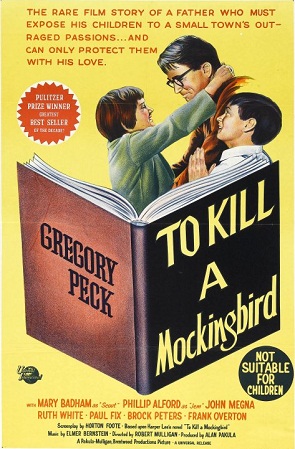
108 years ago today, the actor Gregory Peck was born in San Diego, California. With his deep voice and his Lincolnesque profile, Peck was always best cast as a man of integrity who was willing to take a stand, even if it meant going against the majority. That made him ideal for the role of attorney Atticus Finch in 1962’s To Kill A Mockingbird.
Today’s scene that I love comes from that film. In this scene, Atticus makes his closing statement in the murder trial of Tom Robinson. While Atticus is speaking to the jury, Gregory Peck is speaking to the audience in the theater (and later, in front of the television). Reportedly, Peck only needed one take to perfectly deliver his speech.
4 (or more) Shots From 4 (or more) Films is just what it says it is, 4 (or more) shots from 4 (or more) of our favorite films. As opposed to the reviews and recaps that we usually post, 4 (or more) Shots From 4 (or more) Films lets the visuals do the talking.
Today, we wish a happy 98th birthday to the legendary filmmaker, Roger Corman! And that means that it’s time for….
4 Shots From 4 Roger Corman Films
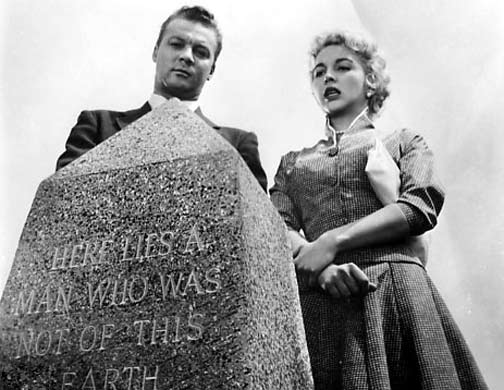
Not Of This Earth (1957, dir by Roger Corman, DP; John J. Mescall)
X: The Man With The X-Ray Eyes (1963, dir by Roger Corman, DP: Floyd Crosby)
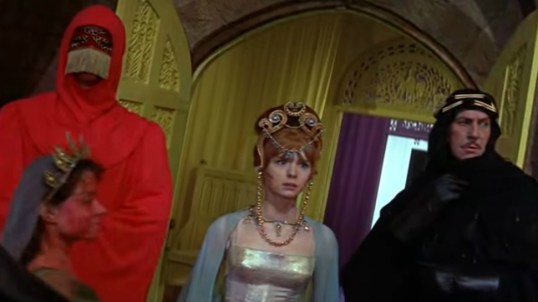
The Masque of the Red Death (1964, dir by Roger Corman, DP: Nicolas Roeg)
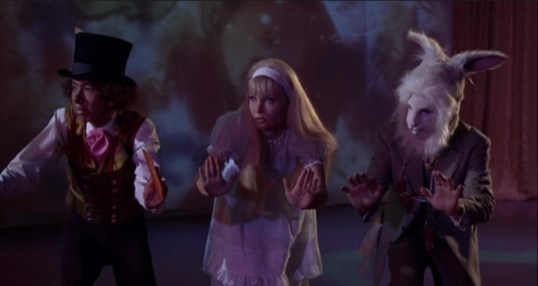
The Trip (1967, dir by Roger Corman, DP: Archie R. Dalzell)
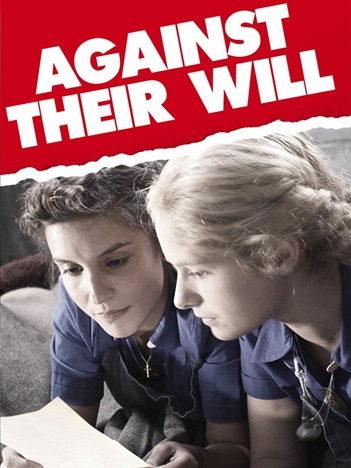
The 2012 French film, Against Their Will, tells the story of two Alsatian teenagers during the Nazi occupation of France.
Lisette (Louise Herrero) is blonde and praised, by the Nazis, for her Aryan appearance. She appears to always have a positive attitude no matter what is going on. Lisette’s father is a collaborationist with the Nazis and Lisette publicly defends the German occupiers while privately disdaining them and the war. Her fiancé, Henri, has been conscripted into the army and has been sent to the Russian front. He writes her letters but, because he is now required to write only in German and not in the French that he and Lisette grew up with, Lisette cannot read them.
Alice (Flore Bonaventura) is dark-haired and therefore considered to be inferior to Lisette. This is despite the fact that Alice is fiercely intelligent and has been trained as a nurse. Alice’s father is a doctor who has been sent to a prison camp as punishment for treating a wounded British soldier. Alice is rebellious and, unlike Lisette, she has no compunctions about telling the Nazis exactly how she feels about them. When she is ordered to salute the Nazi flag, she lifts on arm in a stiff salute while using her other hand to extend her middle finger.
Lisette and Alice are amongst the many teenagers who are taken from their families and sent to a German indoctrination camp, where the strict and cruel Trudl (Julia Thrunau) tries to brainwash them. Lisette and Alice become unlikely friends as they are sent from the camp to work in a munitions factory and finally to serve in the Lebensborn, which was Germany’s eugenics program. While Alice works in the maternity ward, Lisette’s Aryan appearance attracts the attention of a cruel SS officer.
Against Their Will starts out strong, showing how even the most intelligent and independent of people can be forced to do things that go against their beliefs, whether as a result of brainwashing or just plain fear. The scenes in the indoctrination camp and later in the munitions factory show how the Nazi government treated both people in both Germany and the occupied territories as cannon fodder in their war with the Allies. Even during an air raid, Alice is ordered to continue working and, even though one mistake could lead to an explosion that would kill both them and several of their co-workers, Alice and Lisette are continually told to speed up when it comes to making the shells that will later be dropped on the Allies.
The film loses its way during the final third, largely because French girls — even ones from the German-influenced Alsace region of France — would never have been sent to the Lebensborn, which was meant to be exclusively for the breeding of “pure” Germans. By suggesting otherwise, the film unintentionally downplays the nationalism and the racism at the heart of the Nazi ideology. The film’s framing device — in which one of the women tells her story to her granddaughter — also feels a bit awkward and the film also makes a bit too much use of the stereotype of the good German, the one Nazi who is not quite as cruel as the others.
The first half of the film is a strong portrayal of life under an occupation, with both of the lead actresses giving good performances as two women who deal with their circumstances in very different ways. It’s just a shame that the film’s conclusion doesn’t live up to what came before it.
When the wife of rancher Clint Hollister (Earl Dwire) died in childbirth, Clint was so distraught that he rejected his son, Todd. Todd was raised by a rival rancher, John Endicott (Lafe McKee). Hollister resented Endicott for taking his son and a feud developed between the two families. Hoping the end the feud, 15 year-old Todd ran away from home and made a new life for himself as a frontier scout named Idaho.
15 years later, Idaho (Rex Bell) returns home with his sidekick, a reformed outlaw known as The Kid (David Sharpe). Neither Hollister nor Endicott recognize Idaho and, without revealing his identity, Idaho tries to stop their feud. Hollister’s men want to keep the feud going and they manipulate Hollister into challenging his own son to a duel.
Idaho Kid is one of the better B-westerns that Rex Bell made between 1928 and 1936. Though the film has its share of action scenes, Idaho Kid‘s intelligent script puts more emphasis on character development than most B-westerns, with Hollister especially being portrayed as a complex character as opposed to just a stock western villain. Rex Bell always seemed authentic whenever he was riding a horse or shooting a gun. Idaho Kid shows that he could also play more than just a standard western hero.
Though he was being pushed for stardom by Fox Film, Rex Bell voluntarily retired from the film industry in 1936 and instead pursued a career in politics. He was the Lieutenant Governor of Nevada when he died of a heart attack in 1962.