4 Shots From 4 Films: Special Ward Bond Edition


4 (or more) Shots From 4 (or more) Films is just what it says it is, 4 (or more) shots from 4 (or more) of our favorite films. As opposed to the reviews and recaps that we usually post, 4 (or more) Shots From 4 (or more) Films lets the visuals do the talking.

121 years ago today, the great American character actor Ward Bond was born in Benkleman, Nebraska.  In a career that last nearly forty years, Ward Bond appeared in more than 200 films and he currently holds the record for being the actor to appear in the most films nominated for Best Picture.  (He appeared in 13 nominated films, two of which won.)  He did 22 films with John Wayne and was a favorite of both John Ford and Frank Capra.

It’s time for….

4 Shots From 4 Ward Bond Films

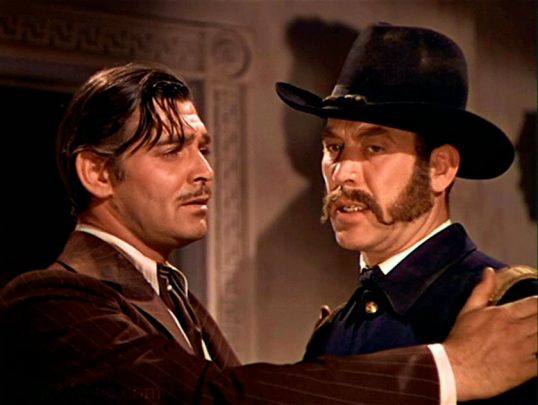
Gone With The Wind (1939, dir by Victor Fleming, DP: Ernest Haller)

It’s A Wonderful Life (1946, dir by Frank Capra, DP: Joseph Walker and Joseph Biroc)

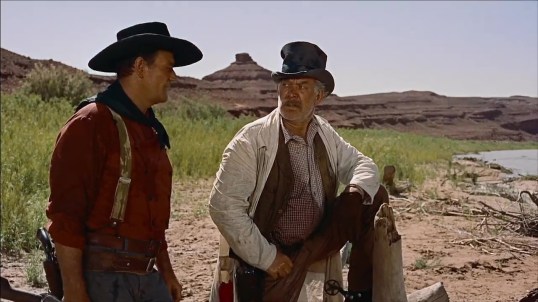
The Searchers (1956, dir by John Ford, DP: Winston C. Hoch)

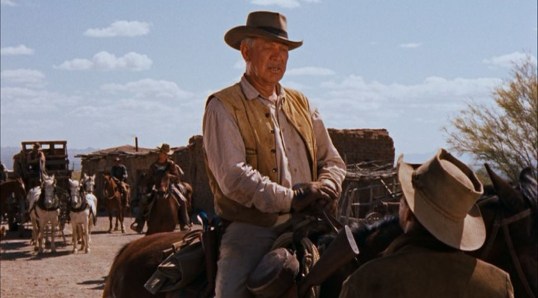
Rio Bravo (1959, dir by Howard Hawks, DP: Russell Harlan)

Streets of Ghost Town (1950, directed by Ray Nazarro)


Years ago, Bill Donner (George Cheseboro) double-crossed the other members of the Selby Gang and ran off with all of their stolen gold.  Now, Donner is blind and half-crazy.  When he says that he hid the gold in the ghost town of Shadeville, the Durango Kid (Charles Starrett), Smiley Burnette, and Sheriff Dodge (Stanley Andrews) ride off to find it.

Shadeville is long abandoned and, as the three men spend the night in a deserted saloon, Smiley is worried about ghosts.  The Durango Kid tells the story of the first time he met the Selby Gang.  The next morning, they discover that they are not the only ones who have come to Shadeville to look for the gold.

Like many of the later Durango Kid movies, Streets of Ghost Town is mostly made up of stock footage to Starrett’s earlier films.  This was a cost-cutting technique on the part of Columbia Pictures but it actually works because the flashbacks were always to the horse chases and the gunfights that the audience came to see in the first place.  In the days before home video and cable, those scenes were probably still new to many of the people sitting in the theater.

Starrett always made for a good hero and Smiley Burnett’s comic relief never took away from the films’s storylines.  This outing features a great scene where Durango shoots a skull in the dark just to let anyone watching him know that he’s a good shot.  I also enjoyed George Cheseboro’s manic performance as a man who really loves his gold.  Despite all of the stock footage, Streets of Ghost Town is still an above average Durango Kid film, predictable but entertaining if you’re a fan of the genre.

Monday Live Tweet Alert: Join Us For Aftershock!


As some of our regular readers undoubtedly know, I am involved in hosting a few weekly live tweets on twitter and occasion ally Mastodon.  I host #FridayNightFlix every Friday, I co-host #ScarySocial on Saturday, and I am one of the five hosts of Mastodon’s #MondayActionMovie!  Every week, we get together.  We watch a movie.  We snark our way through it.

Tonight, for #MondayActionMovie, the film will be 1990’s Aftershock!  Selected and hosted by Rev. Magdalen, this movie is about life after an eclipse!  So, you know it has to be good!

It should make for a night of fun viewing and I invite all of you to join in.  If you want to join the live tweets, just hop onto Mastodon, pull up Aftershock on YouTube, start the movie at 8 pm et, and use the #MondayActionMovie hashtag!  The live tweet community is a friendly group and welcoming of newcomers so don’t be shy.   

Scenes I Love: The Trip from A Field In England


Happy Eclipse Day!

In honor of the eclipse that I will probably not be able to see because of the clouds and the rain, today’s scene that I love comes from 2014’s A Field In England.  This film may (or may not) take place during a solar eclipse.  I won’t try to explain everything that is happening in the scene, beyond stating that this particular field in England is home to some interesting mushrooms.  I encourage you see to watch the film for yourself.

Film Review: Underground (dir by Vincent Sherman)


1941’s Underground tells the story of two brothers on opposite sides in Nazi Germany.

Kurt Franken (Jeffrey Lynn) is a patriotic German who believes that the country got a raw deal at the end of World War I and who is a strong supporter of the Nazis.  He served in the army, fighting on the front.  When he returns home to Berlin, he’s missing an arm.  Whenever his friends and his family say that they’re sorry that he lost his arm, he replies that he was happy to make the sacrifice for his country.  When someone starts to mourn for his son who was killed in the fighting, Kurt accuses the man of being a traitor for doubting the wisdom of the government.  Kurt is a true believer, just the type to be recruited by the SS and tasked with helping to investigate who is behind a series of anti-Nazi radio broadcasts.  Kurt believes that, if the government says it, it must be right.  Laws must be obeyed and orders followed without question.  Kurt, in other words, is a very familiar type.

What Kurt doesn’t realize is that the man behind the broadcasts is his own brother, Eric (Phillip Dorn).  As Kurt investigates, he falls in love with Sylvia (Kaaren Verne) without realizing that she is also a part of the resistance.  While Kurt tries to discover who is behind the underground radio station, Eric and his fellow resistance members attempt to stay one step ahead of the Gestapo.

For a film made in 1941, the film’s doesn’t flinch from showing the brutality of the Gestapo.  Like all authoritarian dictatorships, The Third Reich is determined to quash any and all signs of dissent and they investigate the underground radio station with a ruthlessness that even takes Kurt by surprise.  Witnessing first hand the brutality and sadism of the government for which he gave his arm, Kurt starts to doubt his previous beliefs.  But will Kurt’s doubts come in time to save the lives of Eric and his fellow resistance members?

Made at a time when the United States was still officially neutral in the violent conflict that was sweeping the rest of the world and released just a few months before the U.S. officially declared war on the Axis Powers, Underground is a powerful look at life under a dictatorship.  Shot in a noir style, the film’s black-and-white imagery perfectly captures the harshness of life in Germany while the shadows in the background perfectly capture the paranoia of knowing that saying the wrong word could lead to arrest, torture, and death.  The film’s final minutes involve a guillotine sitting ominously in the background, a reminder that Nazi Germany was not the first authoritarian regime and that it would not be the last.

The film is well-acted, with Jeffrey Lynn epitomizing the otherwise intelligent people who allow themselves to get caught up in the madness of the majority.  His discovery of the truth about Germany was obviously meant to mirror the awakening of the Americans who previously supported a policy of neutrality.  By the end of the film, both Karl Franken and the audience understand that the time for neutrality has passed.

Marshal of Heldorado (1950, directed by Thomas Carr)


Heldorado, Arizona is a frontier town with a problem.  The Tullivers, led by Mike (Tom Tyler), keep robbing the bank and running off anyone who agrees to be the town’s marshal.

The Colonel (Raymond Hatton) and the Mayor (Fuzzy Knight) are at their wits end until a bison hunter named Lucky (Russell Hayden) comes riding into town in search of work.  They hire Lucky to be their new marshal, paying him $200 a week and allowing him three free drinks a day.

They also give Lucky a cabin to stay in but when Shamrock Ellison (James Ellison), a dandy from up north, rides into town on a donkey, Lucky decides to rent him the cabin.  When Ellison arrives at the cabin, he finds two Tulliver brothers looking for the stolen money that they hid in the fireplace.  The brothers try to shoot Ellison but accidentally end up shooting themselves instead.

When Ellison says that he wants to keep a low profile, Lucky takes credit for killing the two Tullivers.  When Mike shows up looking for revenge, Lucky has a change of heart and gives all the credit for Ellison.  Lucky makes Ellison his deputy but what he doesn’t know is that Ellison is actually a government agent who has been sent to Heldorado to clean the town up.

This B-western does a good job of mixing comedy with action.  It was one of many films that Ellison and Hayden made together and Hayden’s bluster plays off well against Ellison’s more serious performance.  Much of the humor comes from Ellison having to keep the other townspeople from realizing that he’s a crack shot who knows how ride a horse as well as anyone in town.  As well, Fuzzy Knight has his moments as the always drinking mayor.  The action scenes are well-choreographed and there’s even a suspenseful scene where Ellison gets a shave from a barber who is actually a relative of the Tullivers.  As always, the beautiful Julia Adams is a welcome addition to the cast as the Colonel’s daughter, who falls for Ellison.  For fans of the genre, there’s plenty of entertainment to be found in this brisk, 50-minute western.

Retro Television Review: The Hunted Lady (dir by Richard Lang)


Welcome to Retro Television Reviews, a feature where we review some of our favorite and least favorite shows of the past!  On Sundays, I will be reviewing the made-for-television movies that used to be a primetime mainstay.  Today’s film is 1977’s The Hunted Lady!  It  can be viewed on YouTube.

Detective Susan Reilly (Donna Mills) reluctantly teams up with a chauvinistic cop named Sgt. Arizzio (Alan Feinstein) to investigate a United States senator who has presidential ambitions.  Arizzio believes that the senator is being back by the Mafia and that it would be disastrous for the country if a mob-connected politician ended up in the White House.  (Being mob-connected didn’t seem to hurt John F. Kennedy but still….)

Now, Detective Reilly and Sgt. Arizzio working together to take down a corrupt senator sounds like an intriguing premise for a movie, right?  Well, oddly enough, that’s not what this movie is actually about.  Instead, it’s about Susan going on the run after she’s framed for Arizzio’s murder.  She escapes from police custody with the help of her father.  Though she’s still recovering from being shot earlier in the film, Susan makes her way to Reno and attempts to hide out from both the cops and the Mafia assassin that has been sent to kill her.

Susan hiding out in Reno.  Hmmm …. sound like an intriguing premise for a movie, right?  Well, don’t get to attached to Susan pretending to be a professional gambler because it turns out that bullet wound was more serious than she realized and she ends up passing out from blood loss.  When she awakens, she’s in a free clinic that is run by Dr. Arthur Sills (Robert Reed).  Dr. Sills doesn’t ask Susan too many questions about her past and even hires Susan on as a nurse.  Susan and Dr. Sills fall in love and try to clear the name of a Native American who has been accused of blowing stuff up.

Doing some research, I was not surprised to discover that The Hunted Lady was originally developed as a possible television show.  The show would have played out like a combination of Charlie’s Angels and The Fugitive, with Susan moving from town to town and getting involved with a new set of guest stars each week.  With both the police and the mob trying to track her down, Susan would try to clear her name while also helping out strangers.  Unfortunately, The Hunted Lady wasn’t exactly a hit in the ratings and Susan’s further adventures went untold.

The main problem with The Hunted Lady is an obvious one.  The idea of the Mafia trying to install one of their guys in the White House is considerably more intriguing that Susan falling in love with Dr. Sills while working at a free clinic.  The whole time that Susan was helping the doctor’s patients, I was thinking, “But what about the senator?”  Donna Mills was surprisingly convincing as a tough cop but she had next to no chemistry with Robert Reed.  If anything, Reed looked annoyed at just having to be there.

Anyway, here’s hoping that Susan cleared her name eventually.  You can only run for so long.

Scenes That I Love: Harry’s Nightmare from The Conversation


1974 was a very good year for Francis Ford Coppola.  Not only did he direct the Oscar-winning Godfather Part II but he also directed another film that was nominated for Best Picture, an intense study of paranoia called The Conversation. 

Today’s scene that I love comes from The Conversation.  Surveillance expert Harry Caul (Gene Hackman, giving one of his best performances) fears that his work may lead to murder.  In this scene, he has a nightmare in which he tries, in vain, to talk to one of the people who he has been surveilling.  This scene perfectly captures the horrific logic and helpless feeling of a nightmare.  Harry, who is not the most open or emotional of men, can only be his true self in his dreams.

4 Shots From 4 Films: Special Francis Ford Coppola Edition


4 (or more) Shots From 4 (or more) Films is just what it says it is, 4 (or more) shots from 4 (or more) of our favorite films. As opposed to the reviews and recaps that we usually post, 4 (or more) Shots From 4 (or more) Films lets the visuals do the talking.

Today is Francis Ford Coppola’s birthday! Coppola is a bit of a controversial figure among some film scholars. While everyone agrees that, with the first two Godfathers, he directed two of the greatest films of all time (and some people would include Apocalypse Now on that list as well) and that he was one of the most important directors of the 70s, his post-Apocalypse Now career is often held up as a cautionary tale. Some say that Coppola’s career suffered because of his own excessive behavior and spending. Others argue that he was treated unfairly by a film industry that resented his refusal to compromise his vision and ambitions. Personally, my natural instinct is to always side with the artist over the executives and that’s certainly the case with Coppola. Coppola has only completed four films since the start of this current century and three of them were not widely released. Say what you will about the films themselves, that still doesn’t seem right. This year will bring us a new Coppola film, Megapolis. I know that we’re all hoping the best.

Regardless of how one views his latter career, Coppola is responsible for some of the best and most important films ever made. And today, on his birthday, it’s time for….

4 Shots From 4 Francis Ford Coppola Films

The Godfather (1972, dir by Francis Ford Coppola, DP: Gordon Willis)
The Conversation (1974, dir by Francis Ford Coppola, DP: Bill Butler)
The Godfather, Part II (1974, dir by Francis Ford Coppola, DP: Gordon Willis)
Apocalypse Now (1979, dir by Francis Ford Coppola, DP: Vittorio Storaro)

Diner (1982, directed by Barry Levinson)


Which member of the Diner gang would you be?

I think that is the question that everyone, or at least every guy, asks themselves after watching Barry Levinson’s debut film.  Most would probably want to say that they’re Boogie (Mickey Rourke), because he’s cool, all the ladies love him, and he makes creative use of a popcorn box at the movies.  Some would probably say that they want to be Fenwick (Kevin Bacon) because he’s smart and sarcastic.  No one wants to be Billy (Tim Daly) or Eddie (Steve Guttenberg), even though we would all want to be their friend.

The truth is that most of us would probably be Shrevie (Daniel Stern), the just-married one who is discovering that being an adult means working an unglamorous job and discovering the rest of the world doesn’t care about your taste in music.  The luckiest of us might be Modell (Paul Reiser), the funny one who doesn’t get a story but who makes a lot of jokes.

Diner was one of the first great hang-out movies.  There is no plot, at least not in the traditional sense.  Instead, it’s about a group of long-time friends who live in Baltimore in 1959.  They grew up together.  They went to high school together.  They’ve been hanging out at the same diner for as long as they can all remember.  And now, they’re at the point in their lives where the world expects them to act like adults and accept all the responsibility that goes along with that.  It’s a film that celebrates their friendship while also acknowledging that some of them are using that friendship as an excuse to not grow up.  They escape into trivia and movies, with one minor character reciting Sweet Smell of Success by memory.  Fenwick drinks.  Boogie gambles.  Even Billy, who doesn’t even live in Baltimore anymore, reverts to his old ways as soon as he returns for Eddie’s wedding and ends up sucker punching someone because of an old high school incident.

The preparations for Eddie’s wedding gives the film what structure it has.  Eddie is marrying the unseen Elyse, assuming she can pass his demanding quiz about the Baltimore Colts.  (That may sound unfair but if you’re from Baltimore, you’ll understand.)  While Eddie gets ready for his wedding, Shrevie’s marriage to Beth (Ellen Barkin) seems to be falling apart and she finds herself tempted to cheat with Boogie, who has his own problems with a local bookie.  Meanwhile, Billy learns that his girlfriend (Kathryn Dowling) is pregnant.

The film is about friendship and the friendships between the men feel real.  Levinson held off on shooting the largely improvised diner scenes until the end of the film, by which time all of the actors had developed their own idiosyncratic relationships with each other.  The heart of Diner is to be found in scenes like the one where Modell tries to ask for someone else’s sandwich without actually coming out and asking for it.  The dialogue in that scene and so many others has the ring of age-old friendship.  Though the film makes it easy to see why Mickey Rourke and Kevin Bacon become movie stars while Tim Daly has spent most of his career on television, the entire cast is still perfect in their roles.  It’s about as strong as an ensemble as you could ever hope to see.  They become the characters and watching the movie, it’s impossible not to see yourself and your friends in their performances.

Barry Levinson has gone on to direct many more films but for me, Diner will always be the best.