Today would have been the birthday of actor Tom Noonan. Today’s scene that I love is a short scene featuring Noonan from 1995’s Heat. Noonan doesn’t have a lot of screentime but his character is key to the plot. In this scene, Noonan shows how much a great character actor can do, even with limited screentime.
Category Archives: Film
4 Shots From 4 Films: Special 1993 Edition
4 Or More Shots From 4 Or More Films is just what it says it is, 4 shots from 4 of our favorite films. As opposed to the reviews and recaps that we usually post, 4 Shots From 4 Films lets the visuals do the talking!
Today, we pay tribute to the year 1993 with….
4 Shots From 4 1993 Films

Mi Vida Loca (1993, dir by Allison Anders, DP: Rodrigo Garcia)
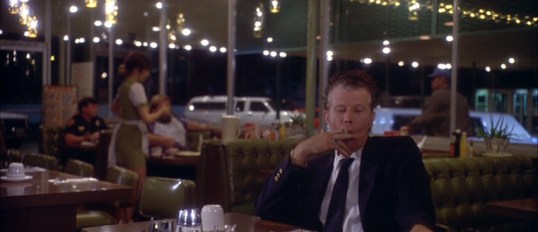
Short Cuts (1993, dir by Robert Altman, DP: Walt Lloyd)

Sliver (1993, dir by Phillip Noyce, DP: Vilmos Zsigmond)
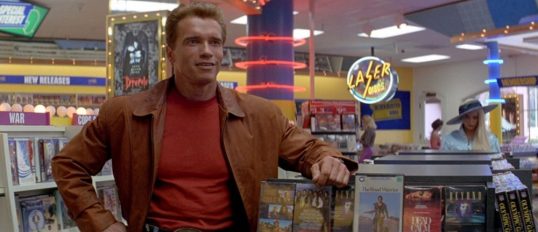
The Last Action Hero (1993, directed by John McTiernan, DP: Dean Semler)
Review: The Poughkeepsie Tapes (dir. by John Erick Dowdle)
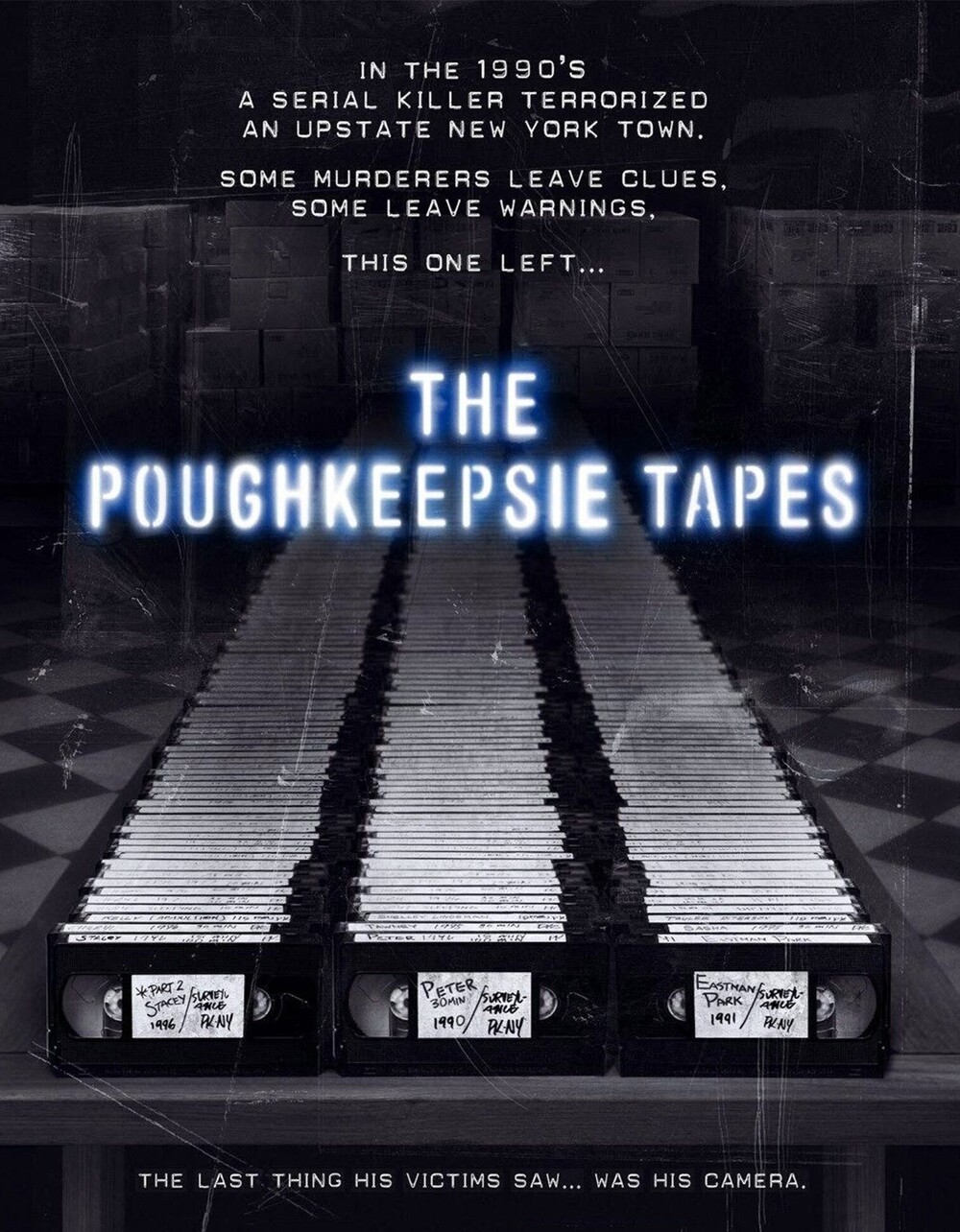
“She kept covering her eyes, whispering ‘please take me home, please take me home, please take me home…’ a week later I got her outta there and I brought her home… but she just kept repeating it. At that point I realized… she didn’t mean OUR home.” — Victoria Dempsey
The Poughkeepsie Tapes emerges from the shadows of independent horror like a grainy artifact unearthed from some forgotten police evidence locker, its found-footage aesthetic not merely a gimmick but a deliberate plunge into the abyss of real-world atrocity documentaries. Directed by the Dowdle brothers—John Erick and Drew—this 2007 effort masquerades as a television special pieced together from hundreds of VHS recordings left behind by a serial killer known only as the Waterworks Killer, operating in upstate New York during the late 1990s and early 2000s.
What sets it apart in the crowded found-footage subgenre is its unyielding commitment to procedural authenticity: interviews with beleaguered detectives, forensic psychologists, and shell-shocked family members intercut with the killer’s own unfiltered home movies, creating a mosaic that feels less like scripted cinema and more like a leaked FBI file. The film clocks in at a taut 86 minutes, yet its impact lingers far longer, burrowing into the psyche with the relentless persistence of damp rot. For those weaned on the polished shocks of mainstream slashers, this is horror stripped bare, a methodical dissection of evil that prioritizes psychological dread over jump scares or excessive gore.
From the outset, the mockumentary framework establishes an ironclad verisimilitude, opening with a SWAT raid on a nondescript Poughkeepsie home where authorities uncover not just dozens of bodies meticulously cataloged in black trash bags, but over 800 videotapes chronicling the killer’s decade-long reign of terror. These tapes, purportedly shot on consumer-grade camcorders, capture everything from mundane abductions in broad daylight to the most intimate depravities imaginable, all rendered in that telltale analog fuzz that evokes early 2000s true-crime broadcasts.
Edward Carver—unforgettably embodied by Ben Messmer—remains an enigma, never fully named in the tapes themselves, his face often obscured, voice distorted into a childish lisp that veers from playful taunting to guttural rage, embodying pure, motiveless malignancy without the monologuing backstory that humanizes figures like Hannibal Lecter. Messmer invests the role with a chilling physicality, his lanky frame clad in a grotesque yellow rain slicker becoming an iconic silhouette of suburban nightmare. Yet the film’s true brilliance lies in its restraint; rather than revel in spectacle, it lets the banality of evil seep through, as when Carver methodically dresses a victim in ballerina attire for a mock performance, or forces another into a twisted tea party, the domesticity amplifying the horror. This isn’t about blood sprays or final girls—it’s a taxonomy of sadism, each tape labeled with clinical precision: “Victim 31 – Jennifer,” “Victim 42 – Dance Recital.”
The ensemble of talking heads grounds the proceedings in stark realism, with standouts like Stacy Chbosky as Cheryl Dempsey, the survivor whose tormented recollections form the emotional core of the investigation. Their discussions—ranging from behavioral profiling to Carver’s fetishistic rituals—mirror actual criminology seminars, lending intellectual weight without descending into exposition dumps. These interludes humanize the victims, transforming statistics into shattered lives: a missing jogger here, a single mother there, their absence rippling through communities with quiet devastation. The Dowdles excel at pacing these elements, crosscutting between tape horrors and investigative fallout to build a suffocating tension, where the real terror is Carver’s omnipresence—he films himself stalking malls, taunting police press conferences, even infiltrating a family Thanksgiving. In a genre often criticized for laziness, The Poughkeepsie Tapes weaponizes its format, making viewers complicit voyeurs, questioning why we’re watching at all.
Thematically, the film probes the pornography of violence, echoing the likes of Henry: Portrait of a Serial Killer or the Paradise Lost documentaries, but with a rawer edge that anticipates the analog horror wave of the 2020s. It grapples with voyeurism’s allure, as detectives pore over tapes like addicts, one admitting the footage “gets into your dreams.” Carver’s escalating fetishes—binding victims in spiderwebs of duct tape, staging puppet shows with their limbs—escalate from perverse play to outright desecration, culminating in a sequence involving a captured police officer that tests even hardened viewers. Yet amid the depravity, glimmers of perverse artistry emerge: the meticulous framing of shots, the almost balletic choreography of assaults, suggesting a mind as creative as it is corrupt. This duality fascinates—evil as both banal and sublime—without ever excusing it. The film’s independent ethos shines through its low-budget ingenuity; shot on digital video run through VHS filters, it achieves a patina of age that rivals big-studio recreations. Sound design deserves special mention—the muffled whimpers, the hiss of tape rewind, the sudden shrieks—crafting an auditory assault that lingers in the ears long after the screen fades.
Of course, no film this ambitious escapes imperfection. The grainy visuals, while immersive, occasionally border on opacity, turning key moments murky when clarity might heighten the impact; a few tapes feel repetitious, padding runtime before the finale’s revelations. Acting varies—some interviews veer toward community theater stiffness, and the killer’s voice modulation can grate like a parody of itself. Pacing sags in the midsection amid procedural minutiae, demanding patience from those expecting non-stop carnage. Distribution woes didn’t help; shelved for years post-Tribeca premiere, it finally surfaced on home video in 2017, its cult status now cemented online but still niche. These are quibbles, though, in a landscape of forgettable slashers; they don’t undermine the core achievement.
Ultimately, The Poughkeepsie Tapes endures as a gut-punch reminder of horror’s primal function: to confront the void within humanity. It doesn’t titillate or moralize—it documents, with unflinching gaze, the machinery of monstrosity. Fans of vérité terrors like Lake Mungo or The Bay will find kin here, a film that trades spectacle for seepage, leaving stains no bleach can remove. In an era of sanitized streaming chills, its refusal to look away remains a defiant virtue. Seek it out on a lonely night, but keep the lights on after.
Body and Soul (2000, directed by Sam Henry Kass)
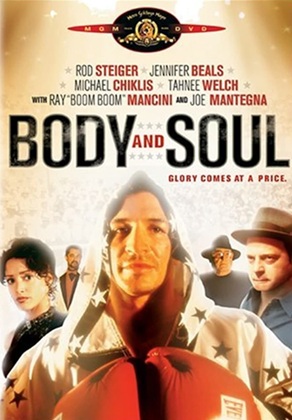 Small town boxer Charlie Davis (Ray Mancini) travels to Reno with his best friend and manager, Tiny O’Toole (Michael Chiklis). Charlie wants to become a professional and he has the support of Tiny and Gina (Jennifer Beals), a saintly hitchhiker that they pick up on the way to Nevada. Charlie managers to impress a legendary trainer (Rod Steiger) but, as Charlie moves up the ranks, he comes under the influence of a corrupt promoter (Joe Mantegna). Seduced by a bad girl (Tahnee Welch) and allowing his success to go to his head, Charlie alienates Tiny just when he needs him the most. A chance to become the champion is coming up and the promoter expects Charlie to throw the fight.
There’s not a boxing cliche that goes unused in this movie. Simple-minded by talented boxer? Check. Loyal best friend? Check. Overwrought narration? Double check because merely calling this film’s narration overwrought doesn’t begin to do it justice. Saintly good girl? Check. Dangerous bad girl? Check. Gruff trainer? Check. Corrupt promoter? Another double check. It’s not that the cliches are necessarily unwelcome. Most boxing movies follow the same basic plot. Instead, the problem here is that the film neither has the direction or the performances to make the cliches compelling.
You would think that casting Ray Mancini as a boxer would give this film some authenticity but Mancini looks as uncomfortable in the ring as he does when he’s having to actually act. As bad as Mancini is, his performance is nowhere near as desultory as Michael Chiklis’s. Chiklis not only plays Tiny but he also narrates the movie and watching and listening to him, you would be hard pressed to believe that he would someday star in The Shield. Meanwhile, Rod Steiger and Jennifer Beals are wasted in underwritten roles.
If there is one thing that redeems the film, it’s Joe Mantegna as the crooked promoter. Using his Fat Tony voice, Mantegna at least seems to have a sense of humor about the film.
I always appreciate a good boxing movie but this ain’t it.
Review: 8mm (dir. by Joel Schumacher)
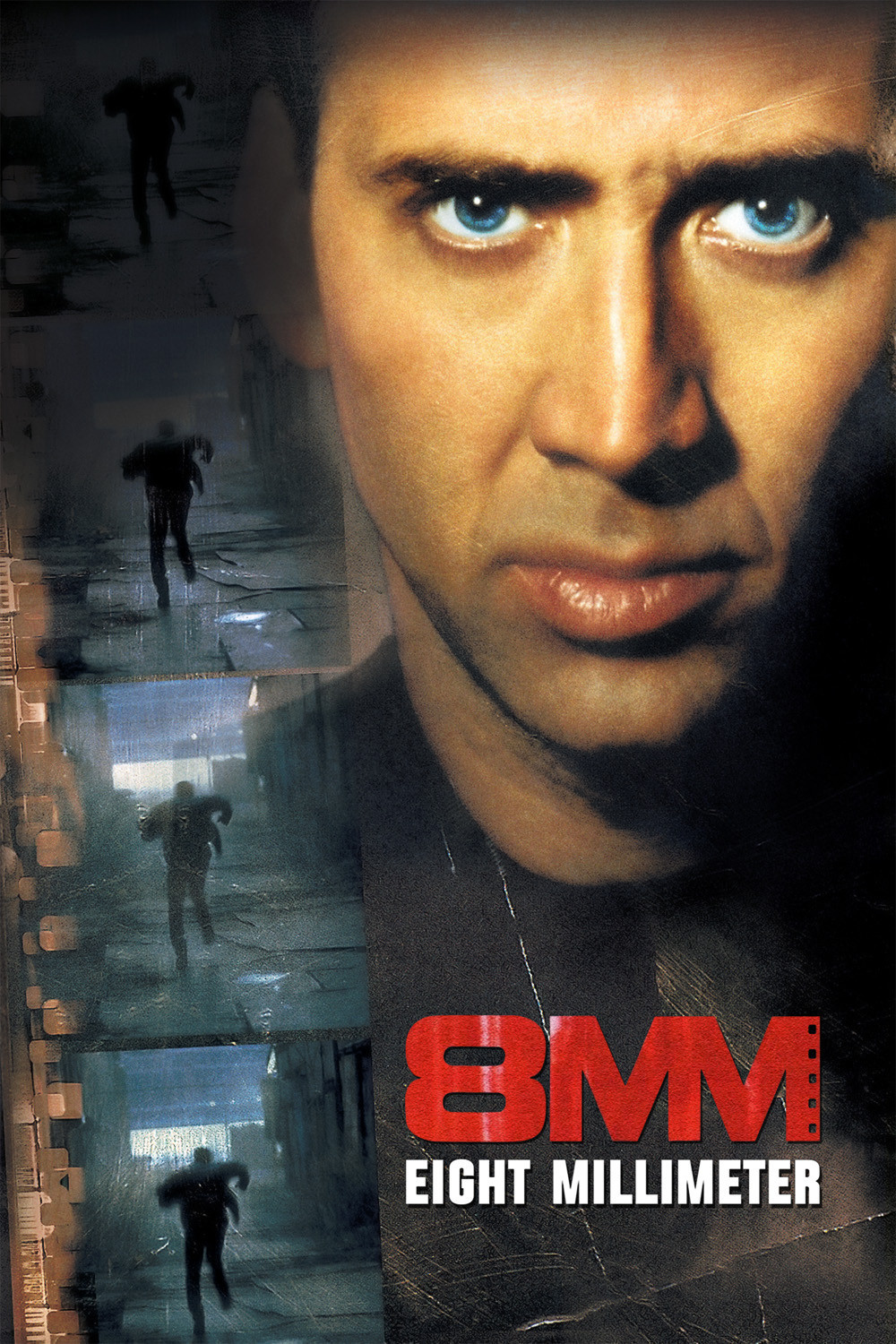
“Because he could!” — Daniel Longdale
Joel Schumacher’s 8MM (1999) uncoils like a reel of forbidden footage you shouldn’t have found, pulling a buttoned-up private eye into the rancid shadows of underground smut peddlers and whispers of snuff films that may or may not exist. It’s a late-’90s thriller smack in the wake of Se7en and Kiss the Girls, starring Nicolas Cage as Tom Welles, a Harrisburg family man whose crisp suits and steady hands belie the unraveling ahead. Hired by a steel magnate’s widow to verify an 8mm tape depicting a girl’s torture-murder, Welles tumbles down a rabbit hole of L.A. peep shows and New York meatpacking sleaze, his moral compass spinning as the line between fantasy and atrocity blurs. Schumacher crafts a narrative engine that hums with procedural grit, doling out dread in measured doses while mirroring the protagonist’s corrosion, though it occasionally stumbles in its heavier-handed turns.
The setup hooks with surgical efficiency, painting Welles as everydad detective: he buries bodies for a living, kisses his infant daughter goodbye, and screens the tape in a vault-like study that feels like a confessional. Myra Carter’s Mrs. Christian trembles with decorous horror as the projector whirs to life, bathing the room in jaundiced flicker; the footage—grainy, handheld, a pleading teen bound for “Machine’s” blade—lands like a gut punch without lingering on gore. Lawyer Longdale (Anthony Heald, all patrician slime) waves it off as staged porn, but Welles digs anyway, tracing victim Mary Ann Mathews through missing-persons archives to her runaway dreams in Hollywood. Paired with Max California (Joaquin Phoenix), a Sunset Strip tape jockey with pawn-shop cynicism and a Zipperhead tee, they prowl fetish dens where vendors hawk needle-play loops and dismiss snuff as urban legend. Schumacher’s lens, via Robert Elswit, turns these dives into feverish grottos—neon strobes slicing steam, racks of VHS promising the forbidden—building unease through denial upon denial.
That mounting frustration propels the first hour’s finest stretches, a slow immersion where Welles’s calls home grow terse, his wife’s concern (Catherine Keener, quietly anchoring) a lifeline fraying in crosscuts. Max’s street-rat patter—”Snuff? Ain’t no such thing as snuff, man”—leavens the rot without undercutting it, Phoenix layering vulnerability beneath the snark that makes his arc genuinely affecting. Schumacher parcels revelations like a fuse burning short: a Florida trailer confirms Mary Ann’s vanishing, a porn mag scout nods toward “real death” commissions, and suddenly they’re in New York, knocking on Dino Velvet’s door. Peter Stormare vamps as the mulleted auteur of extremity, his studio a cathedral of spotlit chains where Machine (masked, hulking) performs for hidden lenses. The confrontation there explodes into sudden violence and betrayal, shattering assumptions about the tape’s origins and thrusting Welles into a desperate fight for survival, with devastating losses that harden his path forward.
This mid-film rupture peels back layers of the underworld’s machinery, revealing how far some will go to sate forbidden appetites—no vast conspiracy, just raw opportunism turning fantasy lethal. Chaos erupts in a brutal showdown that catapults Welles into lone-wolf payback, though the script’s mechanics creak here, tipping from investigation to vengeance saga with less finesse than its buildup promises. He tracks leads back to L.A., confronting scout Eddie Poole (James Gandolfini) in a derelict factory, beating out confessions amid rusted girders, then facing Machine—unmasked as unassuming accountant George Higgins (Chris Bauer), who shrugs, “I like it”—in a rain-slicked graveyard melee. Schumacher stages the violence as visceral toll, not catharsis: fists land with bone-crunching thuds, blood sprays real, and Welles emerges hollowed, sobbing in his wife’s arms over the unerasable stain. It’s raw consequence over triumph, indicting the watcher as much as the watched.
Cage shoulders the load masterfully, dialing back his manic energy for a portrait of competence curdling into obsession—hesitant stares post-tape, fists unclenching at home, exploding only when the dam breaks. It’s restrained Cage at his peak, the fury earned through incremental fracture, though some beats flirt with overemphasis. Phoenix shines brighter still, turning Max from sidekick gag into soulful foil; his death resonates because Joaquin sells the bravado as fragile armor. Stormare’s Dino struts operatic depravity, a Bond villain in wifebeater, while Gandolfini’s Poole simmers regretful everyman heft—pre-Sopranos groundwork for Tony’s shadows. Heald’s Longdale drips WASP entitlement, and bits like Norman Reedus’s twitchy dealer add lived-in texture. Schumacher elicits extremes without cartooning them, populating the underworld with deviants who feel plausibly human, not pulp cutouts.
Visually, 8MM thrums with Schumacher’s maximalist pulse tamed to noir grit: Elswit’s shadows swallow faces in peep booths’ crimson haze, the snuff reel’s jitter evokes cursed artifacts, and the loft showdown’s spotlights carve brutality like Bosch hellscapes. Mychael Danna’s score slithers—piano sparsity for Welles’s drift, synth throbs for dives—capped by Aphex Twin’s “Come to Daddy” warping a raid into glitch-rage frenzy. Production design nails the era’s analog underbelly: dog-eared tape boxes, industrial decay standing in for L.A. (shot cheap in Florida), all evoking a pre-digital void where evil hides on celluloid. The snuff aesthetic probes voyeurism smartly—we glimpse pleas and steel without exploitation, questioning our gaze alongside Welles’s, though the film’s flirtation with seediness risks tipping into the very prurience it critiques.
Andrew Kevin Walker’s script (fresh off Se7en) structures as moral diptych: procedural probe yields to vigilante spasm, bookended by domestic anchors that underscore the cost. No tidy psychologizing redeems the killers—Higgins kills because appetite wills it, Poole for “business,” others for greed—exposing evil’s flat banality over tortured backstories. The widow’s suicide post-truth, Mary Ann’s mom’s grateful note (“You cared enough to try”), and Welles’s scarred homecoming deny closure; vengeance hardens more than heals, bodies burned sans parade of justice. It’s a gut-punch thesis on film’s limits: some horrors defy capture, watching them unmakes the witness. Schumacher, slumming post-Batman gloss, revels in the ugly, though pacing drags early in porn prowls and the revenge rampage strains credulity.
Yet for all its stumbles—script contrivances like convenient turns, a third act veering punchy over precise—8MM endures as underrated descent, a thriller that stares unblinking into appetite’s void. Cage and Phoenix elevate genre tropes, Schumacher’s design makes depravity stick, and the core query lingers: does filming evil make it real, or us complicit? Flaws aside, it hums with the era’s dark electricity, a flawed reel worth unspooling for its unflinching grind.
Live Tweet Alert: Watch Arcade With #ScarySocial!
As some of our regular readers undoubtedly know, I am involved in a few weekly live tweets on twitter. I host #FridayNightFlix every Friday, I co-host #ScarySocial on Saturday, and I am one of the five hosts of #MondayActionMovie! Every week, we get together. We watch a movie. We tweet our way through it.
Tonight, for #ScarySocial, I will be hosting 1993’s Arcade!
If you want to join us on Saturday night, just hop onto twitter, start the film at 9 pm et, and use the #ScarySocial hashtag! The film is available on Prime! I’ll be there co-hosting and I imagine some other members of the TSL Crew will be there as well. It’s a friendly group and welcoming of newcomers so don’t be shy!
Song of the Day: Death and Freedom by Basil Poledouris
Our song of the day comes from 1984’s Red Dawn, directed by the great John Milius.
AVENGE ME!
Scenes That I Love: “I Love The Smell of Napalm in the Morning” from Apocalypse Now (Happy birthday, John Milius!)
Today, the Shattered Lens celebrates the 82nd birthday of the iconic screenwriter and director, John Milius!
While director Francis Ford Coppola definitely put his own stamp on 1979’s Apocalypse Now, the film started life as a script written by John Milius and the film itself is full of dialogue that could only have been written by Milius. The most famous example is Robert Duvall’s monologue about the smell of napalm in the morning. Actually, the entire helicopter attack feels like pure Milius. Reportedly, Duvall’s character was originally named Colonel Kharnage but, by the time the movie was made, his name had become Kilgore. It’s still not exactly a subtle name but it’s not quite as obvious as Kharnage.
(When James Caan read the script, he loved the role so much that he was offended to not be offered it and, as a result, he turned down offers to play not only Willard but also Kurtz.)
Happy birthday, John Milius!
“Someday, this war is going to end.”
4 Shots From 4 Films: Special John Milius Edition
4 Or More Shots From 4 Or More Films is just what it says it is, 4 shots from 4 of our favorite films. As opposed to the reviews and recaps that we usually post, 4 Shots From 4 Films lets the visuals do the talking!
Today is John Milius’s birthday and you know what? It should be a national holiday!
It’s time for….
4 Shots From 4 John Milius Films
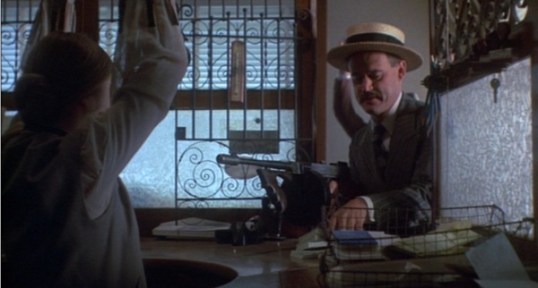
Dillinger (1973, dir by John Milius, DP: Jules Brenner)
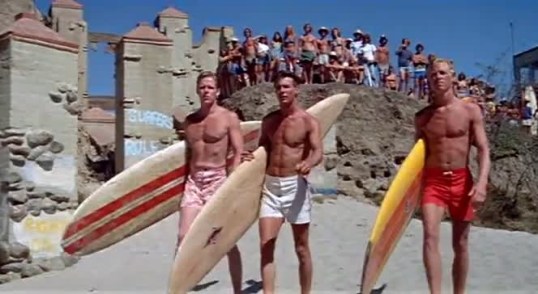
Big Wednesday (1978, dir by John Milius, DP: Bruce Surtees)
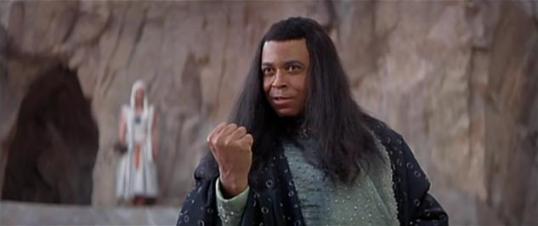
Conan The Barbarian (1982, dir by John Milius, DP: Duke Callaghan)
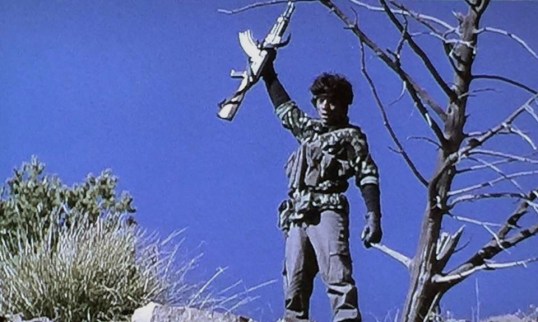
Red Dawn (1984, dir by John Milius, DP: Ric Waite)
Nightstick (1987, directed by Joseph L. Scanlan)
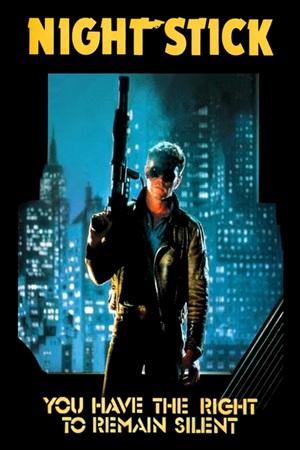 The three Bantam Brothers (Walker Boone, Tony DeSantis, and Dave Mucci) have just gotten out of prison and they’ve all already stolen several pounds of explosives. Pretending to be international terrorists, they try to blackmail banker Adam Beardsley (John Vernon) into paying them off. Deputy Police Commissioner Ray Melton (Robert Vaughn) wants to go by the book but his superior, Thad Evans (Leslie Nielsen), realizes that this case is going to require a cop who is willing to break all the rules. It’s time to call in Jack Calhoun (Bruce Fairbairn).
When this movie started, I assumed that it was a comedy. The title sounded like a double entendre and Leslie Nielsen’s name was right there in the opening credits. The opening heist scene also felt like a comedy, up until the Bantam brothers started shooting people. That was when I realized that this movie was supposed to be a drama. Why would you cast a post-Airplane! Leslie Nielsen in a serious cop film? This film did come out before The Naked Gun but it was still after Nielsen sent up every cop show ever made with the original Police Squad television series. .And then, on top of Nielsen, the film gives us Robert Vaughn and a very grumpy John Vernon. All it needed was OJ Simpson as Calhoun’s partner.
Even though the movie was a drama, it still felt like a comedy. Bruce Fairbairn wasn’t much of a cop but luckily, the three Bantam brothers weren’t that much of a group of criminals. Jack Calhoun had a girlfriend (Kerrie Keane) who constantly reminded him that he could have been having sex with her if he wasn’t constantly searching for the Bantam brothers. “I can’t be in two places at once,” Calhoun said with a sigh. I’m still not convinced this wasn’t a comedy.
Nightstick was originally made for Canadian television. When it first aired, it was called Calhoun. The name was changed to Nightstick for the video release, even though no one in the movie uses a nightstick. Calhoun uses a gun and, at one point, a binder but he doesn’t carry a nightstick. Maybe his character should have been named Jack Nightstick to make the title work.
Did I hallucinate this movie? I’m pretty sure it was a comedy.
 Through the Shattered Lens