Lisa Marie Does It To Larry Crowne (dir. by Tom Hanks)


Jeff and I have been in Baltimore since last Friday and I’ve been having a great time seeing the sights (I thought I’d found the rowhouse where they hid all those bodies on The Wire but Jeff says all condemned buildings look the same) and just getting to meet and hang out with my boyfriend’s family.  We went shopping on Saturday, bonding on Sunday, and on  Monday night, they took me to see the fireworks at Baltimore Harbor.  And, on Tuesday, we went to the movies and saw the new Tom Hanks/Julia Roberts romcom Larry Crowne at the wonderful Harbor East Cinema.  Now, I have to admit that I wanted Larry Crowne to be a really sweet, funny movie because we were seeing it not only with Jeff’s younger sister but with his mom as well. 

So, imagine my horror as Larry Crowne flickered across the screen for 90 minutes and it quickly became apparent that we weren’t watching a cinematic classic.  Far from it.  With each flat punchline and uninspired piece of on-screen business, the feeling of despair at the pit of my stomach grew and grew.  Oh my God, I thought, they’re going to think about this movie now whenever they think about me.  In their heads, I will forever be equated with a bad, boring movie.  In their heads, in their heads…zombie…zombie…zombie…

Suddenly, I had another terrifying thought.  What if they, like a handful of other people in the audience, actually enjoyed the film?  What if, during the end credits, they looked over at me and said, “Wasn’t that wonderful?  That Tom Hanks really delivers.”  What would I do?  In my mind, I replayed all of the fun that I’d had in Baltimore up to that moment.  Damn you, Larry Crowne, I thought, things were going so well!

By the time the end credits had finished, I literally felt like I was aboutto  be ill.

And that’s when Jeff’s mom looked over at me and said, “Well, Tom Hanks sure did drop the ball on that one.”

Glory!  Glory!  Hallelujah! I wanted to shout.  Not only did we agree on the overall quality of the film but she also specifically went out of her way to blame Tom Hanks and not me!  Seriously, I can’t begin to tell you how happy this made me.

As for Larry Crowne, it’s the story a guy named Larry (played by Tom Hanks, who also directs) who loses his retail job because he doesn’t have a college education.  So, he enrolls at the local community college where, for some odd reason, he quickly captures the attention of a girl named Talia (Gugu Mbatha-Raw) who is several years younger and makes it her mission to make Larry into a cool guy.  Why does Talia take such an interest in this guy?  The movie never really says.  It’s not for any sort of romantic reason as Talia has a boyfriend (played by Wilmer Valderamma).   The only thing that she has in common with Larry is that they both drive motor scooters.  In fact, Talia’s in a gang of scooter riders.  And by that, I mean that there’s like 20 to 30 people in this group.  We never learn any of their names or why they’re all hanging out together.  Seriously, it all seems so false and cutesy that, after a good start, the entire film falls apart once Larry and Talia meet.  In the end, it just seems like another case of a Hollywood film in which a down-on-his-luck caucasian is validated by the fact that a member of a minority group has developed an inexplicable interest in his life. 

Anyway, one of Larry’s classes is taught by Julia Roberts and oh my God, can we just be honest here?  I know all you boys love her and stuff but seriously, Julia Roberts is aging terribly and she looks just awful here.  It doesn’t help that the character she’s playing here comes across as a brittle, self-centered psychotic with a drinking problem.  Whenever you see Larry starting to get near her, you just want to yell out, “No, Larry — she’s crazy!”  Julia’s performance gets better as the film goes on but it’s still hard to warm up to her character.  Not only does she appear to have been born with a scowl on her face but she’s also not much of a teacher.  Seriously, what type of public speaking professor interrupts her students while they’re giving a speech?  Anyway, Tom and Julia eventually end up pursuing each other, though not because it makes any sense for their characters to feel any sort of attraction towards each other.  This is the type of romantic comedy where the romance feels like an afterthought.  It’s as if someone said, “Wait — both Tom and Julia are in this movie?  Well, make sure they fall in love.”

Now, the frustrating thing with Larry Crowne is that it’s never actually bad enough to be a “so bad that’s it’s good” type of film.  Instead, the film settles very early for a very complacent, almost lazy sort of mediocrity.  As a result, the film is ultimately not terrible but instead, just very forgettable.  It’s heart it is in the right place.  Tom Hanks has said that this film is meant to be an “antidote to cynicism” and, if that’s the case, he can take pride that there’s not a cynical bone in the film’s body.  It’s all very earnest, very well-intentioned, and finally just very, very bland.

Sometimes, a little cynicism is just what the doctor ordered.
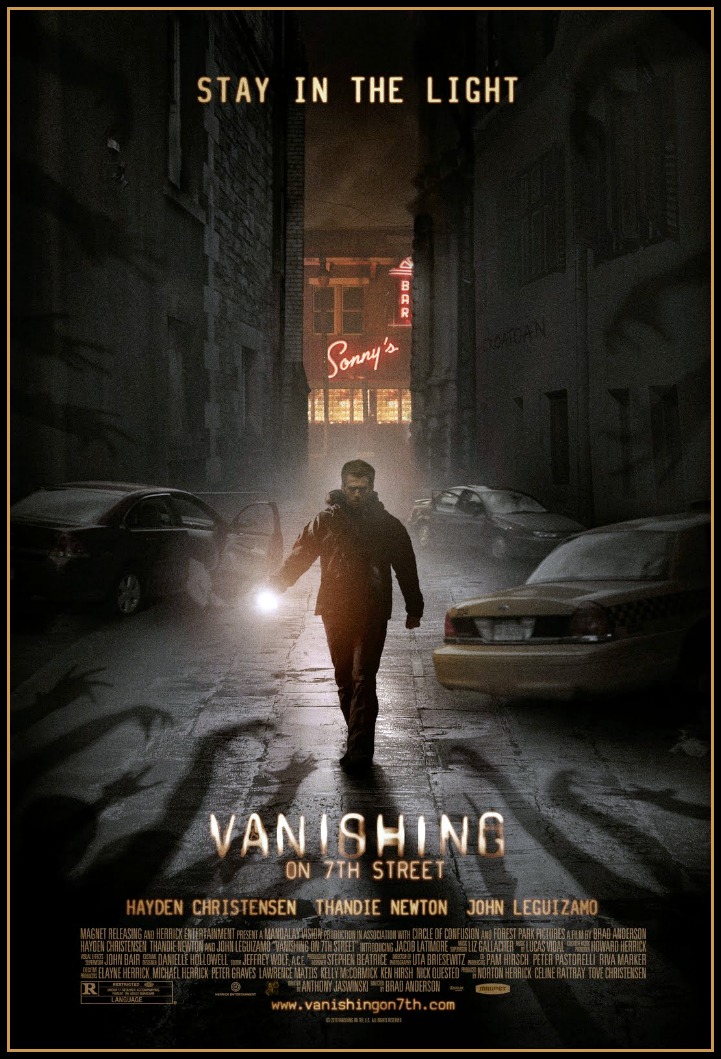
Review: Vanishing On 7th Street (dir. by Brad Anderson)


In the genre world of horror and thrillers there’s been one name who always seem to be on the verge of breaking out. He has done some exceptionally well-crafted horror and thrillers which never could get a mainstream audience to commit to but always gathering a cult-following upon their release. He has done some wonderful work as a TV director for such acclaimed shows as Fringe, Treme, Boardwalk Empire and The Wire. His best known work was a thriller collaboration with Christian Bale in The Machinist. While it’s a film more well-known for the extremes an actor was willing to go for to make their performance as authentic as possible it was also a film which showed style and talent in it’s filmmaker. The person I speak of is Canadian filmmaker Brad Anderson whose latest film was another low-budget horror-thriller which looks to be gaining a cult-following once again despite not being well-received by the mainstream critics. Vanishing On 7th Street was a film using the screenplay of Anthony Jaswinski which puts an interesting, claustrophobic and, at times, entertaining twist on the oft-used and well-ridden post-apocalyptic genre.

The film begins with film projectionist Paul in his projection booth reading up on the lost colony of Roanoke and the mysterious word left behind: CROATOAN. It’s through his point of view that we first see the beginning of what could be the end of the world as lights begin to flicker then go out throughout the theater and the mall it’s located in. Paul investigates this event only to discover sets of clothing and accessories where theater patrons and employees used to be in. With each passing moment the darkness — punctuated by just the flashlights of Paul and a lone mall security guard — becomes to take on an ominous tone before the film sudden moves ahead three days into what would become the major setting for the film: a lit bar on a deserted and darkened stretch of 7th Street in Detroit, Michigan.

We meet the rest of the main cast in this bar. There’s Luke who used to be a TV anchorman who discovers to his horror just what might have been the cause of the disappearance of most everyone in the world as he tries to find his girlfriend at the TV station they both worked at. It’s in these flashbacks to Luke’s early experience with the dark apocalypse that we see some of the most perfectly shot scenes of a major city devoid of life. An urban setting where the sudden disappearance of people during the power outage the night before has caused an eerie detritus of crashed vehicles, empty clothing and, in a sudden and violent sequence, a lone airline crashing in the background. It’s through Luke and the lone survivor in the bar, a 12-year old boy named James (Jacob Latimore), that we begin to try and piece together just what might have caused the event which continues to plague those left behind for the last three days.

The film posits the basic concept that darkness itself was the culprit for the disappearance of everyone and what continues to stalk those still left behind, alive and desperate for answers. While the film never really give definite answers as to the cause the two other characters in the back outside of Luke and James bring their own theories. There’s Rosemary (Thandie Newton), the distraught mother searching for her infant son, who thinks what’s going on around them is the the prophecized Rapture and those left behind were those who have sinned and were now being tormented for whatever sins they might have committed. On the other side is Paul from the beginning of the film who Luke rescues from an illuminated bus stop shelter who believes the very thing which caused the disappearance of the Roanoke colony during the 16th-century has now returned on a global-scale. His reasonings run the gamut of scientific causes from wormholes, black holes, gamma ray burst, nanotech gone amok and even an accident from a particle collider.

The audience are left to decide amongst themselves which explanation holds merit since neither one has enough backing to be the true answer. Vanishing On 7th Street leaves much of the questions raised by the dark apocalypse around these surviving characters to be left ambiguous and unanswered which at times becomes a detriment to the narrative as a whole. It’s a testament to Brad Anderson’s direction that the film was able to move past the apparent weaknesses in Anthony Jaswinski’s script and deliver a taut thriller (the film never truly gets to the level of horror) that just builds and builds with tension from beginning to an end that seemed almost too rushed.

With a low-budget and minimal cast the film tries to create some of the tension in the film be a construction of the differences between the four main characters. The actors were pretty game to try and make their characters more complex than what the script have provided, but in the end they still seem too basic for anyone of them to become sympathetic for the audience to truly care for their well-being. The film has to finally rely on just them as the last people on the planet as the main crux for the audience to latch onto. All the actors involved never become too cartoonish or stereotypical in their performance, but some of their decision-making in the middle and latter section of the film were too horror-typical, but they do add to the film’s many scenes of mounting terror as characters drop flashlights, lose light sources and other such problems with the living shadows in the darkness creeping up to try and take those still left. These scenes do look to be too stereotypical of other horror films but under Anderson’s direction there’s a palpable sense of claustrophobia and menace in these shadows.

What truly sells the film despite these flaws outside of Anderson’s direction would be the minimalist score by first-time film composer Lucas Vidal. His composition for the film were at once ominous and haunting. At times his score shows off hints of influences from the more doom-laden scores of Philip Glass. The other component of the film which definitely added to the atmosphere of inevitable doom to the film was Uta Briesewitz cinematography which made great use of darkness and solitary light sources to create islands of safety in a sea of encroaching terror we never truly comprehend. It’s the trifecta of Anderson’s directing, Vidal’s minimalist doom orchestration of a score and Briesewitz’s cinematography which gives Vanishing On 7th Street enough reasons to be a film which stands out as a fine piece of genre filmmaking despite weaknesses in the script.

Brad Anderson truly seem to be a filmmaker destined to remain in the fringes of mainstream cinema. His Vanishing On 7th Street continues to be another example of his great work in the horror-thriller genre. Despite same flaws which could turn off some of those who see this film it doesn’t diminish the fact that even at it’s worst this film was still an entertaining piece of post-apocalyptic work which brings some new ideas into the genre. Maybe a stronger treatment of the script would’ve made for a near-perfect thriller and one which could’ve had more horror to it, but Anderson was able to make a good enough film with an average script that I think deserves for this film to be seen by more people. For every horror remakes we get from Michael Bay’s Platinum Dunes to the latest in the Saw-like torture porn horror it’s good to see that such films as Vanishing On 7th Street exist to be the solitary beacon of light in a sea of cookie-cutter, by-the-numbers horror films that seem to dominate each film year after the other.

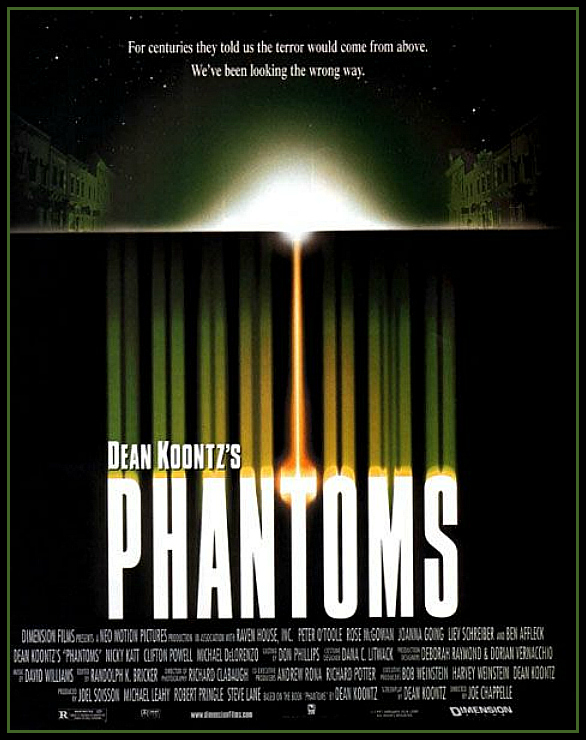
Quickie Review: Phantoms (dir. by Joe Chappelle)


If there was ever an actor in the last twenty years who has suffered ridicule regarding his body of work it would be Ben Affleck. Nevermind the fact that he has actually done very good work as an actor. People tend to view his acting work through some very bad film projects which the online film bloggers (and trolls) have lambasted year after year. One such film which has gained a cult following for all the reasons is the 1998 horror film Phantoms which was adapted from the Dean Koontz horror novel of the same name. This was a film which came out of nowhere and which no one really saw when it first hit the theaters. There’s a reason for this and the main reason for this being that the film was really awful though not without some entertaining bits.

Phantoms starred Ben Affleck in a role that really seemed more suited for an older actor. His Sheriff Hammond in the novel was much older and fit the backstory told in both novel and film that never truly fit Affleck’s youthful appearance and mannerism. He’s joined in this Joe Chappelle production by classically-trained veteran actor Peter O’Toole (who must’ve really needed the money to sign up for this film) in the role of Dr. Exposition dump aka Timothy Flyte who ends up explaining to the surviving cast of characters the very danger facing them in the abandoned town of Snowfield. Rounding out the cast is  Liev Schrieber as the creepy Deputy Stu Wargle who becomes a sort of plot device as the film moves forward. To add to this mix are Joanna Going and Rose McGowan as sisters who first discover that their town has just gone through a terrible event.

The novel this film was based on was pure scifi-horror pulp which stressed one’s suspension of disbelief, but was quite entertaining from beginning to end. Dean Koontz is like the generic fast-food version of Stephen King. This film adaptation borrows heavily from films such as Carpenter’s The Thing and the remake of The Blob. This wouldn’t have been a bad thing since the film’s story does bring into it an interesting concept of an ancient enemy which might or might not have been responsible for unexplained mass disappearances of people and animals throughout history going back to prehistoric times.

What Phantoms ends up doing which ruins the film as a whole was to rush through the narrative it was adapting it. The film pretty much goings through a checklist of all the major scenes in the novel, takes those scenes and truncates them to fit uncomfortably into a 90+ minute film. Some of these scenes could’ve been extended a few more minutes to add to a sense of grandiose to a film that needed it despite it’s B-movie foundation. One such scenes would be the arrival of a special Army unit designed to combat unexplained events, but the film treats this sequence from their arrival right up to their untimely demise in less than 15 minutes. I think in the hands of a much more capable filmmaker these scenes would’ve made the film much more entertaining.

Phantoms was a horror film that could’ve become a 90’s cult-classic if it had been given the proper time and effort from it’s producers, but seeing that it was the Weinsteins of Miramax and Dimension Films this final product was probably the best Joe Chappelle could’ve come up with. Weinsteins during the 1990’s were more concerned of pushing their Oscar-baiting film productions than actually giving time and effort to all their films. If there was any reason to see Phantoms it would be to see just why it kept being mentioned in Kevin Smith’s Jay and Silent Bob Strike Back. Other than that there’s really no reason to see it unless there’s nothing else on.

6 Trailers For America


Flag (Erin Nicole Bowman, 2010)

Seeing as how its the July 4th weekend, this latest edition of Lisa Marie’s Favorite Grindhouse and Exploitation Trailers is dedicated to America.

1) American Ninja (1985)

Let’s start out with this celebration of the fact that Americans always do it better.  Yes, the film was originally titled American Warrior.  Apparently, ninjas are more appealing than just plain old warriors.

2) The Last Hunter (1984)

From director Antonio Margheriti comes one of the best Namsploitation films ever.  How can you go wrong with David Warbeck?

3) Fighting Mad (1976)

What could possibly be more American than Peter Fonda getting mad and killing people?  This was an early film from future “mainstream” director Jonathan Demme.

4) Thunder Alley (1967)

Well, there might be one thing more American than Peter Fonda killing people and that would have to be Nascar.  I’m not sure if they called Nascar Nascar back in 1967 but the idea appears to be the same.

5) Blood Beach (1981)

Let’s celebrate another piece of pure Americana: the beach movie.  John Saxon and Burt Young apparently battle a big hole in the sand.

6) Django Against Sartana (1970)

Finally, what could be more American than a western from Italy?

A Quickie With Lisa Marie: Battle for the Planet of the Apes (dir. by J. Lee Thompson)


And so, we reach the end of the original series of Planet of the Apes films.  Battle for the Planet of the Apes was the cheapest of the Apes films and most critics agree that it’s also the worst.  Sad to say, I happen to agree with them.  If nothing else, Battle For The Planet of the Apes is the only one of the original Apes films that fails to even reach the meager level of quality of Tim Burton’s remake.

The film begins a decade after the end of Conquest of the Planet of the Apes.  A nuclear war has destroyed what was left of human society.  It’s never made clear if that war was between apes and human or between humans and humans.  All that is clear is that the Apes are now firmly in charge of the world.  Caesar (Roddy McDowall) leads the Apes civilization.  Humans, while clearly second class citizens, are treated relatively well by the Apes.  Early on in the film, Caesar views archival footage of his parents and learns of what the future holds.  He immediately makes move to try to prevent that future from occurring.

However, all is not well.  Gorilla general Aldo (Claude Akins) hates humans and is secretly plotting a military coup to overthrow Caesar.  Meanwhile, over in the Forbidden City (a.k.a. New York), there’s a tribe of radiation-scarred humans who are being led by Kolp (Severn Darden), the sadistic torturer from Conquest of The Planet of the Apes.  Driven mad by the ravages of war, Kolp and his followers are plotting to launch their own last-ditch attack on Caesar and the apes.

So much of this film can be legitimately criticized, from the cheap look (the apes are no longer characters but instead just actors in rubber masks) to the predictable storyline.  So, instead of focusing on what’s wrong with this film, I’m going to highlight the handful things that actually did work.  While few of the performers make any effort to invest their characters with any sort of life, both McDowall and Darden give strong performances.  Darden, in particular, makes a great villain and it’s a shame that he didn’t get a better film in which to show off.  Predictable as the film is, there’s a few memorable touches, my favorite being Kolp and his followers converting a bunch of school busses into armored attack vehicules.

As well, Battle for the Planet of the Apes may ultimately feel like an unnecessary chapter in the whole Planet of the Apes saga but the film, at the very least, makes the effort to provide some sort of continuity with the other films in the series.  Kolp and his followers are obviously meant to be the ancestors of the bomb-worshipping mutants from Beneath the Planet of the Apes and, in one of my favorite little touches, Kolp’s assistant is named Mendez.  If you’ll remember, the leader of the mutants in Beneath was named Mendez the Tenth. 

It’s those little touches that show that the filmmakers, at the very least, respected their viewers enough to maintain the continuity of the series.  As bad a film as Battle is (and it’s definitely not very good), it can still teach a valuable lesson to today’s filmmakers.

A Quickie With Lisa Marie: Conquest of the Planet of the Apes (dir. by J. Lee Thompson)


(WARNING: SPOILERS BELOW)

Released in 1972, Conquest of the Planet of the Apes was the fourth film in the original Planet of the Apes saga.  Taking place two decades after the end of Escape from the Planet of the Apes, Conquest details how Caesar, the son of Cornelius and Zira, eventually rallies his fellow apes to overthrow humanity.   Caesar, in this film, is played by Roddy McDowall and Conquest features what is probably his best performance of the series.

Conquest of the Planet of the Apes is definitely the most radical film of the series and it’s probably one of the most radical films of the 1970s.  Once you peel away the sci-fi/fantasy wrapping, you’re left with one of the few “mainstream” studio films to ever promote the idea of overthrowing society with a violent revolution.  Even when viewed today, it’s odd to consider that this violent and rather dark film was actually given the same G rating that was otherwise exclusively given to children’s films.  Obviously, the poor critical reputation of the Planet of the Apes series kept the Hollywood censors from really paying attention to what they were watching.

Director J. Lee Thompson goes for a far different direction from the previous more television-orientated directors involved with the series.  Thompson emphasizes that savage, totalitarian aspect of future human civilization.  This is a film in which the most sympathetic human character (the circus owner played by Ricardo Montalban) is graphically tortured and murdered within the first few minutes of the film.  This is followed by Caesar being given electro-shocked treatment by the cheerful torturer Kolp (Severn Darden, who is a chilling villain) and finally, Caesar and his fellow apes violently overthrowing society while the futuristic city burns in the background. 

Director Thompson reportedly based the ape uprising on contemporary news reports about the Black Panthers and it brings a real sense of urgency to the film.  What sets this film apart is that director Thompson is clearly on the side of the Apes and by the end of the film, so is the audience.  McDowall’s passionate performance is neatly contrasted with an equally impassioned performance from Don Murray (who plays Breck, the racist leader of the humans) and the audience is firmly on McDowall’s side by the end of the film, cheering as their own civilization is destroyed.

Originally, Thompson wanted to end the film with McDowall giving a fiery speech announcing that the time of man was finished.  However, this finally proved to be too much for the film’s producers and, at the last minute, the scene was clumsily redubbed to allow Caesar to suddenly — out of nowhere — have a change of heart and call for a peaceful co-existence.  This revised ending — though it did leave things open for yet another sequel — is an undeniable weakness.  It just doesn’t feel right.

With that in mind, here’s Thompson’s original, unseen ending, in which Caesar watches as his apes followers murder Don Murray.  It gives you a feeling of the type of film that Thompson was going for:

A Quickie With Lisa Marie: Escape From The Planet of the Apes (dir. by Don Taylor)


(Warning: Potential Spoilers, especially if you’re good at reading between the lines of my attempts to be all mysterious-like)

Continuing with our look at the original Planet of the Apes films, we come to 1971’s Escape from The Planet of the Apes.

Escape From The Planet of the Apes starts out with a huge problem — how do you make a sequel to a film that literally ended with the entire planet being destroyed?  Escape handles this problem by reversing the plotline of the original film.  Instead of a group of humans going into the future and landing on a planet dominated by apes, this film features three apes going into the past and landing on a planet dominated by the past.  It’s a premise that the film handles with a surprising amount of cleverness and the end result is probably the best of the various Planet of the Apes sequel.  Certainly, it is the only one that can stand alone as a film separate from the rest of the series.

Using Taylor’s old space capsule, Zira (Kim Hunter), Cornelius (Roddy McDowall), and Milo (Sal Mineo, who you know is doomed because he’s the only one of the three who hasn’t appeared in either of the two previous films) escape Earth shortly before Charlton Heston blows the planet up at the end of Beneath the Planet of the Apes.  Slipping through the same vortex as Heston did in the first film, they end up crash landing on Earth in the year 1974. 

At first, Cornelius and the outspoken Zira become media celebrities.  They do interviews with the press, appear on the covers of magazines, and are generally celebrated like simian Kardashians.  However, one scientist — played by a very handsome Eric Braeden (seriously, he has gorgeous hair in this film) — isn’t as charmed by Zira and Cornelius.  Instead, he views them as threats to the future of the human race, especially after he discovers that Zira is pregnant.

The character that Braeden plays, by the way, is named Dr. Otto Hasslien and attentive viewers will recognize the name from a throw-away reference made by Taylor (Charlton Heston) in the original Planet of the Apes.  One of the more interesting subtexts in this film is that, much as chimpanzees Zira and Cornelius are this film’s equivalent to the human Taylor, Braeden’s Hasslien is this film’s version of Dr. Zaius.  Much as Maurice Evans did for Dr. Zaius, Braeden brings a certain ambiguity to his villianous character.  Though Braeden’s actions are ultimately hateful, it’s also made clear that they’re more motivated by fear than by evil.  Indeed, when Braeden first appears in this film, he’s almost likable.  It’s only at the film’s conclusion that we become fully aware of the irony that the human, “civilized” Dr. Hasslien ultimately shows less mercy and empathy to Zira and Cornelius than the ape Dr. Zaius showed to Taylor.  The moral ambiguity of Braeden’s performance makes this a far more resonant film than most mainstream critics are willing to admit.

 As for, Zira and Cornelius, the once-fawing public eventually turns against them as it becomes apparent that for the two of them to exist, humanity has to be wiped out.  Zira and Cornelius find themselves hunted fugitives, fleeing for their lives while the whole planet — with the exception of a zoo keeper played by Ricardo Montalban and another scientist (played by Bradford Dillman — what a great name for an actor) — seems to be determined to destroy them.

Escape From The Planet of the Apes starts out as a likable, rather breezy social satire (much like Pierre Boulle’s Monkey Planet, the novel that Planet of the Apes was loosely adapted from) and that makes it even more surprising when, about halfway through, the movie shifts gears and becomes a rather dark and bleak action film.  It all ends, like many films from the early 70s, in a brutal act of violence that carries a surprising punch to it.  It’s after the end of the film that we truly become aware just how involved we had become with Zira and Cornelius.  A lot of that has to do with the strong performances of McDowall and Hunter who both created characters that came across as real and worthy, regardless of how many layers of makeup they were acting under.  Their chemistry as a couple makes this underrated film one of the surprising gems of the early 70s.

A Quickie With Lisa Marie: Beneath the Planet of the Apes (dir. by Ted Post)


(WARNING: SPOILERS)

Continuing my look at the original Planet of the Apes film series, we now come to the first sequel, 1970’s Beneath the Planet of the Apes.  Rather blandly directed by Ted Post and featuring only a cameo performance from Charlton Heston, Beneath the Planet of the Apes is rarely given the credit it deserves.  Yes, the first half of the film is rather forgettable but once you get through it, you discover one of the darkest films of the 1970s.

Beneath the Planet of the Apes begins with yet another human astronaut crash landing on the Earth of the future.  This astronaut is Brent and, as played by James Franciscus, he comes across as a slightly more earnest, far less charismatic copy of Charlton Heston’s Taylor.  Brent has been sent in search of Taylor.  Anyway, once he lands on the planet, he is quickly arrested by the apes, meets Zira (Kim Hunter) and Cornelius (David Watson, stepping in for Roddy McDowall), and then escapes with the still-mute Nova (Linda Harrison).  With Nova, Brent makes his way to the Forbidden City where he comes across the ruins of Grand Central Station and discovers that he’s actually on Earth. 

Yes, that’s right.  The first hour of this 95 minutes film is essentially just the first movie all over again.   And yes, this film’s (many) critics are correct when they say that this first hour drags and tests the audience’s patience.  Obviously, Brent may be shocked to discover he’s on Earth but it’s old news to us and many viewers are probably tempted to give up on this film before Brent even figures it out.

But don’t give up!  No, because if you stick with this film you’ll discover that, once Brent figures out where he is, things get really, really fucked up.

Essentially, Brent discovers that the ruins of New York City are now underground.  And in this underground city, there are people.  But they’re not people like Brent or Nova.  No, these are people who have been horribly scarred by radiation.  They’ve also mutated to the extent that they’ve developed the powers of telepathy and mind control.  Under the leadership of Mendez the Tenth (Paul Richards), they spend their time singing hymns to the Alpha/Omega nuclear bomb, or as they call it “The Holy Bomb.”  They keep the Holy Bomb in St. Patrick’s Cathedral.

These mutants capture both Nova and Brent.  Brent is tossed into a cell and who else is there but Taylor?  And Taylor, believe it or not, has become even more sarcastic and scornful than before!  Seriously, Charlton Heston frequently spoke about how much he hated this film and it’s obvious in his performance.  Heston might not have been happy about being there but the audience is because, even if he is busy hating himself, Taylor brings a jolt of life to the film.

And just in time because the Apes, led by Urko (James Gregory), have invaded the forbidden city!  They gun down all the mutants.  Brent , Taylor, and Nova manage to escape their prison and all three of them are promptly gunned down as well.  As he dies, Taylor manages to set off the Alpha/Omega bomb.  We see a blinding white light followed by a somber voice over that tells us: “In one of the countless billions of galaxies in the universe, lies a medium-sized star, and one of its satellites, a green and insignificant planet, is now dead.”

And that’s it!  There’s no final credits, not even a black-out. Instead, on that note, the movie just stops.

Now, seriously, tell me that’s not a great movie.

A Quickie With Lisa Marie: Bad Teacher (dir. by Jake Kasdan)


So, last Friday night, I went and saw the new Cameron Diaz comedy, Bad Teacher.  Right now, all sorts of mainstream critics are running out of ways to trash this film but, for the most part, they seem to overlooking one important fact.  Flawed and unfocused as this film may be, it’s funny.  It made me laugh, it made Jeff laugh, it made my sister laugh, and it made my friend Evelyn laugh.  (Of course, according to Evelyn, I laugh at everything, even if it means I’m the only person laughing, but that’s another story.  Hi, Evelyn!)  It also made almost the entire audience laugh.  Admittedly, it was a small audience.  I guess everyone else was busy crying at Cars 2.  (It’s a Pixar film after all.)  As for Bad Teacher, it may not be a great film but it works.

Anyway, Bad Teacher tells the story of a very bad teacher, played by Cameron Diaz.  She doesn’t care about her students, goes out of her way to antagonize her fellow students, and shows up to work everyday either hungover or stoned.  She’s also snobbish, petty, shallow, and you’d totally hate her except for the fact that 1) you can’t help but admire the way that Diaz throws herself into being as crass and as shallow as possible (she may be playing a vain character but there’s no vanity in her performance) and 2) every other teacher in the school is so annoyingly perky and movie perfect that you can’t help but share Diaz’s disgust with them. 

Anyway, Diaz is teaching because her rich fiancée has dumped her.  (One of the better jokes in the film is the number of lies that Diaz comes up with to explain why her engagement ended.)  She is content to spend the school day asleep while her class watches movies featuring other, better teachers.  However, then she meets the new substitute teacher who is really kinda creepy with his constant “up with humanity” perkiness but is also 1) rich and 2) played Justin Timberlake so he’s like totally hot.  However, Timberlake is dating Diaz’s sworn enemy, the incredibly upbeat Amy Squirrel (played by Lucy Pond).  Diaz realizes that the only way she’ll ever capture Timberlake’s attention is if she can raise the money necessary to get bigger boobs.  The rest of the film basically deals with Diaz’s efforts to raise the money for her boob job (among other things, she accepts bribes from parents and embezzles from the school car wash) while continuing to pursue Timberlake and be pursued by the gym teacher (Jason Segal).

That’s actually a lot of plot for an 89 minute film and, as a result, Bad Teacher does feel overly episodic and ultimately disjointed.  But so what?  I laughed consistently for 89 minutes and that’s the important thing.  It’s not that the film itself is filled with witty lines as much as it’s the fact that the entire cast so totally throws themselves into playing these genuinely odd characters.  Pond steals every scene she’s in and Timberlake especially seems to be having fun spoofing his own image.  If you think that watching people dry hump while fully clothed can’t be hilarious, than you haven’t seen Justin Timberlake in Bad Teacher.

For me, there were two other things that made Bad Teacher a success. 

1) It confirms what we all always suspected and knew in middle school and high school — that our teachers were a bunch of horny, pot-smoking degenerates.  Admittedly, I used to actually get high with my drama teacher — shhhhh!  Don’t tell anyone! — but I’ve always figured that same was probably true of every high school drama student.  This film confirms that the history and math teachers were just as stoned.

2) It features this scene, which got laughs and applause from the Dallas audience that I saw it with:

A Quickie With Lisa Marie: Planet of the Apes (dir. by Franklin J. Schaffner)


(BEWARE!  SPOILERS!)

With Rise of the Planet of the Apes coming out in August, I figured why not go ahead and review the original Planet of the Apes films.   No, I don’t mean the terrible Tim Burton film.  I’m talking about the old school sci-fi series from the early 70s.  For the next five days, I’ll be reviewing each installment of this landmark series of monkey-centric  Let’s start at the beginning with 1968’s Planet of the Apes.

The plot of Planet of the Apes is pretty well-known.  Arrogant earthman takes off from Earth, goes through some sort of time portal, and crash lands at some point in the far future.  Our “hero” finds himself on a planet where all the humans are mute savages and society is dominated by equally arrogant, talking apes.  (“A planet where apes evolved from man!?”)  Eventually, the Earthman reveals that he can speak, he escapes captivity, and — accompanied by his mute concubine — he enters what the Apes call the forbidden zone.  And, once in the forbidden zone, he discovers “his destiny” as old Dr. Zaius puts it.

It’s difficult to review a film like the original Planet of the Apes because the film itself has become a part of American culture.  Even if you’ve never seen the film, you feel as if you have.  Whether you’ve seen the famous ending or not, you know that it features Taylor (Charlton Heston) on his knees in front of the ruins of the Statue of Liberty, raving and cursing while the mute and confused Nova (Linda Harrison) watches.  Everyone understands the significance of such famous lines as: “Take your stinking paws off of me, you damn, dirty ape!” and “Goddamn you all to Hell!” regardless of whether they’ve actually seen them delivered.

Of course, it can be argued that the fact that the film has become such a part of our culture is proof of the film’s quality.  However, I would argue that the proof of the film’s quality comes from the fact that it remains a watchable and entertaining film despite having become such a part of the culture.  It says a lot that a film can stay enjoyable despite being respectable.

Why does the film still work despite  the film’s main selling point — the surprise ending — being neautralized by the passage of tinme?  A lot of the credit, I think, has to go to the apes themselves.  Even under all that makeup, Roddy McDowall as Cornelius, Kim Hunter as Zira, and especially Maurice Evans as the iconic Dr. Zaius all manage to create interesting and intriguing characters who just happen to be apes.  Before long, you forget about the makeup and instead, you’re more interested in seeing how Zaius is going to handle this latest challenge to his society.

That challenge, of course, comes from Charlton Heston.  Everyone is always quick to make fun of Heston as an actor and it’s true that his range was limited.  Frequently, the men he played came across as the type of chauvinistic, pompous heroes that were never quite aware of the fact that everyone was secretly laughing at him.  And it is true that Heston has several of those moments here in Planet of the Apes.  Even his famous final scene is, to be honest, almost painfully over the top. 

And you know what?

In this film, it works perfectly.  I don’t know if an actor has ever been more perfectly cast than Charlton Heston was in Planet of the Apes.  In the role of Taylor, Heston basically spends the entire movie acting like a complete and total pompous ass.  Whether he’s recording a “fuck you” message for Earth at the beginning of the film or if he’s arrogantly dismissing Zaius before entering the Forbidden Zone, Heston comes to epitomize every single thing that we tend to dislike in our fellow human beings.  As played by Heston, Taylor is the perfect clueless hero and a lot of the film’s perverse pleasure comes from watching this paragon of masculinity and superiority repeatedly humbled.

And that, ultimately, is why Planet of the Apes remains a watchable film so many decades after it was made.  Good satire never goes out of style.