It’s St. Patrick Day! Now, I can’t speak for everyone but for me, this is the only holiday that matters. For one thing, it gives me a convenient excuse to show off some of my Irish Folk Dance moves. For another, it gives me an excuse to say things like, “I’m just a good Irish girl,” in the closest I can come to an Irish accent. (Admittedly, that’s not very close. My own accent tends to be kinda twangy and country.)
Oh! And there’s another great thing about St. Patrick’s Day. It gives me an excuse to wear green and I look really good in green. Today, I’m green from my eyeshadow to my underwear.
Anyway, with all that mind, it was pretty easy to pick today’s song of the day. One of my favorite films of 2007 was a wonderfully romantic and charmingly low-key Irish film called Once. The film’s soundtrack, which I’ve been listening to all day today, is one of my all-time favorites.
One of my favorite songs on that soundtrack — and my pick for song of the day — is When Your Mind’s Made Up, performed by the film’s stars Glen Hansard and Marketa Irglova. As actors, performers, and as a real-life couple (awwwwwww!)*, Hansard and Irglova have this amazing chemistry and it’s on display in the video posted below.
(By the way, can I be like really, really sappy here without everyone rolling their eyes and getting all “Gaggggggg!” on me? Sometimes, if I’m feeling really sentimental and silly, I think about how Jeff is like Glen Hansard and I’m like Marketa Irglova. And then I start singing another song from the movie — the Oscar-winning Falling Slowly. Or at least I sing a version of it because I have a hard time remembering lyrics.)
Happy St. Patrick’s Day!
——————-
*According to Wikipedia, Hansard and Irglova are apparently no longer a couple. 😦
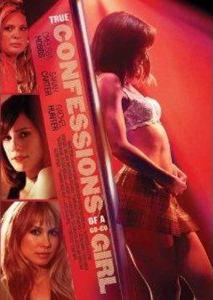
So, late, late last night, I was laying in bed, trying to get to sleep when I suddenly remembered that I had earlier recorded a movie called Confessions of a Go-Go Girl off of the Lifetime Movie Network. So I turned on the TV and I started watching, hoping that the movie would simply calm my racing mind and help me get to sleep. Instead, I found myself sitting up in bed for the next two hours, totally enraptured with this film.
After the first few minutes, I started to scream until my sister Erin woke up and rushed into my room. “What’s going on!?” she asked. “Erin,” I replied, “you have to watch this movie with me!” Erin stared at me for a few minutes before replying, “Oh my God, Lisa,” and then walking out of the room. So, after that, I started to call random friends, telling them about this movie. Unfortunately, most of them were already asleep since it was like 3 in the morning.
Anyway, long story short — I am really, really tired today! But enough about me. Let’s talk about Confessions of a Go-Go Girl.
Why Was I Watching It?
Okay, my friend Evelyn asked me this same question when I called her up last night at 3 in the morning and tried to convince her to come over and watch this with me. So, as I told her, “Oh. My. God. Are you like kidding me!? Confessions of a Go-Go Girl? How can you not watch it!?”
If I’ve learned anything, it’s that if “Confessions” appears in the title of a movie, there’s about a 75% chance that it’s going to be a lot of fun. And if that “Confessions” movie happens to be a Lifetime movie, than those chances increase to 99%.
Add to that, these aren’t just the confessions of a go-go dancer. No, they are the confessions of a go-go girl. In other words, the whole go-go thing isn’t just a job in this movie. It’s a lifestyle.
What’s It About?
It’s yet another Canadian film that’s found a home on the Lifetime Movie Network. In this one, Jane McCoy (played by Chelsea Hobbs) is a sweet and innocent aspiring actress who, in order to make some extra money, secretly takes a job as a “go-go dancer” at a sleazy bar. Under the influence of an older, cocaine-addicted dancer (played by Sarah Carter), Janet quickly starts a downward spiral of drugs, decadence, and alienation. As her new identity as a go-go girl starts to dominate her life, Jane soon finds herself growing distant from her wealthy family, her boring boyfriend, and her stridently scary drama teacher.
What Worked?
Oh my God, this is like the ultimate Lifetime movie. Over-the-top, melodramatic, awkwardly moralistic, and amazingly silly, Confessions of a Go-Go Girl is a camp masterpiece that simply has to be seen to be believed.
Nothing happens in this movie that you couldn’t predict within the first few minutes. The film’s genius is not that it does anything unexpected. Instead, it’s that it takes the expected to such an extreme. Listen, we all know, from the minute that Jane first dances, that she’s going to eventually end up becoming jaded and cynical. What we could never guess is that it’s pretty much going to happen right after the first dance. It’s kinda like one of those old anti-drug films where all it took was one puff off of a “marijuana cigarette.” One puff and you’re a giggling psycho. One dance and suddenly, your soul fades away. This is the type of film where we know that Jane has become a bad girl because she starts to part her hair down the middle and grow out her bangs.
Plus, as I’ve mentioned so many times before, I love to dance, I love to watch others dance, and if nothing else, this movie had a lot of dancing. Watching this movie, I was surprised to discover that sordid, Canadian go-go clubs apparently are capable of providing Broadway-style dance shows. I mean, I’m not big into strip clubs but, from my experience, most of them just seem to involve a runway, a pole, and a lot of plastic. I mean, it’s fun to grab onto that pole and spin around and go, “Wheeee!” but it’s not exactly exciting to watch (or, at least, it’s not for me). But in Canadian go-go clubs, the dance routines have elaborate costumes, ironic themes, and really impressive lighting. After watching this film, I realized that I really want to move up to Canada and become a go-go dancer. Seriously.
Eventually, Jane is approached by a rival go-go club promoter who tells her that he’s seen her perform and, “I remember you dancing in white panties.” This line highlights the fact that this film is obsessed with underwear. And that’s okay because, honestly, who isn’t? Watching this film reminded me of an ongoing debate that I have going with Erin concerning whether or not fancy, pretty, colorful lingerie more sexy than boring, blah, cotton, white underwear. This movie seemed, ultimately, to side with my sister in favor of the boring undies. Obviously, I disagree but the film still gave me a lot to think about. I don’t know, maybe I should start a poll or something. Do any of our male readers have an opinion on the underwear question? Please, use the comments section to let your voice be heard.
What Did Not Work?
When taken on its own terms, the entire film worked. If I’m secretly a kitty cat in human disguise than the Lifetime Movie Network is my catnip and that’s largely because of silly, over-the-top movies like this.
Actually, I do have one or two complaints. First off, the lead character is named Jane McCoy and oh my God, is that not just one of the most bleh names in history? Seriously, she should have been named Lisa Marie McCoy or something. Secondly, Jane’s boyfriend (played by Travis Milne) was soooo boring. I believe the character was named Eric but they might as have just named him “Plastic Man” because seriously, he had all the personality of one of the mannequins from those Old Navy commercials. To me, Eric’s character was defined by the moment when, as Jane went down on him, he said, “I don’t think I know you anymore.” Double bleh on him.
“OMG! Just like me!” Moments
Oh. My. God. There were so many of these moments that I don’t even know where to begin. I love dancing and I love having fun while I’m dancing so watching this film was kinda like peering in to my life in an alternative, Lifetime-based universe.
Lessons Learned
Apparently, I’m incapable of not relating everything I see to my own life. Also, I have absolutely no impulse control because I just ordered the 11 x 17 Confessions of a Go Go Girl movie poster off of Amazon.
The last couple years have seen the return of an old trend from the 50’s and and 60’s. Those decades were what one would call the Golden Age of alien invasion films and stories. We had alien invasion films both serious and comedic. They ranged from classics like The Day the Earth Stood Still and The Thing to the awful like Plan 9 From Outer Space and tons of titles I could barely put down. In 2009 we had an alien-themed film which one could call the return of the genre back to the forefront. District 9 by South African filmmaker Neil Blompkamp was universally hailed as one of the best scifi films of the decade and even got nominated for an Academy Best Picture.
Then there’s the other alien-invasion film from 2010 which covers the low-end of the equation. The Strause Brothers’ own Skyline was universally panned by critics and audiences alike. While some did enjoy the film for it’s “so bad, it’s good” quality (I use that term as loosely as redlight hooker). This film was everything that was opposite of District 9. While I did enjoy that film because it was bad I don’t look back at it too fondly.
The latest film in this alien-invasion resurgence is from another South African filmmaker and one whose body of work is mostly genre films of the low-budget variety. Jonathan Liebesman’s own entry into this scifi genre is Battle: Los Angeles and it lands smack dab between District 9 and Skyline in regards to overall execution. It’s a workman-like film which takes an epic alien invasion war and brings it down into the pavement. We see the film through the eyes of a rifle squad of Marines and that’s where the film really becomes a really fun experience.
Battle: Los Angeles begins in medias rea with the war between the unknown alien invaders already having made their initial surprise landings and the U.S. military making it’s countermoves. We learn from a hasty news conference held by a military commander that the alien forces have landed at over a dozen or so coastal cities around the world have begun to move inland. I was somewhat discouraged to find out that San Francisco didn’t even last half a day and was lost. With Los Angeles the last major coastal city on the west coast that still had a viable military presence we hear one of the film’s tagline in that they cannot lose Los Angeles.
After this brief intro we go back 24 hours before the battle begins to get the character introductions sorted out. We see the Marines who will make up the squad the audience will follow through the rest of the film get their brief time to get introduced with some basic backstory to give them some personality. The one which stood out from all the war film archetype characters was Aaron Eckhart’s grizzled and retiring Staff Sgt. Nantz. He becomes the anchor that holds all the players into a cohesive unit and who also keeps the film from spiraling out into Skyline territory. Some of the cookie-cutter characters we meet would be the commanding officer straight out of Officer Training School who has never seen combat but is eager to lead his men and sees the combat-experienced SSgt. Nantz as someone who might usurp his authority. We also get the Marine whose previous combat tour has left him psychologically damaged and tries to earn his mind back into fighting state. We even get the young Marine who everyone sees as the little brother and who also happens to be a virgin.
To say that the characters in Battle: Los Angeles looked like they came out of old-school World War 2 war film casting call would be an understatement. The film just gives these characters (outside of Eckhart’s veteran noncom) enough personality that we’re able to distinguish one jarhead from another. Characterization is not one of this film’s strong suit, but once the bullets and alien stuff begin to start flying the need to get more character moments from these individuals really go out the window and the audience just holds on as they follow this Marine rifle squad into combat with an enemy force better equipped.
The film borrows much from battle sequences from Ridley Scott’s Black Hawk Down and Spielberg’s Saving Private Ryan as director Liebesman opts to use a cinema verite style to give the audience a documentary, imbedded reporter look to the whole proceeding. The shaky cam look this filmmaking style uses may turn off some people, but the way the action sequences (which pretty much takes up close to 3/5’s of the film’s running time) were edited actually keeps the shaky cam from becoming too overwhelming. The film actually does a very good job of showing the confusing nature of battle, but also the fog of war for the grunts on the ground.
Before I get to what about this film really worked for me I will have to admit that the film’s screenplay is it’s biggest weakness. It’s a major weakness that for some viewers will sink the whole film no matter whatever bright points it might have. The film’s core story was actually pretty good. A story about an alien invasion told from the point of view of human soldiers on the ground trying to repel the invaders was a concept that hasn’t really been explored in this type of film. While that foundation for the film is strong the dialogue and how the characters were written left much to be desired. I put the onus on the flimsiness of most of the characters on the screenplay more than the characters themselves. Spielberg and Scott were able to use the very same war film character archetypes and make them work in their film, but that was possible due to much stronger screenplays.
In this film the dialogue’s very hokeyness doesn’t inspire as much as it makes for some wince inducing moments. I can’t say that all of the dialogue was bad. They’re no worse than most war films both good and bad. The dialogue just didn’t seem to have any energy to them and sounded as if it was still being read from an earlier and much rougher draft. I do believe that if the screenplay had been given a couple of doctoring by competent, veteran screenwriters the film would’ve benefitted greatly from it. Instead, the film ended up having to have a strong veteran actor in Aaron Eckhart deliver these average lines with enough conviction and gravitas to keep the film from becoming a parody of a war film. The fact that the film still manages to hold together despite the weaknesses in the screenplay is a testament to one actor performing the hell out of that script. I won’t even go into some people’s issues about the science or battle tactics in the film since I believe the film was consciously built to keep those vague. The film is not about the who or what about this invasion and why the aliens are here, but about that rifle squad from the 2/5 Marines.
Now, what really worked for me about this film is the battle itself. For a fan of both alien invasion and war films this one combined the two and succeeding in delivering what the filmmakers promised. Battle: Los Angeles gave a visceral look into the trials and tribulations of a squad of Marines as they do their part on the ground to fight off a much more advanced enemy. There’s a scene when the Marines are flying over Santa Monica on their way to their Forward Operation Base and we see a running battle on the gorund below between human defenders and the aliens who have moved up from the beach. Even the firefights Nantz and his squad were in once they entered the battle behind enemy lines looked to be influenced with the many battle footage of American forces conducting ground war in Iraq and Afghanistan.
The special effects both CGI and practical to make Los Angeles look like a wartorn urban battleground was done very well. The aliens and their machines were given a look that wasn’t sleek and shiny but utilitarian and efficient. Some have said that the design of the aliens and their machines looked lazy, but I actually believe that if the filmmakers had fallen back on traditional advanced futuristic designs that would have been lazy. These aliens looked like they were design with only one thing in mind and that was to wage war on a people.
The score to the film by Brian Tyler was good and serviceable as his own modern riff on the old-school World War 2 film score, but I thought what this film needed was a veteran composer who knows how to bring out the machismo, gung-ho and esprit de corps of the Marines the audience followed throughout the film. It’s a shame that film composer passed away several years ago because he definitely would’ve given Battle: Los Angeles the kind of score which would’ve elevated the film from a thrilling war film into an epic one.
In the end, Jonathan Liebesman’s first foray into a bigger budget production hit more than it miss though one of those misses many of it’s detractors have seen as a fatal flaw in the film. Battle: Los Angeles doesn’t reinvent the alien invasion film, but just takes a new angle on the whole proceedings. It’s a film that shows influences from better war films by better filmmakers, but also gives hints that this young South African filmmaker has shown glimpses of talent that could take him places that his compatriot Neil Blompkamp has reached with his own alien-themed film. Battle: Los Angeles is just an old-school war film dressed up with modern fatigues and arrived onto the screen with all the positives and negatives of those very same traditional war films people love and hate since film as entertainment was created. It’s not on the same level as District 9 but it is definitely heads and shoulders above the very laughable Skyline of 2010.
As an aside, while I was watching the film I was struck by how this film looked like a preview of what Blompkamp’s potential sequel to his District 9 would look if and when Christopher Johnson came back to Earth with an armada of very pissed off Prawns…and speaking of pissed off Prawn: pig cannon.
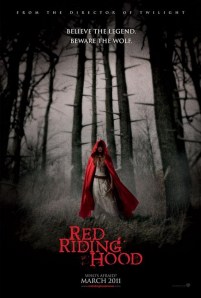
My problems with Red Riding Hood are more of a personal nature than anything else. I’m from a family that clashed old world values of women being blindly subserviant to the Man of the House vs. women being fiercely independent and only having a male in their lives to complement things. These elements were my luggage already brought to the table on seeing the film, but it shouldn’t damper one’s opinion on the film. If this review does this, it’s on me personally and not a reflection of the entire Shattered Lens.
Like Alice in Wonderland before it, Red Riding Hood takes the classic fairy tale and expands on it. While it does so, it doesn’t do it by much. What it has going for it is a nice visual style. Colors are vibrant and director Catherine Hardwicke really has an eye when it comes to forest landscapes (just as she did with Twilight). Mists cover the trees and capes billow in the wind, when it’s not concentrating on the town itself (which does look like a soundstage at times). In the end, however, it suffers from the same quasi teenage issues that Twilight had. I yawned a number of times. Granted, I understand that the movie may be targeted to a younger audience (and for them it may very well work), but even my audience groaned a little and they were target individuals.
Red Riding Hood is the story of Valerie (Amanda Seyfried), who lives in a small village that lives in fear of The Wolf, who has been known to sneak in and attack or kill citizens. To appease the wolf, the townspeople keep animals tied outside. As a child, she forms a bond with a young boy named Peter. Time passes, and we find young Valerie bethrothed to Henry (Max Irons) by way of her mother’s plans (played by Virginia Madsen). Peter (Shiloh Fernandez) still has feelings for Valerie, and this all quickly becomes another Bella / Jacob / Edward triangle. It’s not at the start a story of Valerie choosing her own road, but having to hear from everyone around her that this guy should be the one she marries or that one is the right guy for her. To me, personally, the film in the beginning pushes as much of a pro-“I need a man to survive” stance as Battle:LA does a Pro-Marine one. Is this a terrible thing? Not if that’s where your mindset is, no. Every time I saw them mention anything along the lines of hand and feet worship some guy just because “that’s how it is”, I had to remind myself that it’s just the time period the story takes place in (though I’m sure the audience heard me groan at least once). Again, that’s just me.
In the midst of all this, on being asked to run away with Peter, Valerie is alerted to her sister’s death from the wolf. The townfolk make a point of going after the wolf, and decide to head out the cave where they believe the beast lives. They return with proof of a victory and plan to host a party for the deed. The town priest (Lukas Haas, who somehow seems to less here than he did in Inception) reaches out for help in form of Solomon (Gary Oldman). Solomon, arriving with armed guards warns the townsfolk of the evil of werewolves and that he will hunt it down. The next few nights will be Blood Moon nights, meaning that if the wolf bites anyone during that time, they’ll become werewolves as well. The townsfolk, not buying into this, decide to have a wild party with sexy dancing. This results in a visit from the Wolf, who confronts Valerie and telepathically asks her to come away with it, or the town will be razed. It all kind of escalates from there.
Oldman, for his credit, was fun here and slightly over to the top. Oldman delivers his lines with flair, being far less subdued here than he was in The Book of Eli. For who better to hunt a wolf than Sirius Black himself, right?
And that’s part of the problem I found with Red Riding Hood. With the exception of Seyfried, the supporting cast is actually stronger than the main group of actors the story focuses on. Julie Christie plays Valerie’s grandmother, in a great turn, and as always Billy Burke (Drive Angry, Twilight) is supportive as Valerie’s father. He’s really one of the highlights of the film. As for Henry and Peter’s characters, the most I could think of with them were the Winchester brothers in Supernatural. They’re eye candy for the girls, though I should note that none of the girls in my audience were excited as they were when I saw The Twilight Saga: New Moon. There were lots of screaming for that one.
What does work is that the movie is reminiscient of The Beast Must Die. It is a mystery of who the wolf actually is, and both Valerie and the audience are given clues. That I actually enjoyed, and the third act of the film wasn’t too bad. The action is quick and to the point, but again, it all kind of feels like I could have seen this as a series on the CW. There wasn’t as much of a worry about who would fall at the hands of the wolf or what dangers would face Valerie so much as they actually looked cool when it occurred. Easily a Netflix pick.
As part of my mission to see every film ever nominated for best picture, I watched George Stevens’ A Place In The Sun this weekend. A Place in the Sun was released in 1951. It was a front-runner for best picture but in an upset, it lost to An American In Paris. (Another best picture loser that year: A Streetcar Named Desire.)
Montgomery Clift plays George Eastman, a poor man with a religious fanatic mother and a wealthy uncle. Looking to make his fortune (i.e., to find his “place in the sun), George gets a job working in his uncle’s factory and quickly starts a romance with one of his co-workers, the shy and insecure Alice (Shelley Winters). However, even as he and Alice settle down to a life of dreary romantic bliss, George discovers that the Eastman name also allows him to mingle with (if never truly belong to) high society. He meets the rich (and shallow) Angela Vickers (played by Elizabeth Taylor) and soon, he’s also romancing her. Neither Angela or Alice is aware of the other’s existence and for a while, George has the best of both the world he desires and the world in which he actually belongs. Eventually, George decides that he wants to marry Angela and become a part of her world. However, there’s a problem. Alice is pregnant and demanding that George marry her or else. The increasingly desperate George quickly decides that there’s only one way to get Alice out of his life…
A Place in the Sun was based very loosely on Theodore Dreiser’s 1925 novel, An American Tragedy. While the movie remains (more or less) faithful to the novel’s plot, director Stevens jettisons most of Dreiser’s heavy-handed Marxism and instead concentrates on the more melodramatic elements of the story. The end result is a glorious soap opera that is occasionally a bit tacky and heavy-handed but always watchable and entertaining.
Stevens is helped by the three lead performances. As Angela, a stunningly beautiful Elizabeth Taylor manages to be both calculating and clueless, seductive and innocent. As her counterpart, Shelley Winters gives a really brave performance as Alice. The film is structured that its impossible not to feel sorry for Alice. The genius of Winters performance is that she (and director Stevens) allowed Alice to become a real, flawed human being as opposed to just a symbol of victimization. However, the film is truly dominated by Montgomery Clift. Clift is in just about every scene and his own rather fragile persona translates wonderfully in the role of George. Was Montgomery Clift ever as handsome as he was in A Place In The Sun? He gives a perfect performance as the type of guy that every girl has known, the guy that we fell in love with not because of who he was but who we thought he could be. These are the guys who always end up breaking our hearts, they’re the ones who we still can’t help but think about years later, always wondering “why?”
Unlike a lot of older films, A Place in the Sun remains remarkably watchable and relevent today. Perhaps its most famous scene involves a capsized rowboat and oh my God, that scene freaked me out so much. Admittedly, a lot of that had to do with the fact that I have this morbid fear of drowning (and, like one of the characters in this film, I can’t swim) but director Stevens also does a great job building up the scene’s suspense. He makes brilliant use of sound especially, in much the same way that Francis Ford Coppola would later use that roaring train in The Godfather. Seriously, I watched that scene with my hands literally over my eyes, just taking an occasional peek until it was all over.
One last note — there’s an actor in this film who plays a detective. You’ll see him if you play the trailer at the top of the post. His big line is “You’re under arrest.” I have no idea who this actor was but he had one of the most authentic and memorable faces that I’ve ever seen in a movie, regardless of when the movie was made. He had the type of presence that reminded me why I love character actors.
Last night, as part of my continuing mission to see every film ever nominated for best picture, I watched Sidney Lumet’s Dog Day Afternoon. Dog Day Afternoon was released in 1975. Though nominated for best picture, it lost to One Flew Over the Cuckoo’s Nest.
In Dog Day Afternoon, Al Pacino plays Sonny, a nervous Viet Nam vet who, along with the dim-witted and possibly crazy Sal (John Cazale), attempts to rob a bank. Unfortunately for him, Sonny doesn’t really know what he’s doing and literally within minutes of him first drawing his gun, the bank is surrounded by cops. The robbery quickly descends into a hostage situation. As Pacino negotiates with a NYC police detective (Charles Durning), a crowd of onlookers gathers around the bank and starts to cheer with every defiant word that comes out of Sonny’s mouth. Sonny discovers he likes his new-found fame. In the film’s most famous scene, he stands outside the bank and leads the crowd in a chant of “Attica! Attica!” Eventually, Durning learns that Pacino’s motive for robbing the bank was to steal enough money for his suicidal lover (Chris Sarandon) to get a sex change operation. However, now that the robbery has failed, Pacino has a new plan. He demands a flight out of the country. Meanwhile, the hostages inside the bank start to form their own odd kinship with the two bank robbers and Durning finds himself being challenged by the F.B.I., who have a much more drastic plan for how to end the situation.
Dog Day Afternoon is a remarkable film, a dark comedy of desperation and human nature that, by the final scene, reaches a certain tragic grandeur. Sidney Lumet (who made his directorial debut in 1957 with 12 Angry Men and whose most recent film, Before the Devil Knows Your Dead, was released 51 years later) was one of the most important (if underrated) filmmakers of the 1970s and he proves it here. From the opening montage of New York City looking so wonderfully sordid at the height of the grindhouse era to Pacino’s bumbling initial attempt to rob the bank to the film’s violent and abrupt conclusion, Lumet captures your attention and, much like Al Pacino in this movie, he holds it hostage until the movie ends.
Dog Day Afternoon is probably one of the best acted films that I’ve ever seen. This is one of those films where every role — regardless of how large or how small — fills like an actual human being. By the end of the film, you feel as if you know the bank managers and the tellers almost as well as you know Pacino, Durning, Sarandon, and Cazale. Pacino is simply amazing here, giving a nervous, jittery performance as a character who manages to be both selfish and selfless at the same time. Durning, meanwhile, is hilarious as the frazzled detective who finds himself steadily overwhelmed by the circus around him. Much as you can’t help but root for Pacino no matter how self-absorbed he might act, you can’t help but sympathize with During, even if he is a member of the establishment. As Pacino’s transsexual lover, Sarandon plays his role with a fragile dignity that prevents the role from becoming a stereotype. However, for me, the film truly belongs to John Cazale who is both scary and oddly child-like as Sal. As seen below, Cazale improvised one of the best lines in the movie when he replies to Pacino’s question regarding to which country Cazale wants to make his escape.
Now, this is going to be difficult for me to admit but, as thrilling as it was to watch Pacino shout, “Attica! Attica!,” I honestly had no idea why that phrase was the one he chose to use to work up the crowd. In fact, if I had written this review right after seeing (or while watching) the film last night, I probably would have doubled embarrassed myself by claiming that Pacino was shouting “Ateka.” However, for once, I decided to be a responsible reviewer and I actually did some research as opposed to just going with my first conclusion. So, as a result of this film, I can now say that I know about the Attica Prison Riots of 1971.
But what’s truly significant about that “Attica” chant is that it’s the only part of this film (beyond a few fashion choices) that feels dated. As I watched the movie, it was easy for me to imagine myself jumping on twitter and seeing “#Attica” as a trending topic. We’ve all seen the famous “Attica!” scene in countless compilations but what’s often forgotten is how that sequence ends. When Pacino, obviously a bit star struck by all the attention, goes outside and start chanting a second time, he is suddenly tackled from behind by one of the bystanders who has decided to play hero. And as Pacino goes down to the ground, the same crowd that was previously cheering him now cheers for the new object of their affection. If nothing else, Dog Day Afternoon showed why sometimes we all need to escape to Wyoming.
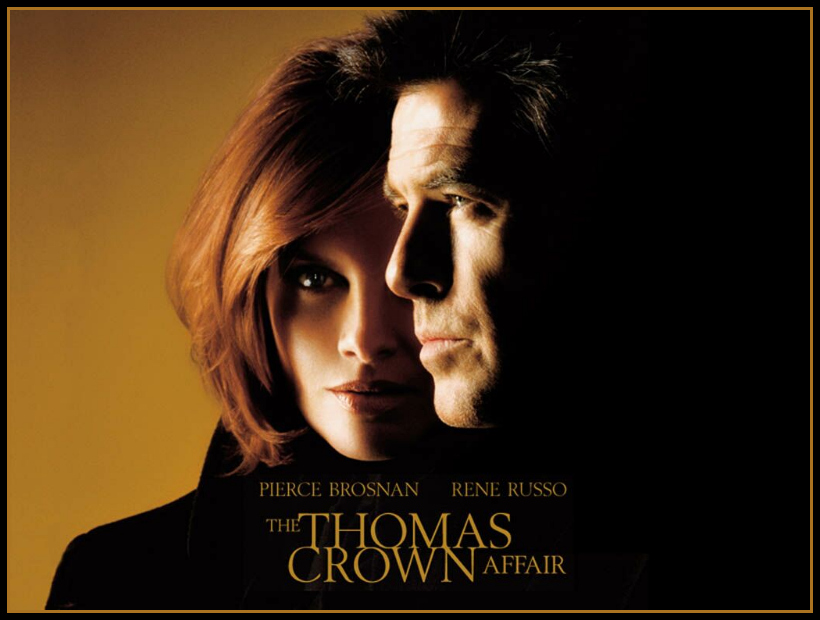
In 1968 there was a little caper film titled The Thomas Crown Affair starring the ever-cool Steve McQueen and a radiant Faye Dunaway. The film was considered hip, cool and sexy in its way during the late 60’s. It took 31 years, but a remake was finally made of this film but this time around starring Pierce Brosnan and Rene Russo in the roles originally played by McQueen and Dunaway. With some great direction from thriller and action filmmmaker John McTiernan, 1999’s The Thomas Crown Affair ends up being the exception to the rule of remakes of older films turning out lesser than the original. This modern and updated version of The Thomas Crown Affair actually surpasses the original McQueen production. McTiernan’s film ably combines humor, thrilling action set pieces, sexy chemistry between the leads and just a beautifully shot film.
Set in New York that never looked as good as shot by McTiernan and his crew, Pierce Brosnan stars and shines as the title character Thomas Crown. Thomas Crown is a suave, roguish and successful businessman who has everything a man could ask for: money, power and any woman he desires.
What does a man like Crown would ever want in life?
The film looks at this and shows that no amount of money in the world could replace the adrenaline rush and thrill of getting acquiring it. Crown does this by staging a complex and elaborate plan to steal a Monet (San Giorgio Maggiore at Dusk) from the NY Metropolitan Arts Museum and do so in the middle of the day. His plan goes off without a hitch and with none the wiser. This heist sequence was actually very fun to watch as McTiernan never lost command of the many threads being weaved to pull off Crown’s plan. McTiernan would one-up this with the climactic finish in the same museum but with a sequence I could only call as the anti-heist.
With the heist completed, the film soon introduces Crown’s foil in the form of Rene Russo as insurance investigator Catherine Banning. Ms. Russo never looked more beautiful, sensual and sexy as she did in this film. Her performance as the determined and crafty Banning more than holds up to Brosnan’s roguish and playful performance as Thomas Crown. From the moment she appears onscreen as the camera slowly pans up her silky-stocking leg and garters, Russo dominated the scene and pretty much commanded attention from everyone. This was especially true whenever she shared the screen with Denis Leary as police detective in charge of investigating the Monet heist. Leary’s always a strong performer in any film he’s in but was pretty much lost in the wake of Russo’s performance when both were on the screen.
The rest of the film was pretty much Crown and Banning trying to get into each others’ heads to find the one advantage that would give them an upper-hand in the “game” they’ve both decided to play. It’s hard to see who is chasing who in the film. Is Banning chasing Crown as her one and only suspect for the theft or is Crown playing her as part of a much more complicated scheme to spice his life. These questions swirl within the frame of the heist investigation and the growing relationship between the two strong-willed characters.
To say that Brosnan and Russo’s on-screen chemistry was strong would be a big understatement. The two pretty much sizzle when together. Whether it’s a playful, flirtation during a nice dinner out on the town to the two steamy dance numbers in the middle of the film. When Crown asks Banning if she wanted to dance or does she want to dance the temperature just went up by degrees. Their love scenes together shows that it could still be done with class and also have a sense of playfulness and fun. It also showed that young couples doing love scenes onscreen have nothing on the mature couple.
There’s not much else to say about McTiernan’s remake of the Thomas Crown Affair than to say that he took a good film, that showcased Steve McQueen’s coolness for everyone to see, and made a much more superior production in every sense. The direction was excellent and the cinematography was beautiful in every second shot. The cast performance was very strong with the two leads in Brosnan and Russo acting their hearts out on the screen. This film shows that remakes really are not bad ideas when put into capable hands. It would be nice to see how the sequel — tentatively titled The Topkapi Affair — to this film turns out with pretty much the same cast and crew returning. I, for one, will be there to see it when it comes out.
This weekend, I saw The Adjustment Bureau, a film that I’ve been looking forward to ever since I first saw the trailer back in November.
In The Adjustment Bureau, Matt Damon plays a New York politician who loses a race for the U.S. Senate and falls in love with Emily Blunt on the same night. Inspired by some advice from Blunt, Damon gives a concession speech which, to me, sounds kinda whiney but apparently, the voters of New York find it to be amazingly compelling. You should understand, of course, that this is a mainstream Hollywood version of the American political system. What that means is that Damon’s character, of course, is a Democrat who would have won that election if not for the fact that apparently, a newspaper ran a photo of him mooning some people in college. Now, seriously, consider that. Not only does this movie start out by asking us to believe that a Democrat could lose a statewide election in New York but it also asks us to believe that he would lose for that reason. Meanwhile, in the real world, Massachusetts (one of the few states more Democratic than New York) is electing a Republican who used to be a Playgirl centerfold to the Senate. Anyway, the film continues to show its political sophistication by having Damon give a speech in which he says that political consultants have too much influence in the American political system and apparently, every voter in New York goes, “Oh my God! He’s right!” I don’t claim to be an expert on politics but seriously, all of the “political” scenes in this film just ring so amazingly false.
Anyway, Damon’s speech is apparently so amazing that his career is revived and soon, he’s being spoken of as a front-runner for the other senate seat (apparently, this film takes place in a world where New York would not only elect one Republican to the Senate but two). In fact, some people are apparently talking him up as a future President. But Damon doesn’t care about that. All he cares about is winning the heart of Emily Blunt.
The Adjustment Bureau, however, has other ideas. What is the Adjustment Bureau? Well, the movie tries to keep it all ambiguous and mysterious but essentially, the members of the Adjustment Bureau are angels and the Chairman they answer to is God. And God has already mapped out Matt Damon’s destiny and Emily Blunt is not meant to be a part of it. (How Calvinistic.) However, Damon insists on pursuing her until eventually, he finds himself being continually pursued by three members of the Adjustment Bureau — the blandly corporate John Slattery, sympathetic Anthony Mackie, and finally the cold and intimidating Terrence Stamp. The whole thing finally culminates in an Inception-like chase through the streets of New York City with Damon insisting that he has free will and the Adjustment Bureau insisting that no, he does not.
What a frustrating film! The plot is intriguing and potentially thought-provoking but the film doesn’t bother with following any of its themes to any sort of real conclusion. In the end, all of the questions raised simply turn out to be an excuse to film Matt Damon being chased across various New York landmarks. Don’t get me wrong. I’m always more than happy to spend money to watch Matt Damon get chased. He looks good running for his life. But still, it’s hard not to look back at the movie and think, “After all that set-up, that’s it?” The Adjustment Bureau is like Inception without that spinning dreidel.
Still, I enjoyed The Adjustment Bureau despite myself and I can’t exactly say that I’m proud of that. With each of its vaguely New Agey themes and its rather simplistic emotional content, this is the type of film that invites me to be cynical. However, I enjoyed the movie even if I did find myself rolling my eyes during some of the more “sincere” moments. A lot of this had to do with the chemistry between Matt Damon and Emily Blunt. They made a likable and cute couple. As well, Mackie, Stamp, and especially Slattery were well-cast as members of the Adjustment Bureau. Director George Nolfi comes up with a few striking images and, if nothing else, he knows how to film people being chased. Then again, it may have just been the fact that I saw this film with a special someone and therefore, I didn’t feel like I had to be cynical. I could just embrace all the emotional silliness in all of its simple-minded glory and as a result, I had a good time.
That said, I don’t think I’ll be seeing The Adjustment Bureau a second time or buying it on DVD. Unlike 0ther guilty pleasures, I don’t imagine this is a film that’s going to hold up well on repeat viewings.
This afternoon, as part of my mission to see every single film ever nominated for best picture, I watched Alexander Korda’s 1933 biopic The Private Life of Henry VIII.
Now, I have to admit that I’ve never been a big fan of the historical King Henry VIII as I have a hard time finding much sympathy for a man who beheads one wife, not to mention two of them. I like to imagine that he met his end in much the same way that Joe Spinell meets his end at the end of Maniac, with all of his dead wives suddenly showing up and ripping off his head. But, Henry is one of those larger-than-life historical figures that always seems to end up as the subject of movies, speculative fiction, and, of course, Showtime television series.
The Private Life of Henry VIII is one of the better known recreation of Henry’s life on-screen. For the most part, the film ignores Henry’s policies as king and instead is a darkly humorous recreation of his relationships with five of his six wives. (His first marriage, to Catherine of Aragon, is ignored.) The episodic film opens with the execution of Anne Boyelen (Merle Oberon). This sequence establishes the film’s tone early and it’s actually a lot more cynical than we usually expect a film from 1933 to be. In between shots of Boyelen waiting to meet her fate, we get extended scenes of two executioners — one French and one English — arguing about which nationality is better when it comes to chopping off heads. Meanwhile, the members of Henry’s court spend their time whispering innuendo about Henry’s new wife, Jane Seymour (Wendy Barrie). When Henry (played by Charles Laughton) finally shows up on the scene, he turns out to be a buffoon, a childish man who happens to control the destiny of England. After Jane dies in childbirth, Henry marries Anne of Cleves (played by Laughton’s wife, Elsa Lanchester). Anne, however, finds Henry to be repulsive and, in the film’s most obviously comedic segment, she goes out of her way to make herself as sexually unappealing as possible in order to convince Henry to give her a divorce. (This, of course, led to the split between England and the Catholic Church but the film doesn’t dwell on that. This is a comedy, not Man For All Seasons.) After the divorce, Henry finally marries Catherine Howard (Binnie Barnes) who has spent the whole movie pursuing Henry. For the first time in the movie, Henry is portrayed as being truly in love, unaware (at first) that Catherine only married him for his crown and is actually having an affair with Thomas Culpepper (Robert Donat).
The Private Life of Henry VIII was not the first movie to be made about Henry VIII but it’s probably the most influential because of Charles Laughton’s Oscar-winning performance in the title role. Laughton’s performance pretty much set the standard as far as future Henry’s were concerned. His Henry is buffoonish womanizer who does everything to excess. (This is the film that pretty much created the whole image of monarchs as men who don’t use forks, knives, or spoons.) However, as over-the-top as Laughton’s performance may seem, it’s actually full of very subtle moments that suggest the actual human being lurking underneath all of the bluster. It’s hard not to sympathize with Laughton’s Henry as he struggles to explain what sex is to Anne of Cleves or with his obvious pain when he discovers that he’s been betrayed by the only one of his wives that he actually loved.
(Of course, any similarity between Laughton’s Henry and the real-life Henry is probably a coincidence.)
The Private Life of Henry VIII was the first British film ever nominated for best picture and, perhaps because it wasn’t made by the Hollywood establishment, it hasn’t aged as terribly as most films from the 30s. While the film does have its slow spots, the performances of Laughton, Oberon, and Lanchester still hold up well and some of the film’s dark comedy almost feel contemporary. Oddly enough, this British film about English history lost to an American film about English history, Cavalcade.
(I should mention that I haven’t seen Cavalcade so I can’t say whether it was a better film. I’m going to have to see Cavalcade eventually but it’ll be later than sooner as the movie is only available as part of a DVD boxed set that costs close to 300 dollars. Agck!)
It’s an animated feature that isn’t in 3D. It caters as much to adults as it does to kids, and doesn’t seem to try to lower itself to be “shiny” in that way. There are a number of scary images that I think would frighten younger kids, but overall, the film is very well done. It’s a fantastic homage to the Wild West, though it does get a little weird at times. I’ll admit that I walked in expecting something like Tangled. It reminds me more of George Miller’s Happy Feet, in how serious at times the story gets. And it does all this under the Nickelodeon banner. Wow, this is a big jump from Spongebob and Rugrats.
It ironic and feels right that Gore Verbinski – who gave us the Budweiser Frogs commercial so long ago and The Mexican – takes on an animated tale. He teams up with his Pirates of the Caribbean stars Johnny Depp and Bill Nighy again, and the results are worth it. Depp brings a spark of funny weirdness to the character of Rango, and the film has a number of pop culture references (including one for Fear and Loathing in Las Vegas). The supporting cast is okay, Isla Fisher (Confessions of a Shopaholic) makes for a quirky female lead trying to hold on to her land and Abigail Breslin (Zombieland)didn’t seem like she was used enough. Ned Beatty and Nighy in particular are the other vocal standouts here, along with Harry Dean Stanton (Big Love) as the the head of a mole family of outlaws. Timothy Olyphant (Justified) has a great cameo as well.
Rango is a chameleon who wishes to be the star of his own story. After an accident leaves him stranded in the desert, he finds is way through the blistering sun to the tiny town of Dirt. The townspeople of Dirt are a diverse lot, and it all has a real Mos Eisley in Star Wars to it. The currency of the town is water, which is pretty hard to come by these days. When he’s asked who he is, Rango takes the moment to be the character he envisioned. After he amazes the town with a display that adds fuel to the fire, the townsfolk end up making him the Sheriff of Dirt and charge him with finding a solution to their money/water issues.
Visually, Rango is a feast for the eyes despite how ugly the main character is. Fur moves, whiskers twitch and the open desert looks wonderful (especially when riding). Sunsets are colorful and Industrial Light and Magic really did some interesting work here. Honestly, I wouldn’t mind seeing this in 3D, but it’s actually nice that it isn’t in that format. Musically speaking, Hans Zimmer’s score adds a nice touch to the film, especially during one key scene involving a chase. I ended up getting the score shortly after seeing the movie.
If Rango suffers from any problems, it would be that it slows down a little in the middle, as if it’s not entirely sure of where it wants to go at one point. It quickly picks up, but the lull may be a little much for younger viewers looking for cartoon action throughout the film. I don’t believe adults will mind this, though.
But what about the Kid Factor?
It’s a Nickelodeon film. It’s designed for kids, and my audience (made up of parents and kids) appeared to really love it. The lessons to learn are that you truly are the center of your own story and growth comes through dealing with struggles. You can’t have a Protagonist without an Antagonist, and a story has to have conflict for it to go anywhere. You can take your kids to see Rango, but Parental Guidance is suggested. There’s a nude top half of a Barbie doll, no biggie there. Nighy’s Rattlesnake Jack brought up a lot of murmurs and gasps from the kids in my audience, so that might be something to be concerned about. There’s also shooting – it is the Wild West, after all – so there are characters that will die. If that doesn’t bother you, then you’ll have tons of fun with Rango. It’s definitely worth seeing.