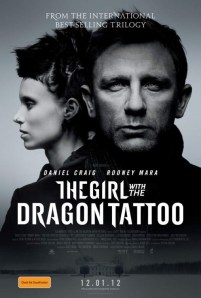
Quick Review: The Girl With The Dragon Tattoo (dir. by David Fincher)


Addendum: Leonth3duke has added his own thoughts on The Girl With The Dragon Tattoo, which are worth reading. Lisa Marie has also added her own viewpoint on the film.

I think had I not seen the Swedish version of The Girl With The Dragon Tattoo, this would be a far easier review to write, really. I tried reading the book a number of times, and found it really tough with Larsson’s exposition to stay with it. As such, this review is somewhat biased, perhaps heavily so, and it may be a little spoiler-ish. My assumption here is that with the novel having been available for some time now, and a separate movie to watch, there are very few people who don’t know what the story’s about.

A funny thing happened while watching David Fincher’s The Girl With The Dragon Tattoo the other night.  In the middle of the film, the projector turned off. After I calmed down, eyeing the exits and thinking the Blob might have made it’s way into my theatre, the audience had fifteen minutes of quiet to wait and give their thoughts on the movie.

One fellow stepped down from the seats, ready to ask for his money back when he stopped and turned around.

“Does anyone know what the F this movie is about? ‘Cause I’m frickin’ confused!” he raised his arms to the audience, pleading for reason.

“It’s about a girl with a Dragon Tattoo.”, Someone yelled back.

“What is supposed to mean!?” The angry man replied, sounding a lot like Rooney Mara in The Social Network. “All I’ve seen is Bond shiver his butt off and this chick type away on her laptop. This is garbage.” And with that, he left.”

“Yeah, this is some bulls—.”, Another fellow said as he left.

Needless to say, the movie resumed. There was a problem that caused their fire alarm to shut off and it stopped every film in the theatre. I’m not sure how much I may have missed, but I’ll probably see this again during the weekend.  I know, it’s not the best of review lead ins.

The simplest thing I can say about The Girl With the Dragon Tattoo is this:

– If you read the book and saw the Swedish film, this version only puts on a coat of Fincher Paint on the story. From the opening credits that rival the one in Se7en to the fade to black, it’s all distinctly Fincher’s touch on things.  You could almost argue that it feels like a Bond film, the way they did it. This basically means that the lighting might be dimmer in some places and the film may be more stylized. It comes across feeling more like a motion picture than the Swedish version, which to me felt a little more like a tv movie.

If you never read the book, I would highly recommend the Swedish version first. It’s on Netflix, and as some of the material is delicate, doing so would give you the freedom to hit the pause or fast forward button should you find yourself uncomfortable. That’s kind of hard to do in a movie theatre without walking out on the money you spent on a movie ticket.

And if you saw the Swedish Version, missed the book and are wondering if you should spend your money on this, Rooney Mara really is the only reason to give this a try. It’s essentially the same story, but with a different ending that’s tighter and closer to the book than the Swedish Film. While Rooney’s Salander may not be hard hitting as Noomi Rapace’s Salander , she deserves so much credit for throwing herself into this as deep as she did, and helping to create her own version of Lisbeth.  Daniel Craig, on the other hand, seems to be more restrained here.

The Girl With the Dragon Tattoo is the story of Mikael Blomkvist, an editor in chief of a magazine called Millenium in Sweden who is dealing with a mishap on a libel case against a magnate named Hans-Erik Wennerstrom. His recent notoriety catches the attention of Henrik Vanger (Christopher Plummer, who’s really having a great year), who asks him to investigate the 40 year old murder of his niece, Harriet. Of course, prior to asking Blomkvist to take on the case, Vanger’s lawyers perform a background check on him with the help of Lisbeth Salander (Rooney Mara). Salander happens to be both an ace Hacker and sports a photographic memory, which makes snooping into Blomkvist’s files a cinch.

Eventually, through his investigation of the Vanger Family on their private island, it becomes apparent that Blomkvist needs a little assistance, so he asks the lawyers if Salander can be brought on to work with him. It’s when the two characters meet that the story really picks up some steam.

While I loved it (I’m going back to see it again over the weekend, I think), there was the odd feeling that something was really off. At one point in the film, I find myself quirking my brow, because it occurred to me that there was just a little too much sex in the movie. I understand that’s not something one should complain about, but the Swedish version of the film led me to believe that Salander’s motives for any kind of passion were just a “want, need, have” and move on. In this version, she came across almost needy. It’s not even the right word. Where Rapace’s Salander felt cold and calculating even though the later parts of the story, Mara’s Salander feels like she’s warming up to Blomkvist emotionally. Of course, this could be attributed to screenwriter Steven Zaillian (Schindler’s List, Searching for Bobby Fischer) playing the story closer to the book than the other film, but it was strange for me in that sense. Fincher, who is notorious for control over his scenes may also be to blame here. If you have access to the behind the scenes for The Social Network, you can watch some of his interviews on the behind the scenes to get an idea of just how much he likes to control where a scene goes.

I don’t hate Fincher. I own Se7en, Fight Club and The Social Network and love all three of these, but even I have to admit that as cool and as stylish as the film is, something’s just off. I loved the film, but it’s just different.

The movie was advertised as the ‘feel bad film of the year’, and in that sense, they’re not lying. Keep the kids home, please. All three versions of the story contained a rape scene. Fincher and Co. Don’t pull any punches here, making it all a little disturbing for anyone not actually prepared for it. One standout to the film has to be the score, developed by Oscar Winners Trent Reznor and Atticus Ross (something I’ll never be fully able to handle saying, having been a Nine Inch Nails fan since the mid ‘90s). The movie has no clear-cut theme to it, but the music that fuels the scene add an extra layer to things. That I really enjoyed.

So, overall, the remake didn’t really need to be made, but it does make me interested to see what Fincher and Zaillian have in store if they decide to continue the Millenium Trilogy. My hopes are that they give Lisbeth Salander a bit of a sharper edge than she already has. Mara herself, they don’t have to worry about. She’s a definite lock as Salander, and I’m happy for her on that. It’s where they choose to take her that I’m concerned about.

Film Review: Sherlock Holmes: A Game of Shadows (dir. by Guy Ritchie)


One of my favorite films of 2009 was Guy Ritchie’s Sherlock Holmes.  I saw the first (of probably many) sequels to that film this weekend.  Now, I have to admit that I was kinda worried about Sherlock Holmes: A Game of Shadows.  As much as I loved the first film, it definitely had the feeling of being a happy accident.  There were so many obvious ways to screw the film up that I found myself suspecting that that’s exactly what would happen with the sequel and I worried that a bad sequel would make it impossible for me ever to really enjoy the first film.  Well, having seen Game of Shadows, I can see that no, it’s not as good as the first film.  However, it’s still  pretty good.

Game of Shadows picks up the story a bit after the end of the first film.  Sherlock Holmes (Robert Downey, Jr.) is still doing cocaine and solving mysteries in London.  Dr. Watson (Jude Law) is still his best friend and is still planning on getting married and, not surprisingly, Holmes is still not happy about the idea of losing him.  Holmes is also still investigating the mysterious criminal mastermind, Dr. James Moriarty (Jared Harris).  Holmes discovers that Moriarty is behind a series of world-wide anarchist bombings and, with the world on the verge of war, Holmes and Watson attempt to both figure out why and to thwart Moriarty’s scheme.  While I haven’t read enough Sherlock Holmes to say for sure (I read the Hound of the Baskervilles in high school and that’s about it), I get the feeling that, plotwise, this film was probably more James Bond than traditional Sherlock Holmes.  But no matter, it’s an intriguing enough plot and director Ritchie wisely doesn’t spend too much time trying to hammer home that similarities between Moriarty’s scheme and certain modern-day conspiracy theories.

If the first Sherlock Holmes was a comedy with some action scenes, this sequel is definitely an action film with a lot of comedic relief.  Whether or not this increases or diminishes your enjoyment of the sequel really depends on how you feel about the action genre in general.  To be honest, most big budget action films bore me several shades of silly and Game of Shadows pulls out all the usual tricks — slow motion explosions, fist fights full of jump cuts so quick that it becomes impossible to really keep track of who is actually fighting who, and the whole zooming into the barrel of a gun just as the trigger is pulled routine.  And yet these action sequences didn’t inspire my usual eye rolling, if just because it was obvious that the film itself understood just how over-the-top and silly all of it was.  The film has the decency not to demand that I take it seriously and for that, I’m more willing to accept the predictable parts than I would be with a film like Battle L.A.

Besides, even with the increased emphasis on action, the filmmakers still understand that what made the first Sherlock Holmes work was the chemistry between Robert Downey, Jr. and Jude Law.  Seriously, Downey and Law have some of the strongest chemistry in the movies today.  Certainly, there a more believable couple than Natalie Portman and Ashton Kutcher.  (It’s probably not a coincidence that the film, very early on, establishes that Watson is getting married and that Holmes is still mourning Rachel McAdams from the previous film.)  You buy their friendship and it’s just fun to watch these two actors bouncing lines off of each other.  Downey still comes across more like Robert Downey. Jr. than Sherlock Holmes (and that’s just fine with me) but Jude Law actually gets a chance to act in this film and he brings a lot of life to a character who, on paper, would just seem to be the prototypical sidekick. 

Joining the cast in this installment as Jarded Harris as the evil Dr. Moriarty and Noomi Rapace as the gypsy fortune teller who gets caught up in Moriarty’s latest scheme.  Now, you may be surprised to hear this with the current efforts to brainwash us all into being Rooney Mara-compliant but Rapace was the original Girl With the Dragon Tattoo and, regardless of the film establishment’s attempts to revise history, she is the one who made Lisbeth Salander into an icon.  Unfortunately, Rapace doesn’t get to do much here but I was happy to see her if just to know that the Hollywood establishment hadn’t succeeded in erasing her from history.  As Moriarty, Jared Harris doesn’t have a lot of scenes but he still totally dominates the entire film.  Harris’s Moriarty is truly serpent-like, outwardly smooth and calm but, on the inside, always ready to strike.  He makes Moriarty into such a memorable, genuinely threatening villain that he ends up giving the film an extra dimension that otherwise wouldn’t be there.  It’s a great performance and hopefully, when the inevitable third Sherlock Holmes film is made, Moriarty will be back and Harris will be playing him.

Lisa Marie Cries and Cries As She Watches A Dolphin Tale (dir. by Charles Martin Smith)


On Wednesday evening, Jeff and I went down to the dollar theater and we finally got around to seeing A Dolphin Tale.  A Dolphin Tale is one of those movies that I was really enthusiastic about seeing when it first opened in theaters but then, for whatever reason, I just never got around to seeing it.  So, I was happy to have a chance to catch it before it left theaters for a sure-to-be popular life as a video rental.  The film’s trailer led me to suspect that I would cry and cry while watching A Dolphin Tale and I was not disappointed.

This is going to be a pretty simple review because A Dolphin Tale is a pretty simple movie and that’s exactly why it’s a good movie.  The movie tells the true story of Winter, a dolphin who was horribly injured by a crab trap and who lost her tail as a result.  After almost dying, Winter manages to fight back and is soon able to swim again.  However, swimming with no tail is damaging her spine and, unless something can be done, Winter will eventually end up killing herself.  Luckily for Winter, there’s a dedicated and eccentric scientist (played by Morgan Freeman, who can make any line sound like an edict from God) who dedicates himself to building her a prosthetic tail.  Will Freeman be able to get the tail built before Winter has to be put down and, more importantly, will Winter be able to learn how to use the new tail before her new home, the Clearwater Marine Hospital, runs out of money and is sold off to a businessman who wants to turn the place into a hotel?

If you don’t already know the answer then you’ve never seen a movie before.  Yes, A Dolphin’s Tale is predictable and yes, it’s not very subtle about manipulating the audience’s emotions but I don’t care.  The movie is just so sincere and the film’s story is just so inspiring that I had no problem allowing myself to be manipulated.    This is a movie that has a good heart and it’s obvious that for director Smith and for most of the cast (which includes Ashley Judd, Harry Connick, Jr., and Nathan Gamble, along with Freeman) that this film really was a labor of love.  The true star of the film, however, is Winter, who plays herself in this film.

The film itself is in 3-D and yes, there’s about a hundred shots of Winter swimming straight at the camera that were obviously included just because the film was in 3-D but who cares?  Yes, it’s manipulative but it works.  At the film’s end, we see documentary footage of Winter actually being rescued and cared for by the real people who we’ve just seen recreated in the film.  Not a single one of them looks as good as Harry Connick, Jr. or quite as wise as Morgan Freeman but they all look like heroes to me.

Seriously, if this film doesn’t touch you then you have no heart and you are quite possibly a member of the walking dead.


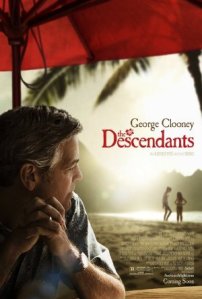
A Dangerous Quickie With Lisa Marie: The Descendants (dir. by Alexander Payne)


One thing that always happens at Oscar season is that certain films will be so embraced by the critical establishment that even daring to challenge their opinion to even the slightest degree will be interpreted as some sort of cinematic heresy.  These are the films that make you feel as if Roger Ebert is standing directly behind you, holding a gun to your head and commanding you to enjoy and be moved by what you’re watching.  Last year, that film was The Social Network.  This year, at least for me, it’s The Descendants.

One reason why The Descendants has been so praised by the critics is because it’s seen as being a film about “real people” and “real life.”  It’s advertised as a film with no easy villains and no easy heroes.  This is the type of film that people tend to praise for not falling into specific genre.  However, those critics are wrong because The Descendants is a pure genre film, make no mistake about it.  It is the latest entry in the Mediocre White Man film genre.  The MWM genre tends to center on middle-aged white guys who are comfortably upper middle class, have quirky relatives, and have been afflicted by ennui.  The protagonist of the MWM film usually narrates the action for us and tends to spend a lot of time explaining how he’s managed to structure his life for maximum efficiency while, at the same time, shutting himself off emotionally from the rest of the world.  Over the course of the MWM film, the protagonist is usually forced to deal with some crisis that makes him realize that 1) he’s getting old, 2) his safe life has become a prison, and 3) there’s not much he can do about it.  The MWM film will feature at least one or more scenes featuring our protaganist either aimlessly running or standing still on an escalator with a blank expression on his face while some old song from the 60s or 70s plays on the soundtrack.  

MWM films tend to do well critically because most critics are mediocre white men themselves.  They also do well with the Academy, probably for the same reason.  And, don’t get me wrong.  There have been some excellent MWW films released over the past decade.  Sideways, Up in the Air, Thank You For Somoking, and even Michael Clayton are all excellent MWM films.  The problem isn’t that The Descendants is a MWM film, the problem is that it doesn’t really bring anything new to genre and even the film’s most effective moments feel awfully familiar.

In The Descendants, George Clooney (a mainstay of MWM genre) plays Matt King, a wealthy attorney living in Hawaii.  Matt’s wife is in a boating accident that leaves her brain-dead.  Matt, who has always been “the backup parent,” finds himself forced to take care of his two daughters (Amara Miller and Shailene Woodley) while going from island to island to inform people of Elizabeth’s impending death.  Along the way, he discovers that Elizabeth has been having an affair with a sleazy real estate agent (Matthew Lillard) and he’s forced to confront the fact that he hasn’t always been the best husband or father.  There’s a lot of quirky and funny moments and there’s a lot of sad moments but they’re never feel quite as genuine as the film seems to believe.  Instead, they often feel more like they were just put there to satisfy the demands of the MWM genre.  The end result is a film that too often seems to mistake ambiguity for insight and which ultimately seems to be more safe than honest.

That doesn’t necessarily mean that The Descendants is a bad film.  Much like The Social Network, it’s a good film that also happens to be very overrated.  Director Alexander Payne keeps the story moving and, as predictable as the film may be, it’s still well-acted and occasionally well-written.  Though I thought a lot of the dialogue was a bit too spot-on perfect (this is a film where even the inarticulate characters sound calculated), the script features enough good one-liners to keep the film entertaining.  Amongst the cast, Robert Forster is poignant as Elizabeth’s grieving father (and his “I’m going to hit you line,” is perfectly delivered) and Judy Greer makes the most of the thankless role of Lillard’s wife.

In the end, I guess the Descendants is a lot like an old middle school crush.  He’s so cute and appealing that it takes a while of digging and soul searching before you can admit that there’s really not much going on there.

And now…6 More Trailers


Hi, everyone!  Sorry for the delay in getting out this latest edition of Lisa Marie’s Favorite Grindhouse and Exploitation Film Trailers.  What can I say?  The holidays are a crazy, crazy time.  If you promise to keep reading and watching then I promise to not be late again in the future.  Deal?  Deal.

And now, without further delay, here’s 6 more trailers!

1) Silent Night, Deadly Night 3: Better Watch Out (1989)

This film was directed by Monte Hellman, who directed some of the best films of the 60s and 70s.  So, in case you were wondering what you get for directing a work of art like Two-Lane Blacktop, well, here you go.

2) Black Christmas (1974)

Continuing the holiday theme, here is the trailer for the original Black Christmas.  This film was directed by the late Bob Clark, who later went on to direct a totally different Christmas movie called A Christmas Story.

3) Madhouse (1974)

I love this trailer for the melodramatic opening.  I love the way the old grindhouse and exploitation movies would literally dare filmgoers to stay away.  That takes confidence!

4) The Freakmaker (1974)

With a title like The Freakmaker, it has to be good.

5) The Creatures The World Forgot (1971)

The World, I am sure, had its reasons for forgetting.

6) Prehistoric Women (1967)

This film is also known as Slave Girls and I’m sure there’s probably prints out there entitled Slave Women and Prehistoric Girls as well. 

Film Review: Santa Claus Conquers The Martians (dir. by Nicholas Webster)


As our longtime readers may have noticed, I’m running behind on getting my weekly exploitation and grindhouse trailer post together.  I apologize for the delay and this week’s post should be up either tomorrow or on Monday.  However, until I finally manage to get my act together, why not enjoy a classic holiday film that just happens to be in the public domain?

You may think that you know everything about Santa but did you know that he’s also a super hero who is capable of interstellar conquest?  Did you know that he’s not only needed on Earth but on Mars as well? Did you know that apparently some people known him as “Santy Claus?”  And most importantly, did you know that Santa is actually kind of a creepy old man whose trademark laugh can actually sound quite disturbing in certain circumstances?

Okay, maybe that’s not true about the actual Santa Claus.  But it’s certainly true about the Santa Claus who turns up in the 1964 film Santa Claus Conquers The Martians.  This film, an obvious labor of love from director Nicholas Webster, presents us with a universe where the children of Mars are so stricken with ennui that the King of Mars has no choice but to go down to Earth and kidnap Santa.  Santa, however, manages to conquer those Martians while bringing holiday goodness and cheer to children all over the universe.  Santa, by the way, is played by John Call and … well, it’s a performance that has to be seen.

In fact, Santa Claus Conquers The Martians itself is a film that simply must be seen.  Everything from the cardboard robot to the cardboard South Pole to the cardboard cast to the painfully catchy theme song “Hooray for Santy Claus” simply demands that you watch this film at least once.  Santa Claus Conquers The Martians has earned its reputation for being one of the worst films ever made but you know what?  It’s also a lot of fun and it’s still better than Avatar.

Seriously, Avatar sucks.

So, please, sit back with your computer and enjoy Santa Claus Conquers The Martians.  Hopefully, next year at this time, it will be rereleased in 3-D.  And, if you’ve seen this film before, you know what the means.  That’s right — Dropo right in your face!

A Quickie With Lisa Marie: My Week With Marilyn (dir. by Simon Curtis)


My Week With Marilyn is apparently based on a true story. 

We know this because the film not only uses the opening title card to tell us that the story is true but the movie itself is narrated by Colin Clark (played by Eddie Redmayne) and Colin tells us pretty much the same thing, over and over again. (Seriously, this film reminded me of why I usually don’t care much for first person narration.)  Anyway, the film takes place in the late 1957.  Colin is the 3rd Assistant Director, working with Laurence Olivier (a haughty and pompous yet oddly touching performance from Kenneth Branagh) on a film called The Prince and the Showgirl.  The film stars Marilyn Monroe (Michelle Williams) who quickly starts to annoy Olivier when it becomes obvious that she’s painfully insecure, self-destructive, and dominated by her agent, acting coach, and cold husband.  Colin, however, is smitten with Marilyn and, despite the ominous warnings delivered by everyone else in the film, he soon finds himself falling in love with her and giving this film a title by spending a week with Marilyn.

My Week With Marilyn has been getting a lot of attention lately because many Oscar watchers are expecting to see Michelle Williams receive a Best Actress nomination for her performance as Marilyn Monroe.  Lately, Kenneth Branagh has become something of a dark horse for a best supporting actor nomination and personally, I would say that Julia Ormond (as a paranoid Vivien Leigh) and Judi Dench (as a supportive actress) both deserve some consideration as well. 

The film is ultimately dominated by Michelle Williams and it works whenever she’s on-screen. (And, unfortunately, it pretty much falls apart whenever she’s not.)  Williams has the daunting job of playing an icon here and she manages to be both believable as an icon and as a very fragile and poignant human being.  The script, to be honest, doesn’t give her much help.  As written, Marilyn is alternatively presented as being a helpless damsel in need of a white knight, a calculating seductress who threatens to lead Colin off of the straight and narrow path (represented here by Emma Watson as the girl that Colin treats quite badly)  and a convenient symbol of a lost age.  The brilliance of Michelle Williams is in how she manages to use these three conflicting characterizations to create one very believable Marilyn Monroe.

The main problem with this film is that it’s not called Marilyn.  Instead, it’s My Week With Marilyn and, as a result, the film is actually about the male gaze of the “My” of the title.  As good a performance as Williams gives, it’s hard to avoid the fact that, as far as this film is concerned, Marilyn ultimately exists just to teach Colin a few life lessons.  Unfortunately, as a character, Colin Clark is so thinly written that he’s never all that compelling and, as the film progresses, it’s hard not to feel that he’s ultimately using Marilyn just as surely as everyone else is. 

(In all honestly, however, I have to admit that one of my issues with Colin is that he’s played by Eddie Redmayne.  Don’t get me wrong, Redmayne is a good actor and he manages to make Colin almost likable but I simply cannot look at him without flashing back to Redmayne’s performance in Savage Grace.  That’s the movie where he plays a schizophrenic who has an incestuous relationship with his mother (Julianne Moore) before murdering her.  Redmayne was so effectively creepy in that film that, as unprofessional as it may be for a film critic, I had a hard time accepting him in the role of white knight.)  

I’ve read a lot of reviews that have complained that this film is basically just a big budget Lifetime Movie and, in many ways, it is.  Director Simon Curtis is a veteran of television and the film has the crisp but flat look of a tv show.  But even more than just the cinematography, My Week With Marilyn feels like a TV movie because its script hesitates to raise any issues that can’t be resolved in two hours.  That said, it’s really not sordid or silly enough to be a great Lifetime movie and it’s far too well acted to be a waste-of-time.  Ultimately, this is a flawed film that deserves to be seen for its performances.  If only the entire film was as compelling and interesting as the performances of Kenneth Branagh, Julia Ormond, and especially Michelle Williams.

Belatedly, here are the Satellite Nominations


One thing about Oscar Season is that you have so many different groups of people tossing around so many different awards that occasionally, you’ll miss a few.  The nominations for the Satellite Awards were announced last Friday but I missed them, largely because nobody really seems to care about the Satellite Awards.  Well, almost nobody.  I care about them because — even when they were known as the Golden Satellites — the Satellite Awards are consistently more interesting than the more mainstream awards.  (For instance, last year, the Satellite Awards had the guts to honor the one and only true girl with the dragon tattoo, Noomi Rapace.)

Best Picture

The Artist

The Descendants

Drive

The Help

Hugo

Midnight in Paris

Moneyball

Shame

Tinker, Tailor, Soldier, Spy

War Horse

What?  No love for David Fincher’s rip-off of The Girl With The Dragon Tattoo?  The AwardsDaily folks must be throwing a fit.  (They’ve been promoting Fincher’s rehash with the same enthusiasm that they attempted to promote Nine two years ago.)

Best Actor

George Clooney in The Descendants

Leonardo DiCaprio in J. Edgar

Michael Fassbender in Shame

Brendan Gleeson in The Guard

Ryan Gosling in Drive

Tom Hardy in The Warrior

Woody Harrelson in Rampart

Gary Oldman in Tinker, Tailor, Soldier, Spy

Brad Pitt in Moneyball

Michael Shannon in Take Shelter

It’s nice to see Brendan Gleeson get some love.  It’s also interesting to note that Michael Shannon’s performance in Take Shelter has been getting a lot of recognition.  Count me among those who hopes that Shannon gets, at the very least, a nomination for giving a great performance in a horror film.

Best Actress

Glenn Close for Albert Nobbs

Olivia Colman in Tryannasour

Viola Davis for The Help

Vera Farmiga in Higher Ground

Elizabeth Olsen in Martha Marcy May Marlene

Meryl Streep in The Iron Lady

Charlize Theron in Young Adult

Emily Watson in Oarnges and Sunshine

Michelle Williams in My Week With Marilyn

Michelle Yeoh in The Lady

Much as the Satellites recognized the work of Noomi Rapace last year, this year they continue to at least nominate some great performances that are being ignored by the mainstream.  In a perfect world, both Verma Farmiga and Higher Ground would be major contenders.

Best Supporting Actor

Kenneth Branagh in My Week With Marilyn

Albert Brooks in Drive

Colin Farrell in Horrible Bosses

Jonah Hill in Moneyball

Viggo Mortensen in A Dangerous Method

Nick Nolte in Warrior

Christopher Plummer in Beginners

Andy Serkis for Rise of the Planet of the Apes

Christoph Waltz in Carnage

Hugo Weaving in Oranges and Sunshine

Wouldn’t it be cool if Andy Serkis actually got an Oscar nomination?  It’s also nice to see Jonah Hill finally getting some recognition for Moneyball.  Brad Pitt has been honored largely for playing Brad Pitt in that film.  Hill actually gave a performance.

Best Supporting Actress

Jessica Chastain in The Tree of Life

Elle Fanning in Super 8

Lisa Feret in Mozart’s Sister

Judy Greer in The Descendants

Rachel McAdams in Midnight in Paris

Janet McTeer in Albert Nobbs

Carey Mulligan in Shame

Vanessa Redgrave in Coriolanus

Octavia Spencer in The Help

Kate Winslet in Carnage

I haven’t seen Shame yet but Carey Mulligan is one of my favorite actresses and she deserved an Oscar for her performance in An Education.  It’s also nice to see Judy Greer getting some recognition for giving one of the few performances in The Descendants that’s actually going to pass the test of time.

The full list of nominees can be found here.

Tyrannosaur Review (dir. Paddy Considine)


Very rarely does a film so bleak, so prone to trample over its characters until they might not come back up, manage to avoid the usual melodrama and clichés we have come to expect and instead stay an honest, unflinching and powerful glimpse of two individuals, one too hard and the other too soft for the world, just trying to make it through the day. Peter Mullan gives one of the year’s most destructive and powerful performances as Joseph, a widower who spends his time drinking, picking fights and experiencing bouts of anger that tends to come crashing down into paralyzing moments of regret. We understand he wants better for himself and could use a bit of redemption but it isn’t an easy thing to achieve. However, he does find some solace in Hannah played by Olivia Colman who also gives one of the year’s most devastating performances as a thrift store owner and born again Christian. Joseph feels drawn to her glow and the sort of warmth he has been looking for. Sadly she isn’t who she seems because behind her smile is immense pain for she lives with an abusive husband who beats her. Hannah had hoped religion could be her savior but when that didn’t work she turned to alcohol. At times Hannah and Joseph can seem total opposites but yet exactly the same. As we watch their relationship develop there are brief moments of hope and even a few laughs, but for me even they are incredibly emotional and at times almost moved me to tears. Considine’s exploration into violence and rage is so gut wrenching and brutally honest that when good things happen you are glad but also very cautious because moods could change without warning and this fine line they walk is hard to watch.

At the center of it all is Joseph’s anger which comes from a place many films rarely explore unless the main character is a villain, and maybe under other circumstances or a different life he would be. But here he is just your “Average Joe” whose fury isn’t brought on by some terrible event or the result of any wrong doing, it is just his nature. He was born with a fire inside. It caused him to be mean and abusive to his wife, it causes him to rough up kids at a pub, and throw a rock through the front window of a shop. The best Joseph can do is try to control this rage and when it gets the best of him, like in the film’s opening when in a fit he kicks his dog’s ribs in, he shows what little kindness he can by carrying it home, being by its side as it dies and then burying it in the back yard. In any other film is would be impossible to expect the audience to forgive such an act, but Considine understands that. You see he isn’t asking for forgiveness but just hoping to reach an understanding with the viewer. As terrible as Joseph’s actions may be at the time the idea that it is his nature, something he can’t control which is destroying him, and the fact that he tries his best to do good evens out the scales just enough for us to have faith in him.

The most important of these attempts to adjust comes with helping Hannah who he tries to protect even though everything about him says otherwise. This leads to the film’s most shocking moment in which he discovers a truth about her, and perhaps about himself and every human, that rattles him to the core. This truth being that even the most glowing and kind of people are capable of unthinkable violence and rage. Now this might seem to be a totally bleak assessment on life, and maybe it is, but Considine doesn’t allow it to prevail without putting up a fight. Instead he tries to make us and Joseph realize that the best you can do is battle through it all and although you will not always find redemption at least maybe a bit of peace and happiness can be earned, which might mean sacrificing yourself.

I really have to hand it to Paddy Considine who most know from his acting in such films as “Deadman’s Shoes” or “In America”. For this to be his first feature is quite impressive. He shows a level of maturity and confidence you would only expect from a veteran director. This could have easily become a preachy or overly stylized independent film that drowned in its own melodramatic miserablism but instead Considine wasn’t afraid to be dark, gritty and realistic and stay true to his characters, caring for them and their emotions in a way that didn’t feel artificial, and making a real connection with the audience. To say it is an easy watch would be a lie but its profoundness in its exploration of violence and anger along with two of the year’s best performances make it a must watch and one of my favorite films of the year.

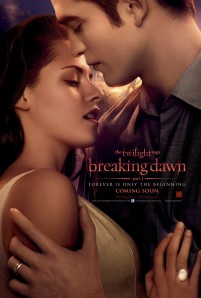
Film Review (plus a Twilight Primer): The Twilight Saga – Breaking Dawn, Part I (dir. by Bill Condon)


“Harry Potter is about confronting fears, finding inner strength and doing what is right in the face of adversity. Twilight is about how important it is to have a boyfriend.” – Stephen King

I have a problem with the notion that says you have to have someone in your life in order for your life to be considered perfect or grand. I’m of the mind that you step into the world alone and leave it the same same way. Even if you are surrounded by your nearest and dearest friends when you pass, you’re still the only one making that trip. And while I love the notion of Romance, I don’t believe it needs to translate to “Omigod, if you’re not near me, I’m going to jump off this building, I swear it because I can’t talk about you without stammering.” or the other obsessive notions that Twilight seems to bring up. This doesn’t mean I outright hate everything that Twilight is, but I’m not totally fond of the overall message it conveys. Perhaps I’m just emotionally cold that way.

And yet, I may know more about Twilight than any other guy in the known universe. It’s an enigma, I know.

A little background on why I, a guy, am writing a review for The Twilight Saga: Breaking Dawn, which is pretty much geared for girls. Note that I’ll refer to the film just as Breaking Dawn, because I really don’t see Twilight as a Saga by any means.

In the early 90’s, I hit a “Vampire Phase”. Between playing games of Vampire: The Masquerade and reading every Vampire Chronicle novel that Anne Rice wrote up until Tale of the Body Thief, I was pretty involved. I grew up with Vampires that were monsters to be feared (and sometimes admired), and dodged the sun more or less. I even owned two vampire encyclopedias. Somewhere between Mark Danielewski’s “House of Leaves” (a book I still haven’t finished) and Andrew Davidson’s “The Gargoyle”, I picked up a hardcover copy of Stephenie Meyer’s “Twilight” from Barnes & Noble. I didn’t think much of the books, save that they were quick reads. Meyer and her vampires were far from Rice and her universe lacked the erotic flair of Laurell K. Hamilton’s earlier books in the Anita Blake series. They were more or less books for teens, but they had vampires in them, so I pretty much inhaled all four books (Twilight, New Moon, Eclipse, and Breaking Dawn) twice in Hardcover. I even went so far to read Meyer’s “The Host” and have seen all of the other Twilight films in the theatre. While they all seem to be really close to the source material, there’s something strange in the translation. What made sense on paper really didn’t on screen (Sparkling Vampires jump to mind), but I guess that’s for an Editorial.

So, when it came to reviewing Breaking Dawn, we at the Shattered Lens drew straws. While we hold to the tenet that any movie can be reviewed by anyone even if the movie was previously reviewed by anyone else (for alternate viewpoints), this was a film that was pretty much off our collective radars. I think we all secretly wanted Lisa or Erin to take it, but both Lisa and my cousin gave the argument that I could probably give a different perspective on the film than all of the girls who planned to see it, most of whom would sprout something like the following:

“I love Edward so much, and that he took his time with Bella was just so heartfelt that I wanted to cry. I felt so bad for Jacob that he could haven’t have her. He deserves better than that!! If anyone doesn’t like what I’m saying, then I will come to their houses and stab them with rusty blades in their beds because no one – I mean no one – gets in the way of my Twilight Love!! You haters could suck it! Team Edward/Jacob Forever!!!!”

So, here I am, writing this. Let’s see what becomes of it, shall we?

For those of you who managed to avoid the Twilight books and movies like they were Sutter Cane novels, here’s everything you’ll ever need to know.

Twilight is the story of Isabella Swan (Kristen Stewart) who moves from Arizona (where Meyer lives) to Forks, Washington to live with her Sheriff father, Charlie (Billy Burke). While in school, she meets an interesting but strange fellow in Edward Cullen (Robert Pattinson). After being saved from a near fatal car crash in an impossible fashion by Edward, Bella becomes intrigued with who and what he may be. A little big of Googling and book buying leads her to discover that Edward is in fact, a Vampire. He explains he’s dangerous. She doesn’t care. He states he’s a killing machine. She loves the danger. He steps into the sunlight to show he doesn’t burn, he just sparkles. She’s just mesmerized.

The original Twilight was Bella’s introduction to The Cullens (who are more or less Vegetarians in that they don’t go after humans, but animals instead):

Carlyle (Peter Facinelli) – Father figure and Doctor. He recruited the rest of the family.

Esmee (Elizabeth Reaser) – Carlyle’s Wife and Mother Figure.

Emmett (Kellan Lutz) – The Muscle of the Family and companion to Rosalie.

Rosalie (Nikki Reed) – Emmett’s Companion and is pretty much opposed to Bella up until Breaking Dawn, for reasons she explains in Eclipse.

Alice (Ashley Greene) – Companion to Jasper and has the ability to see the decisions that others make before they make them.

Jasper (Jackson Rathbone) -The newest vampire of the group and companion to Alice. Has the ability to manipulate the emotional tides of others.

In Twilight, Bella and the Family run into a trio of vampires, one of which decides he has to hunt down and kill Bella (because she’s food). The family is able to kill the vampire and get on with their undead lives, not before a final parting shot showing the vampire’s girlfriend and her desire to kill Bella in return. Bella decides it’s in her best interests to become a vampire and tries to persuade Edward to change her, but he refuses, citing she has many years ahead of her worth living.

In New Moon, Edward decides to celebrate Bella’s birthday at his place. After an accident occurs that leaves her bleeding, Jasper loses it and attacks her. The family is able to save her, but this convinces Edward that it just won’t work out and the entire family leaves town. Left on her own, Bella spends the next four months crying and screaming in her sleep over Edward until her father convinces her to hang out with her friends. She ends up spending more time with Jacob Black (Taylor Lautner), a friend who lives on a nearby reservation that clued her into what the Cullens really were. They get closer as friends and eventually, she discovers that Jacob and his family are actually Werewolves. While cool, she also learns that the Werewolves don’t get along with Vampires and despise the Cullens. They haven’t killed the vampires because of a Treaty that was enacted long ago. Werewolves stay on their side, Cullens on the other and no humans get hurt. Victoria (the girlfriend of that dead vampire in Twilight) returns to town to kill Bella, but she’s protected by the Wolves. She ends up doing a little cliff diving, which catches Alice’s attention and she manages to reunite with the family, though learns that Edward plans to kill himself. Edward believes she died when she jumped off the cliff, volunteering himself to death by the Vampire Congress known as the Volturri.

Alice and Bella fly to Italy and intercede, rescuing Edward from his fate and meeting the Volturri. As Bella knows too much, the Volturri leader demands that within a year she has to becomes a vampire. This of course, excites Bella and annoys Edward, who throws in a “Let’s get Married First” clause into the works. The idea of this is to help give closure to all the humans in Bella’s life. She reluctantly agrees to it. Jacob catches wind of this and spends the next book & film, Eclipse, trying to convince Bella that she should live and that he’s the better choice of a love interest.

Okay, Eclipse. Victoria knows that she can’t get to Bella on her own without dealing with both the Werewolves and the Vampires. She finds a resident of Forks in Seattle named Riley Biers and changes him to a Vampire, convincing him that the Cullens are bad and killed her friend. He builds an army and they attack the Cullens en masse, but somewhere along the line, Victoria forgot to mention there may be giant dogs in the area. The Cullens and Werewolves join forces and defeat the newborns with ease. In the process, Bella learns more about the Wolves and their ability to “Imprint”, meaning they basically obsess over one person for the rest of their lives (much like whales, I suppose). Luckily, Jacob hasn’t Imprinted on Bella yet. Edward eventually dispatches Riley and Victoria, leaving the romance to continue. In Eclipse, the Cullens explain to Bella how they came to be, partially to help her what she has to look forward to, positive or negative.

And all that brings us to Breaking Dawn, Part I.

Of the Twilight movies, I still feel Eclipse was the strongest one. Breaking Dawn covers everything the 1st half of the book does and manages to do it without stepping past the PG-13 bounds it created. The film starts off with Edward and Bella’s Wedding, with different reactions from everyone. Jacob hates it, wolfs out and runs to Canada. The Cullens are ecstatic. Charlie manages to deal with it. The wedding ceremony is done well, and gives some screen time to all of the high school friends (who we won’t be seeing after the wedding). Stephenie Meyer herself even has a cameo here (and eerily looks like my mother). Even the honeymoon is done better than I thought it would. Anyone expecting Bella and Edward’s honeymoon to look like something out of a late night Cinemax series may be disappointed, but the romance is nice to see and there were some laughs in the audience. Again, it’s Twilight. I’m not expecting Jane Eyre or Sense & Sensibility romance levels. At least, that’s what the snoring mother sitting next to me who brought her kids felt, I think.

After the married couple’s wild honeymoon, Bella discovers she’s miraculously pregnant and even worse, the unborn child is sucking the very life from her. The wolves find out about this and feel that she needs to be eliminated, along with the rest of the Cullens, as it breaks the Treaty. Bella is rushed home while the Cullens try to find a way to save both the baby and the mother. Will Bella make it? Will the Wolves pounce on the vampires? Those are some of the questions brought to the table.

Jacob finds himself taking sides with the Cullens, which causes him to recall his Alpha Status in his wolf pack and stand alone (or nearly alone) against his family. In the book, this was done pretty well, but translated to the screen the scene with wolves telepathically yelling at one another seemed a little cartoonish. Just change back to people and talk it over. I guess it was done that way to show how animals have the whole Alpha / Omega relationship, and remains one embarrassing moment in a sea of scenes that were okay.

Visually, Eclipse was a serious step up from both Twilight and New Moon. Breaking Dawn seemingly returns to the look and feel of the original Twilight, right down to Carter Burwell’s score. With the exception of the Bella’s Lullaby theme (which worked incredibly well, especially at the last two minutes of the film), the music felt a little weak to me.  I actually preferred Howard Shore’s score to Eclipse. Don’t get me wrong, the movie goes where it’s supposed to, but you’d expect things to look a little better as it goes along. It would be nice if they improved on that.

One other thing I’ll give this (and that’s all of the Twilight mess) is the audience. I live for seeing audiences react to what they’re seeing on the screen, and I can’t remember a more reactive audience set since Captain America. Some of the girls who go to see this really go wild over it, and some of the guys grumble loudly. My theatre was packed, right down to the front seats where you have to crane your neck up to see everything. It’s the closest to a Midnight Movie experience you could have at a Matinee.

The big problem Breaking Dawn Part II will have will be trying to be exciting, because there isn’t a lot that occurs in the second half of the story that’s worthy of stretching it out to nearly two hours. It’ll be interesting to see what they do with that.

Overall, Breaking Dawn doesn’t really break any new ground in Vampire myths or anything like that. For anyone unfamiliar with the Twilight movies or books, it may feel slow and even a little boring at times. For it’s target audience (readers of the book), it gives them just about everything they wanted.