Paranormal Activity 4 is the first proper sequel to Paranormal Activity. Whereas the second Paranormal Activity film showed events that were happening at the same time as the first film and the third film took place several years before the first one, Paranormal Activity 4 actually takes place several years after the conclusion of the first and second films. It also makes an attempt to further expand the franchise’s mythology but, ultimately, this film just proves that the more things change, the more they remain the same.
In Paranormal Activity 4, Kathryn Newton plays Alex, a teenager who is suspicious of both her odd neighbor Katie (played by a returning Katie Featherston) and Katie’s creepy son, Robbie (Brady Allen). When Katie is mysteriously taken ill, Alex’s family agrees to take in Robbie while Katie recovers. As soon as Robbie movies in, all of the usual Paranormal Activity stuff starts happenings. Doors are mysteriously slammed, a chandelier falls from the ceiling to the floor and nearly crushes Alex, and Robbie befriends Alex’s adopted little brother, Wyatt (Aiden Lovekamp). Alex rightly suspects that Robbie is somehow involved with everything that’s happening but she can’t get her constantly bickering parents to listen to her. So, she does the next best thing and she gets her geeky (but cute) boyfriend (played by the very likable Matt Shively) to set up every computer in the house with a webcam. Soon, even more strange things are happening and the cameras are there to record all of it…
I saw Paranormal Activity 4 at a midnight screening with my best friend Evelyn and that’s probably the best way to see it, late at night when you’re less concerned about logic and surrounded by a bunch of people who are determined to make the film an interactive experience. The worst thing you can do, while watching a Paranormal Activity film, is to start thinking about why nobody ever leaves the house or whether or not someone would actually keep filming while being chased by demonic spirits. Instead, you just have to sit back and enjoy the silly experience for what it is.
When compared to the other films in the series, Paranormal Activity 4 is better than the first two entries but nowhere close to being as good as the third installment. Kathryn Newton and Matt Shively are likable in the lead roles and there’s an adorable orange house cat who shows up at various points during the film. (The cat may actually be the smartest character in the entire film because, whenever anything weird starts happening, she does the smart thing and leaves the room.) Plus, the house in Paranormal Activity 4 is a really nice house. Seriously, if not for the evil spirits and all that, I would love to live there.
Another year means another Paranormal Activity (or, as Evelyn put it when we saw this film, “Again with this?”). Since these films all tend to have the same strengths and flaws and since they all tend to tell the same story, they can be difficult to review. You can either enjoy these films for what they are or you can just throw your hands up in the air in frustration. If you enjoyed the first three Paranormal Activities, you’ll enjoy the fourth. If you spent the previous Paranormal Activity films wondering why everyone was so busy setting up video equipment (as opposed to just leaving the house), then Paranormal Activity 4 is not for you.
The Shattered Lens continues the Bond Marathon leading up to the release of Skyfall with 1964’s Goldfinger. Normally, one would figure that the third film in a series is the one with the most danger of ruining everything. You’ve already had two successful stories and you’re asking audiences to come back for yet another round. Yet Goldfinger manages to be considered a favorite by many, and even managed to be the first 007 film to win an Academy Award (for Sound Effects). It does this by expanding on what was already done.
Building on the format that From Russia With Love started, Goldfinger opens with the gun barrel animation and Bond already on a mission. As he reaches what looks like an oil field under the cover of night, he manages to sabotage it (with a little help from C4 or possibly C3, given the time) and arrive back in a neighboring town before it explodes. Heading to his hotel room, he finds a young lady waiting for him who tries to capture his attentions before he catches sight of a thug in the reflection of her eyes. In the fight that ensues, Bond’s quick thinking and a bathtub full of water makes all of the difference. This prologue will become commonplace in all of the EON Production Bond films save for Dr. No (of course) and Quantum of Solace, which gives you the gun barrel at the end of that film.
Sean Connery reprises his role as MI6’s best agent, finding himself in Miami, where he interrupts the card game of one Auric Goldfinger (Gert Frobe), cheating with the help of Jill Masterson (Shirley Eaton). When Bond is caught off guard and knocked out, he wakes up to find Jill dead in her bed, covered in gold paint. The scene actually sparked a number of rumors that Eaton had died in the process of filming it, and as it was mentioned in the film, without leaving a free space near the base of the spine, the actress suffered “skin asphyxiation”. This was later tested on the Discovery Channel’s Mythbusters, and while skin doesn’t “breathe” the way Fleming wrote, your sweat can’t get out of clogged pores. You end up dying of heat stroke. Guess my science teachers were right there, to a degree. The image is so popular, it was even referenced by Quantum of Solace, though Oil was the substance of choice used there.
Bond is given the mission to track Goldfinger and figure out what he’s up, but not without a quick visit to Q Branch. It’s here where we find James’ new car, the Aston Martin DB5, and are introduced to one of longest professional relationships between an automotive company and a production one. Aston Martin would go on to cover nearly every Bond film save for a few (Goldeneye quickly comes to mind), but I’ll profile that relationship in a separate article. The car is outfitted with machine guns, oil slicks, smoke screens and even an ejector seat, believe it or not. Among the gadgets he’s given are two trackers (one large and one small). In terms of the overall series, this is the point where 007 seemingly becomes more of a gadget hound than relying on his actual abilities. I always felt that the ones in From Russia With Love supported him just when he needed it. In Goldfinger, they come across as utility belt like items, though functional all the same.
One of the other standouts in the film is Goldfinger’s henchman, OddJob (Harold Sakata). With a bowler hat that served as a razor disc, he’s one of the most iconic villains in the series, perhaps second only to Richard Kiel’s Jaws. Tomorrow Never Dies and even Goldeneye went on to use henchmen (or henchwomen in Famke Jassen’s case) to great effect.
In going after Goldfinger, Bond runs into Tilly Masterson (Tania Mallet), who mistakenly tries to kill him. They’re eventually caught an in classic 007 Fashion, Bond is placed in a situation that causes one to ask why no one has ever tried to kill him outright. The laser scene that has Bond tied to a table features one of the most famous lines in Goldfinger. When Bond asks Auric if he expects him to talk because of the laser that’s due to cut him in two, Goldfinger stops, turns to face him and exclaims, “No, Mister Bond! I expect you to die!” Needless to say, Goldfinger changes his mind after Bond mentions “Operation Grand Slam”, a plot to seemingly rob Fort Knox. It’s only later that we find that Goldfinger isn’t out to rob the reserve, he’s planning on detonating a nuclear weapon in it that would make all of the nation’s gold radioactive (and all of his gold worth billions, as a result). This is all showcased in a grand sequence involving Pussy Galore’s flight team and some knockout gas. As a kid, I loved it.
Finally, what Bond film would be complete without a Bond Girl? For Goldfinger, we have Honor Blackman’s Pussy Galore. In doing some research on this, I found that according to an article in Empire Magazine, in order to get the name by the American censors, the movie producers took them out to dinner. They decided to not interfere with the name, but it was never exactly listed in any of the US marketing promos. I’d always wondered about that, myself.
As a Bond Girl, Pussy was great in that she handled herself well with both weapons and hand to hand combat. Honor Blackman was well versed in Judo, so her action scenes with Sean Connery were easy to make. Cold and to the point, Pussy Galore wasn’t the “crying over a broken nail” type, but this being the 60’s, they still had the character succumb to Bond’s advances. Personally, I’m not exactly cool with that, but understand that given the time period and possibly the audience, it had to be written as such. Future Bond Girls would make up for it. At least it was good to see that there was a Bond Girl who could stand toe to toe with Bond.
Regarding the casting, one thing that’s also interesting to note that Gert Frobe, who played Goldfinger had a heavy German accent, so heavy in fact that his lines had to be dubbed by someone else. All of the Bond regulars from previous films make a return – Desmond Llewelyn as Q, Lois Maxwell as Miss Moneypenny, in particular. Felix Leiter would be played by a different actor (my favorite being David Hedison from License to Kill).
The impact of Goldfinger has been huge over the years. It’s one of the films everyone usually recalls, and even famed Video Game creator Hideo Kojima pays homage to the film by way of the theme song used in it’s game “Metal Gear Solid 3: Snake Eater”, as the game takes place in the same time period as Goldfinger.
Overall, Goldfinger remains one of the strongest parts of the 007 saga. Tomorrow, the Shattered Lens takes on Thunderball, the Fourth Connery film and the controversy surrounding it. I’ll leave you with Shirley Bassey’s iconic theme to the film.
Hi there! The name’s Bowman, Lisa Marie Bowman. And tonight, I’m continuing the Shattered Lens’ look at the James Bond film franchise by reviewing 1963’s From Russia With Love.
The 2nd film in the Bond film series, From Russia With Love is considered by many to be one of the best entries in the franchise. I happen to agree with them. There’s a lot of talk right now that Skyfall could be the first James Bond film to receive an Oscar nomination for best picture. Personally, I think From Russia With Love (and not Tom Jones) should have been named the best picture of 1963, (Seriously, has anyone actually tried to watch Tom Jones recently?)
From Russia With Love opens with a tuxedo-clad James Bond sneaking around outside the type of opulent estate that every Bond villain seems to own. Suddenly, Bond is attacked by a hulking assassin named Red Grant (played by a pre-Jaws Robert Shaw) and, as the audience watches shocked, Bond is apparently killed. It’s only after Bond’s dead and on the ground that we learn the truth. The man in the tuxedo wasn’t James Bond at all — instead, he was just some random henchman in a James Bond mask! It turns out that Grant works for the villainous organization SPECTRE and this is all part of his training routine. Now, you would be justified in wondering why SPECTRE would go through the trouble to make a next-to-perfect James Bond mask for a simple training routine but. ultimately, it doesn’t matter. It’s a great sequence, that manages to be both fun and suspenseful at the same time. It’s also a great set-up for the rest of the film.
SPECTRE and its mysterious leader (and this is the first time in which we get to see that iconic image of a hand stroking a white cat while a disembodied voice says evil things) want Bond dead. The job of arranging Bond’s assassination is given to Kronsteen (played by Vladek Sheybal, who has a truly fascinating skeletal face). When he’s not off being evil, Kronsteen is a chess grandmaster and, not surprisingly, he views his assignment as if it’s just one big chess game. In order to kill Bond, he knows that he’s going to need a pawn.
That’s where Tatiana Romanova (played by Daniela Bianchi) comes in. Tatiana is a cipher clerk at the Russian Embassy in Istanbul. She is approached and given an assignment by Rosa Klebb (Lotte Lenya), a Russian intelligence agent who, unknown to Tatiana, is also working for SPECTRE. Tatiana contacts MI6 and tells them that she’s willing to defect but only to James Bond. Tatiana explains that she came across Bond’s picture in a Soviet Intelligence file and the insinuation is that she fell in love (or, at the very least, lust) with that picture.
(Interestingly enough, this parallels the fact that audiences had previously seen Sean Connery in Dr. No and, like Tatiana, spent the year between the two films fantasizing about James Bond themselves. In that way, Tatiana is the perfect audience surrogate.)
James Bond is sent to Istanbul by M (Bernard Lee) but before he goes, he meets with the head of Q branch. Desmond Llewelyn makes his first appearance in the Bond franchise here. In a historic moment of film history, he gives Bond his first booby-trapped briefcase.
When Bond arrives in Istanbul, he meets with station head Kerim Bey (played by Pedro Armanderiz, who tragically committed suicide before From Russia With Love was released). With the help of Kerim Bey and Tatiana (who Bond first meets with she turns up, naked, in his bed), Bond steals the Lektor decoder device from the Russian consulate. Though Bond doesn’t realize this, he’s aided in this task by none other than Red Grant. Grant has been following Bond and perversely, he’s been protecting Bond from KGB assassins so that he might have the chance to kill Bond himself.
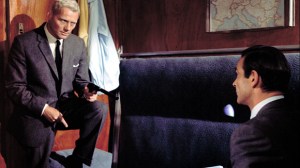
Bringing the Lektor device with them, Bond, Tatiana, and Kerim Bey board the Orient Express. It’s on the train that they meet Nash, a British agent who says that he’s been sent by MI6 to help make sure that Bond and Tatiana safely make it back to England. Of course, what the audience knows, is that the somewhat smug Nash is none other then … Red Grant!
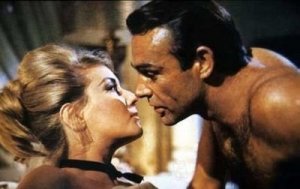
I love From Russia With Love. Everything that makes the James Bond series so special — romance, memorable villains, spectacular locations, exciting action, and a rather sardonic sense of humor — is present in From Russia With Love. Playing Bond for the second time, Connery is more confident with the role here than he was in Dr. No and, as opposed to some of his later appearances in the series, Connery appears to be enjoying bringing this iconic character to life. There’s none of the boredom that marred some of Connery’s later performances. Instead, Connery is exciting to watch and it helps that he and Bianchi have a very real chemistry in this film. As opposed to some Bond girls, Tatiana is a believable, multi-layered character and you actually care what happens to her. The relationship between Tatiana and Bond feels real and, therefore, the film has a surprising emotional resonance to it.
As opposed to Dr. No, with its somewhat bland title character, the villains in From Russia With Love are a fascinating quartet of rogues. Lotte Lenya brings an unexpected amount of depth to the role of Rosa and her final battle with Bond is one of the best in the history of the franchise. Even more exciting than Bond’s fight with Rosa is his final fight with Red Grant. As played by Robert Shaw, Grant comes across as if he’s the literal personification of Bond’s dark side. Both men are killers and both are rather smug about it but the difference is that Bond is capable of caring about Tatiana whereas Grant has surrendered whatever emotions he may have once had. Shaw’s performance so dominates the film that, when I rewatched the film, I was surprised to discover that Grant is only in a handful of scenes.
If Dr. No was an enjoyable B-movie, then From Russia With Love was a cinematic masterpiece that transcended the limitations of genre. If Dr. No established the basic conventions of James Bond, From Russia With Love showed that those conventions could be used to make a great film.
Tomorrow, we’ll be taking a look at the third film in the Bond franchise, Goldfinger.
Last night, I watched Halloween II. No, I’m not referring to the rather disturbing Rob Zombie movie that came out in 2009. Instead, this Halloween II was the original sequel to the original Halloween. This version was written by John Carpenter and Debra Hill. It was released in 1981 and I saw it in 2012, via Cinemax.
Why Was I Watching It?
Because it’s October, of course! It’s horror month and Halloween is one of the great horror movies. Would Halloween II turn out to be another great horror movie? Well, to be honest, I figured it probably wouldn’t but I decided to watch it anyway.
What Was It About?
Halloween II picks up exactly from where the first Halloween ended. The sole surviving babysitter, Laurie Strode (Jamie Lee Curtis), is being rushed to the hospital by two paramedics, one nice (Lance Guest) and one kinda crude and pervy (Leo Rossi). Two guesses which one of our two paramedics eventually ends up dead. Meanwhile, Michael Myers has apparently survived being shot six times and falling out of a second story window and he’s still wandering around Haddonfield, Indiana. Best of all, Dr. Sam Loomis (Donald Pleasence) is still running around all over the place, telling anyone who will listen that it wasn’t his idea to allow Michael to be released. (In one of the film’s best running jokes, everyone responds to Loomis’ protestations by saying stuff like, “Damn you for letting him out!” “Uhmm, I didn’t…” Dr. Loomis mutters at one point.) It quickly becomes apparent that Michael’s rampage wasn’t quite as random as it seemed in the first film. He’s after Laurie and, once he breaks into the local hospital, it seems like he might very well get her. Why? Because, for the most part, it appears that every single citizen of Haddonfield is a total and complete moron.
What Worked?
Halloween II is actually one the better of the slasher sequels of the early 80s. While it can’t compare to the first Halloween, it’s still a fairly suspenseful little film and Michael Myers is just as frightening as ever. However, what truly makes this film memorable, is Donald Pleasence’s unhinged performance as Dr. Loomis. Whereas in the first film, Pleasence played Loomis as just being somewhat testy and annoyed, his performance here suggests that, in the minute or so between shooting Michael and then looking out the window at the end of the first film, Loomis has managed to totally lose his mind. Pleasence gives one of the most mannered, over the top performances in film history in Halloween II and it works perfectly. Whenever the film starts to drag, Pleasence shows up and injects a nice bit of crazy into the proceedings. My favorite moment comes when Loomis suddenly yells at a policeman, “What is it you guys you usually do? FIRE A WARNING SHOT!?”
Lance Guest, who plays the nice paramedic, was really quite likable. I know there’s some debate as to the ultimate fate of his character but I chose to believe that he survived.
The Halloween theme music is still probably one of the most effective horror soundtracks to have not been composed by Goblin or Riz Ortolani. When it came on the TV last night, our cat Doc actually got scared and ran out of the room.
What Didn’t Work?
It’s not the first Halloween.
While the film nominally stars Jamie Lee Curtis, Laurie spends most of the film catatonic and she never really gets to do much other than run from Michael. Say what you will about how Laurie kept dropping her weapons at the end of the first Halloween, she still at least fought back. In Halloween II, Laurie is reduced to being a stereotypical victim.
“Oh my God! Just like me!” Moments
I have to admit that I kinda related to the three nurses who were on call at the hospital. I related to Karen (Pamela Susan Shoop) because, like her, I have, in the past, shown a weakness for bad boys who insist on making out in a hot tub even while there’s a merciless serial killer wandering about. I related to Jill (Tawny Moyer) because, like her, I tend to look at my nails whenever I get bored at work. Most of all, I related to Janet (Ana Alicia), because she couldn’t figure out how to use a walkie talkie. (And, seriously, what type of name is walkie-talkie anyway? It sounds like a cutesy robot.)
So, as opposed to most other slasher films, I was able to find instant empathy with not one but three characters! Unfortunately, all three of those nurses were dead by the end of the film so, seriously … agck!
Hi there! As you may already know, in the days leading up to the release of Skyfall, we’re going to be looking at the previous films in the James Bond franchise. Today, we take a quick look at the first of the “official” James Bond films — 1962’s Dr. No.
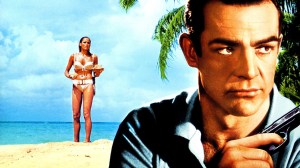
Dr. No is a film of many firsts. It was the first film to be adapted from one of Ian Fleming’s original novels. (Though it was not the first adaptation, that honor going to the 1954 made-for-tv version of Casino Royale). It was, of course, the first Bond film to be produced by the legendary team of Harry Saltzman and Albert Broccoli. It featured the first true Bond girl, with Ursula Andress playing Honey Rider and spending the entire film in an iconic white bikini. Dr. No featured the first appearance of both M and Miss Moneypenny (played, respectively, by Bernard Lee and Lois Maxwell). That iconic theme music made its first appearance in Dr. No as well. However, most importantly, Dr. No featured the first appearance by Sean Connery in the role of James Bond. Even more than Andress’ white bikini, Connery is the reason why Dr. No proved to be the rather unlikely launching pad for one of the most succesful film franchises in cinematic history.
Dr. No, in fact, is a film that contains so many historic firsts that, often, it seems like reviewers tend to neglect the film itself and, instead, chose to concentrate on the film’s legacy. And indeed, 50 years after it was first released, it’s difficult to watch Dr. No without viewing everything about it in relation to what the James Bond franchise would eventually become. Instead of evaluating the film on its own individual merits, the tendency is to watch Dr. No and to spend a lot of time thinking things like: That’s the first time the world ever heard Sean Connery say, “Bond, James Bond.” We tend to forget that, when Connery and director Terrence Young actually made Dr. No, they had no way of knowing that 22 sequels would follow. They didn’t know that they were making film history.
Dr. No begins with a shooting in Jamaica. John Strangeways, the British Intelligence station chief, is ambushed and gunned down by three assassins. Shortly afterward, in a surprisingly brutal scene, his secretary is also assassinated. In response, James Bond is summoned to the offices of MI6. When he receives the summons, Bond is busy gambling and seducing Sylvia Trench (Eunice Grayson). Sylvia, incidentally, was originally meant to be a character who would pop up in all of the subsequent Bond films. Basically, she would have functioned as Bond’s girlfriend, the loyal woman who waited at home while Bond went to exotic countries and slept with every other woman in the world. Perhaps wisely, this idea was abandoned after just two movies but still, Bond’s initial meeting with Sylvia (and the audience) is such an iconic moment that words simply won’t do it justice. Here it is, for your viewing pleasure:
This scene has to rank as one of the best intro scenes in film history. In just a few brief minutes, this scene tells us everything that we need to know about both James Bond and, even more importantly, Sean Connery’s interpretation of the character. In this scene, Connery’s Bond is the epitome of narcissistic charm, giving just a hint of the determined cruelty lurking right underneath the surface. It’s especially interesting to compare Connery’s Bond here to Daniel Craig’s interpretation of the character. Whereas Craig’s Bond often seems to be on the verge of having a nervous breakdown, Connery is established in his first scene as being a cool and calm professional. Craig may be the ideal Bond for our troubled reality but Connery will always be the Bond of our dreams and fantasies.
Bond is sent to Jamaica, where he teams up with CIA agent Felix Leiter (played by Jack Lord). Again, it’s interesting to compare this version of Felix Leiter with Jeffrey Wright’s more-recent interpretation of Felix. Whereas Jack Lord’s Felix Leiter is a cool, calm professional (a bit like an asexual version of Connery’s Bond, to be honest), Jeffrey Wright’s Felix often seems to be mired in self-loathing. Both interpretations are perfectly legitimate (and Felix is usually such a superfluous character that just about any interpretation will do). Instead, they’re interesting largely because of the way that each one of them epitomizes the decade in which each film was made.
With the help of Leiter, Bond quickly figures out that Strangeways’ death is linked to the mysterious, Dr. No (Joseph Wiseman), who has his own private island near Jamaica. The natives claim that a dragon guards the island but Bond, never one to let something like that stop him (especially when it’s always his allies — like the unfortunate Quarrel — who get killed in these films, as opposed to him) sneaks onto the island. It’s here that he first spies Honey Rider (Ursula Andress) walking along the beach. Again, Honey’s introduction is such an iconic scene that, rather than try to describe it, it’s better just to show it:
For all the talk of how the Bond girls were often sexist stereotypes, I would have loved to have been an old school Bond girl. Seriously, they got to be all sexy, they got to make love to James Bond, and occasionally, they got to help save the world. Seriously, what fun!
I’ve spent so much time talking about James Bond and Honey Rider that I haven’t left much room for Dr. No. But that’s okay because, to be honest, Dr. No is not really that interesting of a villain. As opposed to future Bond villains, Dr. No is something of a bland character. Joseph Wiseman plays him with a lot of menace and he has a few over the top moments but it doesn’t matter because there’s really nothing to distinguish Dr. No from any other megalomaniac that’s ever shown up in a low budget spy movie. He’s a perfectly acceptable villain but he’s not an extremely memorable one. (Perhaps if Christopher Lee had accepted the role when it was offered to him, Dr. No would have been a bit more of an effective character.) Rest assured that Dr. No does have an impressive secret headquarters and, that once he does capture Bond and Honey, he takes his time to explain all of his evil plans as opposed to doing something sensible like killing them.
So, how does Dr. No hold up 50 years after first being released?
Surprisingly well.
Despite having a weak villain, Dr. No is still a lot of fun. As opposed to future Bond films, Dr. No was a low-budget affair and, at it’s best, it comes across as an appealing B-movie. Ultimately, the film is best known for introducing audiences to Sean Connery in the role of James Bond and perhaps that is for the best because Connery truly is the best thing in Dr. No. Five decades later, you can still see why the world was so intrigued with both the actor and the character.
Tomorrow, we’ll take a look at one of my personal favorite films of all time — From Russia With Love!
Both Arleigh and I have devoted a lot of time on the site to talking about our mutual admiration for the films of Italian horror director Lucio Fulci. While Fulci will always have as many detractors as defenders, the fact of the matter is that Fulci has been a major and often unacknowledged influence on the direction of horror cinema. To cite just one prominent example, the disturbing and graphic body horror of The Walking Dead has less to do with Romero and everything to do with Fulci.
Fulci remains a controversial figure and that’s not surprising. For every Fulci lover, there’s a detractor. For every good horror film that he made between 1979 and 1982, there’s a terrible one that he made in the years leading up to his mysterious death. But what everyone seems to agree on is that his 1979 epic Zombi 2 is one of the best (and most important) of the post-Romero Zombie films. Zombi 2 may have been produced to take advantage of the popularity of Romero’s Dawn of the Dead but Fulci created a film that transcended its origins.
(Personally, I prefer Fulci’s film to Romero’s but that’s a discussion for another day.)
Zombi 2 is a film that’s provided us with a few scenes that we love here at the Shattered Lens. Whether it’s the scene where a zombie wrestles with a shark or the very first Fulci’s signature eyeball impaling, Zombi 2 is a film that is full of memorable scenes. Tonight, I want to highlight another moment from Zombi 2 — the conquistador scene.
As this scene begins, the film’s star are already fleeing from an army of zombies when they discover that it’s not just the recently deceased that they have to fear. This is a scene that manages to be shameless, silly, and disturbingly effective at the same time. In other words, it’s pure Fulci.
Traditionally, I like to start my film reviews with a trailer but, with this trailer, I do feel the need to include a quick warning. The film being advertised, 1980’s Zombie Holocaust, was released at the height of the Italian exploitation boom and combined two notably gory genres of horror — the cannibal film and the zombie film. The trailer below is pretty explicit (even by the standards of the free speech zone known as the Shattered Lens) and is definitely not safe for work.
Like many of the classic Italian grindhouse films, Zombie Holocaustopens in New York City. A hospital attendant is caught devouring a cadaver in a morgue. After he attempts to escape by throwing himself out of a window, it’s discovered that 1) he’s a native of the Asian Molucca islands and 2) he’s only one of several natives to have both recently immigrated to New York City and gotten a job at a morgue. Dead bodies across NYC are being eaten and anthropologist Lori (played by Aelxandra Delli Colli, who is best known for being the only sympathetic character in Lucio Fulci’s New York Ripper) is determined to discover why.
In order to investigate, Lori and Dr. Peter Chandler (played by Ian McCullough, who was also in Fulci’s classic Zombi 2) lead an expedition to the island. Almost as soon as the expedition arrives, they find themselves being pursued by not only cannibals but zombies as well! Even worse, it turns out that there’s a mad scientist on the island. Dr. Obrero (Donald O’Brien, an Irish actor who appeared in a few hundred Italian films of every possible genre) is convinced that he can unlock the secrets of life by experimenting on dead bodies and doing brain transplants.
(To be honest, I’ve seen this film a few times and I’m still not quite sure what exactly Dr. Obrero was trying to accomplish but I guess it doesn’t matter. He’s a mad scientist with his own private laboratory so I guess he can pretty much do whatever he wants.)
I love Italian zombie films but, for the most part, I try to avoid the cannibal films. I saw both Cannibal Ferox and Cannibal Apocalypse because they both featured Giovanni Lombardo Radice and I saw Cannibal Holocaust because, seriously, that’s one of those films that any student of cinematic horror has to see at least one time. But otherwise, I tend to avoid the cannibal films because, to me, they’re just not that much fun to watch. (And the fact that most of them contain scenes of actual animal cruelty doesn’t help…)
However, Zombie Holocaust is one of the rare cannibal films that I can watch and enjoy because it’s just so ludicrous and over-the-top. It also helps that the film’s gore is so obviously fake that it becomes almost a postmodern statement on Italian cannibal films. And, finally, this film has got zombies in it and who doesn’t love zombies?
Of the countless zombie films that came out of Italy during the early 80s, Zombie Holocaust is one of the odder entries in the genre. While most Italian exploitation films were shameless when it came to imitating other movies, Zombie Holocaust attempts to outdo them all by cramming the conventions of three different genres into one mess of a movie. As such, the movie starts out as a standard cannibal film just to suddenly become an almost shot-by-shot remake of Zombi 2 before then finally wrapping things up by having Donald O’Brien pop up, acting like Peter Cushing in a Hammer Frankenstein film. There’s nothing graceful or subtle about this film’s everything-and-the-kitchen-sink approach to its story and, while the end result isn’t exactly pretty, it’s still watchable in much the same way that a televised police chase is watchable.
Director Marino Girolami was a veteran filmmakers who was ending a long career with his work on Zombie Holocaust and you have to admire the fact that, as opposed to many other filmmakers who have found themselves in a similar situation, he made an honest and unapologetic exploitation film, a shameless rip-off of about a thousand other films. Instead of being embarrassed by the film’s silliness, he instead embraced it and his cast did the same.
Playing the lead role, Scottish actor Ian McCullough plays his character with an attitude that, at times, almost comes across as a parody of stiff upper lip English imperialism. You may have to be a fan of grindhouse cinema to truly appreciate it but, whenever I’ve sat through this film, I always found myself smiling every time that McCullough discovered that another member of his expedition has been killed and responded with a frustrated, “And none of this would have happened if you had simply done as I had told you to do.” By the end of the film, I was expecting McCullough to approach the last remaining native and tell him, “You’re a better man than I am, Gunga Din.”
However, the film is truly stolen by Donald O’Brien, who plays the mad scientist with an almost alarming sense of authenticity. For the most part, nothing that O’Brien says during the film makes the least bit of sense but he delivers the lines with such conviction that it really doesn’t matter. In one of the film’s most famous scenes, O’Brien delivers the line, “Patient’s screams annoying me…performed removal of vocal chords.” It takes a special type of actor to make a line like that work and O’Brien was that actor.
Indeed, watching a film like this, it’s hard not to admire the fact that both the filmmakers and the cast managed to stay sane regardless of how ludicrous the film eventually became. That’s perhaps the best way to describe Zombie Holocaust. It’s ludicrous but it’s still a lot of fun.
(Speaking of ludicrous and fun, when Zombie Holocaust was released here in the States, it was renamed Dr. Butcher, M.D. and it was apparently advertised by a sound truck known as the Butchermobile. To me, that sounds like a lot of fun and it again reminds me that I was born a few decades too late.)
Hi there! I’m back! For the past two weeks, I’ve been “on the road,” traveling from my home in Texas to Baltimore, Maryland and then back to Texas again. It was a great two weeks and a much-needed vacation and now, I am back at my office here at the Shattered Lens Bunker, and I am refreshed and I am ready to get caught up on what really matters: reviewing movies.
This is October, perhaps the third greatest month of the year. Traditionally, October is horror month here at the Shattered Lens and, for my first post-vacation film review, I want to take a look at an underappreciated horror film that came out right before I left for Maryland. It was released to theaters on September 21st, was the number one film in the country for a week, and got next to no love from either mainstream critics or my fellow film bloggers. It’s still playing at a theater near you and, believe it or not, it’s not that bad. The name of the film? The House At The End of the Street.
(Or, as my BFF Evelyn and I called it, “The House at the End of the Cleavage” because seriously…)
In The House At The End of Street, recently divorced Sarah (Elisabeth Shue) and her daughter Elissa (Jennifer Lawrence) move to a small country home. Sarah has managed to buy a house that she really shouldn’t be able to afford and the new neighbors quickly explain to them that this is because, many years ago, a crazy girl named Carrie-Ann was living at the house at the end of the street and she murdered her parents before then disappearing into the woods. Apparently, this has caused all of the property values in town to plummet and I really have to wonder why. I’m not a real estate expert (for instance, I have no idea what a mortgage is and I have no desire to learn) but, personally, I would love to live next to a murder house. Seriously, imagine the interesting conversations that could be started by saying, “So, my neighbor buried a salesman in his basement…”
But anyway, it turns out that Elissa has a perfect view of the house at the end of the street from her bedroom window and she quickly discovers that the house is not deserted. It turns out that Carrie-Anne’s brother Ryan (Max Thieriot) is living in the house and, despite being shunned by the entire community, he seems to be a nice, sensitive guy. Despite her mother’s misgiving, Elissa befriends Ryan and defends him against everyone who claims that he’s crazy.
Of course, what Elissa doesn’t know is that there’s another girl in Ryan’s life and she’s locked up in his basement…
When I look over the negative reviews of House at the End of the Street (especially the ones written by male film bloggers), I frequently come across the phrase “lifetime movie.” Their argument seems to be that House At The End of the Street, with its emphasis on a single mom raising her daughter, was essentially just a PG-13 rated Lifetime movie.
Well, they’re right.
But so what?
Seriously, Lifetime movies are a lot of fun to watch when you’re in the right mood for them and that’s a perfect way to describe House At The End Of The Street. It’s a lot of fun, the type of silly horror film that’s fun to watch with a group of friends. Max Thieriot plays the type of cute but damaged (and potentially dangerous) outsider that every girl has had a crush on and, for the boys in the audience, there’s plenty of cleavage and visible bra straps.
Finally, I think the main reason that House At The End of the Street stayed with me is because both Elisabeth Shue and Jennifer Lawrence really invested themselves in their roles. They were totally believable as mother and daughter and their loving but occasionally contentious relationship felt totally true-to-life (or, at the very least, it was true to my life). Lawrence and Shue both give performances that bring some unexpected depth to this underrated film.
If I had a choice between watching the worst of Paul T. Anderson’s films and the best of Paul W.S. Anderson’s films, P.T. would win just about every time. Unless of course it’s about Event Horizon. I love that film, but that’s for a different review.
Sometimes, you walk into a movie expecting one thing, and are given something completely different. I decided to see Paul Thomas Anderson’s The Master on a whim. It is as amazing as it is strange. Most of the movies I’ve seen lately have been event based, but it was nice to catch a film that seemed more character driven. The film’s protagonist, Freddy Quell is as unorthodox as they come, and I wouldn’t be shocked in the least to see Joaquin Phoenix get some major recognition for this. It’s not without it’s problems, though I’d see it again in a heartbeat.
I’ll be the first to admit that I’m not terribly qualified for a movie like this – it’s very “art house”, much like Refn’s Drive and Von Trier’s Melancholia (one of which I own and the other I love). A lot of it for me felt like the story wasn’t really going anywhere, though I loved the character interactions. Reviewing a film like this requires a bit more depth and understanding of cinema on a whole than what I currently have. For me, there are moments where it almost feels like Anderson said..”Well, they did this…” with someone asking him “And then…?” right after every new point. By the time you’re done with the film, you may ask yourself just what it was you just saw (or what was the point of it, more or less). Then again, I had a similar feeling with the first half of Melancholia and adore that film because of it’s second half. What rescues The Master are the performances, particularly Phoenix’s, that help raise the movie when it threatens to sputter. This, along with the cinematography, really adds to things. The film is beautiful, especially when viewed in the 70MM format. There are some great wide-angle shots, the framing is sweet and the focus is brilliant considering you’re not watching a digital presentation. That’s at least what I took from it, visually. Anderson can make a film look beautiful.
If you can catch a 70MM showing, definitely try to do so.
Okay, that’s sweet, but what is the movie about?
The Master is basically the story of Freddy Quell, a former Naval officer who doesn’t quite walk a straight road. He has a penchant for two things – an explosive temper and the ability to make moonshine out just about any liquid. From his first line, one gets the idea that something is just a little off with him, and it confused me a little in the opening scenes. I guess what I expected was a little different from what I got. Watching someone compulsively masturbate on a beach will do that to you.
Freddy, who finds himself in some odd jobs and situations, stumbles his way onto a boat and finds himself the next morning the guest of one Lancaster Dodd (Philip Seymour Hoffman), the leader of a group that follow a movement called “The Cause”. Dodd asks Freddy to stay and make more of his special brew. This becomes the start of a journey for both individuals. Freddy comes to find that Dodd is quite the interesting person, being invited to have his entourage stay with different friends and share with them the way he’s found to improve upon the human condition. There is a beautiful 10 minute question and answer auditing session between Dodd and Quell that’s a great example of the acting and focus in the film. Everyone seemed to go all out with their performances, which comes to no surprise given how well There Will Be Blood turned out. Amy Adams also has a good role as Dodd’s wife, supporting him through his plans in a number of ways. Having worked with Phillip Seymour Hoffman in the past, they seem to have some great chemistry together. Much of what she did was a little shocking for me, but she handled her scenes very well.
In trying to save Freddy from himself and his reckless ways, The Master doesn’t quite lead the audience where they think it’ll go. Not that it has to, mind you. However, if you’re walking into the film expecting something grand by the end of the film, you may find yourself somewhat disappointed. At least, my audience didn’t seem to voice a lot of good words for the story, though most of what I did hear was praise for the actors. I loved it, but it was just started to lose me in the last 15 minutes. However, the performances are such a standout that you really can’t ignore the film. I’m almost certain that come awards time, The Master will be in the mix.
Before I left on my vacation, I watched several free horror movies on Fearnet. The majority of those films were worth exactly what I paid for them but, occasionally, I came across a film that was worth a quarter or two more. One of those fifty cent films was Slaughter High.
Though it was obviously made a few years earlier, Slaughter High was released in 1986 and was a part of the whole mid-80s slasher cycle. Like many of the films in this cycle, Slaughter High opens with a high school prank gone wrong. Poor Marty (Simon Scuddamore) is the victim of an incredibly cruel April Fool’s Day prank that ends with him totally naked and being dunked in a toilet by a group of 8 students who are surprisingly sadistic. Of course, part of that sadism could have something to do with the fact that they all appear to be in their 30s, yet they’re still students in high school. A coach (who appears to be the only teacher in the entire school) happens to come across the students tormenting Marty and he punishes them by ordering them to go to the gym and start doing push ups.
“This is all Marty’s fault!” one of the 8 sadists exclaims.
So, naturally, they play yet another prank on poor Marty. This prank involves Marty smoking a poisoned joint and then accidentally spilling a jug of acid on his face. As his tormenters watch, a seriously disfigured Marty is taken out of the school on a stretcher.
Exactly ten years later, the 8 sadists (who have now all graduated) get an invitation to attend a reunion at the old high school. When they arrive, they discover that 1) they’re the only ones who have been invited and 2) the high school has been abandoned and is on the verge of collapsing. Now, you might think that this might lead at least one of them to remember that it’s been exactly 10 years since they totally destroyed Marty’s face and life but you would be wrong. Instead, the group decides to break into the old school and spend the night.
You can probably guess how well that works out. Even as our guests discover that random pictures of Marty have been posted throughout the school, none of them suspects that something bad might be about to happen. In fact, it’s not until one of them drinks a beer that’s been spiked with acid that it occurs to any of them that they might not be alone…
Slaughter High is something of a surprise, a low-budget horror film that works exactly because it doesn’t make any sense. Nobody in this film acts like a logical (or halfway intelligent) human being and that — along with a genuinely creepy setting, a camera that never stops prowling through the dark corridors of that dilapidated school, and some surprisingly brutal death scenes — all comes together to create a narrative that feels more and more dream-like as the story continues. Narrative logic is ignored in favor of nightmarish imagery and the end result is a slasher film that seems to be directly descended from Lucio Fulci’s Beyond trilogy.
It’s hard to talk about Slaughter High without talking about the film’s ending and it’s impossible to talk about that ending without spoiling the entire film. So, I’ll just say that Slaughter High has two endings. One concludes the action at the school and then, a few minutes later, there’s a twist ending that concludes the film as a whole. Just on the basis of a few online reviews that I’ve read, the “twist ending” is something that people either love or they hate. Myself, I felt that the film’s first ending would have been a perfect place to end things but, at the same time, the twist didn’t bother me. If nothing else, it nicely complimented the entire film’s lack of narrative logic.
A sad sidenote: Simon Scuddamore, who plays Marty here, never made another film because he apparently killed himself a few weeks after filming his role. On another odd casting note, Caroline Munro plays one of Marty’s high school tormentors despite being in her mid-30s at the time.