The Daily Grindhouse: Mother’s Day (dir. by Darren Lynn Bousman)


One of the great things about writing about films is that occasionally you both get to watch a film that, despite all of your expectations, turns out to be pretty good and then you get to tell other people about it!  Case in point: 2012’s Mother’s Day.

Mother’s Day opens with two memorable scenes.  In the first scene, we watch as a mysterious woman sneaks into a hospital and kidnaps a baby out of the maternity ward.  When a guard attempts to stop her, he ends up with a knife driven into his throat.  While we’ve seen similar scenes in other horror movies, it’s rare that we’ve ever seen this scene handled as well as it is in Mother’s Day.

The second scene opens with an almost intrusive close-up of a woman (played by Jaime King) sobbing as she stares at herself in a mirror.  Again, it’s not that we haven’t seen this scene in other horror films.  Instead, it’s the fact that Jaime King so totally throw herself into those sobs.  We believe her tears and immediately, we want to know why she’s crying and we want to know how she’s connected to that baby being kidnapped from the hospital.  In just two scenes, Mother’s Day captures our attention and, once it grabs a hold of us, it doesn’t let go for the next two hours.

It turns out that King and her husband have just bought a new house and, on one stormy night, they’re throwing a party with a few of their closest friends.  It quickly becomes obvious that, regardless of how happy everyone’s pretending to be, there’s a lot of tension between King and her husband.  Something has happened in the past that no one wants to talk about…

Suddenly, three heavily armed men barge into the house and take everyone hostage.  The three of them are brothers and they’ve just robbed the bank.  The youngest has been shot and is bleeding to death on the couch.  The oldest brother explains that they’re looking for their mother.  She used to live in the house before King and her husband bought it.  The brothers didn’t know that their mother had been kicked out of the house and they’ve been mailing money to the address for the past few months.  When King and her husband claim that none of the money ever showed up at the house, the brothers call their mother and soon, mom shows up to take control of the situation.

Mom is named Natalie and she’s played by Rebecca De Mornay.  From the minute she shows up, it’s obvious that Natalie is both obsessed with her children and that she’s totally and completely insane.  Continually switching between being sweet and psychotic, Natalie is a thoroughly frightening and disturbingly believable monster.  De Mornay wisely underplays Natalie’s more showy moments and prevents the character from becoming just another stereotypical movie psycho.  Instead, she’s the type of villain that we can easily imagine meeting in the real world.  Needless to say, that makes her a hundred time more frightening than any faceless killer with a machete.

Mother’s Day, which was made in 2010 but not released in the U.S. until earlier this year, is a remake of low-budget, 1980 horror film.  This is a rare case where the remake is about a thousand times better than the original.  Director Darren Lynn Bousman keeps the action moving at a perfect pace and the film’s cast (which includes True Blood‘s Deborah Ann Woll in a showy role) creates a disturbingly credible gallery of rogues and victims.

Mother’s Day is a rarity — a horror remake that not only deserves to be seen but which is so good that the original might as well just be an afterthought.

( An earlier version of this review appeared on HorrorCritic.com.)
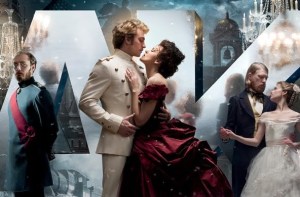
 

Lisa Marie Picks The Best 26 Films of 2012


Anna Karenina Movie

Without further ado, here are my picks for the 26 best films of 2012!

  1. Anna Karenina
  2. The Cabin In The Woods
  3. Life of Pi
  4. Bernie
  5. Django Unchained
  6. The Master
  7. Silver Linings Playbook
  8. Skyfall
  9. The Avengers
  10. Les Miserables
  11. Take This Waltz
  12. Rust and Bone
  13. Cosmopolis
  14. Ruby Sparks
  15. Brave
  16. Damsels in Distress
  17. The Hobbit
  18. Lincoln
  19. Argo
  20. Looper
  21. Moonrise Kingdom
  22. The Hunger Games
  23. Sinister
  24. Silent House
  25. Mother’s Day
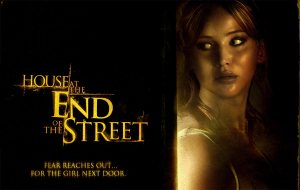
  26. The House AT The End of the Street

House-at-the-End-of-the-Street

Film Review: Guess Who’s Coming To Dinner (directed by Stanley Kramer)


Sometimes, you just had to be there.

That was my reaction as I watched the 1967 Best Picture nominee Guess Who’s Coming To Dinner.  While this film may have been topical and even controversial when it was first released, when watched today it seems to be rather mild and tame.

In Guess Who’s Coming To Dinner, Spencer Tracy plays Matt Drayton.  Matt’s a San Francisco newspaper publisher, a respected member of the upper class establishment.  His wife, Christina (Katharine Hepburn), owns a trendy art gallery and Matt spends his spare time playing golf with Monsignor Ryan (Cecil Kellaway).  He’s the father of the free-spirited Joey (Katharine Houghton, who was Hepburn’s niece in real life).  He’s also, as we’re told repeatedly by every other character in the film, a liberal who supports the civil rights movement.

As the film begins, Joey is returning from a vacation in Hawaii and she has big news.  While in Hawaii, she met and fell in love with the widowed John Prentice, a highly succesful doctor who is literally on the verge of winning a Nobel Peace Prize.  Though he’s 16 years older than her and they’ve only known each other for 10 days, Joey and Prentice are planning on getting married.  While Joey thinks that she’s bringing Prentice to San Francisco just so her parents can meet their future son-in-law, Prentice has specifically come to ask Matt’s permission to marry Joey.  As Prentice explains to Matt, he’ll call the marriage off if Matt doesn’t approve.

John Prentice, by the way, is played by Sidney Poitier and that is the source of the film’s conflict.  Will Matt give his daughter permission to marry a polite, considerate, wealthy, saintly, world-renowned doctor despite the fact that he happens to be black?

Watching Guess Who’s Coming To Dinner was a bit of a culture shock to me, both because I’m the result of an interracial marriage myself (my mom was Spanish and my dad’s white) and because several of my friends are either in or have been a part of an interracial relationship or marriage.  For people my age, it’s not a big deal.  We take it for granted that if you find someone to be attractive, you can have a relationship with him regardless of whatever race he may happen to be.

While I was doing research on Guess Who’s Coming To Dinner, I was reminded that this wasn’t always the case.  When Guess Who’s Coming To Dinner was first released in 1967, interracial marriage was still illegal in 17 states.  In that same year, U.S. Secretary of State Dean Rusk offered to resign when his daughter married a black man.  When Guess Who’s Coming To Dinner was first released, interracial marriage still a controversial subject and when Spencer Tracy struggled with his feelings about it, he stood in for countless Americans who, though they may  have taken pride in how tolerant they were, still weren’t sure what they would do if a black man tried to join their family.

As you can probably guess, Guess Who’s Coming To Dinner is far more interested in teaching a lesson than telling a story.  It’s perhaps not surprising that the film was directed and produced by Stanley Kramer.  Kramer was one of the most prominent filmmakers of the 1960s.  He specialized in making big films that dealt with big issues, the type of films that were regularly nominated for an academy award but rarely honored with an actual win.  In many ways, Guess Who’s Coming To Dinner is a prototypical Kramer picture — its heart is in the right place but the film itself is so conventional and free of ambiguity that it never manages to truly challenge the status quo that it claims to be criticizing.*

In his excellent look at the 1967 nominees for best picture, Pictures At A Revolution: Five Movies And The Birth of The New Hollywood, Mark Harris provides a fascinating behind-the-scenes look at the filming of Guess Who’s Coming To Dinner.  Harris quotes Kramer as explaining that the character of John Prentice had to be perfect because, if the character had any flaws, then bigots in the audience would have seized on those flaws as the reason why Prentice and Joey should not be allowed to marry.  As Kramer explains it, the entire film was set up to make it clear that the only possible reason that Matt could have to object to Prentice would be the color of his skin.

To an extent, I can see Kramer’s point (and again, it’s hard to judge what was necessary to make a point in 1967 from the perspective of 2013) but, as I watched Guess Who’s Coming To Dinner, it was hard not to feel that the main problem with the film was that Prentice was just too perfect.  Certainly, he was too perfect to be in love with Joey who, as played by Houghton, simply seemed to be too naive and foolish to be a good match for a man who is on the verge of winning a Nobel Prize.  Even more importantly, it’s hard to escape the fact that this accomplished, confident black man still needs to get the permission of a well-meaning white liberal before he can marry the woman he claims to love.

Ultimately, despite the film’s noble intentions, it feels more than a bit condescending.  At no point is Prentice allowed to show any anger or frustration at having to prove himself.  There’s even a scene where Prentice criticizes his own father for being too hung up on racism.  “Not until you and you’re whole lousy generation lay down and die will the weight of you be off our backs … You think of yourself as a colored man … I think of myself as a man!” Prentice tells him, as if his success was due to ignoring racism as opposed to defying it.

If Guess Who’s Coming To Dinner has dated badly as a look at race relations in the United States, it remains watchable because of the performances of Katharine Hepburn and Spencer Tracy.  This was their 9th and final film together and the love that these two accomplished actors felt for each other shines through every scene.  Tracy was seriously ill while making the film (and died before it was released) but he gave one of his best and most heartfelt performances here.  He was nominated for a posthumous Oscar but lost to Rod Steiger, who co-starred with Poitier in the film that beat Guess Who’s Coming To Dinner for best picture, In The Heat of the Night.

In the Heat of the Night is best-remembered for the scene in which Poitier angrily declares, “They call me …. MISTER TIBBS!”  This line epitomized the righteous anger that he was not allowed to display in Guess Who’s Coming To Dinner.  If only Guess Who’s Coming To Dinner had its own “MISTER TIBBS” moment, it might be remembered as something other than a film that seems curiously out-of-place as a nominee for best picture.

—

* That said, Kramer’s post-Guess films were actually pretty interesting and a bit more daring.  Some day, I’ll have to get around to reviewing his 1970 campus unrest film, R.P.M.

Movie Review: Texas Chainsaw 3D (dir. by John Luessenhop)


TexasChainsaw3D11012012-thumb-550x382-104468

I like to use 2010’s Nightmare on Elm Street as the basis for horror remakes I’m not fond of. So when Texas Chainsaw 3D was announced, I automatically wrote it off as being something you could put on the shelf right next to this one. I have to admit I was actually surprised. Yeah, it’s a bad movie, but I didn’t find myself scoffing nearly as much as I did Nightmare, which really didn’t work for me at all. I just don’t see myself running back to see this one. I believe part of this has to do with the way the film opens.

Having gone into the film blind, I expected a remake of the remake. Essentially the same story we had with The Texas Chainsaw Massacre: The Beginning. The shock was that the film starts with the events of the original Tobe Hooper film, rendered in 3D (which was very cool, I might add). It then moves to the afternoon after the last victim ran away. This gives anyone who may be unfamiliar with the original a bit of a bridge, and personally having never liked any of the original sequels, I liked the aftermath that takes place.

Essentially, Texas Chainsaw 3d is the story of Heather Miller (played by Percy Jackson’s Alexandra Daddario), who receives word from her lawyer that she’s inherited a home in Dallas, Texas. What she doesn’t realize is that this inheritance comes with a few problems. She decides to hop in a van and head down there, accompanied by her friend Nikki (Tania Raymonde), Nikki’s date Kenny (Keram Malicki-Sanchez), and her boyfriend (Tremaine “Trey Songz” Neverson, who the girls in my audience gave the same whoops and catcalls normally reserved for Pattinson/Lautner in a Twilight Showing).

Basically, the movie becomes the cliché “draw this person into isolation and Bam!” that every horror film has, but I’ll admit that I watched a lot of those scenes with my eyes averted, so in that aspect, it got the job done. The visual makeup effects were done by Robert Kurtzman, the “K” in the KNB Effects group (The Walking Dead’s Gregory Nictotero and Howard Berger are the others), and there’s no shortage of blood in this film. While it’s not quite on the level on what the upcoming Evil Dead looks like – that appears to be on the epic Dead Alive levels – Chainsaw does have limbs lost, blood spurting and Leatherface’s signature weapon used to fullest extent. Those moments of isolation come of as very intense, and the direction isn’t bad.

The 3D in the film was nice, though used sparingly. To be honest, the best use of the effects was in what it added to the pieces of the original film that were used. I really enjoyed the outcome there and there are a few key “weapon in the camera” shots that may make you flinch.

Horror films have their eye candy. Sex sells, let’s face it. In Chainsaw, both Raymonde and Daddario had the guys captivated, and Scott Eastwood (Clint’s Son) works for the ladies. While there’s no nudity in the film, good considering how many kids were at my showing, there’s enough skin to appreciate.

What I didn’t like about the film was that in this day and age where you have smart heroes in horror stories – one need only look at Cabin in the Woods here – Chainsaw resorts to the classic “two step, drop” method, meaning that characters meaning to escape will only make it a few steps before stumbling over their feet. I don’t know if that works anymore for audiences. The times that it happened at my showing brought about more laughter than it did horror. Granted, I can’t say I’d be the best of runners with someone wielding a noisy chainsaw behind me, but you’d be damn sure I’d be up or kicking from the floor if I had to. Additionally, the heroes make a few stupid mistakes, which they have to I suppose. Still, I would have liked a few more smart moves. One other thing is that Leatherface himself, while menacing, doesn’t have the same effect that the Brynarski one in Marcus Nispel’s film with Jessica Biel. The Leatherface in that film was a hulking behemoth of a dude that ran with football player like speeds. Chainsaw 3D’s Leatherface is more like your grandpa that caught you stomping around his rose garden and chased after you with garden shears. It’s the equivalent of seeing Dawn of the Dead running zombies and going back to shuffling walkers.

Overall, Texas Chainsaw 3D isn’t anything fantastic and new. You can wait for it on 3D Blu-Ray. If you are an absolute fan of the series, it’s worth a look for both the connections to the original and a cool Gunnar Hansen cameo. Or you can watch it just for Daddario. Just make sure someone else buys you the ticket.

The Daily Grindhouse: The Horror of Party Beach (dir by Del Tenney)


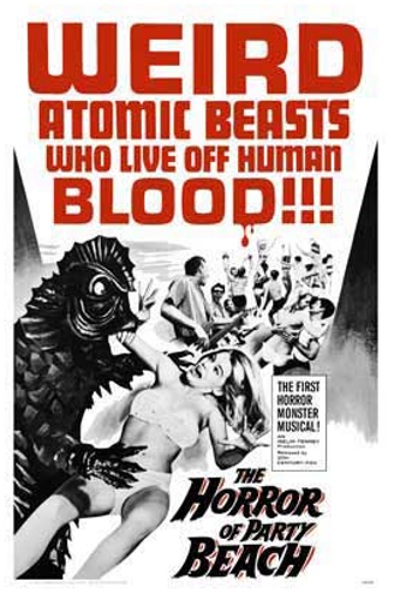
horror-of-party-beach-one-sheet-1964The Horror of Party Beach is a personal favorite of mine but it’s not an easy film to review.  Technically, this is a terrible film but it’s also a lot of fun.  It’s the type of film that makes the traditional definitions of good and bad irrelevant.  In short, this 1964 “horror” film simply has to be seen to be believed.

Party Beach is perhaps the most depressing stretch of sand and surf to ever appear in a 1960s beach film.  During the day, the beach is full of amazingly skinny dancers and leather-clad motorcyclists who spend all of their time dancing to music of the Del-Aires.  Occasionally, a fight breaks out between the motorcyclists and the dancers but, for the most part, everyone seems to spend their time engaging in witty banter that I imagine was probably dated even in 1964.  The skies are permanently overcast and the whole beach just reeks of a combination of societal decline and general ennui.

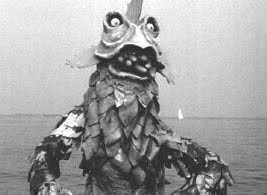
Even worse, the film opens with a toxic waste spill that somehow causes an underwater skeleton to mutate into a creature that’s apparently half-man and half-fish and which also has an insatiable lust for blood and a mouth that appears to be full of hot dogs.  Soon, every night, the creatures are wandering around the town, killing people, and dragging the bodies off to the quarry.

HorrorOfPartyBeach

One of the first victims is Tina, the wild girlfriend of Hank.  Hank is a scientist who has the young Aryan look that most B-movie heroes seemed to have in the early 60s.  Seriously, Hank manages to get through the entire film without once getting a single hair out-of-place.  You would think that Hank would be upset over Tina’s death but he’s not because, as he told Tina before she died, he’s “no longer the campus bigshot who will do anything for kicks!”  It also probably helps that Hank has fallen in love with Elaine, who appears to be about 40 years old but who, in a typically dramatic moment, turns down an invitation to go to a slumber party with all of her teenage friends.

Elaine’s father is Dr. Gavin.  Dr. Gavin is also Hank’s boss and we can tell that Dr. Gavin is a genius because he not only wears glasses but he’s also bald and smokes a pipe.  Together, Dr. Gavin and Hank try to figure out if there’s any way that the monsters can be stopped.

Dr. Gavin also has a maid named Eulabelle, who appears to have come to Horror of Party Beach straight from an awkwardly racist 1930s comedy.  At one point, Eulabelle explains that she’s not only locked the front door but that she’s “double-locked and triple-locked it.  Ain’t no monsters gettin’ in here…”

Perhaps if everyone on Party Beach had taken Eulabelle’s advice, many lives could have been saved.  But oddly, even after everyone knows that there are monsters among them, the party continues on Party Beach.  Not even the fear of death can silence the Del-Aires…

I make no apologies for loving The Horror of Party Beach.  Everything about it — from the ludicrous monsters to the expressionless performances of the cast to the thoroughly nonsensical plot — make The Horror of Party Beach a one-of-a-kind experience.  I’ve come across quite a few critics who have claimed that The Horror of Party Beach is one of the worst movies ever made but, seriously, it’s way too silly to be truly bad.  It may not be a good film but it’s definitely a fun viewing experience.

Film Review: The Racket (dir. by Lewis Milestone)


Originally released in 1928 and produced by Howard Hughes, The Racket was one of the first films to ever be nominated for an Oscar.  It was also one of the first films to miss out on its chance to claim Oscar glory as the first statuette for Best Picture was given to the producers of Wings.

Like many films that were made in during the silent era,  The Racket subsequently sunk into obscurity and, for several decades, it was considered to be a lost film.  After the death of Howard Hughes, the last remaining copy of The Racket was discovered hidden away in his vast film collection.  This print has been preserved at the University of Nevada, Las Vegas.  After several years of restoration, the film made its first appearance on TCM in 2004 and it has since been frequently broadcast on that network.  That’s how I first saw it way back in 2012.

Based on a play by Bartlett Cormack, The Racket is a gangster film.  Nick Scarsi (played by Louis Wolheim) is a powerful and politcally-connected bootlegger.  He’s pursued by one of the few honest cops in town, Captain McQuigg (Thomas Meighan).  When McQuigg proves to be incorruptible, Scarsi uses his political influence to get McQuigg transferred to a precinct in the suburbs.  However, when Scarsi’s younger brother is arrested for a hit-and-run in McQuigg’s new precinct, the captain uses the incident to launch a complex plan to bring down both Scarsi and the corrupt public officials that allow him to run the city.

Seen today, The Racket is an almost quaintly traditional gangster film.  According to the film’s title cards, everyone in the film speaks in hard-boiled slang and the characters — from the honest cop to the cynical reporters to the nightclub singer played by Marie Prevost — will all seem very familiar to anyone who has ever seen a classic Warner Bros. crime film.  That said, The Racket is still a lot of fun to watch and director Lewis Milestone keeps the story moving at a good pace.  At the very least, it’s interesting to see a gangster film that was actually made during the gangster era.  Nick Scarsi was based on Al Capone and, perhaps not surprisingly, the film was banned in Chicago when it was originally released.

The film shows up frequently on TCM and it’s also available on YouTube.  And it can be watched below!

The Daily Grindhouse: Shoot (dir. by Harvey Hart)


As I explained yesterday in my review of the 1935 film version of Les Miserables, one of my resolutions for 2013 is to review a film a day, alternating between films that were nominated for an Oscar and film’s that most certainly were not.  Today’s film stars two Oscar winners (Cliff Robertson and Ernest Borgnine) but it was not nominated for any awards itself.  Along with being ignored by the Academy, this film is unfairly obscure and has an oddly bad reputation among cult movie fans.  The movie is a Canadian exploitation film from 1976 and it’s probably even more relevant today than when it was first made.  The name of the film?  Shoot.

Rex (played by Cliff Robertson) is a veteran of the National Guard, a respected community leader in his small town, and a man who loves his guns.  His house is full of guns of all shapes and sizes and he’s so proud of his military background that the living room even appears to have camouflage style wallpaper.  From the film’s opening shots, it quickly establishes that Rex is not comfortable being civilized.  The few attempts that he makes to speak to his wife are painfully awkward.  Rex only feels truly alive during the weekends that he spends out in the wilderness, hunting with his buddies, played by Ernest Borgnine and Henry Silva.  His friends look up to Rex as their leader, to the extent that one of them refers to Rex as being the “senior officer in charge.”

During one hunting trip, Rex and his heavily armed friends pause to rest next to a river.  Suddenly, on the other side of the river, another group of heavily armed strangers show up.  They stare at each other for a few minutes before suddenly, a shot rings out.  The two groups start shooting at each other.  One man is wounded and another is killed before Robertson and his group retreat to the security of Borgnine’s cabin.

Instead of going to the police, Robertson convinces his group to keep the incident a secret.  They return to town, swearing not to tell anyone about what’s happened.  However, Robertson’s paranoia gets the better of him.  Before long, he’s convinced himself that the other group is going to seek revenge and that the only way to survive is to kill them first.  Along with the hot-headed Silva, Robertson recruits a small army of townsfolk to return with him to the wilderness.  Only Borgnine questions the wisdom of Robertson’s plan.  The whole thing eventually leads to a genuinely shocking and disturbing climax.

Robertson and his friends are obviously meant to be representatives of American gun culture and to call Shoot heavy-handed would be a bit of an understatement.  That said, Shoot is still an undeniably effective piece of propaganda.  Robertson, Silva, and Borgnine all give excellent performances and director Harvey Hart  manages to generate and maintain a good deal of suspense concerning just what (if anything) Robertson is going to find waiting for him in the wilderness.  Though the film has its slow spots, the emphasis on characterization and suspense makes the surprise ending all the more effective.

Shoot is not an easy film to see.  It has never been released on DVD or Blu-ray and I only happened to learn of it because I was bored one day and I was flipping through one of my film reference books.  However, the film has recently been uploaded to YouTube and here it is:

Film Review: Les Miserables (dir. by Richard Boleslawski)


Every year, I set a few goals for myself.  In 2012, for instance, my goal was to stop worrying so much about achieving unrealistic goals.  For 2013, my goal is to post a film review a day, alternating between reviews of films that have been nominated for Academy Awards and films that most assuredly were not.

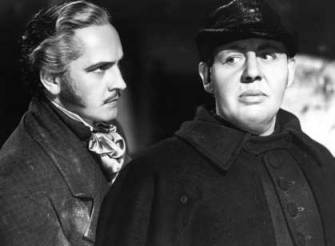
With that in mind, I’d like to get things started by taking a look at Les Miserables.  Now, I’m not talking about the Tom Hooper-directed musical extravaganza that’s currently playing at a theater near you.  Instead, I’m talking about the Les Miserables that was directed by Richard Boleslawski and which was nominated for best picture of 1935.  (It lost to another literary adaptation that featured Charles Laughton as a classic villain, Mutiny On The Bounty.)  As opposed to Hooper’s film, this version of Les Miserables is not based on a Broadway musical.  Instead, it’s a condensed version of Victor Hugo’s original novel.

As opposed to the novel, Les Miserables takes a straight-forward chronological approach to telling the story of Jean Valjean.  We start with Valjean (played here by Fredric March) being sentenced to prison and then follow him through his experiences in prison.  We watch as the embittered Valjean first meets the kindly bishop (played here by Cedric Hardwicke) who turns his life around.  Valjean becomes both a mayor and the protector of the young Cosette, who eventually ends up falling in love with the young revolutionary Marius.  Thoughout all of this, Valjean is pursued by the obsessive Inspector Javert (Charles Laughton).

As a film, Les Miserables is more faithful to the spirit of Hugo’s original novel than to the exact details.  For instance, in this film, Javert first encounters Valjean while the latter is in prison.  While this is clearly different from the novel, it works perfectly from a cinematic point of view.  As well, the film jettisons many of the book’s longer digressions and instead, it focuses on the characters of Valjean and Javert.  As such, characters like Cosette and Marius are only important (and considered) in how they relate to the two main characters.  Fortunately, Valjean and Javert are played by two of the best actors to ever appear on screen.

While Charles Laughton, in the role of Javert, gets to the give the showier performance, the film is rightfully dominated by Fredric March’s quietly determined performance as Jean Valjean.  Valjean is a truly complex character who, over the course of the film, goes from being bitter and angry to kindly and strong and March perfectly captures each side of Valjean’s personality.  As an actor, Fredric March is not as well-remembered as some of his contemporaries (like Charles Laughton, for instance).  However, in this film, Fredric March proves himself to be the perfect Jean Valjean.  He is the Jean Valjean that all other Valjeans must be judged against.

While director Richard Boleslaswki is hardly a household name (I have to admit that I had never heard of him before I saw this film), his work on Les Miserables is impressive.  Interestingly, he directs the film almost as if it was a combination of a Warner Bros. gangster film and a Universal monster film.  (It’s easy to imagine some alternative universe where his version of Les Miserables starred Edward G. Robinson as Valjean and Boris Karloff as Javert.)  He’s at his strongest is the dream-like sequence where Valjean carries the wounded Marius through the sewers of Paris.

While Les Miserables may not be a perfect film, it is the perfect introduction to Hugo’s novel. Incidentally, the most faithful cinematic adaptation of Les Miserables actually came out a year before the Boleslawski version.  It was a French film that had a running time of five hours.  It occasionally turns up on TCM and, like the 1935 version, it’s well-worth watching.

Lisa Marie Picks The 16 Worst Films Of 2012


Let’s be honest: 2012 sucked.  In fact, and I can say this because I’m secretly a history nerd, 2012 was the worst year since 1934.  Who needs a zombie apocalypse when you’ve got 2012?

At the same time, it was also a strangely bland year for the movies.  Just as there weren’t any massively brilliant films, there weren’t that many huge disasters.  Instead, it was a year that celebrated blandness.  Fortunately, for me and my love of making lists, there were still just enough remarkably bad films for me to make out my annual worst of the year list.  Yay!

Listed in descending order, here are my picks for the worst of 2012.*

16) The Paperboy

15) Seeking a Friend For The End Of The World

14) Ghost Rider: Spirit of Vengeance

13) The Raven

12) The Trouble With Bliss

11) Savages

10) A Thousand Words

9) 96 Minutes

8) Haywire

7) Dead Season

6) This Means War

5) Rock of Ages

4) Project X

3) The Devil Inside

2) The Wicker Tree

And my pick for both the worst film of 2012 and perhaps one of the worst films ever made…

1) Branded

Tomorrow, I’ll be continuing my look back at 2012 with my picks for the 10 best songs of the year.

—-

* Needless to say, these picks reflect my opinion and my opinion alone and do not necessarily represent the views of the other writers here at the Shattered Lens.  Hopefully, some of them will post their own lists.

Lisa Marie’s Favorite Film of 2012: Anna Karenina (dir by Joe Wright)


For the most part, 2012 was a bland year as far as cinema is concerned.  The most acclaimed films of the year (Argo and Lincoln being two obvious examples) were well-made and often entertaining but they were hardly revolutionary.  2012 was the year that the establishment told us what we should enjoy and, for the most part, film critics slavishly hopped on the bandwagon.  As you can probably guess, 2012 was not my favorite year as far as the movies are concerned.  That said, there were a few films that gave me hope.  As the year ends, despite being underwhelmed by most of the films that were released, there are a few that I truly did love.

My favorite film of 2011 was a criminally underappreciated film from director Joe Wright.  That name of that film was Hanna.  My favorite film of 2012 is another criminally underappreciated film from director Joe Wright.  The name of this film?  Anna Karenina.*

History has a way of repeating itself.

Anna Karenina is, of course, based on the classic novel by Leo Tolstoy.  Anna Karenina (played, quite brilliantly, by Kiera Knightley) is the wife of the noble (but somewhat boring and judgmental) Russian statesman Alex Karenin (Jude Law, who is also quite brilliant and rather tragic in a role that, in lesser hands, could have become a stock villain).  When Anna’s good-for-nothing brother (played in a wonderfully comedic performance by Matthew MacFayden) is caught cheating on his wife, Anna leaves her safe home in St. Petersburg and travels to Moscow where she helps to save her brother’s marriage and meets Count Vronsky (Aaron Taylor-Johnson).

Among the members of the Russian high society, it is well-known that Vronsky is pursuing the hand of the young and beautiful Kitty (Alicia Vikander, who generates a lot of sympathy for a character who, at the start of the film, could easily have been portrayed as just a spoiled brat).  However, at the ball where it is widely expected that Vronsky will ask Kitty to marry him, Vronsky creates a scandal by dancing with Anna instead.

Vronsky loses interest in Kitty and instead, he now obsessively pursues the married Anna.  Though Anna is resistant at first, she finally gives in and embarks on an adulterous affair with Vronsky, resulting in scandal and tragedy.

Again, history repeats itself.  The story of Anna Karenina is a familiar one that has been told repeatedly over the ages.  That’s one reason why Tolstoy’s novel has remained one of the greatest novels ever written and why it has been adapted into so many other mediums.  Director Joe Wright begins Anna Karenina with the assumption that the majority of the people in his audience already know the story of Anna’s ill-fated love affair with Vronsky.  As such, he puts less emphasis on the story itself and more on how the story is told.

Anna Karenina is a masterpiece of style.  When the film opens, Wright has his actors literally performing on a stage.  When Anna travels to Moscow, a miniature train is seen rolling across the stage.  When the scene changes from a factory to a high society ball, the factory workers walk backstage, change costumes, and then step back onstage, suddenly transformed into noblemen.  At one point, we even see a janitor nonchalantly cleaning up the now-empty theater while the story continues to play out on the stage in front of him.  When Anna and Vronsky dance for the first time, the other actors freeze in place and a spotlight shines down on the dancing couple.  It’s an amazingly romantic moment, one to which anyone who has ever been infatuated will be able to relate.  Finally, a door opens onstage and the characters (and the viewing audience) are able to step out into the “real” world but, throughout the film, we occasionally return to that stage.  While several critics have criticized this aspect of the film, I thought it was brilliant.  By literally putting his actors on stage, Wright both acknowledges that this is a story that may be familiar but can be interpreted in many different ways and he also drives home the point that, ultimately, we are all just actors on a stage, being observed and judged by a society that is often hostile to any sign of individual desire or unpredictable  emotion.

Needless to say, the film’s extreme stylization is not for everyone.  That’s actually one of the reasons that I love this version of Anna Karenina so much.  In a year that was almost excessively safe, Joe Wright took a risk and, as a result, encouraged us to look at a familiar story in a different way.  For that reason, Anna Karenina is my favorite film of 2012.

—-

* For the record, my second favorite film of 2012 was The Cabin In The Woods.