Film Review: Dragonheart 3: The Sorcerer’s Curse (dir by Colin Teague)


Dragonheart-3-The-Sorcerer’s-Curse-2015

Before I get into this quick review of Dragonheart 3, I better admit that I haven’t seen the first two Dragonheart films.  I assume that they all had something to do with dragons.  As a result, I can’t tell you whether or not Dragonheart 3 is better than Dragonheart 2 or whether it’s worthy of being associated with the original Dragonheart.  

But, then again, that’s not necessarily a bad thing.  Ultimately, all films — even sequels and prequels — have to be able to stand on their own and be judged based on their own individual merits.  And, speaking as someone who knows nothing about the previous films in the series, Dragonheart 3 has a good deal more merit than you might expect.

The film’s plot … well, does the plot really matter?  Surprisingly enough, it does.  It’s obvious that the filmmakers understood that the main appeal of the film would be to see the dragon but they at least made an effort to keep the film’s non-dragon scenes interesting as well.  Taking place in post-Roman, pre-medieval Britain, Dragonheart 3 tells the story of two separate societies that are divided by Hadrian’s Wall.  On the “civilized” side of the wall, villagers live in fear of brutish knights who, in the best tradition of governmental overreach, claim to be providing protection but are mostly just interested in collecting exorbitant taxes and bullying the citizenry.  On the other side of the wall, fierce warriors live in the wilderness and resist all forms of government control.  Meanwhile, an evil sorcerer named Brude (Jonjo O’Neill) plots to conquer both the civilized and the uncivilized.

(And if I wanted to, I could explain how the civilized side of the wall represents our corrupt federal government, the warriors on the other side of the wall represent the grassroots political activists, and Brude represents any number of cynical politicians and so-called “community organizers” who have used those activists to pave their way into becoming a part of the same corrupt government that they claim to be attempting to reform.  But, I’ll save that for another day…)

On the civilized side of the wall, cocky Gareth (Julian Morris) wants to be a knight but, when he proves to be too kind-hearted to be an efficient extortionist, he is expelled from the knighthood and told that he can only rejoin if he pays a penalty.  Later, that night, Gareth sees a comet fall onto the other side of the wall.  Thinking that the comet will contain gold, Gareth sneaks over the wall and goes in search of it.

When Gareth does finally find the comet, he discovers that it contains several eggs and a dragon named Drago (voiced by Sir Ben Kingsley).  It also turns out that Brude is also hunting for the dragon and its eggs and, when Gareth is severely injured while fighting Brude’s warriors, Drago saves Gareth’s life with an infusion of blood which leads to Gareth and Drago sharing a heart and becoming psychically linked…

There’s a surprising amount of plot in Dragonheart 3 but it can all be boiled down to this: Brude wants to conquer Britain and he’s cast a spell that allows him to occasionally control Drago.  Gareth has to both break the spell and defeat Brude.  Along the way, Gareth learns from Drago’s noble example and becomes a stronger knight and a better man.

Against all expectations, it’s all actually rather nice and sweet, with surprisingly good CGI for a low-budget, direct-to-video film.  As well, Kingsley brings a wounded dignity to the voice of Drago and Julian Morris gives a sincere and likable performance as Gareth.  It’s doubtful that anyone would have noticed if the two of them had just gone through the motions but instead, both of them give performances that elevate the entire film.

However, I have to admit that my favorite character was Rhou (Tamzin Merchant), a warrior who joins with Gareth and Drago to battle Brude.  Not only is Rhou fierce and fearless but, much like me, she has red hair!  Only 2% of the world has red hair and we all kick ass.

Dragonheart 3 is currently available on Netflix and it’s not a bad way to spend 97 minutes.

Dragonheart

The Things You Find On Netflix: The Last House On Cemetery Lane (dir by Andrew Jones)


Last House on Cemetery Lane

Usually, I like to think that I can find something to love about any horror film but occasionally, I watch one that is so ineptly produced and so devoid of both horror and subtext that even I have to admit that it’s just not a very good film.

Case in point: The Last House On Cemetery Lane, a British horror film that I watched on Netflix last month.  I actually had high hopes for the film, based on the title alone.  The title, of course, reminded me of such classic horror thrillers as Last House On The Left, The House On The Edge of the Park, The House At The End of the Street, Last House On Dead End Street, and The House By The Cemetery.  These are all films that have their strengths and weaknesses but the main thing that they have in common is that, years and, in some cases, decades after first being released, they still carry the power to either scare or disturb.

The Last House On Cemetery Lane does neither.

In fact, the title itself doesn’t really work because, as far as I can tell, the house is not actually located on cemetery lane.  And it’s not exactly the last house on its street either.  If anything, it appears to be the only house on its street.  To be honest, I can’t even remember if there’s a cemetery located anywhere near the house and, quite frankly, I’m not going to force myself sit through this film for a second time just to find out.

The Last House On Cemetery Lane tells a familiar story.  Screenwriter John (who is played by Lee Bane and, giving credit where credit is due, Bane actually gives a pretty good performance) needs to write a script and he needs to get away from the distractions of London.  So, he rents a house in Wales.  As he tours the house, his real estate agent (played by Tessa Wood) informs him that there’s a blind old woman named Agnes who lives up in the attic but he won’t have to worry about her because he’ll never see her.

Needless to say, John isn’t thrilled about that idea but, after a minute or two of considering it, he decides that he can handle living in a house with creepy old Agnes up in the attic.

Really?

Okay, John is a screenwriter so I’m going to assume that he’s seen a movie before.  Doesn’t he know that any time you’re told that there’s a creepy old woman living in the attic that means that something bad is going to happen?

Anyway, John moves into the manor and then he spends a few hours wandering around the nearby village and walking on the beach.  He finds a bottle washed up on the beach.  In the bottle, there’s a piece of paper that reads “Message.”  John laughs and throws the bottle back out into the ocean.  And the movie goes on like that for a while.  As a veteran movie watcher, I kept expecting the bottle to show back up but it never did.  Apparently, that whole thing with the bottle was just included to pad out the film’s running time.

Speaking of running time, this film lasts 112 minutes and you will feel every single one of those 112 minutes.  The Last House On Cemetery Lane is literally one of the slowest films that I have ever watched.  The deliberate pace may have been intended to work as an atmosphere builder but no … this film has no atmosphere.  It’s just kind of there.

Anyway, eventually, some things start to happen.  It’s all the usual haunted house crap.  Things go bump in the night.  Music keeps playing.  John meets a mysterious woman (Georgina Blackledge) who has secrets of her own.  John runs around the house and demands to know who is haunting it.  He talks to the mysterious woman.  He knocks on Agnes’s door.  Things go bump.  Music plays.  John talks to the mysterious woman.  John knocks on Agnes’s door.  John runs around the house and demands to know who is haunting it.  He talks to the…

BLEH!

Okay, so you might be getting the idea that not much happens in Last House On Cemetery Lane.  And you would be right.  What kills the film is that it ultimately becomes so repetitive.  There’s only so many times that you can listen to John bitch about living in a haunted house before you just say, “Then move, you jerk!”  Ironically, the film probably would have worked just fine if it has just been a 15-minute short.  But stretching material this thin out to nearly two hours — well, it just doesn’t work.

I love horror films but The Last House On Cemetery Lane is one to avoid.

What Lisa Watched Last Night #118: Stalked By My Neighbor (dir by Doug Campbell)


Last night, I watched the latest Lifetime original movie, Stalked By My Neighbor.

stalked-by-my-neighbor-katrina-norman

Why Was I Watching It?

Well, of course, the obvious reason was because it was on Lifetime and I love Lifetime movies.  But, even if I wasn’t a Lifetime movie addict, I probably would have watched Stalked By My Neighbor.  Stalked By My Neighbor is a great title.  Whenever you see a Lifetime movie with the word “Stalk” in the title, you know that it’s going to be a good one.

What Was It About?

It’s a Lifetime homage to Rear Window!  Jodi (Kelcie Stranahan) and her mother (Amy Pietz) move to the suburbs.  A talented photographer, Jodi is still struggling to deal with the after-effects of a horrifying home invasion.  Hiding out in her bedroom, Jodi watches her new neighborhood through the lens of her camera and eventually comes to believe that she may have witnessed the murder of a neighbor (Kelly Packard).  While the police suspect that the murderer was the cute boy who lives next door (Grant Harvey), Jodi suspects that it may have actually been the dead woman’s niece (Katrina Norman).  Soon, Jodi, camera in hand, is stalking her neighbors and trying to solve the mystery.

What Worked?

Stalked By My Neighbor was directed by Doug Campbell, who earlier this year gave us Sugar Daddies.  As I previously stated in my review of Sugar Daddies, Campbell is one of the better filmmakers to regularly make films for Lifetime.  (He also directed several of my favorite ….At 17 movies.)  Much as he did with Sugar Daddies, Campbell strikes just the right balance between melodrama and realism.  As both director and screenwriter, he pushes the story as far as it can go without allowing things to go overboard.  The end result is a very entertaining film that is the epitome of why people like me love Lifetime movies.

Kelcie Stranahan was well-cast as Jodi and she had a lot of chemistry with Grant Harvey.  As well, she and Amy Pietz were totally believable as mother-and-daughter.  Wisely, while the film had a lot of fun with the more melodramatic elements of the mystery plot, Jodi’s PTSD was played totally straight and Stranahan did a great job of capturing Jodi’s fragile mental state.  By the end of the film, Jodi is a role model for survivors everywhere.

What Did Not Work?

It all worked.  This was Lifetime moviemaking at its best!

“Oh my God!  Just like me!” Moments

I totally related to the character of Jodi, which is a huge reason why I enjoyed the movie.  Towards the end of the film, Jodi had a fight with her mom and ended up getting grounded.  Afterward, Jodi made it a point to elaborately apologize and then, as soon as her mom left the room, Jodi was sneaking out the bedroom window.  That one scene pretty much epitomized my senior year of high school.

And really, the relationship between Jodi and her mom was the main reason why I loved Stalked By Neighbor.  Don’t get me wrong.  The mystery was fun.  Grant Harvey was cute and the scene where he dances with Jodi was really well done.  But ultimately, the film worked for me because I related so much to Jodi and I saw so much of my mom in her mom.

Lessons Learned

If you think you’re neighbor might be a murderer, always make sure you have an extra memory card for your camera.  (Seriously, watch the movie.  It’ll make sense.)

The Daily Grindhouse: Cruel Jaws (dir by Bruno Mattei)


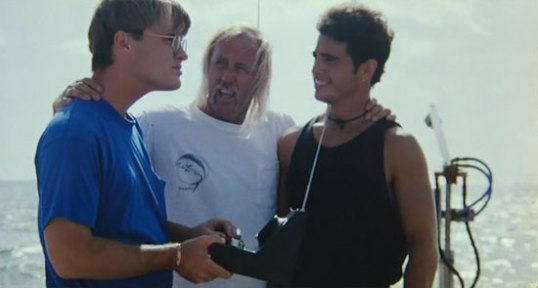
"Whattya say we go hunt some freaking sharks?"

“Whattya say we go hunt some freaking sharks?” (picture credit: Mondo Exploito)

Believe it or not, Samson vs. The Vampire Women was not the only bad film that I watched with the Late Night Movie Gang on Saturday night.  We also watched a movie from 1995 that was called Cruel Jaws.  You might be able to guess from the title that the film is a rip-off of Jaws but this is no ordinary rip-off!  This is literally the worst shark movie that I’ve ever seen.

And yet, it was so bad that it was also oddly fascinating.  Listen, any director can rip-off Jaws.  It happens all the time and, for the most part, the majority of Jaws rip-offs are forgettable.  It takes true talent to make something like Cruel Jaws, a film that is so terrible that it cannot be forgotten!

After watching Cruel Jaws, I was inspired to look it up on the imdb and I was not particularly shocked to discover that it was directed by the infamous Italian filmmaker Bruno Mattei.  Given that Mattei was notorious for reusing footage from previous films, I figured that I would reuse a paragraph that I originally wrote for a review of his 1984 film, Rats: Night of Terror:

“While it’s generally agreed that Mattei was responsible for making some of the worst films in history, I’ve always had a sneaky admiration for him.  It’s hard not to love someone who defies the odds while pursuing his dream.  Mattei’s dream was to make movies and he never allowed a thing like budget or talent to stand in his way.  While Mattei is best known for taking over the direction of Zombi 3 after Lucio Fulci walked off the set, he was a prolific director who dabbled in every genre.”

If nothing else, Cruel Jaws was definitely a case of Mattei defying the odds.  Critics might point out that the film is basically a scene-for-scene remake of Jaws that even features some of the exact same dialogue.  Mattei says, “So?  I’ll call the movie Cruel Jaws and we’ll pretend it’s a sequel.”  Critics might say that no one in the film can act.  Mattei says, “So?  I’ll just make my hero a guy with platinum blonde hair and a Fu Manchu mustache and you’ll be so busy staring at him, you won’t even notice that he can’t act!”  Critics might point out that Mattei made a film about a killer shark without actually investing in a shark.  Mattei says, “So?  I’ll just use stock footage and lift a lot of scenes from other shark movies!”  Critics might complain that all of the stock footage and lifted scenes are edited together in such a haphazard way that the film is next to impossible to follow.  Mattei says, “Shut up and listen to the score, which I literally lifted from Star Wars and Indiana Jones.”  Critics might suggest that all of this involves some sort of copyright violation.  Mattei says — well, by this point, Bruno would probably have left the building to count his money and have a good laugh.

"Check out that shark stock footage!"

“Check out that shark stock footage!” (picture credit: Mondo Exploito)

What really makes Cruel Jaws interesting is that, while 90% of the film is lifted from other films, the 10% that isn’t is truly weird.  For instance, the film’s hero is named Dag Snerson and he owns a water park that is apparently made up of exactly two dolphins and a sea lion.  His daughter is probably the most cheerful wheelchair-bound child ever.  There’s a subplot involving the mafia.  Two girls start yelling “Dickbrain” at two boys that they like.

It’s all pretty bad and pretty weird but it’s pure Bruno Mattei and therefore, it’s all oddly forgivable.

And guess what?

You can watch Cruel Jaws below!

The Daily Grindhouse: Samson vs. The Vampire Women (dir by Alfonso Corona Blake)


samson-vs-the-vampire-women

Just a few hours ago, I gathered with my friends in the Late Night Movie Gang and we watched the classic Mexican “horror” film, Santo vs. las Mujeres Vampiro (or, as it was released over here in the states, Samson Vs. The Vampire Women.)  You’ll notice that I put the word horror in quotes because there was really nothing traditionally scary about Samson Vs. The Vampire Women.  

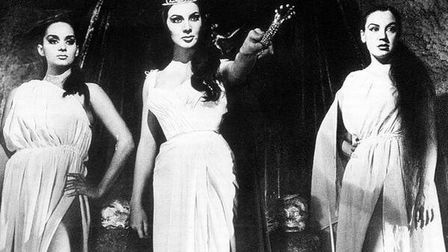
The film opens with a bunch of vampire women waking up after being asleep for hundreds of years.  When we first see the vampire women, they all look like they have really bad skin and could really use some moisturizer.  However, once they drink some blood and say some magic words, they all suddenly look really pretty and they get to wear these really nice white dresses as well.

The queen of the vampires, Thorina (Lorena Valesquez), has been tasked with finding a bride for the Evil One and her pick is Diana (Maria Duval), who is the daughter of Prof. Orlof (Augusto Benedico).  We know that Orlof is intelligent because he wears glasses, has a beard, and his English-language dialogue has been dubbed by an actor who has a deep, intellectual voice.  However, despite being brilliant, Orlof is totally ineffectual when it comes to protecting his daughter from being turned into a vampire.

(Diana, we’re told, is on the verge of turning 21.  She looks like she’s closer to 40.)

And, of course, we get all of the things that you would expect from a low-budget, black-and-white vampire movie.  Bats fly by on strings.  Whenever Thorina needs to hypnotize someone, we get a closeup of her eyes.  Whenever the sun shines, all of the vampires scream and run out of the room.  It’s all pretty typical and, as a result, not particularly scary.

What is scary, however, is the man who Orlof summons to protect his daughter.  Not only can Samson (played by real-life Mexican wrestler Santo) fight vampires and communicate with people via television but he’s a professional wrestler as well!  In fact, Diana would probably have nothing to worry about if not for the fact that Samson has to balance protecting her with his lucrative wrestling career.

Samson vs. the Vampire Woman

What I’m saying here is that there’s a lot of wrestling in Samson vs. The Vampire Women.  Not only does Samson wrestle with vampires but he also wrestles with ordinary, every day wrestlers.  Even when he’s not wrestling, Samson runs around in his wrestling outfit — mask, cape, manties, and bulge.

(Oddly enough, none of the vampire women ever think to maybe kick Samson in that bulge, which is probably what I would do if I was ever suddenly approached by someone dressed like Samson…)

Now, I know what you’re wondering.  And the answer is no.  We never get to see what Samson looks like under the mask.  I assume that he looked like Jack Black but who knows for sure?

Anyway, Samson vs. The Vampire Women is probably one of those films that everyone should see at least once, if just because that way you won’t be left out of any inside jokes that may develop between your friends once they’ve actually experienced it for themselves.  It’s not a particularly good film but it’s certainly an odd one and there’s definitely something to be said for that.

You can watch it below!

What Lisa Watched Last Night #117: Wuthering High School (dir by Anthony DiBlasi)


Yesterday, I finally got around to watching the latest film from both Lifetime and the Asylum, Wuthering High School!

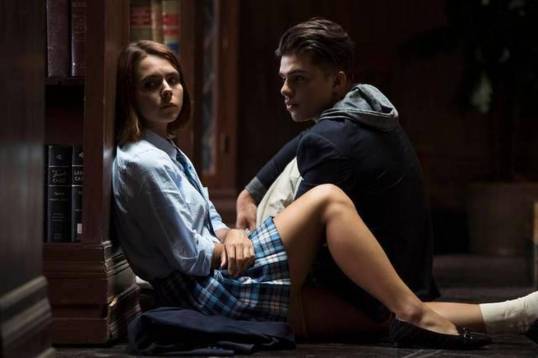
Wuthering High

Cathy and Heath


Why Was I Watching It?

I was late in watching Wuthering High School.  Saturday afternoon, I spent five hours in the Emergency Room, all so I could find out that I have bronchitis.  By the time I finally got home, I was so tired that I slept through the Lifetime premiere of Wuthering High School.  Fortunately, I did DVR it and yesterday, I finally found the time to watch it.

As to why I was watching it — hey, it’s a modern version of Wuthering Heights that’s set in a high school!  And it was produced by the Asylum!

Wuthering Heights, high school, and The Asylum, three of my favorite things.

Seriously, how could I not watch it?

What Was It About?

Wuthering High School is the latest version of Emily Bronte’s classic novel, Wuthering Heights.  After his family is deported, Heath (Andrew Jacobs) is adopted by wealthy Mr. Earnshaw (James Caan).  Soon, Earnshaw is viewing Heath as being more of a son to him than his biological child, the drug-addicted Lee (Sean Flynn).  Meanwhile, Heath has fallen in love with Earnshaw’s daughter, Cathy (Paloma Kwiatkowski).  Cathy is struggling to come to terms with the recent death of her mother and soon, she and Heath are skipping school, tearing up school books in slow motion, and getting sentenced to community service.  However, when Cathy rejoins the school’s popular clique of mean girls, she starts to grow distant from Heath.  While Heath plots his revenge, Cathy is pursued by the well-meaning but ineffectual Eddie Linton (Matthew Boehm).

What Worked?

At its heart, Wuthering High School was definitely a “look at the pretty clothes and look at the pretty houses” type of film.  And that’s okay because, ultimately, the clothes and the houses were all very pretty and they were all filmed in very loving detail by director Anthony DiBlasi.  At it’s best, Wuthering High School is a pure celebration of melodramatic style.

Modernizing a classic, 19th century novel is always a risky proposition.  Setting it in a high school is equally dangerous as well.  But I actually liked a few of the ways that Bronte’s story was updated.  For instance, I thought it was brilliant to turn the novel’s gambling addicted Hindley Earnshaw into the film’s drug-addicted Lee Earnshaw.  As well, transforming gypsy Heathcliff into Heath, the son of a deported illegal immigrant, worked far better than I expected that it would.

Among the supporting cast, Matthew Boehm and Francesca Eastwood were both well-cast.  Eastwood, especially, seemed to be having a lot of fun delivering her Mean Girls-style dialogue.  (“That’s not the first time you’ve been wet,” she says after pouring a drink on Cathy.)  And James Caan brought a lot of gravitas to his role.

And, finally, Paloma Kwiatkowski was well-cast as the angry and outspoken Cathy.  Many scenes that should not have worked did work because of Kwiatkowski’s sincere and empathetic performance.

What Did Not Work?

So, with all of those good points that I mentioned above, why wasn’t Wuthering High School as much fun as it should have been?  Ultimately, I think the film’s pacing was just a little bit off.  Certain scenes moved just a bit too slowly while other scenes were finished too quickly and, as a result, the entire film had an oddly rushed feel to it.

As well, I had some issues with the film’s ending.  Obviously, this is going to be a SPOILER so, if you want to be surprised, don’t read any further.  *SPOILER BEGINS* Towards the end of Wuthering High School, Cathy chooses to walk out into the ocean and drowns herself while Heath watches.  We are then left with a montage of everyone mourning, Heath digging up her grave and curling up next to her in a coffin, and Cathy — speaking to us from beyond the grave — saying that she’s now finally been reunited with her mother.   And … seriously?  Obviously, Cathy had to die in order to remain true to the spirit of Wuthering Heights but did she have to commit suicide and, even more importantly, did the film have to suggest that she was better off having done so? *SPOILER ENDS*

Finally, of the many actors to have played Heathcliff over the years, Andrew Jacobs was not exactly the most convincing.  He came across as being more petulant than passionate.

“Oh my God!  Just like me!”  Moments

Oh, I totally related to Cathy.  I always do.

Lessons Learned

Avoid the ocean at all costs.

Life is a Beach #4: Spring Break (dir by Sean S. Cunningham)


I think I may have made a mistake.  When I started reviewing beach films, I did so because it’s currently spring break for thousands of college students across the country and, right now, they’re all probably having a good time on the beach.  Unfortunately, what I didn’t consider was that watching and reviewing these films would make me start to wish that I was currently there with them.

Don’t get me wrong.  It’s not that I want to go hang out on the beach and party and flirt and get high and live for the moment and … well, no, actually, that’s exactly what I wish I was doing right now.  None of the beach films that I’ve watched so far have been good exactly but they do all get at a larger truth.

We all need some sort of spring break.

That’s certainly the theme of the 1983 comedy, Spring Break.

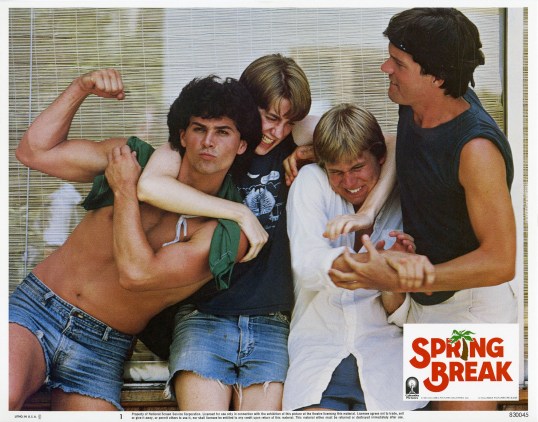
The heroes of Spring Break

The heroes of Spring Break

Perhaps the most surprising thing about Spring Break is that, unlike Malibu Beach and The Beach Girls, it was not produced by Crown International Pictures.  It certainly feels like a Crown International movie.  The film is a largely plotless collection of scenes, all of which take place over the course of spring break in Ft. Lauderdale.  It starts out as a comedy and then gets strangely dramatic towards the end.  It features a lot of nudity for male viewers but luckily, it has two hot guys for me so it all works out in the end.

Two nerdy students, Nelson (David Knell) and Adam (Perry Lang) go down to Florida for spring break.  Nelson does this despite the fact that he had promised that he would spend spring break working on his politically ambitious stepfather’s campaign.  When Nelson and Adam’s picture ends up in the paper, Nelson’s stepfather (Donald Symington) sends his operatives down to Florida to basically kidnap Nelson and drag him home.  Along the way, the stepfather also somehow gets involved in a plot to take over the motel where Nelson and Adam are staying.

Uhmmm…what?

Yes, it doesn’t make much sense but then again, the plot is never that important in these type of films.  What is important is that the motel is overbooked and, as a result, Nelson and Adam find themselves roommates with two hot guys from New York, Stu (Paul Land) and O.T. (Steve Bassett).

One thing that I did like about this movie is that it didn’t waste any time pretending that Stu and O.T. wouldn’t become best friends with Nelson and Adam.  Instead, the four of them start bonding as soon as they meet and they were all best friends within the first 15 minutes of the film.  Yay for another successful bromance!  But seriously, it is kind of sweet.

And it’s also fortunate because, once Nelson is kidnapped and held prisoner on a boat by his stepfather, who better to rescue him than two guys from Brooklyn?

Yes, it’s all pretty stupid but, as far as teen sex comedies from the early 80s are concerned, this is one of the better of them.  At the very least, Knell and Lang are both likeable and Land and Bassett are both hot and that really is about the best that you can hope from a film like this.  Add to that — and this is a theme that I seem to keep returning to as far as these beach films are concerned — Spring Break is a time capsule.  Though Spring Break was released before I was born, I feel like, having seen it, that I now have some firsthand experience of what it was like to be alive in 1983.

So 80s....

So 80s….

As I mentioned at the start of this review, Spring Break feels like a Crown International Picture but, actually, it was released by Columbia Pictures.  And it was directed by Sean S. Cunningham, who is probably best known for directing the original Friday the 13th!  Harry Manfredini even provided the music for both films.  That said, the fun-loving teenagers of Spring Break come to a much happier end than the ones at Camp Crystal Lake.

Life is a Beach #3: The Beach Girls (dir by Pat Townsend)


The_Beach_Girls_1982

“You louse!  You hussy!”

“What’s a hussy?”

“Who’s loud?”

— Typical dialogue from The Beach Girls (1982)

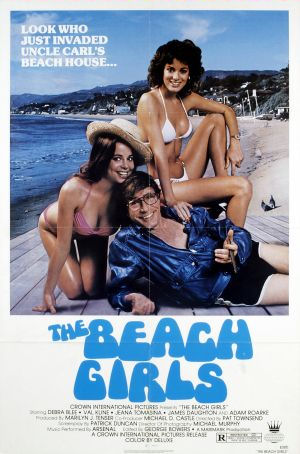
 As you may have guessed from the combination of the film’s title, the film’s poster, and the film’s dialogue, the 1982 comedy The Beach Girls is yet another production from Crown International Pictures.

And if you had any doubts, The Beach Girls quickly erases them by not only featuring the exact same songs that were heard in both The Pom Pom Girls and Malibu Beach but by also reusing a good deal of beach footage that originally appeared in Malibu Beach.  Remember that dog in Malibu Beach that kept stealing everyone’s bikini top?  Apparently, the folks at Crown International really liked that dog because all of his scenes are awkwardly inserted into The Beach Girls.

CIP_Logo

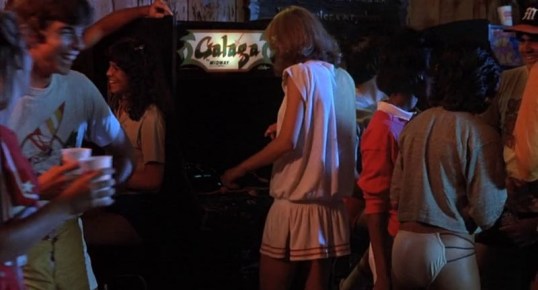
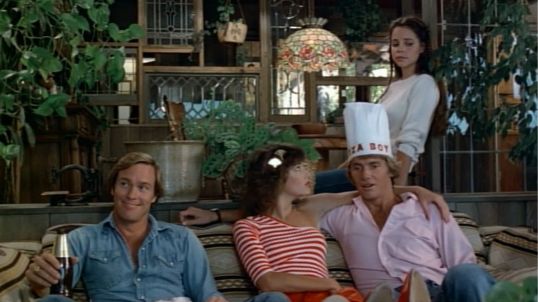
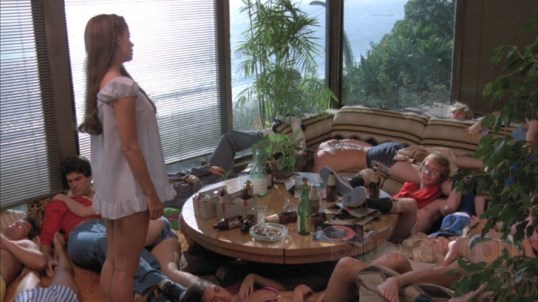
In between all of the Malibu Beach footage, The Beach Girls tells the story of three girls who have a nice beach house for the summer and who proceed to throw a party.  That is literally the plot of the entire film.  Two of the girls — Ginger (Val Kline) and Ducky (Jeana Tomasina) — are up for anything while their best friend, the shy and intellectual Sarah (Debra Blee), desperately needs to relax and have a good time.  Fortunately, there’s a sensitive musician at the party.  His name is Scott and he’s played by James Daughton, who was also in Malibu Beach.  With Scott’s help, Sarah starts to come out of her shell, which largely means that she starts to progressively wear less and less clothes.

Just when it looks like the party might be on the verge of concluding, six garbage bags of weed wash up on the beach.  That comes in handy once all of the uptight authority figures start to show up and demand that the party end.  Fortunately, the super weed inspires everyone to just relax and have fun.  Not even the eventual arrival of the Coast Guard can stop this party…

The Beach Girls

The Beach Girls is pretty much your typical Crown International teen sex comedy.  The main thing that distinguishes it from The Pom Pom Girls and Malibu Beach is that the main characters in The Beach Girls are all female.  And while the three main characters all still required to spend a good deal of the film undressed, this is a rare teen comedy where the guys are just as likely to get naked as the girls and where the girls have as much fun as the guys.  As a result, there’s little of the misogyny that lay underneath the surface of The Pom Pom Girls and, to a lesser extent, Malibu Beach.

Don’t get me wrong.  The Beach Girls, which is currently available Hulu and has also been included in a few Mill Creek box sets, is hardly a great or even a good film.  It’s pretty much a standard sex comedy where both the characters and the jokes are predictably dumb.  But, when taken on its own modest terms, it’s an inoffensive little time capsule.

Plus, the film’s beach house is really nice!  Seriously, that’s one thing that I love about films from the 80s.  Even the low-budget comedies always take place in the nicest houses!

The Beach Girls 2

Life is a Beach #2: Malibu Beach (dir Robert J. Rosenthal)


MALIBU-BEACH

Yesterday, I started my 2-week miniseries of reviews on beach movies by taking a look at 1963’s Beach Party.  For my next review, I will be jumping forward 15 years and taking a look at 1978’s Malibu Beach.  

Just by comparing the two films, you can tell that a lot changed during those 15 years.  As opposed to the euphemism-spouting surfers of Beach Party, the teenagers that hang out on Malibu Beach know exactly what they want and they’re not ashamed to say it.  What Beach Party could only hint at, Malibu Beach has the freedom to make explicit.  The film’s poster claims that “everything can happen on Malibu Beach” and, in theory, that’s certainly true.

And yet, at the same time, Malibu Beach has more in common with Beach Party than you might think.  Ultimately, they’re both about the same thing: celebrating the idea of being young and having freedom.  Both films are a bit of a chore to try to watch today but are interesting as cultural time capsules.  Beach Party had no plot.  Malibu Beach has no plot.  Beach Party featured some oddly generic music.  Malibu Beach features the same three generic songs being played over and over and over again.  Beach Party features Erich Von Zipper and his motorcycle gang.  Malibu Beach features a muscle-bound bully named Dugan (Steve Oliver).  Beach Party featured a cameo appearance from Vincent Price.  Malibu Beach features a dog that steals bikini tops.  Beach Party was produced by American International Pictures.  Malibu Beach was produced by Crown International Pictures.

That’s right!  Malibu Beach is a Crown International Picture and anyone who loves 70s exploitation knows what that means.  Malibu Beach is a cheaply produced film that was made to exploit then-current trends and bring in a lot of money.  Like a lot of Crown International Films, it’s technically a pretty bad film but it’s so sincere and honest about what it is that it almost feels petty to be too critical of it.

CIP_Logo

Oddly enough, Malibu Beach pretty much feels like a remake of a previous Crown International Picture, The Pom Pom Girls, the main difference being that, while the visual style of The Pom Pom Girls was almost oppressively ugly, Malibu Beach at least features some pretty beach scenery.

Much like in the Pom Pom Girls, the heroes of Malibu Beach are two high school jocks, one of whom, Bobby (played by James Daughton, who, that same year, also played the evil Greg in National Lampoon’s Animal House), is dark and brooding while the other, Paul (Michael Luther), is skinny and dorky.

Much as in The Pom Pom Girls, one of the heroes has a nemesis for no particular reason.  Seriously, I never could figure out why Bobby and Dugan hated each other but they certainly did.  What’s odd is that, whenever there’s a confrontation between the two of them, Malibu Beach suddenly gets extremely serious.  Bobby and Dugan glare at each other and speak through clenched teeth.  Suddenly, there’s no music on the soundtrack and all we can hear are seagulls above and the tide rolling in and it all feels very ominous.  I sat through Malibu Beach expecting either Dugan and Bobby to be dead at the end of the film, that’s how seriously their conflict is portrayed.

Also, much like The Pom Pom Girls, Bobby and Paul each have girlfriends.  Paul is dating the spacey Sally (Susan Player).  Bobby, meanwhile, is romancing the new lifeguard, Dina (Kim Lankford).  Dina has a big scene where she tells Bobby that she can’t handle being caught in the middle of his increasingly intense rivalry with Dugan.  Again, it’s a deadly serious scene and it’s just so strange to see it there, awkwardly dropped in between scenes of a bumbling cop smoking weed and a dog stealing bikini tops.

Finally, the main similarity between The Pom Pom Girls and Malibu Beach is that the exact same three songs appear in both films!  Obviously, somebody at Crown International, really loved those three songs.

Malibu Beach is one of those films that was obviously made to appeal to hormonal teens at a drive-in but, by today’s standards, it’s rather tame.  It’s currently playing on Hulu and it’s also available in several of those Mill Creek box sets that we all know and love.  Is the film any good?  No.  Do I recommend it?  Not really.  But, much like Beach Party, it is a portal into the past.

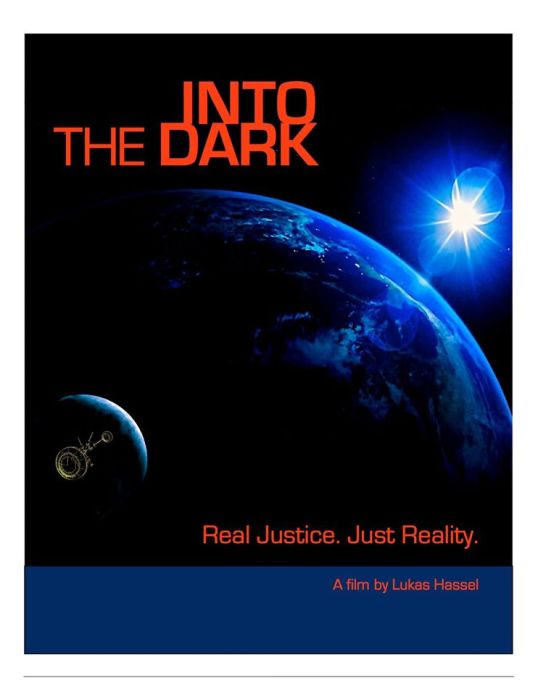
Film Review: Into the Dark (dir by Lukas Hassel)


Into the Dark

“Congratulations!  You just destroyed government property!” —

33963 (Lee Tergesen) in Into the Dark (2014)

The quote above comes from a 14-minute short film that I was recently fortunate enough to have the opportunity to view.  If you’ve read my previous reviews on this site, then you probably know that I’m not a huge fan of government property in general so, as you can imagine, that line made me smile.  Within the context of the film, it also provided a brief moment of triumph for two men who have both reached a point where they have to be happy for whatever temporary victory they may happen to achieve.

Into the Dark opens with a haunting image of an urban skyline.  The moon hangs over the city and, as we watch, we briefly see that something has been launched into the night sky.  That object is a small capsule that includes two men who have been strapped in back-to-back.  The two men are identified not by name but by number.  58257 (Lukas Hassel, who also wrote and directed Into the Dark) is angry and shouts at the unseen people who are watching him.  Meanwhile, 33963 (voiced by Lee Tergesen) gives him advise on how to turn off a strobing blue light and tells him that, no matter how loudly he shouts, nobody watching can hear a word that he’s saying.  No one on Earth is interested in what these two men have to say for themselves.  Instead, the audience simply wants the catharsis of seeing what happens to them.

As we listen, it becomes apparent that these two men have broken the law and this space ride is a part of their punishment.  33963 was a political revolutionary while 58257’s crimes are a bit more ambiguous.  Every few seconds, a condescending computerized voice tells them to think about what they’ve done.  As their punishment approaches, 33963 begs 58257 to just talk to him and to allow him to experience some sort of human interaction…

Into the Dark may take place in the future but it deals with a very modern reality: we live in a very bloodthirsty time and that’s especially true in the way that we treat those who have been convicted of breaking the law.  At a time when people feel like they have less and less control over their own fates, there’s a need to punish those who break “the rules,” never mind the fact that some rules make more sense than others.  At any given times, you can turn on the television and watch reality shows about cops arresting lawbreakers, attorneys prosecuting the accused, and guards watching the convicted.  These shows presents us with a world where the is no difference between a murderer and some guy who happened to have a little bit of weed in his car and where the only thing that matters is that people are being held responsible for breaking the rules that it’s assumed the viewer automatically and unquestioningly obeys.  These shows allow an insecure society to feel superior.

That’s one reason why Into the Dark is so memorable.  The final twist, the truth of why Hassel and Tergesen are in that capsule together, is totally plausible.  It’s something that we, as an audience, know is probably going to end up happening some day.  When the plausibility of that twist is mixed with the emotional power of the performances of Tergesen and Hassel, the end result is a thought-provoking look at crime, punishment, and the manufacturing of televised reality.

Another thing that makes Into The Dark so memorable is that the end credits mention that the majority of this film was shot in “Lukas Hassel’s apartment.”  You wouldn’t know that from watching the film, which takes wonderful advantage of the production’s low-budget.  The inside of the capsule is claustrophobic and cramped in the way that you would expect an intergalactic jail cell to be small and cramped.  Despite almost entirely taking place in one small set, Hassel and cinematographer Henry Lee never allow the action to get stagey. Instead, it’s a fully cinematic experience and the fact that it was shot in someone’s apartment should give hope to aspiring independent filmmakers every where.

Into the Dark is currently playing on the festival circuit.  You can find out more about the film here.  And you can also check out it’s Facebook page.  Or, if you’re at the Queens World Film Festival on March 18th or the Maryland Film Festival on March 28th, you can check it out there as well!