Film Review: Good Kill (dir by Andrew Niccol)


Good_Kill_poster

Good Kill is an angry film that is somewhat grounded by a strong lead performance from Ethan Hawke.  Hawke was nominated for Best Supporting Actor for his performance in Boyhood and … well, he probably won’t be nominated for anything for Good Kill.  The film’s coming out too early in the year and it’s not really a crowd-pleasing Oscar movie.  It’s too angry and polemical but still, Ethan Hawke gives an excellent performance.

Hawke plays Thomas Egan, an air force pilot who, after serving 6 tours in Afghanistan, is reassigned to pilot drones from a base in Las Vegas.  For 12 hours a day, Egan sits in a cramped room where he and three other pilots spend their time staring at video monitors and observing people going about their lives on the other side of the world.  Occasionally, a phone rings and they are given orders by a never seen CIA supervisor.  All Egan has to do is push a button and, in just ten seconds, he can blow up a stranger 7,000 miles away.

Of course, it’s not just the targets who get blown up.  Anyone unlucky enough to be standing nearby ends up getting blown up as well, which is something that Egan’s commanding officer (Bruce Greenwood) insists is a regretful but acceptable consequence of fighting the War of Terror.  Except, of course, nobody’s quite sure that they’re actually blowing up terrorists.  Instead, often times, it’s a matter of guesswork.  People are blown up because they could be terrorists, not because they definitely are.

While most of the members of Egan’s unit are unconcerned about the ethics or the legalities of drone warfare, Vera Suarez (Zoe Kravitz) is an exception.  She worries that they’re just creating more terrorists.  (And yet, interestingly enough, she still follows orders whenever she’s told to blow someone up.)  Egan is troubled by the implications of what he’s doing but, for the most part, he keeps his feelings to himself.

From the beginning, the tightly wound Egan struggles with the pressure of being a drone pilot.  After spending half of the day killing strangers who may or may not be terrorists, Egan finds it difficult to spend the rest of the day with his wife (January Jones) and his children.  Slowly but surely, cracks start to appear on Egan’s facade.  He starts drinking.  He drives recklessly.  He yells at his family.  He grows paranoid about the neighbors.  When a cop asks him how the War on Terror is going, Egan smirks and replies that it’s going as well as the War on Drugs…

Even though I agreed, for the most part, with everything that the film had to say, I still found it to be incredibly heavy-handed.  There is something to be said for subtlety and Good Kill is definitely not a subtle movie.  Rabidly anti-military audiences will enjoy having their own prejudices confirmed but, with everyone other than Egan and Vera being portrayed as being bloodthirsty and ignorant, you can be sure that this film won’t change any minds.  Politically, this a political film that’s not going to make a bit of difference.

At the same time, there is an interesting subtext running through the film.  During the 12 hours that Egan spends in that room, he essentially ceases to be a human being and becomes an extension of that drone.  Both literally and figuratively, he becomes a part of the war machine.  Just imagine if a director like David Cronenberg had handled this material.  Director Anrew Niccol briefly touches on the Cronenbergian aspects of the story but, in the end, he gets too bogged down in all of the speeches.

The problem with political films like Good Kill is that they often feel very artificial and that’s why you’re thankful for Ethan Hawke’s performance.  Hawke gives a performance of such raw power that he cuts through all of the polemical bullshit.  The film is nearly smothered under the director’s heavy hand but Hawke breathes it back to life.  Hawke’s performance brings much needed authenticity to Good Kill and, as a result, he elevates the entire film.
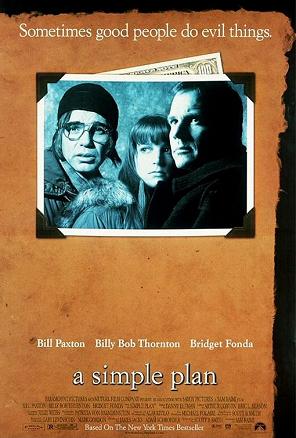
Embracing the Melodrama Part II #96: A Simple Plan (dir by Sam Raimi)


Simple_plan_poster

The 1998 film A Simple Plan reunites Bill Paxton and Billy Bob Thornton.  After previously playing adversaries in One False Move, they played brothers here.  However, it’s not just the cast that makes A Simple Plan feel like a spiritual descendant of One False Move.  Both One False Move and A Simple Plan deal with greed and violence.  Both One False Move and A Simple Plan take place in a small town where everyone thinks that they know all there is to know about each other.  Both One False Move and A Simple Plan feature Paxton as a man who turns out to be something more than what the viewer originally assumed.  Perhaps most importantly, both One False Move and A Simple Plan are meditations on guilt, greed, and community.

A Simple Plan takes place in Minnesota, in a world that seems to exist under a permanent layer of snow and ice.  While out hunting, Hank (Bill Paxton), his well-meaning but dim-witted brother Jacob (Billy Bob Thornton), and their redneck friend Lou (Brent Briscoe) stumble across an airplane that has crashed in the woods.  Inside the airplane, they find a dead pilot and a bag containing 4 million dollars.  At first, Hank says they should call the authorities and let them know what they’ve found but he rather easily allows Jacob and Lou to talk him out of it.  Instead, they agree that Hank will hide the money at his house until spring arrives.  They also agree to not tell anyone about the money but, as soon as he arrives home, Hank tells his pregnant wife Sarah (Bridget Fonda) everything that has happened.

Needless to say, this simple plan quickly get complicated.  Sarah is soon telling Hank that he should not trust Lou and Jacob.  The local sheriff (Chelcie Ross) saw Hank and Jacob leaving the woods after discovering the plane and may (or may not) be suspicious of what they found.  Alcoholic Lou starts to demand his share of the money early.  As things start to spiral, Hank finds himself doing things that he would have never thought he would ever do.  Or, as Sarah puts it, “Nobody’d ever believe that you’d be capable of doing what you’ve done.”

And then, one day, a mysterious FBI agent (Gary Cole) shows up and says that he’s looking for the plane.  Except that, according to Sarah, he’s not really with the FBI…

It’s appropriate that A Simple Plan takes place in a world that appears to be permanently covered in snow because it is a film that is both chilly and chilling.  Bill Paxton and Billy Bob Thornton are both perfectly cast.  (Thornton received an Oscar nomination for his performance.  Paxton undoubtedly deserved one.)  Bridget Fonda turns Sarah into a small town Lady MacBeth and Gary Cole, Brent Briscoe, and Chelcie Ross are all memorable in smaller roles.

(Brent Biscoe, in particular, is a redneck nightmare.)

The next time that you want to contemplate the evil that is done in the name of money, why not start off with a double feature of One False Move and A Simple Plan?


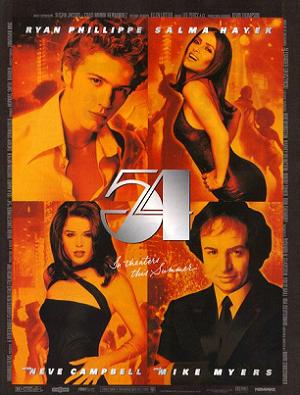
Embracing the Melodrama Part II #95: 54 (dir by Mark Christopher)


54_poster

“A guy named Steve Rubell had a dream: To throw the best damned party the world had ever seen and to make it last forever. He built a world where fantasy was put up as reality and where an 80-year-old disco queen could dance till dawn. Where models mingled with mechanics, plumbers danced with princes. It was a place where all labels were left behind. A place where there were no rules.”

— Shane O’Shea (Ryan Phillippe) in 54 (1998)

So, did you actually read that quote at the beginning of the review?  I don’t blame if you didn’t because not only is it ludicrous overwritten but it just goes on and on.  It’s one of those quotes that you read in a script and you think to yourself, “They better get absolutely the best actor in the world to deliver these lines,” and then you realize Ryan Phillippe has been cast in the role.

Except, of course, I doubt that any of those lines were found in the original script for 54.  54 is one of those films where, as you watch it, you can literally imagine the chaos that must have been going on during the editing process.  Subplots are raised and then dropped and the mysteriously pop up again.  Characters change both their personalities and their motives in between scenes.  Huge dramatic moment happen almost at random but don’t seem to actually have anything to do with anything else happening in the film.

In short, 54 is a mess but it’s a mess that’s held together by incredibly clunky narration.  Shane O’Shea, who spent the waning days of the 1970s working at Studio 54, narrates the film.  And, despite the fact that Shane is presented as being kinda dumb (think of Saturday Night Fever‘s Tony Manero, without the sexy dance moves), his narration is extremely verbose and reflective. It’s almost as if the narration was written at the last-minute by someone desperately trying to save a collapsing film.

I watched 54 on cable because I saw that it was about the 70s and I figured it would feature a lot of outrageous costumes, danceable music, and cocaine-fueled melodrama.  And it turns out that I was right about the cocaine-fueled melodrama but still, 54 is no Boogie Nights.  It’s not even Bright Lights, Big City.

54 does have an interesting cast, which makes it all the more unfortunate that nobody really gets to do anything interesting.  Poor Ryan Phillippe looks totally lost and, in the film’s worst scene, he actually has to stand in the middle of a dance floor and, after the death of elderly Disco Dottie (that’s the character’s name!), yell at all the decadent club goers.  Breckin Meyer is cute as Phillippe’s co-worker and Salma Hayek gets to sing.  Neve Campbell plays a soap opera actress who Phillippe has a crush on and…oh, who cares?  Seriously, writing about this film is almost as annoying as watching it.

Mike Myers — yes, that Mike Myers — plays the owner of the club, Steve Rubell.  The role means that Myers gets to snort cocaine, hit on Breckin Meyer, and vomit on the silk sheets of his bed.  I think that Myers gives a good performance but I’m not really sure.  It could have just been the shock of seeing Mike Myers snorting cocaine, hitting on Breckin Meyer, and vomiting on the silk sheets of his bed.

If you want to enjoy some 70s decadence, avoid 54 and rewatch either Boogie Nights or American Hustle.

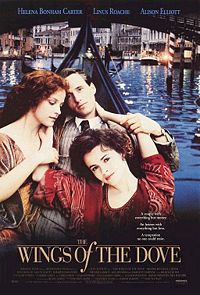
Embracing the Melodrama Part II #94: The Wings of the Dove (dir by Ian Softley)


Wings_of_the_dove_ver1For nearly two months now, I’ve been in the process of reviewing 126 cinematic melodramas.  (I know that I originally said that I would be reviewing 126 films in 3 weeks but, even at the time I said that, I think a part of me knew that it would probably be more like 8 or 9 weeks.)  And, while it seems like forever since I started this series by reviewing the 1927 silent classic Sunrise, I’ve still been having fun discovering and rewatching some wonderful films.  It’s been a lot of work but if I’ve inspired anyone to see any of the 93 films that I’ve reviewed so far, then it’s all been worth it.

For our 94th entry, let’s take a quick look at the 1997 film The Wings of the Dove.

Based on a novel by Henry James, The Wings of the Dove open in London.  The year is 1910 and Kate Croy (Helena Bonham Carter) has problems.  Her mother has recently died and her father (Michael Gamon) is a penniless opium addict.  Kate is taken in and supported by her wealthy Aunt Maude (Charlotte Rampling).  Maude has plans for Kate to marry the vapid Lord Mark (Alex Jennings) and demands that Kate have no contact with either her father or any of her old friends.

Among those that Kate is supposed to abandon is a journalist named Merton Densher (Linus Roache).  Kate and Merton are in love but there’s no way that Maude would ever allow them to get married.  Merton is not only poor but he’s a bit of a radical as well.

While visiting with Lord Mark, Kate meets an American heiress named Milly (Alison Elliott).  As open and kind as Kate is cynical and manipulate, Milly is touring Europe.  Milly and Kate quickly become friends and Milly goes as far as to invite Kate to go to Venice with her.  It’s also through her friendship with Kate that Milly first meets Merton.  Attracted to him and unaware of her relationship with Kate, Milly invites him to come to Venice as well.

Kate, meanwhile, has discovered that Milly is terminally ill.  She comes up with a scheme, in which Merton will romance Milly.  Kate is convinced that Milly will then change her will to include Merton.  Once Milly dies, Merton will be rich and then Maude will have no reason to object to him marrying Kate.

At first, Merton is repulsed by the scheme but he finally agrees, specifically so that he can go to Venice with Kate.  However, once they’re all actually in Venice, things start to get complicated.  Merton starts to fall in love with Milly and Kate discovers that she loves Merton more than she originally realized…

The Wing of the Dove is an effective literary adaptation, one that brings a contemporary spin to the material while still remaining truthful to the spirit of the source material.  The costumes and the sets are beautiful to look at and Venice is as wonderfully romantic and cinematic as always.  Linus Roache is a bit of a stiff as Merton (but then again, the same could be said for the character himself) but it doesn’t matter because the film is dominated by Helena Bonham Carter’s ferocious performance in the role of Kate.  She plays Kate as a bundle of nervous energy and barely repressed carnality, an Edwardian femme fatale.  She was rightfully nominated for best actress for her performance in this film.  The award, however, went to Helen Hunt for As Good As It Gets.

(This, along with the complete snubbing of Boogie Nights, would seem to suggest that 1997 was not a banner year as far as the Academy Awards were concerned…)

The Wings of the Dove is currently available to be viewed on Netflix.  Don’t miss it.


What Lisa Marie Watched Last Night #126: The Secret Life of Marilyn Monroe, Part 2 (dir by Laurie Collyer)


On Sunday night, I watched Part 2 of Lifetime’s The Secret Life of Marilyn Monroe.

The Secret Life of Marilyn MonroeWhy Was I Watching It?

I was watching it because I watched Part One on Saturday and I absolutely loved it!  I wanted to see how Part Two would deal with the second half of Marilyn’s life.  Would it explore the mysteries that still surround her death?  Would the Kennedys make an appearance?  Who would come off worse — Joe DiMaggio or Arthur Miller?

What Was It About?

Part Two of The Secret Life of Marilyn Monroe deals with her life after she became a star.  We watch as the increasingly fragile Marilyn marries the physically abusive Joe DiMaggio (Jeffrey Dean Morgan) and the mentally abusive Arthur Miller (Stephen Bogaert).  (Seriously, neither Joe nor Arthur comes across positively in this film.)  Marilyn continues to deal with her own fears that she’ll go crazy like her mother (Susan Sarandon).  She has a brief moment of hope when she meets John F. Kennedy, though the film is deliberately vague about the details of their relationship.  Ultimately, she ends up having a breakdown and is hospitalized against her will.  By the end of the film, it seems like she’s found some hope for the future but then, we see her tossing and turning in bed and clumsily reaching for a bottle of pills…

What Worked?

Kelli Garner’s performance as Marilyn was just impressive here as it was during the first part of the film.

What Did Not Work?

Sadly, Part Two just wasn’t as good as Part One.  To a large extent, Part One worked because of the emphasis on Marilyn’s relationships with her mom (Susan Sarandon) and her adopted aunt Grace (Emily Watson).  In Part Two, those relationships were overshadowed by Marilyn’s unhappy marriages to DiMaggio and Miller.  As a result, the film lost some of its focus and it often seemed to be meandering from one unhappy scene to another until Marilyn’s final night.

Also, I was disappointed that the film was so vague in its approach to Marilyn’s relationship with the Kennedys.  Listen, everyone knows that Marilyn had an affair with both Jack and Bobby Kennedy.  The film tried to create some ambiguity about this point, never actually showing either Kennedy brother on screen and instead, just having Marilyn talk about them.  Rather unfairly, this created the impression that both affairs could have been another one of Marilyn’s delusions.  Quite frankly, Marilyn Monroe deserves better than that.

“Oh My God!  Just like me!” Moments

Just as with Part One, there were several.  Kelli Garner humanized her iconic role to such an extent that I think everyone watching could relate to her.  I’ll just say that I’ve known my DiMaggios and my Millers and leave it at that.

Lessons Learned

Fame does not equal happiness.

In the end, Part Two was not as good as Part One but, overall, The Secret Life of Marilyn Monroe was worth the 4 hours it took to watch it.  It did a great job of recreating the Hollywood of the past and Kelli Garner gave a great performance.  Since this is Lifetime that we’re talking about, I imagine both parts will be rerun frequently.  If you missed them the first time, don’t make the same mistake twice!

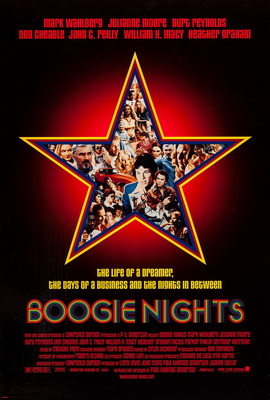
Embracing the Melodrama Part II #93: Boogie Nights (dir by Paul Thomas Anderson)


Boogie_nights_ver1The 1997 film Boogie Nights (which, amazingly enough, was not nominated for best picture) is a bit of an overwhelming film to review.  It’s a great film and, if you’re reading this review, you’ve probably seen Boogie Nights and you probably already know that it’s a great film.  And if you haven’t seen Boogie Nights, you really should because it’s a great film.  So, this review, in short, amounts to: Great film.

Boogie Nights takes place in the late 70s and the early 80s.  Eddie Adams (Mark Wahlberg) is a high school dropout who works as a busboy, lives with his parents, and has a really big cock.  (Indeed, one of the film’s most famous lines is, “This is a giant cock.”)  When we first meet Eddie, he’s likable and cute in a dumb sort of way.  Then he meets adult film director Jack Horner (Burt Reynolds) and becomes a star.  At first, everything is great.  Eddie changes his name to Dirk Diggler and no longer has to deal with his abusive mother (a chilling Joanna Gleason).  Jack and Amber Waves (Julianne Moore) become his new parents.  He gets a cool older brother in the form of actor Reed Rothschild (John C. Reilly, totally nailing the “People tell me that I look like Han Solo,” line).  He makes friends with other adult film actors, like the desperately unhip Buck (Don Cheadle), the free-spirited (and secretly very angry) Rollergirl (Heather Graham), and the poignantly insecure Jessie St. Vincent (Melora Walters).  He gets new admirers, like Scotty J. (Philip Seymour Hoffman).  He also gets addicted to cocaine.  And while Dirk falls from stardom, the adult film industry is taken over by gangsters like Floyd Gondolli (Philip Baker Hall) and self-styled artists like Jack Horner find themselves pushed to the side.

And you may have noticed that I mentioned a lot of actors in the paragraph above.  That’s because Boogie Nights is a true ensemble piece.  It’s full of great performances and memorable characters.  Along with everyone that I mentioned above, the cast also includes William H. Macy as cinematographer “Little Bill” Daggett.  From the minutes we first meet Little Bill, we get the feeling that he might be a little bit too uptight for pornography.  Maybe that’s because his wife — played by the inspiring sex positive feminist and veteran adult film star Nina Hartley — is constantly and publicly cheating on him.  Macy and Hartley do not have as much screen time as the rest of the cast but, ultimately, their characters are two of the most important in the film.

And then there’s Robert Ridgely, who is marvelously sleazy as the paternal but ultimately icky Col. James.  When we first meet the Colonel, he’s almost a humorous character.  But then, suddenly, there’s one chilling scene where he opens up to Jack Horner and we are forced to reconsider everything that we had previously assumed about both the Colonel and his business.

And how can we forget Luis Guzman, as a club owner who desperately wants to appear in one of Jack’s films?  Or Ricky Jay as a plain-spoken cameraman?  Or how about Thomas Jane, playing one of those tightly wound characters who you know is going to be trouble as soon as you see him?  And finally, nobody who has seen Boogie Nights will ever forget Alfred Molina, singing along to Sister Christian and running down the street, clad only in black bikini briefs and firing a shotgun.

But it’s not just the actors who make Boogie Nights a great film.  This was Paul Thomas Anderson’s second film and, under his direction, we feel as if we’ve been thrown straight into Dirk’s exciting and ultimately dangerous world.  When the film begins, the camera almost seems to glide, capturing the excitement of having everything that you could possibly want.  But, as things go downhill for Dirk, the camerawork gets more jittery and nervous.   A sequence where Anderson cuts back and forth between Jack trying to shoot a movie on video (as opposed to his beloved film) and Dirk nearly being beaten to death in a parking lot remains one of the best sequences that Anderson has ever directed.

And then there’s the music!  Oh my God!  The music!

And the dancing!

And the singing!

I’ll be the first admit that I have no idea whether or not Boogie Nights is a realistic portrait of the adult film industry in the 70s and 80s.  But ultimately, Boogie Nights is not about porn.  It’s about a group of outsiders who form their own little family.  At the end of the film, you’re happy that they all found each other.  You know that Dirk will probably continue to have problems in the future but you’re happy for him because, no matter what happened in the past or what’s going to happen in the future, you know that he’s found a family that will always love him.

As I mentioned at the start of this appreciation, Boogie Nights was not nominated for best picture.  Titanic was named the best picture of 1997.  As I’ve said before, I loved Titanic when I was 12.  But, nearly 18 years later, Boogie Nights is definitely the better picture.

It has stood the test of time.


What Lisa Marie Watched Last Night #125: The Secret Life of Marilyn Monroe, Part I (dir by Laurie Collyer)


Earlier tonight, I watched Part One of the latest Lifetime original movie, The Secret Life of Marilyn Monroe.

The Secret Life of Marilyn Monroe

Why Was I Watching It?

Lifetime has been advertising The Secret Life of Marilyn Monroe for about two months now.  From the first commercial, I knew that this was something that I was going to have to watch.  After all, a movie about a famous and tragic actress on the always melodramatic Lifetime network?  How could I not watch?

What Was It About?

It’s right there in the title.  The Secret Life of Marilyn Monroe tells the story of how poor country girl Norma Jean Baker became the iconic Marilyn Monroe.  The first part of this two-part film dealt with Marilyn’s early years.  We watched as Marilyn (played by Kelli Garner) made her way out to Hollywood and appeared in her first few films, all the while dealing with her mentally unstable mother, Grace (Susan Sarandon).  Part One ended with Marilyn on the verge of becoming the world’s biggest star.  It was a happy ending for Marilyn but not so much for the audience because we know what’s going to happen to her during Part II.

What Worked?

The first part of The Secret Life of Marilyn Monroe was everything that you could possibly want from a Lifetime movie.  The costumes, the production design, the cinematography — it was all properly opulent and wonderful to look at.

Even more importantly, Part One was anchored by three wonderful performances from three great actresses.  Susan Sarandon was heartbreaking and poignant as Marilyn’s unstable mother.  Emily Watson brought a quiet strength to the role of Marilyn’s surrogate mother, Grace.  And finally, there’s Kelli Garner in the title role.  After years of doing good work in small roles (Bully, Lars and The Real Girl), The Secret Life of Marilyn Monroe finally gives Kelli Garner a chance to show what she’s capable of doing as an actress.  In part one, Garner gave a performance that both humanized an icon while also suggesting the legend that she would eventually become.

What Did Not Work?

The film’s framing device, in which Marilyn told her story to a psychologist played by Jack Noseworthy, occasionally felt a bit awkward.  Otherwise, as far as the first half of The Secret Life of Marilyn Monroe was concerned, it all worked.

“Oh my God!  Just like me!” Moments

Obviously, I don’t want to sit here and compare myself to Marilyn Monroe.  I’ll leave that for others to do.  However, I do have to say that there were quite a few “Oh my God!  Just like me!” moments in the first part of The Secret Life Of Marilyn Monroe.  That was one reason why the film worked so well — it took an iconic figure and humanized her to the extent that anyone viewing could relate to her.

There were many moments that I related to during part one, particularly when it came to Marilyn’s emotional vulnerability and her desire to be seen as something more than just another pretty face.  In fact, there were more than a few times that I had to look away from the screen because, often, Marilyn’s pain was my pain.

Ultimately, though, the biggest “OMG!  Just like me!” moment came at the start of the film when Marilyn spent over an hour trying on different outfits before greeting the psychologist waiting in the next room.  I’m just as obsessive, especially when it comes to picking the right clothes for a doctor’s appointment.

(Seriously, I once spent an entire day putting together the perfect outfit for seeing the allergist.)

Lessons Learned

Fame can’t buy happiness but it can come awfully close.  (Of course, I have a feeling that lesson will be invalidated once I watch the second part of The Secret Life of Marilyn Monroe.)

Embracing the Melodrama Part II #92: Stealing Beauty (dir by Bernardo Bertolucci)


Stealing_Beauty_PosterI love Italy.

Some of that’s because I happen to be a fourth Italian.  And a lot of it is because many of my favorite filmmakers are Italian.  However, Italy is also place of which I have a lot of wonderful memories.  I spent the summer after my high school graduation in Italy and it was amazing.

Venice was full of sensual mystery (and, to be honest, some pretty obnoxious tourists as well).  Naples was dangerous and exciting.  Pompeii made me feel like I was living history.  Rome was full of handsome men and temptation.  When I walked through the Vatican, my inner Catholic girl suddenly woke up and I just had to stop and stare.  And Tuscany — oh my God, Tuscany!  That summer, as far as I was concerned, Tuscany was the most beautiful and romantic place on Earth.  I can still remember standing in the street of Florence and seeing the dome of the Cattedrale di Santa Maria del Fiore in the distance and, for a minute, I almost felt like I was in a painting.  And I actually started to get light-headed and dizzy, I was so overwhelmed by it all.

(That’s right.  Stendhal Syndrome isn’t just a Dario Argento film.)

At it’s best, the 1996 film Stealing Beauty made me think about that wonderful summer that I spent in Italy.  And, at its worse, Stealing Beauty made me happy that I made that trip with my sisters and not Lucy Harmon.

Lucy Harmon is the main character in Stealing Beauty.  Played by a young Liv Tyler, Lucy is the teenage daughter of a poet who has recently committed suicide.  Lucy is a poet herself.  Among her poems: “The dye is cast/ The dice are rolled/ I feel like shit/ you look like gold” and “I wait/ I wait so patiently/ I’m as quiet as a cup/ I hope you’ll come and rattle me/ Quick!/ Come wake me up.”  That’s right — Lucy writes the same type of crap that I used to write when I was 17 and trying to impress everyone with the depth of my mind.  The only difference is that Lucy is rich and privileged so her poetry doesn’t actually have to be any good.

Anyway, Lucy comes to Tuscany for three reasons.  First off, she wants to be sculpted by one of her mother’s friends, who lives in a villa.  Secondly, she wants to lose her virginity to an Italian boy who, years before, kissed her.  And, finally, she wants to learn the identity of her father, who she believes to be one of the residents of the villa.

The film’s great when it concentrates on the beauty of Tuscany.  It’s a beautiful film to look at and, as its best, it captures the romance of being young and having your entire life ahead of you.  In that way, the film brought back a lot of good memories and it made me want to revisit Italy.

But then, whenever I was fully content to just enjoy the sight of Tuscany, the film had to try to focus on Lucy and the other people living in the villa and … bleh.  For all of their talk about art and political posturing, they all basically came across as being a bunch of self-righteous fakes, the equivalent of the millionaire with a Che poster in his office.  In the end, there are only two adults that you end up liking.  You like writer Alex Parris (Jeremy Irons) because he’s dying and, as a result, doesn’t feel the need to try to impress anyone.  And, despite the film’s intentions, you end up liking the local fascist, Carlo Lisca (Carlo Checchi), because he doesn’t apologize for or try to rationalize his narcissism.  You like Carlo because all of the other characters dislike him.

In the role of Lucy, Liv Tyler is obviously beautiful and gives as good a performance as the script will allow.  At the same time, as a character, Lucy got on my last nerve.  Judging from what we see of her work, Lucy is not a particularly talented poet.  In fact, Lucy appears to often be an amazingly vapid person.  (Her much-commented on virginity only serves to confirm that Lucy is largely meant to be a male fantasy.)  But, at the same time, she’s rich and she’s got a famous mother and, as a result, the film seems to be telling us that it’s not important that she’s not really that interesting.

So, plotwise, Stealing Beauty did not really work for me.  But the scenery was truly beautiful.

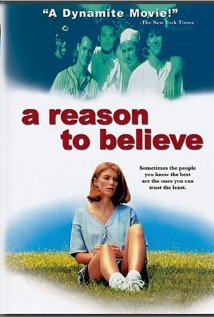
Embracing the Melodrama Part II #91: A Reason to Believe (dir by Douglas Triola)


A Reason to BelieveThroughout the late 90s, a rather obscure film from 1995 called A Reason To Believe used to show up on Cinemax fairly frequently. I was 11 when I first saw it.  At the time, I was indulging in my rebellious streak by secretly staying up past my bed time and sneaking into the living room, where I would watch whatever forbidden sordidness what being aired.  Because I didn’t want to wake anyone up, I would watch with the volume turned almost all the way down.  Hence, when I first saw A Reason To Believe, I literally had to sit less than an inch away from the TV just so I could hear the dialogue.

And I remember that, at the age of 11, A Reason To Believe really blew me away.  I thought it was one of the greatest films that I had ever seen.  The fact that the film involved college students made me feel like I was both watching a movie for adults and getting a preview of what life would be like when I was older.  All of the sex and the language made me feel like I was getting away with something while I was watching it.  At one point, there was a shot of Sharon (played by Holly Marie Combs) putting a condom on Wesley’s (Danny Quinn) erect penis and I found myself glancing over my shoulder, convinced that at any minute a responsible adult was going to enter the living room and say, “WHAT ARE YOU WATCHING!?”

So, when I recently rewatched A Reason To Believe, I did so wondering how the film would hold up now that I’m an adult.  Not surprisingly, a good deal of the film now seemed to be heavy-handed.  For every good line in the script, there was a line that was way too obvious.  Characters who were funny when I was 11 — like dorky stoner Potto (Keith Coogan) — now seemed to be annoying.  And, of course, my more experienced eyes immediately realized that Holly Marie Combs was putting that condom on a prosthetic penis.

And yet, A Reason To Believe is still fairly effective and probably deserves to be better known than it actually is.  Usually, I refuse to give extra credit for good intentions but I’m willing to make an exception for A Reason To Believe because the film deals with a subject that, now more than ever, needs to be dealt with.

Charlotte (Allison Smith) is a student at an unnamed generic university.  When her boyfriend, Wesley (Danny Quinn), has to go away for the weekend, he asks Allison not to go to Viking, an annual party thrown by his fraternity.  Charlotte promises that she won’t but then goes anyway.  At Viking, she hangs out with Wesley’s best friend, Jim (Jay Underwood).  Jim is also dating Allison’s friend, Judith (Kim Walker).  Realizing that she’s had too much to drink, Allison attempts to leave the party but instead, Jim leads her into his bedrom.  He kisses her.  She says no but Jim forces himself on her.  Repeating all the old bullshit excuses (i.e., Charlotte was flirting with him, all girls say no when they mean yes, and all the rest) Jim seems to truly believe that the sex was consensual.  Charlotte knows it was rape.

At first, Charlotte doesn’t want to face what happened.  When she finally does go to the university administration and reports what happened, the frat — including her boyfriend — comes together to protect Jim.  Charlotte’s friends — like Judith — abandon her.  Her only supporter is Linda (Georgia Emelin), an anti-fraternity campus activist who is more interested in Charlotte as a means to an end than as a human being.

A Reason To Believe held up fairly well.  Yes, it’s heavy-handed and a lot of the dialogue is too spot-on and literal.  I could have done without the scenes featuring Obba Babatunde as a bombastic professor.  However, Allison Smith and Jay Underwood both gave excellent performances in the two lead roles and the film deserves a lot of credit for not shying away from just how misogynistic the fraternity/sorority culture can truly be.  Ultimately, flaws and all, it’s a valuable, realistic, and angry portrayal of rape culture and it deserves to be seen for that reason.

It can currently be viewed on YouTube.

Gloriously Insane Action That Is Kung Fury


Kung FuryThe Insanely Glorious Action That Is Kung Fury

I grew up during the 1980’s and I do remember how it was a decade dominated by martial arts films and cop action films. Even looking back through rose-tinted goggles, I will admit that for a majority of films released under those two genres most were quite bad. Yet, they were bad and enjoyable in their own clumsy and low-budget way.

The short comedy action film Kung Fury arrives on the web today. Why a short film and not a full-length? Well, while it’s kickstarter campaign more than passed it’s goal of $200,000 dollars it failed to reach a stretch goal of $1,000,000 to turn the film into a full-length feature film. While I believe a full-length film would’ve been nice to see, I think this film works best in it’s short film format.

Kung Fury (written, directed and starring David Sandberg) is a pastiche of all the over-the-top action beats action film fans love about the genre during the 1980’s. It throws everything it could think of onto the screen and blends them together with no thought in mind of how ridiculous and insane it turned out. It’s a film that’s a homage and a parody of those very 80’s action and martial arts films that we know and love so much.

Yet, for all the insanity that occurs in the film there’s actually a weird logic to the film’s narrative that reaches a nice pay-off in the end that screams and begs for a sequel. What better way to end a film that’s a love letter to all things 1980’s action than making sure it ends in a blatant cliffhanger that screams sequel and franchise building.

If there’s one film you should see this weekend that doesn’t involve costumed superheroes, post-apocalyptic marauders, acapella throwdowns, and the next disaster porn then it should be the 30-minutes of insane martial arts, time-traveling, police action film called Kung Fury.