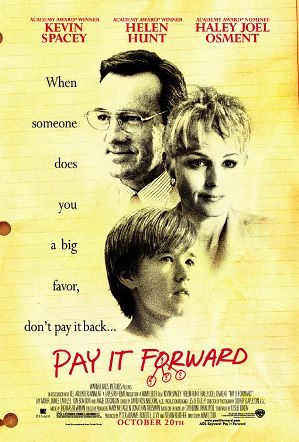
Embracing the Melodrama Part II #99: Pay It Forward (dir by Mimi Leder)


Pay_it_forward_ver1Speaking of crappy films…

Listen, I’m not going to say too much about the 2000 film Pay It Forward because it’s such a terrible movie that I feel like writing too much about it would be like the equivalent of having sex in It Follows.  Seriously, you talk too much about Pay It Forward and you’ll end up with some sort of shape-shifting demon following you around, doing you favors and demanding that you do three more favors for three other people and then those people have to do three more favors and pretty soon, everyone in the world is doing favors for everyone and…

AGCK!

Okay, okay — I know that probably doesn’t sound too bad to some people.  “People being nice to each other!?  What could be wrong about that?”  Well, watch the damn film and find out.

In Pay it Forward, Haley Joel Osment plays a creepy little kid who basically “saves” the world.  At the end of the film, he’s violently murdered and the entire population of Las Vegas gathers outside of his house with candles.  His mother Helen Hunt is truly touched that everyone was so moved by Haley’s mission.  That said, if Haley had never decided that everyone should pay it forward, he probably wouldn’t be dead.  I mean, let’s just be honest here.

Before he died, Haley was challenged by his social studies teacher, Kevin Spacey.  Mr. Spacey challenged an entire class of 7th graders to come up with an idea that will change the world.  (Honestly, don’t 7th graders already have enough to deal with?)  Haley’s idea is that he’ll do a favor for three random people and then those three people will do three nice things for three people and then…

BLEH!  God, I hate this movie!

Anyway, Haley gives money to a homeless man and then that homeless man keeps a woman from committing suicide and then that woman does something nice for Angie Dickinson and then somehow, this all eventually leads to some rich guy giving Jay Mohr a car and telling him to “pay it foward.”

And Jay’s a reporter!

So, naturally, he starts to work his way backwards on the chain of good deeds.  Along the way, he meets a prison inmate who has been converted to Pay It Forwardism.  “This is going to change the world!” he tells Jay.  “I’m even getting the brothers in here in on it!”

By the way, there’s exactly one person of color in Pay It Forward and he’s a prison inmate who thinks that other inmates will want to do random favors for each other.

Oh, but Haley has to do two other favors!  So, he sets Helen Hunt up with Kevin Spacey and when he catches his teacher coming out his mom’s bedroom, Haley gets really, really excited and … well, it’s pretty creepy.

At first, Helen thinks that Kevin thinks that she’s not smart enough to date him.  When Helen asks him point blank if he thinks that she’s dumb, he responds by giving a really long monologue about the time that his father set him on fire.  Kevin does not mention what his father was attempting to pay forward…

And then Jay shows up in town and interviews Haley and oh my God, Haley’s going to change the world!  Yay!  But then Haley spends his third favor trying to protect a kid (played by Degrassi‘s Marc Donato) from some bullies and ends up getting stabbed to death.

But fear not!  Along with that candlelight vigil, we also hear an anchorwoman breathlessly reporting that there have been reports of “Pay it Forwardism” across the country.

Now, there’s a lot of negative things that I could say about Pay It Forward but … well, I kinda already did.  Pay It Forward pops up on TV a lot and there’s a lot of idiots who always get excited about it.

https://twitter.com/_sierraalynn/status/606195871949156353

https://twitter.com/TreyClark56/status/605372272690356225

https://twitter.com/KelliOtto_/status/605370371248951296

Here’s my fear concerning the whole Pay It Forward idea.  It seems like anybody can just do anything and then go, “Pay it forward,” and suddenly, you are obligated to go do three favors.  You may be running late.  You may have other things you need to do.  But no, you’ve been told to pay it forward and now, you have to!  Because of one creepy little kid who wanted his social studies teacher to have sex with his mom, you have now been inconvenienced.

There doesn’t seem to be any rule about how big of a favor anyone actually has to do before they can smugly order you to “Pay it forward.”  Think about this.  You’re trying to get a Coke from a vending machine but all of your dollars are all crumbled up and the machine won’t accept them.  You’re about to give up and go home when suddenly, a stranger walks up and deposits three quarters in the machine and punches a button.

He tosses you a grape drink.  You wanted a Coke but, because you’re nice and you think he was selflessly trying to help you out, you smile and say, “Thank you.”

“Pay it forward,” he replies before walking away.

Well, now, you’re screwed, aren’t you?

Now, suddenly, you have to go find three people who need a favor.  You didn’t want grape.  You wanted a Coke and, even if you had never gotten that Coke, it would not have been the end of the world.  But, because you were polite and said thank you, you are now obligated.

As you look for people to help, it occurs to you that stranger really didn’t care about whether you wanted a Coke.  What he cared about was completing his third favor so he could actually get on with his life.  So, no, he wasn’t trying to help you or trying to make the world a better place.  Instead, he was just trying to free himself of a nagging obligation.

So, after a long search, you’ve finally found your three strangers and you’ve done your three favors and you’re finally free of your obligation.  And then suddenly, another stranger runs up and tosses you the keys to one of those stupid looking Smart cars and yells, “Pay it forward!”

SERIOUSLY, IT NEVER ENDS!

Don’t tell me about paying it forward.

Just leave me alone and let me drink my damn Coke.
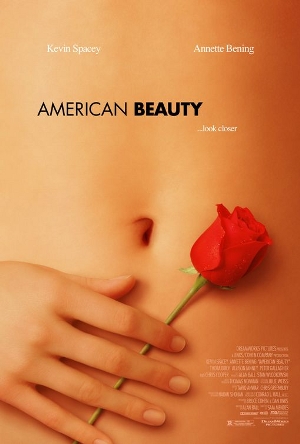
Embracing the Melodrama Part II #98: American Beauty (dir by Sam Mendes)


American_Beauty_posterWhat crap!

I know, I know.  “American Beauty is an incisive satire that looks at the stifling conformity of American suburbia with Kevin Spacey giving the definitive portrait of the male midlife crisis and blah blah blah blah blah blah.”  Listen, American Beauty is a terrible film.  I don’t care if it won a lot of Oscars, including the 1999 award for best picture.  American Beauty is a shallow film that, at its worst, is deeply misogynistic.

American Beauty tells the story of two people.  They’re married.  They live in the suburbs.  They have a teenage daughter who is a cheerleader.  They pretend to have the perfect life but actually, everyone’s extremely unhappy.

WOW!  OH MY GOD!  PEOPLE ARE SECRETLY UNHAPPY IN THE SUBURBS!?  MY MIND IS BLOWN!  WOW, NO ONE’S EVER HAD THAT THOUGHT BEFORE!  OH.  MY.  GOD!

Anyway, the husband is named Lester (Kevin Spacey).  Lester’s a loser.  He narrates the film and he’s played by Kevin Spacey so you’re supposed to think that he’s really this great guy who deserves better but honestly, Lester’s a whiny little jerk.  He’s upset because, now that he’s an adult, he misses being a teenager.  Life hasn’t turned out the way that he wanted it to.  Boo hoo.  As I said, Lester is kind of whiny but the film treats him like he’s an enlightened truth seeker.  In order to keep the audience from realizing that Lester is a loser, the film surrounds him with one-dimensional stereotypes.

And really, Lester is the ultimate male fantasy.  Everything that he says and thinks is wise.  His every thought and feeling matters.  To its discredit, the world has failed to recognize that Lester’s vapid thoughts are worthwhile.  Lester quits his job and finds employment working in fast food.  Lester fantasizes about fucking his daughter’s best friend (Mena Suvari).  Lester starts to smoke weed with his teenage neighbor (Wes Bentley).  In real life, Lester would just be another pathetic guy having a midlife crisis but, in the world of American Beauty, he’s a seeker of truth,

Anyway, eventually, Lester gets shot in the back of the head and dies but that doesn’t keep him from still narrating the film.  You just can’t shut him up.

Meanwhile, Lester’s wife is Carolyn (Annette Bening) and wow, is she evil!  Get this — she actually tries to keep the house clean, is obsessive about her job, and wants her family to eat dinner together.  Oh my God, so evil!  She ends up having an affair with Buddy Kane (Peter Gallagher) and, when they have sex, we’re supposed to laugh at them because they’re so cartoonishly loud.  And when Lester catches them, the audience is expected to applaud and say, “Way to go, Lester!”  The film ridicules Carolyn’s affair but it idealizes Lester’s sexual fantasies.  Lester’s determination to be independent and do what he wants is presented as being heroic.  Carolyn’s determination to have a life that does not revolve around her pathetic husband is presented as being villainous.

And why is that?

Basically, it comes down to the fact that Lester has a penis whereas Carolyn has a vagina.

American Beauty is probably one of the most misogynistic films that I have ever seen, one in which men are exclusively victims of all those unreasonable and untrustworthy women.  Whiny loser Lester is presented as being a hero.  Ricky, the next door neighbor played by Wes Bentley, spends his time going on and on about the beauty of an empty bag and we’re supposed to see some sort of higher truth in his pretentious blathering.  Meanwhile, Carolyn is portrayed as being a shrew.  Lester’s teenager daughter (Thora Birch) is a spoiled brat.  Lester’s sexual obsession, the cheerleader played by Mena Suvari, is presented as being a suburban seductress but, in the film’s eyes, she’s partially redeemed when she suddenly admits to being a virgin.

(The film seems to think that the revelation that teenagers lie about sex is truly shocking.  This is one of those films that makes you wonder if the filmmakers have ever hung out with anyone outside of their own small circle of friends.)

One huge subplot deals with Ricky’s father, a military guy played by Chris Cooper, mistakenly believing that Lester is gay.  And, honestly, American Beauty would have been a better film if Lester had been a gay man and if, instead of buying a new car and getting a crappy job, Lester had dealt with his identity crisis by coming out of the closet.  Certainly, a lot of Lester’s anger would have made a lot more sense if he was a man struggling to come to terms with his sexuality as opposed to being a man who just doesn’t like his job and is upset that his wife no longer has the body of a 17 year-old.

(We are, of course, supposed to be shocked when Cooper suddenly reveals that he himself is gay.  But, honestly, the film’s plans for Cooper are obvious from the minute he first appears on-screen and dramatically squints his eyes in disgust at the sight of two men jogging together.  Cooper is a good actor but he’s terrible in American Beauty.)

It would have taken guts to make Lester gay and, at heart, American Beauty is a very cowardly film.  It attacks easy targets and it resolutely refuses to play fair.  So desperate is it to make Lester into a conventional hero that it refuses to let anyone around him be human.  As a result, a talented cast is stuck playing a collection of one-note stereotypes.  No wonder a lot of people love this film — it makes you feel smart without requiring that you actually think.

American Beauty was written by Alan Ball and directed by Sam Mendes.  Both Ball and Mendes have subsequently done far better work, which is good because American Beauty is a terrible movie.  The script is a pretentious mess and Mendes never seems to be quite sure what exactly he’s trying to say from scene-to-scene.

American Beauty did win best picture but who cares?

It’s a crappy film.


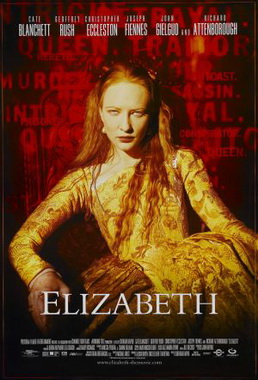
Embracing the Melodrama Part II #97: Elizabeth (dir by Shekhar Kapur)


Elizabeth_Poster“I am no man’s Elizabeth!”

— Queen Elizabeth I (Cate Blanchett) in Elizabeth (1998)

I have to admit that I always feel guilty about the fact that I love movies about British royal history.  After all, I have roots in Northern Ireland and I was raised Catholic.  If anything, I should refuse to watch films about British royalty on general principle.  I should be writing more reviews of films like Bloody Sunday.

But I can’t help myself.  Whether it’s because I enjoy looking at all of the costumes or I just have a thing for movies set in drafty old castles, I have a weakness for films about British royalty.  (And I will also admit that I sat through the entire royal wedding and I have a bit of a girlcrush on both Pippa and Kate Middleton.  As I said, I just can’t help myself.)

Of course, some of it definitely has to do with the fact that I’m an unapologetic history nerd.  I am fascinated with how people lived in the past.  And, of course, anyone who shares my obsession understands that, when it comes to history, there’s both the official story and the truth.  The official story is something that’s passed down over the centuries.  It’s what we learn in school.  The truth, however, is always far more obscure.  The truth is what historians piece together from what little gossipy evidence has managed to survive the passage of time.

We all know that the official story of Queen Elizabeth I is that she was England’s greatest Queen, she defeated the Spanish Armada, and she never married.  She was the “Virgin Queen,” forsaking love to serve her nation.  That’s the official story but is it the truth?

That’s the question at the heart of the 1998 Best Picture nominee Elizabeth.  Now, don’t get me wrong.  I’m not arguing that Elizabeth represents the truth.  Historically, the film is messy and full of speculation that is less based on evidence and more on the desire to keep things cinematic.  But still, Elizabeth is an interesting film specifically because it takes a historical figure and dares to suggest that she may have been human before she became an icon.

Cate Blanchett gives a great performance in the role of Elizabeth.  When we first meet her, she’s a somewhat silly girl who is less concerned with politics and religion and more concerned with her boyfriend, Robert Dudley (Joseph Fiennes).  Elizabeth is also the protestant half-sister of Catholic Queen Mary (Kathy Burke).  Mary is planning on ordering Elizabeth’s execution but dies of stomach cancer before she gets around to singing the order.

Suddenly, Elizabeth is Queen of England.  Young and insecure, she is, at first, manipulated by advisors like William Cecil (Richard Attenbrough), who pressures her to marry the cross-dressing Henry III (Vincent Cassel) of France.  Meanwhile, the Pope (John Gielgud) signs an order calling for Elizabeth’s death.  Catholic nobleman Thomas Howard (Christopher Eccleston) and mysterious priest John Ballard (Daniel Craig) conspire to assassinate Elizabeth.  With even Robert Dudley giving her reason to distrust him, Elizabeth discovers that her only ally is the enigmatic and ruthless “spymaster,” Francis Walsingham (Geoffrey Rush). It all ultimately ends in a sequence that basically transports the finale of The Godfather to the Elizabethan era.

I really should not like Elizabeth.  It’s undoubtedly an anti-Catholic film, though it’s nothing compared to the histrionic anti-Catholicism of its sequel, Elizabeth: The Golden Age.  But I can’t help myself, I enjoyed Elizabeth.  It was impossible for me not to relate to Cate Blanchett’s passionate performance.  (And there was just something so incredibly hot about the way Joseph Fiennes, with his intense eyes, would stare at her.)  When you ignore the film’s protestant bias and just concentrate on the performances and the gorgeous production design, you can’t help but love Elizabeth.

Film Review: Good Kill (dir by Andrew Niccol)


Good_Kill_poster

Good Kill is an angry film that is somewhat grounded by a strong lead performance from Ethan Hawke.  Hawke was nominated for Best Supporting Actor for his performance in Boyhood and … well, he probably won’t be nominated for anything for Good Kill.  The film’s coming out too early in the year and it’s not really a crowd-pleasing Oscar movie.  It’s too angry and polemical but still, Ethan Hawke gives an excellent performance.

Hawke plays Thomas Egan, an air force pilot who, after serving 6 tours in Afghanistan, is reassigned to pilot drones from a base in Las Vegas.  For 12 hours a day, Egan sits in a cramped room where he and three other pilots spend their time staring at video monitors and observing people going about their lives on the other side of the world.  Occasionally, a phone rings and they are given orders by a never seen CIA supervisor.  All Egan has to do is push a button and, in just ten seconds, he can blow up a stranger 7,000 miles away.

Of course, it’s not just the targets who get blown up.  Anyone unlucky enough to be standing nearby ends up getting blown up as well, which is something that Egan’s commanding officer (Bruce Greenwood) insists is a regretful but acceptable consequence of fighting the War of Terror.  Except, of course, nobody’s quite sure that they’re actually blowing up terrorists.  Instead, often times, it’s a matter of guesswork.  People are blown up because they could be terrorists, not because they definitely are.

While most of the members of Egan’s unit are unconcerned about the ethics or the legalities of drone warfare, Vera Suarez (Zoe Kravitz) is an exception.  She worries that they’re just creating more terrorists.  (And yet, interestingly enough, she still follows orders whenever she’s told to blow someone up.)  Egan is troubled by the implications of what he’s doing but, for the most part, he keeps his feelings to himself.

From the beginning, the tightly wound Egan struggles with the pressure of being a drone pilot.  After spending half of the day killing strangers who may or may not be terrorists, Egan finds it difficult to spend the rest of the day with his wife (January Jones) and his children.  Slowly but surely, cracks start to appear on Egan’s facade.  He starts drinking.  He drives recklessly.  He yells at his family.  He grows paranoid about the neighbors.  When a cop asks him how the War on Terror is going, Egan smirks and replies that it’s going as well as the War on Drugs…

Even though I agreed, for the most part, with everything that the film had to say, I still found it to be incredibly heavy-handed.  There is something to be said for subtlety and Good Kill is definitely not a subtle movie.  Rabidly anti-military audiences will enjoy having their own prejudices confirmed but, with everyone other than Egan and Vera being portrayed as being bloodthirsty and ignorant, you can be sure that this film won’t change any minds.  Politically, this a political film that’s not going to make a bit of difference.

At the same time, there is an interesting subtext running through the film.  During the 12 hours that Egan spends in that room, he essentially ceases to be a human being and becomes an extension of that drone.  Both literally and figuratively, he becomes a part of the war machine.  Just imagine if a director like David Cronenberg had handled this material.  Director Anrew Niccol briefly touches on the Cronenbergian aspects of the story but, in the end, he gets too bogged down in all of the speeches.

The problem with political films like Good Kill is that they often feel very artificial and that’s why you’re thankful for Ethan Hawke’s performance.  Hawke gives a performance of such raw power that he cuts through all of the polemical bullshit.  The film is nearly smothered under the director’s heavy hand but Hawke breathes it back to life.  Hawke’s performance brings much needed authenticity to Good Kill and, as a result, he elevates the entire film.

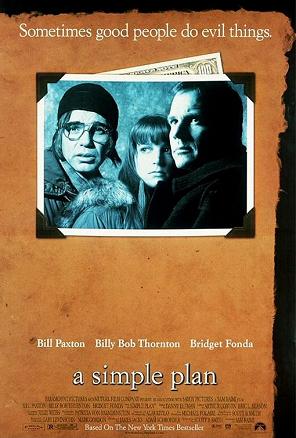
Embracing the Melodrama Part II #96: A Simple Plan (dir by Sam Raimi)


Simple_plan_poster

The 1998 film A Simple Plan reunites Bill Paxton and Billy Bob Thornton.  After previously playing adversaries in One False Move, they played brothers here.  However, it’s not just the cast that makes A Simple Plan feel like a spiritual descendant of One False Move.  Both One False Move and A Simple Plan deal with greed and violence.  Both One False Move and A Simple Plan take place in a small town where everyone thinks that they know all there is to know about each other.  Both One False Move and A Simple Plan feature Paxton as a man who turns out to be something more than what the viewer originally assumed.  Perhaps most importantly, both One False Move and A Simple Plan are meditations on guilt, greed, and community.

A Simple Plan takes place in Minnesota, in a world that seems to exist under a permanent layer of snow and ice.  While out hunting, Hank (Bill Paxton), his well-meaning but dim-witted brother Jacob (Billy Bob Thornton), and their redneck friend Lou (Brent Briscoe) stumble across an airplane that has crashed in the woods.  Inside the airplane, they find a dead pilot and a bag containing 4 million dollars.  At first, Hank says they should call the authorities and let them know what they’ve found but he rather easily allows Jacob and Lou to talk him out of it.  Instead, they agree that Hank will hide the money at his house until spring arrives.  They also agree to not tell anyone about the money but, as soon as he arrives home, Hank tells his pregnant wife Sarah (Bridget Fonda) everything that has happened.

Needless to say, this simple plan quickly get complicated.  Sarah is soon telling Hank that he should not trust Lou and Jacob.  The local sheriff (Chelcie Ross) saw Hank and Jacob leaving the woods after discovering the plane and may (or may not) be suspicious of what they found.  Alcoholic Lou starts to demand his share of the money early.  As things start to spiral, Hank finds himself doing things that he would have never thought he would ever do.  Or, as Sarah puts it, “Nobody’d ever believe that you’d be capable of doing what you’ve done.”

And then, one day, a mysterious FBI agent (Gary Cole) shows up and says that he’s looking for the plane.  Except that, according to Sarah, he’s not really with the FBI…

It’s appropriate that A Simple Plan takes place in a world that appears to be permanently covered in snow because it is a film that is both chilly and chilling.  Bill Paxton and Billy Bob Thornton are both perfectly cast.  (Thornton received an Oscar nomination for his performance.  Paxton undoubtedly deserved one.)  Bridget Fonda turns Sarah into a small town Lady MacBeth and Gary Cole, Brent Briscoe, and Chelcie Ross are all memorable in smaller roles.

(Brent Biscoe, in particular, is a redneck nightmare.)

The next time that you want to contemplate the evil that is done in the name of money, why not start off with a double feature of One False Move and A Simple Plan?


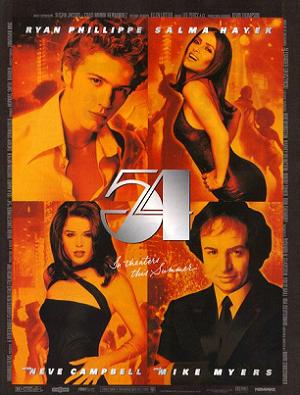
Embracing the Melodrama Part II #95: 54 (dir by Mark Christopher)


54_poster

“A guy named Steve Rubell had a dream: To throw the best damned party the world had ever seen and to make it last forever. He built a world where fantasy was put up as reality and where an 80-year-old disco queen could dance till dawn. Where models mingled with mechanics, plumbers danced with princes. It was a place where all labels were left behind. A place where there were no rules.”

— Shane O’Shea (Ryan Phillippe) in 54 (1998)

So, did you actually read that quote at the beginning of the review?  I don’t blame if you didn’t because not only is it ludicrous overwritten but it just goes on and on.  It’s one of those quotes that you read in a script and you think to yourself, “They better get absolutely the best actor in the world to deliver these lines,” and then you realize Ryan Phillippe has been cast in the role.

Except, of course, I doubt that any of those lines were found in the original script for 54.  54 is one of those films where, as you watch it, you can literally imagine the chaos that must have been going on during the editing process.  Subplots are raised and then dropped and the mysteriously pop up again.  Characters change both their personalities and their motives in between scenes.  Huge dramatic moment happen almost at random but don’t seem to actually have anything to do with anything else happening in the film.

In short, 54 is a mess but it’s a mess that’s held together by incredibly clunky narration.  Shane O’Shea, who spent the waning days of the 1970s working at Studio 54, narrates the film.  And, despite the fact that Shane is presented as being kinda dumb (think of Saturday Night Fever‘s Tony Manero, without the sexy dance moves), his narration is extremely verbose and reflective. It’s almost as if the narration was written at the last-minute by someone desperately trying to save a collapsing film.

I watched 54 on cable because I saw that it was about the 70s and I figured it would feature a lot of outrageous costumes, danceable music, and cocaine-fueled melodrama.  And it turns out that I was right about the cocaine-fueled melodrama but still, 54 is no Boogie Nights.  It’s not even Bright Lights, Big City.

54 does have an interesting cast, which makes it all the more unfortunate that nobody really gets to do anything interesting.  Poor Ryan Phillippe looks totally lost and, in the film’s worst scene, he actually has to stand in the middle of a dance floor and, after the death of elderly Disco Dottie (that’s the character’s name!), yell at all the decadent club goers.  Breckin Meyer is cute as Phillippe’s co-worker and Salma Hayek gets to sing.  Neve Campbell plays a soap opera actress who Phillippe has a crush on and…oh, who cares?  Seriously, writing about this film is almost as annoying as watching it.

Mike Myers — yes, that Mike Myers — plays the owner of the club, Steve Rubell.  The role means that Myers gets to snort cocaine, hit on Breckin Meyer, and vomit on the silk sheets of his bed.  I think that Myers gives a good performance but I’m not really sure.  It could have just been the shock of seeing Mike Myers snorting cocaine, hitting on Breckin Meyer, and vomiting on the silk sheets of his bed.

If you want to enjoy some 70s decadence, avoid 54 and rewatch either Boogie Nights or American Hustle.

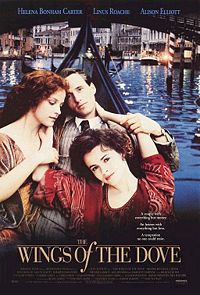
Embracing the Melodrama Part II #94: The Wings of the Dove (dir by Ian Softley)


Wings_of_the_dove_ver1For nearly two months now, I’ve been in the process of reviewing 126 cinematic melodramas.  (I know that I originally said that I would be reviewing 126 films in 3 weeks but, even at the time I said that, I think a part of me knew that it would probably be more like 8 or 9 weeks.)  And, while it seems like forever since I started this series by reviewing the 1927 silent classic Sunrise, I’ve still been having fun discovering and rewatching some wonderful films.  It’s been a lot of work but if I’ve inspired anyone to see any of the 93 films that I’ve reviewed so far, then it’s all been worth it.

For our 94th entry, let’s take a quick look at the 1997 film The Wings of the Dove.

Based on a novel by Henry James, The Wings of the Dove open in London.  The year is 1910 and Kate Croy (Helena Bonham Carter) has problems.  Her mother has recently died and her father (Michael Gamon) is a penniless opium addict.  Kate is taken in and supported by her wealthy Aunt Maude (Charlotte Rampling).  Maude has plans for Kate to marry the vapid Lord Mark (Alex Jennings) and demands that Kate have no contact with either her father or any of her old friends.

Among those that Kate is supposed to abandon is a journalist named Merton Densher (Linus Roache).  Kate and Merton are in love but there’s no way that Maude would ever allow them to get married.  Merton is not only poor but he’s a bit of a radical as well.

While visiting with Lord Mark, Kate meets an American heiress named Milly (Alison Elliott).  As open and kind as Kate is cynical and manipulate, Milly is touring Europe.  Milly and Kate quickly become friends and Milly goes as far as to invite Kate to go to Venice with her.  It’s also through her friendship with Kate that Milly first meets Merton.  Attracted to him and unaware of her relationship with Kate, Milly invites him to come to Venice as well.

Kate, meanwhile, has discovered that Milly is terminally ill.  She comes up with a scheme, in which Merton will romance Milly.  Kate is convinced that Milly will then change her will to include Merton.  Once Milly dies, Merton will be rich and then Maude will have no reason to object to him marrying Kate.

At first, Merton is repulsed by the scheme but he finally agrees, specifically so that he can go to Venice with Kate.  However, once they’re all actually in Venice, things start to get complicated.  Merton starts to fall in love with Milly and Kate discovers that she loves Merton more than she originally realized…

The Wing of the Dove is an effective literary adaptation, one that brings a contemporary spin to the material while still remaining truthful to the spirit of the source material.  The costumes and the sets are beautiful to look at and Venice is as wonderfully romantic and cinematic as always.  Linus Roache is a bit of a stiff as Merton (but then again, the same could be said for the character himself) but it doesn’t matter because the film is dominated by Helena Bonham Carter’s ferocious performance in the role of Kate.  She plays Kate as a bundle of nervous energy and barely repressed carnality, an Edwardian femme fatale.  She was rightfully nominated for best actress for her performance in this film.  The award, however, went to Helen Hunt for As Good As It Gets.

(This, along with the complete snubbing of Boogie Nights, would seem to suggest that 1997 was not a banner year as far as the Academy Awards were concerned…)

The Wings of the Dove is currently available to be viewed on Netflix.  Don’t miss it.


What Lisa Marie Watched Last Night #126: The Secret Life of Marilyn Monroe, Part 2 (dir by Laurie Collyer)


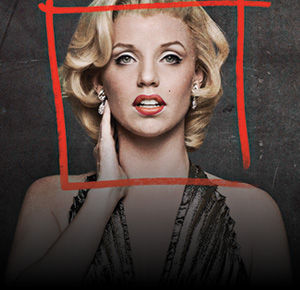
On Sunday night, I watched Part 2 of Lifetime’s The Secret Life of Marilyn Monroe.

The Secret Life of Marilyn MonroeWhy Was I Watching It?

I was watching it because I watched Part One on Saturday and I absolutely loved it!  I wanted to see how Part Two would deal with the second half of Marilyn’s life.  Would it explore the mysteries that still surround her death?  Would the Kennedys make an appearance?  Who would come off worse — Joe DiMaggio or Arthur Miller?

What Was It About?

Part Two of The Secret Life of Marilyn Monroe deals with her life after she became a star.  We watch as the increasingly fragile Marilyn marries the physically abusive Joe DiMaggio (Jeffrey Dean Morgan) and the mentally abusive Arthur Miller (Stephen Bogaert).  (Seriously, neither Joe nor Arthur comes across positively in this film.)  Marilyn continues to deal with her own fears that she’ll go crazy like her mother (Susan Sarandon).  She has a brief moment of hope when she meets John F. Kennedy, though the film is deliberately vague about the details of their relationship.  Ultimately, she ends up having a breakdown and is hospitalized against her will.  By the end of the film, it seems like she’s found some hope for the future but then, we see her tossing and turning in bed and clumsily reaching for a bottle of pills…

What Worked?

Kelli Garner’s performance as Marilyn was just impressive here as it was during the first part of the film.

What Did Not Work?

Sadly, Part Two just wasn’t as good as Part One.  To a large extent, Part One worked because of the emphasis on Marilyn’s relationships with her mom (Susan Sarandon) and her adopted aunt Grace (Emily Watson).  In Part Two, those relationships were overshadowed by Marilyn’s unhappy marriages to DiMaggio and Miller.  As a result, the film lost some of its focus and it often seemed to be meandering from one unhappy scene to another until Marilyn’s final night.

Also, I was disappointed that the film was so vague in its approach to Marilyn’s relationship with the Kennedys.  Listen, everyone knows that Marilyn had an affair with both Jack and Bobby Kennedy.  The film tried to create some ambiguity about this point, never actually showing either Kennedy brother on screen and instead, just having Marilyn talk about them.  Rather unfairly, this created the impression that both affairs could have been another one of Marilyn’s delusions.  Quite frankly, Marilyn Monroe deserves better than that.

“Oh My God!  Just like me!” Moments

Just as with Part One, there were several.  Kelli Garner humanized her iconic role to such an extent that I think everyone watching could relate to her.  I’ll just say that I’ve known my DiMaggios and my Millers and leave it at that.

Lessons Learned

Fame does not equal happiness.

In the end, Part Two was not as good as Part One but, overall, The Secret Life of Marilyn Monroe was worth the 4 hours it took to watch it.  It did a great job of recreating the Hollywood of the past and Kelli Garner gave a great performance.  Since this is Lifetime that we’re talking about, I imagine both parts will be rerun frequently.  If you missed them the first time, don’t make the same mistake twice!

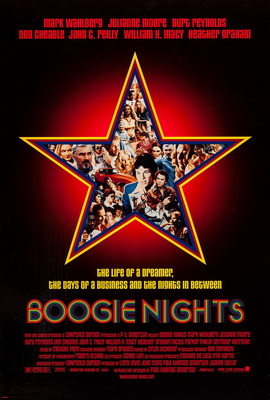
Embracing the Melodrama Part II #93: Boogie Nights (dir by Paul Thomas Anderson)


Boogie_nights_ver1The 1997 film Boogie Nights (which, amazingly enough, was not nominated for best picture) is a bit of an overwhelming film to review.  It’s a great film and, if you’re reading this review, you’ve probably seen Boogie Nights and you probably already know that it’s a great film.  And if you haven’t seen Boogie Nights, you really should because it’s a great film.  So, this review, in short, amounts to: Great film.

Boogie Nights takes place in the late 70s and the early 80s.  Eddie Adams (Mark Wahlberg) is a high school dropout who works as a busboy, lives with his parents, and has a really big cock.  (Indeed, one of the film’s most famous lines is, “This is a giant cock.”)  When we first meet Eddie, he’s likable and cute in a dumb sort of way.  Then he meets adult film director Jack Horner (Burt Reynolds) and becomes a star.  At first, everything is great.  Eddie changes his name to Dirk Diggler and no longer has to deal with his abusive mother (a chilling Joanna Gleason).  Jack and Amber Waves (Julianne Moore) become his new parents.  He gets a cool older brother in the form of actor Reed Rothschild (John C. Reilly, totally nailing the “People tell me that I look like Han Solo,” line).  He makes friends with other adult film actors, like the desperately unhip Buck (Don Cheadle), the free-spirited (and secretly very angry) Rollergirl (Heather Graham), and the poignantly insecure Jessie St. Vincent (Melora Walters).  He gets new admirers, like Scotty J. (Philip Seymour Hoffman).  He also gets addicted to cocaine.  And while Dirk falls from stardom, the adult film industry is taken over by gangsters like Floyd Gondolli (Philip Baker Hall) and self-styled artists like Jack Horner find themselves pushed to the side.

And you may have noticed that I mentioned a lot of actors in the paragraph above.  That’s because Boogie Nights is a true ensemble piece.  It’s full of great performances and memorable characters.  Along with everyone that I mentioned above, the cast also includes William H. Macy as cinematographer “Little Bill” Daggett.  From the minutes we first meet Little Bill, we get the feeling that he might be a little bit too uptight for pornography.  Maybe that’s because his wife — played by the inspiring sex positive feminist and veteran adult film star Nina Hartley — is constantly and publicly cheating on him.  Macy and Hartley do not have as much screen time as the rest of the cast but, ultimately, their characters are two of the most important in the film.

And then there’s Robert Ridgely, who is marvelously sleazy as the paternal but ultimately icky Col. James.  When we first meet the Colonel, he’s almost a humorous character.  But then, suddenly, there’s one chilling scene where he opens up to Jack Horner and we are forced to reconsider everything that we had previously assumed about both the Colonel and his business.

And how can we forget Luis Guzman, as a club owner who desperately wants to appear in one of Jack’s films?  Or Ricky Jay as a plain-spoken cameraman?  Or how about Thomas Jane, playing one of those tightly wound characters who you know is going to be trouble as soon as you see him?  And finally, nobody who has seen Boogie Nights will ever forget Alfred Molina, singing along to Sister Christian and running down the street, clad only in black bikini briefs and firing a shotgun.

But it’s not just the actors who make Boogie Nights a great film.  This was Paul Thomas Anderson’s second film and, under his direction, we feel as if we’ve been thrown straight into Dirk’s exciting and ultimately dangerous world.  When the film begins, the camera almost seems to glide, capturing the excitement of having everything that you could possibly want.  But, as things go downhill for Dirk, the camerawork gets more jittery and nervous.   A sequence where Anderson cuts back and forth between Jack trying to shoot a movie on video (as opposed to his beloved film) and Dirk nearly being beaten to death in a parking lot remains one of the best sequences that Anderson has ever directed.

And then there’s the music!  Oh my God!  The music!

And the dancing!

And the singing!

I’ll be the first admit that I have no idea whether or not Boogie Nights is a realistic portrait of the adult film industry in the 70s and 80s.  But ultimately, Boogie Nights is not about porn.  It’s about a group of outsiders who form their own little family.  At the end of the film, you’re happy that they all found each other.  You know that Dirk will probably continue to have problems in the future but you’re happy for him because, no matter what happened in the past or what’s going to happen in the future, you know that he’s found a family that will always love him.

As I mentioned at the start of this appreciation, Boogie Nights was not nominated for best picture.  Titanic was named the best picture of 1997.  As I’ve said before, I loved Titanic when I was 12.  But, nearly 18 years later, Boogie Nights is definitely the better picture.

It has stood the test of time.


What Lisa Marie Watched Last Night #125: The Secret Life of Marilyn Monroe, Part I (dir by Laurie Collyer)


Earlier tonight, I watched Part One of the latest Lifetime original movie, The Secret Life of Marilyn Monroe.

The Secret Life of Marilyn Monroe

Why Was I Watching It?

Lifetime has been advertising The Secret Life of Marilyn Monroe for about two months now.  From the first commercial, I knew that this was something that I was going to have to watch.  After all, a movie about a famous and tragic actress on the always melodramatic Lifetime network?  How could I not watch?

What Was It About?

It’s right there in the title.  The Secret Life of Marilyn Monroe tells the story of how poor country girl Norma Jean Baker became the iconic Marilyn Monroe.  The first part of this two-part film dealt with Marilyn’s early years.  We watched as Marilyn (played by Kelli Garner) made her way out to Hollywood and appeared in her first few films, all the while dealing with her mentally unstable mother, Grace (Susan Sarandon).  Part One ended with Marilyn on the verge of becoming the world’s biggest star.  It was a happy ending for Marilyn but not so much for the audience because we know what’s going to happen to her during Part II.

What Worked?

The first part of The Secret Life of Marilyn Monroe was everything that you could possibly want from a Lifetime movie.  The costumes, the production design, the cinematography — it was all properly opulent and wonderful to look at.

Even more importantly, Part One was anchored by three wonderful performances from three great actresses.  Susan Sarandon was heartbreaking and poignant as Marilyn’s unstable mother.  Emily Watson brought a quiet strength to the role of Marilyn’s surrogate mother, Grace.  And finally, there’s Kelli Garner in the title role.  After years of doing good work in small roles (Bully, Lars and The Real Girl), The Secret Life of Marilyn Monroe finally gives Kelli Garner a chance to show what she’s capable of doing as an actress.  In part one, Garner gave a performance that both humanized an icon while also suggesting the legend that she would eventually become.

What Did Not Work?

The film’s framing device, in which Marilyn told her story to a psychologist played by Jack Noseworthy, occasionally felt a bit awkward.  Otherwise, as far as the first half of The Secret Life of Marilyn Monroe was concerned, it all worked.

“Oh my God!  Just like me!” Moments

Obviously, I don’t want to sit here and compare myself to Marilyn Monroe.  I’ll leave that for others to do.  However, I do have to say that there were quite a few “Oh my God!  Just like me!” moments in the first part of The Secret Life Of Marilyn Monroe.  That was one reason why the film worked so well — it took an iconic figure and humanized her to the extent that anyone viewing could relate to her.

There were many moments that I related to during part one, particularly when it came to Marilyn’s emotional vulnerability and her desire to be seen as something more than just another pretty face.  In fact, there were more than a few times that I had to look away from the screen because, often, Marilyn’s pain was my pain.

Ultimately, though, the biggest “OMG!  Just like me!” moment came at the start of the film when Marilyn spent over an hour trying on different outfits before greeting the psychologist waiting in the next room.  I’m just as obsessive, especially when it comes to picking the right clothes for a doctor’s appointment.

(Seriously, I once spent an entire day putting together the perfect outfit for seeing the allergist.)

Lessons Learned

Fame can’t buy happiness but it can come awfully close.  (Of course, I have a feeling that lesson will be invalidated once I watch the second part of The Secret Life of Marilyn Monroe.)