What’s an Insomnia File? You know how some times you just can’t get any sleep and, at about three in the morning, you’ll find yourself watching whatever you can find on cable? This feature is all about those insomnia-inspired discoveries!
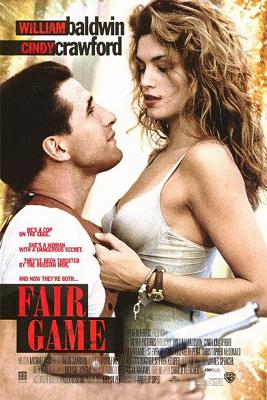
On Tuesday night, if you were suffering from insomnia at midnight, you could have turned over to HBO Signature (commonly listed as HBOSIG) and watched Fair Game, a remarkably mindless action film from 1995.
Originally, my plan was to start this review of Fair Game by telling you, in quite a bit of detail, just how sick I am of the Russian Mafia. Seriously, Russian mobsters have become the default villain for lazy crime films everywhere. And, quite frankly, I’m getting bored with them. I’m bored with how the head Russian mobster is always described as being “former KGB” and is always found sitting in the back room of restaurant, wearing an overcoat and smoking filterless cigarettes. I am bored with how his main henchman is always some big guy with a crew cut and that guy always has a thin sidekick who wears his hair in a pony tail and has a bad mustache. I’m sick of the overexaggerated accents of American and British accents trying to sound Russian and the way they’re always listening to EDM while driving. It’s all so predictable and tedious.
But then I considered that Fair Game was made 20 years ago. Even if the villains are Russian mobsters and even if they are some of the least interesting Russian mobsters in cinema history, it’s totally possible that, when Fair Game, was made, there was still some sort of novelty about the Russian Mafia.
However, even if we give Fair Game a pass on using the cliché of the Russian mob, the villains still weren’t particularly interesting. Kazak (Steven Berkoff) is … well, the film isn’t really that clear on what Kazak’s big plan is but he has a lot of henchmen and they certainly do end up killing a lot of people. Kazak runs his operations off of a yacht that belongs to a Cuban criminal named Emilio (Miguel Sandoval). Emilio is in the process of getting divorced and attorney Kate McQuean (model Cindy Crawford, who made her film debut here and has never played a leading role since) is determined to repossess his boat. So, Kazak decides that the perfect solution would be to murder Kate…
Which makes absolutely no sense. Kazak doesn’t want anyone to discover his operation so he decides to blow up a good portion of Miami, all in pursuit of one person. Wouldn’t it make more sense for Kazak to just blow up the boat and buy a new one?
Anyway, as the film opens, Kate is out jogging when suddenly someone driving by in a car opens fire on her. She ends up getting grazed in the arm, not that it seems to bother her. She wears a bandage for a few scenes but it soon vanishes. Kate is all business so, even after getting shot, she still goes into the office and starts to make plans to repossess that yacht. Personally, if anyone ever shot at me, I would probably be so freaked out that I would never leave the house again.
Now, you may be thinking that Kate was shot because of Kazak but actually, it turns out that the shooting was just a random thing that happened. Apparently, the shooter was trying to shoot someone else and Kate just happened to be in the wrong place at the wrong time. So, we never find out who actually shot Kate and that really bothered me, as that seems to be kind of a huge plot point to bring up and then refuse to resolve.
Anyway, Kate meets a detective named Max Kirkpatrick (William Baldwin) and, soon, they’re on the run from Kazak’s assassins. The majority of the film is made up of Max and Kate running from one location to another. One thing that really bothered me was that literally everyone that Max and Kate talked to ended up getting killed just a few minutes later. At one point, Kate flirts with a computer service expert to get him to help them out. The scene is played for laughs but then, five minutes later, that same innocent technician guy is being brutally tortured by a bunch of Russians and, though we don’t see it happen, it’s safe to assume that he was eventually murdered by them. And no point do Max or Kate appear to feel any guilt or concern about the number of innocent people who are killed just for associating with them.
Anyway, Fair Game is a completely mindless film that has a rather nasty streak of sadism to it. (I imagine, when this film was released, it probably set a record for close-ups of people getting shot and stabbed in the crotch.) William Baldwin and Cindy Crawford both have perfect bodies and give totally wooden performances, which leads to them having a dimly-lit sex scene that is both physically hot and emotionally cold at the same time.
(I have no idea what entropy at absolute zero means but it sounds like a pretty good description of the chemistry between Cindy Crawford and William Baldwin in Fair Game.)
One good note: Salma Hayek has a small role as Max’s ex-girlfriend. Whenever she shows up in the movie, she starts screaming at everyone. I don’t blame her.
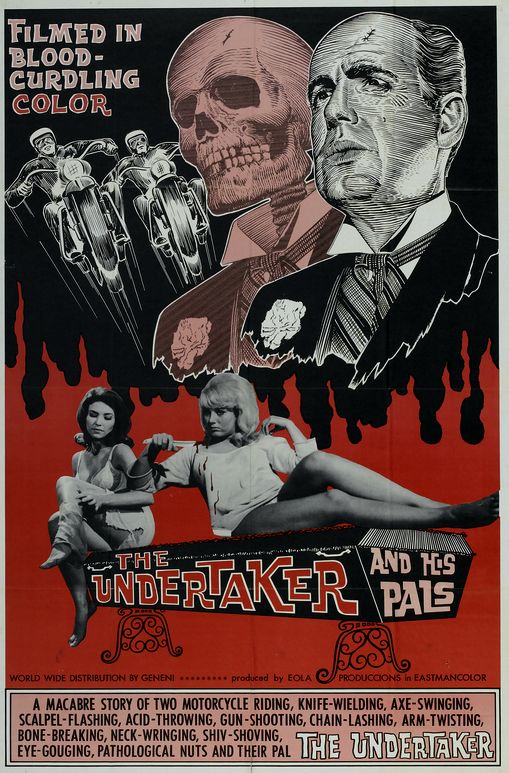
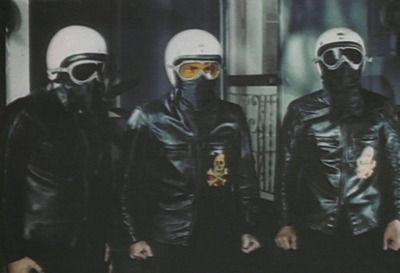
Say what you will about the overall quality of the 1966 horror-comedy, The Undertaker And His Pals, it has an absolutely brilliant opening shot. One man on a motorcycle drives around in a circle in a parking lot. He’s wearing a leather jacket and his features are hidden underneath a white helmet. Soon, another man wearing a leather jacket and white helmet rides up on another motorcycle. And again, they circle the parking lot. And then, they’re joined by a third identically dressed man on yet another motorcycle and the three of them circle the parking lot before then driving off into the city. The night is dark, the city streets are otherwise deserted, and the entire scene is tinted an otherworldly yellow. It’s a truly creepy scene and, for those first few moments of the film, those three faceless riders are truly frightening. If you ever watch The Undertaker and His Pals, be sure to appreciate that opening scene because nothing else in the film matches it.
It turns out that our three motorcycle riders are up to no good. Two of them own a restaurant and, because they’re too cheap to actually order fresh meat, they kill people and serve them up as the special of the day. The third one is the local undertaker. Business has apparently been struggling so he’s started killing people so that he can get paid to provide them a funeral. Apparently, half of each corpse is turned into lunch meat while the other half is put in a cheap, wooden casket at Shady Rest Funeral Parlor.
Now, here’s what makes The Undertaker and His Pal such a strange movie. The murders are graphic and gory (and I imagine they were quite extreme for 1966) but the rest of the movie is an over-the-top comedy, full of bad puns and slapstick. At the start of the film, while the latest victim is being stabbed to death, the camera continually cuts to a photograph of her sailor boyfriend, looking more and more upset with each cut. Later, the undertaker accidentally steps on a skateboard and we watch as he uncontrollably careens into the middle of the street while everyone else in the film points and laughs. When the undertaker finally falls off the skateboard, we even hear a waa waa on the soundtrack. After the undertaker has his accident, the owner of the diner accidentally insults a customer and literally gets a custard pie thrown in his face. (And again, we hear that waa waa.)
And then there’s the names! The film’s first victim is named Sally Lamb. The next day, the special at the diner is literally “Leg of Lamb.” When an administrative assistant named Ann Poultry complains about the poor quality of her leg of lamb and threatens to call the health department, the next day’s special is “Breast of Chicken.”
Ann worked for and was dating a detective named Harry Glass (James Westmoreland, appearing here under the name Rad Fulton). After her death, Harry is … well, Harry really doesn’t seem to care. Harry is the film’s nominal hero but he really doesn’t do anything. In fact, he is remarkably stupid. Though he claims that he’s trying to solve his girlfriend’s murder, he seems to spend most of his time unknowingly eating her down at the diner.
The Undertaker and His Pals is weird and yet strangely watchable. Of course, it helps that the film is only 66 minutes long and that the acting so cartoonish (and, I think, intentionally so) that it’s impossible to take the movie seriously. (If the film was, in any way, believable, it would be almost unbearably grim and misogynistic.) Fortunately, the film ends with clips of the entire cast coming back to life and laughing, letting us know that no one was intentionally harmed or traumatized and apparently, everyone had a great time making The Undertaker and His Pals.
I imagine the film was made to capitalize on the success of Herschell Gordon Lewis’s similarly over the top Blood Feast.Ultimately, The Undertaker and His Pals works best as a weird time capsule of what was shocking in 1966.
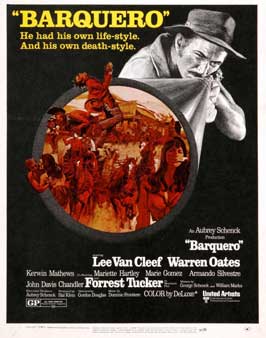
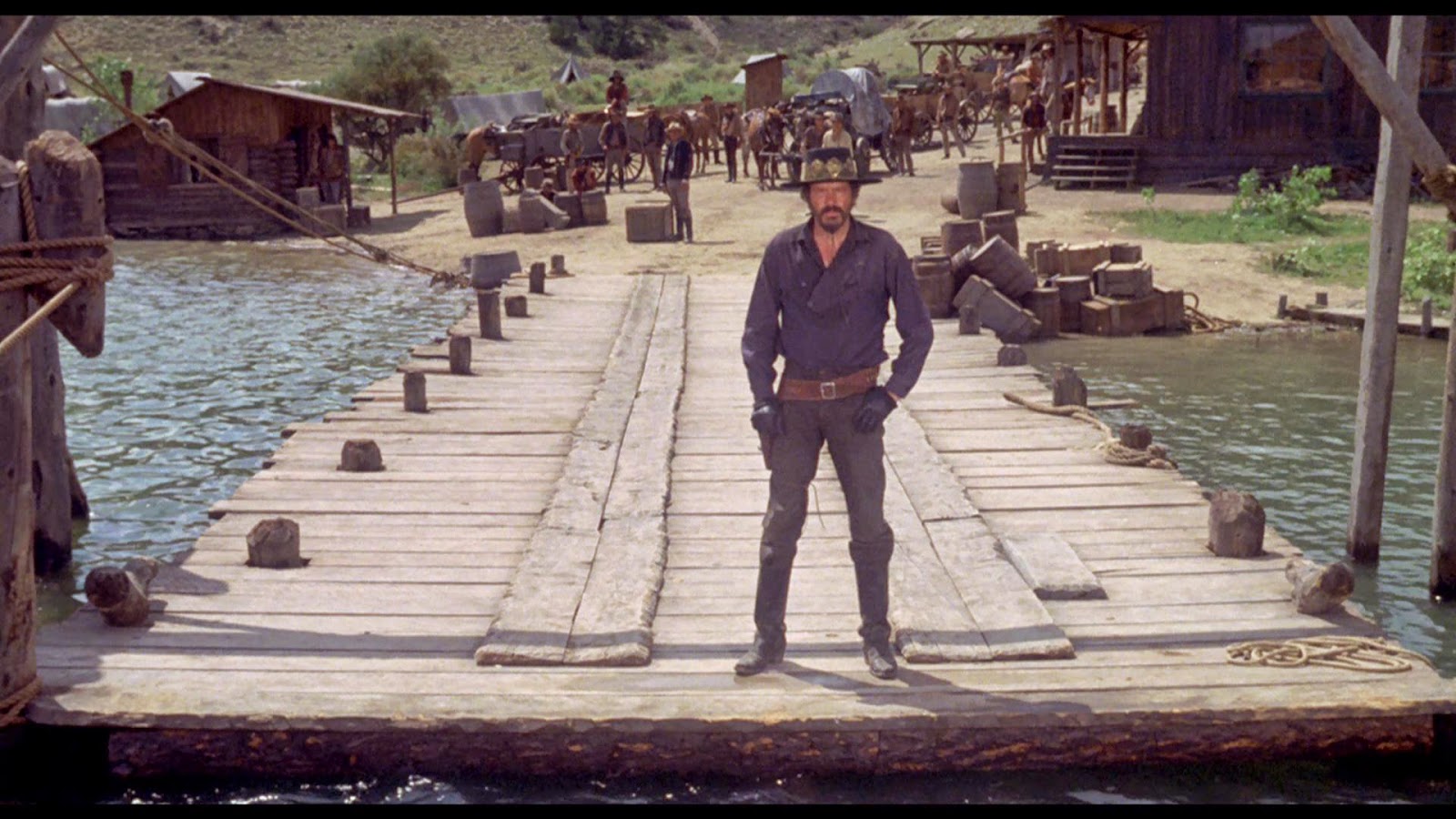
Travis (Lee Van Cleef) is a former gunslinger who now makes his living taking settlers across a river on his small barge. When we first meet him, he is telling a child to shut up and stop bothering him while he is guiding the barge. He depends on the settlers on the other side of the river for his livelihood and they depend on him for transportation but he doesn’t like them and they don’t like him. Travis only cares about two people, his Mexican lover, Nola (Maria Gomez) and an eccentric hunter named Mountain Phil (Forrest Tucker).
After stealing a shipment of silver, outlaw Jake Remy (Warren Oates) and his army of mercenaries need to cross the river to escape into Mexico. To prevent anyone from following, they plan to destroy the barge afterward. However, Travis and Phil find out that Remy is on the way and take the barge to the other side of the river. When Jake and his gang arrive, a tense stand-off ensues, with the outlaws on one side of the river and Travis and the settlers trapped on the other.
Though Barquero was directed by the veteran American director Gordon Douglas (Douglas’s best known film is the 1950s giant ant film, Them!), it was heavily influenced by contemporary Spaghetti Westerns and Sam Peckinpah’s The Wild Bunch. This can be seen in both its graphic violence and in the casting of Lee Van Cleef and Warren Oates in the leading roles.
Travis was a perfect role for Van Cleef, a talented actor who was ignored by Hollywood until he found fame playing ruthless villains in European westerns. Surly and unsmiling, Travis may seem like an unlikely hero but, like many of the best Spaghetti westerns, there are no traditional good guys in Barquero. Travis is more interested in saving his boat than protecting the settlers. He is a hero of circumstance.
As Jake, Warren Oates is a great villain. In his very first scene, he and a prostitute watch as his gang massacre the citizens of a small town. When the prostitute asks if she can come with them, Jake calmly replies, “I don’t think so” and shoots her dead. Stuck on his side of the river, Jake smokes the local weed and starts to have violent hallucinations. Soon, he is shooting bullets into the river.
Also doing good work are Forest Tucker as Mountain Phil and Kerwin Mathews. Mathews, who is best remembered for starring in The 7th Voyage of Sinbad, plays the Marquette, a disgraced French nobleman who has started a second life as Jake Remy’s right-hand man.
Barquero starts with a bang but it struggles to keep up the momentum over its entire running time. The opening shoot out is exciting but things slow down almost too much during the stand-off at the river. It is an interesting but flawed western that deserves to be better known than it is and worth watching to see Lee Van Cleef and Warren Oates at their best.
“If you listen to fools. The mob rules!”
-The Mob Rules by Black Sabbath (1981)
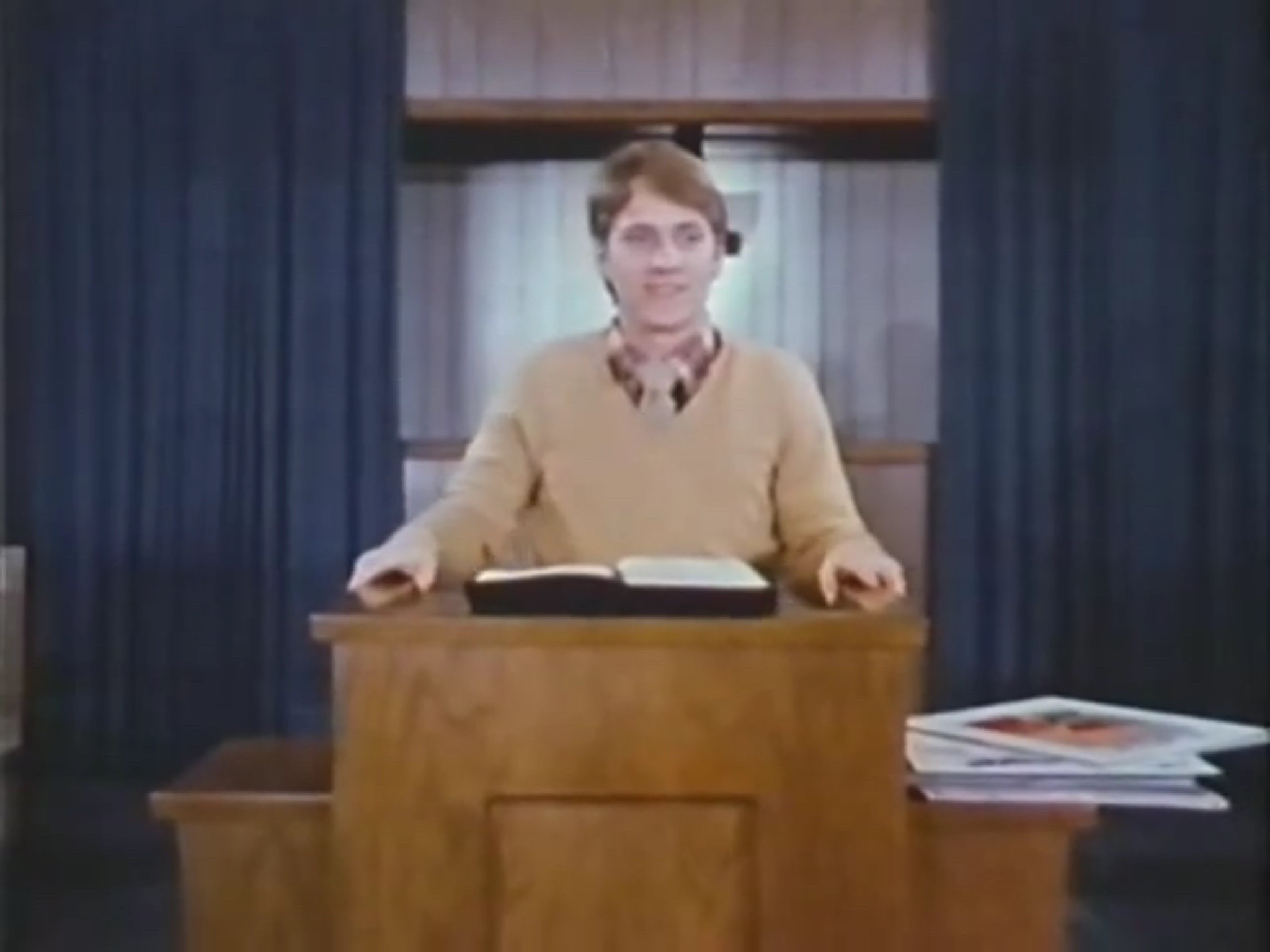
I’m finally taking Lisa up on doing my own review of this thing. Guess I kind of have to after reviewing Law Enforcement Guide To Satanic Cults. Is this really going to be my thing now? Reviewing fundamentalist paranoia films and other religious movies. Well, they can be entertaining, and I’m still hoping to find a copy of Super Christian 2, so maybe. If you want to skip right to the sermon, then I’ve marked it below. Otherwise, let’s get this party started.
The movie opens at a rock concert. The band is playing a generic song about having an unspecified good time. Since this film is about how rock music is a tool of Satan, I have to call bullshit right here. We all know that Kool & the Gang’s Celebration didn’t become a sin till Ross played it using the bag pipes on Friends.
Then we cut to a house where loud rock music is playing. This is when we meet Jeff who clashes with his mother over rock music. He storms from the house, gets in his car, and drives off. He nearly gets into an accident because he’s so worked up. He turns on the radio and the song that is playing has the lyrics: “Can’t walk on water. Got a ball and chain.” When you have a son that doesn’t like you telling him to turn down his music, what do you do? Well, complain to your husband that’s out of town, then call his youth minister. The youth minister can surely remind him of obedience. Not that she tried to do it herself. Her husband even asks if she talked to him again, but she says no that won’t work. Oh, and where Jeff drove to is church. This kid is clearly on a highway to hell.
“I’ve had enough of being programmed
And told what I ought to do
Let’s get one thing straight
I’ll chose my fate
And it’s got nothing to do with you”
– You Don’t Have To Be Old To Be Wise by Judas Priest (1980)
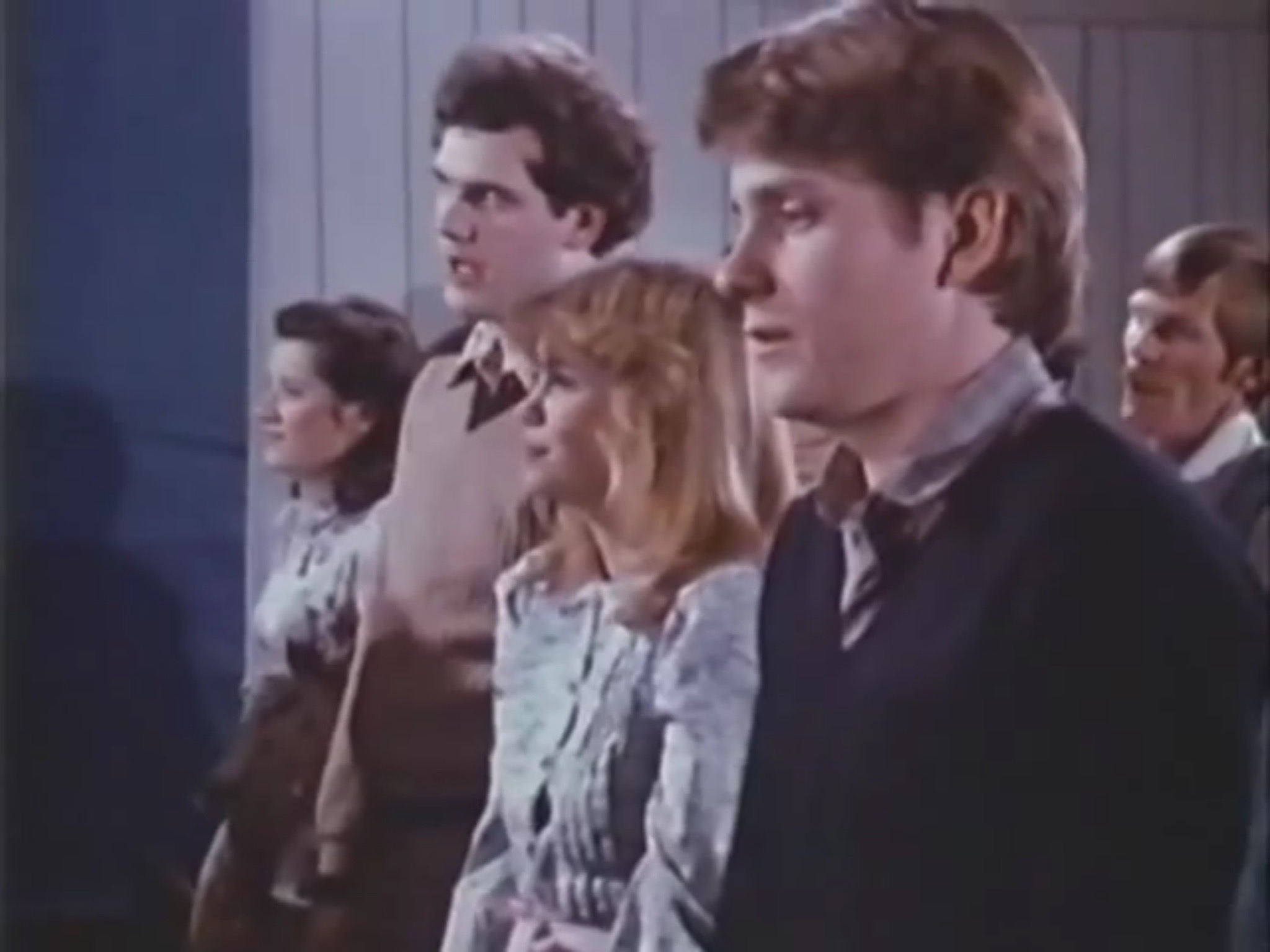
Next we cut to the youth meeting at the church where one of Jeff’s friends is complaining about everyone coming to the church to tell him how sinful he is. Jeff says to himself that he feels a certain way. That whatever that is, is the reason he clashes with his mother. This is the first mention of a main part of the message in this film. That being that rock music actually controls you against your better judgement. You know, the same thing that people who claim to speak for God can. Just pointing out when they do the, but it’s okay when Christianity does it, bit.
Then he gets home and apologizes to his mother. Also, apparently there were two kids that were saved at the meeting. I know what he means, but based on the rest of the material in the movie, being saved apparently means giving up all individuality and free will to follow what older people tell you God wants you to do. Then he goes into his room and turns on the stereo. The song is great. The lyrics keep repeating “devils and demons have taken your life.” No, no, no. If we are going down that route, then I have much better lyrics:
“God told me to skin you alive.
I kill children
I love to see them die
I kill children
And make their mamas cry
Crush ’em under my car
I wanna hear them scream
Feed ’em poison candy
To spoil their Halloween”
-I Kill Children by Dead Kennedys (1980)
See ma, it could be much much worse.
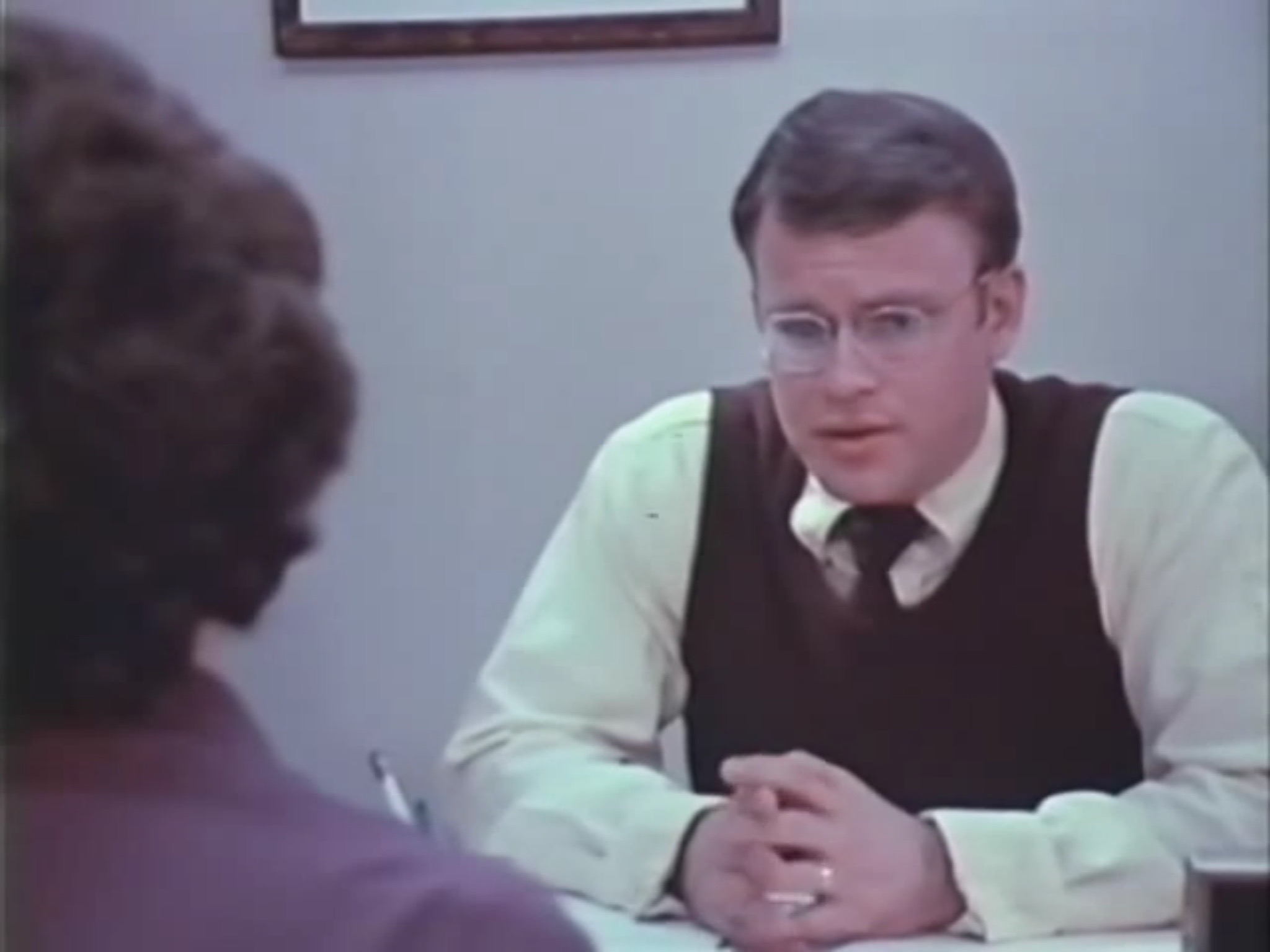
Now mom meets with youth pastor Jim Owen about how her son gets angry when he is told he can’t listen to the music he enjoys. Owen is quite interesting in this movie because of the things he says. First, his mother says Jeff’s attitude changed when they gave him his own stereo. This is when Owen talks about Jeff’s rock music problem in an interesting way. He uses the same language that someone would if they were talking to a parent that thought their child’s drug problem was a recent development.
Owen explains that kids identify so closely with their music that an attack on it, is an attack on them. True. He even says that it’s especially true when you don’t know anything about the music the kid is listening to. Keep that piece of advice in mind for the feature presentation final sermon of the film. But then he says that most parents aren’t knowledgable about rock music. Really? This came out in 1982. Is this film claiming children of the 1980’s were given birth by people who lived their lives prior to 1982 in caves? Of course they are because as everyone knows, when the 1980’s came, it became time to pretend that the 1960’s and 1970’s never happened.
He says that Jeff could come up with scriptural evidence that she shouldn’t be watching soap operas. Then he actually gives her some good advice about parenting. It’s always a little weird when propaganda weaves in the good with the BS. The next line is the BS: “Rock music is one of the most difficult things a Christian young person must deal with.” Seriously?
What about his girlfriend here? I think learning about safe sex or even abstinence is just wee bit more important than anything about rock music. Owen agrees to meet with Jeff.
This part is really funny to me. Owen reminds Jeff of a conversation they had when Jeff came in to talk to Owen about his salvation a year prior. They don’t tell you till the very end of the movie, but this film was put together by Baptists. Baptists don’t baptize you till you are old enough to make that choice yourself. That’s probably why the title is the way it is.
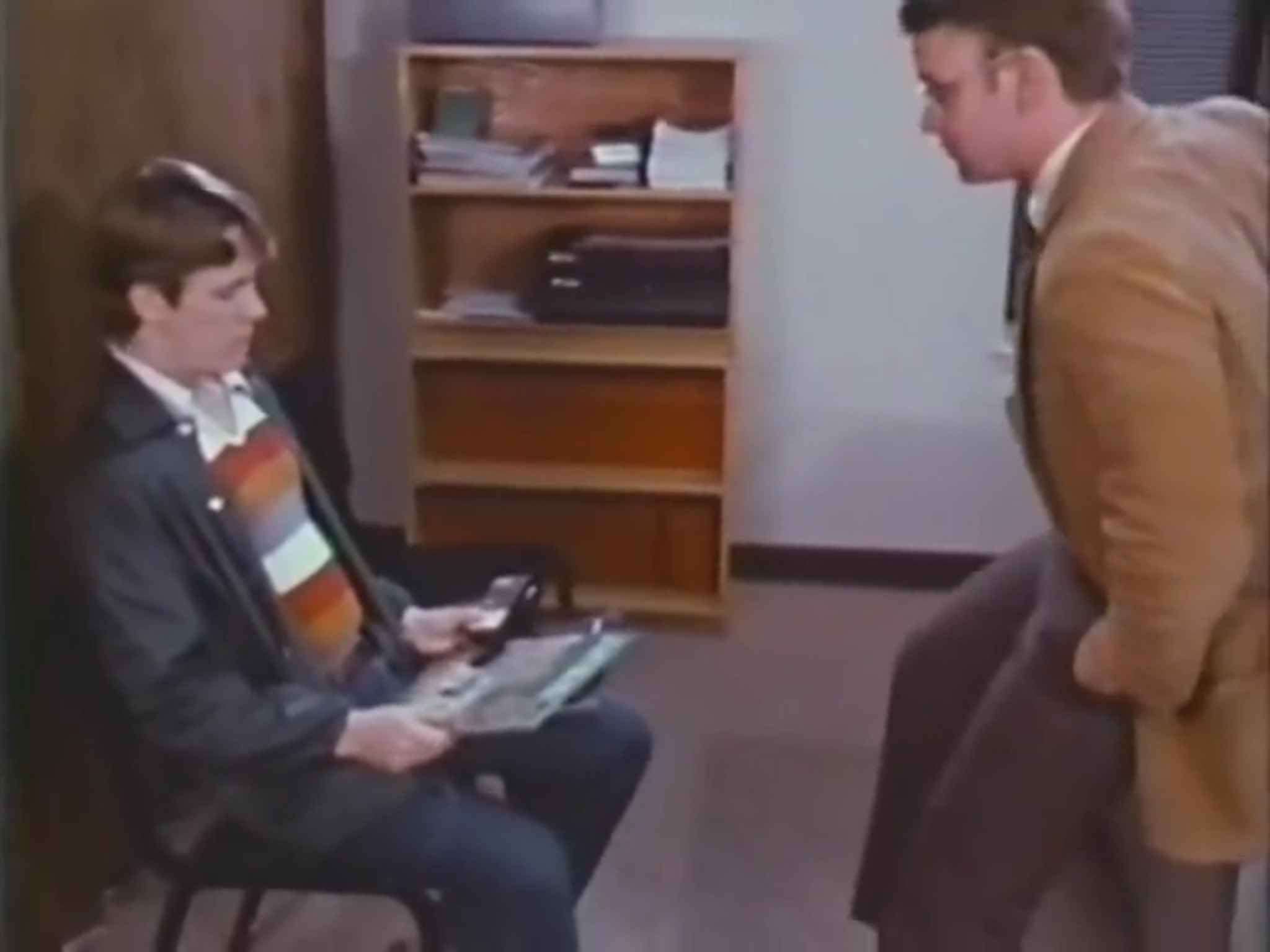
After quoting a few lines from the bible, Owen asks Jeff if his music can be included in his life of glorifying Jesus Christ. Jeff asks how he knows where to draw the line between acceptable music and unacceptable music. Owen of course gives the Protestant response that the answer is in scripture. Keep that in mind during this film because you will never see Jeff consult scripture. Not once.
Then we get more BS from Owen: “Illicit sex, drugs, mocking God, the occult. Aren’t these things often found in rock music?” Jeff responds that not all rock music is like that. True. Then Owen says that some contemporary music wouldn’t fit in to any of those categories, but that they mainly are the exception. Really? So this says two things to me:
1. That means rock music only turned evil recently.
2. Owen is really ignorant of rock music and music as a whole.
Now comes the experiment. Owen tells Jeff to try and not listen to rock music for 2 weeks. During those 2 weeks he is supposed to do research on whether rock music has a place in his Christian life. Keep that in mind too because Jeff doesn’t do any research. He reads one book and then turns into a raving maniac. But back to the experiment.
This is where Owen gives him some music from his own personal collection. I know what you’re thinking, but no, we never hear the music that is supposedly safe. Now he tells him to research rock music to find his own conclusion. But then he says based on scripture, not an opinion. How can it be your own conclusion if it isn’t an opinion. Jeff doesn’t understand, so Owen explains that opinions change, but God’s word doesn’t cause the Old and New Testaments are exactly the same, right? Then he says that dedication and surrender apply to his music. Why? Why does he have to do and believe everything in the music he listens to? Isn’t he supposed to use his brain?
“Everyone goes through changes
Looking to find the truth
Don’t look at me for answers
Don’t ask me
I don’t know”
“You gotta believe in someone
Asking me who is right
Asking me who to follow
Don’t ask me
I don’t know”
“Nobody ever told me
I found out for myself”
-I Don’t Know by Ozzy Osbourne (1980)
Where to start the research? Well, Owen has some books. We only see one.
That’s The Big Beat: A Rock Blast by Frank Garlock. I haven’t read it, but here’s a quote from it listed on Amazon.com.
“Yes, I believe that we can definitely conclude that rock ‘n roll is not only a symptom of the problems of teenagers in this generation but also a part of the cause. ‘You know a person by the company he keeps,’ the old saying goes; and, if any music has been guilty by association, it is rock music. It would be impossible to make a complete list, but here are a few of the ‘associates’ of rock: drug addicts, revolutionaries, rioters, Satan worshippers, drop-outs, draft-dodgers, homosexuals and other sex deviates, rebels, juvenile criminals, Black Panthers and White Panthers, motorcycle gangs, blasphemers, suicides; heathenism, voodooism, phallixism, Communism in the United States (Russia outlawed rock music around 1960), paganism, lesbianism, immorality, demonology, promiscuity, free love, free sex, disobedience (civil and uncivil), sodomy, venereal disease; discotheques, brothels, orgies of all kinds, night clubs, dives, strip joints, filthy musicals such as ‘Hair’ and ‘Uncle Meat’; and on and on the list could go almost indefinitely. Perhaps we should include in this list powerless Christianity, because churches and so-called Christian groups who have lost their spiritual power have adopted rock music as a way of reaching teenagers; but what a cheap substitute for spirituality it turns out to be.”
Didn’t think you were going to see another list like that after Law Enforcement Guide To Satanic Cults, did you? Honestly, you could probably go through every single one of those things and find that religion causes them as well. Just saying. My favorite parts are that apparently Black Panthers and White Panthers are listed there. I don’t think most people even know the White Panthers existed. They were an organization created with encouragement from the Black Panthers for white people who supported their cause. Their house band is one of the most important garage rock bands of the era. That being MC5. I can see how this could be very threatening.
“Yeah, but I can see the chickens coming home to roost
Young people everywhere are gonna cook their goose
Lots of kids are working to get rid of these blues
‘Cause everybody’s sick of the American ruse
-The American Ruse by MC5 (1970)
But back to the movie. Because the downward spiral begins now. Apparently, one reading of that book and your life is over. His girlfriend comes over to his place to ask if he got the tickets to the rock concert. She doesn’t say what concert, but since it’s 1982, I’m going to assume they were going to see Duran Duran. Of course they clash and she storms out threatening to go to the concert with someone else. So Jeff goes to bother his other friend Marty. Marty agrees to hear Jeff out.
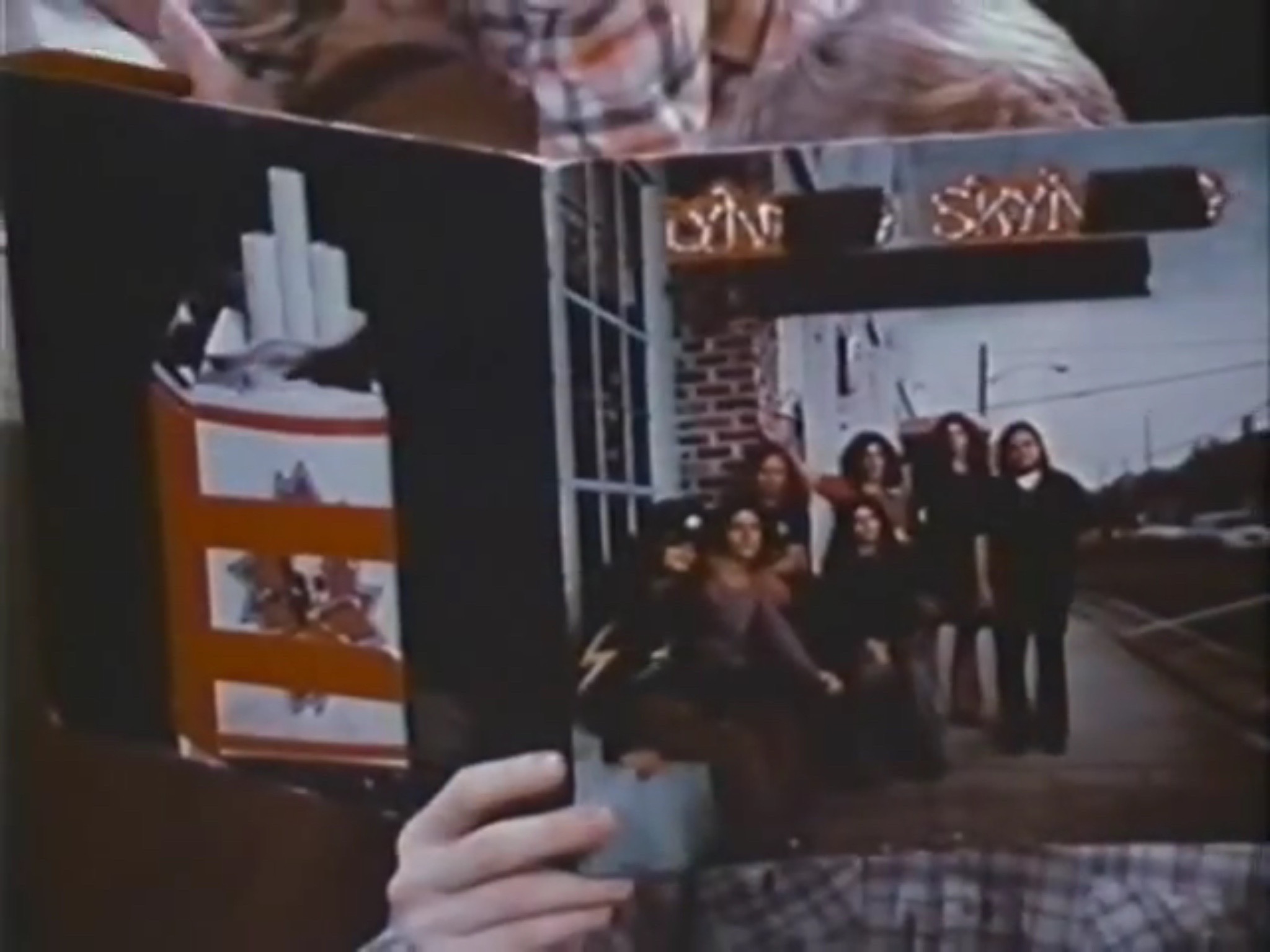
I was really hoping I would recognize the name of the band here, but that black tape just hides too much! This is where Jeff brings up that some rock groups are involved with the occult. Any examples, Jeff? Nope, he never gives an actual example of a group involved in the occult anywhere in the movie. Then he goes on to complain that the average age of a kid buying a KISS record is 12 years old. Well, the answer is simple. Satan needs to get those kids knighted early on. In all honesty, I’m sure that changed quickly when kids saw the video for Lick It Up.
That’s terrifying!
However, Jeff does make one good point here and that’s if you don’t approve of the lifestyles of certain musicians, then don’t buy their music. But then he says “the record industry is pumping sex and Satanism into the minds of little children.” This is the same kind of us vs. them posturing that Law Enforcement Guide To Satanic Cults was all about. He also throws The Rolling Stone’s into the lot here.
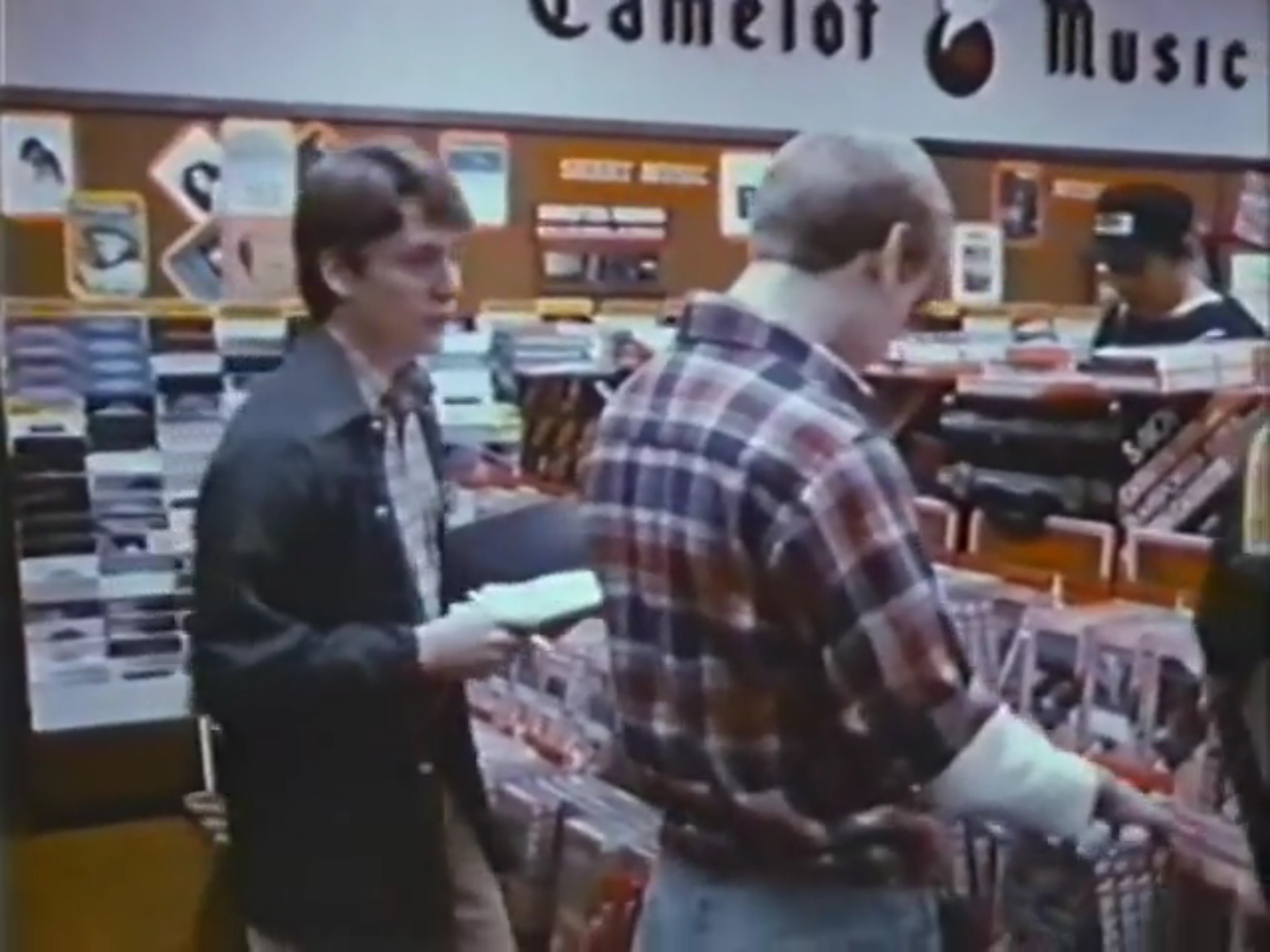
Well, as you can guess, Jeff’s friend tells him to quit preaching to him and that people have a right to their own taste in music. So of course this means he’s the villain when we actually really want to root for this guy. Oh, also he knew the average age of a kid buying a KISS album was 12 years old because he talked to two clerks at a record store. Putting aside that that’s hardly a survey, that means Jeff went into a record store asking about what little kids are listening to. I bet Phil Phillips was in the toy store on his fast at that mall at the same time, but that’s Deception Of A Generation. I’ll get to that video eventually.
Jeff’s girlfriend tries to reconcile, but they just clash again. Now Jeff has to confide in Owen once again. He tells him he went into a record store to ask some people about the music there, but they hassled him when they found out he was a Christian. That’s probably because Jeff opened up the conversation with the question “Do you know what kind of music you are buying?” But we don’t hear that part. We do see Jeff leaving the record store and the music playing nearly tempts him back, but he fights it and walks away. He says he felt like he was being controlled. To late to be worried about being controlled, that’s already a forgone conclusion, Jeff.
Then the bomb drops. Owen was once a drummer in a band. He actually almost talks like he regrets that he had to give it up. I don’t know why? He could have joined a Christian metal band instead of taking the radical approach of rejecting all rock music. I just listened to Lightshine by Resurrection Band and it’s damn catchy, but with Christian lyrics. Well, with that little kick to keep Jeff on the path to crazy town, it’s time to go to a party!
Of course his friend Marty does the unthinkable and puts on rock music. I love that it has no lyrics, but is somehow evil anyways. This is when Jeff has his crisis of faith about a book he read that isn’t the bible and has nothing to do with Christianity. But first he listens to that rock song from the beginning that says “can’t walk on water…”
I love the really moving music that kicks in here. He says he tried so hard. Seems like everything has gone wrong. He says he can’t fight everybody. He wants to glorify Jesus and everything. Even in his music.
Okay, he didn’t try at all actually. He never once looked in the bible which he was told was the be all and end all of where he should draw truth from. Everything went wrong because you went around treating people like garbage. Nobody, even Owen, asked you to fight everybody. You chose to pick fights with everyone yourself, Jeff. How about you glorify Jesus Christ by treating people with love rather than judgement. Nah! That would mean we don’t get the epic sermon. Before he does that, he goes back to the party and tries to tell his girlfriend how he is the one that has been mistreated.
———————-The Sermon———————-
This is where we get told all the things wrong with rock music and he finally gets around to really naming names. I’ll try to take these point by point if I can:
He starts by comparing listening to rock music with shooting up heroin.
Then he says that the carnal part of him still likes rock music. That he can turn it on and his bad mood goes away. But then he says what about the spiritual part. This is where suddenly listening to music becomes something that supplants spirituality and a belief in Jesus Christ. The logic just doesn’t hold water here.
Now he goes on to say that rock is very pervasive and thus has somehow taken the place of the Holy Spirit in guiding your life. Although he never actually does say the Holy Spirit, but that’s what he means.
Then he does something hilarious. He says that at a rock concert people don’t sit quietly in their seats, but dance around so that means they are being controlled. Hate to break it to you Jeff, but that particular part of rock comes straight out of it’s Gospel roots.
Now he goes on to talk about lyrics in rock music. He surveyed some people who said they didn’t really care about the lyrics as long as the music was good. That’s true, but then he goes on to say that in singing along to these evil lyrics, they don’t have the mind of Christ. The main themes of rock are apparently sex and the occult. Jeff really needed a real musical education if he believed that.
Then Jeff declares that some are admitted homosexuals. That’s where any sympathy you might have for him goes out the window. If he was worried about the admitted homosexuals in 1982, then I’m guessing he didn’t survive the 1990s.
Then he goes on to talk about some of the perils of the rock lifestyle like drugs and lots of sex. Except he conveniently forgets that those things have nothing to do with the music itself. That kind of stuff is what happens whenever you give people loads of money, fame, and put enormous amounts of pressure on them. That’s a systemic problem with humanity, not exclusive to rock music nor avoidable by not listening to rock music.
Now he actually claims to have read something from the bible and quotes something that is just a list of things that are supposed to be bad.
Now we get names! Fun time!
One Of These Nights by The Eagles: His problem is that it’s a song about wanting a woman, which isn’t godly. So acknowledging the existence of sex is evil.
At this point he just starts listing song titles under the assumption that they clearly sound evil.
Sympathy For The Devil by The Rolling Stones: It’s a song about the atrocities committed by humankind.
Dancing with Mr. D by The Rolling Stones: I wasn’t familiar with this one before, but how exactly is the audience that he is preaching to going to connect that title with a song about Death or a succubus?
Devil’s Den by Jefferson Starship: I’m not going to pretend I completely get the meaning of the lyrics, but it’s clearly a metaphor and probably has to do with American capitalism. Hardly Satanic.
Dance with the Dragon by Jefferson Starship: It’s an anti-war song that references the Chinese New Year of the Dragon.
Evil Ways by Santana: The song basically just repeats the line “You’ve got to change your evil ways.” The only thing to complain about here is that the only sin the girl in the song committed was having a social life rather than staying home and cooking.
Soul Sacrifice by Santana: It’s an instrumental song so I don’t have the foggiest idea what is evil here.
Now comes AC/DC!
Rock ‘N’ Roll Damnation by AC/DC: It’s a song about the very kind of people who made this video. Also, about the problems of the rock and roll lifestyle.
Let There Be Rock by AC/DC: The only sin that I can see here is that they dared to refer to the birth of rock in creationist book of Genesis terms. I guess they should have talked about the evolution of rock instead of treating it like it was created.
Highway To Hell by AC/DC: A song about how it feels to be touring all the time and living your life on the road.
Hell Ain’t A Bad Place To Be by AC/DC: Metaphor, and it is about a shallow man who is taken advantage of by a woman.
Now he mentions KISS album names: Hotter Than Hell, Dressed To Kill, and Destroyer. Wow! Yep, those titles are just awful. No, I mean they’re not that great of titles and no kid, as he keeps mentioning listens to KISS, is going to care one bit about them. It’s only in Jeff’s head that 12 year olds take those titles to heart.
Now comes Captain & Tennille. He complains that even they have tried to change their image by doing songs like You Need A Woman Tonight and You Never Done It Like That. Yep, if your only exposure to Captain & Tennille is Love Will Keep Us Together, Disney Girls, and Muskrat Love, then yes those songs are a little different. Then again, they also covered Shop Around before those songs which is at least as suggestive as anything Jeff has mentioned. Also, Tennille worked with Elton John and is on Pink Floyd’s album The Wall.
Now he brings up Rod Stewart and shouts out the title Da Ya Think I’m Sexy. Then it’s Passion and Tonight’s The Night. Just more complaining about songs that have to do with sex.
Now he just says that if you buy albums with these songs on them, then you encourage them to make more of them. Congrats Jeff, you just figured out how economics works.
But he has to take one final crack at someone. This time it’s Barry Manilow’s Could It Be Magic. With all the examples out there, brining Manilow and Captain & Tennille into your argument makes you sound really crazy. Especially when your speech is supposed to be to teenagers your age. Do you really think that’s what they’re listening to, Jeff?
At this point, I had one question. How exactly did Billy Joel escape Jeff’s wrath. In 1977 he did a song called Only The Good Die Young which is about a guy trying to deflower a Catholic girl. And it did kick up a fair amount of controversy at the time. Billy Joel only got more popular afterwards. This would have fit the illicit sex, the against God, and Jeff’s argument that you should vote with your dollar when it comes to music. Oh, well.
Then it’s a little bit about how if we don’t stick out like sore thumbs and act differently from everyone else, then people won’t think they have to be Christians. His speech kind of sounds like a white supremacist calling for racial separation except swap out white for Christianity. Then he does this.
After smashing a record, probably just Disco Duck, Jeff says he’s made his decision and asks us what ours is. So I can chose to be a raving bigoted fanatic who ceases to think and is just told what Jesus Christ wants me to do till I become old enough to tell younger people what God is telling them to do. Or, I can use my brain, be good to others, and live my life without having to be an awful person. In other words: I wanna rock!
It’s also Dario Argento’s 75th birthday! And what better way to celebrate the maestro‘s birthday than with a scene that I love?
The opening of Argento’s 1977 masterpiece, Suspiria, is about as perfect an opening as one could hope for. American ballet student Suzy Banyon (Jessica Harper) arrives in Frieburg, Germany. Both Argento and Harper perfectly portray Suzy’s confusion as she makes her way through the airport and, as torrential rain drenches her, attempts to hail a taxi and get a ride to the dance academy. (What Suzy doesn’t know, of course, is that the dance academy is home to the ancient witch known as Our Mother of Sighs.) With this opening scene, Argento both immediately establishes the off-center, nightmarish atmosphere of Suspiria and establishes Suzy as a character who we, as the audience, relate to and care about. Suspiria is a great film and it all begins with this brilliant opening.
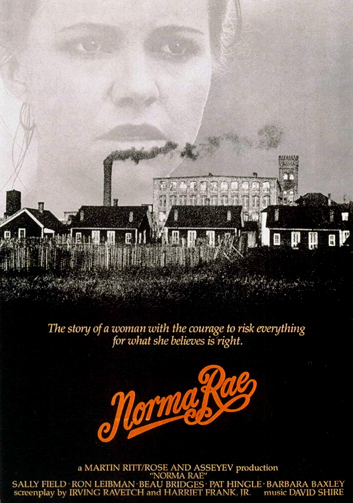
Earlier, in honor of Labor Day, I reviewed one of the most anti-labor union films ever made, the 1954 Oscar winner On The Waterfront. In the interest of fairness, it only seems right to now take a look at one of the most pro-union films ever made, the 1979 best picture nominee Norma Rae.
Norma Rae takes place in one of those small Southern towns that is defined by just one industry. In this case, almost everyone in town works for minimum wage at the local textile mill. Conditions are terrible, with the employees working long and brutal shifts in a hot and poorly ventilated factory. The overwhelming roar of the machines have left the majority of the workers deaf to reality, both figuratively and literally. The mill is run by the usual collection of slow-talking, tie-wearing rednecks who always seem to show up in movies like this.
One day, a union organizer from New York shows up in town. Brash and cocky, Ruben Warshowsky (Ron Leibman) is determined to unionize the mill but, at first, he struggles. Nobody wants to risk their job by being seen with him and his Yankee manners rub many of the townspeople the wrong way.
Eventually, Ruben does find one ally. Norma Rae (Sally Field) has worked at the mill her entire life. She’s tough and determined but she’s also regularly shunned because of her past. A widow who has three children (“She’s had a child out of wedlock!” a judgmental union organizer tells Ruben in a near panic), Norma channels her frustration into drinking too much and having an affair with a married (and abusive) salesman.
Two things happen that give Norma Rae a new purpose in life. First off, she meets and marries the well-meaning but chauvinistic Sonny (Beau Bridges). Secondly, she helps Ruben in his efforts to unionize the plant, even at the risk of going to jail and losing her job. With the mill’s management spreading untrue rumors about Norma’s relationship with Ruben, her dedication to the union soon starts to threaten her marriage to Sonny.
I have to admit that I have mixed feelings about Norma Rae. In many ways, Ruben is an annoying character. He’s so brash and so smugly out-of-place that I actually found it difficult to consider any of the points that he was making. I suppose that was partly intentional. Ruben can’t accomplish anything until he gets Norma Rae on his side. But, at the same time, there was something very condescending about Ruben as a character. Much like the villainous rednecks in charge of the mill, Ruben felt like a stock character. He was Super Yankee, bravely venturing below the Mason-Dixon Line to bring the truth to all of us stupid Southerners. Whenever Ruben smirked and started to complain about how dumb everyone else was, I was reminded of why I never wanted much to do with the whole Occupy Movement.
As well, Norma Rae is one of those films that technically takes place in the South but it’s the South of the Northern imagination. The accents were inconsistent and the dialogue often tried way too hard to sound “authentic.” Ultimately, Norma Rae lacked the artistry necessary to disguise its more heavy-handed moments.
And yet, I still liked Norma Rae. It had nothing to do with the film’s political message and everything to do with the character of Norma Rae. Sally Field gives such a good performance as Norma, making her both strong and vulnerable. The film’s best moments are the ones where Norma stands up for herself and does what she feels is right, despite the opposition from the mill’s management, Sonny, and her father (Pat Hingle). Towards the end of the film, there’s a simply incredible scene where Norma finally tells her children about her past and, at that moment, Norma Rae reveals itself to be a great and heartfelt tribute to the strength and resilience of women everywhere. At that moment, Norma’s strength reminded me of the greatest woman that I’ve ever known, my mom. It made me appreciate the struggles that my mom went through as she raised four strong-willed daughters on her own, while working crappy jobs and dealing with a society that is always threatened by and cruelly judges a woman who refuses to settle. Personally, I think Norma could have done better than Sonny and that Ruben should have been called out for constantly talking to down to her but what’s important, in the end, is that Norma never stopped standing up for what she believed. By the end of the film, Norma is standing in for every woman who has ever been underestimated or judged or told that her opinions didn’t matter. Norma is standing up for all of us.
Sally Field won an Oscar for her role in Norma Rae. Off the top of my head, I have no idea who she defeated for the award. (Yes, I know that I could just look it up on wikipedia but that’s not the point.) But, regardless of her competition, it’s an honor that she definitely deserved.
Nowadays, that can be a dangerous thing to admit. On The Waterfront won the Oscar for Best Picture of 1954 and Marlon Brando’s lead performance as boxer-turned-dockworker Terry Malloy is still regularly cited as one of the best of all time. The scene where he tells his brother (played by Rod Steiger) that he “could have been a contender” is so iconic that other films still continue to either parody or pay homage to it. On The Waterfront is one of those films that regularly shows up on TCM and on lists of the greatest films ever made.
And yet, despite all that, it’s become fashionable to criticize On The Waterfront or to cite it as an unworthy Oscar winner.Certain film bloggers wear their disdain for On The Waterfront like a badge of honor. Ask them and they’ll spend hours telling you exactly why they dislike On The Waterfront and, not surprisingly, it all gets tedious pretty quickly.
Like all tedious things, the answer ultimately comes down to politics. In the early 50s, as the House UnAmerican Affairs Committee conducted its search for communists in Hollywood, hundreds of actors, writers, and directors were called before the committee. They were asked if they were currently or ever had been a member of the Communist Party. It was demanded that they name names. Refusing to take part was career suicide and yet, many witnesses did just that. They refused to testify, apologize, or name names.
And then there was the case of Elia Kazan. When he was called in front of HUAC, he not only testified about his communist past but he named names as well. Many of his past associates felt that Kazan had betrayed them in order to protect his own career. On The Waterfront was Kazan’s answer to his critics.
In On The Waterfront, Terry Malloy’s dilemma is whether or not to voluntarily testify before a commission that is investigating union corruption on the waterfront. Encouraging him to testify is the crusading priest, Father Barry (Karl Malden), and Edie (Eva Marie Saint), the saintly girl who Terry loves. Discouraging Terry from testifying is literally every one else on the waterfront, including Terry’s brother, Charlie (Rod Steiger). Charlie is the right-hand man of gangster Johnny Friendly (a crudely intimidating Lee J. Cobb), who is the same man who earlier ordered Terry to throw a big fight.
At first, Terry is content to follow the waterfront of code of playing “D and D” (deaf and dumb) when it comes to union corruption. However, when Johnny uses Terry to lure Edie’s brother into an ambush, Terry is forced to reconsider his previous apathy. As Terry gets closer and closer to deciding to testify, Johnny order Charlie to kill his brother…
The issue that many contemporary critics have with On The Waterfront is that they view it as being essentially a “pro-snitch” film. It’s easy to see that Elia Kazan viewed himself as being the damaged but noble Terry Malloy while Johnny Friendly was meant to be a stand-in for Hollywood communism. They see the film as being both anti-union and Kazan’s attempt to defend naming names.
And maybe they’re right.
But, ultimately, that doesn’t make the film any less effective. Judging On The Waterfront solely by its backstory ignores just how well-made, well-acted, well-photographed, well-directed, and well-written this film truly is. Elia Kazan may (or may not) have been a lousy human being but, watching this film, you can’t deny his skill as a director. There’s a thrilling grittiness to the film’s style that allows it to feel authentic even when it’s being totally heavy-handed.
And the performances hold up amazingly well. Marlon Brando’s performance as Terry Malloy gets so much attention that it’s easy to forget that the entire cast is just as great. Rod Steiger makes Charlie’s regret and guilt poignantly real. Karl Malden, who gets stuck with the film’s more pedantic dialogue, is the perfect crusader. Eva Marie Saint is beautiful and saintly. And then you’ve got Lee J. Cobb, playing one of the great screen villains.
The motives behind On The Waterfront may not be the best. But, occasionally, a great film does emerge from less than pure motives. (Just as often, truly good intentions lead to truly bad cinema.) Regardless of what one thinks of Elia Kazan, On The Waterfront is a great work of cinema and it’s on that basis that it should be judged.
Now, I have to be honest. I’m not really sure what the point of Labor Day is. I have no idea what we’re supposed to be celebrating today. I’ve got the day off, which seems kind of unfair when you consider that people who have far worse jobs than me — i.e., the actual laborers — are having to work.
Like many Americans, I spent this weekend hanging out with my extended family. On Sunday, I did a poll of every cousin, aunt, uncle, sister, niece, and nephew that I could find and almost every single one of them agreed with me that Labor Day sounded like something tedious that Jesse Myerson would come up with and then demand that everyone celebrate. In short, it sounded communistic.
So, with that in mind, I think the best way to start out Labor Day would be by watching this educational film from 1962. In Red Nightmare, Jerry Donavon (Jack Kelly) takes his freedom for granted. So, Jack Webb shows up and casts a magic spell, which causes Jerry to have a dream about what it would be like to live in a communist society. In fact, you could even say that Jack Webb gives Jerry a red nightmare!
So, there’s two ways to review a film like Red Nightmare. We can either debate the film’s politics and get into a big discussion about economics and policy and all that crap and OH MY GOD, doesn’t that just sound perfectly tedious? Or, we can simply enjoy Red Nightmare for what it is, a histrionic but sincere time capsule of what was going on in the psyche of 1962 America.
Red Nightmare! Watch it before getting brainwashed by Labor Day!
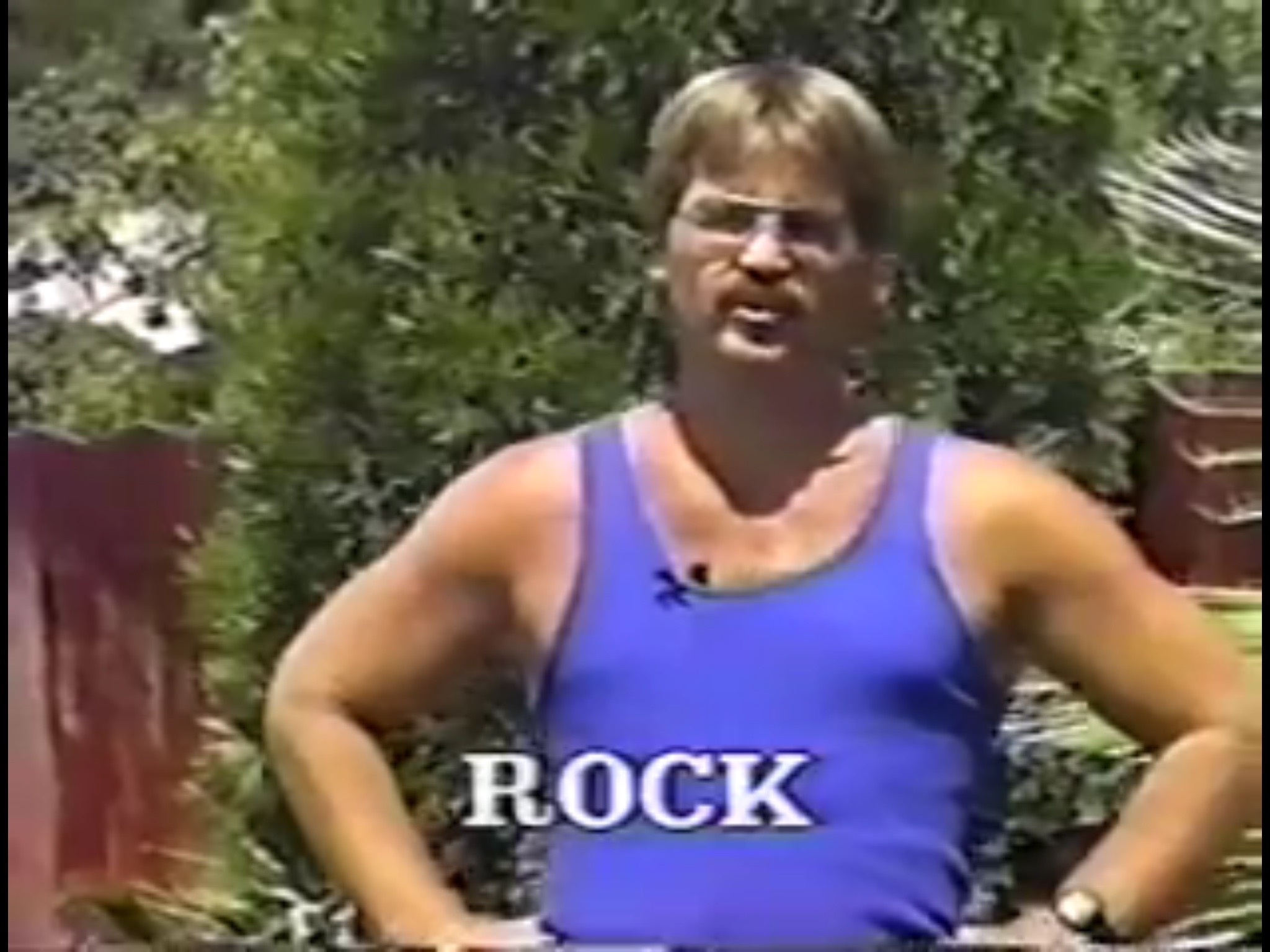
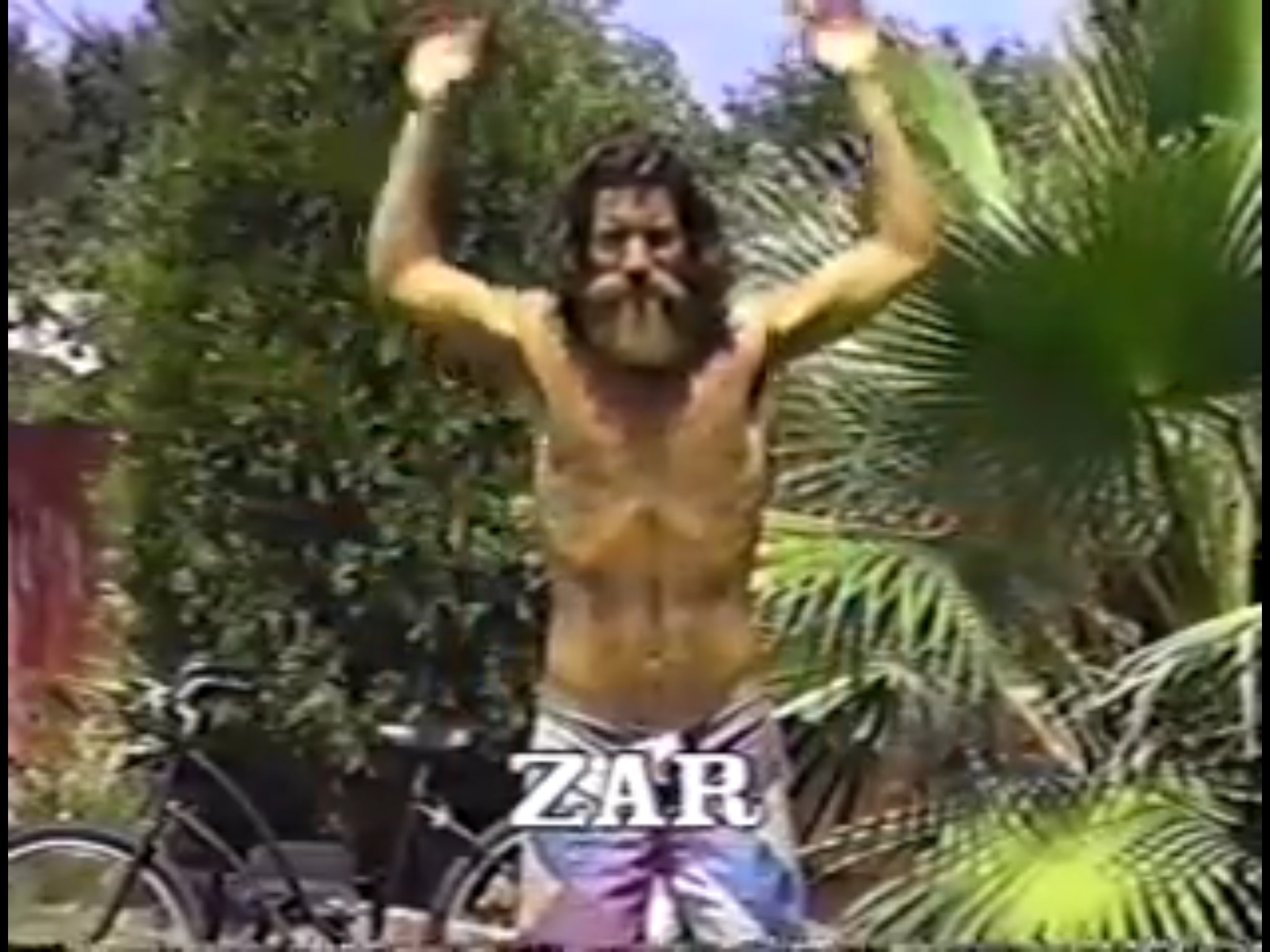
This is probably the weirdest thing I have ever written about. This is what appears to be a really bizarre unreleased amateur workout video from 1990. A guy named Rock is going to guide the audience through exercises that don’t involve weights with the help of what appears to be a homeless guy named Zar, two surfer friends, and an old man named Dorral Silverthorn.
It begins with Zar doing some exercises including crunches and jumping. Then it cuts to Dorral Silverthorn.
He goes off. He’s angry about what he calls the “two-faced” hypocritical government. He complains about Prohibition being repealed. He says my new catch phrase: “Booze is a loser. And a loser is a boozer.” He briefly talks about how the government is spending a lot of money to curtail drugs coming into the country, but not enough on homegrown ones. Then it’s back to the workout.
This is the first of the two surfer dudes. I believe they refer to him as big Zaddi. He then has a foot race with Zar after Zar tries to jump so high that his head hits the ceiling.
Now we meet the next surfer dude named John who takes us through a few more exercises.
We see Zar ride a bike and then it’s goodbye to the audience.
The movie ends with Zar chilling in a pool.
Oh, and during this whole thing some really depressing piano music plays.
This may be the strangest thing I have ever written about. I don’t normally do this because things get taken down off of YouTube all the time, but here’s the full video if you want to see it. It’s really short.
Ordinary Miracles (2005) – This movie begins with a judge hearing a case of two foster parents who want to give up their foster daughter back into the system because she is too much for them. What they tell the judge she has done is pretty minor and if they are foster parents then they should have been able to handle it. Anyways, the judge grants their wish, but unfortunately is stuck because she has no where else to put her but into juvenile prison.
With that over with, some blonde shows up to plead her case as the judge is leaving for a vacation of sorts. This lady was obviously hired because of her angelic appearance, but she’s just plain annoying. I say this because she harasses the judge about helping the girl. She says she cares deeply about what happens to her. She didn’t care enough to show up to the case under the guise that her department is too busy. Fine, but if you care so much about her, then instead of bothering the judge, do something about it yourself! Instead, she guilts the judge into taking the girl out of holding to try and foster the girl herself.
The rest is pretty typical. There’s the boyfriend who’s the bad influence. The judge tries to do research into her past to find her missing parents. And the girl goes through some adjustment issues. There’s also a minor subplot with the judge’s parents as well. Nothing particularly interesting or great. It’s just decent.
The only thing that bothered me, other than the blonde, was the supposed visit from the ghost of the daughter’s dead mother. It’s almost like they were planning to do more with it, but didn’t. She has a nightmare near the beginning of the film that we are told was actually her talking to someone. Later we actually see the ghost of her mother talk to her. I don’t really know what the point of that was. It doesn’t add anything and feels out of place.
Ice Dreams (2010) – There are quite a few characters here so I’m going to try and give you the gist. You have an ice rink that isn’t doing well financially and looks run down. It’s run by two guys. One who is there for comic relief and a couple of speeches. The other is the male romantic interest who really runs the place. Then you have a girl who used to skate and is allowed to skate at the rink after hours. She is having financial difficulties. Another lady is trying to help her daughter get into skating. Then you have the mother of the girl who skates at night trying to come back into her life.
The romantic interest helps to setup the after hours skater as a coach for the young girl. He and her become an item. The skating rink is brought up to snuff. The mother comes back into the life of her daughter. Everything raps up nicely.
This one is definitely a straight average Hallmark movie. The only thing is that it is cluttered with a few too many characters. However, that kind of helps to give a reason for the film to keep going without feeling padded out.
This one’s okay.
The Last Cowboy (2003) – This is one of those movies where there really isn’t anything to talk about except it’s problems and little noteworthy things. The plot is that the patriarch of the family has died and the inheritance is a bit of a mess for the family. Basically it’s all an excuse just to have Jennie Garth and Lance Henrikson bash heads till they find a way to keep the Texas ranch and be family again.
Okay, now the other stuff. First, this actually has Bradley Cooper in it. Well before he did The Hangover. He is barely in the movie, but you can tell he had talent even here. And yes, he looks even more boyish.
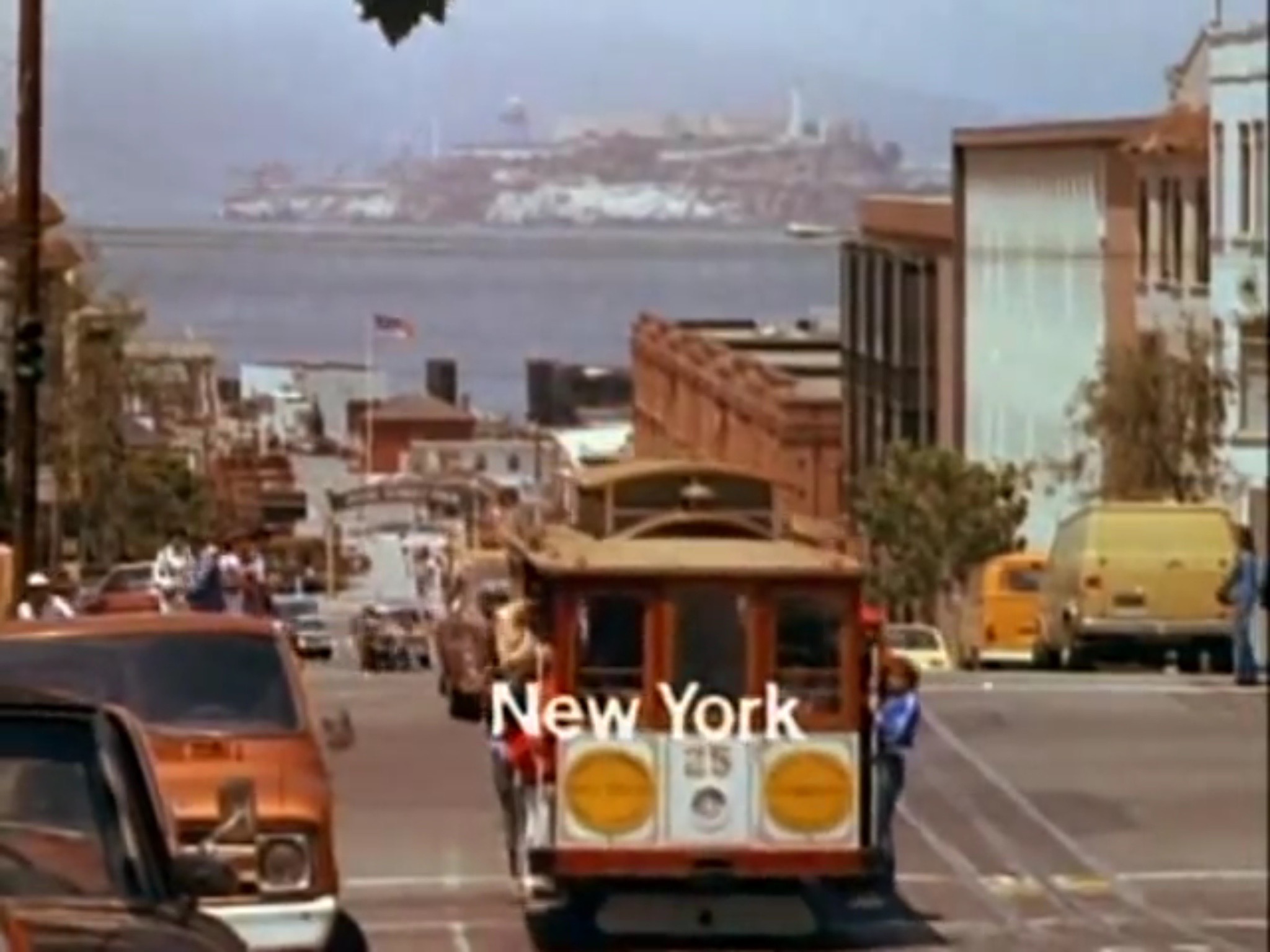
Second, the movie takes place in Texas. However, it was clearly filmed in California. Maybe if you don’t know the open spaces of California that well then it might not be as obvious, but I am familiar with the big parks in the Bay Area. Every time they try to say they are in Texas it’s like this shot from Attack Of The Killer Tomatoes! (1978).
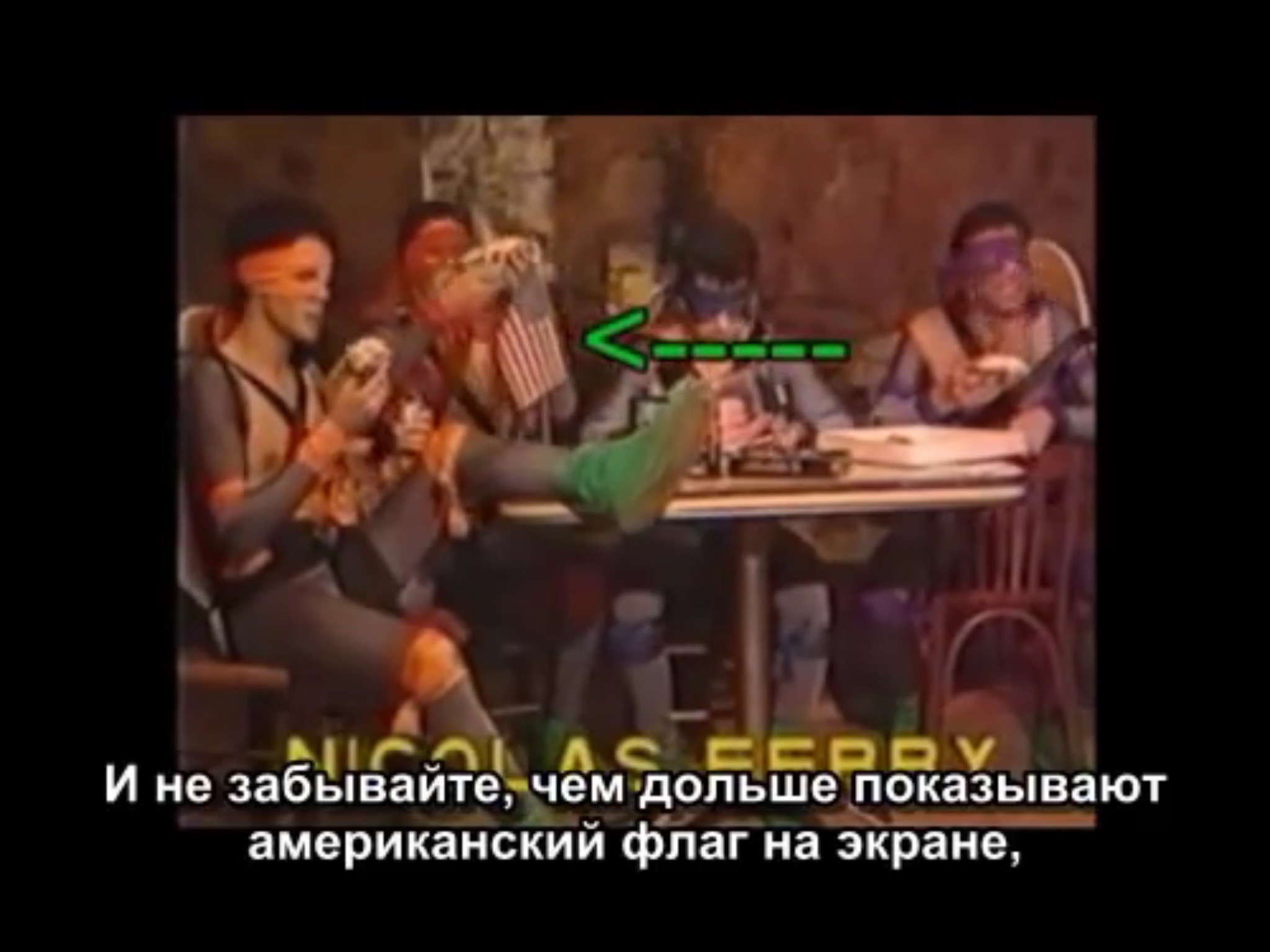
There’s even a scene where we see a Texas license plate and it’s like when a foreign film puts an American flag in the scene so we totally believe they are Americans. Like this shot from the Argentinian porno spoof of the Teenage Mutant Ninja Turtles.
There is a great scene near the end of the movie when the barn burns. Lance Henrikson goes in and comes out with his arm on fire. He just walks over to the two other people nonchalantly. In fact, he begins to just stand there like he doesn’t even care before one of the other actors puts it out with his hat. That’s badass!
The only other thing is a weird censorship issue. I remember when they muted the word “butt” in Mystery Woman: Game Time (2005). In this they mute two uses of the word “ass” and one use of the word “jackass”. It’s in the movie because you can hear them say the words around it and mouth “ass” and “jackass”, but it falls silent on those words. Makes me wonder if maybe Hallmark has become more conservative then they were when they first switched from an explicitly religious station to what they are now. However, later in the film someone says the word “jackass” and it isn’t censored. Figure that one out cause I don’t know what happened.
This one is okay if you can keep yourself from saying, “It’s fucking California!,” every time they show “Texas”. I know I did.
Uncorked (2009) – I usually don’t mention the directors of these Hallmark movies, but this one was done by David S. Cass Sr. who has done many of the ones I have reviewed so far. Notably, he did Class (2010) and Keeping Up With The Randalls (2011). Both of those movies had miscast leads. This one has one obvious miscast that almost ruins the movie. There’s something else in addition to it that truly ruins it, but let me summarize first.
This is yet another movie about how a woman with a successful job in the city who isn’t happy and avoids an unhappy relationship to end up in the country with another man. This time it’s wine country. The guy has a kid so that means he was once married. I really wonder what screenwriters would do if they didn’t have cancer and drunk drivers to kill off spouses and parents in movies. In this case, it’s cancer. She is in town for a convention and ends up spending some time with him since he is a bit of a local celebrity. She loses out on one business opportunity, gets another, but leaves it to go back to him and put her business skills to use to help his winery.
Sounds fine when I summarize it like that, but it has two big problems. The first is the casting of the male lead. Just take a look at him.
This guy should be playing a serial killer like a murderous lumberjack, not a romantic lead. At least not with that facial hair and his sizable build. In fact, he made me think of Eric Freeman in the now infamous Garbage Day scene from Silent Night, Deadly Night Part 2 (1987).
The second problem comes when you reach these two lines:
Girl: “I’ve only know you for four days.”
Boy: “It seems like so much more.”
No, no it doesn’t. It seems like you spent even less than four days together. I kept pausing it to look at the running time because I was wondering how this film was going to make us believe they should be together with so little time spent together. It was a real problem for me.
Also, we never get as convinced that she should be unhappy with where she is in life as we do in other Hallmark movies. Usually it’s kind of obvious, but here you wonder why she couldn’t have made that part of her life work rather than making a sea change.