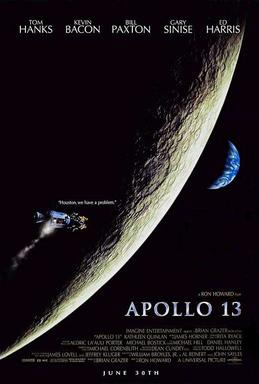
I just finished watching the TCM premiere of the 1995 Best Picture nominee, Apollo 13. Of course, it wasn’t the first time I had seen it. Apollo 13 is one of those films that always seems to be playing somewhere and why not? It’s a good movie, telling a story that is all the more remarkable and inspiring for being true. In 1970, the Apollo 13 flight to the moon was interrupted by a sudden explosion, stranding three astronauts in space. Fighting a desperate battle against, NASA had to figure out how to bring them home. Apollo 13 tells the story of that accident and that rescue.
There’s a scene that happens about halfway through Apollo 13. The heavily damaged Apollo 13 spacecraft is orbiting the moon. Originally the plan was for Apollo 13 to land on the moon but, following that explosion on the craft, those plans have been cancelled. Inside the spacecraft, three astronauts can only stare down at the lunar surface below them.
As Commander Jim Lovell stares out the craft’s window, we suddenly see him fantasizing about what it would be like if the explosion hadn’t happened and if he actually could fulfill his dream of walking on the moon. We watch as Lovell (and, while we know the character is Jim Lovell, we are also very much aware that he’s being played by beloved cinematic icon Tom Hanks) leaves his foot print on the lunar surface. Lovell opens up his visor and, for a few seconds, stands there and takes in the with the vastness of space before him and making the scene all the more poignant is knowing that Tom Hanks, before he became an award-winning actor, wanted to be a astronaut just like Jim Lovell. Then, suddenly, we snap back to the film’s reality. Back inside the spacecraft, Lovell takes one final look at the moon and accepts that he will never get to walk upon its surface. “I’d like to go home,” he announces.
It’s a totally earnest and unabashedly sentimental moment, one that epitomizes the film as a whole. There is not a hint of cynicism to be found in Apollo 13. Instead, it’s a big, old-fashioned epic, a story about a crisis and how a bunch of determined, no-nonsense professionals came together to save the day. “Houston,” Lovell famously says at one point, “we have a problem.” It’s a celebrated line but Apollo 13 is less about the problem and more about celebrating the men who, through their own ingenuity, solved that problem.
That Apollo 13 is a crowd-pleaser should come as no surprise. It was directed by Ron Howard and I don’t know that Howard has ever directed a film that wasn’t designed to make audiences break into applause during the end credits. When Howard fails, the results can be maudlin and heavy-handed. But when he succeeds, as he does with Apollo 13, he proves that there’s nothing wrong with old-fashioned, inspirational entertainment.
Of course, since Apollo 13 is a Ron Howard film, that means that Clint Howard gets a small role. In Apollo 13, Clint shows up as a bespectacled flight engineer. When astronaut Jack Swiggert (Kevin Bacon) mentions having forgotten to pay his taxes before going into space, Clint says, “He shouldn’t joke about that, they’ll get him.” It’s a great line and Clint does a great job delivering it.
Apollo 13 is usually thought of as being a Tom Hanks film but actually, it’s an ensemble piece. Every role, from the smallest to the biggest, is perfectly cast. Not surprisingly, Bacon, Bill Paxton, Gary Sinise, Kathleen Quinlan, and Ed Harris all turn in excellent performances. But, even beyond the marquee names, Apollo 13 is full of memorable performances. Watching it tonight, I especially noticed an actor named Loren Dean, who played a NASA engineer named John Aaron. Dean didn’t get many lines but he was totally believable in his role. You looked at him and you thought, “If I’m ever trapped in space, this is the guy who I want working to bring me home.”
Apollo 13 was nominated for best picture but it lost to Mel Gibson’s film Braveheart. Personally, out of the nominees, I probably would have picked Sense and Sensibility but Apollo 13 more than deserved the nomination.
I just finished watching the 1982 best picture winner Gandhi on TCM. This is going to be a tough movie to review.
Why?
Well, first off, there’s the subject matter. Gandhi is an epic biopic of Mohandas Gandhi (played, very well, by Ben Kingsley). It starts with Gandhi as a 23 year-old attorney in South Africa who, after getting tossed out of a first class train compartment because of the color of his skin, leads a non-violent protest for the rights of all Indians in South Africa. He gets arrested several times and, at one point, is threatened by Daniel Day-Lewis, making his screen debut as a young racist. However, eventually, Gandhi’s protest draws international attention and pressure. South Africa finally changes the law to give Indians a few rights.
Gandhi then returns to his native India, where he leads a similar campaign of non-violence in support of the fight for India’s independence from the British Empire. For every violent act on the part of the British, Gandhi responds with humility and nonviolence. After World War II, India gains its independence and Gandhi becomes the leader of the nation. When India threatens to collapse as a result of violence between Hindus and Muslims, Gandhi fasts and announces that he will allow himself to starve to death unless the violence ends. Gandhi brings peace to his country and is admired the world over. And then, like almost all great leaders, he’s assassinated.
Gandhi tells the story of a great leader but that doesn’t necessarily make it a great movie. In order to really examine Gandhi as a film, you have to be willing to accept that criticizing the movie is not the same as criticizing what (or who) the movie is about.
As I watched Gandhi, my main impression was that it was an extremely long movie. Reportedly, Gandhi was a passion project for director Richard Attenborough. An admirer of Gandhi’s and a lifelong equality activist, Attenborough spent over 20 years trying to raise the money to bring Gandhi’s life to the big screen. Once he finally did, it appears that Attenbrough didn’t want to leave out a single detail. Gandhi runs three and a half hours and, because certain scenes drag, it feels ever longer.
My other thought, as I watched Gandhi, was that it had to be one of the least cinematic films that I’ve ever seen. Bless Attenborough for the nobility of his intentions but there’s not a single interesting visual to be found in the entire film. I imagine that, even in 1982, Gandhi felt like a very old-fashioned movie. In the end, it feels more like something you would see on PBS than in a theater.
The film is full of familiar faces, which works in some cases and doesn’t in others. For instance, Gandhi’s British opponents are played by a virtual army of familiar character actors. Every few minutes, someone like John Gielgud, Edward Fox, Trevor Howard, John Mills, or Nigel Hawthorne will pop up and wonder why Gandhi always has to be so troublesome. The British character actors all do a pretty good job and contribute to the film without allowing their familiar faces to become a distraction.
But then, a few American actors show up. Martin Sheen plays a reporter who interview Gandhi. Candice Bergen shows up as a famous photographer. And, unlike their British equivalents, neither Sheen nor Bergen really seem to fit into the film. Both of them end up overacting. (Sheen, in particular, delivers every line as if he’s scared that we’re going to forget that we’re watching a movie about an important figure in history.) They both become distractions.
I guess the best thing that you can say about Gandhi, as a film, is that it features Ben Kingsley in the leading role. He gives a wonderfully subtle performance as Gandhi, making him human even when the film insists on portraying him as a saint. He won an Oscar for his performance in Gandhi and he deserved one.
As for Gandhi‘s award for best picture … well, let’s consider the films that it beat: E.T., Tootsie, The Verdict, and Missing. And then, consider some of the films from 1982 that weren’t even nominated: Blade Runner, Burden of Dreams, Class of 1984, Fast Times At Ridgemont High, My Favorite Year, Poltergeist, Tenebrae,Vice Squad, Fanny and Alexander…
When you look at the competition, it’s clear that the Academy’s main motive in honoring Gandhi the film was to honor Gandhi the man. In the end, Gandhi is a good example of a film that, good intentions aside, did not deserve its Oscar.
I’m currently stuck at home on this beautiful day, dealing with a really bad cold. (Even as I sit here typing this up, I am currently in a feverish haze.) It’s frustrating but, fortunately, I’ve got a lot of movies to watch. After all, TCM is wrapping up their 31 Days of Oscars and my DVR is currently full of nominated films waiting to be reviewed.
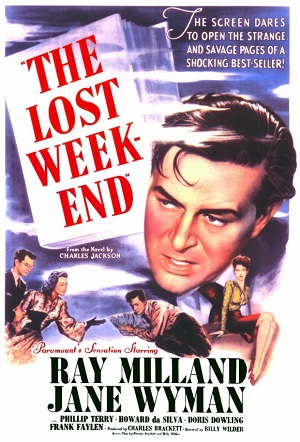
For instance, I just watched the 1945 best picture winner, The Lost Weekend. The Lost Weekend was directed by Billy Wilder, a director who is most often associated with sad-eyed comedies like Some Like It Hot, The Apartment, and The Seven Year Itch. However, The Lost Weekend is most definitely not a comedy. Instead, it’s an incredibly harrowing and rather depressing portrait of addiction and lost promise.
Don Birnan (Ray Milland) is a struggling writer. When we first meet him, he’s packing for a weekend trip with his brother, Wick (Philip Terry). The conversation between Don and Wick at first sounds friendly but soon, we start to hear hints of suspicion in Wick’s voice. Wick seems incredibly concerned about what exactly Don is packing and Don starts to get defensive. Don says that it’s been ten days since he had a drink and that there is no more liquor in the apartment. However, whenever Wick turns his back, Don starts to search for the bottles that he’s hidden around his bedroom. (He’s even got a bottle of whiskey hanging on a rope outside the window.) It gets to the point that, whenever Wick isn’t looking, Don is holding a bottle.
And while that may sound potentially humorous, there’s nothing funny about the scene. Don’s desperation is too real. As someone who grew up having to deal with an alcoholic father, I recognized Don and his addiction immediately. Everything about him — from his fast smile to his continual assurances that he’s cleaned himself up — is a facade, designed to help him survive until he can get his next drink.
The main thing about alcoholics is that they’re extremely clever. Don knows that Wick wants to get him away for the weekend so that he can’t drink. When Don’s girlfriend, Helen (Jane Wyman), mentions that she has two tickets for a concert, Don convinces Wick to go to the show with her. Once Wick is out of the apartment, Don can sneak down to the neighborhood bar. When it comes time to leave for that dry weekend vacation, Don manages to accidentally on purpose miss the train.
Left alone for the weekend, Don can now do what he wants. He tries to write about his life as an alcoholic but discovers that his brain is too muddled for him to think straight. So, instead, he drinks. Unfortunately, Wick hasn’t left him any money and has also ordered all the local bars and liquor stores to not allow his brother to run up a tab. As a result, Don finds himself scrounging for money.
In perhaps the film’s most famous scene, Don carries his typewriter down to the local pawnshop so that he can get money to buy a drink. However, the pawnshop is closed for Yom Kippur. The camera follows Don as he staggers around New York City, looking for an open pawnshop. Wilder shot this scene on the streets of New York City, using a hidden camera. The people who we see reacting to Don are not Hollywood extras but instead are actual New Yorkers who had no idea that the pathetic drunk they were gawking at was actually film star Ray Milland.
As the weekend plays out, Don transforms. He goes from being smooth and outwardly confident to being unshaven and desperate. Eventually, Don ends up in a sanitarium, where he’s taunted by a sadistic nurse. (The nurse is played by Frank Faylen, who played Ernie the cab driver in It’s A Wonderful Life.) Even when Don manages to get back to his apartment, he finds himself screaming as he hallucinates a bat eating a mouse. Blood runs down the walls.
Does the film, at least, have a happy ending? It depends. The local bartender, Nat (Howard Da Silva), returns Don’s typewriter to him. Helen convinces Don to write about his lost weekend. Don says that he’s never going to drink again but, at the same time, we can’t help but remember that the movie started with Don saying the same thing…
As directed by Billy Wilder, The Lost Weekend plays out like a noir thriller, full of menacing shadows. The score, composed by Miklos Rozsa, uses a theremin to let us hear the addiction-fueled chaos within Don’s head. Best of all, Ray Milland totally loses himself in the role of Don Birnan, with the vanity of film stardom soon replaced with the pathos of addiction. Even watching the film today, it’s easy to understand how The Lost Weekend won the Oscar for Best Picture of 1945.
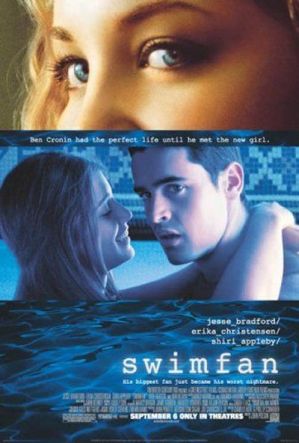
Do you remember Swimfan? It originally came out in 2002 and it starred Jesse Bradford, the hot guy from Bring It On, and Erika Christensen, the drug addicted runaway from Traffic. The movie is like a high school version of Fatal Attraction. Jesse swims for the high school swim team. Erika is a psycho stalker who is obsessed with swimmers. Chaos follows.
I was on a high school date when I first saw Swimfan. Fortunately, the movie offered up some very important life lessons.
Probably the film’s most important lesson was that you should always put out because, if you don’t, your dumbass boyfriend is going to end up cheating on you with some psycho bitch who is going to go all obsessive on his ass and end up framing him for murder. When Swimfan starts, Ben (Jesse Bradford!) is dating Amy (Shiri Appleby) and they’re a cute couple but Amy is more into studying and planning for the future than in having sex with Ben.
So, of course, Ben ends up cheating on her with the new girl at school, Madison Bell (Erika Christensen). He does this despite the fact that Madison is obviously unbalanced from the minute that he meets her, has a major case of the crazy eyes, and tends to come across as being a little bit robotic. It’s only one night and Ben says that he feels terrible about it but Madison still decides that Ben is her man now.
It all leads to this scene:
(I have to admit that the artful placement of the camera in this scene makes me laugh every time. The filmmakers were obviously really determined to get that PG-13 rating. Also, just a little tip — if you’re taking nudes for your man, try smiling.)
When Ben keeps rejecting her, Madison conspires to get him kicked off the swim team. She also kills the swimmer who takes Ben’s place on the team and frames Ben for the crime. (The exact same thing happened to Michael Phelps but you never hear about it because all the media wants to talk about is that time he got his picture taken at that party.) And then she tries to kill Amy and, the movie tells us, this all could have been avoided if only Amy hadn’t spent so much time worrying about which college to go to. Keep your man happy, girls, the movie tells us, or be prepared to deal with the consequences. Boys will be boys!
The other life lesson is that you should really learn how to swim. Since this movie is called Swimfan and it features a gigantic subplot about swimming, you can already guess that it’s all going to end with a big fight in a pool. Ben can swim. Madison and Amy can’t. Can you guess what happens? Watching Swimfan last night reminded me that I still need to learn how to swim. Thank you, Swimfan!
Anyway, Swimfan is definitely a guilty pleasure. I mean, if you want to get technical about it, this is a really, really bad movie. The plot is derivative of every single stalker thriller that you’ve ever seen. Jesse Bradford is pretty good but Erika Christensen appears to be in a daze. And yet, whenever I see that it’s on, I can’t help but watch it. Some of it, of course, is because Swimfan appeals to the same nostalgia that still causes me to sing …Baby One More Time, at the top of my lungs, whenever I’m driving home despite the fact that Britney’s later songs are so much better. But beyond the nostalgia appeal, Swimfan is just so ludicrous and silly and over the top. How can you not be a fan of Swimfan?
After causing quite a stir at the 2015 Sundance Film Festival, the horror film The Witch has finally been given a general release. It is a genuinely creepy and thought-provoking horror film, one that works as a historical recreation (it takes place in 17th century America), a psychological thriller (you’re never sure who is allied with the witch and who isn’t), and an atmospheric horror film. The film has been critically acclaimed and, for those who care about this sort of thing, it currently has a score of 86 over at Metacritic. For once, I agree with most of the critics.
And yet, The Witch is underperforming at the box office. According to Cinemascore, audiences have given The Witch an average grade of C-.
That’s sad but it’s understandable. The Witch moves at a deliberate pace, it requires that the audience have at least a rudimentary knowledge of history, and a good deal of its horror comes less from shock and more from the anticipation of that shock. The Witch is a very cerebral horror film and, as a result, it’s not a crowd pleaser. It’s not for everyone. Instead, it’s a film for discriminating horror fans like you and me.
The Witch opens with William (Ralph Ineson) and his family being kicked out of a village in New England. William is a deeply religious man and apparently, his style of Calvinism has offended everyone else in the village. After leaving, William and his family end up settling on a stretch of land that is right next to a dark forest. William builds a house and a farm on the land, his wife Katherine (Kate Dickie) gives birth to a fifth child, and all seems right with their world.
Or is it?
As quickly becomes obvious, William’s family is not as content as they may originally seem to be. His teenager daughter, Tomasin (Anya Taylor-Joy) and son, Caleb (Harvey Scrimshaw) are both struggling with the burden of growing up totally isolated from the rest of civilization. Katherine secretly years to return home. Twins Mercy (Ellie Grainger) and Jonas (Lucas Dawson) are both rambunctious and keep playing with an aggressive black goat that they’ve named Black Phillip. William, himself, is struggling to make ends meet and has even resorted to secretly selling a silver cup, a present from Katherine’s mother. The crops are dying and the farm animals are just as likely to produce blood as they are milk.
And, then, the baby disappears. One day, while Tomasin is playing with him, something drags the baby into the woods and kills him. At first, the family assumes that it was a wolf but we know that it was a witch.
If there’s one thing that I wish this film had done, I wish it had left it a little bit more ambiguous as to whether or not there was actually a witch out in that forest. The Witch appears extremely early in the film. The actress playing her, Bathsheba Garnett, has a genuinely unsettling screen presence and provides the film with one of its creepiest scenes but, at the same time, it’s hard not wonder what The Witch would have been like if the audience had been forced to wonder if there really was a witch in the forest or if the family was just being paranoid in seeking a supernatural reason for their increasingly bad luck.
And make no mistake about it, things go from bad to worse for William’s family, with William growing increasingly fanatical and all of the children accusing each other of witchcraft.
At the end of the film, we’re told that The Witch is based on historical records and that a good deal of the dialogue was lifted directly from diaries, court transcripts, and letters from the 17th Century. The Witch does have a genuinely authentic feel to it. At no point do you doubt that you’re watching a historically accurate recreation of the 17th century. That accuracy works in the film’s favor, giving it an almost documentary-like feel. At the same time, it also means that the audience has to adjust its thinking. This is a film about people who lived in a far different culture from today and, to the film’s credit, the characters react like 17th Century Calvinists and not 21st century film goers.
In many ways, The Witch is a demanding film. It’s not for everyone. I enjoyed the film but, for the record, I can understand why a lot of people in the audience did not. (And, I have to admit, that even I occasionally got frustrated with the film’s slow pace. It pays off in the end but The Witch still demands a bit of patience.) Though there are a few shockingly bloody scenes, The Witch is largely a mood piece. Almost of the film’s scares come not from jump scenes but from an unrelenting atmosphere of darkness and doom. Making his directorial debut, Robert Eggers accomplishes a lot with just a few shots of that dark forest, the trees ominously looking down on the humans who have foolishly wandered too far into the wilderness to ever come back.
It may not be for all tastes but I recommend taking a chance on The Witch.
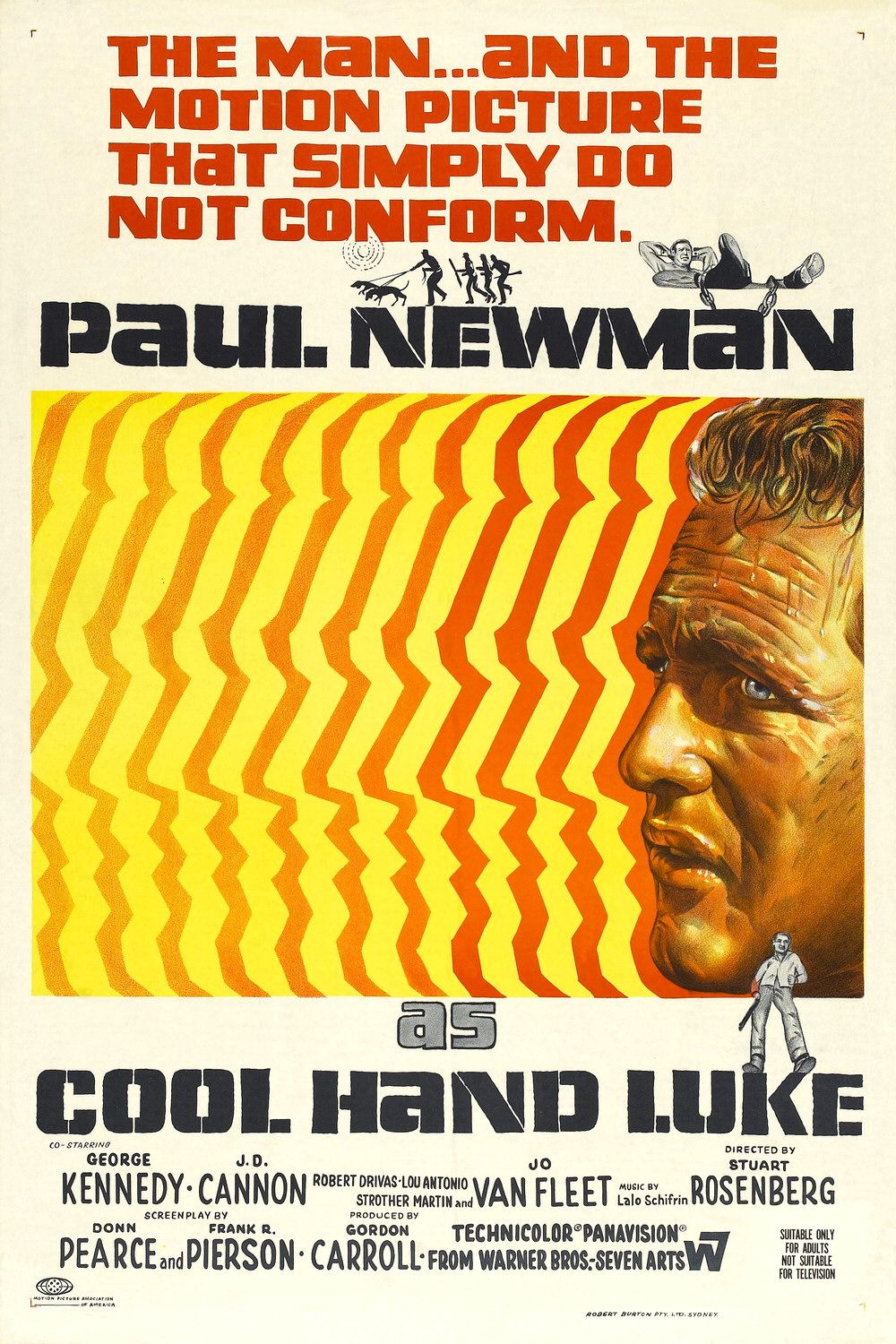
The Sixties was the decade of the rebellious anti-hero. The times they were a-changin’ and movies reflected the anti-establishment mood with BONNIE & CLYDE, EASY RIDER, and COOL HAND LUKE. Paul Newman starred as white-trash outsider Luke Jackson, but it was his co-star George Kennedy who took home the Oscar for his role as Dragline, the king of the cons who first despises then idolizes Luke.
War vet Luke gets busted for “malicious destruction of municipal property while drunk”, and sent to a prison farm in Florida. The non-conformist Luke butts heads with both the “bosses” (prison guards aka authority) and Dragline, a near illiterate convict who runs the yard. Dragline and Luke decide to settle their differences in a Saturday boxing match. The hulking Dragline beats the shit out of Luke, but the smaller man keeps getting up for more. Dragline finally walks away, and Luke earns both his and…
What’s an Insomnia File? You know how some times you just can’t get any sleep and, at about three in the morning, you’ll find yourself watching whatever you can find on cable? This feature is all about those insomnia-inspired discoveries!
Whenever I look at my cable guide, I always notice that channel 834 is listed as being “MorMax.” For some reason, I always assume that MorMax stands for Morman Max and I’m always expecting that it’s going to show movies about Joseph Smith and Brigham Young. But actually, MorMax stands for More Cinemax.
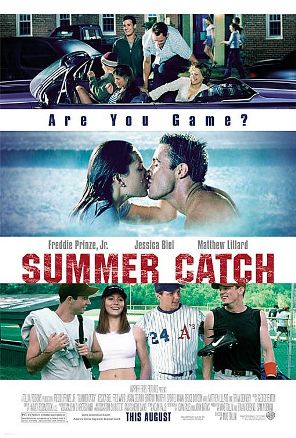
Anyway, last night, if you were having a hard time sleeping around midnight (though why anyone would ever try to go to sleep before midnight is beyond me), you could have turned on MorMax and watched the 2001 romantic comedy Summer Catch!
Though it may be hard to believe today, there was a time when Freddie Prinze, Jr. was a pretty big deal. From 1997 to 2001, Prinze appeared in 179 movies. Well, actually, he only appeared in 10 but since they were all aimed at teenage girls and played on cable constantly, it felt like 179. (Seriously, there was a time when I could not get through an entire day without seeing at least a few minutes of She’s All That.) For the most part, all of these films were pretty much the same. Freddie Prinze, Jr. plays a kind of dumb guy who falls in love with a girl. Prinze’s character was usually from a working class family and had at least one wacky friend. The girl was usually from a rich family and had one bitchy friend who would be an ex-friend by the end of the movie. There was usually at least one scene set on the beach or at a swimming pool, the better for Freddie to remove his shirt and his costar to chastely strip down to her underwear. There was usually a falling in love montage and at least one big misunderstanding. Freddie would always flash the same goofy smile whenever the misunderstanding was cleared up. Even at the time that the films were being released, nobody was ever under the impression that Freddie Prinze, Jr. was a particularly good actor. But he was likable, unthreatening, and hot in an oddly bland sort of way.
(Speaking of oddly bland, check out the titles of some of Prinze’s films: She’s All That, Down To You, Boys and Girls, Head over Heels, and, of course, Summer Catch.)
Summer Catch opens with Ryan Dunne (Freddie!) explaining that he’s just a working class kid from Massachusetts but this summer, he’s going to be playing amateur baseball in Cap Cod and hopefully, he’ll get signed to a professional contract as result. (Freddie adopts an inconsistent “pahk ya cah by the bah” accent and its kind of endearing to see him trying so hard.) Ryan, of course, is just a local guy who mows lawns for a living but he’s determined to succeed. He just has to stay focused.
However, that’s going to be difficult because he’s just met Tenley Parrish (Jessica Biel). The Parrishes own a vacation home on Cape Cod and they are so rich that they can afford to name their oldest daughter Tenley. Soon, Tenley and Ryan are a couple but Tenley’s father wants Tenley to marry a rich boy and Ryan’s father is too busy being all surly and working class to appreciate Ryan’s dreams.
(Tenley’s father, incidentally, is played by Bruce Davison because all snobbish WASPs of a certain age are played by Bruce Davison. Ryan’s father is played by Fred Ward because Summer Catch was made in 2001.)
Because every Freddie Prinze, Jr. movie needs a hyperactive and wacky sidekick, Ryan’s best friend on the team is a catcher named Billy Brubaker (Matthew Lillard.) Billy is known as “Bru.” There’s a lot of scenes of people saying stuff like “Yo, Bru,” and “Come on, Bru!” After a while, I found myself hoping for a scene where Bru went crazy and started shouting, “My name is Billy, dammit! BILLY! DAMN YOU ALL TO HELL!” Instead, however, we get a subplot about how Billy can’t get any hits until he has sex with and wears the thong underwear of a local baseball fan.
Anyway, Summer Catch is an extremely predictable film. It’s not surprising that this was one of Freddie’s final star vehicles because, other than his heroic effort to maintain a Massachusetts accent, even he seems to be bored with it all. Perhaps the most remarkable thing about Summer Catch is that there’s next to no actual conflict in the film. Oh sure, Ryan and Tenley have a few misunderstandings but it’s never anything serious.
If there’s an unheralded hero to Summer Catch, it’s the uncredited guy who we hear providing commentary during the games. Seriously, I would have been so lost if not for him constantly saying stuff like, “This is Ryan Dunne’s chance to show what he can do,” and “Billy Brubaker needs to get a hit here…” They should have made the entire movie about him and his efforts to remain up-to-date on all the players.
Because Summer Catch was a baseball film, I begged my sister Erin to watch it with me so that she could explain all the baseball stuff to me. For the record, Erin says that the game scenes were okay (and I personally liked all of the totally gratuitous slow motion) but that the film wasn’t really a deep examination of baseball. To be honest, I really wasn’t expecting that it would be. I just wanted to make my sister stay up late and watch a movie with me.
As I was watching The Red Dress, I found myself thinking that it had to be one of the most deliberately paced Lifetime film that I had ever seen. It moved slowly, taking its time to tell its story and, as far as I could tell, attempting to build up a certain atmosphere of existential doom. (In many ways, it reminded me of the trailer for Angelina Jolie’s By The Sea.) It really wasn’t paced right for TV but that’s probably because it really wasn’t made for TV.
From the occasionally blanked out lines of dialogue to a blurred hint of sideboob, it was obvious that The Red Dress was a theatrical film that somehow ended up making its American premiere on the Lifetime Movie Network. What would have worked just fine when watched in one uninterrupted 90 minute viewing worked less well when stretched out to two hours and frequently interrupted by commercials for Liberty Mutual Insurance. The film, itself, frequently plays with time and makes heavy use of flashbacks. It’s not necessarily a complicated story but it’s still one that requires a bit of concentration. It’s not always easy to concentrate when you have to deal with a commercial about an insane person who named her car Brad.
As for the story that the movie tells, Patricia (Rachel Skarsten) and Rainer (Callum Blue) are young, rich, married, and maybe in love. Of course, Patricia did have an affair with Rainer’s business partner, James (Sean Maguire). And, after Patricia announced that she was pregnant, Rainer did start to feel like “an appendage.” As for the baby, it died in a mysterious fire that may or may not have been arson.
With Patricia in a deep depression, Rainer suggests that they move to a beachfront house in Malta. It’s here that Rainer can spend all of his time floating in the pool and Patricia can deal with the constant nightmares that make it impossible for her to sleep. At times, being in Malta seems to bring the spark back to their marriage. But then there are other times when Patricia suspects that Rainer is keeping a secret from her.
And then there’s the mysterious girl who Patricia keeps seeing. The girl seems to always be heading towards a castle that lies in the distance, lit up with a crimson glow that makes it seem like it belongs in a Jean Rollin film or maybe Inception‘s Limbo. Patricia suspects that the girl may have been kidnapped by the mysterious local hunter, Angelo (John Rhys-Davies). Rainer, however, seems to believe that the solution to everything is for Patricia to take more pills.
The Red Dress doesn’t really work as a film, largely because Rainer and Patricia are such unlikable characters that you really don’t care what happens to them. Far too often, they put the idle into idle rich. As well, the film’s final twist is not as much of a surprise as the film seems to think it is. You’ll see it coming. That said, I did like the look of a film. Malta is a great location and the film takes advantage of that fact.
As for the film’s title, it refers to a dress that Patricia wears in a few of the flashbacks. And you know what? It is a really nice dress.
I finally got out of South Korea for at least two of these movies. That’s something. Too bad none of them were very good. Let’s begin.
Shadows in the Distance (2015, dir. Orlando Bosch) –
I wrote a longer review here if you want to read it.
Oh, “Lust At First Glance”. That sounds interesting. Let’s look at the trailer.
At least the trailer is honest. Somewhat. What it doesn’t tell you is that the movie is really director Orlando Bosch throwing every art film cliche he can think of at the screen. It really doesn’t work. The movie even shows a clip of Breathless (1960) in it. The film is supposed to be about a couple who notice each other in a movie theater then pursue each other, kind of, sort of, not really. That shot at the end of the trailer that looks like a ridiculous art exhibit scene is an example of the kind of art house cliches I’m referring to.
Look familiar? Sure reminded me of something.
Yep, the “documentary” on black people having sex called Black Love (1971).
I particularly love the scene where they both go into a telephone booth to get out of the rain. Who does that? The rain could go on all night. Are you going to sleep there? You are better off making your way home and taking a shower.
I hope director Orlando Bosch really tries to forget this movie and move on from that third stage of cinephilia where you become obsessed with the world canon. Please drop the art film cliches. I was sick of these a long time ago. It was already really old when Leos Carax broke them out and filtered them through the MTV version of the French New Wave to make the lousy The Lovers on the Bridge (1991). But I remember Carax using them sparingly and knowing when to use them even if I didn’t like the movie. It really feels like Bosch just tried everything he had ever seen show up in a foreign film.
Spare yourself this movie. The least I can say is that it should be labeled as a comedy on IMDb. I kept laughing throughout the film every time something I had seen in another foreign film showed up for no apparent reason.
Love Affair (2014, dir. Jung Hwan Kim) – Yes, South Korea again. At least that poster is close to being accurate. This was an un-IMDbed movie that I had to add. It actually took two attempts and a lengthy explanation to prove to them this actually exists. It doesn’t help that on Amazon Prime it’s listed with the title Intimacy and uses the poster from the 1966 movie with that title. I think what sealed the deal was that Intimacy is in English, but their link to it on Amazon Prime clearly shows that it has English subtitles. I would love to show you the trailer, but I can’t find it.
I get two strong impressions about this movie. First, I really think the version on Amazon Prime is dubbed into Mandarin. The reason is that I lived with a guy from China for 2 years in college and they sure sounded just like when he would be talking on the phone. Oddly, this film has another tie to that roommate from college. The second thing is that I think this was a film adaptation of a Korean drama. I even get the feeling that it was just the original drama edited down to about a 90 minute film. I know that at least Korea adapting their Dramas into regular films is a thing. I did watch My Sassy Girl (2001) back in college at the encouragement of my roommate.
The movie is the title. An older married guy who runs a bookstore has an affair with another married woman. There really isn’t anything else plot wise. The only thing in that area is that there are two friends of the bookstore owner. I think they are his brothers. Either that or they really like the whole “Hey, Bro” thing. His Bro that fancies himself a bit of a ladies man really reminded me of my college roommate Rocky. Rocky could have played this guy even though he wasn’t a ladies man type.
It’s reasonably good. It certainly is the best of the three films here. I liked the leads. I especially like the actor they chose for the bookstore owner. He has a great older, but still very handsome, kind, and beautiful face. I think he was perfectly cast in the role. It has some problems and some weird editing at times, but this is the one to check out of the films here. If it’s still up when you get here, then there it is. Otherwise, it should be easy to find.
Virgin Theory: 7 Steps to Get on the Top (2014, dir. Ahn Cheol-ho) – That is the poster they show on Amazon Prime. Any reasonable person would look at that poster and think they are going to watch erotica. It’s like the trailer for My Baby Is Black! (1961) that was made to look like an exploitation film for the American market.
Here is a realistic poster for this movie.
Oh, and you’re probably wondering what exactly has the girl on the left who is shocked and the girl on the right who is bored. They are looking at porn. No joke. They are looking at porn. That’s the movie in a gist. The girl on the left is a virgin and wants to get laid. The girl on right is certainly not a virgin and wants to be taken seriously by people. They end up together because the girl on right was sleeping with the girl on the left’s father who left the house to her when he died during sex. They make sure you know that even by showing a condom with sperm in the tip picked up off the floor.
The virgin wants to go out with a ballet dancer and even envisions him in his tights, but untucked. The girl on the right does art, wants to be taken seriously, but doesn’t seem to realize that maybe dialing back on the sleeping around thing might help a little. I mean she was sleeping with the virgin’s father who apparently is so important that a call to the president of South Korea can be made. Her sex life is a tad high profile. She winds up trying to give the virgin instructions on how to get a guy. By and large, they are the kind of instructions someone who has watched too many movies like Hooked Up (2009) would give. That’s the movie with Corey Feldman, who never appears to have aged after all these years, which is obsessed with blow jobs.
That’s the movie. I don’t even remember how it ends. That’s how little of an imprint this sex comedy left on me.
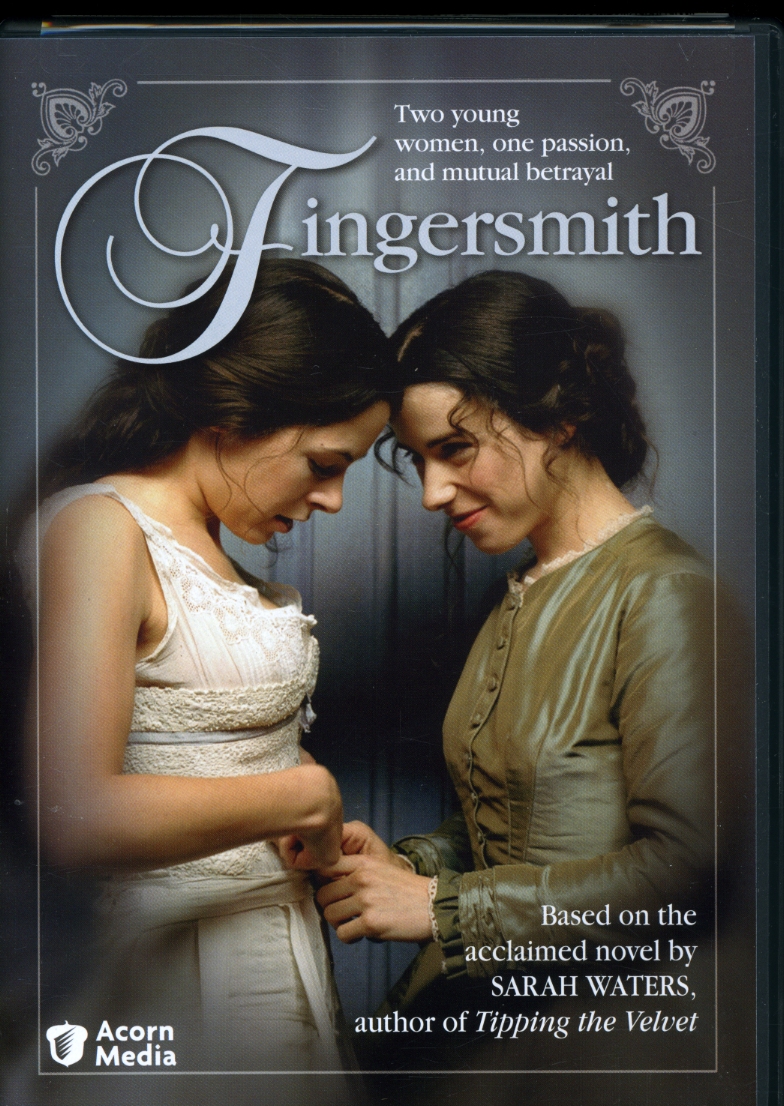
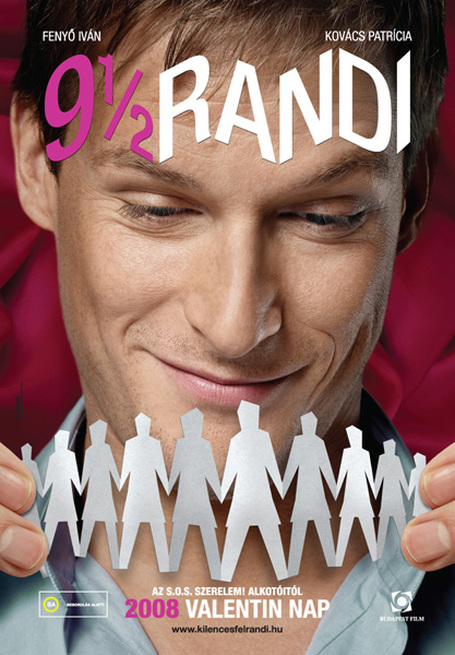
9 1/2 Dates (2008, dir. Tamás Sas) – Oh, yeah! That looks like a lesbian love story poster to me. I mean look at the one for Fingersmith (2005) which is a lesbian movie.
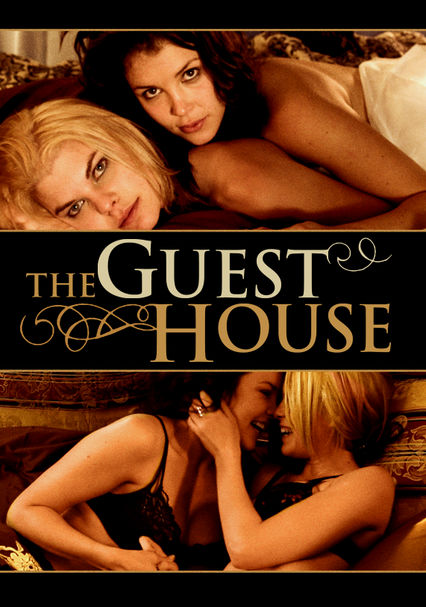
Or the poster for The Guest House (2012) which is also a lesbian love story.
This isn’t a lesbian story. Let’s take another look at the poster. It says the cast that get top billing are Ferenc Elek, Patricia Kovács, and Gábor Hevér. That’s two actors and an actress. So of course 80-90 percent of the movie is actually with actor Iván Fenyö. Here is the realistic poster for this movie.
Just wow! You probably want to know what the plot of this movie is now. Sorry, I nearly forgot with these misleading posters.
The movie is about a guy named Dávid who wrote a book that did well, but hasn’t really published anything recently. However, he is now under pressure to put something out and is told to date 10 women, then turn around to write about what he learned from the experience. Sounds like a simple enough concept. Shouldn’t be too hard to do. Well, they screwed it up.
First, the directing is sloppy. A quick example is when a musical audio lead-in starts so soon during the current scene that we aren’t sure if it’s coming from the radio or not. This kind of bad directing plagues the film.
Second, you’d think the movie would focus on the women he dates while having the lead be low-key and mainly listen to the ladies he is dating so he has material for his book. Yeah, you’d think that, but it’s not. The dates are pushed so far onto the back burner of this film that you could forget they exist. You could even forget that the women he dates paint a bit of sad portrait of modern Hungarian women. Seriously, they are so glossed over that you can totally miss that. They are really subplots in this movie. The main plot is him trying to get back in with his ex who has been assigned to work with him on the book.
Thirdly, while this is a problem with Amazon Prime and not the movie, the subtitles are fast as lightning. If you are going to subject yourself to this movie, then make sure you can read fast. You’d think they would be onscreen longer when there are a bunch of words on the screen. Nope! Sometimes that happens, but often it disappears so fast that you are missing half of what is being said. Also, I think these subtitles weren’t done by someone who has a good grasp on the English language. It’s not awful, but there are enough moments where the subtitles really don’t read right.
So, it’s sloppy, glosses over it’s plot, and has subtitles you have to be very quick to read. Avoid it.
Go with Love Affair if you want to see any of these movies.
It’s always interesting to me when my favorite exploitation and grindhouse filmmakers end up making a movie for Lifetime. It happens a lot more that you might expect and it’s always undeniably fun to see how they adapt their own sensibilities to the requirements of the network. For instance, last year, Fred Olen Ray gave Lifetime both River Raft Nightmare and The Christmas Gift.
And then, in January of this year, David DeCoteau gave us The Wrong Roommate. As far as Lifetime films are concerned, The Wrong Roommate is pure perfection. It gives the viewer everything that she could possibly want from a Lifetime film. There’s melodrama. There’s romance. There’s an untrustworthy ex-fiance. There’s a mysterious artist who is both hot and dangerous and who has got like the most incredible abs. There’s a big fancy house and lots of pretty clothes and there’s even a sex-positive best friend who is eager to help her BFF rebuild her life. I enjoyed The Wrong Roommate when I first watched it and I enjoyed it when I rewatched it earlier today. But as I watched The Wrong Roommate, I wondered how members of the typical Lifetime viewing audience would have reacted to seeing some of DeCoteau’s other 122 films, like Sorority Babes in the Slimeball Bowl-O-Rama or Bigfoot vs. D.B. Cooper.
It’s DeCoteau’s background in B-movies that made him the perfect director for The Wrong Roommate. Like many filmmakers, DeCoteau began his career working with Roger Corman and then later worked with Charles Band. These are filmmakers who understood how to tell a story. Above all else, Roger Corman and his best students all understood the importance of storytelling. They understood the importance of keeping the audience entertained.
And, whatever else one may say about it, The Wrong Roommate is a terrifically entertaining film.
The film opens with a man getting run over by a car. That man is Prof. Floyd and he’s played by Eric Roberts. From the minute that I saw that Eric Roberts was going to be in The Wrong Roommate, I assumed that he would be playing another one of his trademark crazy stalker roles but instead, Roberts is one of the good guys here. He’s actually playing a sympathetic character. It’s clever casting because, even once it starts to become clear that he’s not going to kill anyone, you’re still uncertain about him because he’s played by Eric Roberts. Eric Roberts as a good guy keeps the audience off-balance and tells them not to take anything for granted.
That said, Roberts only has a supporting role here. The film is about Laurie Valentine (Jessica Morris). Laurie has just broken up with her controlling jerk of a fiancee, Mark (William McNamara). And now, she’s rebuilding her life. Her best friend (Dominique Swain) has gotten her a job teaching at the local college. And her older sister has invited Laurie to spend the summer at her mansion. The only catch is that Laurie has to look after her rebellious 17 year-old niece, Ricki (Brianna Joy Chomer).
After moving in, Laurie discovers that there’s someone else living on the estate. Alan (Jason-Shane Scott) is staying in the guest house. Ricki has a huge crush on him and soon, so does Laurie. And why not? Alan has amazing abs, spends all of his time shirtless, and he’s an artist! He specializes in wood work and there’s nothing sexier than a man who is good with his hands and his wood…
But, wait a minute!
If Alan’s so great, why does he stage a break-in at the house?
Why doesn’t he ever seem to be surprised when Mark drops by the mansion?
And, of course, we have to consider the fact that Alan has installed a secret webcam in Laurie’s bedroom so that he can watch her undress on his laptop.
Hmmmm…something might not be quite right….
You’ll probably be able to guess what’s going on within the first 30 minutes of the film but who cares? This is a fun movie and David DeCoteau’s direction strikes a perfect balance between melodrama and parody. The film looks great, the cast looks great, and I was jealous of that big house. The Wrong Roommate is wonderful entertainment, in the best tradition of Corman, Band, and DeCoteau.