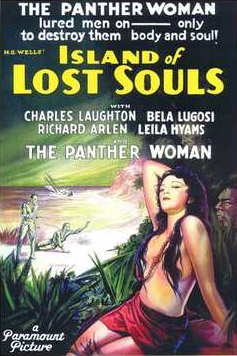
In the 1932 film Island of Lost Souls, Ruth Thomas (Leila Hyams) has reason to be concerned. She’s on the island of Samoa, awaiting the arrival of her fiancée, Edward Parker (Richard Arlen). When Parker’s boat doesn’t show up, it can only mean one thing. He’s been shipwrecked! Did he survive or was he lost at sea?
Well, Ruth need not worry. Parker did survive being shipwrecked. He was picked up by a freighter carrying a wide selection of animals to an isolated island. Unfortunately, when Parker complained about the way that Parker was abusing some of his admittedly odd-looking passengers, the captain responded by dumping Parker on that island as well.
On the island, Parker becomes the guest of Dr. Moreau (Charles Laughton) and his assistant, Montgomery (Arthur Hohl). Parker also meets and finds himself becoming attractive to the seemingly naive Lota (Kathleen Burke). Though Moreau seems to be a good host, Parker grows suspicious of him. It turns out that there’s a room in Moreau’s compound, a room that Lota calls “the house of pain.” At night, Parker can hear horrifying screams coming from the room.
Initially believing the Moreau is torturing the island’s natives, Parker soon discovers an even more disturbing truth. Moreau has been experimenting with trying to transform animals into humans. Lota, it turns out, was once a panther and the woods surrounding the compound are full of other Moreau creations. Though Moreau claims that his intentions are benevolent, he rules his island like a dictator. The animal-men are kept in line by the Sayer of the Law (Bela Lugosi) and any transgressions are punished in the House of Pain…
The Island of Lost Souls was the first cinematic adaptation of H.G. Wells’s The Island of Dr. Moreau. (Perhaps the most famous adaptation came out in 1996 and is the subject of Lost Souls, a fascinating documentary that, I believe, can still be found on Netflix.) I watched it last night on TCM and I have to admit that I had a mixed reaction to it. On the one hand, the film’s atmosphere of mystery and danger is palpable and Charles Laughton’s performance definitely set a standard for all misguided scientists to follow. The human-animals are fantastic creations and the film’s ending still has some power. Bela Lugosi’s performance of the Sayer of the Law was superior to his work as Dracula. (As shown by both this film and Ninotchka, Lugosi was an outstanding character actor.) Kathleen Burke also does a great job as Lota, which makes it all the more interesting that she was apparently cast as a result of winning a contest that was sponsored by Paramount Pictures.
(On a personal note, I always find it amusing that pre-code films always feature at least one scene of an actress removing her stockings, even if the scene itself has next to nothing to do with the rest of the film. In this case, the legs belong to Leila Hyams.)
On the negative side, Richard Arlen is not a particularly interesting hero and, from a contemporary point of view, Island of Lost Souls is a rather slow-moving film. Watching it today requires modern audiences to make a bit of an adjustment to their expectations.
With all that in mind, I still recommend Island of Lost Souls. Watch it for Charles Laughton and Bela Lugosi. Watch it as a valuable piece of cinematic history.



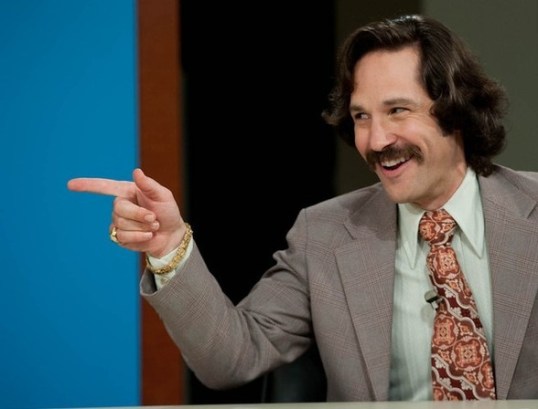
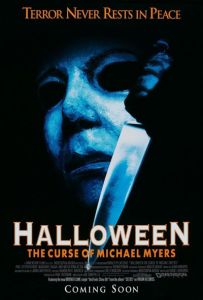 Long before he was either Ant-Man or Judd Apatow’s favorite leading man, Paul Rudd was just another young actor looking for his first break. He got it in 1995 when he was cast in the latest entry in the Halloween franchise. Though Clueless was released first, the man who would be Brian Fantana got his introducing credit for Halloween: The Curse of Michael Myers. (He’s credited as Paul Stephen Rudd.)
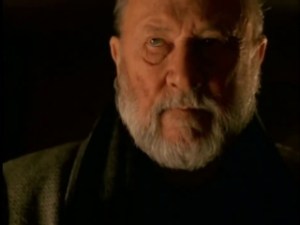 Donald Pleasence is back as Dr. Sam Loomis but it is not a happy return. This was Pleasence’s final film and, in his few scenes, it is obvious that he was not in good health and his famous voice had been reduced to a hoarse rasp. Pleasence died shortly after filming his scenes, which meant that he wasn’t available for the reshoots that Miramax demanded after the first cut of the film tested badly. Add that to the fact that director Joe Chapelle reportedly had not seen any of the previous Halloweens, did not find the Loomis character to be interesting, and cut him out of several scenes and Dr. Loomis is barely in The Curse of Michael Myers.
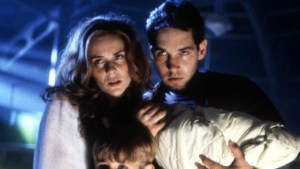 Why does the Cult want the baby? Why do birds suddenly appear whenever you are near? There is no explanation, it’s just something that happens.
 In 1978, Michael “escapes” from Smith’s Grove and tries to kill Laurie. Both he and Dr. Loomis get blown up at the hospital.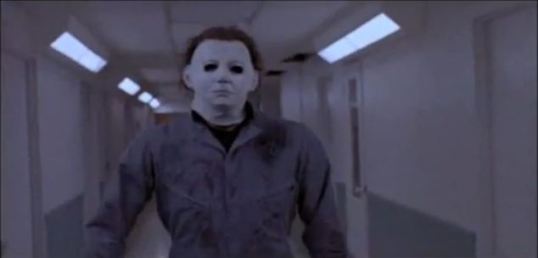
 Through the Shattered Lens