What Lisa Watched Last Night #161: Under The Bed (dir by Daniel Myrick)


Last night, I watched the latest Lifetime premiere film, Under the Bed!

under-the-bed

Why Was I Watching It?

Well, there were a few reasons why I watched it.  First off, it was on Lifetime and, by this point, it’s kind of a tradition around these parts that I always live tweet every Lifetime premiere.  Secondly, I watched it so that I could write this review.  After all, it’s a new year and that means that it’s time for a new set of What Lisa Watched Last Night reviews!

Add to that, the film had the word “bed” in the title so I assumed there would be a lot of sex.

What Was It About?

It’s yet another Lifetime stalker film!  This one, which is apparently based on a true story, features Hannah New as Callie Monroe.  Callie’s an acclaimed journalist who has a beautiful home, a cute dog, and absolutely no love life.  She’s just broken up with her longtime boyfriend and its going to take more than winning a Pulitzer for her article about climbing Kilimanjaro to fill the void in her life!

What Callie doesn’t know is that there’s a man  (played by Pat Healy) living underneath her bed.  Seriously.  He’s broken into her apartment.  He’s put secret cameras all over the place.  And he is now literally living underneath her bed, from which he regularly sends her messages.

Say it with me now — Agck!

What Worked?

Under the Bed was directed by Daniel Myrick, who co-directed the original Blair Witch Project.  There were a few effectively creepy scenes in the movie.  I mean, just the idea of having a stranger living with you in your bedroom without your knowledge is creepy in and of itself.  You could probably argue that the success or failure of this film depended on whether or not it inspired you to look underneath your bed after watching it.  I know I did.

Hannah New gives a good and sympathetic performance as Callie and Pat Healy is appropriately frightening as her stalker.  Beverly D’Angelo also provides some good support as Callie’s mother.

What Did Not Work?

(Spoiler Alert)

Freddy the Dog dies.  Freddy is an adorable little dog that Callie owns.  Unlike his owner, Freddy understands that there’s a man living underneath the bed.  So, one day, the man puts Freddy in a bag and buries him alive.  And we see all of this happen and, quite frankly, it’s too much.  First off, there was no reason to kill Freddy.  Secondly, the burial scenes ends on a somewhat ambiguous note so you’re not really sure whether or not Freddy was fully buried or not.  I spent the entire final hour of the film waiting for Freddy to suddenly show up and it really depressed me when he didn’t.

There’s more to the thing with Freddy than just the fact that I don’t like scenes of animal cruelty.  The scene itself didn’t only feel unnecessary but it also felt incredibly mean-spirited as well.  If you want to kill the dog that badly, have him dragged off-screen and do the little whimper thing.  Instead, by having us watch as Freddy’s buried alive, it felt like the film was saying, “Look how edgy we are!  We killed the dog!”  It felt terribly out-of-place and it soured me on the entire film.

It also didn’t help that the stalker was so obvious about what he was doing that, pretty soon, you started to resent Callie for being so naive.  When Callie finally discovered her stalker and started to fight back, it never felt empowering.  Instead, I was just kinda like, “Well, it’s good that you’re finally aware of what’s going on in your apartment but this could have all been avoided if you had just happened to glance under your bed once or twice over the past week.”

“Oh my God!  Just like me!” Moments

In some ways, I could relate to Callie but — and this is the important thing — I know I don’t have to worry about anyone living underneath my bed because, between all of my scrapbooks and old magazines, there’s no room under there.

(That said, Doc Bowman does enjoy hanging out underneath my bed but I’m pretty sure he can be trusted.)

Lessons Learned

Be kind to animals, dammit.

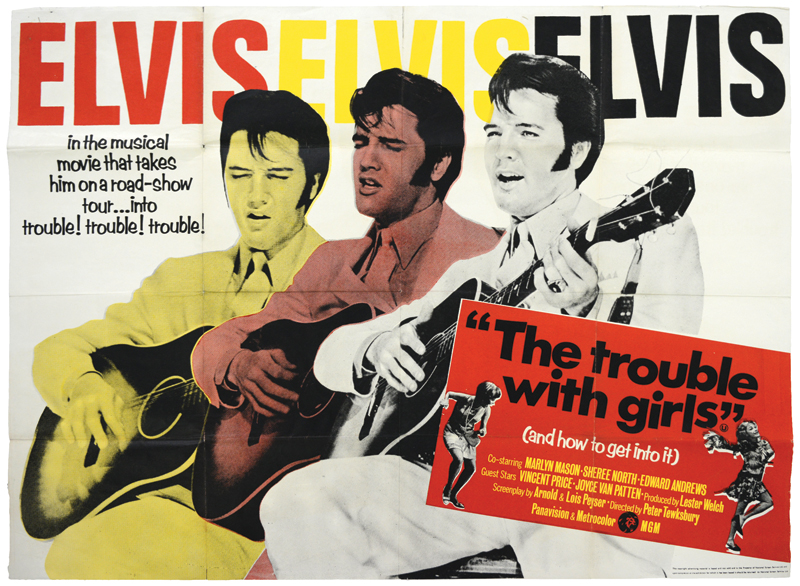
Happy Birthday Elvis!: THE TROUBLE WITH GIRLS (MGM 1969)


gary loggins's avatarcracked rear viewer

twg1

Elvis Aron Presley was born on this date in 1935. The King of Rock’N’Roll got the older generation “All Shook Up” when he burst on the national scene in 1956 with hits like “Heartbreak Hotel” and “Hound Dog”. He also made his first film that year, the Western LOVE ME TENDER, and was an immediate box office sensation. His following three films, LOVING YOU, JAILHOUSE ROCK , and KING CREOLE, were well done, but after his stint in the Army, and the success of 1961’s BLUE HAWAII, Presley’s 60’s movies followed a strict formula, thanks to manager Col. Tom Parker, with interchangeable titles like KISSIN’ COUSINS, HARUM SCARUM, and DOUBLE TROUBLE.

By the late 60’s, things had changed. The Beatles  were top of the pops, the psychedelic revolution was in full effect, and Elvis hadn’t had a hit record in a few years. The movies were still profitable, but lacked energy. Presley’s 1968…

View original post 697 more words

A Movie A Day #7: Sharky’s Machine (1981, directed by Burt Reynolds)


220px-sharkys_machine_ver3After a drug bust goes wrong, Atlanta police detective Tom Sharky (Burt Reynolds, who also directed) is transferred from narcotics to the vice squad, the least desirable assignment in the Atlanta police department.  Despite all of his honors and commendations, Sharky finds himself reduced to busting hookers with Papa (Brian Keith) and Arch (Bernie Casey).  But then Sharky discovers evidence of a prostitution ring being run by Victor D’Anton (Vittorio Gassman), one that services the wealthiest and most powerful men in Georgia.

Working with Papa, Arch, and a burned-out bugging expert named Nosh (Richard Libertini), Sharky begins a surveillance of Domino (Rachel Ward), one of Victor’s girls.  As the days turns into weeks, Sharky falls in love with Domino, who doesn’t even know that she’s being watched.  Sharky also discovers that Domino is sleeping with Hotckins (Earl Holliman), who is about to be elected governor of Georgia.  At the same time, a heroin-addicted assassin named Billy Score (Henry Silva) is assassinating anyone who could reveal Victor’s crimes.

There are two great sequences in Sharky’s Machine.  One is the opening credits scene, in which a bearded Burt Reynolds walks through the roughest parts of Atlanta while Randy Crawford sings Street Life.  This scene lets everyone know from the start that this is not another Burt Reynolds good ol’ boy comedy.  The other is a cat-and-mouse chase through an Atlanta skyscraper, as Sharky and his partners try to track down Billy Score, who is so doped up on painkillers that he barely flinches whenever he’s shot.  Billy Score is one of the most frightening movie villains of all time, seemingly indestructible and capable of moving like a ghost.

henry-silvaWith the exception of maybe Deliverance, Sharky’s Machine is Burt Reynolds’s darkest movie.  There are moments of humor and appearances by the usual members of the Burt Reynolds stock company, like John Fiedler and Charles Durning.  But overall, this is one dark movie.   Likable characters die.  Sharky cries and loses two fingers when they are graphically chopped off by the bad guys.  A woman’s face is literally blown off.  Even when Sharky starts to talk about his childhood, a sentimental moment the occurred in almost every Burt Reynolds film, Domino tells him that she doesn’t care.

In other words, this ain’t The Cannonball Run.

Burt Reynolds’s first cut of Sharky’s Machine reportedly ran for 140 minutes.  Twenty minutes were cut before it was released into theaters and, as a result, Sharky’s Machine sometimes seems to be rough around the edges.  (One important supporting character is killed off-screen and if you don’t pay close attention to the dialogue, you might never know what happened to him.)  Still, this violent film noir, which Reynolds once called “Dirty Harry in Atlanta,” is one of Burt’s best.

sharky-machine

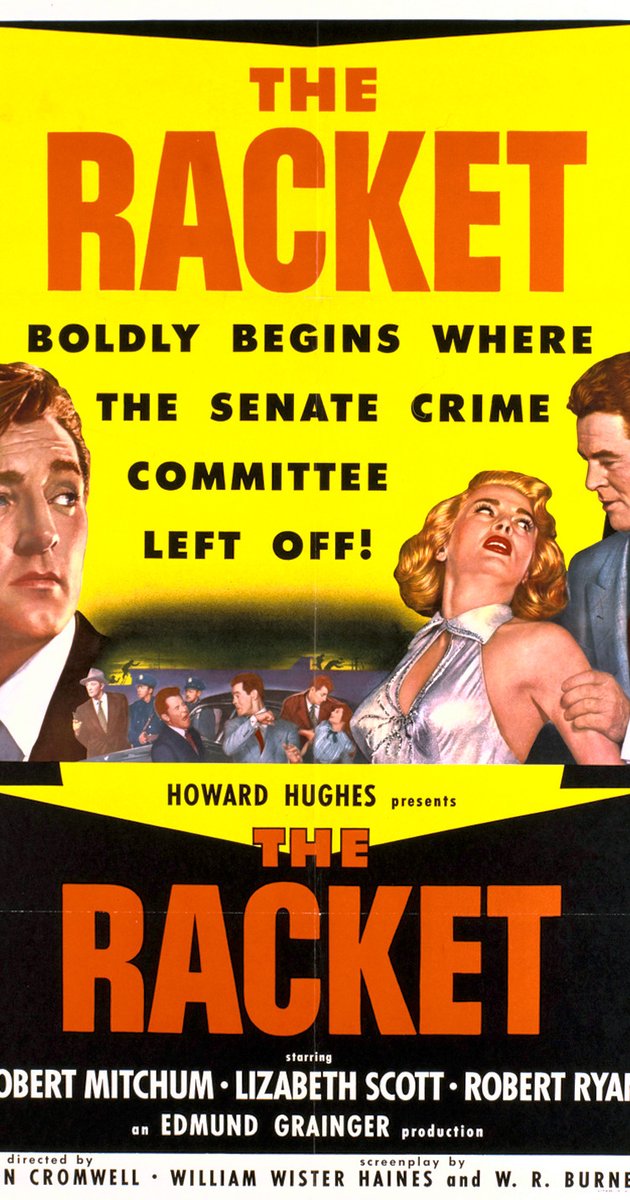
Diluted Noir: Robert Mitchum in THE RACKET (RKO 1951)


gary loggins's avatarcracked rear viewer

racket1

A solid film noir cast headed by Robert Mitchum Robert Ryan , and Lizabeth Scott ; and a lineage that dates back to both a Broadway smash and an Oscar-nominated original can’t save THE RACKET from rising above minor status. Once again, tinkering behind the scenes by RKO honcho Howard Hughes, this time under pressure from Hollywood censorship czar Joseph I. Breen, scuttles a promising premise that coulda been a contender into an average movie.

racket2

City crime boss Nick Scanlon is an old-school hood whose violent ways don’t jibe with the modern-day syndicate. Capt. Thomas McQuigg, “an honest cop” who’s a no-nonsense guy, is determined to take him down. But the city’s rife with tainted politicians, making McQuigg’s job that much harder. Scanlon’s got a headstrong kid brother named Joe dating a “cheap canary” named Irene, and McQuigg plans on using him to get to Nick. Add a crooked DA, a…

View original post 531 more words

A Movie A Day #6: The Cannonball Run (1981, directed by Hal Needham)


cannonball_runA legendary Hollywood stuntman, Hal Needham moved into directing in the 1970s and proved that all he required to make a successful film were willing stuntmen, fast cars, Coors beer, and Burt Reynolds.  Following that logic, The Cannonball Run may very well be the ultimate Hal Needham movie.

The Cannonball Run follows several teams of racers as they compete to see who can be the first to reach California from Connecticut.  Trying to stop them is Arthur J.  Foyt (George Furth), who represents the Safety Enforcement Unit and who believes that cars are a menace.  However, Foyt is no match for these racers, who include:

  • J.J. (Burt Reynolds), who is racing in memory of his father, and his mechanic Victor (Dom DeLuise), who turns into Captain Choas whenever he is feeling threatened.  J.J. and Victor are driving an ambulance and are accompanied by crazy Dr. Van Helsing (Jack Elam) and a fake “patient” (Farrah Fawcett),
  • Bradford Compton (Bert Convy) who is riding a motorcycle and who, because of the weight of his mechanic, has to pop a wheelie for the entire race,
  • An Arab oil sheik (Jamie Farr) who is racing for “the glory of Islam” and who would probably not be in the movie if it were made today,
  • Sidney Goldfarb (Roger Moore), the heir to a mattress fortune who has had extensive plastic surgery to make himself look like Roger Moore,
  • Jackie Chan and Michael Hui, called “The Japanese team” even though they both speak Cantonese throughout the entire movie,
  • Terry Bradsahw and Mel Tillis because why the Hell not?,
  • Marcie (Adrienne Barbeau) and Jill (Tara Buckman), using their cleavage to get out of speeding tickets, or at least they do until they’re pulled over by Valerie Perrine,
  • And Dean Martin and Sammy Davis, Jr., pretending to be priests and apparently drunk throughout filming.

Based on a real life (and very illegal) cross-country race that was held four times in the 1970s, The Cannonball Run is profoundly stupid movie that, if you’re in the right mood for it, is also profoundly fun.  It’s a movie that really has no plot but it does have a lot of cars, a lot of stunts, a lot of cleavage, and a lot of politically incorrect humor, some of which has not aged well.  Despite being hated by the critics, The Cannonball Run was a huge box office hit and it still remains a nostalgic guilty pleasure for a lot of people, myself included.  One person who did not like The Cannonball Run was Burt Reynolds who, in an interview with the New York Times, once said, “”I did that film for all the wrong reasons.  I never liked it. I did it to help out a friend of mine, Hal Needham. And I also felt it was immoral to turn down that kind of money. I suppose I sold out so I couldn’t really object to what people wrote about me.”

Burt has a point but, in defense of The Cannonball Run, what other movie actually features Jackie Chan beating up Peter Fonda?

chan-fonda-cannoball-run

Or Roger Moore playing someone who thinks that he’s Roger Moore?

roger-moore

Or Jack Elam playing a mad scientist?

jack-elam

Or Sammy and Dino, phoning it in one last time?

sammy-and-dean

Or Captain Chaos?

captain-chaos

Like most of Hal Needham’s films, The Cannonball Run ends with outtakes of Burt Reynolds blowing his lines and hitting people.

Tomorrow’s movie a day will be a film that Burt Reynolds is presumably much more proud of, Sharky’s Machine.

Playing Catch-Up With The Films of 2016: Eye In The Sky (dir by Gavin Hood)


Eye in the Sky is many things.  It’s a tense and involving drama.  At times, it’s a satire of the bland and often cowardly bureaucracy that controls so much of the world.  Occasionally, it’s an angry polemic and a sad-eyed look at the state of the world today.  It’s a film about drone warfare, one that is remarkably honest about both the costs and the benefits of being able to randomly blow people up on the other side of the world.  It’s a film that will make you think and it will make you cry and it will even make you laugh in a resigned sort of way.

But, at heart, it’s ultimately the story of two houses in Nairobi, Kenya.

In the first house, terrorists are plotting their next attack.  The film leaves little doubt as to what they are planning.  Thanks to a miniature drone controlled by Jama Farah (played by Barkhad Abdi and it’s good to see him giving as good a performance here as he did in Captain Phillips), both American and British intelligence are aware of what’s happening in that house.  A British jihadist is planning her next attack.  Guns are being loaded.  Suicide vests are being prepared.  If nothings done to stop their plans, hundreds of people are going to die.

Sitting nearby is the other house.  And, in this other house, an apolitical Kenyan family is going about their day with zero knowledge of what’s happening just a few doors down.  11 year-old Alia Mo’Allim (Aisha Takow) twirls a hula hoop while her father watches.  Later, in the day, she’ll go out in her village and, while the local militia harasses anyone who doesn’t look right to them, Alia will attempt to sell bread.  She’ll set up her table directly outside of the first house.

And what no one in that village realizes is that an armed drone is hovering above them.  As they go about their day, they have no idea that there are men and women in America and Britain who are debating whether or not to blow them up.

Colonel Katherine Powell (a steely and totally convincing Helen Mirren) is determined to blow up that house and the terrorists within, even if it means blowing up Alia in the process.  However, before Powell can give the order, she has to get permission from Lt. Gen. Frank Benson (Alan Rickman, at his weary best) and Benson has to get permission from the government.  And the government is full of people who are eager to take credit for killing terrorists but who don’t want to be blamed for any of the inevitable collateral damage.  Everyone passes responsibility to someone else.

Powell may be the most determined of everyone to blow up that house but she is not the one who will actually be firing the missiles.  That responsibility falls on two Americans, Lt. Steve Watts (Aaron Paul) and Carrie Gershon (Phoebe Fox).  As the teorrists prepare and Alia tries to sell bread and the bureaucrats debate, Watts and Gershon are the only ones who seem to truly understand what’s about to happen.  If they fire the missiles, Alia will probably die.  If they don’t, hundreds of other definitely will.

It all makes for incredibly tense and thought-provoking film, one that is all the more effective because it actually allows both sides to make their case.  In Eye in the Sky, no one is presented as being perfect.  On the one hand, Powell may be willing to manipulate the data to get permission to fire that missile.  But, on the other, the film doesn’t deny that Powell is right when she says that if they don’t blow up the terrorists when they have a chance, hundreds of innocent people are going to die.  Towards the end of the film, Alan Rickman says, “Never tell a soldier that he doesn’t understand the cost of war,” and Eye in the Sky appears to understand that cost as well.  Nobody escapes this film untouched.

Well-acted and intelligently written and directed, Eye in the Sky was one of the most thought-provoking films of the previous year.  See it if you haven’t.

Playing Catch-Up With The Films of 2016: Alice Through The Looking Glass, Gods of Egypt, The Huntsman: Winter’s War, Me Before You, Mother’s Day, Risen


Here are six mini-reviews of six films that I saw in 2016!

Alice Through The Looking Glass (dir by James Bobin)

In a word — BORING!

Personally, I’ve always thought that, as a work of literature, Through The Looking Glass is actually superior to Alice’s Adventures in Wonderland.  That’s largely because Through The Looking Glass is a lot darker than Wonderland and the satire is a lot more fierce.  You wouldn’t know that from watching the latest film adaptation, though.  Alice Through The Looking Glass doesn’t really seem to care much about the source material.  Instead, it’s all about making money and if that means ignoring everything that made the story a classic and instead turning it into a rip-off of every other recent blockbuster, so be it.  At times, I wondered if I was watching a film based on Lewis Carroll or a film based on Suicide Squad.  Well, regardless, the whole enterprise is way too cynical to really enjoy.

(On the plus side, the CGI is fairly well-done.  If you listen, you’ll hear the voice of Alan Rickman.)

Gods of Egypt (dir by Alex Proyas)

I don’t even know where to begin when it comes to describing the plot of Gods of Egypt.  This was one of the most confusing films that I’ve ever seen but then again, I’m also not exactly an expert when it comes to Egyptian mythology.  As far as I could tell, it was about Egyptian Gods fighting some sort of war with each other but I was never quite sure who was who or why they were fighting or anything else.  My ADHD went crazy while I was watching Gods of Egypt.  There were so much plot and so many superfluous distractions that I couldn’t really concentrate on what the Hell was actually going on.

But you know what?  With all that in mind, Gods of Egypt is still not as bad as you’ve heard.  It’s a big and ludicrous film but ultimately, it’s so big and so ludicrous that it becomes oddly charming.  Director Alex Proyas had a definite vision in mind when he made this film and that alone makes Gods of Egypt better than some of the other films that I’m reviewing in this post.

Is Gods of Egypt so bad that its good?  I wouldn’t necessarily say that.  Instead, I would say that it’s so ludicrous that it’s unexpectedly watchable.

The Huntsman: Winter’s War (dir by Cedric Nicolas-Troyan)

Bleh.  Who cares?  I mean, I hate to put it like that but The Huntsman: Winter’s War felt pretty much like every other wannabe blockbuster that was released in April of last year.  Big battles, big cast, big visuals, big production but the movie itself was way too predictable to be interesting.

Did we really need a follow-up to Snow White and The Huntsman?  Judging by this film, we did not.

Me Before You (dir by Thea Sharrock)

Me Before You was assisted suicide propaganda, disguised as a Nicolas Sparks-style love story.  Emilia Clarke is hired to serve as a caregiver to a paralyzed and bitter former banker played by Sam Claflin.  At first they hate each other but then they love each other but it may be too late because Claflin is determined to end his life in Switzerland.  Trying to change his mind, Clarke tries to prove to him that it’s a big beautiful world out there.  Claflin appreciates the effort but it turns out that he really, really wants to die.  It helps, of course, that Switzerland is a really beautiful and romantic country.  I mean, if you’re going to end your life, Switzerland is the place to do it.  Take that, Sea of Trees.

Anyway, Me Before You makes its points with all the subtlety and nuance of a sledge-hammer that’s been borrowed from the Final Exit Network.  It doesn’t help that Clarke and Claflin have next to no chemistry.  Even without all the propaganda, Me Before You would have been forgettable.  The propaganda just pushes the movie over the line that separates mediocre from terrible.

Mother’s Day (dir by Garry Marshall)

Y’know, the only reason that I’ve put off writing about how much I hated this film is because Garry Marshall died shortly after it was released and I read so many tweets and interviews from people talking about what a nice and sincere guy he was that I actually started to feel guilty for hating his final movie.

But seriously, Mother’s Day was really bad.  This was the third of Marshall’s holiday films.  All three of them were ensemble pieces that ascribed a ludicrous amount of importance to one particular holiday.  None of them were any good, largely because they all felt like cynical cash-ins.  If you didn’t see Valentine’s Day, you hated love.  If you didn’t see New Year’s Eve, you didn’t care about the future of the world.  And if you didn’t see Mother’s Day … well, let’s just not go there, okay?

Mother’s Day takes place in Atlanta and it deals with a group of people who are all either mothers or dealing with a mother.  The ensemble is made up of familiar faces — Jennifer Aniston, Julia Roberts, Kate Hudson, and others! — but nobody really seems to be making much of an effort to act.  Instead, they simple show up, recite a few lines in whatever their trademark style may be, and then cash their paycheck.  The whole thing feels so incredibly manipulative and shallow and fake that it leaves you wondering if maybe all future holidays should be canceled.

I know Garry Marshall was a great guy but seriously, Mother’s Day is just the worst.

(For a far better movie about Mother’s Day, check out the 2010 film starring Rebecca De Mornay.)

Risen (dir by Kevin Reynolds)

As far as recent Biblical films go, Risen is not that bad.  It takes place shortly after the Crucifixion and stars Joseph Fiennes as a Roman centurion who is assigned to discover why the body of Jesus has disappeared from its tomb.  You can probably guess what happens next.  The film may be a little bit heavy-handed but the Roman Empire is convincingly recreated, Joseph Fiennes gives a pretty good performance, and Kevin Reynolds keeps the action moving quickly.  As a faith-based film that never becomes preachy, Risen is far superior to something like God’s Not Dead 2.


A Movie A Day #5: ffolkes (1979, directed by Andrew V. McLaglen)


A group of terrorists, led by Lou Kramer (Anthony Perkins, at his bitchiest) and Harold Schulman (Michael Parks), have hijacked Esther, a supply ship that services two North Sea oil rigs, Ruth and Jennifer.  Kramer demands that the British government pay him 25 millions pounds.  If he’s not paid, he’ll blow up the two oil rigs, destroying the British economy and causing a catastrophic environmental disaster.  Kramer has also rigged the Esther with explosives.  If anyone tries to board the boat, he will blow both the ship and himself up, taking the crew with him.

The British Prime Minister (Faith Brook, playing Margaret Thatcher) could pay the ransom or she could call in counter terrorism expert, Rufus Excalibur ffolkes (Roger Moore).

(Though the name undoubtedly looked odd to American audiences, ffolkes is a common Welsh surname and is often spelled with both fs lowercase.)

Made in between The Spy Who Loved Me and Moonraker, ffolkes was Roger Moore’s attempt to defy the typecasting that had defined his career.  Other than his loyalty to Queen and country, ffolkes has very little in common with James Bond.  James Bond was a suave smoker who bedded several women per film, lived in a hip London flat, drank Martinis, and was always ready with a quip.  ffolkes is humorless, drinks Scotch, hates cigarette smoke, and lives in an isolated castle.  The biggest difference between Bond and ffolkes?  Embittered by one bad marriage, ffolkes has no interest in women and refuses to work with them.  Instead, ffolkes loves cats.

ffolkes had always been overshadowed by Moore’s work as James Bond but it holds up well as a good, old-fashioned adventure film.  In many ways, Anthony Perkins’s Kramer feels like a predecessor to Die Hard‘s Hans Gruber and, if ffolkes had been released ten years later, it probably would have been referred to as being “Die Hard at sea.”  If you can get used to him playing someone other than James Bond, Roger Moore does a good job as the eccentric ffolkes and James Mason provides welcome support as ffolkes’s only friend.

Though ffolkes was a box office disappointment, it retains a cult following and it used to show up regularly on British television.  (I saw it at least once every summer that I went to the UK.)  When it was originally released in the U.K., it was called North Sea Hijack.   When it was released in the U.S., presumably under the assumption that American audiences wouldn’t be able to find the North Sea on a map, the title was changed to ffolkes, which probably left audiences more confused than the North Sea ever would have.  When the movie was first broadcast on American television, the title was changed yet again, this time to Assault Force.

To quote Roger Moore: “The film has so many title changes that I’ve lost count.  But everyone seems to like the character I played.”

For tomorrow’s movie a day, it’s another film where Roger Moore did not play James Bond, The Cannonball Run.

roger-moore-is-ffolkes

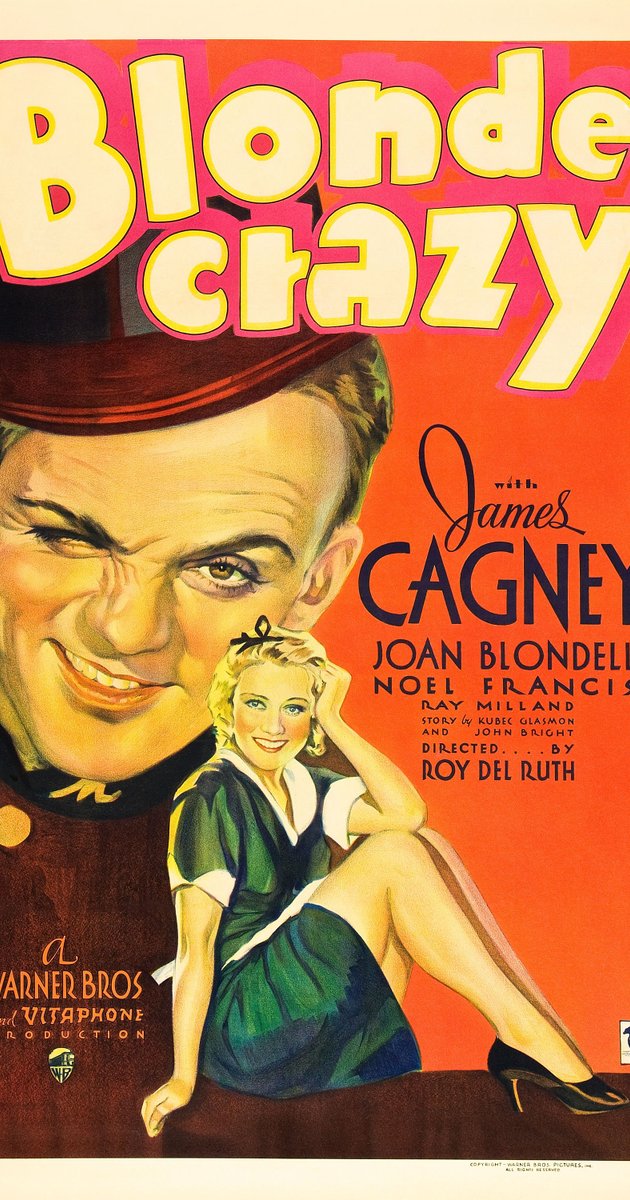
Pre Code Confidential #9: James Cagney in BLONDE CRAZY (Warner Brothers 1931)


gary loggins's avatarcracked rear viewer

blcr1

When James Cagney burst onto the screen like a machine gun barrage in 1931’s THE PUBLIC ENEMY, a star was immediately born. His rough-and-tumble personality was perfectly suited to films of the era, and he’s given a good showcase in BLONDE CRAZY, along with Pre-Code cutie Joan Blondell , who could dish it out with the best of them. Though it’s a little creaky in spots, BLONDE CRAZY is tons of fun, and Cagney gives everybody a lesson in what being a movie star is all about.

jnj2

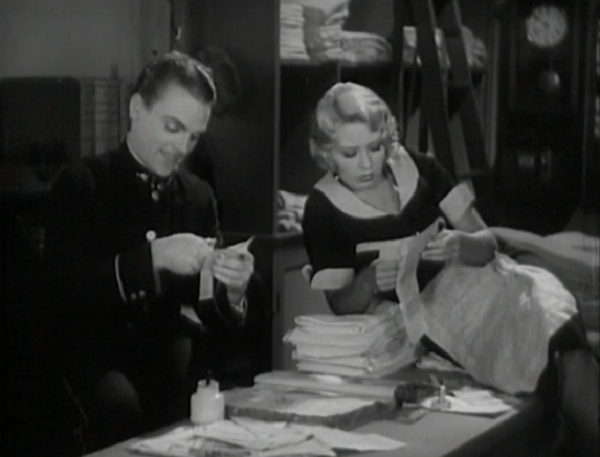
Cagney plays Bert Harris, a bantamweight bellboy looking to make a fast buck during the Depression running crap games and selling bootleg hootch. When he first meets blonde Anne Roberts (our girl Joan) he ogles her body lecherously, and we know right from the get-go what his intentions are! But Ann’s no sucker, she a been-around-the-block kinda gal, and soon this dynamic duo are…

View original post 527 more words

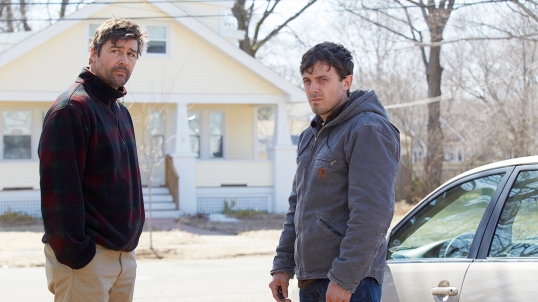
Playing Catch-Up: Manchester By The Sea (dir by Kenneth Lonergan)


manchester-by-the-sea-sundance-2016

Manchester By The Sea is the latest Oscar contender to be set in Massachusetts.  I’m not exactly sure why but it appears that if you want your film to get some sort of Oscar consideration, it’s always good idea to set it some place in New England.

Consider some of the films nominated for Best Picture since the 1992:

1992′ Scent of a Woman featured a New England prep school.

1994’s The Shawshank Redemption took place in Maine.

1997’s Good Will Hunting took place in Boston.

1999’s The Cider House Rules was set in Maine.

2001’s In The Bedroom took place in Maine.

2003’s Mystic River was set in Boston.

The 2006 winner The Departed was also a Boston-set film.

2010’s The Fighter also set in Boston.  For that matter, The Social Network started at Harvard.

2013’s Captain Phillips featured Tom Hanks speaking with Boston accent.

And, finally, last year’s Spotlight was as much a celebration of Boston as anything else.

As of this writing, it appears that Manchester By The Sea will continue the long tradition of New England-set films being nominated for best picture.  Interestingly, of all those films, Manchester By The Sea is probably the most low-key.  Though it’s a film that deals with death, it’s a natural death as opposed to the violent executions that dominated The Departed and Mystic River.  And though there are two bar fights, there’s very little violence to be found in Manchester By The Sea.  As opposed to Spotlight, Manchester By The Sea is not about moral crusaders battling against the corrupt establishment.

Instead, it’s the story of an intelligent but irresponsible man named Lee Chadler (Casey Affleck).  When Lee was a young man living in the town of Manchester-By-The-Sea, he was someone.  He was a high school hockey star.  He made an okay living, he had a lot of friends, and he was very close to his older brother, Joe (Kyle Chandler).  He was married to Randi (Michelle Williams) and he had two daughters.

And then he lost everything.  He lost his daughters, through a stupid accident for which he blamed himself.  Randi divorced him.  His friends abandoned him.  The only thing that prevented him from shooting himself was the intervention of Joe.  Lee eventually ended up in Quincy, Massachusetts, working as a maintenance man and keeping to himself.

And that’s probably what Lee would have done his entire life, if Joe hadn’t died.  Lee returns to Manchester-By-The-Sea and, to his shock, he discovers that he’s been named the guardian of Joe’s sixteen year-old son, Patrick (Lucas Hedges).  Still struggling with his own feelings of guilt, Lee now finds himself thrust into the role of being a father.

Patrick, of course, doesn’t think he needs a guardian and sometimes, it almost seems as if Patrick might be right.  At times, it’s hard not to feel that Patrick is a hundred times more mature than his uncle but occasionally, Patrick’s grown-up mask will slip.  When he learns that his father cannot be buried until the spring and the body will be kept in a freezer, Patrick stays calm until he opens up the freezer at home.  That’s when the reality of it all hits him and it’s an amazingly powerful moment.

Manchester By The Sea is not an easy film to describe.  There’s not much of a plot.  Instead, it’s just a portrait of people living from day-to-day, trying to juggle handling tragedy with handling everyday life.  Conditioned by previous films, audiences watch something like Manchester By The Sea and wait for some gigantic dramatic moment that will magically make sense of the human condition but, by design, that moment never comes.  That’s not what Manchester By The Sea is about.  If there is any great lesson to be found in Manchester By The Sea, it’s that life goes on.

Despite being full of funny lines, it’s a sad film but fortunately, it’s also a well-acted one.  I have to admit that I’m not as crazy about Manchester By The Sea as some of the critics who are currently declaring Manchester to be the best film of 2016 are but I can’t disagree with those who have praised Casey Affleck’s lead performance.  Lucas Hedges also does a good job as Patrick and Michelle Williams gets one revelatory scene in which she happens to randomly run into her ex-husband on the street.

As I said, I liked Manchester By The Sea but I didn’t quite love it.  It’s a well-made and well-acted film and, if it’s not as brilliant as some have claimed, it’s still worthy of respect.