
In Mudbound, Jonathan Banks plays one of the most hateful characters to ever appear in a motion picture.
We never find out the character’s given name. Everyone just calls him Pappy. He’s the patriarch of an unimpressive family, a wannabe king who has no kingdom over which to rule. Pappy never has a kind word to say to anyone. He even tends to be brusque with his grandchildren. When one of his sons returns from serving in World War II, Pappy only wants to know if he got laid in Europe and how many men he killed. Pappy only killed one man in World War I but he did it face-to-face. He’s proud of that.
As much as Pappy dislikes the members of his family, it’s nothing compared to how much Pappy hates people who aren’t white. Pappy is the type to demand that, when he dies, he not buried anywhere near anyone black. Pappy is also the type who takes it as a personal insult if a black man uses the same door that he uses. When he sees Ronsel Jackson (Jason Mitchell) using the font door of the local grocery store, it doesn’t matter that Ronsel has just returned from serving his country and is still wearing his uniform. It also doesn’t matter that Ronsel’s mother is helping to raise Pappy’s granddaughters. What matters is that Ronsel is defying the social norms of 1940s Mississippi and Pappy takes that as a personal insult.
There are six narrators in Mudbound, all of whom tell us their story and share with us their thoughts. Pappy is not one of those narrators and, for that, I was thankful. I would have been frightened at the thought of entering his hate-fueled mind. All we have to do is look into his hateful eyes or listen to his scornful voice and we know what’s going on in Pappy’s head. He’s a man who has accomplished nothing in his long life, whose only happiness comes from making others miserable, and who fears the change that he secretly knows is coming. It’s not just hate that makes Pappy demand an apology when Ronsel Jackson uses the front door. It’s fear.
Mudbound tells the story of two families in Mississippi and the farmland on which they both live and work. (Early on, when a skull with a bullet hole is discovered, we’re informed that an old slave cemetery is under plowed fields.) Pappy’s oldest son, Henry McAllan (Jason Clarke), owns the land. Desperate for his father’s approval, Henry hopes to succeed as a farmer but he soon proves himself to be rather clueless. Henry’s wife is Laura (Carey Mulligan). Laura was a 31 year-old virgin when she met Henry. She tells us that she married him because she didn’t want to be alone. She stays with him because she loves their children.
The Jacksons live on Henry’s land. They’re tenant farmers and Hap (Rob Morgan), the family patriarch, dreams of one day owning his own farm. While Pappy openly hates the Jacksons, Henry treats them with a patronizing condescension. (Whereas Pappy knows that he’s hated, Henry actually thinks that the Jacksons look up to him. There’s not a lot of humor to be found in Mudbound but I couldn’t help but smile at Henry’s cluelessness about how little Hap thought of him.) Henry and Laura even hire Hap’s wife, Florence (Mary J. Blige), to serve as a housekeeper. Henry and Laura think they’re doing Florence a favor, never considering that they are essentially asking Florence to neglect her own family so that she can take care of their’s.
The Jackson and the McAllans do have one big thing in common. They both have sons serving in the army. Ronsel is a sergeant who is both surprised and happy to discover that white Europeans are not the same as white Americans. Henry’s younger brother, Jamie (Garrett Hedlund), is a captain in the Air Force. When the war ends, both Ronsel and Jamie return to their families. Jamie returns with a severe case of PTSD and a drinking problem. Having experienced freedom in Europe, Ronsel is angered to return to a country where he is still expected to sit in the back of the bus and cheerfully accept being treated like a second class citizen.
When both of them are caught off guard by the sound of a car backfiring, Ronsel and Jamie immediately recognize each other as returning soldiers. A friendship develops between them, one that goes against the racist norms of their society. Violence and tragedy follows.
Mudbound is a Netflix film. It’s currently getting a one-week theatrical release so that it’ll be Oscar-eligible. (If it is nominated for best picture — and many think that it may be — it’ll be the first Netflix film to be so honored.) That said, the majority of the people who see Mudbound will see it via Netflix. That’s a shame because, visually, Mubound is a film that should be seen on a big screen. The imagery — the farmland that seems to stretch on forever, the storms that always seem to roll in at the worst possible moment, the scenes of Ronsel and Jamie in Europe — is frequently beautiful and haunting. (The comparisons to the work of Terrence Malick are justified.) Even when viewed on a laptop, Mudbound still looks good but I fear that the small screen will rob the film of some of its epic scope. Since Mudbound is a leisurely paced film, I fear that many members of the Netflix audience are going to be tempted to hit pause and then not return to the film for an hour or two, therefore robbing Mudbound of its cumulative power.
Over the time that I’ve spent writing this review, I’ve come to realize that I actually liked Mudbound a lot more than I originally thought I did. As opposed to many of the films that I’ve seen this year, I have a feeling that Mudbound is actually going to stick with me. Carey Mulligan, Mary J. Blige, Jason Clarke, and Rob Morgan all give wonderful performances, though the cast standout is Jason Mitchell, playing a man who, having tasted freedom, refuses to silently go back to the way things were.
Mudbound is a very good film. I wouldn’t necessarily call it a great film, though many other critics and viewers are. Director Dee Rees captures some beautiful images and some wonderful performances but the film itself has some pacing problems. The first part of the film is occasionally too slow while a few of the final scenes felt rushed. I haven’t always been a huge fan of Garrett Hedlund in the past and, when the movie started, I had my doubts about whether or not I’d be able to accept him as Jamie but, by the end of the movie, he had won me over. In the past, I’ve found Hedlund to be a little stiff but, having now seen Mudbound, I have to say that he’s grown as an actor. I’m looking forward to seeing where his talent takes him next.
Even if it does have flaws, Mudbound is a powerful film and one that I recommend taking the time to watch.
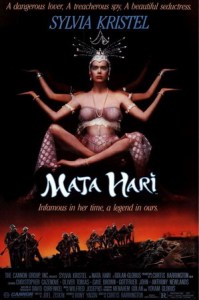 Europe, during World War I. The beautiful dancer, Mata Hari (Sylvia Kristel), is in love with two different soldiers, one German and one French. (The soldiers, played by Olivier Tobias and Christopher Cazenove, are also friends though they are now on opposite sides of the Great War.) Forced into the world of decadent, high class espionage by Frau Doktor (Gaye Brown), Mata Hari sleeps with everyone, shares information with both the Germans and the French, and tries to prevent more people from dying. Just as in history, Mata Hari ultimately has to face a firing squad but not before taking part in threesomes, voyeurism, and a topless sword fight.
 “The family is like a drug and we’re all junkies.” So says Charley Warner (Vincent D’Onofrio), one of the many pissed off people at the center of Crooked Hearts.
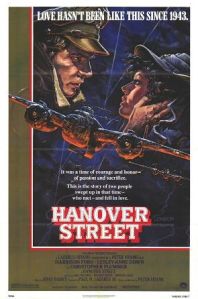 The time is World War II and, for the British, the American army is “overpaid, oversexed, and over here.” David Halloran (Harrison Ford) is a pilot who has been stationed in England. With no loved ones to worry about, David has no fear of flying over occupied France and dropping bombs on the Nazis below. But then David meets an English nurse, Margaret (Lesley-Anne Down). As David falls in love, he loses his enthusiasm for the war because he now has “a reason to live.” The only problem is that Margaret is already married to Paul (Christopher Plummer), an officer in British Intelligence. When David accepts an assignment to fly a British agent into France, he is shocked when the agent turns out to be Paul. When David’s plane crashes, he and Paul have to work together to complete Paul’s mission and escape back to Britain.
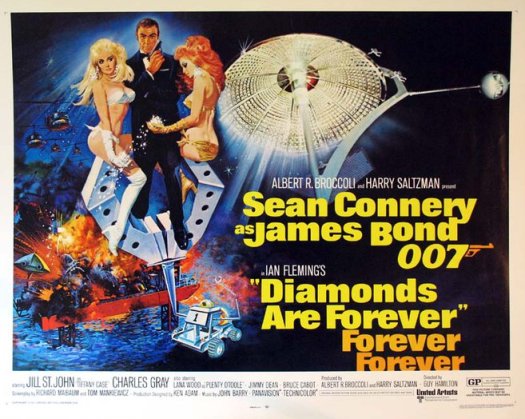
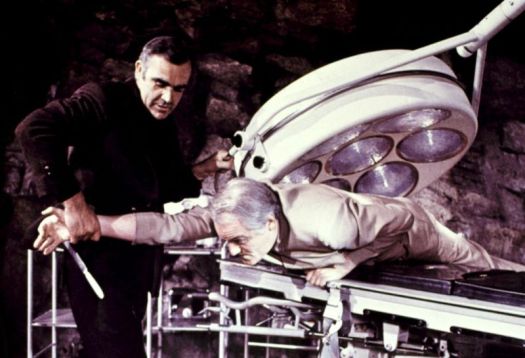
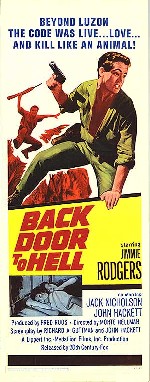 The time is World War II. The place is the Philippines, shortly before the famous return of Douglas MacArthur. Three U.S. soldiers have been sent on a very important mission to knock out a Japanese communication center before the American invasion. Lt. Craig (Jimmie Rodgers) is their leader and he worries that he might not have what it takes to kill a man. Sgt. Jersey (John Hackett) is cynical and tough. Cpl. Burnett (Jack Nicholson) is the radio man with a sarcastic sense of humor. They have been told to meet up with a rebel leader named Miguel but, shortly after arriving, they discover that Miguel has been killed and the new leader is Paco (Conrad Maga), who distrusts the Americans almost as much as he dislikes the Japanese. Meanwhile, a Japanese captain (Joe Sison) threatens to execute all of the children in a nearby village unless the Americans either surrender or are captured.
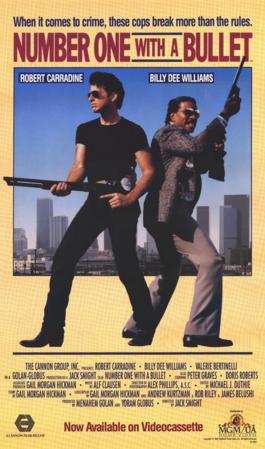 Number One With A Bullet is the story of two cops. Nick Barzack (Robert Carradine) is so crazy that the all criminals have nicknamed “Beserk.” (Who says criminals aren’t clever?) Nick’s partner, Frank Hazeltine (Billy Dee Williams) is so smooth that jazz starts to play whenever he steps into a room. Nick keeps a motorcycle in his living room, wants to get back together with his wife (Valerie Bertinelli), and has an overprotective mother (Doris Roberts). Hazeltine is Billy Dee Williams so all he has to worry about is being the coolest man on Earth. Their captain (Peter Graves!) may want them to do things by the book but Nick and Hazeltine are willing to throw the book out if it means taking down DaCosta, a so-called respectable citizen who they think is actually the city’s biggest drug lord.
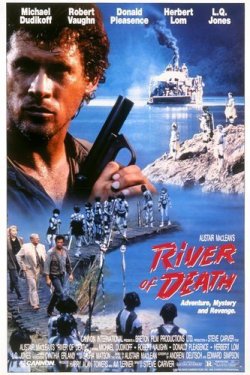 In the Amazon, natives are dying of a mysterious disease. Could it have anything to do with a German war criminal named Wolfgang (played by Robert Vaughn) who is living in a cave that is decorated with a Nazi flag? A scientist (Victor Melleney) and his daughter, Anna (Sarah Maur Thorp), are determined to find out. They hire a tough explorer, John Hamilton (Michael Dudikoff), to lead them up the river but John does not do a very good job because the scientist ends up dead and Anna ends up kidnapped.
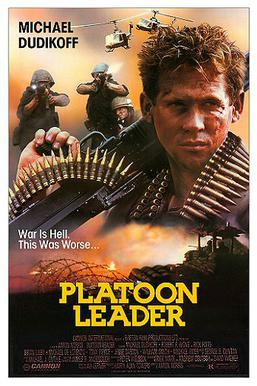 Having just graduated from West Point, Lt. Jeff Knight (Michael Dudikoff, the American Ninja himself) is sent to Vietnam and takes over a battle-weary platoon. Lt. Knight has got his work cut out for him. The VC is all around, drug use is rampant, and the cynical members of the platoon have no respect for him. When Lt. Knight is injured during one of his first patrols, everyone is so convinced that he’ll go back to the U.S. that they loot his quarters. However, Knight does return, determined to earn the respect of his men and become a true platoon leader!
 Through the Shattered Lens