What Lisa Watched Last Night #172: Web Cam Girls (dir by Doug Campbell)


Last night, I watched one of the final Lifetime movies of 2017, Web Cam Girls!
Why Was I Watching It?

Well, the obvious answer is that I was watching it because it was on Lifetime and our regular readers know how much I love Lifetime!

However, from the minute that I saw the first commercial for Web Cam Girls, I grew convinced that it would be better than the average 2017 Lifetime film.  The commercials were just so melodramatic and wonderfully sordid.  If I’ve learned anything over the years, it’s that the best Lifetime films always seem to be about capitalizing on people’s fear of the dark web.  (Then again, people probably should be scared of the dark web…)

Finally, I knew that I was going to have to review this film just because of the title.  Now, whenever someone does a search for “web cam girls,” there’s a good chance they’ll end up on this site.  They’ll probably get mad once they arrive here but a click is a click.

What Was It About?

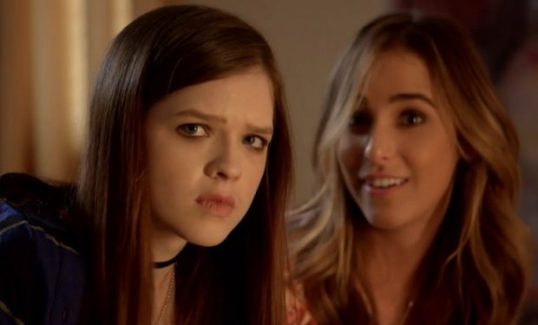
Carolyn (Lorynn York) needs money so she becomes a web cam girl.  Her cousin, Alex (Sedona Legge), says it’s a bad and dangerous idea but Carolyn claims that it’s actually the safest way to make money.  She never meets the men who watch her.  All she has to do is undress a little on camera and, pretty soon, she’ll be able to get an apartment in New York and make all of her dreams come true.

But then, one night, Carolyn gives in to temptation to agrees to meet one of her admirers in a sleazy motel.  She promptly vanishes, leaving Alex and their friend Shawn (Liam McKanna) to try to figure out what happened.  Was she kidnapped and, if so, by whom?  There are suspects all around and it’s starting to look like the only way Alex is going to find her is by going on camera herself.

What Worked?

Oh my God, Lifetime really did save the best for last!  After a year that left many longtime Lifetime viewers feeling somewhat disappointed, Lifetime finally gave us the type of movie that made us fall in love with the network in the first place.  Web Cam Girls is wonderfully melodramatic, over the top, and incredibly entertaining.  The houses are beautiful, the villain is perhaps one of the most evil characters to ever appear in a Lifetime film, and the whole thing is full of details that will reward the observant viewer.

For instance, Carolyn, Alex, and Shawn discuss watching Sunrise in film class.  Sunrise, of course, is a film about an innocent who is tempted by the sinful city, much in the same way that Carolyn and Alex are tempted by the sinful internet.  Later, another teacher tells Alex that he was impressed with her essay about H.P. Lovecraft.  References to both Lovecraft and F.W. Murnau in a Lifetime movie?  How can’t you love that?

It was also well-acted.  Stephen Graybill and Joe Hackett were memorable as two sinister teachers.  I liked both Jon Bridell as Carolyn’s drunk but ultimately heroic father and John Dinan as his best friend.  In the role of Carolyn’s mentor, Nikki, Tonya Kay made such a strong impression that a lot of us on twitter were demanding that Nikki get a spin-off film of her own.  Down to the smallest part, everyone made their character interesting.

What Did Not Work?

It all worked.

“Oh my God!  Just like me!” Moments

When I was in high school, I also used to dress in black and write essays about H.P. Lovecraft.

Lessons Learned

Beware the dark web!
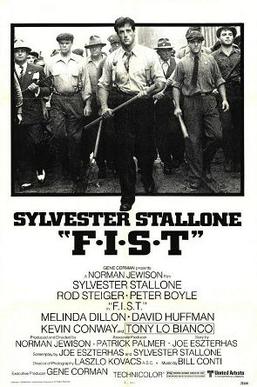
 

A Movie A Day #355: F.I.S.T. (1978, directed by Norman Jewison)


Sylvester Stallone is Jimmy Hoffa!

Actually, Stallone plays Johnny Kovak, a laborer who becomes a union organizer in 1939.  Working with him is his best friend, Abe Belkin (David Huffman).  In the fight for the working man, Abe refuses to compromise to either the bosses or the gangsters who want a piece of union.  Johnny is more pragmatic and willing to make deals with ruthless mobsters like Vince Doyle (Kevin Conway) and Babe Milano (Tony Lo Bianco).  Over thirty years, both Johnny and Abe marry and start families.  Both become powerful in the union.  When Johnny discovers that union official Max Graham (Peter Boyle) is embezzling funds, Johnny challenges him for the presidency.  When a powerful U.S. senator (Rod Steiger) launches an investigation into F.I.S.T. corruption, both Johnny and Abe end up marked for death.

Obviously based on the life and mysterious disappearance of Jimmy Hoffa, F.I.S.T. was one of two films that Stallone made immediately after the surprise success of Rocky.  (The other was Paradise Alley.)  F.I.S.T. features Stallone in one of his most serious roles and the results are mixed.  In the film’s quieter scenes, especially during the first half, Stallone is surprisingly convincing as the idealistic and morally conflicted Kovak.  Stallone is less convincing when Kovak has to give speeches.  If F.I.S.T. were made today, Stallone could probably pull off the scenes of the aged, compromised Johnny but in 1978, he was not yet strong enough as an actor.  Far better is the rest of the cast, especially Conway, Lo Bianco, and Boyle.  If you do see F.I.S.T., keep an eye on the actor playing Johnny’s son.  Though he was credited as Cole Dammett, he grew up to be Anthony Keidis of the Red Hot Chili Peppers.

The box office failures of both F.I.S.T. and Paradise Alley led Stallone back to his most famous role with Rocky II.  And the rest is history.


Catching Up With The Films of 2017: A Woman, A Part (dir by Elisabeth Subrin)


There’s a great montage during the first half of A Woman, A Part.

An actress named Anna (Maggie Siff) wanders around her home, reading scripts for tv shows and movies.  In between shots of her snorting cocaine, we listen as she reads dialogue aloud.  One of the scripts features her as a dying mother who, with her last words, asks her children to look after their father.  Another script is obviously from a Lifetime film and again, the role that Maggie reads is for a mother.  In another script, she’s a love interest.  And, in another, she’s just a bitchy authority figure.  As becomes obvious from the dialogue, none of the scripts offer her the chance to play a leading or even a fully developed character.  In each script, she’s either a plot device or a part of the scenery.  She reads a script, she does a line.  As she finishes each script, she tosses it into her pool until soon, the water is full of shallow characters and clichéd dialogue.  Soon, Anna is floating in the pool, surrounded by the debris of her career.

Anna moved to Los Angeles from New York.  In New York, she was all about theater and seeking truth through acting.  In Los Angeles, she has a role on a sitcom and a certain amount of fame.  People stare at her in restaurants.  Some ask for autographs.  Anna is exhausted, frustrated, and very aware that Hollywood has little to offer an actress in her 40s.

Anna escapes Los Angeles, heading back to New York.  She hopes to reunite with her former friends but, when she arrives, she discovers that some have moved on and some have not.  Her former acting partner, Kate (Cara Seymour), no longer considers herself to be an actress and resents Anna for having left their show to go to Los Angeles.  Playwright Isaac (John Ortiz) has written a play, one that centers around a flawed character who Anna immediately recognizes as being based on herself.

A Woman, A Part is the first full-length feature film to be directed by the video artist, Elisabeth Subrin.  It’s a flawed but promising debut.  For every moment that runs the risk of falling into cliché, there’s a sequence like that pool scene or the scenes where Kate and Anna deal with their fractured friendship.  It’s in those scenes between Maggie Siff and Cara Seymour that the film really comes alive.  When a fan approaches Anna while she’s talking to Kate and Anna responds by saying that everyone should be asking for Kate’s autograph, Kate rightly calls Anna out for her condescending attempt at kindness.  At the same time, the film is also honest enough in its characterizations to admit that much of Kate’s reaction is due to her own resentment that Anna found the success that Kate didn’t.  This is a film that realizes that friendships are often the most complex of relationships.  Maggie Siff and Cara Seymour both give honest and poignant performances.

As I said, A Woman, A Part is not without its flaws.  To be honest, the character of Isaac never interested me as much as Anna and Kate.  There are a few scenes which are just a little bit too on the nose.  It’s not a perfect film but it is a promising one and I look forward to seeing what Elisabeth Subrin does next.


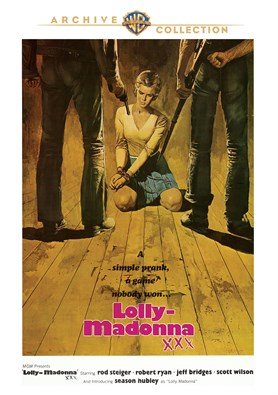
A Movie A Day #354: Lolly-Madonna XXX (1973, directed by Richard C. Sarafian)


In the backwoods of Hicksville, USA, two families are feuding.  Laban Feather (Rod Steiger, bellowing even more than usual) and Pap Gutshall (Robert Ryan) were once friends but now they are committed rivals.  They claim that the fight started when Pap bought land that once belonged to Laban but it actually goes back farther than that.  Laban and Pap both have a handful of children, all of whom have names like Thrush and Zeb and Ludie and who are all as obsessed with the feud as their parents.  When the Gutshall boys decide to pull a prank on the Feather boys, it leads to the Feathers kidnapping the innocent Roonie (Season Hubley) from a bus stop.  They believe that Roonie is Lolly Madonna, the fictional fiancée of Ludie Gutshall (Kiel Martin).  Zack Feather (Jeff Bridges), who comes the closest of any Feather to actually having common sense, is ordered to watch her while the two families prepare for all-out war.  Zack and Roonie fall in love, though they do not know that another Feather brother has also fallen in love with Gutshall daughter.  It all leads to death, destruction, and freeze frames.
Lolly-Madonna XXX is a strange film.  It starts out as a typical hicksploitation flick before briefly becoming a backwoods Romeo and Juliet and finally ending up as a heavy-handed metaphor for both the Vietnam War and the social upheaval at home.  Along with all the backwoods drama, there is a fantasy sequence where Hawk Feather (Ed Lauter) briefly imagines himself as an Elvis-style performer.  (Hawk also dresses up in Roonie’s underwear.)  Probably the most interesting thing about Lolly-Madonna XXX is the collection of actors who show up playing Feathers and Gutshalls.  Along with Steiger, Ryan, Martin, Bridges, and Lauter, everyone from Randy Quaid to Paul Koslo to Scott Wilson to Gary Busey has a role to play in the feud.  Lolly-Madonna XXX is too uneven and disjointed to really be considered a good movie but I can say that I have never seen anything else like it.

One final note: Lolly-Madonna XXX was directed by Richard Sarafian, who is best known for another early 70s cult classic, Vanishing Point.

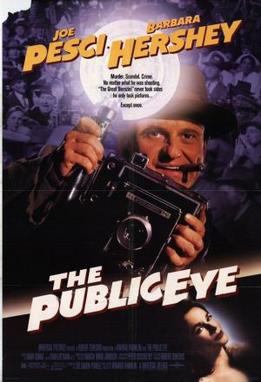
A Movie A Day #353: The Public Eye (1992, directed by Howard Franklin)


New York in the 1940s.  Leon “Bernzy” Bernstein (Joe Pesci) is nearly a legend in the city, a freelance news photographer with a police radio in his car and a darkroom in his trunk.  Bernzy is a solitary man who lives for his work, the type who has many acquaintances but few friends.  He gets the pictures that no one else can get but his dream of seeing a book published of his photographs seems to be unattainable.  As more than one snobbish publisher tells him, tabloid photographs are not art.
Bernzy is invited to a meeting with Kay Levitz (Barbara Hershey).  Kay is the widow of one of Bernzy’s few friends.  She has inherited a nightclub but now a mysterious man is claiming to be a former partner of her husband and says that he owns half of the club.  She asks Bernzy to discover who the man is.  Bernzy agrees and soon finds himself a suspect in a murder.  Even as Bernzy tries to clear his name, he never stop looking for the perfect shot.

Joe Pesci made this neo noir shortly after winning an Oscar for GoodfellasThe Public Eye was an attempt to elevate Pesci from being a character actor to a leading man.  It may not have accomplished that but it is still one of the better neo noirs of the 90s.  Howard Franklin does such a good job of recreating the style of film noir that the movie seems like it’s in black-and-white even though it’s in color and Barbara Hershey is perfectly cast as a sultry femme fatale.  The tough but eccentric Bernzy turns out to be a perfect role for Joe Pesci, who gives one of his best performances.  This overlooked film is one to watch for.

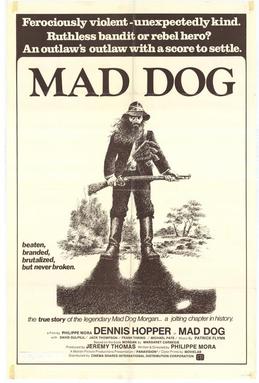
A Movie A Day #352: Mad Dog Morgan (1976, directed by Philippe Mora)


Though he may not be as internationally well-known as Ned Kelly, Dan “Mad Dog” Morgan was one of the most infamous bushrangers in 19th century Australia.  Much as with the outlaws of American west, it is sometimes difficult to separate the fact from the legend when it comes to Mad Dog Morgan but it is agreed with Morgan has one of the most violent and bloodiest careers of the bushrangers.  Whether Morgan was a folk hero or just a ruthless criminal depends on which source you choose to believe.
In Mad Dog Morgan, Dennis Hopper plays Morgan as being the ultimate outsider.  Though the real Morgan was believed to have been born to Irish immigrants in New South Wales, the film presents Morgan as being the immigrant, an Irishman who ends up in Australia searching for gold and who is disgusted when he sees the way that the colonial authorities run the country.  Addicted to opium and angered by the casual brutality and corruption that he sees all around him, Morgan fights back and soon ends up in prison where he spends years being abused and raped.  It is all intended to break his spirit but, instead, Morgan comes out of prison even more determined to seek revenge on any and all figures of authority.  Working with a fellow outsider, an Aborigine named Billy (David Gulpilil, from Nicolas Roeg’s Walkabout), Morgan blazes a bloody and self-destructive trail across Australia.

Mad Dog Morgan was made long before Hopper cleaned up his act and became on of America’s favorite character actors.  This is Hopper back when he was still one of the most unpredictable and dangerous actors around.  By many accounts, Hopper was in the throes of drug-induced psychosis during the filming of Mad Dog Morgan, which makes it all the more remarkable that Hopper still gave one of his best performances as the legendary bushranger.  (For proof of how authentic Hopper feels in the role, compare his performance to Mick Jagger’s in Ned Kelly.)  Hopper was an outlaw playing an outlaw and his full commitment to the role is obvious from the start.  Featuring brutal action and a cast of talented Australian character actors, (Jack Thompson, Bruce Spence, Bill Hunter, and Hugh Keays-Byrne all have roles) Mad Dog Morgan is an essential film for fans of both Australian cinema and Dennis Hopper.

Playing Catch-Up With The Films of 2017: American Assassin (dir by Michael Cuesta)


Probably the best thing about American Assassin is how simple it is.

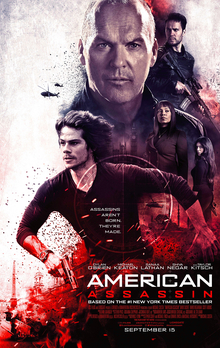
The film opens on the beach, with Mitch Rapp (Dylan O’Brien) asking his girlfriend to marry him.  No sooner has she accepted than suddenly, terrorists are washing up on the beach and, in a genuinely frightening scene, shooting everyone that they see.  Mitch is wounded.  His girlfriend is killed.

Mitch seeks revenge against the man who killed his “future wife” (to borrow a phrase from The Room) but U.S. Special Forces kill the terrorist seconds before Mitch gets the chance.  However, the CIA is so impressed, by Mitch’s single-minded and obsessive desire for revenge, that they recruit him to join Orion, a black ops unit.  Under the guidance of grizzled veteran, Stan Hurley (Michael Keaton), Mitch becomes an American assassin.  His first mission?  To stop a renegade mercenary known as the Ghost (Taylor Kitsch).

In many ways, American Assassin feels like a throwback to the action films of the early aughts.  There’s none of the moral ambiguity of the Bourne films and Mitch Rapp never indulges in any of the self-loathing that’s marred the Daniel Craig James Bond films.  Remember how Bond got drunk and tried to interrogate that rat in SPECTRE?  Judging from American Assassin, that’s something Mitch Rapp would never do.  And, if he ever did, Stan Hurley would probably tell him to stop whining and get back to work.

In American Assassin, the bad guys are undoubtedly the bad guys and the good guys are undoubtedly the good guys and, while that may not be the approach that leads to Academy Awards and overwhelming critical acclaim, it still makes for an undeniably entertaining movie.  Director Michael Cuesta does a good job with the action scenes and he gets good performances from the entire cast.  Taylor Kitsch is far more compelling as a villain than he ever was in any of his heroic roles and, not surprisingly, Michael Keaton steals the whole show as the tough but caring Stan Hurley.  Michael Keaton is definitely one of the best actors working today.  He can slide seamlessly from a prestige drama like Spotlight to an action film like American Assassin to a comic book film like Spider-Man: Homecoming and he can do it without missing a beat.  Those are three very different films and Keaton was the best thing in all of them.

And, finally, we have Dylan O’Brien.  Last year, as we all know, O’Brien was seriously injured while filming the third Maze Runner film.  At the time, it was announced that O’Brien’s injuries were “substantial but not life threatening” but I know there was a feeling that his career might be over.  Even though American Assassin was not his first film since getting injured, it was his first starring role and I have to admit that it was good to see O’Brien back and looking good.  O’Brien brought a lot of gravity to the role of Mitch Rapp.  He had the haunted look of a man obsessed with revenge.  When I saw O’Brien in The Maze Runner and, before that, in Teen Wolf, I thought he was a pleasant young actor but, in American Assassin, he gives his most mature performance to date.  With American Assassin, Dylan O’Brien grows up.

As I said, American Assassin is a simple film.  There’s not much going on beneath the surface and it you’re looking for anything deeper than pure entertainment, you might want to look elsewhere.  American Assassin is what it is and makes no apologies.  What it does, it does well.

Film Review: Kingsman: The Golden Circle (dir by Matthew Vaughn)


Before I say too much about Kingsman: The Golden Circle, I do want to acknowledge a few good things about the movie.

First off, it doesn’t take long for the film to reveal that Harry (Colin Firth) didn’t actually die when Samuel L. Jackson shot him in the head in the first movie.  Undoubtedly, that diminishes the power of that scene but, at the same time, it also means that Colin Firth gets to come back.

Secondly, Taron Egerton returns as Eggsy.  The script really doesn’t give him too many opportunities to show what he’s capable of as an actor, largely because the character of Eggsy was fully developed by the end of the first movie.  Now that Eggsy is a fully trained and competent Kingsman, there’s not really much for him to do other than trade a few quips and take a few lives.  That said, Egerton is a likable actor and he’s fun to watch.

Third, Julianne Moore has a few fun scenes as the film’s main villain, Poppy Adams.  Poppy is the head of an international drug cartel.  She’s also obsessed with the 1950s and always amazingly cheerful.

Fourth, all of the Kingsmen still wear suits and Michael Caine-style glasses.  Colin Firth gets to use his umbrella as a shield.

Finally, Mark Strong is back as Merlin.

So, that’s five good things about Kingsman: The Golden Circle.  Unfortunately, all five of those things are somewhat obscured by the fact that the movie really, really sucks.

Admittedly, I had really high hopes for the movie.  I loved the first Kingsman film, which was a stylish satire that featured one of the greatest action set pieces of all time.  And I was excited to see that not only was Firth returning but Matthew Vaughn would also be directing the sequel.

But no.  This movie just doesn’t work.

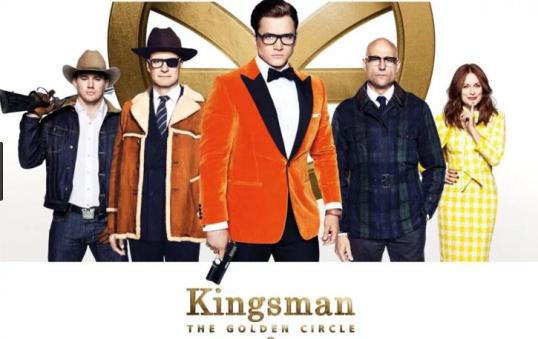
Kingsman: The Golden Circle attempts to do everything on a larger scale than the first Kingsman.  That means more violence, more betrayals, and a longer running time.  This time, the movie not only features the Kingsmen but also the Statesmen, which is the American equivalent of the Kingsmen.  (The Statesmen all dress like cowboys and speak in exaggerated Southern drawls, which I got kind of sick of listening to after about three minutes.)  Along with the returning stars of the first film, Jeff Bridges, Emily Watson, Bruce Greenwood, Halle Berry, and Channing Tatum all have small roles.  Pedro Pascal (best known for playing Oberyn Martell on Game of Thrones) has a much larger role as a Statesman codenamed Whiskey.

Unfortunately, bigger is not always better.  The Golden Circle never comes close to matching the lunatic heights of the first movie.  There are a lot of action scenes but none of them match the church fight from the first film.  There’s a surprise death but it’s nowhere near as shocking or effective as Firth’s “death” in the first film.  Even the required barroom brawl falls flat.  Nowhere does The Golden Circle match the audacity of the first film.  The first film ended with exploding heads.  This film ends with the promise of more sequels.

But really, I think what really doomed The Golden Circle was that extended running time.  There’s really no good reason for The Golden Circle to last for 2 hours and 21 minutes.  Quite a bit of the film, especially during the first hour, felt padded out and, as a result, it seemed like took forever for the film’s story to actually get started.  Probably 40 minutes to an hour could have been cut from The Golden Circle without anyone missing it.

Ultimately, I think the main problem is that the first Kingsman felt like it was made by people who truly did love the material.  This film feels contractually obligated.  The Golden Circle has a lot of action but it’s just not very fun.

A Movie A Day #351: Moonshine Highway (1996, directed by Andy Armstrong)


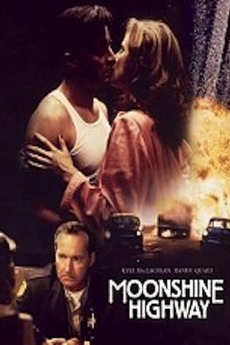
The time is the 1950s.  The place is the backwoods of Tennessee.  Everyone is obsessed with three things: cars, sex, and moonshine.  Jud Muldoon (Kyle MacLachlan) served his country in World War II and now he just wants to make a living.  He is the best moonshine runner in Appalachia.  When he gets behind the wheel of a car, no one can outrun him.  As long as he gets his cut, Sheriff Wendell Miller (Randy Quaid) has no problem with looking the other way when it comes to the moonshiners in his county.  Or at least he doesn’t until the feds show up and start breathing down his neck about all the money they’re losing through non-taxed liquor sales.  Complicating matters even more is that when Jud isn’t running moonshine, he’s sleeping with Ethel (Maria del Mar), who just happens to be married to the sheriff.

Though Canada fills in unconvincingly for Tennessee and the movie is full of more  corn-prone clichés than you can shake a stick at, Moonshine Highway is still a fairly entertaining tribute to old drive-in movies like Thunder Road and Moonrunners.  Kyle MacLachlan is surprisingly convincing as a backwoods driver and Randy Quaid was always at his best when playing corrupt Southern law enforcement.  (This was filmed before Quaid’s infamous meltdown.)  This was the only film directed by famed stunt coordinator Andy Armstrong and he does a good job capturing all of the vehicular mayhem.  Moonshine Highway was originally made for Showtime and it is not the easiest movie to find.  It’s available on VHS and on DVD in Argentina.

If you do see the movie, keep an eye out for director David Cronenberg in a small role.

Playing Catch Up With The Films of 2017: The Boss Baby (dir by Tim McGrath)


I have to admit that The Boss Baby is an animated film that I have mixed feelings about.

Actually, that shouldn’t be surprising.  The Boss Baby is the epitome of the type of film that is disliked by critics but loved by audiences.  It got fairly dismissive reviews but it also made a ton of money and apparently, there’s a sequel in the works.

It’s a product of Dreamworks Animation, which has always basically been Pixar without the edge.  If Pixar films often seem to be about the animators working out their own personal issues through their work, the films from Dreamworks are often distinguished by just how little is actually going on beneath the surface.  If Pixar specializes in crowd pleasers that challenge you to think, Dreamworks specializes in crowd pleasers that invite you to sit back and relax.

(Of course, that’s a generalization.  Dreamworks is responsible for the Shrek films, the majority of which I absolutely love.  At the same time, as much as I love Pixar, I would warn against giving too much thought to anything in the first two Cars films.)

Anyway, The Boss Baby is the story of Ted, a little baby who wears a suit and tie and who sounds just like Alec Baldwin.  Strangely, only his older brother , Tim (Max Bakshi), appears to see anything strange about any of this.  Everyone just dismisses Tim’s concern as a product of Tim being jealous of his baby brother and, to a certain extent, they have a point.  The older children are always jealous of their younger siblings.  (Fortunately, I was the youngest of four so I never had to be jealous of anyone.)  Still, it turns out that Tim is correct about something being strange about Ted, who has actually been sent into the world on a secret mission.  Francis E. Francis (Steve Buscemi) is the CEO of Puppy Corp. and he’s conspiring to make puppies cuter than babies.  The Boss Baby has to stop him and he only has a few days to do so before he forgets how to speak and turns into an ordinary baby.

It’s a surprisingly busy plot and a lot of it feels as if it was ripped off from the Toy Story films.  Instead of talking toys, we’ve got a talking baby.  Just as Toy Story 3 featured a lengthy chase scene and a bitter villain, The Boss Baby features a lengthy chase scene and a bitter villain.  Much as how every Toy Story movie ended with a rumination on what it means to get older and grow up, The Boss Baby ends with a rumination on what it means to get older and grow up.  Many times, The Boss Baby feels like a compilation of scenes and characters lifted from other animated films.

At the same time, the idea of a baby wearing a suit and talking like a New York tough guy is undeniably cute.  I’m not the world’s biggest Alec Baldwin fan but, in this case, it’s perfect casting.  As the film itself makes clear, babies are cute.  This is especially true when they’re animated and you’re not the one who has to change their diapers or clean up after them.

There’s a thin line between keeping an audience happy and pandering and, often, The Boss Baby steps over that line.  It’s a very derivative film, one that never reaches either the comedic or the emotional highs of a good Pixar film.  However, the baby is cute and sometimes, that’s enough.