The TSL’s Grindhouse: Death Journey (dir by Fred Williamson)


Imagine being caught up in the following situation.

You’re the district attorney of Manhattan.  You’ve got a chance to convict the city’s most powerful mob boss on some pretty serious charges.  In fact, you’ve got three eye witnesses who are willing to testify against him.  Sounds pretty good so far, right?

But wait a minute!  One of your eyewitnesses just died.  Oh well.  You’ve still got two left and surely, the police can protect two… oh wait.  Hold on.  Okay, you know that second witness that you had?  Well, he just got blown up or something.  Now, you’ve only got one witness left.  He’s a weaselly little mob accountant named Finley (Bernard Kirby).  He’s really not a bad guy, once you get past all of the Hawaiian shirts and his obsession with candy.  The only problem is that Finley is in California and you’re in New York.  How are you going to get Finley across the country without him getting blown up by the mob?

Well, let’s see.  You could ask the government for help but when was the last time government managed to do anything without screwing it up.  You could reach out to the FBI or something like that.  Maybe Finley could go into witness protection.  I mean, it’s worked for a countless number of other mob associates…

But no.  There’s no way Finley could survive in witness protection.  He’d probably give himself away as soon as someone offered him a candy bar.  Seriously, Finley is really obsessed with chocolate.

No, what you’re going to do is you’re going to call up Jesse Crowder (Fred Williamson).  Crowder used to be a cop but now he’s a private eye.  He’s a lot like Shaft, except he doesn’t ever get political.  There’s really nothing that Jesse Crowder can’t do.  He’s a marksman.  He’s a fighter.  He’s a lover.  When we first see him, he’s doing kung fu in slow motion.  If you really needed proof that Jesse Crowder is the ultimate badass, consider this: he smokes cigars.  You read that correctly.

Now, you may be asking yourself: why would the Manhattan district attorney know a Los Angeles private eye?  Because everyone knows Jesse Crowder, that’s why.

Anyway, Jesse agrees to take the case.  He’ll escort Finley to New York, on the condition that he get paid $25,000 upon arrival.  Of course, if he has to kill a lot of people, Jesse expects to be paid $50,000.

Needless to say, Jesse does end up having to kill a lot of people.  It’s not really his fault, of course.  They just keep popping up and getting in his way.  Jesse tries all sorts of ways to get Finley to New York.  He tries to drive him.  He tries to take the train.  No matter what he does, the mob shows up.  Is it possible that the mob had someone inside the district attorney’s office?

Fred Williamson not only starred in 1976’s Death Journey but he directed it as well.  Though it’s obvious that Williamson didn’t have much of a budget to work with, he still did a fairly good job with Death Journey.  Certainly, his direction here feels stronger than it did in Mean Johnny Barrows.  In its own undeniably dumb way, Death Journey‘s a fun action movie.  Williamson may not have been a great actor but he had a strong screen presence and it’s impossible not to be amused by the fact that, no matter what he does or where he goes, somewhat inevitably pops out of the shadows and tries to kill him.  With the exception of that opening kung fu sequence that goes on forever, Death Journey is a fast-paced action film.  The film only last 74 minutes so, right when you start to wonder if Williamson’s ever going to show any personality beyond being a cocky badass, the movie ends.

If you’re a fan of low-budget 70s action films, you’ll probably enjoy Death Journey.  If you don’t enjoy it, just make sure Jesse Crowder doesn’t find out.  After all, he knows karate.
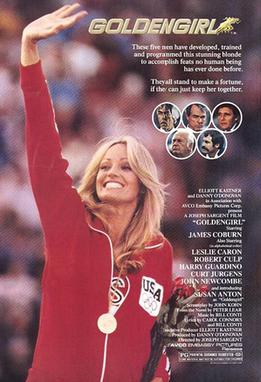
An Olympic Film Review: Goldengirl (dir by Joseph Sargent)


The 1979 film Goldengirl is a film that I had wanted to see ever since I first came across this trailer on one of the 42nd Street Forever compilation DVDs:

Wow, I wondered.  What was Goldengirl’s secret and why was she ordering James Coburn to kiss her feet?  For that matter, why did James Coburn have a haircut that made him look exactly like this old lady who used to live next door to my grandma in Fort Smith?  What did it all have to do with the villain from The Spy Who Loved Me and just how drunk was Robert Culp when he shot his scenes?  Even more importantly, why did Goldengirl keep running into that wall?  That looked painful!

I did some research.  (That’s a fancy way of saying that I looked the movie up on Wikipedia.)  I discovered that Goldengirl was made in 1979.  It was originally meant to be a television miniseries that would not only air during the 1980 Summer Olympics but which would feature Goldengirl competing at those Olympics!  However, during production, it was decided to just use the material for a feature film instead. (Hmmmm, I thought, behind-the-scenes drama!  Intriguing!)  The film was released in June of ’79 and, despite one rave review from Vincent Canby in the New York Times, the film failed at the box office.  Add to that, the U.S. ultimately boycotted the 1980 summer games, which made Goldengirl‘s Olympic-set climax a bit awkward.

I also discovered that Goldengirl is nearly impossible to see.  It’s never been released on DVD or Blu-ray or any digital or streaming service.  So, I resigned myself to the fact that I’d probably never see Goldengirl and, the more I thought about it, the more I realized that I really didn’t care that much.

However, for the past few days, I have been absolutely obsessed with the Winter Olympics.  Even though it was a Summer Olympic movie, I decided to go on YouTube and see if anyone had uploaded Goldengirl since I last checked.

And guess what?

They had!

Now, here’s the problem.  The two guys who uploaded Goldengirl also talked over the entire movie.  Don’t get me wrong.  The movie looked about as good as a VHS copy of a movie from 1979 is ever going to look.  And I could still follow Goldengirl‘s story, even if I sometimes had to really strain to hear the dialogue over the two guys “commenting” on it.  Still, it meant that I had to put a bit more effort into watching this movie than it perhaps deserved.  It was kinda hard not to resent that.

Anyway, I have finally seen Goldengirl and I can now tell you that it’s a pretty lousy movie.  Goldengirl is Goldine (Susan Anton).  Her father is a German scientist who used to work for the Nazis.  When he came to the United States, he decided to prove that his theories of eugenics were correct by adopting a daughter and breeding her to be the world’s greatest athlete.  Working with a psychiatrist named Dr. Lee (Leslie Caron, for some reason), they have not only turned Goldine into the world’s greatest athlete but they’ve also turned her into a bright, smiling media personality.  (Dr. Lee has trained Goldine, through the use of a vibrator, to always give the right answer when she’s asked a question.)  Now, they just need Goldine to win three gold medals at the Summer Olympics and for PR agent Jack Dryden (James Coburn) to make Goldine into a star.  Dryden is the only person who really cares about Goldine as something other than an experiment or a way to make money.

Goldine spends almost the entire movie running.  There’s one running montage that seems to go on forever.  Susan Anton was a model when she was cast as Goldine.  She’s got the right look to be a celebrity but she’s never convincing as an Olympic-class athlete.  Whenever Goldine competes, we either get a close-up of Anton running in slow-motion with no other runners around her or else a long-shot that’s designed to keep us from noticing that Anton isn’t really on the track.

Really, that’s entire film.  On the basis of the trailer, I was expecting that Goldengirl would turn out to be a robot or something like that.  Instead, it just turns out that her stepfather has spent years injecting her with vitamins and hormones and now, as a result, she has diabetes.  Seriously, that’s it.  She gets pretty mad when she finds out that her handlers have put her health at risk just so she could win a race.  But then she goes ahead and runs the race anyway so I guess it was all for the best.  Seriously, that’s the entire freaking movie.  It doesn’t help that Anton’s acting is amateurish and the rest of the cast seems bored.  Only Curt Jurgens really makes much of an impression, mostly because he’s too sinister not to be memorable.

The trailer is better than the movie.  That’s the secret of Goldengirl.

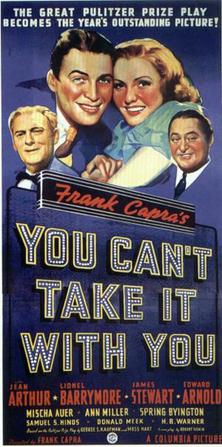
Lisa Reviews An Oscar Winner: You Can’t Take It With You (dir by Frank Capra)


(With the Oscars scheduled to be awarded on March 4th, I have decided to review at least one Oscar-nominated film a day.  These films could be nominees or they could be winners.  They could be from this year’s Oscars or they could be a previous year’s nominee!  We’ll see how things play out.  Today, I take a look at the 1938 best picture winner, You Can’t Take It With You!)

“You can’t take it with you.”

If there’s any one belief that defines the worldview of Martin Vanderhof (Lionel Barrymore), it’s this.  It doesn’t matter how much money you make in your life.  It doesn’t matter how successful you are at business or anything else.  The fact of the matter is that, when your time is up, you won’t be able to take any of that stuff with you.  Instead, Grandpa Vanderhof (as he’s called by his large family) believes that the most important thing to do during your lifetime is to make friends and pursue what you’re truly interested in.

Vanderhof has another belief, one that particularly appealed to be me.  He has never paid income tax.  He doesn’t see the point of giving money to the government when he doesn’t feel that they’ll make good use of it.  When an outraged IRS agent (Charles Lane) stops by Vanderhof’s sprawling house and demands that Vanderhof pay his taxes, Vanderhof refuses.  When the IRS man argues that the income tax is necessary to pay for the Presidency, the Congress, and the Supreme Court, Vanderhof offers to give him five dollars.  “Hell yeah!” I shouted at the TV.  With an attitude like that, Vanderhof should have moved down here to Texas.  We would have elected him governor.

Grandpa Vanderhof is the head of a large and cheerfully eccentric family, all of whom live together under the same roof.  Penny (Spring Byington) writes novels because, years ago, a typewriter was accidentally delivered to the house.  Her husband, Paul (Samuel S. Hinds), has a basement full of fireworks.  Essie (Ann Miller) loves to dance and spends almost the entire movie twirling from room to room.  Her husband, Ed (Dub Taylor), is a xylophone player.

Of course, it’s not just family living in the Vanderhof House.  There’s also Potap Kolenkhov (Mischa Auer), a Russian who is “teaching” Essie how to dance.  There’s Rheba the maid (Lillian Yarbo) and Donald (Eddie Anderson) the handyman.  Actually, the house appears to be open to just about anyone who wants to stay.

And then there’s Penny’s daughter, Alice (Jean Arthur).  Alice is the most “normal” member of the family.  She has just become engaged to Tony Kirby (James Stewart) and she is still trying to figure out how to introduce Tony’s stuffy parents (Edward Arnold and Mary Forbes) to her eccentric family.  What she and Tony don’t know is that Mr. Kirby is currently trying to buy up all the houses that are near a competitor’s factory.  Only one homeowner has refused to sell.  The name of that homeowner?  Martin “Grandpa” Vanderhof.

It all leads, of course, to one chaotic dinner party, one lively night in jail, and a huge fireworks display.  It also leads to true love, which is nice.  Jimmy Stewart and Jean Arthur are even more adorable here than they were in Mr. Smith Goes To Washington.

Based on a Pulitzer-winning play by George S. Kaufman, You Can’t Take It With You was the second comedy to win the Oscar for Best Picture.  The first comedy to win was 1934’s It Happened One Night.  It’s probably not coincidence that both of these films were directed by Frank Capra.

Seen today, You Can’t Take It With You seems a bit slight for an Oscar winner.  Grandpa Vanerhof is a lovable eccentric.  Tony’s father is a stuffy businessman.  Hmmm … I wonder whose philosophy is going to be victorious at the end of the movie?  Still, predictability aside, it’s a delightfully enjoyable film.  While it never quite escape its stage origins, it features wonderful performances from all the usual members of the Capra stock company.  James Stewart and Jean Arthur are a charming couple while Lionel Barrymore gives a performance that is so warmly likable that it’s hard to imagine that, just 9 years later, he would be so perfectly cast as the heartless Mr. Potter in It’s A Wonderful Life.  Of course, my favorite member of the member was Essie, mostly because I also like to dance from room to room.  While it’s hard to justify awarding it Best Picture over The Adventures of Robin Hood and Grand Illusion, You Can’t Take It With You is still a wonderfully fun movie.

It’ll make you smile and laugh.  Who can’t appreciate that?


New Orleans Film Review: Bad Lieutenant: Port Of Call New Orleans (dir by Werner Herzog)


“Do you think fish dream?”

— Terrence McDonagh (Nicolas Cage) in Bad Lieutenant: Port of Call New Orleans (2009)

Happy Mardi Gras!

Since today is not only Fat Tuesday but also rapidly coming to a close, I think it’s time for me to share one final New Orleans film review.  Admittedly, though this film takes place and was filmed in New Orleans, it doesn’t feature any Mardi Gras scenes.  However, it does feature a lead performance that is perhaps as bizarre as anything that you’re likely to see in the French Quarter tonight.  Of course, I’m talking about Werner Herzog’s 2009 film, Bad Lieutenant: Port Of Call New Orleans.

Whenever I mention this movie to anyone, it only takes a few minutes before they get around to saying, “What was the deal with the iguanas?”  Everyone remembers the two iguanas who would randomly show up throughout the movie.  At one point, they were sitting in a coffee table while Lt. Terrence McDonagh (Nicholas Cage) and Sgt. Stevie Pruit (Val Kilmer) were watching a house across the street.  When McDonagh demanded to know why the iguanas were on his coffee table, Pruit replied, “There ain’t no iguanas.”  McDonagh looked down at them and grinned.  This was followed by several hand-held close-ups of the iguanas, looking around inquisitively while McDonagh kept giving them the side eye.

The iguanas show up a second time, after McDonagh has tricked one gangster into killing another gangster.  “Shoot him again,” McDonagh demands, “his soul’s still dancing!”  Herzog pans over to show us that, indeed, the man’s soul is still dancing next to his corpse.  After the soul gets shot down, an iguana wanders across the floor.

What do the iguanas represent?  Some people think that they actually are meant to be hallucinations.  As the result of a back injury that he received saving a prisoner during Hurricane Katrina, McDonagh has permanent back problems and this has led to him getting hooked on drugs.  The perpetually high McDonagh sees and does a lot of bizarre things over the course of this movie.  Perhaps the iguanas are just a part of his addiction.

Myself, I think the iguanas represent the fact that, no matter what McDonagh and anyone else in New Orleans does over the course of the film, the randomness of nature is going win out in the end.  After all, Bad Lieutenant: Port of Call New Orleans opens with Katrina, which is perhaps the ultimate example of how helpless modern society is in the face of nature’s whims.  The film takes places in neighborhoods that have yet to recover from the flooding.  Every corner of the film is full of physical, emotional, and mental debris.  McDonagh pops pills and snorts cocaine in an attempt to maintain some semblance of control but ultimately, the iguanas are going to show up regardless of how much control he thinks he has.  Just as how Klaus Kinski, at the end of Aguirre, The Wrath Of God, couldn’t keep the monkeys off of his raft, Terrence McDonagh can’t keep the iguanas off of his coffee table.

Bad Lieutenant: Port of Call New Orleans apparently started life as a reboot of Abel Ferrara’s 1992 film, Bad Lieutenant.  The script (which was credited to William M. Finkelstein) is full of moments that mirror scenes from Ferrara’s film.  Once again, the protagonist is a corrupt police lieutenant who spends almost the entire film fucked up on drugs and whose only friend is a prostitute.  Again, there’s a disturbing scene in which the lieutenant harasses a young woman in a parking lot.  Again, the lieutenant has gambling debts and again, the lieutenant has to solve a horrifying crime.

While promoting his film, Herzog always said that 1) he had never seen Bad Lieutenant and 2) he didn’t even know who Abel Ferrara was.  Judging from the way Herzog directs the film, which is the complete opposite of the approach that Ferrara took to similar material, I’m inclined to believe Herzog.  Whereas Ferrara’s film was a grim and humorless plunge into the depths of Hell, Herzog takes an almost satirical approach to the story.  The running joke throughout Herzog’s film is that the bad lieutenant gets results precisely because he is so thoroughly messed up and incompetent.  The final part of Herzog’s film features so many sudden twists and turns that it’s hard not to conclude that Herzog is poking fun at how American crime films always have to wrap everything up within the final fifteen minutes, regardless of how messy or convoluted their plots may be.  Whereas Ferrara’s film featured Harvey Keitel naked and bellowing in soul-searing pain, Herzog gives us Nicolas Cage grinning, laughing, and apparently having a ball.

This has got to be one of Nicolas Cage’s wildest performances.  He yells.  He bulges his eyes.  He grins maniacally at the strangest moments.  He interrogates a suspect while taking hits off a joint.  Because his character has a bad back, Cage moves stiffly, carrying himself almost as if he were a living Golem.  McDonagh may have his demons but, at the same time, he also seems to be having a blast every time we see him.  Wisely, Herzog also allows the character some quieter moments.  When the lieutenant talks about how he used to imagine there was pirate treasure buried in his back yard or when he and an ex-con sit in front of a gigantic fish tank, Cage gets a chance to show that there actually is something going on underneath all of McDonagh’s bluster.  This not only one of Cage’s most over the top performances but also one of his best.

Herzog not only gets the best out of Cage but also the best out of New Orleans.  He may not make New Orleans look beautiful but he still captures the atmosphere that has made New Orleans one of the most legendary cities in the world.  Cage, Herzog, and New Orleans make for a great combination.

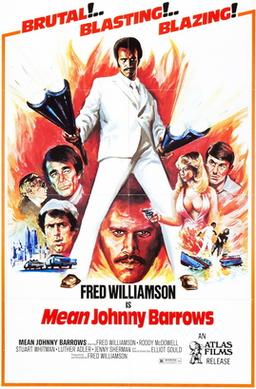
Film Review: Mean Johnny Barrows (dir by Fred Williamson)


“Dedicated to the veteran who traded his place on the front line for a place on the unemployment line. Peace is Hell.”

— the end credits of Mean Johnny Barrows (1976)

“He’s not that mean.”

— Me, while watch Mean Johnny Barrows

Who is Johnny Barrows?  As played by blaxploitation star Fred Williamson, Johnny Barrows is a former football great who later served in Vietnam and won several silver stars.  As a soldier, he killed an untold number of people but he is always quick to explain that he wouldn’t do the same thing as a civilian.  Even after the war ended, Johnny remained in the army, teaching new recruits.  He was good at his job but, one day, a racist officer decided to play a stupid trick on Johnny.  During a training exercise, that officer put a live landmine out on the training grounds.  After defusing the mine, Johnny promptly punched the officer.  The result?  A dishonorable discharge and the lesson that peace is Hell.

Johnny returns to Los Angeles and discovers that the country he fought for isn’t willing to fight for him.  Because of his dishonorable discharge, Johnny can’t find a good job.  Because he can’t find a job, he can’t afford a place to live.  Johnny stays on the streets.  His only friend is a self-described philosophy professor (Elliott Gould, in an amusing cameo) who teaches Johnny all about soup kitchens.

When Johnny steps into an Italian restaurant and asks for food, he is shocked to discover that the owner, Mario Racconi (Stuart Whitman), knows who he is.  Mario says that he played against Johnny in a high school football game.  (Perhaps Johnny’s shock is due to the fact that Mario appears to be at least ten years older than him.)  Mario gives Johnny something to eat and even offers him a job.  Realizing that the work is mob-related, Johnny says that he’s not interested.  He’s not going to break the law…

And here’s where we run into a problem with the film’s title.  The film is entitled Mean Johnny Barrows but, so far, he’s been almost painfully nice.  Then again, Mild Johnny Barrows doesn’t have much of a ring to it.

Anyway, Johnny does try to stay out of trouble.  He even manages to land a demeaning job cleaning the toilets at a gas station.  But his boss (R.G. Armstrong) is a real jerk and Johnny has his dignity, no matter how much the world wants to take it away from him.  Finally, Johnny agrees to work with the Racconi Family.  Not only does he become friends with Mario but he also falls for Mario’s girlfriend, Nancy (Jenny Sherman).

Unfortunately, not all Mafia families are as kind-hearted and generous as the Racconi Family.  The Da Vinci family wants to flood Los Angles with drugs.  It’s all the master plan of Tony Da Vinci (Roddy McDowall).  Tony is eager to prove himself to his father and what better way to do that than to smuggle heroin?  Tony also loves flowers because … well, why not?  Anyway, when the Racconis object to Tony’s scheme, a mob war erupts.  Nearly all of the Racconis are killed.  It looks like it’s time for Johnny Barrows to put on his white suit, pick up a gun, and get vengeance for his surrogate family.

There are some pretty obvious problems with Mean Johnny Barrows, not the least of which is the casting of Roddy McDowall — perhaps the least Italian actor in the history of cinema — as a ruthless mafioso.  After having starred in several successful blaxploitation films, Fred Williamson made his directorial debut with Mean Johnny Barrows.  Williamson’s inexperience as director shines through almost every minute of Mean Johnny Barrows.  Though he does well with the action scenes, there are other parts of the film where Williamson doesn’t even seem to be sure where he should point the camera.  With almost every role miscast, the performances are pretty inconsistent but Williamson gives a good performance (it’s obvious that he understood his strengths and weaknesses as an actor) and Elliott Gould is an entertaining oddity as the Professor.

If anything saves the film, it’s that Williamson’s anger at the way America treats its veterans feels sincere.  The heart of the film is in the first half, which details Johnny’s struggle to simply survive from one day to the next.  Even if Williamson’s direction is often shaky, the film’s rage is so authentic that you do get caught up in Johnny’s story.  The film ends on a properly down note, suggesting that, for men like Johnny Barrows, there is no hope to be found in America.

To quote the film’s theme song: Peace is Hell.

An Olympic Film Review: Downhill Racer (dir by Michael Ritchie)


For the past few days, like all good people, I have been totally obsessed with the Winter Olympics!  Last week, I asked my friends to suggest some Winter Olympic-themed movies that I could watch and review.  More than a few of them immediately recommended that I check out a film called Downhill Racer.

First released in 1969, Downhill Racer tells the story of David Chappellet (a very young and very handsome Robert Redford).  When we first meet David, he’s just arrived in Switzerland.  An alternate to the U.S. ski team, David has been summoned by Coach Eugene Claire (Gene Hackman) to replace an injured skier.  From the minute that David arrives, it’s obvious that he’s not interested in being anyone’s friend.  He’s upset that he was an alternate.  He’s upset that he’s going to be skiing so late in the competition.  He’s upset about … well, almost everything.  Unlike the rest of his teammates, he’s a loner and he rarely has much to say.  He cares about one thing: winning championships and being recognized as the best.  David is not a particularly likable character.  However, the fact that he doesn’t seem to care what anyone thinks about him is one of the things that makes him compelling.  Add to that, David quickly proves himself to be one of the best.  He may be arrogant but, more often than not, he can back up his pride.

Why is David so driven?  We get some clues when David returns to his hometown in Idaho.  Even though everyone in the town knows him and he doesn’t have any trouble convincing a former girlfriend to go off with him, David still seems out-of-place.  When he visits his father, the taciturn man is not impressed by David’s success.  As his father puts it, the world is full of champions.  Why should David deserve any more praise than anyone else?

Standing in contrast to the reservered David is Coach Claire.  Whereas David is reserved, Claire is passionate.  Whereas David is an unapologetic loner, Claire is willing to fight for every member of his team.  Whereas David reacts to a crash by refusing to accept that he made a mistake, Coach Claire is always brutally honest.  David couldn’t be a champion without Claire’s help but, in the end, the Coach is destined to remain in the background while David signs lucrative sponsorship deals and becomes a hero to television viewers everywhere.

It’s a familiar story, though perhaps it wasn’t as familiar in 1969 as it is today.  Today, we’ve grown accustomed to the idea that celebrities can be jerks and that “heroes” are often just manufactured idols.  (Downhill Racer has a good deal of fun with the shallowness of the media’s coverage of David Chappellett’s career.)  That said, familiar or not, there’s a good deal of authenticity to be found in the performances of both Redford and Hackman.  It takes a bit of courage to play a character who is as narcissistic and arrogant as David Chappellett but, even more so, it takes talent to make that character compelling.  As for Hackman, he’s the ideal coach.  He knows both how to get the best out of Chappellett but also when to call him out on his crap.  From the minute we meet the Coach, we knows that he cares but we also know that he’s seen a lot of David Chappelletts come and go over the years.

Of course, the main reason to watch Downhill Racer is because of the racing scenes, many of which were filmed as a point-of-view shot, putting you in the skis as the frozen landscape flies past you.  They are amazing to watch.  I’ve never been skiing, which is probably a good thing when you consider that I’m a bit accident-prone.  But the skiing sequences in Downhill Racer left me breathless, shaken, and exhilarated.

Downhill Racer is definitely one to watch, during the Olympics or any other time.

Lisa Reviews An Oscar Nominee: Dodsworth (dir by William Wyler)


(With the Oscars scheduled to be awarded on March 4th, I have decided to review at least one Oscar-nominated film a day.  These films could be nominees or they could be winners.  They could be from this year’s Oscars or they could be a previous year’s nominee!  We’ll see how things play out.  Today, I take a look at the 1936 best picture nominee, Dodsworth!)

Dodsworth is the type of film that makes me thankful for both TCM and my own obsession with Oscar history.

Based on a Sidney Howard-penned stage adaptation of a Sinclair Lewis novel, Dodsworth tells the story of an American couple abroad and how their travels change them as both individuals and as a couple.  Sam Dodsworth (Walter Huston) is a wealthy man living in the middle of the United States.  20 years ago, he founded Dodsworth Motors and now, he’s finally reached the point where he can sell his company and retire.  Sam doesn’t have any big plans, not yet anyway.  Mostly, he just wants to visit Europe with his wife, Fran (Ruth Chatterton).  They’ve never been.

Walter Huston is perfectly cast as Sam Dodsworth.  When we first meet Sam, we’re not really sure whether we’re going to like him or not.  He seems to be a decent human being but he also seems to be rather resistant to change.  He’s a self-made man.  He’s smart but he’s not well-educated.  He’s honest but he’s stubborn.  He’s rich but he’s hardly sophisticated.  He says that he wants to experience new things but we can’t help but wonder how he’s going to react when he actually has the opportunity.

The cracks in Sam and Fran’s marriage become obvious as soon as they board a luxury liner heading for England.  Sam meets another traveler, Edith (Mary Astor).  Edith is divorced and lives in Italy, two things that make her very exotic to a proud product of middle America like Sam Dodsworth.  Edith and Sam immediately hit it off but there’s no way that Sam would ever consider having an affair.  Meanwhile, Fran finds herself attracted to a series of different Europeans, played by David Niven, Paul Lukas, and Gregory Gaye.  While Fran loves Europe, Sam finds himself yearning to return to the small town world that he knows best.

For a film that was released 82 years ago, Dodsworth remains a remarkably watchable and involving film.  Along with featuring brilliant lead performances from Walter Huston, Ruth Chatterton, and Mary Astor, Dodsworth touches on universal themes that remains as relevant as today as when the film was first released.  Though neither Sam nor Fran would probably recognize the term, their trip to Europe leads to an existential crisis that will be familiar to anyone who has ever looked at their life and wondered, “Is this all there is?”  At the start of the film, both characters believe that they’ve found perfection in their marriage, their family, and their money.  By the end of the movie, both of them realize just how wrong they were.

If not for my love of Oscar history, I never would have seen Dodsworth listed among the films nominated for best picture of 1936.  And, if not for TCM, I wouldn’t have had the opportunity to DVR Dodsworth this morning and then watch it earlier tonight.  That’s why it pays to know your history and to take chances on films of which you previously may not have heard.

Dodsworth was nominated for 7 Academy Awards but it only won the Oscar for Best Art Direction.  It lost Best Picture to a far less memorable film, The Great Ziegfield.

A New Orleans Film Review: J.D.’s Revenge (dir by Arthur Marks)


Ike (Glynn Turman) is a nice guy.  He’s a law student living in New Orleans.  When not studying, he makes money driving a taxi cab.  He has a beautiful and loving wife named Christella (Joan Pringle).  He has a nice but modest apartment.  When we first see Ike, he is calmly and rationally breaking up a fight.  Perhaps the only real complain that can be made about Ike is that he’s actually too nice.  There’s nothing dangerous about Ike.  He works hard.  He studies.  That’s about it.

When Christella and their friends tell him that he needs to take a night off from studying, Ike is reluctant.  However, he finally agrees to go out with them.  They start out at a strip club in the French Quarter and eventually, they end up watching a hypnotist.  Ike is one of the men randomly selected to go up on stage.  Amazingly, rational and mild Ike is easily hypnotized.  The audience loves watching as Ike and the other men all reacts to hypnotic suggestion.  What they don’t know is that, while in his trance, Ike has been … possessed!

That’s right!  The ghost of J.D. Walker has entered Ike.  Who is J.D. Walker?  As we learn from a series of gauzy flashbacks, J.D. Walker was a gangster in the 1940s.  He wore a fedora.  He wore nice suits.  He was every bit as flamboyant as Ike is mild.  But then, one day, J.D. was killed, gunned down by his former business partner, Theotis Bliss (Fred Pinkard).

Soon, Ike starts to act … well, not like himself.  Suddenly, Ike is using 1940s slang.  He’s wearing 1940s clothes.  He’s gambling.  He mugs an old lady who gets in his cab and then abandons her on the wharf.  When his wife asks him why he’s acting like a 1940s gangster, he gets violent.  Soon, Ike is speaking in a different voice and dancing.

What does J.D. want?  He wants revenge against not only the man who shot him but also Theotis’s younger brother, a popular preacher named Elijah (Lou Gossett, Jr.).  As wild as the possessed Ike may be, he’s got nothing on Elijah.  Elijah was a boxer before he became a man of God and he’s still liable to throw a punch or two during his sermons.  Elijah, however, is also rather naive and has no hesitation about inviting J.D. to become a member of his congregation.  Theotis, who is now Elijah’s manager, is a bit more suspicious…

An oddly paced film that never quite escapes the lengthy shadows of all of the horror films that inspired it, J.D.’s Revenge is worth seeing for the performances Glynn Thurman and Lou Gossett, Jr.  Gossett is all energetic charisma in the role of the reverend, giving a performance that features just enough ambiguity that you’re never sure whether you should trust Elijah or not.  Meanwhile, Thurman is very good as the mild-mannered Ike but he seems to be having an absolute blast whenever he gets to play the psychotic J.D.  During the final confrontation between Ike/J.D. and the Bliss Brothers, Thurman’s performance is so bizarre and over the top that you simply cannot stop watching him.

J.D.’s Revenge was filmed in New Orleans, which add a little bit of gothic atmosphere to the film.  As I write this, a lot of our readers may currently be in New Orleans for Mardi Gras.  I wish them all well but I hope they’ll remember the lesson of J.D.’s Revenge.  Just say no to hypnosis!

Lisa Reviews An Oscar Nominee: Shanghai Express (dir by Josef von Sternberg)


(With the Oscars scheduled to be awarded on March 4th, I have decided to review at least one Oscar-nominated film a day.  These films could be nominees or they could be winners.  They could be from this year’s Oscars or they could be a previous year’s nominee!  We’ll see how things play out.  Today, I take a look at the 1932 best picture nominee, Shanghai Express!)

Welcome to China, circa 1931.  The country is beautiful, mysterious, and dangerous.  Civil War has broken out and living in China means being caught between two equally brutal forces, the government and the Communists.  Captain Doc Harvey (Clive Brook) is scheduled to ride the so-called Shangai Express, the train that will take him from Beiping to Shanghai.  The Governor-General is ill and Doc Harvey is the only man in China who operate on him.

For Doc, it’s a matter of duty.  However, soon after boarding, he discovers that he is traveling with the infamous Shanghai Lily (Marlene Dietrich).  Though Doc has never heard of her, everyone assures him that Shanghai Lily is one of the greatest courtesans in China.   When Doc does finally meet her, he’s shocked to discover that Shanghai Lily is his former lover, Magdalen.  Did his decision to break up with her lead to Magdalen becoming a courtesan?

“It took more than one man to change my name to Shanghai Lily,” she replies.

However, Doc and Lily aren’t the only two people with their own personal drama taking place on the train.  The train is full of passengers, all of whom have their secrets.  Some of the secrets are minor.  One woman spends most of the trip trying to keep anyone from discovering that she’s smuggled her dog onto the train.  Other secrets are major.  It is suspected that one of the passengers might be working for the rebels.  And then there’s people like Sam Salt (Eugene Pallette), who is addicted to gambling and Eric (Gustav von Syffertitz), the opium dealer.  Looking over it all is a Christian missionary (Lawrence Grant) who considers both Lily and her companion, Hui Fey (Anna May Wong), to be fallen women.

It’s not an easy journey, no matter how nice and romantic the train may be.  If the express isn’t being stopped by government soldiers, it’s being hijacked by a warlord who not only wants to stop Doc from performing the operation but who also wants to take Lily back to his palace…

Shanghai Express is pre-code drama at its best.  Director Josef von Sternberg delivers an ornate mix of opulence and melodrama, never shying away from the story’s more flamboyant possibilities.  Marlene Dietrich, appearing in her fourth film for von Sternberg, gives a strong and unapologetic performance as Shanghai Lily.  Just as Lily never apologizes for who she is, the film both refuses to judge her and condemns anyone who would try.  The film’s sympathy is purely with Dietrich and Wong as they do what they must to survive in a world dominated by men who are either judgmental, brutish, or weak.  (Within just a few years, the Hays Code would make it impossible for a film like Shanghai Express to be made by an American studio.)  With one very important exception, the entire cast is strong, with Warner Oland and Eugene Pallette especially turning in strong support.  The only exception is Clive Brook, who comes across as being a bit too dull to have ever won the the heart of Shanghai Lily.

Shanghai Express is not the best von Sternberg/Dietrich collaboration.  That would be the brilliantly insane Scarlet Empress.  However, it’s still a wonderfully entertaining melodrama.  It was nominated for best picture but lost to another entertaining melodrama, Grand Hotel.

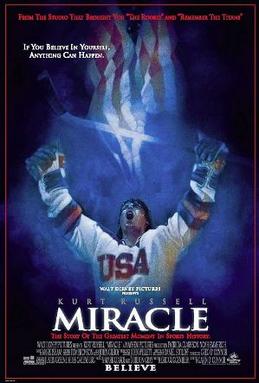
An Olympic Film Review: Miracle (dir by Gavin O’Connor)


(Back in 2011, Chris Mead — who wrote under the name Semtex Skittle — reviewed Miracle for this site.  At the that time, I had not seen the film.  Below are my thoughts but please, also be sure to read Chris’s review as well.)


Like all good people, I’m currently obsessed with the Winter Olympics.  Earlier this week I asked a couple of friends if they could recommend some good Winter Olympics movies.  A lot of movies were suggested but, without fail, everyone thought I should see Miracle.  (A lot of people also suggested Cool Runnings, which I’ll be watching next week.)  Having watched Miracle earlier today, I can see why everyone recommended it.

The year is 1980 and two hockey teams are about to face off at the Winter Olympics in upstate New York.  (The location, to be exact, is Lake Placid.  Fortunately, the giant alligators are nowhere to be seen.)

On one side you have the Russian team (or the Soviets as they were known back then).  They are widely considered to be one of the greatest hockey teams in history.  They are big, fierce, and determined.  Coming from a system that has declared individuality to be a crime against the state, the Soviet team plays like a machine.  The Soviets have won the gold in the last four Olympics.  As one American coach puts it, their greatest strength is that every other hockey team in the world is terrified of them.

On the other side, you have the American team.  However, this isn’t the type of American dream team that one would expect to see today.  In 1980, professional athletes were not allowed to compete on the U.S. Olympic team.  Instead, the 1980 hockey team is made up of amateurs and college players.  Unlike the Soviet teams, the American don’t have a government that grooms and supports them.  Instead, win or lose, they have to do it on their own.

Of course, it’s not just two hockey teams that are about to face off.  It’s also two super powers and two very different ways of life.  In 1980, the U.S. and the Soviet Union were the two most powerful rivals in the world.  The Soviets were trapped in an endless and unpopular war in Afghanistan.  Meanwhile, in the U.S., the economy was shaky, American citizens were being held hostage in Iran, and an ineffective President gave long-winded speeches about how unhappy everyone in the country appeared to be.  Both countries needed a victory but only one could win.

And it would take a miracle for that winning team to be American…

I don’t think it requires a spoiler alert to tell you that’s exactly what happens.  I mean, after all, I’m reviewing a film  called Miracle!  On top of that, it’s based on true events.  The U.S. hockey team — made up of college students and led by Coach Herb Brooks (played, in one of his best performance, by Kurt Russell) — not only managed to defeat the highly favored Soviet team but they went on to win the gold medal.

Even if you didn’t know that the Americans beat the Russians, you would never have any doubt about how Miracle is going to end.  Miracle is a film that utilizes almost every sports film cliché but it manages to do so with such sincerity and such style that you don’t mind the fact that the movie doesn’t exactly take you by surprise.  Is there any actor who is as good at project sincerity and human decency as Kurt Russell?  Whenever he says that he’s going to make his team into champions, you believe him.  When he says that he’s being hard on them because he wants them to be the best, you never doubt him or his techniques.  When he says that he’s proud of his team and his country, it brings tears to your eyes.  If there’s ever a movie that deserves a chant of “USA!  USA!  USA!,” it’s Miracle.