Film Review: Barabbas (dir by Richard Fleischer)


Who was Barabbas?

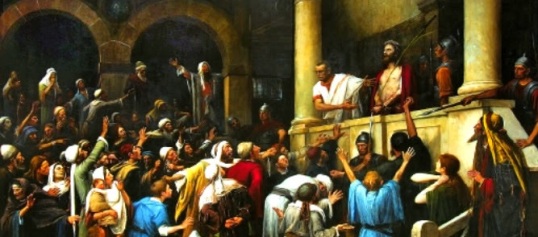
The simple answer to that is that Barabbas was the prisoner who, according to the Gospels, Pontius Pilate released during Passover.  As the story goes, Pilate gave the people the choice.  He could either release Barabbas or Jesus.  For what crime was Barabbas being held?  The Gospel of Matthew merely says that Barabbas was a “notorious prisoner.”  Mark and Luke both write that he was involved in a recent riot and that he was a murderer.  The Gospel of John refers to him as being a bandit, which may have been another term for revolutionary.  Regardless of what crime he had committed, the people overwhelmingly called for Barabbas to be released and for Jesus to be crucified.  What happened to Barabbas after he was set free is not recorded but has been the subject of a good deal of speculation over the centuries.

(Of course, there are some scholars who believe that the Barabbas story was simply an invention of later writers, designed to shift the responsibility for the crucifixion away from the Romans.  There’s also some who say that Jesus and Barabbas were actually the same person and that the inclusion of the Barabbas story was meant to indicate that Jesus was actually a revolutionary who was working to free Judea from Roman role.  I imagine Dan Brown will eventually base a novel on this theory, so look forward to hearing your grandma debating the historicity of Barabbas at some point in the future.)

Back to the original question, who was Barabbas?

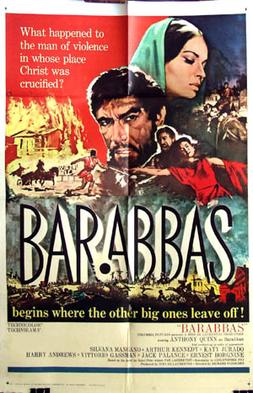
According to the 1961 film of the same name, Barabbas was Anthony Quinn.

Based on a novel by the Nobel Prize-winning Swedish author, Pär Lagerkvist, Barabbas opens with Pilate (Anthony Kennedy) making his infamous offer.  Barabbas or Jesus?  Perhaps the only person more shocked than Pilate by the people’s decision is Barabbas himself.  A brutish and violent man, Barabbas is looking forward to returning to his old life but, as he leaves the prison, he finds himself fascinated by the sight of Jesus stoically carrying the cross, heading to the fate that Barabbas was spared.  Later, Barabbas witnesses the Crucifixion and is shaken when, upon Jesus’s death, the sky turns black.

(Director Richard Fleischer shot the Crucifixion during an actual solar eclipse, so that the sky actually did turn black during filming.  It’s a stunning scene.)

For the rest of his life, Barabbas is haunted by both his narrow escape from death and his subsequent notoriety.  When Barabbas tries to reunite with his former lover, Rachel (Silvana Mangano), he discovers that not only does she now want nothing to do with him but that she has also become a follower of Jesus.  (Later, in a surprisingly graphic scene, Rachel is stoned to death.)  Barabbas becomes convinced that he cannot die and he becomes increasingly reckless in his behavior.  Over the next few decades, he finds himself sold into slavery and forced to spend 20 years working in the harsh sulfur mines of Sicily.  He befriends a Christian named Sahak (Vittorio Gassman) and, with him, is trained to be a gladiator by the sadistic Torvald (Jack Palance).  Eventually, Barabbas finds himself rejected by both the Romans and the Christians while Rome burns all around him.

Barabbas is a film that really took me by surprise.  I’ve seen a lot of Biblical and Roman films from the 50s and 60s and I was expecting that Barabbas would be another sumptuously produced but slow-paced epic, one that would inevitably feature stiff dialogue and overly reverential performances.  I mean, don’t me wrong.  I happen to love spectacle and therefore, I enjoy watching most of those old historical and religious epics.  But still, for modern audiences, these films can often seem rather … well, hokey.

But Barabbas was totally different from what I was expecting.  As wonderfully played by Anthony Quinn, Barabbas wanders through most of the film in a state of haunted confusion.  Even at the end of the film, after he’s met St. Peter (Harry Andrews), Barabbas doesn’t seem to fully understand what he believes or how he’s become one of the most notorious men in Rome.  Quinn plays Barabbas almost like a wild animal, one that has been cornered and trapped by his own infamy.  The more Barabbas struggles against his fate, the more trapped he becomes.  Barabbas may be a brute but, the film suggests, even a brute can find some sort of redemption.  Quinn gets good support from the entire supporting cast.  Jack Palance is perfectly evil as Torvald while Vittorio Gassman, Silvana Mangano, and Ernest Borgnine bring some needed nuance to characters who, in lesser hands, could have just been cardboard believers.

Barabbas is a surprisingly dark film.  When Rachel is stoned, the camera doesn’t flinch from showing just how cruel an execution that was.  Nor does the camera flinch from the violent brutality of the gladiatorial games.  When Barabbas is sold into slavery, the sulfur mines of Sicily are depicted in Hellish detail and practically the only thing that saves Barabbas from spending the rest of his life being smothered under a cloud of sulfur is a giggly Roman woman who decides to buy Barabbas so that he can serve as a good luck charm.  The scenes of Barabbas’s skill of a gladiator are contrasted with the bloodthirsty crowd demanding and cheering death.  Even when Barabbas joins the Christians in the Roman catacombs, he discovers that they want nothing to do with him, suggesting that they believe in forgiveness for everyone but him.  The spectacle of Rome is displayed but so is the terror of what lies underneath the city’s ornate surface.  If Barabbas is occasionally a ruthless or unsentimental character, one need only look at the world he lives in to understand why.

With the exception of a few slow scenes at the start of the film, director Richard Fleischer does a good job of keeping the action moving.  It’s a long film but it never becomes a boring one.  In the end, thanks to Quinn’s performance and the film’s unflinching portrayal of life in ancient Rome, Barabbas is a biblical epic for people who usually don’t like biblical epics.
 

Jaws Meets Mad Max: Razorback (1984, directed by Russell Mulcahy)


Deep in the Australian outback, a young child named Scotty goes missing.  His grandfather, Jake (Bill Kerr), swears that a giant boar (“a razorback”) broke into his house and ran off with his grandson.  The locals don’t think it was a boar.  They don’t even think it was a dingo.  Instead, they charge Jake with killing his grandson but, because there’s not evidence to convict him, Jake goes free.

Two years later, a nosy American reporter named Beth Winters (Judy Morris) mysteriously vanishes shortly after arriving in the Outback to do a story on how kangaroos are being hunted to the point of extinction.  Women and children are vanishing in the Outback?  This sounds like a job for Lee Majors but the best this movie can do is Gregory Harrison.  Harrison plays Beth’s husband, Carl, who comes to Australia to search for her.  At first, he thinks that she may have been kidnapped by the moronic Baker brothers (Chris Haywood and David Argue) but then he meets Jake and a comely pig expert named Sarah (Arkie Whiteley).  Jake tells Carl about the razorback and later comes across Beth’s wedding ring in a pile of boar shit.

Razorback was probably pitched as being “Jaws meets Mad Max.”  Just as in Jaws, the authorities refuse to accept that people are being eaten by a giant boar and it is up to an inexperienced American, an old timer, and a scientist to try to stop it.  Also, like in Jaws, the boar is that star of the show even though it does not get much screen time.  When the boar does appear, it bears a distinct resemblance to Motorhead’s War-Pig.  Just as in Mad Max, every Australian in Razorback drives like a maniac.  Whenever the Baker brothers tear across the screen in their truck, it’s easy to imagine Max Rockatansky and Goose in hot pursuit.

Along with the boar, the other star of the film is the Australian outback itself, which the film treats as almost being an alien landscape:

If Razorback makes the Australian outback look like an 80s new wave music video, that might be because it was directed by Russell Mulcahy, who started his career directing videos for Duran Duran.  Before one boar attack, Duran Duran’s New Moon On Monday is even heard playing on a radio.  (Ironically, New Moon On Monday was one of the few early Duran Duran videos that Mulcahy did not direct.)  Both the boar and the film look great but all of the humans get overshadowed by the visuals.   Not that it matters, since they’re only there to serve as razorback food.

Despite the strong visuals and the amazingly cool monster, Razorback got only lukewarm reviews when it was first released.  Critics aside, it was a hit in Australia, where it won Australian Film awards for both editing and cinematography.  (Cinematographer Dean Semler later won an Oscar for his work on Dances with Wolves.)  It only found cult success in the United States.  One admirer was Steven Spielberg, who reportedly called Mulcahy to ask how he achieved some the film’s visual effects.  Two years after the release of Razorback, Mulcahy directed his best-known film, Highlander.

Flaws and all, Razorback is the best movie ever made about a wild boar eating people in Australia.


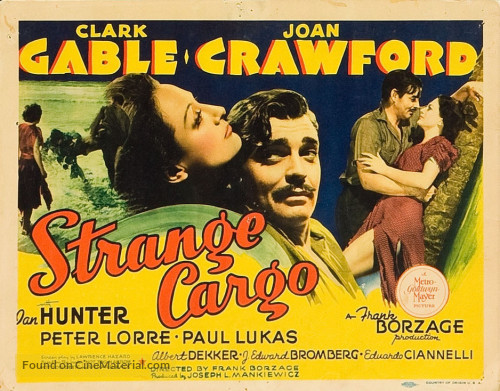
Repent, Ye Sinners!: STRANGE CARGO (MGM 1940)


gary loggins's avatarcracked rear viewer

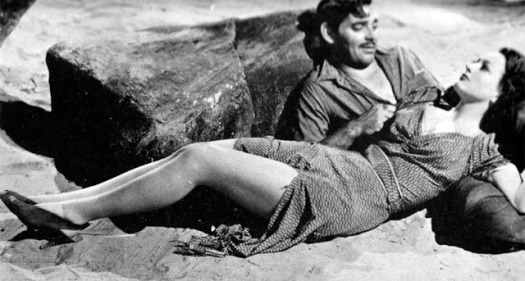
Any film condemned by the Catholic Legion of Decency can’t be all bad!  STRANGE CARGO depicts a bunch of hardened, unrepentant criminals escaping a brutal French Guiana prison, with a prostitute in tow to boot, and is laced with plenty of lascivious sex and brutal violence. But that wasn’t all the self-appointed guardians of morality objected to… there was the character of Cambreau who, though the film doesn’t come right out and say it, supposedly represents none other than Jesus Christ himself!

One more time: Clark & Joan

Clark Gable and Joan Crawford , in their eighth and final film together, lead this pack of sinners through a sweltering jungle of lust, murder, and ultimately redemption. He’s a con named Verne, “a thief by profession”, whose several attempts at escape have proved unsuccessful. She’s Julie, a two-bit hooker plying her trade on the island. The pair, as always, crackle like…

View original post 693 more words

Scenes That I Love: Peter Stegman Plays The Piano in Class of 1984


“I am the future!” Peter Stegman (Timothy Van Patten) announced in the 1982 film, Class of 1984, and, in many ways, he was correct.  Though it’s easy to be snarky about the fashion choices made by Stegman’s gang, Class of 1984‘s portrait of a school where teachers have taken to carrying guns to protect themselves is still relevant today.

One thing that set Class of 1984 apart from other exploitation films was that it acknowledged something that most people aren’t willing to admit.  Sometimes, the worst people can create the most beautiful music.  This is a point that was made quite literally in the scene below.

As the scene begins, the new music teacher — Andy Norman (Perry King) — is just trying to start his class when suddenly Stegman and his gang decide to drop in.  At first, Andy tells them to go away but then, suddenly, Stegman sits down at a piano and starts to play.

Timothy Van Patten, who would later go on to become an award-winning television director, reportedly actually played every note heard in this scene.  For a few brief seconds, Peter Stegman is revealed to be something more than just another high school psycho.  When Stegman sits in front of that piano, he becomes an artist and, throughout the film, both Andy Norman and the audience occasionally wonder who Peter Stegman could have been under different circumstances.

Of course, ultimately, it doesn’t matter.  Peter Stegman could have been a concert pianist but instead, he went down a different path.  Over the course of the film, Stegman is responsible for not only Michael J. Fox getting stabbed but Roddy McDowall getting blown up.  When Andy makes one final attempt to reach out to him, Stegman tries to cut his hand off.   Now wonder Andy eventually allowed Stegman to plunge through that skylight.

But even as Stegman falls to his death and discovers that he’s not the future, it’s hard not to think about that beautiful piece of music that he played just a few days earlier and wonder about what could have been.

Peter Stegman.  R.I.P.

Base-Brawl: William Bendix in KILL THE UMPIRE (Columbia 1950)


gary loggins's avatarcracked rear viewer

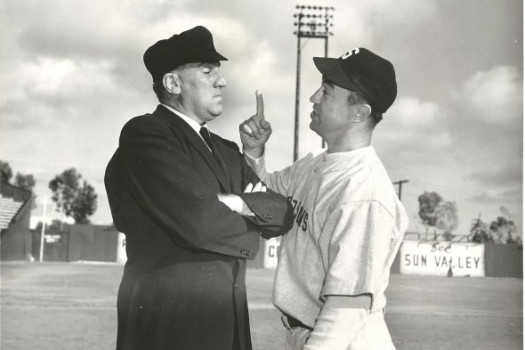
Ahh, spring is in the air, that magical time of year, when a young man’s fancy turns to thoughts of… baseball!! That’s right, Dear Readers, Opening Day is upon us once again, and what better way to celebrate the return of America’s National Pastime than taking a look back at KILL THE UMPIRE, a 1950 comedy conceived in the warped mind of former animator Frank Tashlin and directed by ex-Warners vet Lloyd Bacon.

Big lug William Bendix stars as Bill Johnson, an ex-major leaguer whose passion for the game keeps him from holding a regular job because he keeps playing hooky to go to the ballpark. Bill hates only one thing more than missing a game – umpires! But when his exasperated wife threatens to leave him, his ex-ump father-in-law suggests he go to umpire school to save his marriage. Bill balks at first, but then reluctantly agrees, not wishing…

View original post 451 more words

The TSL’s Grindhouse: Gor (dir by Fritz Kiersch)


The 1987 film Gor opens with a nerdy college professor (played by Urbano Barberini, of Demons and Opera fame) giving perhaps the worst lecture in the history of underwhelming lectures.  The professor explains that there is a counter-earth, a place that he claims is known as Gor.  Gor shares the same orbit as Earth but it’s linearly opposed to Earth, which apparently makes it impossible to see.  However, the professor says that his father gave him a ring which can transport the user to Gor.  The only problem is that the professor has not figured out how to use the ring.

The students all look incredibly bored with the lecture and I don’t blame them.  Not only does the professor seem to be rambling but he doesn’t even offer up any visual aides.  He could have at least utilized a powerpoint presentation or something.  Instead, his only teaching aide is a whiteboard on which he’s written “counter-earth.”  I have to wonder what their final exam is going to look like.  “True or false.  Your professor is a freaking loon.”

(I found myself wondering what university would possibly grant tenure to some guy who thinks he owns a magic ring but then I remembered Evergreen College.)

The professor’s name is Tarl Cabot and I think that’s a good deal of his problem right there.  When you give a child a name like Tarl Cabot, you’re pretty much guaranteeing that he’s going to grow up believing that he has a magic ring that’ll transport him to another planet.

Of course, in Tarl’s case, it turns out that the ring does just that.  After his teaching assistant dumps him so that she can go on a date with another professor, Tarl crashes his car and when he wakes up, he finds himself on Gor.  Apparently, the ring only works if you crash your car or something.

As for Gor itself, it turns out to be kind of a dump.  It’s a huge desert.  Seriously, check out this counter-earth:

If Tarl wanted to see a desert, he could have just driven around Southern California and saved himself a lot of trouble.

Yes, there is trouble in Gor.  No sooner has Tarl arrived then he’s being attacked by a bunch of barbarians on horseback.  The barbarians are led by the evil Sarm (played by Oliver Reed).  Much as with the case of Tarl Cabot, I think that once you name a child Sarm, you’ve pretty much guaranteed the way that his life is going to turn out.  Anyway, Tarl somehow survives being attacked by the barbarians.  He even manages to kill Sarm’s son, which leads to Sarm declaring that he wants Tarl dead.

Fortunately, Tarl is eventually rescued by another group of barbarians.  This group is led by Talena (Rebecca Ferratti) and she wants Tarl to help her rescue her father from Sarm’s fortress.  But how can Tarl help when he’s literally useless?  Don’t worry!  The good barbarians are willing to train Tarl.  One montage later, Tarl is now a master swordsman.  Now, all Tarl has to do is dress like a barbarian and then track down a little person who can serve as a guide to Sarm’s fortress!

And what a fortress it is!  Sarm may be evil but he likes to make sure that both his guests and his slaves have a good time.  Sarm welcomes Tarl to the fortress and even tries to recruit him over to his side.  (So apparently, Sarm’s over that whole “you killed my son” thing.)  Sarm understands that the best way to recruit Tarl is with a dance number!  As Sarm laughs lustfully, the slaves put on a show.  It’s somewhat out-of-place but at least it distracts from the rest of the film.

Anyway, there’s a lot of problems with Gor but the main one is that the place itself just doesn’t seem like it’s worth all the trouble.  After spending years trying to figure out how to get to the planet, Tarl arrives and discovers that it’s basically the same desert that was used in almost every post-apocalyptic film made in the 80s and 90s.  (In fact, judging from John Carter, it’s still being used today.)  What I always wonder about this type of movie is 1) why is the other planet always full of humans who speak perfect English and 2) why do all of these planets feature a society that resembles that ancient Roman Empire?  Apparently, swords and arrows are literally universal weapons because they’re used on every planet in the universe.

When I first saw that this film starred Urbano Barberini, I assumed that it was going to turn out to be an Italian production.  (In the late 80s, there were several Italian films that featured barbarians fighting in post-apocalyptic landscapes.)  However, it turns out that Gor was a South African production, co-produced by the legendary Harry Alan Towers and directed by an American named Firtz Kiersch.  (Kiersch also directed the first film version of Children of the Corn.)  That said, the film itself is so ineptly dubbed and the production values are so low-budget that it would still be easy to mistake Gor for a film directed by Bruno Mattei or Claudio Fragasso.

Because he’s so badly dubbed, it’s difficult to really judge Barberini’s performance as Tarl Cabot.  At the very least, he looks good with a sword in his hand and he’s cute — if never quite believable — when he plays Tarl as a neurotic physicist.  However, Barberini can’t really compete with Oliver Reed, who devours every inch of scenery that he can find.  Reed bellows and laughs and appears to be drunk in almost every scene in which he appears but at least he seems to be having a good time.  Reed is also required to wear a silly helmet in most of his scenes and I sincerely hope that he got to take it home with him.

Oliver Reed isn’t the only familiar face to pop up in Gor.  There’s also Jack Palance.  Palance only shows up for about two minutes and he looks rather confused as he discusses his plan to conquer the world.  (Apparently, Palance returned in Gor‘s sequel.)  For two minutes of screen time, Palance managed to score himself third billing in the opening credits of Gor, above even Oliver Reed!  Way to go, Jack!

Anyway, Gor is a pretty stupid movie.  I appreciated the random dance number but otherwise, it’s fairly dull and only occasionally enlivened by Oliver Reed’s refusal to go gently into that dark night.  I’m going to guess that films like this were popular with filmgoers who saw themselves as real-life Tarl Cabots and who spent their spare time thinking, “Nobody will laugh at me once they see me with a sword!”  I caught the film yesterday on Comet TV, which is quickly becoming one of my favorite channels for watching bad movies.


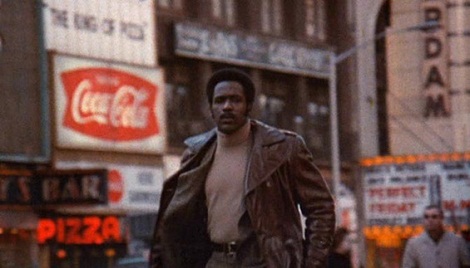
That’s Blaxpolitation! 12: SHAFT (MGM 1971)


gary loggins's avatarcracked rear viewer

“That Shaft is a bad mother…”

“Shut your mouth!”

“But I’m talkin’ about Shaft”

“We can dig it!”

  • – lyrics from Isaac Hayes’ “Theme from SHAFT

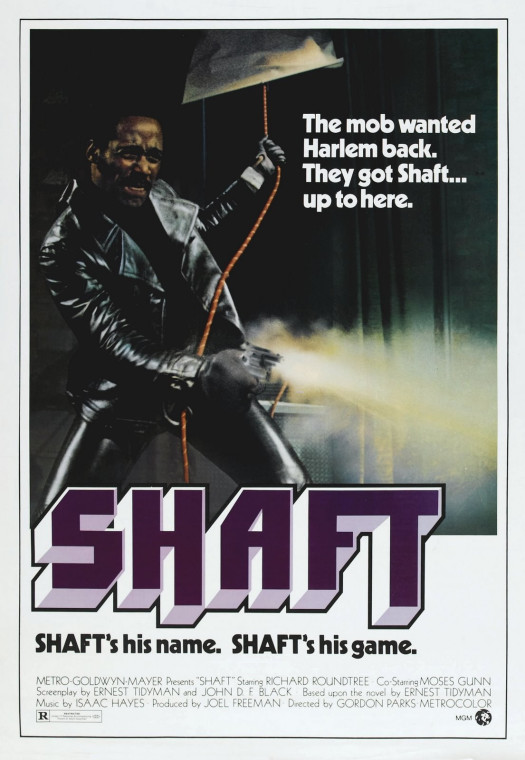
1971’s SHAFT, starring Richard Roundtree as “the black private dick that’s a sex machine to all the chicks”, is the movie that kicked off the whole 70’s Blaxploitation phenomenon.  Sure, Mario Van Pebbles’ indie SWEET SWEETBACK’S BADASSSSS SONG was released three months earlier, but it’s X-rating kept younger audiences out of the theaters. SHAFT reached more people with it’s R rating, and the publicity machine of MGM behind it. In fact, John Shaft not only saved the day in the film, but helped save the financially strapped MGM from bankruptcy!

The opening sequence alone makes it worth watching, as the camera pans down the gritty mean streets of New York City (42nd Street, to be exact!) and that iconic funky theme song by Isaac…

View original post 458 more words

Film Review: The Misguided (dir by Shannon Alexander)


“Happy families are all alike; every unhappy family is unhappy in its own way”

— Leo Tolstoy, Anna Karenina (1878)

“Me and him are totally different.”

— Leo (Caleb Galati), brother of Wendel (Steven J. Mihaljevich), in The Misguided (2018)

Oh, poor Leo.

From the first minute that he appears on screen, Leo is a familiar type.  He’s handsome He’s friendly, though there are always hints that he has secrets that he’s hiding.  He’s ambitious but he’s not particularly driven.  He seems like the type who is more likely to have a good plan than to understand how to actually pull it off.  We’ve all known someone like Leo.  Leo has just dropped out of college and he’s also just been kicked out of the place where he was staying.

What’s Leo to do?  Sleep on the streets or maybe spend a few weeks living with his brother, Wendel?  Looking at Wendel, it’s hard not to feel that you’ve stepped into a time portal and caught a glimpse of who Leo is going to be in another few years.  When Wendel isn’t using drugs, he’s dealing them.  Wendel is friendly, except for when he’s going out of his way to be menacing.  Wendel is charismatic and even people who should know better are drawn to Wendel.  And yet, it’s also hard not to suspect that Wendel might be a sociopath.  Like Leo, Wendel will be a familiar character to most viewers.  We’ve all known a Wendel.Along with having a place to stay, Wendel also has a car.  The only problem is that it’s not actually his car.  The car belongs to Wendel’s ex-girlfriend, Sanja (Jasmine Nibali).  When Sanja and her sister, Vesna (Katherine Langford, who viewers may recognize from 13 Reasons Why) come by to get the car, they meet Leo.  And soon, Sanja and Leo are a couple.

Of course, not everyone is happy about the idea of Sanja and Leo being together.  Vesna is convinced that Leo is just as bad as his brother.  Sanja’s father (Athan Bellos) is almost violently protective and is not happy to come home and find Leo relaxing in the family’s swimming pool.  As for Wendel, he claims not to care but you get the feeling that he’s lying.  That’s actually a feeling that you get a lot with Wendel.  But Sanja doesn’t care what anyone else thinks.  Soon, she and Leo are even talking about leaving Perth and moving to Melbourne together.  It sounds like a nice plan but will Leo be able to escape from his older brother’s destructive influence?

At times, it feels as if The Misguided is a plotless film but that feeling is just as deceptive as one of Wendel’s stories.  The film’s story plays out at a pace that is almost leisurely but always steady.  Whether we’re watching Wendel’s passive aggressive interaction with his brother or the genuinely sweet scenes of Leo and Sanja exploring Perth, we’re always aware that Leo is ultimately going to have to choose whether to escape his brother or to remain forever in Wendel’s shadow.  Shannon Alexander’s direction emphasizes gritty realism with a few stylistic flourishes.  Occasionally, the film speeds up.  A few scenes end with a freeze frame.  At one point, the image flickers as if Wendel’s drug-addled consciousness has infected the film itself.  In the style of early Godard, all of this suggests that we’re watching a world that has become unbalanced.

It’s also a well-acted movie.  The characters all seem real and, as a result, you care about them even if they sometimes seem to be incapable of doing the right thing.  Caleb Galati and Jasmine Nibali have a really nice chemistry.  They’re a cute couple and you can’t help but hope that things work out well for them.  The sibling relationship between Sanja and Vesna, with its mix of jealousy and sincere concern, felt real as well.  I’m the youngest of four sisters.  I could definitely relate.  I also particularly liked the performance of Athan Bellos, who is so intense and overprotective as Sanja and Vesna’s father that he’s actually a bit scary at times.

And then there’s Steven J. Mihaljevich, who is force of destructive nature in the role of Wendel.  Mihaljevich plays Wendel as the type of person who will smile even as he tells you absolutely the worst thing that he possibly could.  At the same time, Mihaljevich is also charismatic enough that you believe that Sanja could have actually been attracted to him before meeting Leo.  As played by Mihaljevich, Wendel is the bad influence that we’ve all known at some point in our life.  Whenever Wendel talks to anyone, you’re never quite sure whether he’s going to laugh and kill them but you’re always intrigued enough to want to find out.

The Misguided will soon be available on Amazon, Google, Vimeo and iTunes.

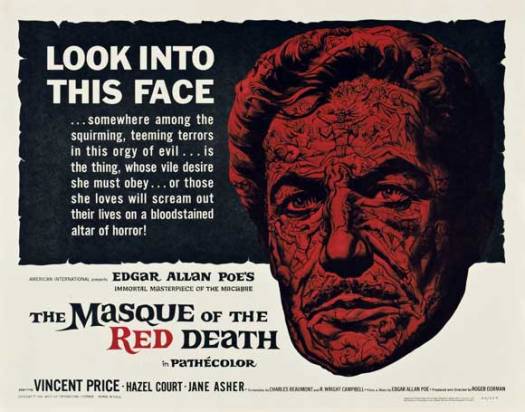
Creature Double Feature 5: THE MASQUE OF THE RED DEATH (AIP 1964) and THE TOMB OF LIGEIA (AIP 1965)


gary loggins's avatarcracked rear viewer

Boston’s WLVI-TV 56 ran it’s ‘Creature Double Feature’ series from 1972 to 1983. Though fans remember it mostly for those fabulous giant monster movies starring Godzilla and friends, CDF occasionally featured some monsters of a different kind… 

Roger Corman and Vincent Price had teamed to make five successful Edgar Allan Poe adaptations for American-International Pictures, beginning with 1960’s HOUSE OF USHER (there was a sixth, THE PREMATURE BURIAL, that starred Ray Milland rather than Price). Studio execs James Nicholson and Sam Arkoff, always on the lookout for ways to cut costs, joined forces with Britain’s Anglo-Amalgamated Productions (makers of the CARRY ON comedies) and shipped Corman and company to jolly ol’ England for the final two, THE MASQUE OF THE RED DEATH and THE TOMB OF LIGEIA. Both turned out to be high points in the Corman/Price/Poe series.

1964’s MASQUE OF THE RED DEATH is a sadistic, psychedelic nightmare of…

View original post 878 more words

Playing Catch-Up: Autumn in New York, Griffin & Phoenix, Harry & Son, The Life of David Gale


So, this year I am making a sincere effort to review every film that I see.  I know I say that every year but this time, I really mean it.

So, in an effort to catch up, here are four quick reviews of some of the movies that I watched over the past few weeks!

  • Autumn in New York
  • Released: 2000
  • Directed by Joan Chen
  • Starring Richard Gere, Winona Ryder, Anthony LaPaglia, Elaine Stritch, Vera Farmiga, Sherry Stringfield, Jill Hennessy, J.K. Simmons, Sam Trammell, Mary Beth Hurt

Richard Gere is Will, a fabulously wealthy New Yorker, who has had many girlfriends but who has never been able to find the one.  He owns a restaurant and appears on the cover of New York Magazine.  He loves food because, according to him, “Food is the only beautiful thing that truly nourishes.”

Winona Ryder is Charlotte, a hat designer who is always happy and cheerful and full of life.  She’s the type who dresses up like Emily Dickinson for Christmas and recites poetry to children, though you get the feeling that, if they ever somehow met in real life, Emily would probably get annoyed with Charlotte fairly quickly.  Actually, Charlotte might soon get to meet  Emily because she has one of those rare diseases that kills you in a year while still allowing you to look healthy and beautiful.

One night, Will and Charlotte meet and, together, they solve crimes!

No, actually, they fall in love.  This is one of those films where a young woman teaches an old man how to live again but then promptly dies so it’s not like he actually has to make a huge commitment or anything.  The film does, at least, acknowledge that Will is a lot older than Charlotte but it still doesn’t make it any less weird that Charlotte would want to spend her last year on Earth dealing with a self-centered, emotionally remote man who is old enough to be her father.  (To be honest, when it was revealed that Charlotte was the daughter of a woman who Will had previously dated, I was briefly worried that Autumn in New York was going to take an even stranger turn….)

On the positive side, the films features some pretty shots of New York and there is actually a pretty nice subplot, in which Will tries to connect with the daughter (Vera Farmiga) that he never knew he had.  Maybe if Farmiga and Ryder had switched roles, Autumn in New York would have worked out better.

  • Griffin & Phoenix
  • Released: 2006
  • Directed by Ed Stone
  • Starring Dermot Mulroney, Amanda Peet, Blair Brown, and Sarah Paulson

His name is Henry Griffin (Dermot Mulroney).

Her name is Sarah Phoenix (Amanda Peet).

Because they both have highly symbolic last names, we know that they’re meant to be together.

They both have cancer.  They’ve both been given a year to live.  Of course, they don’t realize that when they first meet and fall in love.  In fact, when Phoenix comes across several books that Griffin has purchased about dealing with being terminally ill, she assumes that Griffin bought them to try to fool her into falling in love with him.  Once they realize that they only have a year to be together, Griffin and Phoenix set out to make every moment count…

It’s a sweet-natured and unabashedly sentimental movie but, unfortunately, Dermot Mulroney and Amanda Peet have little romantic chemistry and the film is never quite as successful at inspiring tears as it should be.  When Mulroney finally allows himself to get mad and deals with his anger by vandalizing a bunch of cars, it’s not a cathartic moment.  Instead, you just find yourself wondering how Mulroney could so easily get away with destroying a stranger’s windshield in broad daylight.

  • Harry & Son
  • Released: 1986
  • Directed by Paul Newman
  • Starring Paul Newman, Robby Benson, Ellen Barkin, Wilford Brimley, Judith Ivey, Ossie Davis, Morgan Freeman, Katherine Borowitz, Maury Chaykin, Joanne Woodward

Morgan Freeman makes an early film appearance in Harry & Son, though his role is a tiny one.  He plays a factory foreman named Siemanowski who, in quick order, gets angry with and then fires a new employee named Howard Keach (Robby Benson).  Howard is the son in Harry & Son and he’s such an annoying character that you’re happy when Freeman shows up and starts yelling at the little twit.  As I said, Freeman’s role is a small one.  Freeman’s only on screen for a few minutes.  But, in that time, he calls Howard an idiot and it’s hard not to feel that he has a point.

Of course, the problem is that we’re not supposed to view Howard as being an idiot.  Instead, we’re supposed to be on Howard’s side.  Howard has ambitions to be the next Ernest Hemingway.  However, his blue-collar father, Harry (Paul Newman, who also directed), demands that Howard get a job.  Maybe, like us, he realizes how silly Howard looks whenever he gets hunched over his typewriter.  (Robby Benson tries to pull off these “deep thought” facial expressions that simply have to be seen to be believed.)  There’s actually two problems with Howard.  First off, we never believe that he could possibly come up with anything worth reading.  Secondly, it’s impossible to believe that Paul Newman could ever be the father of such an annoying little creep.

Harry, of course, has problems of his own.  He’s just lost his construction job.  He’s having to deal with the fact that he’s getting older.  Fortunately, his son introduces him to a nymphomaniac (Judith Ivey).  Eventually, it all ends with moments of triumph and tragedy, as these things often do.

As always, Newman is believable as a blue-collar guy who believes in hard work and cold beer.  The film actually gets off to a good start, with Newman using a wrecking ball to take down an old building.  But then Robby Benson shows up, hunched over that typewriter, and the film just becomes unbearable.  At least Morgan Freeman’s around to yell at the annoying little jerk.

  • The Life of David Gale
  • Released: 2003
  • Directed by Alan Parker
  • Starring Kevin Spacey, Kate Winslet, Laura Linney, Gabriel Mann, Rhona Mitra, Leon Rippy, Matt Craven, Jim Beaver, Melissa McCarthy

For the record, while I won’t shed any tears whenever Dzhokahr Tsarnaev is finally executed, I’m against the death penalty.  I think that once we accept the idea that the state has the right to execute people, it becomes a lot easier to accept the idea that the state has the right to do a lot of other things.  Plus, there’s always the danger of innocent people being sent to die.  The Life of David Gale also claims to be against the death penalty but it’s so obnoxious and self-righteous that I doubt it changed anyone’s mind.

David Gale (Kevin Spacey) used to the head of the philosophy department at the University of Texas.  He used to be a nationally renowned activist against the death penalty.  But then he was arrested for and convicted of the murder of another activist, Constance Harraway (Laura Linney) and now David Gale is sitting on death row himself.  With his execution approaching, journalist Bitsey Bloom (Kate Winslet) is convinced that Gale was framed and she finds herself racing against time to prevent Texas from executing an innocent man…

There’s a lot of things wrong with The Life of David Gale.  First off, it was made during the Bush administration, so the whole film is basically just a hate letter to the state of Texas.  Never have I heard so many inauthentic accents in one film.  Secondly, only in a truly bad movie, can someone have a name like Bitsey Bloom.  Third, the whole film ends with this big twist that makes absolutely no sense and which nearly inspired me to throw a shoe at the TV.

Of course, the main problem with the film is that we’re asked to sympathize with a character played by Kevin Spacey.  Even before Kevin Spacey was revealed to be a sleazy perv, he was never a particularly sympathetic or really even that versatile of an actor.  (Both American Beauty and House of Cards tried to disguise this fact by surrounding him with cartoonish caricatures.)  Spacey’s so snarky and condescending as Gale that, even if he is innocent of murder, it’s hard not to feel that maybe David Gale should be executed for crimes against likability.