Cleaning Out The DVR: Cheerleader Nightmare (dir by Danny J. Boyle)


I recorded Cheerleader Nightmare off of Lifetime on July 29th, 2018.

According to the imdb, Cheerleader Nightmare was originally titled Teen Drone Stalker.  Lifetime often changes the title of the movies that it acquires so I guess it’s not a shock that Teen Drone Stalker became Cheerleader Nightmare.  And I guess I can understand the reasoning behind the title change.  Teen Drone Stalker is a bit of an unwieldy title while Cheerleader Nightmare rolls right off the tongue.  Add to that, as a title, Cheerleader Nightmare promises both cheerleaders and nightmares, which has been a successful Lifetime formula in the past.

That said, Teen Drone Stalker is actually a far more accurate title.  Don’t get me wrong.  There are cheerleaders in this film and one of them does get murdered.  So, it’s not as if the new title is deceptive or anything.  But, in the end, it’s the teen drone stalkers who are far more important to the story than the dead cheerleaders.

(Add to that, Teen Drone Stalker is a great name for a band. I’d probably call them TDS for short, however.)

Anyway, the story centers around Sophie (Taylor Murphy), who is her high school’s official photographer.  She and her friend Mickey (Johnny Vistocky) use a drone to capture exciting action shots of the school’s football team and the cheerleaders.  Sophia has a complicated history with cheerleading.  On the one hand, her mother (Melissa Ponzio) is the cheerleading coach and never makes a secret of the fact that she wishes Sophie was on the team.  On the other hand, Sophie wants to find her own identity and maintain her independence.  Meanwhile, Sophie’s former best friend, Leah (Mia Stallard) is the head cheerleader and Sophie’s boyfriend, Tyler (Jeremy Shada), is on the football team.  You would think that Sophie’s mother would be happy that Sophie’s dating a football player but, instead, she’s concerned because Tyler used to be a juvenile delinquent.

Got all that?

Good, because things are about to get complicated.

While using Mickey’s drone to spy on a party being given at the football coach’s house, Sophie catches Tyler making out with Leah!  Then, someone murders Leah!  Was it Tyler?  Was it one of the other cheerleaders?  Was it Mickey, who seems to have issues with popular students?  Or …. could it have been Sophie!?  Seriously, Sophie seems to have a lot of unresolved issues towards cheerleaders.

I’ll be honest.  I spent the first 45 minutes or so convinced that Sophie would be revealed to be the murderer.  I had it all worked out in my mind.  I was convinced that Sophie suffered from blackouts, during which time she became a murderous named Sofia.  Was I right?  Was I wrong?  I guess you’ll have to watch the film to find out.

That said, I did relate to the character of Sophie.  When I was in high school, I was frequently told that I should I be a cheerleader but I never tried out because my sister was a cheerleader and I was all like, “I have to have my own identity!”  Looking back, it seems like kind of a silly thing to worry about but, at the time, it was like my declaration of principles.  Needless to say, I made my sister watch Cheerleader Nightmare with me so that I could get her opinion.  Erin says that it was an okay movie but she also pointed out that, if the cheerleaders had done a better job, everyone would have been too full of school spirit to commit any murders.  I have to agree with her on that.

Cheerleader Nightmare got off to a good start but it lost its way about halfway through.  I did enjoy counting up all of the red herrings that the film introduced before revealing the identity of the killer but there’s only so much you can really do with a red herring.  In the end, the identity of the murderer was not a big shock and it was hard not to feel that the murder would have been solved a lot earlier if Sophie and her mom had just stayed out of everyone’s way.   Unfortunately, Cheerleader Nightmare was no The Cheerleader Murders.


Film Review: Invasion U.S.A. (dir by Alfred Green)


Here’s how Invasion, U.S.A. opens:

A bunch of strangers sit in a bar.  On the television, a blandly handsome anchorman delivers the news.  He talks about foreign wars.  He talks about domestic conflicts.  One of the bar patrons asks the bartender to turn off the news.  Who cares about all of that stuff?  All he wants to do is have a nice drink before heading home to his cattle ranch.  Can’t he just do that in peace?  The bartender agrees and turns off the news…

That’s a scene that gets played out a lot nowadays.  No one wants to watch the news.  Certainly not me.  I guess we all know that we should because it’s important to know what’s going on in the world and blah blah blah.  But seriously, people who spend all of their time watching the news inevitably seem to end up going insane and ruining twitter.  I’ve got no interest in doing that.

Here’s the thing, though.  Invasion U.S.A. may open with a contemporary scene but it’s hardly a contemporary movie.  Instead, it was made in 1952 and it serves as proof that we’re not the first Americans to get sick of watching the news and that our current crop of politically minded filmmakers are not the first to try to change our mind with heavy-handed propaganda.

Everyone at the bar has a complaint.  The Arizona rancher resents having to pay high taxes just to support the defense department.  The Chicago industrialist is upset that the government wants to use his factories to build weapons.  Congressman Haroway (Wade Crosby) is a drunk.  Socialite Carla Sanford (Peggie Castle) worked in a factory during World War II but she no longer follows the news.  Newscaster Vince Potter (Gerald Mohr) is a cynic.  Tim the Bartender (Tom Kennedy) is too busy selling cocktails to worry about the communists.

Only the mysterious Mr. Ohman (Dan O’Herlihy, who would later play Conal Cochran in Halloween III) seems to care.  While holding a conspicuously oversized brandy glass, Mr. Ohman explains that he’s a forecaster.  What’s a forecaster?  A forecaster is … oh wait!  There’s no time to explain it because the communists have invaded!

Everyone sits in the bar and watches as the news reports on the invasion of the U.S.A.  (Everyone except for Mr. Ohman, who has mysteriously vanished.)  In the tradition of all low-budget B-movies, the invasion is represented through stock footage.  Lots and lots of stock footage.  Planes drop bombs.  Soldiers run out of a barracks.  Cities burn.

When everyone leaves the bar, they discover that America has been crippled by people like them, people who never thought it would happen.  Some of our bar patrons die heroically.  (Not Tim the Bartender, though.  He’s still making dumb jokes and cleaning beer mugs when the bomb drops.)  Some of our patrons regret that they didn’t care enough when it would have actually made a difference.  The industrialist discovers that, because he wouldn’t let the government take over his factory, he now has to take orders from sniveling little Marxist.  The rancher discovers that taxis get really crowded when everyone’s fleeing the Russians.  And others discover that better dead than red isn’t just a catch phrase.  It’s a way of life.

Of course, there’s a twist ending.  You’ll guess it as soon as you see Mr. Ohman with that brandy glass…

Invasion U.S.A. is often cited as one of the worst films ever made but I have to admit that I absolutely love it.  I have a soft spot for heavy-handed, over the top propaganda films and they don’t get more heavy-handed than Invasion, U.S.A.  There’s not a subtle moment to be found in the entire film.  You have to love any film that features character authoritatively declaring that something will never happen mere moments before it happens.  Best of all, you’ve got Dan O’Herlihy, playing Mr. Ohman with just a hint of a knowing smile, as if he’s as amused as we are.

Politically, this film is a mixed bag for me.  The film argues that you should trust the government and basically, shut up and follow orders.  I’m a libertarian so, as you can imagine, that’s not really my thing.  At the same time, the villains were all communists and most of the communists that I’ve met in my life have been pretty obnoxious so I enjoyed the part of the film that advocated blowing them up.  The only thing this film hates more than communists is indifference.

In the end, Invasion U.S.A. is a real time capsule of a film, one that shows how different things were in the past while also reminding us that times haven’t changed that much.  Though the film’s politics may be pure 1952, its paranoia and its condemnation of apathy feels very contemporary.

(For the record, apathy is underrated.)

Seen today, what makes Invasion U.S.A. memorable is its mix of sincerity, paranoia, and Dan O’Herlihy.  Unless the communists at YouTube take down the video, you can watch it below!


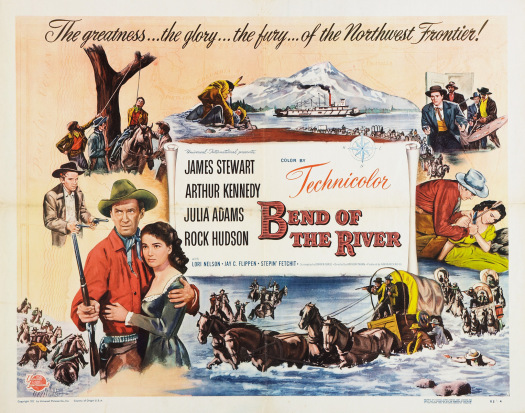
Western Noir: James Stewart in BEND OF THE RIVER (Universal-International 1952)


gary loggins's avatarcracked rear viewer

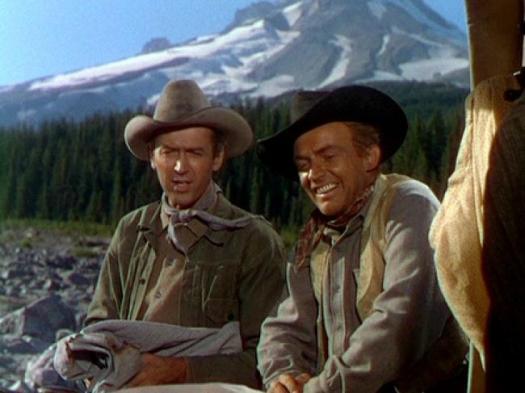
BEND OF THE RIVER, the second of the James Stewart/Anthony Mann Westerns, isn’t quite as good as the first, WINCHESTER ’73 . That’s not to say it isn’t a good film; it’s just hard to top that bona fide sagebrush classic. Stewart continues his post-war, harder edged characterizations as a man determined to change his ways, and is supported by a strong cast that includes a villainous turn by the underrated Arthur Kennedy .

Jimmy plays Glyn McLyntock, an ex-outlaw now riding as trail boss for a group of farmers heading to Oregon to begin a new life. He encounters Kennedy as Emerson Cole, a horse thief about to be hanged, and enlists his help on the trail west. Both men know each other’s reputations; they were both once raiders along the Missouri/Kansas border. The wagons are attacked at night by Shoshone, an arrow piercing young Laura Baile, daughter of…

View original post 580 more words

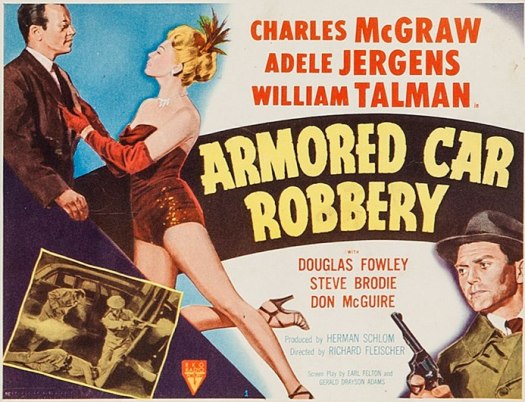
Dirty Deeds Done Dirt Cheap: ARMORED CAR ROBBERY (RKO 1950)


gary loggins's avatarcracked rear viewer

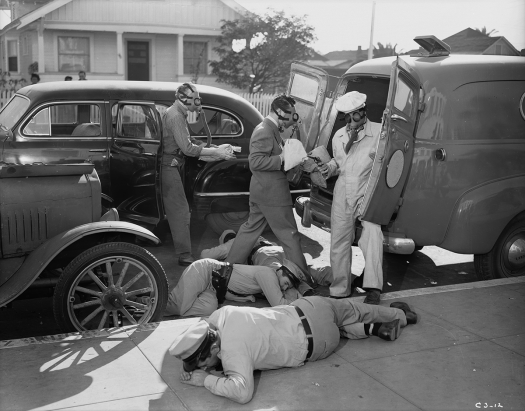
Looking for a tough, no-frills ‘B’ crime drama? Look no further than ARMORED CAR ROBBERY, which is just what it says it is, the planning, execution, and aftermath of said dirty deed, with a cast of rugged mugs and hard-hearted dames directed by Richard Fleischer during his salad days at RKO. The movie echoes Robert Siodmak’s CRISS CROSS in its heist scene, and I’m sure Stanley Kubrick watched and remembered it when he made his film noir  masterpiece THE KILLING .

Make no mistake, ARMORED CAR ROBBERY isn’t on a par with those two films. It is, however, an enjoyable little 67 minutes of cops vs crooks. Criminal mastermind Dave Purvis assembles a gang of low-lives to pull the caper off, killing a cop in the process. The cop’s partner, Lt. Jim Cordell, is now determined to hunt the crooks down and avenge him. One of the participants, Benny McBride…

View original post 402 more words

What Lisa Watched Last Night #187: The Wrong Cruise (dir by David DeCoteau)


Last night, I watched the latest Lifetime premiere, The Wrong Cruise!

Why Was I Watching It?

Well, the obvious answer is that it was on Lifetime and I always watch Lifetime original films.  I’m running a little bit behind in reviewing all of them and, for that, I apologize.  Hopefully, I’ll be able to get caught up next week!

The other reason that I was watching The Wrong Cruise was because it was a “wrong” movie.  As any regular Lifetime watcher knows, there are several different genres of Lifetime movies, each with their own quirks and rules.  There’s the “Killer” movies, which usually feature Barbie Castro.  There’s the “at 17” movies.  There’s the “Deadly” movies.  And then there’s the “Wrong” movies.  Several of these films — including The Wrong Cruise — were directed by David DeCoteau and usually featured Vivica A. Fox and William McNamara in memorable supporting roles.  The “Wrong” movies are always a lot of fun.

What Was It About?

Ever since her father died, teenager Sky Tanner (Sidney Nicole Rogers) has been acting out.  After throwing a punch at track meet, Sky finds herself on the verge of being expelled from school!  Uh-oh!

Fortunately, for Sky, it looks like she’s about to get a break from the stress of dealing with high school.  Her mother, Claire (Vivica A. Fox), is booked on a cruise to Mexico and there’s no way that Claire’s going to leave Sky home alone.

At first, it seems like the perfect vacation!  Claire meets a man named Dante (Andres Londono).  Sky meets a teenage boy named Rico (Adrian Quinta).  Love is in the air!  Dante is charming and quite insistent that Claire go sailing with him.  As for Rico, he’s willing to buy drinks for the underage Sky and he’s more than happy to show Sky around Mexico.

If, at this point, you’re saying, “I don’t trust either of them!,” you’re not alone.  After you’ve seen enough Lifetime films, you know better than to trust any charming stranger.  Add to that, while Sky is drinking with Rico and Claire is flirting with Dante, there’s a creepy ship’s mate (played by William McNamara) who seems to be determined to keep an eye on both of them.  What’s up with that?

What Worked?

This one was a lot of fun, largely because Vivica A. Fox and Sidney Nicole Rogers were totally and completely believable as mother and daughter.  Every time that Claire said something overprotective and Sky reacted by sighing and rolling her eyes, the more you found herself believing in their characters.  When they inevitably ended up getting into trouble, the stakes felt real because the mother/daughter relationship felt real.

Londono and Quinta both did work as Dante and Rico but the film was ultimately stolen by William McNamara.  For such a handsome actor, he’s really good at playing creepy Lifetime movie villains.

What Did Not Work?

I would have liked to have spent a little more time on the cruise ship.  For a film called The Wrong Cruise, it seemed like the boat was a little underused.  Then again, maybe I just want to go on a cruise…

“Oh my God!  Just like me!” Moments

I didn’t run track in high school but, if I had, I would hope that I would have had just as combative an attitude towards my competitors as Sky had towards her’s.

Also, like Sky, I spent a lot of my teenage years rolling my eyes at overprotective parental figures.

Lessons Learned

Never get out of the boat.

Grandma Guignol: WHATEVER HAPPENED TO BABY JANE (Warner Bros 1962)


gary loggins's avatarcracked rear viewer

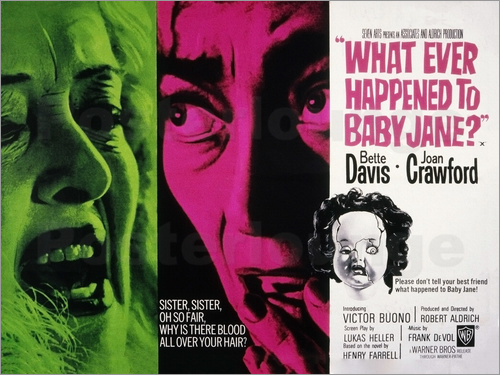
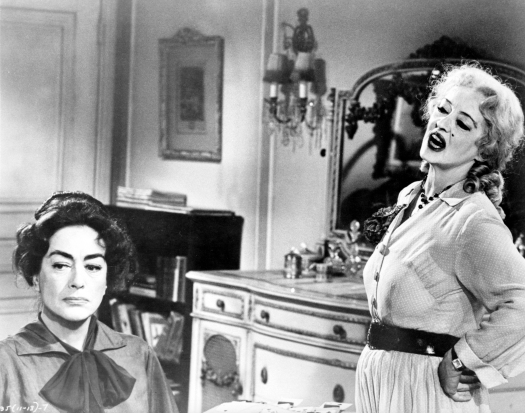
Joan Crawford  and Bette Davis had been Hollywood stars forever by the time they filmed WHATEVER HAPPENED TO BABY JANE?. Davis was now 54 years old, Crawford 58, and both stars were definitely on the wane when they teamed for this bizarre Robert Aldrich movie, the first (and arguably best) of what has become know as the “Grand Dame Guignol” (or “psycho-biddy”) genre.

Bette is Baby Jane Hudson, a washed-up former vaudeville child star with a fondness for booze, while Joan plays her sister Blanche, a movie star of the 30’s permanently paralyzed in a car accident allegedly caused by Jane. The two live together in a run-down old house, both virtual prisoners trapped in time and their own minds. Blanche wants to sell the old homestead and send Jane away for treatment, but Jane, jealous of her sister’s new-found popularity via her televised old films, descends further into alcoholism…

View original post 419 more words

Film Review: Live By Night (dir by Ben Affleck)


Remember Live By Night?

Released in December of 2016, Live By Night was one of those highly anticipated films that ended up bombing at the box office and leaving critics cold.  The anticipation was due to the fact that Live By Night was the first film that Ben Affleck had directed since Argo won best picture.  It was seen as Affleck’s next prestige picture, the one that would remind everyone that he was more than just the latest actor to be cast as Batman.  Live By Night was expected to be a huge Oscar contender.  As for why it bombed at the box office, that may have had something to do with the fact that Live By Night is not a very good film.

It’s a gangster film, one that takes place during prohibition.  Joe Coughlin (Ben Affleck) is the most boring gangster in Boston.  Or, at least, he is until he falls for the wrong woman and he ends up having to flee down to Tampa.  Once down there, Joe sets himself up as the most boring gangster in Florida.  There’s all sorts of themes running through Live By Night — racial themes, economic themes, even some heavy-handed religious themes — but ultimately, the main impression that one gets from the film’s story is that Joe Coughlin was a very boring gangster.

Anyway, Joe gets involved in all sorts of corruption and violence.  He brings down his friend, Dion (Chris Messina), to help him out.  Whereas Joe is rational and dull, Dion is violent and dull.  You spend the entire movie waiting for the moment when Dion will turn on Joe but it never happens.  I guess that’s a good thing since Joe and Dion are busy battling the Klan.  Joe may be a 1920s gangster but he’s got the political and cultural outlook of a 21st century movie star.

Joe knows that prohibition is going to end someday, so he hopes to make money through opening up a casino.  Standing in the way of the casino is a prostitute-turned-evangelist named Loretta (Elle Fanning).  Loretta is the daughter of the local police chief (Chris Cooper), with whom Joe has an uneasy friendship.  You keep expecting this plot to go somewhere but it really doesn’t.  Loretta’s just kinda there.  That said, we do get a hilarious shot of a tearful Chris Cooper repeating the word repent over and over again so there is that.

Zoe Saldana is also just kind of there, playing Joe’s Cuban wife.  Again, you expect a lot to happen with Saldana’s character but, for the most part, she’s mostly just a plot device who exists solely so that Joe can have some sort of motivation beyond simply wanting to get rich.

It’s a big, sprawling film that never quite feels like an epic.  A huge part of the problem is that Ben Affleck the director is let down by Ben Affleck the actor.  Regardless of what’s happening in the scene, Affleck always has the same grim look on his face.  At times, it seems as if he’s literally been chiseled out of a marble and you find yourself wondering if he’s actually capable of any facial expression beyond glum annoyance.  A gangster film like this need a bigger-than-life protagonist but, as played by Affleck, Joe always seems to be in danger of vanishing into the scenery.

I think part of the problem is that Affleck’s previous films all dealt with places and subjects that Affleck felt comfortable with, perhaps because he could relate their stories to his own personal experiences.  Gone, Baby, Gone and The Town both took place exclusively in Boston.  Argo dealt with the film industry.  Live By Night is a period piece set in the South and Affleck is obviously lost from the minute Joe arrives in Florida.

Live By Night, I think, could have been a good movie if it had been directed by someone like Paul Thomas Anderson and maybe if an actor like Colin Farrell played the role of Joe.  But, as it is, it’s just a rather stolid and uninspiring gangster film.

Pre-Code Confidential #21: Wheeler & Woosley in DIPLOMANIACS (RKO 1933)


gary loggins's avatarcracked rear viewer

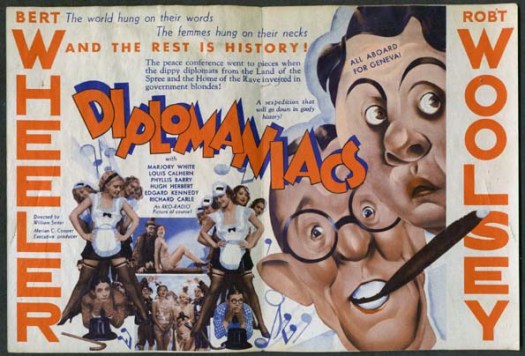
Political satire in film ran rampant during the Pre-Code Era. Somewhere between W.C. Fields’s MILLION DOLLAR LEGS and the Marx Brothers’ DUCK SOUP  sits DIPLOMANIACS, Wheeler & Woolsey’s madcap take on war and peace, 1930’s style. It’s purely preposterous, unadulterated farce, and is guaranteed to offend someone, if not everyone.

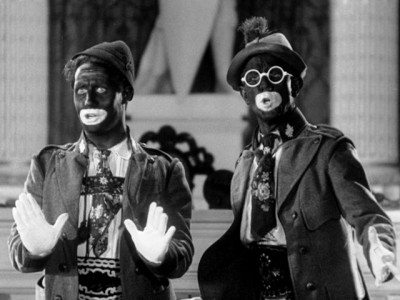
Let’s get it out of the way right now: DIPLOMANIACS is not politically correct in any way, shape, or form. It’s loaded with racist stereotypes, casting Hugh Herbert as a not-so-wise Chinaman (“It is written that it is written that it is written that it is written”), lambastes Jews, Native Americans, and homosexuals, and portrays women as sex objects (spy Marjorie White is delivered in plastic wrap). A bomb tossed into the peace talks causes everyone to turn blackface, leading to a prolonged minstrel number! If you’re already offended, stop reading… but if you can take the heat, by all…

View original post 476 more words

Film Review: Streets of Fire (dir by Walter Hill)


File this one under your mileage may vary…

Okay, so here’s the deal.  I know that this 1984 film has a strong cult following.  A few months ago, I was at the Alamo Drafthouse when they played the trailer and announced a one-night showing and the people sitting in front of me got so excited that it was kind of creepy.  I mean, I understand that there are people who absolutely love Streets of Fire but I just watched it and it didn’t really do much for me.

Now, that may not sound like a big deal because, obviously, not everyone is going to love the same movies as everyone else.  I love Black Swan but I have friends who absolutely hate it.  Arleigh and I still argue about Avatar.  Leonard and I still yell at each other about Aaron Sorkin.  Erin makes fun of me for watching The Bachelorette.  Jedadiah Leland doesn’t share my appreciation for Big Brother and the Trashfilm Guru and I may agree about Twin Peaks but we don’t necessarily agree about whether or not socialism is a good idea.  And that’s okay.  There’s nothing wrong with healthy and respectful disagreement!

But the thing is — Streets of Fire seems like the sort of film that I should love.

It’s a musical.  I love musicals!

It’s highly stylized!  I love stylish movies!

It’s from the 80s!  I love the 80s films!  (Well, most 80s films… if the opening credits are in pink neon, chances are I’ll end up liking the film…)

It takes place in a city where it never seems to stop raining.  Even though the neon-decorated sets give the location a futuristic feel, everyone in the city seems to have escaped from the 50s.  It’s the type of city where people drive vintage cars and you can tell that one guy is supposed to be a badass because he owns a convertible.  All of the bad guys ride motorcycles, wear leather jackets, and look like they should be appearing in a community theater production of Grease.

Singer Ellen Aim (Diane Lane) has been kidnapped by the Bombers, a biker gang led by Raven (Willem DaFoe).  Ellen’s manager and lover, Billy Fish (Rick Moranis), hires Tom Cody (Michael Pare) to rescue Ellen.  Little does Billy know that Cody and Ellen used to be lovers.  Cody is apparently a legendary figure in the city.  As soon as he drives into town, people starting talking about how “he’s back.”  The police see Cody and automatically tell him not to start any trouble.  Raven says that he’s not scared of Cody and everyone rolls their eyes!

It’s up to Cody to track Ellen down and rescue her from Raven and … well, that’s pretty much what he does.  I think that was part of the problem.  After all of the build-up, it’s all a bit anti-climatic.  It doesn’t take much effort for Cody to find Ellen.  After Cody escapes with Ellen, it doesn’t take Raven much effort to track down Cody.  It all leads to a fist fight but who cares?  As a viewer, you spend the entire film waiting for some sort of big scene or exciting action sequence and it never arrives.  The film was so busy being stylish that it forgot to actually come up with a compelling story.

I think it also would have helped if Tom Cody had been played by an actor who had a bit more charisma than Michael Pare.  Pare is too young and too stiff for the role.  It doesn’t help to have everyone talking about what a badass Tom Cody is when the actor playing him doesn’t seem to be quite sure what the movie’s about.  Also miscast is Diane Lane, who tries to be headstrong but just comes across as being petulant.  When Cody and Ellen get together, they all the chemistry of laundry drying on a clothesline.

On the positive side, Willem DaFoe is believably dangerous as Raven and Amy Madigan gets to play an ass-kicking mercenary named McCoy.  In fact, if McCoy had been the main character, Streets of Fire probably would have been a lot more interesting.

I guess Streets of Fire is just going to have to be one of those cult films that I just don’t get.

Cleaning Out The DVR: The Colossus of Rhodes (dir by Sergio Leone)


I recorded this 1961 Italian film off of TCM on June 14th!

From 280 BC to 226 BC, a 108 feet high statue of the sun-god Helios stood in the Greek city of Rhodes.  It was reportedly built to celebrate a major military victory and it overlooked the harbor, serving to both welcome friends and intimidate enemies.  No one’s quite sure what it actually looked like but we do know that it was considered, by its contemporaries, to be one of the Seven Wonders of the World.  No trip to Greece was complete without a stopover in Rhodes so that the curious could feast their eyes upon the Colossus.  Eventually, the statue was destroyed in an earthquake and it was never rebuilt.

The statue serves as the centerpiece for the aptly named 1961 film, The Colossus of Rhodes.  The film opens with its dedication and ends with the earthquake that toppled it.  (Of course, in the film, the earthquake occurs just a week or two after the dedication.)  The film imagines that the Colossus was not just a monument to a God.  No, instead, this film suggests that the Colossus was an elaborate torture chamber, one that could pour fire down on anyone trying to sail underneath it.  Inside the Colossus is an elaborate labyrinth of dungeons, where anyone who has displeased the king is punished.

And, indeed, quite a few people have displeased the king.  King Serse (Roberto Camardiel), it turns out, is a mad tyrant who spends all of his days eating grapes and having people executed in the coliseum.  (He’s like Nero but without the artistic temperament.)  Not only do the rebels want him dead but so does his evil second-in-command, Thar (Conrado San Martin).  With the people angry that they’ve been forced to build a giant statue for no reason other than their king’s vanity, it seems like a perfect time for a revolution!

Caught in the middle of it all is Darios (Rory Calhoun).  Darios is from Athens and the only reason he came to Rhodes was to visit his uncle and see the statue.  At first, Darios is more interested in trying to get laid than the revolution.  When that doesn’t quite work out, Darios tries to leave the island, just to discover that, thanks to the Colossus, escape is impossible.  When Darios is accused of being a supporter of the revolution, he has no choice but to take up arms against Serse, which is exactly what Thar wants him to do…

The plot’s is more than a little convoluted and Darios is never the most sympathetic of heroes but The Colossus of Rhodes is still an enjoyable example of the peplum genre.  Though the acting is frequently stiff, the film is visually impressive, with both the Colossus and ancient Rhodes brought to wonderfully decadent life.  The idea that the Colossus was actually just an elaborate torture chamber is handled well and the frequent battle scenes are well-choreographed.  (I was particularly impressed with a scene of Darios fighting off an army while also trying to maintain his balance on the Colossus’s arm.)  And, of course, the climatic earthquake is as grandly operatic as you would hope.  Say what you will about the Italian film industry, it always delivered what audiences wanted.

That said, the main reason that The Colossus of Rhodes is known today is because it was the Sergio Leone’s first directorial credit.  (It was, however, the second film that he actually directed.  Though uncredited, he previously replaced Mario Bonnard as the director of 1959’s The Last Days of Pompeii.)  While The Colossus of Rhodes was obviously very different from the spaghetti westerns for which Leone is best known, there are some thematic similarities between the film and Leone’s future work:

For instance, much like Clint Eastwood in the Dollars Trilogy, Charles Bronson in Once Upon A Time In The West, and the gangsters in Once Upon A Time In America, Darios starts out as an amoral hero.  When Darios does join the revolution, it’s reminiscent of James Coburn aiding Rod Steiger in Duck, You Sucker

The corrupt and greedy Serse has much in common with the crooked land barons and businessmen who lurked behind-the-scenes in Once Upon A Time In The West.

Even the torture chamber in the Colossus brought to mind the grisly torments that both Clint Eastwood and Eli Wallach had to endure in The Good, The Bad, and The Ugly.

(Unfortunately, unlike other Leone films, Ennio Morricone did not provide the score for The Colossus of Rhodes.  Instead, Angelo Francesco Lavagnino provided a rather standard “epic” orchestration.)

The Colossus of Rhodes may not be a great film but, as an early work of a great filmmaker, it’s definitely worth watching.