Rondo Hatton (1894-1946) was dubbed by “The Ugliest Man in Hollywood” by Universal for his repulsive visage. Originally a Tampa-based sportswriter, Hatton began developing the disease acromegaly as a young adult, a form of gigantism which distorts the facial features and bone structure (wrestler Andre the Giant suffered from this). Rondo moved to Hollywood and got work as a film extra and some bit parts (he can be spotted in SAFE IN HELL , IN OLD CHICAGO, THE HUNCHBACK OF NOTRE DAME (’39 version), and THE OX BOW INCIDENT, among others).
1944’s “The Pearl of Death”
Hatton played “The Hoxton Creeper” in the 1944 Sherlock Holmes entry THE PEARL OF DEATH (with Universal Scream Queen Evelyn Ankers as a villainess, for a change), then proceeded to scare the daylights out of audiences in JUNGLE CAPTIVE and THE SPIDER WOMAN STRIKES BACK. While not a trained actor, his unique looks made…
Released in 1958, How To Make A Monster is a clever little horror satire from American International Pictures in which the stars of Teenage Werewolf and Teenage Frankenstein are hypnotized into believing that they actually are the monsters that they played! The main culprit is a movie makeup artist (Robert H. Harris) who has been deemed obsolete by the new bosses at AIP.
When his parents leave to spend the summer in Europe, Frankie (Trevor Lissauer) has the entire mansion to himself. Frankie wants to spend the time getting closer to his girlfriend, Dee Dee (Daisy Torme), but his best friend Bogie (Danny Hitt) says that it’s time to “party hearty!” (That’s right. Someone in a film made after 1991 says that it’s time to party hearty.) Bogie thinks that the best way to party would be to invite Moondoggie (Johnny Venocur) and his gang (which includes Carmen Elecrta) to hang out at the house. But then it turns out that Moondoggie is a vampire and once he’s invited in, he refuses to leave! Even worse, Dee Dee dumps Frankie for Moondoggie! Luckily, there is one man on the beach who can help Frankie out of his predicament. They call him the Big Kahuna, he wears a Hawaiian shirt and he’s played by Adam West.
This is really, really dumb but at least it’s got Adam West saying lines like, “Stop that sucking!” and “Holy wipe out!” The movie is supposed to be a throwback to the old Frankie and Annette beach party movies from the 60s, just with vampires. (Moondoggie’s real named is Count Erich Von Zipper.) What the movie didn’t take into account is that there was already a perfectly good Beach Party movie with vampires and it was called The Lost Boys. Don’t be fooled by that PG-13 rating or the way that Carmen Electra is posing on the poster. An American Vampire Story is a tame and bloodless vampire story. The cast is game but most of the jokes fail to land like they should and ultimately, only Adam West keeps the anemic tale alive.
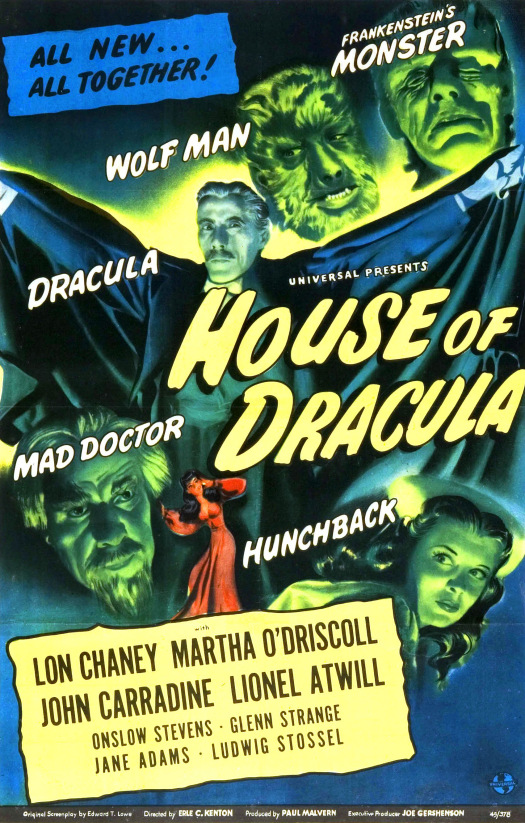
Since I’ve already reviewed HOUSE OF FRANKENSTEIN back in 2015, we now turn our attention to HOUSE OF DRACULA, the last “official” entry in the series (though the Universal Monsters would ‘Meet Abbott & Costello’ three years later). The film tries to put a new slant on things, using science to conquer the supernatural, but winds up being just a hodgepodge of familiar horror tropes without much cohesion. HOUSE OF DRACUA does have its fans, but I’m not one of them.
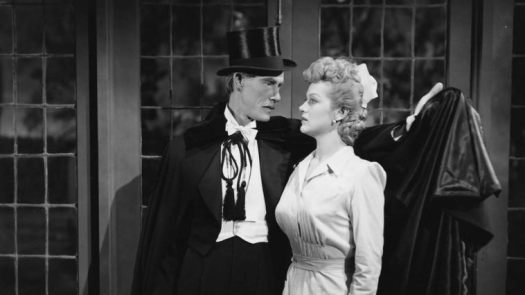
John Carradine returns as Count Dracula, introducing himself as Baron Latos to Dr. Edlemann (Onslow Stevens ) and seeking a cure for his vampirism. Edlemann discovers a “peculiar parasite” in Dracula’s blood, and believes he can cure him through a series of transfusions. But the Count, that sneaky devil, has his fangs set for Edlemann’s pretty nurse Militza (Martha O’Driscoll), whom he hypnotizes with those hypnotic eyes of his…
This film was produced as a direct result of the box office success of I Was A Teenage Werewolf. Just as in Teenage Werewolf, Whit Bissell plays a mad scientist who makes the mistake of trying to play God. (He also makes the mistake of keeping an alligator in his lap but that’s another story.) The end result …. Teenage Frankenstein!
The makeup on the Teenage Frankenstein is probably the best thing about this film. If nothing else, this film features a monster who actually looks like he was stitched together in a lab.
Count Dracula (played by Udo Kier) has a problem. In order to stay strong and healthy, he needs a constant supply of virgin blood. (Or, as Kier puts in, “weergen blood.”) Unfortunately, he lives in 1920s Romania and apparently, there just aren’t many virgins left in Eastern Europe.
However, Dracula’s assistant, Anton (Arno Juerging) has a solution. Dracula just needs to move to Italy! After all, Italy is the home of the Vatican and it’s just been taken over by Mussolini and the fascists. Surely, no one in Italy is having sex! Dracula should be able to find all the virgins that he needs in Italy!
So, Dracula climbs into his coffin and Anton drives him to Italy. Once they arrive, they meet an Italian land owner, Il Marchese di Fiore (played by Italian neorealist director Vittorio De Sica). The Marchese is convinced that Dracula is a wealthy nobleman and he says that Dracula can marry any of his four daughters. He assures Dracula that they’re all virgins but Dracula soon discovers that two of them are not. It turns out that, thanks to the estate’s Marxist handyman, Mario (Joe Dallesandro), it’s getting as difficult to find a virgin in Italy as it was in Romania!
After completing work on Flesh For Frankenstein, director Paul Morrissey and actors Udo Kier, Joe Dallesandro, and Arno Juerging immediately started work on Blood for Dracula. Though Blood for Dracula never quite matches the excesses of Flesh for Frankenstein, it still taps into the same satiric vein that provided the lifeblood that gave life to Flesh for Frankenstein. Once again, the sets and costumes are ornate. Once again, the frequently ludicrous dialogue is delivered with the straightest of faces. Once again, Udo Kier goes over-the-top as a famous monster. And, once again, Joe Dallesandro plays his role with a thick and anachronistic New York accent and he looks damn good doing it.
Ironically, one of the differences between Flesh for Frankenstein and Blood for Dracula is that there’s quite a bit less blood in the Dracula film. Then again, that’s also kind of the point. Dracula literally can’t find any blood to drink and, as a result, he’s become weak and anemic. Udo Kier is perhaps the sickliest-looking Dracula in the history of Dracula movies. By the time that he meets the Marchese’s four daughters, he’s so sick that he literally seems like he might fade away at any second. As ludicrous as the film sometimes is, you can’t help but sympathize with Dracula. All he wants is some virgin blood and the communists aren’t even willing to let him have that. Blood for Dracula is, in its own twisted way, a much more melancholy film than Flesh For Frankenstein. Or, at least it is until the finale, at which point one character gets violently dismembered but still continues to rant and rave even after losing the majority of their limbs.
When Blood for Dracula was released in 1974, it was originally called Andy Warhol’s Dracula, though Warhol had little to do with the movie beyond allowing his name to be used. As with Flesh for Frankenstein, Antonio Margheriti was credited in some prints as a co-director, largely so the film could receive financial support from the Italian government.
Sadly, there would be no Andy Warhol’s The Mummy or Andy Warhol’s Wolfman. One can only imagine what wonders Kier, Dallesandro, and Morrissey could have worked with those.
Here are just a few things to be experienced in 1973’s Flesh For Frankenstein:
A fanatical Baron von Frankenstein (Udo Kier) needs a brain for his latest creation so his assistant, Otto (Arno Jurging) goes out with a giant pair of hedge clippers, snips off a divinity student’s head, and then runs off with it.
An incredibly sexy farmhand named Nicholas (Joe Dallesandro) speaks with a thick and very modern New York accent, despite living in Germany in the 19th century. Meanwhile, everyone around him speaks with an extra-thick German accent.
The Baron announces to Otto, “To know life, you must fuck death in the gall bladder!”
Nicholas has an affair the Baroness von Frankenstein (Monique van Voreen), who in one scene loudly sucks on Nicolas’s armpit.
The Baron gets rather obviously turned on while removing organs from a body.
The Baron’s children decapitate their dolls and take a perverse pleasure in being cruel. Some of this could possibly be because the Baron and the Baroness are also brother and sister.
The Baron rants and raves about how, by bringing the dead back to life, he will be able to create the perfect Serbian race, one that will only take orders from him and which will …. well, do something. The Baron has a lot of plans but he’s not always clear on just what exactly the point of it all is.
Speaking of points, one character eventually gets a spear driven through his back an out of his chest. Despite the fact that his heart is literally hanging off the tip of the spear, he still manages to get out a very long and very emotional monologue before dying.
Now, of course, you have to remember about that scene with the heart is that Flesh for Frankenstein was originally shot in 3D, which means that audiences in 1973 would have literally had that heart dangling over their heads while waiting for that endless monologue to stop. How the audience would react to that would have a lot to do with whether or not they were in on the joke.
And make no mistake, Flesh For Frankenstein is not a film that’s meant to be taken too seriously. It’s a satire of …. well, just about everything. Baron Frankenstein, with his sexual hang-ups and his obsession with creating a perfect male and a perfect female so that they can have perfect Serbian children, is the ultimate parody of the mad scientists who usually populate these films and Udo Keir gives a truly mad performance in the role. One need only compare Keir’s Frankenstein to the coldly cruel version that Peter Cushing played in Hammer’s “serious” Frankenstein films to see just how much Keir embraced the concept of pure batshit insanity. Whereas Keir joyfully overacts every moment that he’s on-screen, Joe Dallesandro pokes fun at the traditional image of the strong, silent hero by barely reacting to anything at all. The film’s nonstop flow of blood parodies the excesses of the horror genre while Nicholas’s affair with the Baroness satirizes not only Marxism but also an infinite number of European art films. Flesh for Frankenstein is a film that is so deliberately excessive that it often feels as if it’s daring you to stop watching. Of course, you don’t stop watching because you know the movie will probably start making fun of you as soon as you turn your back on it.
Flesh For Frankenstein is also known as Andy Warhol’s Frankenstein. Warhol actually had little do with the movie, beyond lending his name. The film was directed by Paul Morrissey, who served as Warhol’s “house director” during the Factory years. The best Factory films were defined by the combination of Warhol’s detachment with Morrissey’s political and religious conservatism. With Flesh For Frankenstein, Morrissey not only satirizes what he viewed as being the excesses of European and horor cinema but he also satirizes the fact that there’s an audience for his satire. Flesh For Frankenstein is definitely not a film for everyone but, in this case, that can be considered a compliment. It’s an audacious and wonderfully over-the-top movie, one that would be followed by Blood for Dracula.
One final note: Because the film was made in Italy, Antonio Margheriti was credited as being a co-director on the film with Morrissey. While Margheriti did do some second unit work, it is generally agreed that he was not, in any way, a co-director. Apparently, Margheriti was credited as being a co-director so that the film could receive financial aid from the Italian government. This scheme later led to both Margheriti and producer Carlo Ponti being charged with criminal fraud.
Sadly, there are some films that I will probably never get to see and this is one of them.
There’s a lot of reasons that films become lost. Some films have been purposefully destroyed. Some have been merely forgotten. Unfortunately, it took several decades for people to understand that films could also be art. Back during the silent era, I imagine people would have laughed at the idea that someone in 2018 would have any interest in watching a film that was made in 1920.
1920 was the year that a German-Italian production company produced Il mostro di Frankenstein. It was one of the first film adaptations of Mary Shelley’s classic monster. (It wasn’t the first, of course. Thomas Edison produced his version of Frankenstein in 1910 and there may have even been earlier versions.) It was a silent film. It reportedly starred the hulking Umberto Guarracino as Frankenstein’s Monster while the Baron was played by a former circus performer name Luciano Albertini. (Albertini also produced the film.) The completed film reportedly ran afoul Italy’s then-stringent censorship laws and so much footage was cut that the final version only ran 39 minutes.
Il mostro di Frankenstein is considered to be a lost film, one that is now remembered for being one of the few Italian horror films released before the 1950s. (As a genre, horror was frowned upon by both the Vatican and Mussolini, which meant the while the genre thrived across the world, Italian horror spent several decades moribund.) In fact, I’ve read that Il mostro di Frankenstein was the last horror film to be produced in Italy until Riccardo Freda’s I Vampiri was released in 1957. I can’t say for sure whether that’s true or not but it makes for a good story.
Sadly, I’ll probably never see Il mostro di Frankenstein. But, hey — if anyone in your family ever worked in the Italian film industry, why don’t you go up to your attic and take a look? If it’s in your basement, get it out. And if you find it in a storage locker, don’t throw it away because you’ve got a piece of history that many of us would like to see.
Until that happens, we only have this one screenshot to let us know that there was once a silent Italian film about Frankenstein and his monster.
Directed by and starring Kenneth Branagh, the 1994 film Mary Shelley’s Frankenstein sticks pretty closely to the plot (if not the tone) of Mary Shelley’s original novel. What that means is that this movie includes a lot of the good stuff that often seems to get left out of other Frankenstein adaptations. For instance, we learn more about the life of Victor Frankenstein (Kenneth Branagh) before he created his monster. We find out about his family and his troubled romance with Elizabeth (Helena Bonham-Carter). Victor’s good friend Henry Clerval (Tom Hulce) is included and so is Professor Waldman (John Cleese) and Captain Robert Walton (Aidan Quinn).
It also means that we get to watch as the Monster (Robert De Niro) flees into the wilderness and later befriends a kindly blind man (Richard Briers). The Monster, as always, is happy until mankind interferes and treats him unfairly. The Monster learns to speak and, after it learns to read, it discovers who created it and it sets out for revenge. We watch as everyone that Victor Frankenstein cares about dies, all as a result of his desire to play God.
And yet, while you have to respect the fact that Branagh tried to stay (more or less) true to the plot of the original novel, Mary Shelley’s Frankenstein is a bit of a chore to sit through. A huge part of the problem is that Kenneth Branagh cast himself to play Victor Frankenstein. In the book, Victor is a rather sickly character and his desire to create life is probably as much inspired by his own poor health and the death of the people close to him. In the film, Branagh plays Victor as being almost a Byronic figure, with the camera emphasizing his flowing hair and his muscular physique. Even when Victor does push himself to the point of death in his research, you never really believe it because Branagh the director isn’t willing to let Branagh the actor look weak or malnourished. However, turning Victor into an alpha male also turns him into a jerk. Unlike say Colin Clive or Peter Cushing in The Curse of Dracula, you never find yourself sympathizing with Kenneth Branagh’s Victor.
And then you have Robert De Niro as the Monster. Now, really, I imagine that — in 1994 — the idea of De Niro playing the Monster seemed like an obvious one. I mean, the Monster is a great role and De Niro’s one of the greatest actors who ever lived so if anyone could find a new and interesting way to play Frankenstein’s Creation, it would have to be De Niro, right?
But no. First off, De Niro may be a great actor but it’s hard to accept the idea that a monster created in Germany would speak with a New York accent. Even under tons of makeup, De Niro does an okay job of projecting the Monster’s rage but, unlike Karloff or Christopher Lee, De Niro never seems to really connect with the character. You never forget that you’re watching a heavily made-up Robert De Niro. De Niro often seems to be rather detached from what’s happening on screen.
Branagh’s directs in a manner that can only be called operatic, which turns out to be a mistake. The story is already dramatic enough without Branagh spinning the camera around every few moments. There’s not a subtle moment to be found in the film but unfortunately, Frankenstein is a story that needs just a little bit of subtlety. It all gets to be a bit overwhelming and, by the time the Monster is literally ripping a heart out of a body, you’re just like, “Enough already!”
This year, watching the World Series has felt strange to me.
I love baseball so, of course, I’m going to watch. But with neither the Rangers nor the Astros playing this year, I don’t really have anything invested in who wins. The last time the Red Sox were in the series, I wanted them to win because the city was still recovering from the Boston Marathon bombing but this year, the Red Sox are the team that defeated Houston for the American League Championship. I guess I want the Dodgers to win but it feels weird to cheer for a National League team. The Red Sox are currently up 2 to 0. That doesn’t mean that the Dodgers are out of it but they’ve got some ground to make up. Luckily, they’ll be playing at home tonight.
Since there wasn’t a game last night, I watched Eight Men Out, a 1988 movie about the 1919 World Series. I love this movie.
In the 1919 World Series, the Cincinnati Reds faced off against the Chicago White Sox. The 1919 White Sox team was considered to be one of the best in the history of baseball and they entered the series of heavy favorites. When they lost 5 games to 3 (the 1919 World Series was a best of nine series), a lot of gamblers lost a ton of money but there were a few that made a fortune. Even before the series was over, there were rumors that several members of the White Sox were paid off to intentionally lose the game. The scandal grew so large that the franchise owners agreed to appoint a judge named Kennesaw Mountain Landis as the first commissioner of baseball. Eight White Sox players were accused of taking money to throw the game. Even though they were acquitted of all the criminal charges, Landis still banned all eight of them from ever again playing major league baseball. Among the players who were banned, 6 were definitely in on the fix. However, both Buck Weaver and Shoeless Joe Jackson would go to their graves insisting that they hadn’t thrown a single game.
Eight Men Out tells the story of that World Series and how the White Sox came to be known as the Black Sox. The film begins with various gamblers all approaching different players and offering them money to throw the World Series. Fed up with being taken for granted and mistreated by management, some of the players agree immediately while others, like pitcher Eddie Cicotte, are more reluctant. When the owners of the White Sox cheats Cicotte out of a bonus, Cicotte finally decides to accept the gamblers’s offer.
The best part of Eight Men Out are the scenes that contrast how the White Sox play when they’re throwing a game to how they play when they’re trying to win. Even though they’re getting paid to lose, the players are depressed and angry after a loss. When they play to win, they’re happy because they’re doing what they’re good at and they’re amazing to watch. Those scenes are what baseball are all about.
Eight Men Out is a movie that loves baseball almost as much as I do and I recommend it to anyone else who loves the game. It’s got a big cast and they’re all very good, even Charlie Sheen who plays one of the players. My favorite performances were John Mahoney’s as the disappointed White Sox manager and John Cusack’s as Buck Weaver, who does nothing wrong but suffers the worst of any of the accused players.
If you’re just not feeling the World Series this year, check out Eight Men Out.


 1944’s “The Pearl of Death”


 Through the Shattered Lens