Italian Horror Showcase: The Vampire and the Ballerina (dir by Renato Polselli)


“If you want to taste the night, come downstairs.”

— The Professor (Pier Ugo Gragnani) in The Vampire and The Ballerina (1960)

A young woman relaxes with her friends at a waterfall.  She sees a funeral procession passing by and cheerfully announces, “A funeral!  It brings good luck!”

One person who would disagree with that would be the girl in the coffin.  She’s just the latest villager to have been found passed out in a field in the middle of the night, lacking blood.  The locals say that there’s a vampire on the loose.  The local doctor insists that the girl is just anemic and will recover in ten days.  Instead, the girl ends up in a coffin, only opening her eyes while being carried to her grave.  From her point of view, we watch as clumps of dirt are tossed onto the coffin, one after another until finally all is dark.

At night, she leaves her grave and runs into the horribly disfigured vampire who previously bit her.  He greets her and tells her to lie down in his coffin.  As soon as she does, he drives a take through her heart and says that he must remain “the master of my world.”

It’s a strange world.  In the village, a dance troupe is, for some reason, staying at a villa belonging to an older man (Pier Ugo Gragnani) who is called both “grandpa” and “The Professor.”  (Despite the film’s title and some of the dialogue, they are clearly a modern dance troupe.)  The professor tells the dancers a story about vampires.  Everyone’s amused.  Interestingly, most of the dancers seem to believe that there is a vampire on the loose but none of them seem particularly concerned about it.  From my own experience, this is probably the most realistic part of the film.  When you’re a dancer, that’s pretty much all you worry about.

Later, two of the dancers, Luisa (Helene Remy) and Francesca (Tina Gloriani), are walking around the woods with Francesca’s fiancée, Luca (Iscaro Ravaiolli) when it starts to rain.  They take refuge in a nearby castle, one which they believe to be deserted.  It turns out that it’s not.  Countess Alda (Maria Luisa Rolando) lives there with her manservant, Herman (Walter Brandi).  Alda explains that she allows the villagers to believe the castle is deserted and haunted because she doesn’t want to be bothered by them.  Luca is immediately enchanted with Alda while Francesca wonders why Alda looks exactly like the woman in a 400 year-old painting that is hanging in the dining room.  Luisa wanders off and gets bitten by the same disfigured vampire who has been preying on the villagers.

That night, Luisa waits in bed until the vampire comes to her.  Meanwhile Luca sneaks back to the castle to see Alda.  Alda claims that Herman is holding her prisoner but, when Herman suddenly shows up, Alda orders Luca away and proceeds to drink Herman’s blood and he goes from being a handsome servant to being the disfigured vampire that we saw earlier in the film.  It turns out that Alda and Herman’s blood-soaked relationship is all about trying to stay young.  When Herman ages, he drinks the villager’s blood to become young again.  Then Alda drinks his blood to retain her youth, which means that the now aged Herman again has to go out and drink more villager blood….

Meanwhile, the dance troupe’s choreographer has a brilliant idea!  Why don’t they do a number about vampires!?

1960’s The Vampire and the Ballerina is a personal favorite of mine.  That really shouldn’t surprise anyone, of course.  I love vampires.  I love to dance.  Of course, I’m going to love a film that brings those two things together!  But beyond that, The Vampire and The Ballerina is just such a strange little film.  From the off-center performances to Angelo Baistrocchi[‘s haunting cinematography, The Vampire and the Ballerina plays out like a filmed fever dream. The fact that the plot often doesn’t make sense only adds to the film’s surreal atmosphere.

Continuing what Hammer started with the Horror of Dracula, The Vampire and the Ballerina takes the sexuality that has always been the subtext of most vampire films and instead puts it front and center.  The formerly repressed Luisia writhes in bed as she waits for the vampire to come to her.  Luca stares at Alda with an obsessive intensity before forcefully kissing her hand.  Alda and Herman torment each other, even though one could not exist without the other, a relationship that is more sado-masochistic than supernatural.

The Vampire and the Ballerina is an Italian horror film that deserves to be better known than it is.  I mean, seriously, how can anyone resist a movie that has this many vampires and this much dancing?

It’s a strange world.

Horror on the Lens: Night of the Living Dead (dir by George Romero)


Happy Halloween everyone!

Well, as another horrorthon draws to a close, it’s time for another Shattered Lens tradition!  Every Halloween, we share one of the greatest and most iconic horror films ever made.  For your Halloween enjoyment, here is George Romero’s Night of the Living Dead!

(Be sure to read Arleigh’s equally famous review!)

All In A Day’s Work: The Carpenter (1988, directed by Daving Wellington)


Alice Jarett (Lynne Adams) has problems.

She’s recovering her latest nervous breakdown and her husband, Martin (Pierre Lenoir) is having an affair with one of his students.  Martin and Alice have just moved into a new house that was never actually completed and the construction crew that they’ve hired is made up of lazy nogoodniks who all have mullets.  Alice’s only relief is the carpenter (Wings Hauser) who materializes in the house every midnight and who, unlike the construction crew, carefully and lovingly works on the house while talking about the value of doing a good day’s work.

Even though she comes to believe that the carpenter might be the ghost of a murderer, Alice still falls in love with him and he seems to fall for her too.   Want to get on the carpenter’s bad side?  Just try to hurt Alice or the house.   When a member of the construction crew attempts to rape Alice, the carpenter chops off the rapist’s arm with a radial saw.  When two other construction workers break into the house, the carpenter kills them too.  In fact, the carpenter kills a lot of people and what gives this movie a new wrinkle is that Alice seems to be okay with a lot of those murders.  Is the carpenter real, dead, or a product of Alice’s fragile mental state?  No one knows but the carpenter himself.

The Carpenter is all about Wings Hauser, who was practically the patron saint of straight-to-video exploitation films in the late 80s and early 90s.  The movies tries to keep us guessing as to whether the carpenter is a real person or a ghost but all that matters is that he’s Wings Hauser, giving one of his most crazed performances.  Wings Hauser could make any otherwise bad movie watchable and that’s the case with The Carpenter.

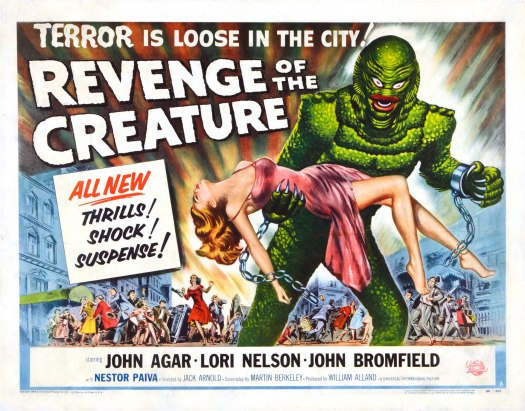
Halloween Havoc!: REVENGE OF THE CREATURE (Universal-International 1955)


gary loggins's avatarcracked rear viewer

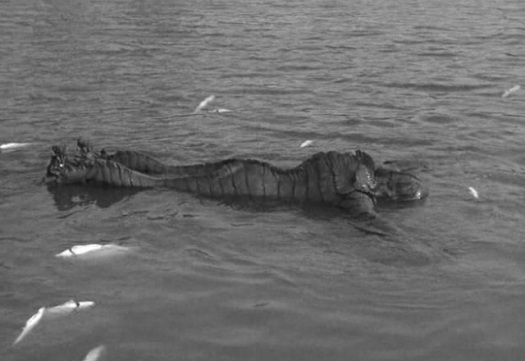
The Gill-Man  made his second appearance in REVENGE OF THE CREATURE, a good-not-great sequel that finds The Creature out of his element and in the modern (well, 1955) world. In fact, The Creature is the most sympathetic character in the film, as he’s hunted, ripped from his home, chained up, tortured, and treated like a freak-show attraction. The humans, with the exception of heroine Lori Nelson, are your basic 50’s sci-fi hammerheads who fear what they don’t understand and try to force The Gill-Man to their will.

Old friend Captain Lucas is once again heading down the Amazon to the Black Lagoon, in his new boat The Rita II. Joe Hayes and George Johnson of Florida’s Ocean Harbor Oceanarium are out to capture The Creature and use him as a theme park attraction. Underwater dynamite charges stun The Gill-Man into a coma, and he’s trussed up and transported stateside. Professor…

View original post 454 more words

Horror on the Lens: The Little Shop of Horrors (dir by Roger Corman)


(It’s tradition here at the Lens that, every October, we watch the original Little Shop of Horrors.  And always, I start things off by telling this story…)

Enter singing.

Little Shop…Little Shop of Horrors…Little Shop…Little Shop of Terrors…

Hi!  Good morning and Happy October the 30th!  For today’s plunge into the world of public domain horror films, I’d like to present you with a true classic.  From 1960, it’s the original Little Shop of Horrors!

When I was 19 years old, I was in a community theater production of the musical Little Shop of Horrors.  Though I think I would have made the perfect Audrey, everybody always snickered whenever I sang so I ended up as a part of “the ensemble.”  Being in the ensemble basically meant that I spent a lot of time dancing and showing off lots of cleavage.  And you know what?  The girl who did play Audrey was screechy, off-key, and annoying and after every show, all the old people in the audience always came back stage and ignored her and went straight over to me.  So there.

Anyway, during rehearsals, our director thought it would be so funny if we all watched the original film.  Now, I’m sorry to say, much like just about everyone else in the cast, this was my first exposure to the original and I even had to be told that the masochistic dentist patient was being played by Jack Nicholson.  However, I’m also very proud to say that — out of that entire cast — I’m the only one who understood that the zero-budget film I was watching was actually better than the big spectacle we were attempting to perform on stage.  Certainly, I understood the film better than that screechy little thing that was playing Audrey.

The first Little Shop of Horrors certainly isn’t scary and there’s nobody singing about somewhere that’s green (I always tear up when I hear that song, by the way).  However, it is a very, very funny film with the just the right amount of a dark streak to make it perfect Halloween viewing.

So, if you have 72 minutes to kill, check out the original and the best Little Shop of Horrors

Friends With Benefits: Demon Wind (1990, directed by Charles Phillip Moore)


Stupid Cory (Eric Larson) has a surprisingly large number of friends and, one weekend, he drags them all out to a burned-out farmhouse.  It used to belong to Cory’s grandparents and Cory hopes to learn why they died.  As soon as they all arrive, a thick fog rolls in and, quicker than you can say Evil Dead, the farmhouse is under siege by monsters that are definitely not Deadites and all of Cory’s friends turn into demons who spits up pancake batter whenever they die.  it turns out that the demons travel on the wind and there’s nothing this demon wind can’t do.

That’s Demon Wind, which is one of the more forgettable straight-to-video horror films to come out of the 90s.  It has a cult following because it was released with one of those 3-D covers that led to a lot of people renting it but the movie itself is a drag with bad acting, bad dialogue, and not enough gore or nudity to really qualify as even a guilty pleasure.  I did like that Cory’s friends were all given one weird personality quirk to help us keep them apart.  There’s a jock with a brainwashed girlfriend and a nerd and two karate guys who dress up like magicians and do magic tricks.  I also liked that even the nerd could get a hot girlfriend.  Though that happens all the time today, that was a bold move for 1990!  When Cory starts to run low on friends, more of them drive up from out of nowhere.  Those are some loyal friends!  Too bad Cory gets everyone killed for no good reason.

Keep an eye out for Lou Diamond Phillips, who was married to the film’s assistant director and who has a cameo as one of the demons.

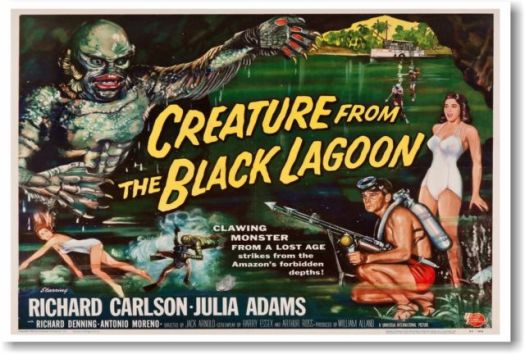
Halloween Havoc!: THE CREATURE FROM THE BLACK LAGOON (Universal-International 1954)


gary loggins's avatarcracked rear viewer

By the early 1950’s, the type of Gothic horrors Universal was famous for had become passe. It was The Atomic Age, and science fiction ruled the roost, with invaders from outer space and giant bugs unleashed by radiation were the new norm. But the studio now called Universal-International had one more ace up its collective sleeve: THE CREATURE FROM THE BLACK LAGOON, last of the iconic Universal Monsters!

Scientist Dr. Maia, exploring “the upper reaches of the Amazon” with his native guides, discovers a fossilized hand that may be the evolutionary “missing link”. Taking his finding to the Institudo de Biologia Martima, he teams with ichthyologist David Reed, David’s pretty assistant/fiancé Kay Lawrence, institute chief Dr. Mark Williams, and fellow scientist Dr. Thompson to form an expedition. They charter the steamer The Rita, skippered by Captain Lucas, and head down the river into the Black Lagoon. Maia’s Indian guides…

View original post 574 more words

I Watched The Jackie Robinson Story


Since I was pretty much indifferent to who won the World Series this year (Congratulations, Boston), I’ve been watching baseball movies instead.  I just finished watching The Jackie Robinson Story.

The Jackie Robinson Story was made in 1950, back when Robinson was still playing second base for the Brooklyn Dodgers.  The movie not only tells the story of how Jackie Robinson became the first black man to play in the major leagues but it also stars Jackie Robinson as himself!

Starting with Jackie’s childhood in Pasadena, the movie follows Jackie as he attends UCLA, serves a brief stint in the Army, and then plays baseball on an all African-American team (Jackie played for the Kansas City Monarchs but, in the movie, the team is renamed the Black Panthers!) before eventually getting signed to join the Dodgers and integrate major league baseball.  While the movie skips over a lot of Jackie’s early life, it doesn’t gloss over the prejudice that he encountered at every step of the way.  When he wins a scholarship to UCLA, people complain that the college has already recruited too many black athletes.  Even when he’s a star player in the Negro Leagues, he still has to ask permission to enter and use the washroom in a diner.  And when he joins the Dodgers, riots are threatened if he plays anywhere in the South.  During one game, his wife (Ruby Dee) overhears the whites in the stands talking about how “the Lodge” is going to visit Jackie.  Through it all, Jackie Robinson keeps his cool and refuses to give the racists the satisfaction of getting to him.  Jackie answers every bigoted comment with the crack of his bat, leaving no doubt that he belongs in the major leagues.

Jackie Robinson was a great baseball player and a great man.  He wasn’t a great actor and, in this movie, he comes across as being stiff and nervous whenever he has to play any dialogue scenes.  But then he swings a bat or catches a ball and it doesn’t matter that he can’t act.  Jackie Robinson was an amazing player and it’s still exciting to watch footage of him today.

The Jackie Robinson Story is a rousing, feel-good baseball movie and a condemnation of racism and bigotry, in all of its insidious forms.

Jackie Robinson

Horror On The Lens: The Twonky (dir by Arch Oboler)


In this 1953 satire, a philosophy professor named Kerry West (Hans Conried) buys a television.  (Remember, this was a time when televisions were still a relatively new phenomena.)  Imagine Kerry’s surprise when he discovers that his television can walk, talk, light his cigarettes, clean the house, and make money materialize out of nowhere!

Sounds great, right?

The only problem is that this TV is not only a bit possessive but it also uses its powers to brainwash people and rob them of their individuality!

Technically, The Twonky is more a comedy than a horror movie.  In fact, it’s really not scary at all.  But it is a lot of fun and it’s interesting to see how a filmmaker in the 50s dealt with television’s growing role in American society.

Enjoy!

Cold Terror: Dead of Winter (1987, directed by Arthur Penn)


Katie (Mary Steenburgen) is a struggling actress with an out-of-work husband (William Russ) and a deadbeat brother (Mark Malone).  Desperately in need of money, Kate goes to an open audition and is immediately hired by Mr. Murray (Roddy McDowall), who explains that Katie will have to meet with one of the film’s investors, the wheelchair-bound Dr. Lewis (Jan Rubes).  In the middle of a raging snowstorm, they go to Dr. Lewis’s home and, once they’ve arrived, Katie discovers that she is meant to replace an actress who looked exactly like her but who Dr. Lewis claims had a nervous breakdown.  She’s told that she must stay the night so she can meet the director in the morning and when she tries to call her husband to let him know where she is, the line is dead.  (For those born after 1996, the line being dead was the 80s equivalent of not being able to get a signal.)  Dr. Lewis says it must be due to the storm but he promises to have Mr. Murray take her into town in the morning.  Of course, the next morning, the car doesn’t start and it becomes clear that Dr. Lewis is not planning on ever letting Katie leave his home.

Dead of Winter is a throw-back to the type of gothic, damsel-in-distress films that actresses like Nina Foch, Ingrid Bergman, and Linda Darnell used to make back in the 1940s and 50s.  If you can accept that anyone could ever be as naive as Katie, it’s not that bad of a thriller.  Director Arthur Penn fills his movie with homages to Hitchcock and the scene where a drugged Katie wakes up to discover that she’s missing a finger is an effectively nasty shock.  By the end of the movie, Mary Steenburgen has played three different characters and she does a good job as all three of them.  Jan Rubes makes Dr. Lewis’s too obviously evil but Roddy McDowall is great as the polite but psychotic Mr. Murray.  When Mr. Murray sees that Katie has tried to escape by climbing out a window, he yells, “Oh dear!” and only Roddy McDowall could have pulled that off.

Dead of Winter was Arthur Penn’s second-to-last theatrical film.  After making films like Bonnie and Clyde, Little Big Man, and Alice’s Restaurant, Penn’s career went into decline as the American film industry became increasingly centered around blockbusters and Penn’s cerebral approach fell out of favor.  After Dead of Winter, Penn would direct Penn & Teller Get Killed before returning to his roots as a television director.  Penn ended his long and distinguished career as an executive producer on Law & Order.