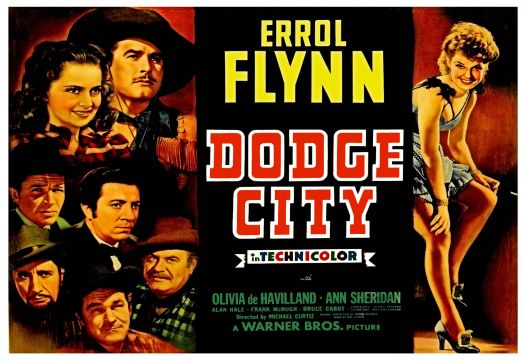
1939 has been proclaimed by many to be Hollywood’s Greatest Year. I could make a case for 1947, but I won’t go there… for the moment. Be that as it may, 1939 saw the release of some true classics that have stood the test of time, including in the Western genre: DESTRY RIDES AGAIN, JESSE JAMES, STAGECOACH , and UNION PACIFIC. One that doesn’t get a lot of attention anymore is DODGE CITY, the 5th screen pairing in four years of one of Hollywood’s greatest romantic duos, heroic Errol Flynn and beautiful Olivia de Havilland.
DODGE CITY was Warner Brothers’ biggest hit of 1939, and the 6th highest grossing picture that year, beating out classics like GOODBYE MR. CHIPS, GUNGA DIN, NINOTCHKA, and THE WIZARD OF OZ. It’s a rousing actioner with plenty of romance and humor thrown in, shot in Glorious Technicolor by Warners’ ace director Michael Curtiz …
And if you don’t believe it is a real movie: Here is the poster to prove it.
WARNING: This movie contains extreme language, nudity, strong sexual content, and very intense scenes of gore. Not at all recommended for people who are sensitive to that!
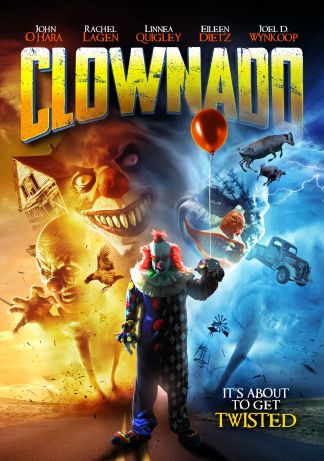
Cursed demonic circus clowns set out on a vengeful massacre using tornadoes. A stripper, Elvis impersonator, truck driver, teen runaway, and a dude get caught in the supernatural battle between femme fatal and the boss clown from hell.
Review:
Seriously, as some one who suffers from coulrophobia, I could not help but laugh at this movie. The plot is so ridiculous. The acting is beyond bad. The clowns are no more than juggalo wannabes in bad makeup. The writing seemed like it was made up on the spot by a really bad improve troop. The special effects were neither special nor effective. It, however, could have been a quality horror movie if they had spent a bit more money on the movie than they did on the opening credits.
I guess, as the press release says, “The Joke’s on you when Clownado blows in” and I did spend 1 hour and 34 minutes of my life watching this movie.
When can you see Clownado?
Wild Eye Releasing along with Extreme Entertainment will let the clowns blow thru your VOD September 3rd and touch down on your DVD’s September 17th!
Oh, you are still reading this preview / review and want to see the trailer for Clownado? Ok, but don’t say I didn’t send you a Clownado warning!
The year is 1919 and a brutish young man named Al (played by Rod Steiger) has just arrived in Chicago. He’s got a new job, working for the city’s top mobster, Johnny Torrio (Nehemiah Persoff). Torrio is the second-in-command to Big Jim Colosimo (Joe De Santis) and is impressed enough by the young Al to take him under his wing.
It’s an exciting time to be a gangster in Chicago because prohibition is about to become the law of the land. Alcohol is about to become illegal, which means that there will soon be an unregulated underground of people smuggling booze into the United States and selling it in speakeasies across the land. Those speakeasies are going to be need men to watch the door and to toss out troublemakers and it turns out that’s a perfect job for someone who isn’t afraid of violence.
Someone like Al, for instance.
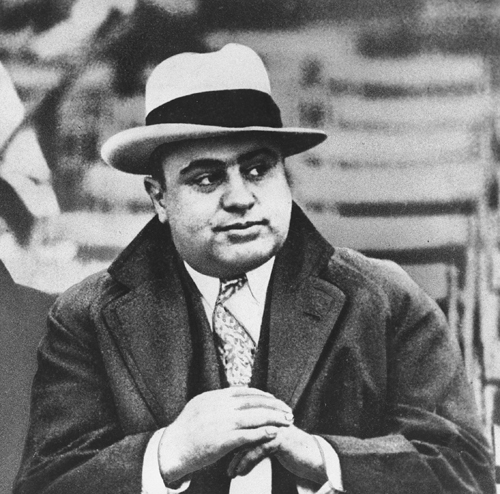
It’s while Al is working as bouncer that he receives a long and deep gash across his face. When the wound heals, it leaves him with the scar that will come to define him for the rest of his life. As much as he hates the nickname “Scarface,” it’s what Al Capone will be known as.
The 1959 film, Al Capone, follows Capone as he works his way up the ladder of the Chicago underworld until he eventually finds himself sitting atop an empire of corruption and crime. Along the way Capone kills the majority of his rivals and finds the time to fall in love with Maureen Flannery (Fay Spain), the widow of one of his victims.
Well, perhaps love is the wrong word. As played by Rod Steiger, Al Capone isn’t really capable of loving anyone but himself. This film does not provide us with the superslick or diabolically clever Capone that has appeared in other gangster movies. Instead, Steiger plays Capone as almost being a caged animal. Capone comes to power through violence and betrayal and he uses the same techniques to hold onto power. The film suggests that the secret of his success was his complete lack of conscience but that the same arrogant stupidity that makes him so fearsome also leaves him doomed to failure. There’s really nothing subtle about Steiger’s performance but then again, there was probably nothing subtle about Al Capone, either. Steiger’s tendency to overact every moment works well in the role of a man who constantly seems to be striking out at anyone who makes the mistake of getting too close to him.
Though many films had featured characters based on Capone, Al Capone was the first biographical film to actually be made about the infamous leader of the Chicago Outfit. (Up until the mid-50s, the Hollywood Production Code expressly forbade anyone from portraying a “real” gangster in a movie.) With the exception of the character of Maureen Flannery (who was a heavily fictionalized stand-in for Capone’s then-living widow), Al Capone is fairly faithful to the know facts of Capone’s life. The film not only includes most of Capone’s violent acts (i.e., the St. Valentine’s Day Massacre) but it also explores both how Capone was protected by Chicago’s corrupt political establishment and how prohibition actually enabled the activities that it was meant to prevent. Director Richard Wilson directs in a semi-documentary style and the film’s harsh black-and-white images capture the idea of a shadowy world hidden away from “respectable” society. It’s a fast-paced film and fans of classic character acting will be happy to see James Gregory as an honest cop and Martin Balsam as a not-at-all honest reporter.
If you’re looking to put together a quick cinematic history lesson about the origins of the Mafia before you watch Martin Scorsese’s The Irishman later this year, Al Capone is a worthwhile addition to your curriculum.
The will to survive is a strange thing. Why do some people give up their wallet or purse to a mugger freely and others snap and fight to the death? Back in the days when I could jog, I was in Central Park early on a Sunday and a mugger tried to take my little POS MP3 player. I could’ve done the smart thing and given it up, but something just clicked and I started punching and punching. His face was total shock and he wandered off. He wasn’t threatening my life, but it didn’t matter if he were, I would’ve acted the same. And Yes, my 93 tracks ranging from Springsteen to Modest Mouse remain safe to this day. Ready or Not tests whether Grace (Samara Weaving) has the will to survive and she didn’t even have an ipod to protect.
The people hunting people is almost a sub-genre, but this movie had style. It’s got horrible and quasi-incompetent murderers, a tough but vulnerable heroine, and lots and lots of BLOOD!
Grace is set to marry into a family of rich asshats who treat her like garbage. Well, except for Daniel (Adam Brody) the brother of Alex – the groom to be. Daniel thinks she should leave because she’s too good for his worthless family. Daniel has a point. The aunt is a mean spirited jerk and all of the people who enter the family are pretty desperate in one way or the other, making them agreeable to participate in their lethal affairs.
Grace decides to marry Alex anyway even though the family’s shitty personalities are on full-display. The honeymoon begins and Grace must choose a card because she is entering the family. A creepy box has a playing card and determines which card; sometimes the game is Chess, Checkers, or Hide and Seek. If Hide and Seek is chosen, the family will hunt the new entrant to the family and sacrifice him or her to Satan- In-Laws … Am I Right?!!!
Grace picks hide and seek and the game is a foot….dun dun dun! This kicks off a lot of suspense and humor as Grace fights her in-laws to the death. Grace asks her new husband Daniel why he didn’t warn her that his family is a bunch psycho killers? His response: You would’ve left me. Daniel, you suck! We all hate you Daniel…A LOT!
The family hunts Grace all over the estate and she gets hurt and screams….and Screams…AND SCREAMS! Samara Weaving’s screams are THE BEST EVER. They are a mixture of gutteral staccato and high pitched terror and they are legit real. All other scream queens before her must hail the new Queen. Here is an example of Samara’s amazing scream queen skills:
RIGHT?!!!! She’s is legit awesome – a throwback and beyond to the glory days of horror. She’s a mix of vulnerable and badass, cunning and funny, basically she rocks this entire movie! Everyone should go see this movie tonight!
Yes, this review is a little brief, but I don’t want to spoil too much. Enjoy!
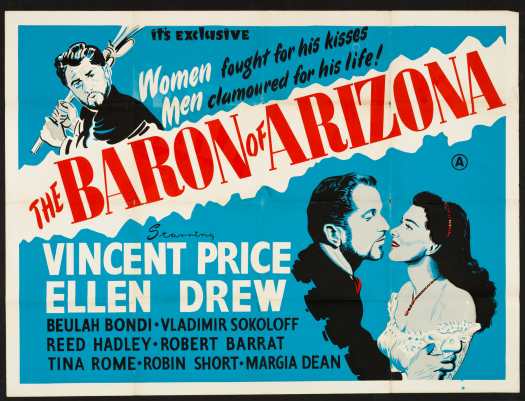
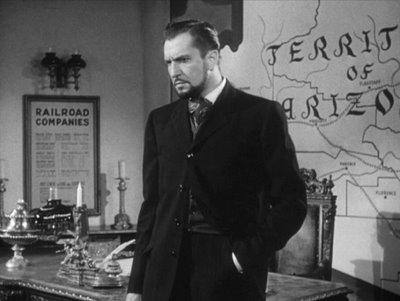
We all know and love Vincent Price for his creepy performances in horror films, from his demented Henry Jarrod in HOUSE OF WAX, to all those AIP/Roger Corman/Edgar Allan Poe shockers, to his turn as The Inventor in EDWARD SCISSORHANDS. But the actor was more than just a screen fiend, playing in many a filmnoir, comedies, costume swashbucklers, and even the Western genre. Our Man Vinnie got top billing in a strange little oater titled THE BARON OF ARIZONA, and as a bonus for film fans the director is a young tyro by the name of Samuel Fuller!
In this bloodless but gripping outing, Price plays James Addison Revis, a swindler, con man, and forger who concocts an elaborate, grandiose scheme to gain control over the Arizona Territory in 1882. He begins his con game ten years earlier by grooming an orphaned waif named Sofia to later be…
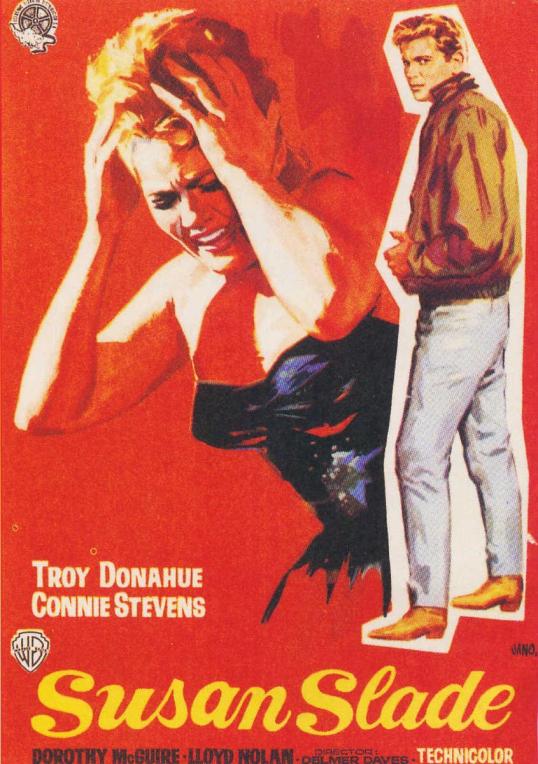
Shortly after this 1961 film begins, 17 year-old Susan Slade (Connie Stevens) announces, “We’ve been sinful!”
She’s talking to her first lover, Conn White (Grant Williams). You would think that anyone — even someone as unbelievably naive and innocent as Susan Slade — would know better than to ever trust someone named Conn White but no. From the minute that Conn and Susan met on an ocean liner heading from South America to California, it was love at first sight. In fact, Susan was so sure of her love that she spent the night in Conn’s cabin, fully knowing that it would mean surrendering her status as an Eisenhower era good girl.
Conn laughs off her concerns about sin. He also tells her that it makes perfect sense for her not to tell her parents (played by Dorothy McGuire and Lloyd Nolan). “When we’re married,” he asks, “are you going to tell your mother every time that we make love?”
Wow, Conn still wants to get married even though he’s already had sex with her!? And he’s also extremely wealthy and stands to inherit control of a multinational corporation! He sounds like the perfect guy! Way to go, Susan!
Unfortunately, it turns out that Conn does have one flaw. He really, really likes to go mountain climbing. In fact, he’s planning on scaling fearsome old Mt. McKinley. While Susan and her family settle into life in Monterey, California, Conn heads up to Alaska. He promises Susan that he’ll keep in touch but, when she doesn’t hear from him, she fears the worse. Has he abandoned her? Was he lying when he said he wanted to get married? Then one day, she gets a call from Conn’s father, informing her that Conn fell off the mountain and died. Susan’s almost father-in-law tells her that Conn’s body cannot be retrieved from the mountain. Though it’s neither confirmed nor denied by the film, I decided that this was because Conn faked his own death to get out of having to spend any more time listening to Susan talk about sin.
Anyway, Susan’s single again but, fortunately, she does not lack for suitors. For instance, there’s the spoiled Wells Corbett (Bert Convy), who is kind of shallow and arrogant but who has a lot of money. And then there’s Hoyt Brecker (played, in reliably vacuous style, by Troy Donahue), who is poor but honest and who is also an aspiring writer. “Someday,” Susan declares,”they’ll say that Robert Louis Stevenson, Jack London, and Hoyt Brecker wrote here!” Who will Susan chose? The sensitive artist who loves her unconditionally or the arrogant rich boy who smirks his way through the whole film?
Complicating matters is the fact that Susan is …. pregnant! That’s right, this is another one of those movies from the early 60s where having sex outside of marriage always leads to an unplanned pregnancy. And, because this movie is from 1961, the only solution is for the Slades to move down to Guatemala for two years, just so they can fool the people on Monterey into believing that the baby is actually McGuire’s and that Susan Slade is not an unwed mother but is instead an overprotective older sister. Will either of Susan’s two suitors be waiting for her when she and her family return to California?
Now, please don’t get me wrong. I do understand that there’s a big difference between 1961 and 2019 and that there used to be a lot more scandal attached to sex outside of marriage and unwed pregnancy. In fact, I guess that difference is really the only thing that makes Susan Slade interesting to a modern viewer. As soon as we see that this film was directed by Delmer Daves (the poor man’s Douglas Sirk) and that it stars Troy Donahue, we know who poor Susan is going to end up with so it’s not like there’s any real surprises lurking in the film’s plot. And none of the actors, though Connie Stevens sometimes to be trying, seems to be that invested in the film’s story. Instead, Susan Slade is mostly useful of a time capsule of the time in which it was made, a time when sex outside of marriage was unironically “sinful” and the only possible punishment was either pregnancy, death, or both. Indeed, Susan Slade is less concerned about the hypocrisy of a society that would force Susan to lie about her new “brother” and more about whether bland lunkhead Troy Donaue will still be willing to marry Susan even if she’s no longer eligible to wear white at their wedding. The film seems to be asking, “After being sinful, can Susan Slade become a good girl again?” As a movie, it’s fairly turgid but as a cultural artifact of a time in which everyone was obsessed with sex but no one was willing to talk about it, Susan Slade is occasionally fascinating.
Poor Susan Slade! If only she had gotten pregnant in a 1971 film instead of one made in 1961, her story could have been so different. But no, she was sinful in the early 60s and that means she’ll be have to settle for Troy Donahue.
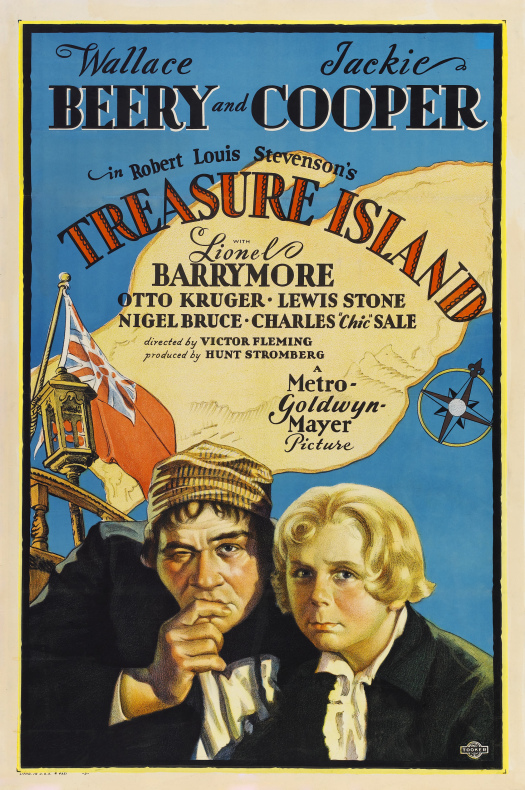
Robert Louis Stevenson’s venerable 1883 adventure novel TREASURE ISLAND has been filmed over 50 times throughout the years, beginning with a 1918 silent version. There was a 1920 silent starring Charles Ogle (the original screen FRANKENSTEIN monster!) as that dastardly pirate Long John Silver, a 1972 adaptation with Orson Welles, a 1990 TV Movie headlined by Charlton Heston, and even a 1996 Muppet version! Most movie buffs cite Disney’s 1950 film as the definitive screen TREASURE ISLAND, with Bobby Driscoll as young Jim Hawkins and Robert Newton as Long John (and Newton would go on to star in the TV series LONG JOHN SILVER, practically making a career out of playing the infamous fictional buccaneer), but…
…a case can certainly be made for MGM’s star-studded 1934 interpretation of the story, teaming Wallace Beery and Jackie Cooper as Long John and Jim. This was the first talking TREASURE ISLAND, and the…
After, which was released back in April, tells the story of the world’s most boring college romance.
Tessa (Josephine Langford) is a beautiful, intelligent, but shy good girl who has just started college and who is struggling to fit in with her fellow students. Her new roommate has tattoos and a nose ring and Tessa’s just not sure if she can keep up with a group of campus rebels who drink, vape, and play extremely anodyne games of truth or dare. Tessa’s roommate demands to know why Tessa has so many old books. It’s because Tessa loves to read but we soon discover that her literary tastes seem to be dominated by her old high school reading list. In her lit class, she says that Pride and Prejudice is a “revolutionary feminist novel,” in a tone of voice that indicates that she googled “revolutionary feminism” for the first time the previous night.
Hardin (Hero Fiennes-Tiffin) is a bad boy because he has tattoos and he tends to smirk before leaving a room. Hardin seems like he’s …. well, I guess he’s supposed to be dangerous. He’s cynical and he says there’s no such thing as love but actually, he just needs someone to help tend to his emotional wounds. We know that he’s not really a bad dude because he likes Jane Austen and he has a copy of Wuthering Heights in his room, one that’s full of book marks, indicating that he is an actual serious student of literature. He also says that The Great Gatsby was all a dream. (Seriously, you know he’s serious about literature when he owns copies of both Wuthering Heights and The Great Gatsby. I imagine if the movie had lasted a few minutes longer, he would have said, “Hemingway was the poor man’s Hemingway,” and everyone’s mind would have been totally blown.)
Anyway, from the minute that a towel-clad Tessa returns to her dorm room from taking a shower and discovers Hardin sitting in the corner (and reading, of course!), it’s pretty obvious that they’re destined to fall in love. (Of course, considering that Hardin refused to leave the room so Tessa could get dressed, it was perhaps just as likely that she would end up filing a harassment complaint.) Of course, the path to true love never runs smoothly. Tessa has a sweet boyfriend that she’ll need to dump. Hardin has all sorts of emotional baggage that he needs someone to unpack for him. Still, while Hardin and Tessa are swimming in the nearby lake, Hardin says, “We could never be just friends….”
If this all sounds like bad fanfic, that’s because it is. After is based on a novel by Anna Todd. The novel started out as fan fiction and Hardin was originally named Harry Styles. Anyway, the novel sold a lot of copies and developed a reputation for being an innocent version of Fifty Shades of Grey so I guess it’s inevitable that it would later be adapted into an amazingly bad movie. I mean, the sex was the only good thing about Fifty Shades so I’m not sure why someone would say, “Let’s make a chaste version of this book!”
The main problem with After is that both Tessa and Hardin are such inherently boring characters and all the soft-focus shots in the world can’t make them interesting. It doesn’t matter how much time they spend interlocking their fingers, they never seem like people who you’d want to get stuck in a conversation with. Tessa may claim to be into “revolutionary feminism” but she only exists to find a man. She’s defined by how she feels about Hardin and Hardin seems to be the only thing she’s interested in. Meanwhile, Hardin is the worst type of phony intellectual, the self-centered rich boy who has a convenient tragedy for every occasion. Josephine Langford and Hero Fiennes-Tiffin are both attractive in a “I just shot a pilot for the CW” sort of way but neither has much screen presence and, together, they generate so little chemistry that they might as well be two wax figures staring into each other’s glass eyes.
“I’m a mess,” Hardin says and Tessa agrees, “I think we’re both a mess,” and everyone who is a real mess replies, ‘Oh, fuck off, you two.”
I always worry a little bit about Chloe Grace Moretz.
Seriously, it seems as if every film in which she appears features her either losing her entire family or getting stalked by some psycho or both. It’s rare that she ever gets to play someone who is happy with their life. Even when she was cast against type as a spoiled, vacuous brat in Clouds of Sils Maria, she still came across as being the saddest spoiled, vacuous brat imaginable. Obviously, Mortez has the dramatic talent necessary to play these type of roles and, out of all the young actresses working today, she seems the most likely to still have an interesting career 30 years from now. Still, it’s hard not to wish that she could just do a nice, romantic comedy at some point in the future, if just to give her a break from constantly being menaced on screen.
This year’s Chloe Moretz Gets Stalked film was Greta. In this one, Moretz plays Frances McMullen, a waitress living in New York City. Frances lives in a nice loft, has a fantastic roommate and best friend named Erica (Maika Monroe), and a strained relationship with her wealthy father (Colm Feore). As is typical of any character played by Chloe Moretz, Frances is still struggling to come to terms with the recent death of her mother.
After Frances finds an expensive handbag on the subway, she returns it to its owner, a piano teacher named Greta Hibeg (Isabelle Huppert). Greta claims to be French and says that she’s been lonely ever since her daughter left home to study music in France. Frances needs a substitute mother. Greta needs a substitute daughter.
Can you tell where this is going?
If you said, “Together, they solve crimes!,” — well, you’re wrong but you’re still my hero. Instead, what all this leads to is Greta becoming rather obsessed with Frances. When Frances discovers that Greta has a whole closet full of handbags and that she’s not even French, Frances decides to end their friendship. However, Greta will not take no for an answer. Soon, Greta is following both Frances and Erica all around New York City. Greta even goes to Frances’s place of employment and makes a scene that leads to Frances losing her job. (Considering the amazingly ugly waitress uniform that Frances was required to wear, I’d say that Greta was doing her a favor.) Eventually, it all leads to a kidnapping, a drugging, and an unexpected visual gag involving the Eiffel Tower.
About 30 minutes into Greta, there’s a scene in which Isabelle Huppert spits a piece of chewing gum into Chloe Moretz’s hair and it was at that moment that I knew that I was going to absolutely love this film. I mean, there have been a lot of films made about people being stalked but it takes a certain amount of demented genius to have one of the world’s most acclaimed actresses actually spit a piece of gum into someone’s hair. Brilliantly, the film follows this up with a scene of Frances and Erica trying to press assault charges against Greta, all because of the gum incident. The cop is so cynical and unimpressed by their story that you just know that Frances is probably like the hundredth person to get attacked by chewing gum in just that day.
My point here is that there’s absolutely nothing subtle about Greta and we’re all the better for it. As directed by Neil Jordan, Greta is a thoroughly excessive and deliberately campy little film and definitely not one to be taken too seriously. Everything, from the lush cinematography to Greta’s sudden rages, is wonderfully over-the-top. While Moretz wisely underplays her role (because, after all, someone has to keep things at least vaguely grounded in reality), Maika Monroe and especially Isabelle Huppert dive head first into the film’s melodramatic atmosphere. Huppert, especially, deserves a lot of credit for her ferocious performance as Greta. Whether she’s cheerfully celebrating a murder by doing an impromptu dance or suddenly screaming in Hungarian, Huppert is never less than entertaining while, at the same time, remaining credible as a very threatening individual. One of the great joys of Greta is watching this masterful French actress play a Hungarian who is obsessed with Paris. (It’s also probably not a coincidence that Greta is obsessed with someone named Frances.)
There’s an interesting subtext to the Greta and Frances relationship, one that goes beyond a girl who needs a mother and a woman who needs a daughter. In many of the scenes where Greta stalks Frances, Huppert plays her as if she’s a spurned lover, crying out, “I love you!” and demanding that Frances return her phone calls. As for Frances, she’s portrayed as being an almost absurdly repressed single girl who spends all of her personal time with two very different women, the accepting and fun-loving Erica and the predatory and destructive Greta. (When Erica tells Frances that a guy who is interested in her is throwing a party, Frances says that she already has plans with Greta.) Watching Greta, it occurred to me that the film was really about Frances coming to terms with her own sexuality, with Greta representing her fears and Erica representing the peace of accepting who you are. The film may be about Greta stalking Frances but it’s also about Frances struggling to decide whether to give in to her fears or to accept her own identity.
Then again, it’s also totally possible that there’s no intentional subtext at all to this film. It might just be an entertaining film about Isabelle Huppert stalking Chloe Moretz. And that’s fine, too! Either way, it’s a fun movie.
Baseball movies are as American as apple pie, and everyone has their favorites, from classic era films like THE PRIDE OF THE YANKEES and TAKE ME OUT TO THE BALL GAME to latter-day fare like THE NATURAL and FIELD OF DREAMS. There’s so much to choose from, comedies, dramas, and everything in-between. One of my all-time favorites is 1993’s coming of age classic, THE SANDLOT.
Like most baseball movies, THE SANDLOT is about more than just The Great American Pastime. Director David Mickey Evans’ script (co-written with Robert Gunter) takes us back to 1962, as young Scotty Smalls has moved to a brand new neighborhood in a brand new city. His dad died, and his mom (Karen Allen of NATIONAL LAMPOON’S ANIMAL HOUSE fame) has remarried preoccupied Bill (young comedian Denis Leary…. hmmm, I wonder what ever happened to him??), who tries to teach the nerdy kid how to play…





 Through the Shattered Lens