Horror On The Lens: Night Tide (dir by Curtis Harrington)


Night Tide

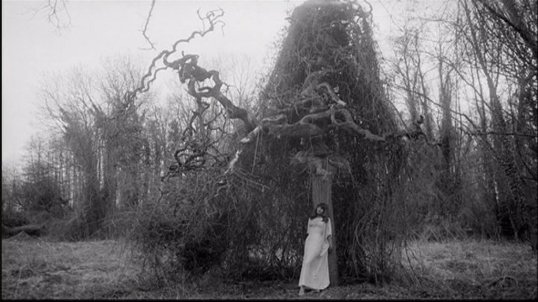
First released in 1961 and directed by Curtis Harrington, Night Tide stars a young Dennis Hopper as Johnny, an awkward sailor.  Johnny meets Mora (Linda Lawson), who works as a “mermaid” on the pier.  For Johnny, it’s love at first sight.  However, the more that Johnny pursues her, the more he learns about both her mysterious past and the dark fate of her previous boyfriends.

Night Tide is low-key and atmospheric gem of a movie, one that serve as an inspiration for low-budget filmmakers every where.  Lawson is perfectly cast as the enigmatic Mora but the film really belongs to Dennis Hopper.  Hopper’s naturally off-key presence made him perfect for the role of Johnny.

Night Tide is one of those low-budget movies that, because it’s in the public domain,  has been released on DVD (often in inferior form) by dozens of different companies.  Often times, films like this turn out to be fairly forgettable.  Night Tide, however, is an exception.

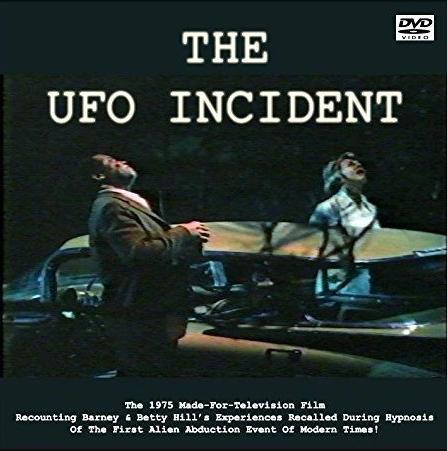
The Story of the Hills: The UFO Incident (1975, directed by Richard A. Colla)


Betty and Barney Hill (played by Estelle Parsons and James Earl Jones) are a happily married couple living in New Hampshire in the mid-60s.  They are both haunted by something that happened two years previously, while they were on vacation.  They both remember something appearing in the sky over their car but they can’t remember anything that happened afterwards.  They are both haunted by nightmares and a strong feeling that something terrible most have happened to them.  Finally, they meet with Dr. Benjamin Simon (Barnard Hughes), who places them both under hypnosis.  Only then does a clear picture start to emerge of what Betty and Barney believe happened as they both describe being abducted and experimented upon by aliens.

The UFO Incident is a very sober and serious account of the Hills’s abduction.  It never takes a clear side as to whether Betty and Barney are remembering something that actually happened or if they’re just remembering elaborate dreams.  That works to the film’s advantage, though it might disappoint those looking for a more dramatic take on the subject.  This is a made-for-TV movie so don’t expect much from the special effects and the alien costumes look disappointingly cheap.  The important thing, though, is that the film treat the Hills and their story with respect and James Earl Jones gives one of his best and most relatable performances as Barney.  The film is as much about how even a good marriage can be threatened by stressful times as it is about the UFOs.

The UFO Incident is based on the non-fiction book, The Interrupted Journey by John G. Fuller, which purported to tell the story of the Hills and their abduction.  The Hills were two of the first people to come forward with a story about being abducted by aliens.  Much of the common elements that can be found in stories about alien abductions, like the little grey men, the medical experimentation, and the amnesia afterwards, began with the Hills’s account of what they believed happened to them in 1961.  The Hills, who were active and highly respected in their community, were considered to be unusually credible witnesses, though Dr. Simon ultimately decided that Barney’s recollections of being on the UFO were probably influenced by Betty’s descriptions of her nightmares.  Barney, himself, died in 1969, three years after the book was published.  Betty remained active in the UFO community until her death in 2004.

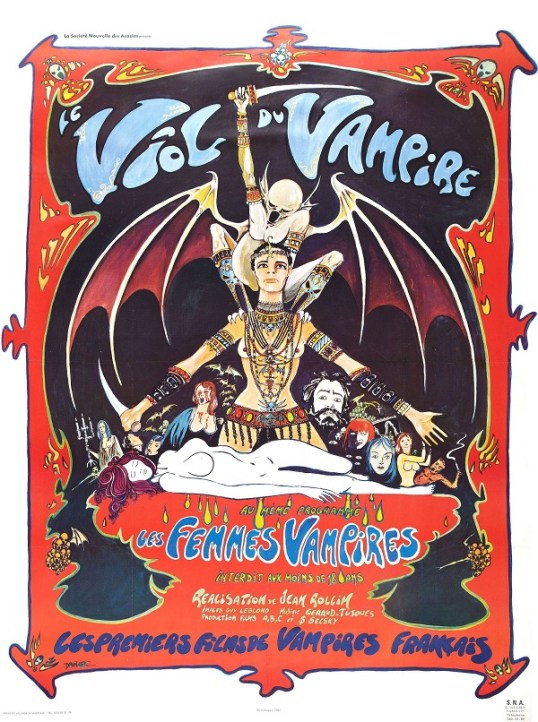
Critique Cinématographique: Le Viol du Vampire (dirigé par Jean Rollin)


Don’t worry, I’m not going to review this film in French.

I wish I could because this was the feature film debut of Jean Rollin, who made horror films that were uniquely French in both their vision and their execution.  A decade ago, I probably could have written an at least 300-word review in vaguely passable French but, unfortunately, my language skills have gotten a bit rusty as of late.  “But Lisa, what about Google translate?”  Uhmmm ….. yeah, that’s not a good idea.  The comprehension powers of Google translate are a bit overstated.

Anyway, on to the film!

I absolutely love the wonderfully surreal films of Jean Rollin.  At his best, Rollin was responsible for some of the most visually impressive and narratively incoherent films ever made.  Believe it or not, I don’t mean incoherent in a bad way.  A Rollin film creates its own unique world, one in which things don’t necessarily have to make much sense.  A Jean Rollin movie is like a filmed dream, one in which the stories continually seem to loop back to the same group of obsessions.  There’s always an emphasis on memory and the importance of the past.  The countryside is always beautiful but also always full of menace.  There’s always a scene or two at the beach.  It’s not unusual for a Rollin film to end with the water washing away the evil, like some sort of fairy tale.  There’s usually a house in the country and Rollin’s camera loved old French architecture just as much as it loved images of people making love.  Rollin’s films often very sincerely celebrated female friendship while, at the same time, continually returning to the theme of lesbian vampires.  In fact, I think it can be argued that the best way to appreciate Rollin’s films is to sit down and watch all of them, one after another.  So many theme reoccur from film to film that ultimately, they all become a part of giant and very strange tapestry of lust, secrets, and the paranormal in France.

Le Viol du Vampire (which translates to The Rape of the Vampire in English) was Rollin’s feature directing debut.  It started out as a 30-minute short film, one that more or less made sense.  A producer then offered Rollin some money to expand the short into a feature film.  The end result was a deeply strange but visually stunning film, one in which characters who clearly died in the original short film mysteriously came back to life so that they could take part in the second part of the film.

During the first 30 minutes of the film, three Parisians are called out to a country château (because it’s not a Rollin film without a château) to investigate four sisters who believe that they’re vampires.  (One of the sisters is blind and says she became a vampire after being raped by the local peasants, hence the film’s title.)  The Parisians believe that the sisters are being manipulated by an evil old man.  The sisters believe that they are all vampires.  It turns out that they’re all right!

As I said, that part of the film makes sense.  But then suddenly, a vampire queen appears and suddenly there’s all these other vampires running around and some of them are dressed like court jesters and there’s a doctor working at a clinic who thinks that he can cure vampirism and then there’s a revolution against the queen and there’s a car chase and you’re never really sure who is who or what it is that they’re doing or why they’re doing it.  Rollin was a noted fan of the old serials and that’s how directs the final 60 minutes of Le Viol du Vampire.  Cliffhanger after cliffhanger follows twist after twist and, again, you find yourself wondering if even Rollin was able to keep up with it all.

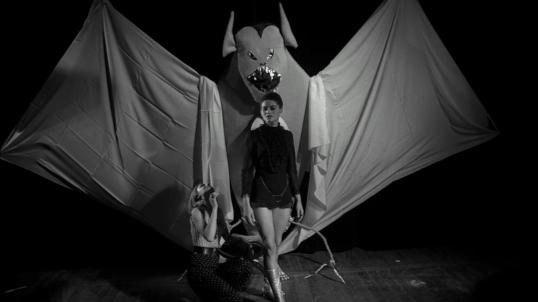
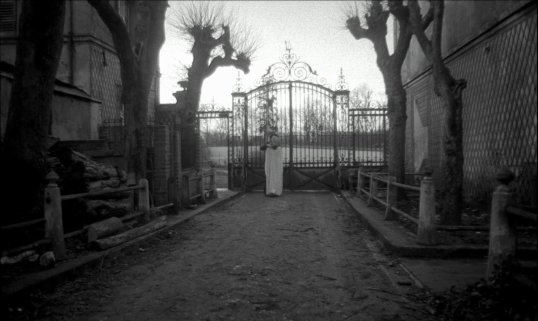
And yet, it remains a compelling film because Rollin was such a gifted visual artist and the black-and-white cinematography is so atmospheric that it’s very easy to ignore the plot and instead just enjoy looking at the film.  I would actually suggest waiting to watch this film until you’ve seen some of Rollin’s other films.  Once you’ve experienced Rollin’s unique aesthetic vision, it’s easy to watch Le Viol du Vampire and say, “There’s the beach!  There’s the clowns!  There’s the lesbian vampires!  There’s everything that we’ve come to expect from Jean Rollin!”

Le Viol du Vampire was released in 1968.  It was released at a time when political turmoil had brought much of the French film industry to a halt.  As a result, Le Viol du Vampire was the only film playing several theaters.  If you were in France during the summer of 1968 and you wanted to go to the movies, Le Viol du Vampire was often the only option available.  As a result, a huge number of people went to this movie.  Audiences were reportedly so angered by the film’s intentional incoherence that they rioted and threw things at the screen.  It was quite a scandal but it also made Rollin a bit of a star.

Seen today, the film is still incoherent but it’s also a chance to see where one of the most interesting horror directors of the 20th Century got his start.

Horror Film Review: The Amazing Mr. X (dir by Bernard Vorhaus)


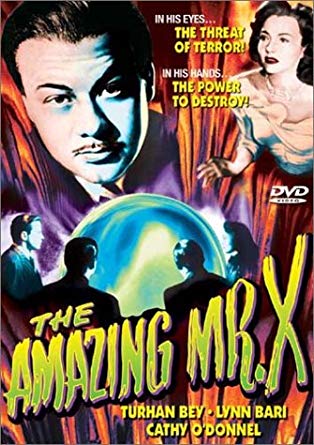
A woman named Christine (Lyn Bari) walks along the beach when she thinks that she hears the voice of her husband calling out her name.  The only problem is that her husband has been dead for two years.  Christine’s sister, Janet (Cathy O’Donnell), says that Christine is just hearing things and that she needs to move on from mourning.  After all, her boyfriend, Martin (Richard Carlson), is on the verge of asking Christine to marry him….

And yet, Christine can’t escape the feeling that her husband is trying to contact her from beyond the grave.  During another walk along the beach, she runs into a handsome man who introduces himself as being Alexis (Turhan Bey).  Alexis says that he’s a medium and that he has the power to speak to the dead.  Furthermore, he tells Christine that he can speak to her dead husband for her.

Despite the fact that Alexis owns a really impressive crystal ball, Martin is skeptical of his claims.  Martin even goes so far as to hire a private investigator (Harry Mendoza) to investigate Alexis’s past.  Meanwhile, though she has her suspicions, Janet finds herself falling in love with the charming Alexis….

Released in 1948, The Amazing Mr. X is an unjustly obscure little mystery film.  Though I guess it’s open to debate whether it should be considered a horror film or just a noirish thriller, The Amazing Mr. X is full of creepy atmosphere and eerie moments.  Employing expressionistic camera angles and dark lighting, director Bernard Vorhaus turns The Amazing Mr. X into a dream of dark and forbidden things.  Some of the black-and-white shots are simply stunning and the seance sequence is brilliantly done.

The film is also well-acted by a cast of actors who deserve to be better remembered.  Lynn Bari is perfectly fragile and sympathetic as the haunted Christine while Cathy O’Donnell turns the potentially boring Janet into a compelling character.  The film even makes good use of Richard Carlson’s reliable dullness by casting him as the one character who is meant to be a force of stability in Christine’s otherwise neurotic life.

That said, the entire film is stolen by Turhan Bey.  Born in Austria and of Turkish descent, Turhan Bey was nicknamed the “Turkish Delight” during his film career and, watching The Amazing Mr. X, you can see why.  Bey is so charming and so handsome that you can understand why even those who should know better would want to believe that Alexis could talk to the dead.  The Amazing Mr. X was one of the last films that Bey filmed in the United States.  He retired a few years later and returned to his native Austria, where he ran a cafe.  (40 years later, the now elderly Bey did come out of retirement and made a few appearance of television before passing away, at the age of 90, in 2012.)

Like all good mysteries, The Amazing Mr. X has a third act twist that you probably won’t see coming and it ends with the proper combination of tragedy and redemption.  The Amazing Mr. X is currently in the public domain and can be viewed on YouTube so check it out!  You won’t be sorry!

Horror On The Lens: The House On Haunted Hill (dir by William Castle)


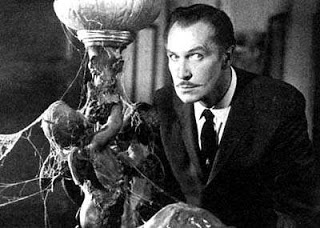
The original The House on Haunted Hill is a classic and one that we make it a point to share every Halloween.  And since October is nearly halfway over, now seems like the perfect time to do so!

Be sure to check out Gary’s review by clicking here!

Enjoy Vincent Price at his best!

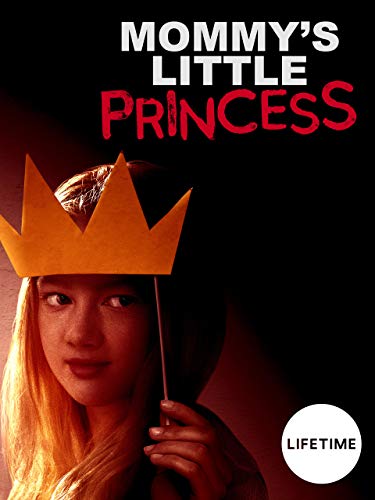
What Lisa Watched Last Night #201: Mommy’s Little Princes (dir by Curtis Crawford)


Last night, as soon as I got home from work, I turned over to the Lifetime Movie Network and I watched Mommy’s Little Princess!
Why Was I Watching It?

Why not?

No, actually, I did have a very specific reason for watching it.  Mommy’s Little Princess was a film that I watched earlier this year but, for whatever reason, I didn’t review it.  Unfortunately, I didn’t record it either.  So, by watching it yesterday, I was able to reacquaint myself with the film before reviewing it.

Because that’s what ethical reviewers do!

What Was It About?

12 year-old Lizzy (Sarah Abbott) is haunted by the memories of her abusive mother and a fear that she’s not that special.  In order to make Lizzy feel a bit better about herself, her adoptive mother, Julianna (Alicia Leigh Willis), decides to send away for a DNA testing kit!

When the results are returned, Lizzy discovers that she’s a little bit French, a little bit English, and a whole lot German!  In fact, she’s even descended from German nobility!  Soon, Lizzy is walking around and telling everyone that she’s a princess.  She covers an entire wall of her bedroom with pictures of European nobility and tells everyone that it’s a collage of her real family.

Unfortunately, not everyone is impressed with Lizzy’s heritage.  Some of them even go so far as to suggest that being distantly related to royalty is no big deal.  Those people, Lizzy kills.

What Worked?

I have to admit that I kind of enjoyed the irony of Lifetime broadcasting a movie about someone being driven crazy as a result of obsessing on royalty when Lifetime is also the same network that has, so far, done one movie about William and Kate and two movies about Harry and Meghan!  It was kind of fun, like Lifetime was saying, “Don’t spend too much time living in a fantasy and, by the way, stick around for the next royal wedding movie….” Mommy’s Little Princess felt wonderfully subversive.

Sarah Abbott did a really good job as poor, psychotic little Lizzy.  You feared her but, at the same time, you felt sorry for her.  As a flashback to her time with her birth mother showed, Lizzy really never had a chance.

What Did Not Work?

It all worked!  This was a fun little Lifetime melodrama and it had just the right amount of self-awareness.

“Oh my God!  Just like me!” Moments

As far as DNA goes, I’m primarily Irish, Italian, and Spanish.  As far as I know, I’m not related to royalty.  If I was related to royalty and in line for the throne of some country, I would totally hold it over everyone’s head.  Seriously, I would find a way to sneak it into every conversation.  “You’re going to the store?  Hey, could you pick me up some a tiara or something because, after all, I am royalty and I could have you executed.”  My friends would probably get tired of hearing about it.

So, all in all, I guess it’s good that I’m not yet a part of the royal family.

Lessons Learned

DNA tests only lead to pain and misery.

Cleaning Out The DVR: Headline Shooter (dir by Otto Brower)


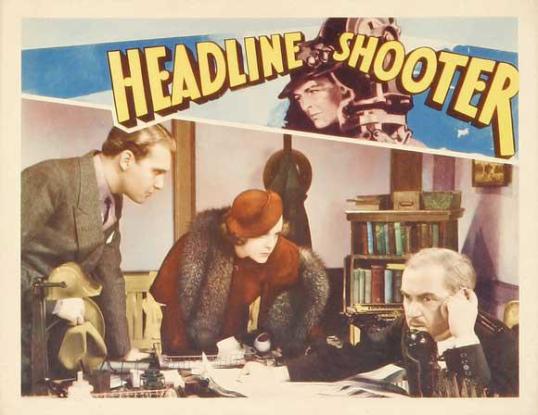
Bill Allen (William Gargan) is cynical newsreel cameraman.  Everywhere he goes, he’s got a tripod and a camera ready to go.  He films the disasters that other people are too scared to go near.  When there’s an earthquake, he runs outside to film it.  When a building catches on fire, he risks life and limb to record the event.  When a dam breaks, Bill is there to not only record the devastation but also help expose the man responsible for the poorly constructed dam.  When the man later commits suicide, Bill shrugs it off.  The public, he says, had a right to know.

Jane Mallory (Frances Dee) is a reporter.  She tough and she can just as sarcastic as Bill.  When she’s held hostage by  bunch of gangster, she proceeds to not only challenge them to a game of gin rummy but she beats them too!  Jane loves pursuing a good story but she worries that she might end up as cynical and callous as some of her colleagues.  As much as Jane loves it, a part of her is desperate to get out of the news business and, instead, marry the decent but boring Hal Caldwell (Ralph Bellamy, of course).

Together, Bill and Jane …. SOLVE CRIMES!

Actually, they do.  Of course, that doesn’t happen until towards the end of this zippy 61 minute film from 1933.  Before they solve a crime and run afoul some gangsters, Bill and Jane fall in love.  Of course, it’s a cynical journalist type of love, where quips and snarky put-downs replace the traditional endearments.  But it’s love just the same.  Bill and Jane share an understanding of what it feels like to pursue a big story.  It’s something that Hal, as decent a person as Ralph Bellamy ever played in a 1930s movie, just cannot understand.

This is a pre-code film, which means that the characters are allowed to smoke and drink and the dialogue is full of double entendres.  When Bill mentions that a woman he knows has a cold, Jane replies, “Let me guess.  It kept you up all night.”  That’s the type of dialogue that, in just a few short years after the release of Headline Shooter, studio productions would no longer be allowed to get away with.

Headline Shooter is a fast-paced film, one where everyone speaks almost exclusively in the fast rat-a-tat style of 1930s New York.  Considering that it’s only an hour long, it still manages to fit in a lot of plot.  There’s also a lot of real footage of actual disasters, the majority of which is passed off as being footage that was shot by either Bill or his colleagues.  Watching the film today, it’s interesting to consider that the newsreel cameraman were essentially early versions of the paparazzi, searching the city for anything worth shooting and, for the most part, not concerning themselves with the ethical concerns of exploiting disaster.  Many of the issues raised by Headline Shooter are still pertinent today.  One could almost argue that a film like Nightcrawler is a direct descendant of Headline Shooter.

Of course, Headline Shooter in never as dark as something like Nightcrawler.  Instead, all things considered, it’s a rather cheerful melodrama.  Gargan and Dee are wonderful in the lead roles and the cast is full of wonderful 1930s character actors.  This film shows up occasionally on TCM so keep an eye out for it!

(Unless, of course, you’re a Comcast customer….)

Guilty Pleasure No. 43: The Resurrection of Gavin Stone (dir by Dallas Jenkins)


Well, we’re halfway through October and the annual Shattered Lens Horrorthon and what better time than now to review a …. faith-based comedy about an irresponsible actor who pretends to be a Christian so that he can star in a megachurch’s Easter play?

Embrace the unexpected!

The 2017 film, The Resurrection of Gavin Stone, tells the story of Gavin Stone (Brett Dalton), a former child star who is now better known for his stints in rehab than for his acting.  After a trip to his hometown ends with Gavin getting arrested for public intoxication and apparently firing a catapult off the top of his hotel, Gavin is sentenced to do community service.  He has to live with his estranged father (Neil Flynn) and he can’t leave Ohio until he’s completed his hours.  What about Gavin’s career back in California?  What career?

Anyway, Gavin ends up doing his community service at the local Protestant megachurch.  The well-meaning pastor (D.B. Sweeney) suggests that Gavin just do maintenance work until his hours are up.  Gavin would rather try out for the lead role in the church’s annual Easter play, both because he wants to act and because he has a crush on the play’s director (Anjelah Johnson-Reyes), who just happens to be the pastor’s daughter.

“Well, the play is a part of our ministry,” the pastor explains, “so we do ask that everyone involved be a Christian.”

“I am a Christian!” Gavin announces, even though he’s totally not.

Naturally, Gavin gets cast in the role of Jesus.  Along with learning about his role, Gavin spends rehearsals shaking up the church’s somewhat stodgy play and, slowly but surely, becoming a better human being.  However, when Gavin is suddenly offered a role on a television series, he must decided whether to do what’s best for the play or what’s best for his career.  You can probably already guess what’s going to happen.

Obviously, a lot of people are going to be turned off by the film’s Christian origins but The Resurrection of Gavin Stone is actually a surprisingly sweet movie and, compared to most faith-based films, it’s not particularly heavy-handed.  Unlike a lot of Christian films, Gavin Stone actually has a sense of humor about itself and it’s hard not smile a bit when Gavin, after spending a night with Google, shows up for church on Sunday with a Jesus fish on his bumper and loudly greeting everyone with “Blessings!”  Brett Dalton (who we all know as Grant Ward on Agents of SHIELD) is sincere and likable in the lead role.  Anjelah Johnson-Reyes is stuck with the underwritten stock role of being the preacher’s daughter who loosens up over the course of the movie but she actually does a pretty good job of bringing some spark to the character.

The Resurrection of Gavin Stone has its flaws, of course.  There’s a few times that the dialogue gets a bit clunky and you never quite buy the film’s positive conclusion.  But what this film’s does very well is that it captures the excitement of being a part of a production.  The best parts of the film are the ones that just focus on the characters rehearsing.  Anyone who has ever been involved with a community theater will be able to relate and it’s kind of fun to watch everyone progress from stiffly reading from the script to delivering their lines like fully committed amateur thespians.  The Resurrection of Gavin Stone is at its best when it celebrates the joy of performing.

Previous Guilty Pleasures

  1. Half-Baked
  2. Save The Last Dance
  3. Every Rose Has Its Thorns
  4. The Jeremy Kyle Show
  5. Invasion USA
  6. The Golden Child
  7. Final Destination 2
  8. Paparazzi
  9. The Principal
  10. The Substitute
  11. Terror In The Family
  12. Pandorum
  13. Lambada
  14. Fear
  15. Cocktail
  16. Keep Off The Grass
  17. Girls, Girls, Girls
  18. Class
  19. Tart
  20. King Kong vs. Godzilla
  21. Hawk the Slayer
  22. Battle Beyond the Stars
  23. Meridian
  24. Walk of Shame
  25. From Justin To Kelly
  26. Project Greenlight
  27. Sex Decoy: Love Stings
  28. Swimfan
  29. On the Line
  30. Wolfen
  31. Hail Caesar!
  32. It’s So Cold In The D
  33. In the Mix
  34. Healed By Grace
  35. Valley of the Dolls
  36. The Legend of Billie Jean
  37. Death Wish
  38. Shipping Wars
  39. Ghost Whisperer
  40. Parking Wars
  41. The Dead Are After Me
  42. Harper’s Island

The TSL’s Horror Grindhouse: Psycho III (dir by Anthony Perkins)


Norman Bates is back!

Released in 1986 and directed by Anthony Perkins himself, Psycho III picks up a few months after Psycho II ended.  Norman (Anthony Perkins, of course) is still free.  He’s still got his motel.  He’s still talking to his dead mother.  Of course, at the end of Psycho II, Norman was told that the woman who Norman thought was his mother actually wasn’t his mother.  Instead, Emma Spool told Norman that she was his mother, which led to Norman promptly hitting her with a shovel and then keeping her preserved body hidden away in the motel.  Got all that?  Great, let’s move on….

In Psycho III, business suddenly starts booming at the Bates Motel!  All sorts of people come by to visit.

For instance, there’s the obnoxious tourists who show up at the motel so they can watch a football game and get drunk.  Future director Katt Shea plays one of the unfortunate tourists, who ends up suffering perhaps the most undignified death in the history of the Psycho franchise.  Shea later ends up being stored in the motel’s ice chest.  At one point, the local sheriff grabs a piece of ice and tosses it in his mouth without noticing that it’s covered in blood.

And then there’s Duane Duke (a young Jeff Fahey!), who is superhot but also super sleazy.  For reasons that are never quite clear, Norman hires Duke to be the assistant manager at the motel.  Duke turns out to be thoroughly untrustworthy but he’s Jeff Fahey so he remains strangely appealing even when he shouldn’t be.

Red (Juliette Cummins) shows up at the motel so that she can have sex with Duke and then get stabbed to death while taking off her top in a phone booth.  That, I guess, is Psycho III‘s equivalent of the first film’s shower scene.  Later, Duke comes across Norman mopping up all the blood in the phone booth but he doesn’t say anything about it.  Duke knows better than to ask why there’s blood in the phone booth.

Tracy Venable (Roberta Maxwell) is a journalist whose sole purpose in life is to prove that Norman murdered Emma Spool.  Tracy’s main function in this film is to explain just why exactly so many different women have claimed to be Norman’s mother.  It’s a rather complicated story and you’ll get a migraine if you think about it for too long.

And finally, there’s Maureen (Diana Scarwid), the former nun who has lost her faith and her sanity.  She shows up at the motel and stays in Marion Crane’s old room.  She takes a bath instead of a shower and slits her wrists.  When Norman storms into the room to kill her, the barely lucid Maureen mistakes him for the Virgin Mary and sees his knife as being a crucifix.  Maureen survives and Norman is hailed as a hero for rescuing her.  Later, Norman and Maureen fall in love.  You can guess how that goes.

When compared to the first sequel, Psycho III is much more of a standard slasher film and there’s certainly never any doubt over who is doing the killing.  However, Perkins again does a great job in the role of Norman, making him both sympathetic and creepy.  Fahey, Scarwid, Maxwell, and Hugh Gillin (as the hilariously clueless sheriff) all provide good support.  There’s really not a single character in this film who doesn’t have at least one odd or memorable quirk.  Duane Duke, for instance, is one of the most amazingly sleazy characters in the history of American cinema.  Just when you think that the character can’t get any worse, he proves you wrong.

As mentioned above, Perkins directed this film.  It was one of two movies that Perkins would direct before his death.  As a director, Perkins had a good visual sense, even if he did allow the narrative to meander a bit.  There’s nothing particularly subtle about Perkins’s direction and several of the scenes — like the sex scene between Duke and Red — are so over the top that they become rather fascinating to watch.  That said, there was really no longer any need to be subtle when it came to Norman Bates and his story.

With the exception of the weird Gus Van Sant remake with Vince Vaughn, Psycho III would be the last Psycho film to be released into theaters.  It would also be Perkins’s second-to-last time to play Norman.  (The last time would be in a 1990 made-for-TV sequel, Psycho IV: The Beginning.  Despite it’s title, Psycho IV pretty much ignored everything that happened in the previous two sequels.)  Perkins passed away in 1992, at the age of 60 but the character of Norman Bates would live on, both in his own performances and in the later work of Freddie Highmore in Bates Motel.

Missed Opportunities: Alien Nation (1988, directed by Graham Baker)


Alien Nation starts out with an intriguing premise but sadly doesn’t do enough with it.

In 1988, a spaceship lands in Mojave Desert.  Inside are 300,000 humanoid aliens, known as the Newcomers.  Intended to serve as intergalactic slaves, the Newcomers are now stuck on Earth.  (Of course, in the view of many humans, it’s Earth that’s stuck with them.)  Three years later, the Newcomers have settled in Los Angeles and they have adopted human names.  Some of them, like businessman William Harcourt (Terrence Stamp), have become successful and have been accepted by the human establishment.  The majority remain second-class citizens, facing discrimination and feeling alone in a world that doesn’t seem to want them.

Detective Matthew Sykes (James Caan) does not like the Newcomers but, after his partner is killed by one of the aliens, he ends up working with one.  Sam Francisco (Mandy Patinkin) is the first Newcomer to have been promoted to the rank of detective and is eager to prove himself.  Sykes renames him George and enlists him to investigate a series of recent Newcomer deaths.  Sykes’s real goal is to use Francisco’s Newcomer connections to investigate the death of his partner.  What the two of them discover is that the deaths are linked to a drug called Jabroka, which has no effect on human but was previously used to keep the Newcomers enslaved.

Alien Nation starts out with an intriguing premise.  I love the early scenes of Sykes driving down the streets of Los Angeles and seeing Newcomer prostitutes, Newcomer families, and even a Newcomer dance studio.  There is a lot promise in those scenes and they capture the feeling of a familiar world that has been irrevocably changed.  Both Caan and Patinkin give good performances and the alien makeup is still impressive.  Unfortunately, once Sykes and George start their investigation, the movie becomes a standard-issue police movie with a plot that could easily have been lifted from a Lethal Weapon rip-off.  So many interesting ideas are left unexplored, making Alien Nation an intriguing missed opportunity.  (There was later a television series based on the movie, which explored the Newcomer culture in greater detail.)

Alien Nation still has a strong cult following and I wouldn’t be surprised if it influenced District 9.  In 2016, it was announced that Jeff Nichols would be writing and directing a remake.  Nichols seems like the ideal director for a film like this and this is the rare case of a remake that I’m actually looking forward to.