Review: Frankenstein (dir. by Guillermo Del Toro)


“An idea, a feeling became clear to me. The hunter did not hate the wolf. The wolf did not hate the sheep. But violence felt inevitable between them. Perhaps, I thought, this was the way of the world. It would hunt you and kill you just for being who you are.” — the Creature

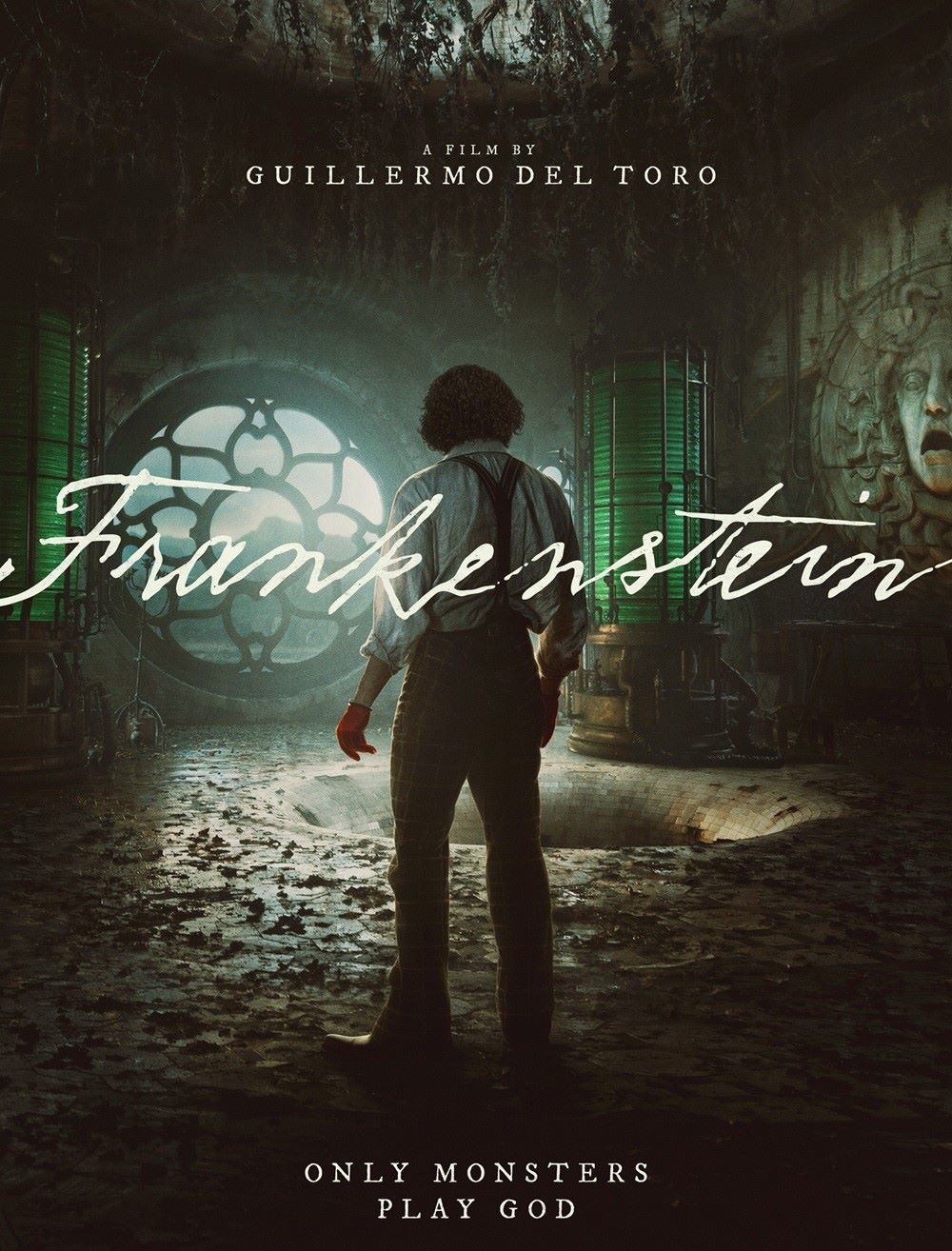
Guillermo del Toro’s long-awaited take on Frankenstein finally lumbers to life after years of speculation and teases, and it’s every bit the dark, hypnotic fever dream you’d expect from his imagination. The film, a Netflix-backed production running close to two and a half hours, stars Oscar Isaac as the guilt-ridden Victor Frankenstein and Jacob Elordi as his tragic creation. The result lands somewhere between Gothic melodrama and spiritual lament—a lush, melancholy epic about fathers, sons, and the price of neglect. It’s both a triumph of aesthetic world-building and a case study in overindulgence, the kind of movie that leaves you haunted even when it occasionally tests your patience.

From the very first frame, del Toro plunges us into a Europe steeped in rot and beauty. His world feels more haunted than alive—every misty street lamp and echoing corridor loaded with centuries of decay. Victor, introduced as both a visionary and a failed son, is shaped by years of cruelty at the hands of his domineering father, played with aristocratic venom by Charles Dance. That upbringing lingers in every decision he makes, especially when he turns to science to defy death. Del Toro shoots his laboratory scenes as though they were sacred rituals: the flicker of candlelight reflecting off glass jars, the close-up of trembling hands threading sinew into flesh. When the Creature awakens, lightning cracks like some divine act of punishment. It’s a birth scene that feels more emotional than monstrous—Elordi’s raw, wordless confusion gives it a painful tenderness that lingers longer than the horror. Del Toro discards the usual clichés of flat heads and neck bolts, opting for something far more human: an imperfect body full of scars and stitched reminders of mortality.

One of the most striking choices del Toro makes is reframing Victor and the Creature as mirror images rather than opposites. Instead of playing Victor as a simple mad scientist, del Toro paints him as a broken man desperate to reclaim the control he never had as a child. That fear and obsession ripple through the Creature, who becomes his unacknowledged shadow—an extension of Victor’s failure to love or take responsibility. The movie often frames the two in parallel shots, their movements synchronized across different spaces, suggesting that creator and creation are locked in a tragic loop. The audience watches both sides of the story—Victor’s guilt and the Creature’s anguish—without clear moral lines. This emotional split gives the film its heartbeat: the Creature isn’t a villain so much as a rejected child, articulate and lonely, begging to know why he was made to suffer.

Jacob Elordi’s performance is revelatory. He channels something hauntingly human beneath the layers of prosthetics and makeup. There’s a fragility to the way he moves—those long, uncertain gestures feel less like a monster testing its strength and more like someone trying to exist in a world that never wanted him. His eyes carry the movie’s emotional weight; the moment he sees his reflection for the first time is quietly devastating. Oscar Isaac, meanwhile, leans hard into Victor’s manic idealism, all sweat-soaked ambition and buried grief. He makes the character compelling even at his most despicable, though at times del Toro’s dialogue spells out Victor’s torment too bluntly. Still, the scenes between them—particularly their tense reunion in the frozen north—achieve the Shakespearean tragedy that del Toro clearly aims for.

Visually, Frankenstein is pure del Toro—sumptuous, grotesque, and alive in every corner of its composition. Each frame looks painted rather than filmed: flickers of gaslight reflecting on wet marble, glass jars filled with organs that seem to breathe, snow settling gently on slate rooftops. The film feels drenched in the texture of another century, yet vibrates with modern energy. Costume designer Kate Hawley, longtime collaborator of del Toro, deserves special recognition here. Her work helps define the story’s emotional tone, dressing Victor in meticulously tailored waistcoats that hint at obsession through precision, and the Creature in tattered fabrics that seem scavenged from several lives. Elizabeth’s gowns chart her erosion from warmth to mourning, using color and texture as silent narration. Hawley’s palette moves from opulent golds and creams to bleak greys and winter blues—visually tracing how ambition and grief drain the light from these characters’ worlds. The costumes, much like del Toro’s sets, feel alive with history, heavy with stories stitched into every seam.

Mia Goth gives a strong, if underused, turn as Elizabeth, Victor’s doomed fiancée. Her early scenes bring a spark of warmth to the story’s coldness; her later ones turn tragic in ways that push Victor toward his final breakdown. Minor characters—the townspeople, the academics, the curious aristocrats who toy with Victor’s discovery—carry familiar del Toro trademarks: grotesque faces, eccentric manners, glimmers of compassion buried in callousness. The composer’s score matches this tone perfectly, alternating between aching melodies on piano and surging orchestral crescendos that make even the quiet scenes feel mythic. Combined, the sound and visuals give Frankenstein a grandeur that most modern horror films wouldn’t dare attempt.

Still, not every gamble lands cleanly. Del Toro’s interpretation leans so hard into empathy that it dulls the edges of the original story’s moral conflict. Shelley’s Creature grows into a murderous intellect, acting out of vengeance as much as sorrow; here, his violence is softened or implied, as though del Toro can’t quite bring himself to stain the monster’s purity. The effect is powerful emotionally but flattens some of the tension—Victor becomes the clear villain, and the Creature, the clear victim. It fits del Toro’s worldview but leaves the viewer missing some ambiguity. The pacing also falters in the middle third. There are long, ornate monologues about divinity, creation, and guilt that blur together into a swirl of purple prose. The visuals never lose their grip, but the script occasionally does, especially when it slows down to explain what the imagery already tells us.

Those fits of overexplanation aside, del Toro’s Frankenstein stays deeply personal. The story connects directly to the themes he’s mined for years: innocence cursed by cruelty, love framed in pain, beauty stitched from the broken. The Creature isn’t just man made from corpses; he’s a kind of prayer for grace—a plea for understanding in a world defined by rejection. Victor’s failure to nurture becomes an act of spiritual cowardice rather than scientific arrogance. The parallels between them give the film its emotional voltage. Every time one character suffers, the other feels it by proxy, as if their bond transcends life and death.

By the final act, all the grand tragedy is distilled into the silence between two beings who can’t forgive each other—but can’t let go, either. The closing image of the Creature, trudging across a barren arctic plain beneath a rising sun, borders on mythic. His tear-streaked face and quiet acceptance of solitude bring the story full circle: a being born of man’s arrogance chooses forgiveness when his maker couldn’t. It’s sad, tender, and surprisingly spiritual, hinting at del Toro’s constant fascination with mercy in a cruel universe.

As a whole, Frankenstein feels like the culmination of del Toro’s career obsessions condensed into one sprawling film. It’s not perfect—it wanders, it sermonizes, and it sometimes sacrifices fear for sentiment—but it’s haunted by sincerity. You can see del Toro’s fingerprints in every gothic curve and crimson hue, and even when he overreaches, you believe in his conviction. Isaac anchors the film with burning intensity, Elordi gives it wounded humanity, and Goth tempers the heaviness with grace.

In the end, this version of Frankenstein isn’t about horror in the traditional sense. It’s not there to make you jump—it’s there to make you ache. The film trades sharp scares for bruised hearts, replacing terror with empathy. Del Toro reanimates not just flesh but feeling, dragging one of literature’s oldest monsters into our modern reckoning with parenthood, grief, and the burden of creation. It’s daring, messy, and undeniably alive. For better or worse, it’s exactly the Frankenstein Guillermo del Toro was always meant to make.

The Films of 2025: Magazine Dreams (dir by Elijah Bynum)


Remember Magazine Dreams?

Though Magazine Dreams did not get a brief theatrical release until 2025, the film first made an impression two years earlier.  At the 2023 Sundance Film Festival, Magazine Dreams was one of the most buzzed about entries.  A film about a mentally unbalanced body-building fanatic, the film starred Jonathan Majors.  Majors was on top of the world at that time.  Not only was he being groomed to be the new center of the Marvel Cinematic Universe but he was also just a few months away from playing the antagonist in the highly anticipated Creed III.  The U.S. Army was using Majors in recruitment commercials.  Both Magazine Dreams and Majors’s performance were lauded at Sundance.  Some critics started to say that Majors had, at the very least, an Oscar nomination in his future.

Then, on March 25th, 2023, Jonathan Majors was arrested and charged with assaulting his ex-girlfriend.  Several other women came forward and said that they had also been abused physically and emotionally by Majors.  The Army stopped airing his commercials.  Marvel announced that Majors would no longer be appearing in their films and that the storyline around his character would simply be abandoned.  (Indeed, the fallout over Majors’s arrest was so much a problem for Marvel that they eventually resorted to bringing back Robert Downey, Jr. to try to staunch the bleeding.)  Creed III took on a whole new meaning as the relatively likable Michael B. Jordan beat the hell out of Jonathan Majors’s snarling ex-con.

As for Magazine Dreams, it fell into limbo.  Fox Searchlight had acquired the film at Sundance and had given it an Oscar-friendly December release date.  After Majors’s arrest, Searchlight removed the film from its schedule and, eventually, the rights were sold back to the film’s producers.  Eventually, Briarcliff Entertainment released the film on March 21st, 2025.  The film made barely a million at the box office.

With all of the behind the scenes drama, it’s tempting to overlook the most important question.  Was the film itself any good?

It’s …. okay.  Jonathan Majors plays Killian Maddox, a grocery store worker who, as a child, was traumatized by the murder-suicide of his mother and father.  Maddox is obsessed with body building.  He studies body building magazines the way that some people study ancient texts.  One gets the impression that Maddox feels that having the perfect body will make up for all of the imperfections in his life.  He shoots steroids.  He uploads painfully earnest videos to YouTube.  He doesn’t know how to express his emotions, allowing his anger to come out at inappropriate times.  He wants to connect with someone but he doesn’t know how to do it.

To the film’s credit, it understands just how intimidating Killian Maddox can be.  A scene in which Maddox confronts the nephew of his boss initially seems as if it’s going to be about Maddox standing up for himself but instead becomes increasingly disturbing as Maddox upsets the man’s family.  Martin Scorsese’s Taxi Driver was obviously an influence on the film but Magazine Dreams doesn’t have that film’s wit or its subversive edge.  There are scenes that work.  The scene where a bloody Killian Maddox tries to compete despite being seriously injured is effective, even if it does owe a debt to Whiplash.  Another scene, in which Killian reads the trolling comments that have been left on one of his YouTube videos, actually does make you feel a bit of sympathy for him.  Ultimately, though, the film is so downbeat and unpleasant that you start to wonder why it was made in the first place.  Was Killian Maddox really so interesting a character that the audience needed to spend two hours with him?  Is there really anything to be learned from Killian Maddox and his experiences?

As for Jonathan Majors, he gives a believable performance.  He was a good actor, even if he couldn’t quite make Killian Maddox into a truly compelling character.

Lifetime Film Review: Taken At A Basketball Game (dir by Ruba Nadda)


TAKEN …. at a basketball game!

I’ve always appreciated any made-for-TV movie that’s absolutely shameless about ripping off a big budget feature film and, as such, I did appreciate the chutzpah of Taken At A Basketball Game.  I mean the word “TAKEN” is right there in the title!  D.B. Woodside plays Wayne Edwards, an ex-cop who is now the head of security for a casino.  Wayne is haunted by a shooting that left an innocent girl dead.  Wayne is also middle-aged and struggling to relate to his teenage daughter, Robyn (Claire Qute).  When Robyn is abducted by sex traffickers at a basketball game, Wayne sets out to track her down and rescue her.  It probably will not surprise you to hear that there’s a scene where Wayne explains that, even before he was a cop, he was a member of Special Forces and, as such, he knows how to get information out of people.

That said, it’s been quite a while since Taken was first released.  The first film came out in 2008 and it can be somewhat surprising to remember how excited everyone was about it.  At that time, Liam Neeson was best-known for appearing in prestige pictures so there was something enjoyably subversive about him playing a relentless torturer on a mission.  A lot of people were also under the impression that Taken was based on a true story.  A sequel followed in 2012 and, by that point, people were much more used to the idea of Liam Neeson killing people.  The third (and, to date, final) Taken film came out in 2015 and no one really cared.  There was a television series that sputtered along for two seasons.  There were countless Taken rip-offs, many of which starred Nissan himself.  The initial cultural footprint of Taken was huge but, by the start of the 2020s, it had pretty much evaporated.  Taken At A Basketball Game comes out at a time when even Liam Neeson has started parodying his image.

This is my long-winded way of saying that Taken At A Basketball Game would probably have worked better as a parody than a straight action film.  At this point, whenever an actor starts to give a monologue about how he’s been given very special training, it’s hard not to laugh because it’s a scene that has shown up in so many movies that it’s basically been done to death.  Everyone thinks that they can do a perfect impersonation of Liam Neeson reciting the Taken speech.  Of course, what originally sold the speech in 2008 was that Neeson delivered it with an intensity and a commitment that kept it from sounding like a bunch of empty boasts.  Listening to Neeson in that first film, you sincerely believed that he could and would kill someone if he felt like it.  D.B. Woodside, who is probably best-known for playing the less interesting of 24‘s two President Palmers, comes across as being a bit too mild-mannered to give a convincing “I’ve been trained to inflict pain” speech.  For most of the film, he seems like he’d rather just go back to his office and maybe sell someone some insurance.

The other problem with Taken At A Basketball Game is that very little of it actually takes place at the basketball game.  Don’t get me wrong.  I’m not a fan of basketball.  Those squeaky shoes give me a migraine.  But the stadium was a good location and it’s easy to imagine a fairly entertaining film could have been made out of Woodside spending 90 minutes running from one level to another, searching for his daughter and fighting off various bad guys.  (Yes, I realize this would have made the film into a Die Hard rip-off instead of a Taken rip-off but Die Hard rip-offs still work whereas Taken reached its expiration date years ago.)  Instead, the film abandoned the game early on and just went through the motions for the remainder of its running time.

Oh well.  Maybe Liam Neeson will make a basketball movie someday….

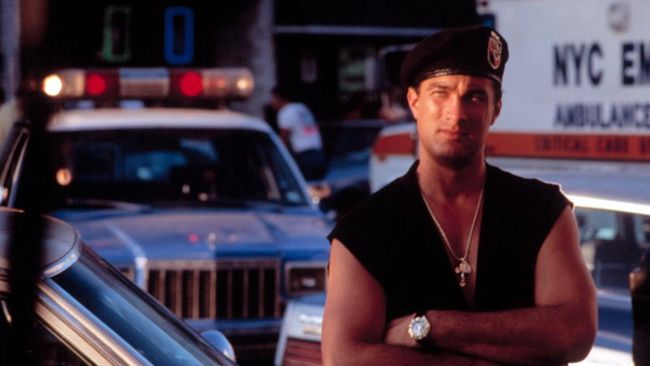
Brad reviews OUT FOR JUSTICE (1991), starring Steven Seagal!


17 year-old Brad Crain was at the movie theater in April of 1991 to see Steven Seagal’s latest action film, OUT FOR JUSTICE! Seagal’s career had shot out of a cannon with his first three films being the highly successful movies ABOVE THE LAW (1988), HARD TO KILL (1990), and MARKED FOR DEATH (1990). As a guy who loved action movies, Seagal (with his pony tail) was a cool new action star, and I was down for it.

Steven Seagal plays Detective Gino Felino, a Brooklyn cop called into duty when a guy who grew up with him in their neighborhood, mob enforcer Richie Madano (William Forsythe), goes completely off the rails. Hooked on drugs and looking to settle some personal scores, Richie murders Gino’s partner, and begins turning their neighborhood into a war zone, even pulling a woman out of her car and blowing her away in broad daylight over a simple traffic incident. Convinced that Richie will not leave the neighborhood he grew up in, Gino talks Captain Ronnie Danziger (Jerry Orbach) into letting him have an unmarked police car, a shotgun, and his approval to engage in a manhunt for the drugged out psycho. From that point forward, Gino shakes down Richie’s family members and associates to try to find out where he is. As bodies and broken bones pile up, Gino is determined to do whatever it takes to bring Richie to justice!

I’ll just say up front that OUT FOR JUSTICE is my personal favorite Steven Seagal film. It’s not the crowd pleaser or the box office champ that the next year’s UNDER SIEGE (1992) would be, and film critics largely blew it off when it first hit cinemas, but it does feature the star at his most charismatic, something that would all but disappear after the mid-90’s. I love the way Seagal plays Gino. Sure he’s tough, but he talks more, he laughs more, and it feels like he’s actually enjoying himself. His Gino isn’t just a badass cop, he’s a neighborhood guy, a former street punk who grew up and made something positive out of himself. Seagal’s performance here truly works, and he plays the role with so much confidence that it’s a shame that he didn’t remain this engaged in future performances.

OUT FOR JUSTICE is a badass action film. After it opens with Richie’s horrific murders, it then follows Gino’s hunt for the killer into smoky bars filled with wannabe tough guys who know more than they’re letting on. They get their asses handed to them. It follows Gino as Richie’s goons attack him at various places, from meat shops to apartment buildings, and he dispatches them with calm precision, but often in gruesome ways. I still wince when I see the results of meat cleaver fights and close quarter shotgun blasts. OUT FOR JUSTICE is a throwback to an era when action films featured men with integrity who kick ass and take names. While the movie does have some melodrama and humor, at the end of the day, this is tough-guy cinema done right. 

I did want to shout out a few other things about OUT FOR JUSTICE that helps put it over the top for me. William Forsythe is incredible as Richie Madano. He’s sweaty, twitchy, cruel, and completely unhinged. He makes you believe that he’s literally capable of doing anything, and it seems like his goons may be following more out of fear than anything else. His Richie is a man who doesn’t expect that he’ll be alive that much longer, so he’s willing to cross every line that may have once mattered in his life. Director John Flynn captures the urgency of the film’s action very well, and we can feel the tension as Gino tries to locate the crazy Richie as quickly as possible before more innocent people are killed. He isn’t afraid to show the brutality of the violence as part of Gino’s quest, either. This shouldn’t be surprising when you recognize that Flynn directed the revenge classic ROLLING THUNDER (1977) about fifteen years earlier. The one last thing I wanted to point out about OUT FOR JUSTICE is that it was written by R. Lance Hill, who wrote the brutal Charles Bronson hitman film THE EVIL THAT MEN DO (1984). These are talented guys who know how to tell tough stories about even tougher men who are willing to do what it takes to get justice when no one else can. 

At the end of the day, Steven Seagal would go on to make a lot more movies, but I don’t think he ever quite recaptured the balance of charisma and toughness that he shows here. And OUT FOR JUSTICE is a badass action movie that doesn’t really care what movie critics think, either. Buoyed by Seagal’s performance, the film’s action is angry, focused, unapologetic, and still hits hard over thirty years after it was originally released.

The Films of 2025: War of the Worlds (dir by Rich Lee)


Let’s hear it for War of the Worlds, the 2025 film that took one of the greatest science fiction novels ever written and then re-imagined it as something really stupid.

It takes a certain amount of balls to take a book that was written in the 19th century and to adapt it as a low-budget screenlife film.  Plus, the idea of making the protagonist an employee of the DHS who abuses his power to monitor his children, and his daughter’s boyfriend?  That’s actually kind of clever.  Good for you, movie!  Way to point out just how invasive our current surveillance state is.  It always kind of amazes me that, here in America, we’ve given up so much of the freedom that people died for but, whenever you point that out to people, you just kind of get an apathetic shrug.

You know what isn’t a good idea?  Casting Ice Cube as the DHS employee in question.

Ice Cube plays Will Radford, the straight-laced and uptight DHS employee and 90% of the film is basically just shots of him staring at the screen of his laptop.  During the day, he argues with his kids and tries to ascertain the identity of a mysterious hacker.  He also checks in with Clark Gregg (who plays the head of the DHS) and with a NASA scientist who is played by Eva Longoria.  Let’s give some credit where credit is due and admit that Clark Gregg seems to understand exactly what type of film that he’s in and, as such, he gives about as good a performance as anyone could in the role.  Eva Longoria, on the other hand, comes across as if she’s just killing time until the next Democratic convention comes around.

But let’s get back to Ice Cube.  Ice Cube is not a bad actor.  When cast in the right role, he can bring an unbeatable authenticity to the screen.  That said, Ice Cube does not have a particularly wide range.  When he was cast as the Captain Dickson in 21 Jump Street, the intentional miscasting made for one of the best jokes in the film.  In War of the Worlds, when Will starts yelling at his daughter’s boyfriend, it’s hard not to be reminded of Captain Dickson reacting to Jonah Hill dating his daughter in 22 Jump Street.  The only problem — well, not the only problem — is that War of the Worlds is not meant to be a comedy.

So, what is War of the Worlds meant to be?  It’s not easy to say.  It’s certainly not meant to be any sort of tribute to H.G. Wells and his classic novel.  If anything, the film seems to take a perverse joy in not caring about the source material.  It can be argued that the film is meant to be a commercial for Amazon, seeing as how an Amazon drone plays a key role in the film’s conclusion.  Considering that the film was released on Prime, that certainly seems to be a fair interpretation.  In the end, even though the villains are ultimately revealed to be some of Will’s colleagues, the film still feels like a perhaps unintentional endorsement of the Surveillance State.  Where would be without Ice Cube watching over us?

Where indeed?

Lifetime Film Review: I Was A Child Bride: The Courtney Stodden Review (dir by D’Angelo Proctor)


In 2011, the news broke that 51 year-old Doug Hutchinson had married 16 year-old Courtney Stodden.  I can still remember my initial reaction.

“Who?”

Though the stories all made Doug Hutchinson out to be a some sort of household name, I wasn’t sure who he was.  This was despite the fact that I had seen The Green Mile and Lost and a few other shows in which he had roles.  With the exception of The Green Mile‘s Percy Wetmore, the majority of Hutchinson’s roles were small and he never made enough of an impression for me to really remember him.  Doug Hutchinson was not a big star and yet, all of the initial stories about his marriage to Courtney focused on Doug and not on the 16 year-old girl that he had married.  The stories often mentioned that Courtney was blonde and a few found an excuse to list her measurements but few really seemed to give much thought to how a 16 year-old ends up married to a 51 year-old.  Courtney’s mother was often portrayed as being the ultimate stage mom, pushing her daughter into marrying an older man out of a belief that it would help her career (as if Doug Hutchinson was some sort of power player as opposed to being an occasionally employed character actor).

Today, it’s fashionable for everyone to claim that they were outraged from the moment that they heard about the Hutchinson/Stodden marriage.  At the time the story came out, though, most people treated it as just another bit of a salacious gossip from “Hollyweird.”  Doug and Courtney appeared on reality shows, including quite a few that featured them getting marriage counseling while the cameras rolled.  If Doug was usually portrayed as being an old lech, Courtney was often portrayed as being a young gold digger.  (Again, the fact that Doug Hutchinson was hardly a star rarely seemed to factor into these portrayals.  He was an actor who had co-starred with Tom Hanks and hence, people assumed he had money.)  It’s only now, with the marriage over, that people have really started to acknowledge that Courtney Stodden was a victim of both Doug Hutchinson’s grooming and the world’s tabloid culture.

Lifetime’s I Was A Child Bride: The Courtney Stodden Story dramatizes the story of Courtney’s life and her marriage to Dough Hutchinson.  The film was produced by Stodden and she also provides the narration, commenting on what’s happening onscreen and trying to explain what was going through her head at the time.  In the dramatization, she’s played by Holly J. Barrett while Doug Hutchinson is played, to creepy perfection, by Doug Savant.  Maggie Lawson plays Krista Stoddard, Courtney’s mother.  The film follows Courtney as she goes from being pushed into stardom by her mother to then being ordered to give up her career by Doug.  When the story of Doug and Courtney’s marriage comes out, Doug mourns that his career is over while Krista excitedly pulls up every online story.  When Courtney points out that most of the stories are bad, Krista chirps that all publicity is good publicity.  (The film implies that Krista is the one who leaked the details of Courtney and Doug’s marriage to the press.)  Soon, teenage Courtney is the breadwinner for both her 51 year-old husband and her mother.

The film is ultimately effective, even if it’s sometimes just as salacious as the tabloids that the movie criticizes.  I was proud of Courtney for having finally broken free from Doug.  That said, the story leaves quite a few unanswered questions, especially about the extent of the role that Krista played in Doug and Courtney getting married.  Parents are always told to be aware of who their children are talking to online.  But what do you do when the parents know and just don’t care?

Lifetime Film Review: Abducted in the Everglades (dir by Damian Romay)


It’s Spring Break!

For Carly (Tommi Rose) and her friend, Simone (Nikki Nunziato), that means heading down to Florida so that they can drink, dance, and party on the beach.

For Carly’s mom, Beverly (Tori Spelling), it means staying up all night and worrying about her daughter.

Beverly owns a diner and she’s worked hard to put Carly through college.  Carly appears to be super responsible and she’s got a bright future waiting for her.  She’s going to go to medical school and becoming a doctor.  Compared to Simone, Carly can be a bit naive.  No sooner has she arrived in Florida than she’s accidentally insulted a local named Luke (Joseph Cannon).  Later, when Simone introduces her to the obviously sleazy and tattooed Pete (Nick Flaig), Carly’s first impulse is to ask him what college he goes to.

Pete doesn’t go to college.  Instead, he lives in an isolated Everglades cabin.  That’s where Carly ends up, tied to a chair and blind-folded after an attempt to humiliate her and Simone goes wrong.  Pete, it turns out, is related to Luke.  And a plan to simply embarrass a snobbish college student has instead led to Carly getting abducted and Simone ending up in a coma at a local hospital.

When Beverly attempts to report her daughter missing, the local authorities tell her to calm down.  It’s Spring Break.  College students come down to Florida and forget to check in all the time.  Carly’s probably just drunk somewhere.  “Not my daughter!” Beverly says and soon, she’s in Florida searching.  Helping her out is Ray (Luke Ballard), a hot and rugged local boatman.  Even if Beverly doesn’t find her daughter, it looks like maybe she’s found a new husband!

Advertised as being based on a true story, Abducted In The Everglades tells a familiar Lifetime story.  That said, as I’ve explained in the past, the familiarity is often the point when it comes to Lifetime movies.  One doesn’t necessarily watch a Lifetime movie to be surprised.  Instead, one watches to see how the film will embrace the melodrama.  There’s a comfort to watching a Lifetime movie.  Watching a Lifetime movie is like visiting an old friend who never changes and who always delivers what they’ve promised.

For a lot of viewers, the main appeal of this film will be the chance to see Tori Spelling playing the mother.  Back in the 90s, Spelling almost always played the naive daughter who ended up getting kidnapped (Mother, May I Sleep With Danger?) or the snooty popular girl who upset the wrong person (Death of a Cheerleader).  Now, Spelling is the one worrying about her college-age daughter.  Tori Spelling has never been much of an actress.  She wasn’t particularly good in any of her earlier movies and she’s not particularly believable as a blue collar mom in this film.  But oddly, that’s part of the appeal of Tori Spelling.  It’s not just that she’s a bad actor.  It’s that she’s so spectacularly bad that it becomes fascinating to watch.

The rest of the cast is a bit better, especially Luke Ballard and Nick Flaig.  That said, the real stars here are the Everglades, the cottonmouths, and the alligators.  They all do their bit to bring this Florida film to life.  I should note that Jeff and I spent the first half of our summer vacation in Florida and we absolutely loved it.  It’s a beautiful state.  If Texas ever brings back the state income tax, I know where I’m moving.

Lifetime Film Review: Murder At The Lighthouse (dir by Eric D. Howell)


In Murder at the Lighthouse, Jessica Vickers (Skye Coyne) is trying to escape her abusive husband, Colton (Mark Justice).  She meets up with Rory (Brandon Brooks), an old friend from college who now runs a charter boat service with his brother Anthony (Tyler Noble).  It’s implied that Rory has always had romantic feelings for Jessica and, when she asks him to help her escape from Colton, he agrees to use his boat to take her to Canada.

The only problem is that they sail straight into a storm.  While Colton is murdering Anthony on the mainland, a tidal wave is capsizing the boat.  Rory drowns.  Jessica washes up on a nearby beach where, the next morning, she is found by Adeline (Shelli Manzoline).  Adeline takes Jessica back to the lighthouse that she calls home.  When Jessica wakes up, Adeline explains that the lighthouse is pretty much isolated from the rest of civilization.  The nearest town is a few miles away.  There’s no landline.  There’s no cell reception or WiFi.  There’s just Adeline, the lighthouse, and a goldfish.

At first, Jessica keeps her past a secret from Adeline.  But, when Colton shows up at the lighthouse and asks Adeline if she’s seen Jessica or Rory, Jessica finally breaks down and tells Adeline everything.  Adeline reveals that she is also a victim of abuse and she promises to protect Jessica from Colton.

At first, I was like, “Yay!”  Women have to stand up for other women and I was very much looking forward to Adeline protecting Jessica from Colton in much the same way that Lillian Gish protected the children from Robert Mitchum in Night of the Hunter.  However, as the film progressed, I noticed that there seemed to be something a bit off about Adeline.  I was so happy that she was going to stand up to the vile Colton that it took both me and Jessica a while to notice that she had a possessive streak of her own.  It turns out that Adeline has some secrets as well.

Murder at the Lighthouse is a superior Lifetime film, one that plays with the genre’s conventions and successfully lulls the audience into a false sense of security before tossing a few new twists at them.  Skye Coyne, Mark Justice, and Shelli Manzoline all give strong performances.  Mark Justice is especially intimidating at Colton, a husband who is not just an abuser but also a corrupt cop as well.

What really makes Murder at the Lighthouse stand out, though, is its ominous atmosphere.  From the opening shots with the wind howling in the background to the final confrontation at the lighthouse, Murder at the Lighthouse makes a wonderful use of its isolated and stormy setting.  The lighthouse is a wonderful location and the movie does a good job of keeping Jessica and the audience disorientated.  About halfway through the movie, I was truly asking myself, “How is she ever going to find her way out of there?”

Murder at the Lighthouse is a bit of somber film, especially by Lifetime standards.  That said, it keeps you guessing and it ultimately embraces the melodrama in that way that we all love.

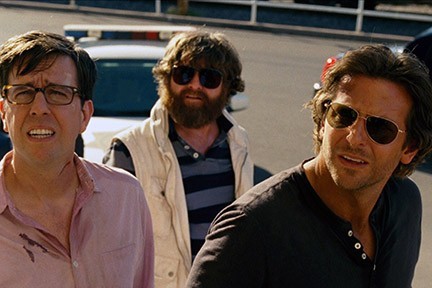
Brad reviews THE HANGOVER PART III (2013), directed by Todd Phillips!


In THE HANGOVER PART III, Phil (Bradley Cooper), Stu (Ed Helms), and Doug (Justin Bartha) get back together so they can help Alan (Zach Galifianakis), whose gone off his meds and seems incapable of handling his dad’s sudden death. After a family intervention, the guys are driving him to a rehabilitation facility when their car is forced off the road and out steps the gangster Marshall (John Goodman), assisted by Black Doug (Mike Epps). Marshall kidnaps (white) Doug as leverage to force the guys to bring him their old friend Leslie Chow (Ken Jeong) within three days, or they won’t see Doug alive again. It seems that Chow, who recently escaped from a Thai prison, had stolen $21 million in gold from Marshall, and he’s pissed. The Wolfpack head back to Vegas, and with the help of a few old friends, they do whatever they have to do to save Doug one more time! 

Released in the summer of 2013, THE HANGOVER PART III pulled in around $362 million in worldwide box office against a $103 million budget. While definitely a box office hit, these numbers are a big step down from the prior film’s $586 million, so up to this point, Part III has remained the Wolfpack’s last adventure. While THE HANGOVER PART II was practically a remake of the first film, PART III seems to be going the opposite way and actively tries not to repeat itself. The “what the hell happened last night” plot lines are abandoned for something different, and honestly, that’s probably about the smartest decision the filmmakers could have made for this installment. The film plays more like a darker, R-rated crime comedy, leaning into the action, heist, and confrontation sequences. While the change isn’t entirely successful, I definitely appreciate the attempt to come up with something different.

Even though THE HANGOVER PART III isn’t as funny as the prior films, I still enjoy the chemistry between Bradley Cooper, Ed Helms, and Zach Galifianakis as the primary members of the Wolfpack. I also thought it was funny that Justin Bartha’s pack member Doug is once again relegated to the guy who’s not really involved, as he’s the one who’s kidnapped. Ken Jeong’s Mr. Chow, as cartoonish and unhinged as he is, is probably my favorite character in the series at this point. He pretty much steals every scene he’s in. John Goodman is a welcome addition as the intimidating bad guy, and he’s good in the film, but it’s the kind of role he could do in his sleep. I also really liked the fact that PART III returned to the initial setting of Las Vegas, which provides a nice sense of closure to the series, while also allowing for the participation of former characters like Heather Graham’s Jade and her son Tyler! It was nice to check in with them again. 

Ultimately, THE HANGOVER PART III is a pretty good conclusion to the series. It’s certainly not as funny or outrageous as the prior films, but it does deserve some credit for trying something new instead of simply repeating the formula for a third time. And I also thought the final scenes were emotionally effective as they took us for a quick trip down memory lane with the Wolfpack. It felt like the end, and I felt good watching it.

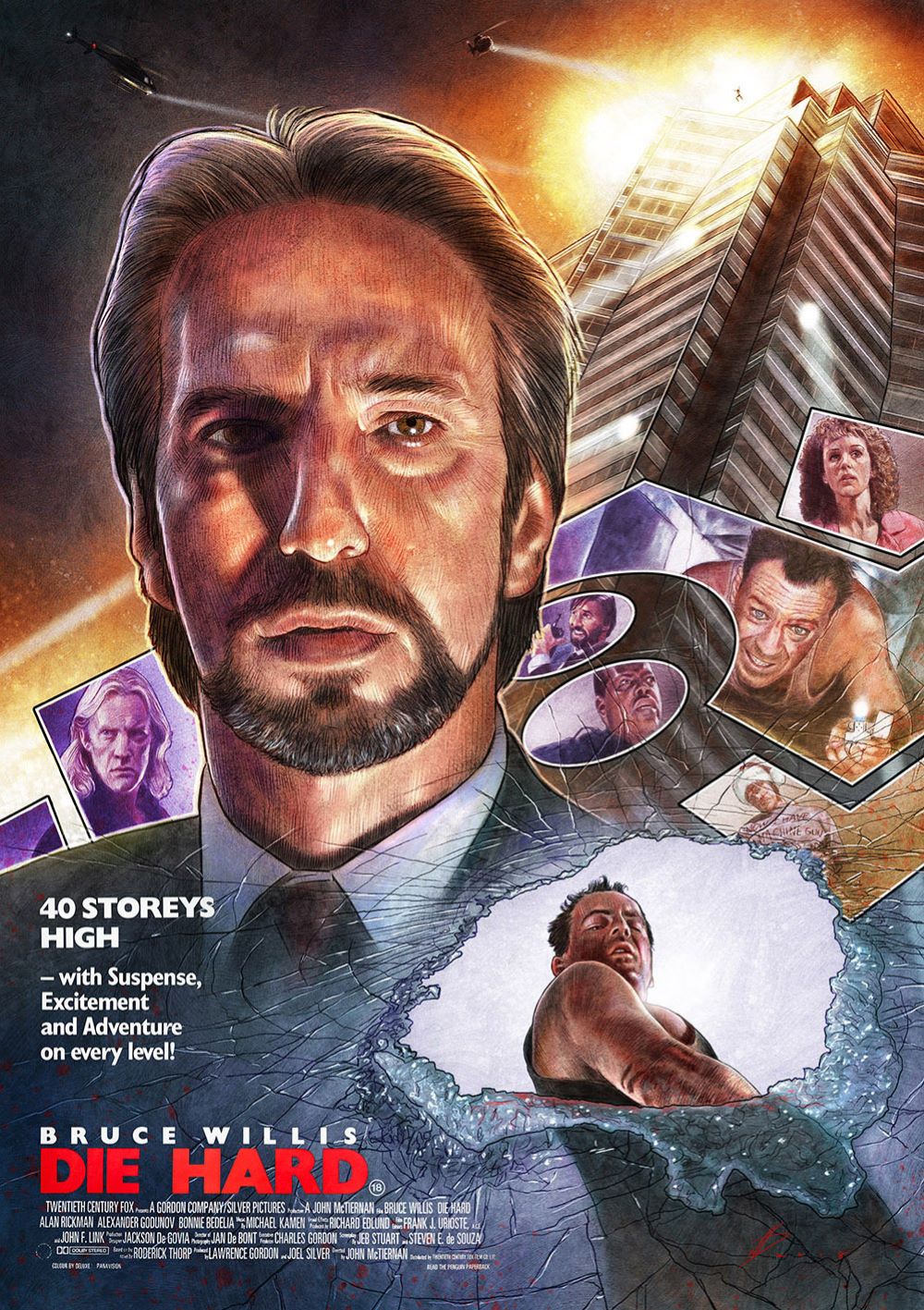
Review: Die Hard (dir. by John McTiernan)


“Welcome to the party, pal!” — John McClane

Die Hard is the ultimate Christmas film (though not the greatest) disguised as an action thriller, blending holiday cheer with high-stakes mayhem in a way that has sparked endless debates and turned it into a seasonal staple for millions. It stands as a landmark action movie and a sharp, character-driven thriller that continues to set the standard for the genre. The film mixes bombast with genuine heart, balancing tension, wit, and raw emotion so effectively that its imperfections only add to its enduring appeal.

Released in 1988 under John McTiernan’s direction, Die Hard follows New York cop John McClane (Bruce Willis) arriving in Los Angeles during the holidays to reconcile with his estranged wife Holly at her office Christmas party in Nakatomi Plaza. He’s fresh off a transcontinental flight, nursing a cocktail of jet lag and marital tension, hoping a festive gathering might thaw the ice between them after her career move to the West Coast has strained their family life. No sooner has he kicked off his shoes—famously leaving him barefoot for most of the chaos—than a disciplined crew of armed robbers, masquerading as terrorists under the command of Hans Gruber (Alan Rickman), storms the building, holding the revelers captive and forcing McClane to fight back shoeless and outgunned amid the towering offices. This lean setup—one man, one skyscraper, one chaotic evening—drives the story’s relentless pace, with straightforward spatial awareness keeping viewers locked into the rising peril. The Christmas setting isn’t just window dressing; twinkling lights, carols on the soundtrack, and a rooftop Santa sleigh add layers of irony and warmth to the gunfire, making the film a peculiar but perfect yuletide watch.

The movie refreshingly casts its action lead as an everyday underdog, full of sarcasm and frailty rather than invincible machismo. McClane takes real damage—he’s slashed by glass, battered by falls, and wheezing from asthma attacks—freaks out under pressure, second-guesses himself constantly, and limps through the ordeal covered in cuts and shards while grumbling about his lousy luck. These moments of raw vulnerability humanize him in a genre often dominated by perfect physiques and unflappable cool. Bruce Willis brings a rumpled, relatable edge to the role, drawing from his TV background on Moonlighting to infuse McClane with quick-witted banter and hangdog charm, making his pigheaded risks and desperate quips—like his tense radio chats or infamous air vent shuffle—land as the outbursts of an ordinary Joe desperate for survival and a way out. Willis’s casting was a gamble at the time, pivoting from wisecracking detective to gritty hero, but it paid off by redefining what an action star could be: flawed, funny, and fiercely determined.

Hans Gruber remains a standout antagonist, living up to every ounce of his legendary status—and remarkably, this was Alan Rickman’s very first film role, launching him into stardom with a performance that still defines screen villainy. Fresh from stage work, Rickman infuses him with suave detachment and subtle menace, his silky British accent dripping with condescension as he portrays a criminal mastermind who approaches the heist like a hostile merger, his cultured facade slipping just enough to reveal cold ruthlessness. Lines like his mocking “Mr. Mystery Guest” taunts or his gleeful disdain for American excess have become iconic, delivered with a theatrical precision that elevates Gruber above typical thugs. Clever writing highlights his contempt for yuppie excess and delight in red tape, while McTiernan’s direction turns their encounters into personal showdowns brimming with verbal sparring beyond mere firepower, turning cat-and-mouse into a battle of intellects as much as endurance.

A strong ensemble bolsters the narrative without bogging down the momentum. Bonnie Bedelia’s Holly exudes quiet strength, proving herself a sharp professional unafraid of bosses or bandits, which elevates her rapport with McClane above clichéd rescue tropes—she’s calling shots from the hostage room and holding her own in tense negotiations. Reginald VelJohnson’s Sergeant Al Powell elevates a stock radio contact into the story’s heartfelt core, offering McClane solace and shared regrets during their poignant nighttime talks about lost family and second chances, creating an unlikely but touching bromance across police lines. Figures like Hart Bochner’s smarmy Ellis, with his coke-fueled deal-making, or William Atherton’s pushy journalist Richard Thornburg, chasing scoops with ruthless ambition, add biting commentary on greed and sensationalism, sharpening the film’s take on ’80s excess and how corporate snakes and media vultures complicate the crisis. Even smaller roles, like the hapless deputy chief or the bickering SWAT team, paint a vivid picture of institutional incompetence that McClane must navigate alone.

Die Hard excels in choreographing escalating clashes within tight quarters, turning the skyscraper into a multi-level chessboard. McTiernan masterfully exploits Nakatomi’s design—raw construction levels with exposed beams, service elevators for ambushes, fire stairs slick with tension, upper decks for sniper duels, and cubicle warrens for close-quarters chaos—to distinguish every skirmish from rote shootouts, ensuring each fight feels unique and earned. Precise editing weaves between McClane’s scrambles, captive dread, robber schemes, and external responders, layering suspense without devolving into explosive filler; the cross-cutting builds dread as plans intersect disastrously. Standout sequences thrill because of careful buildup around deadlines and official blunders, like ill-timed interventions that raise the stakes sky-high. The practical effects—real stunts, squibs, and pyrotechnics—give the action a tangible weight that CGI-heavy modern films often lack, grounding the spectacle in sweat and physics.

Blending laughs with savagery proves the film’s toughest feat, yet it mostly triumphs. McClane’s biting comebacks, taped to dead bodies or barked into walkie-talkies, and the dark comedy amid cop-thug banter sustain levity amid dire threats and mounting casualties, preventing the film from tipping into grim slog. Gags like the executive’s C4 “gift” or Powell’s Twinkie diet poke fun at excess without diffusing danger. Certain gags and era-specific jabs feel dated—like mockery of inept brass or overzealous feds—but this institutional skepticism fuels the plot, portraying red tape and hubris as lethal as automatic weapons, a theme that resonates in any age of bloated bureaucracies.

The film’s action overload, ironically its signature strength, occasionally trips it up. Later stretches bombard with relentless blasts and ballets, prompting some to decry the carnage’s intensity or plot holes from initial reviews, where critics noted the escalating body count’s numbing effect. Elements like tactical decisions by authorities or vault breach logistics falter on nitpicks, relying now and then on lucky breaks to align the chaos, such as perfectly timed discoveries or overlooked details in the heist plan. Fans of taut caper tales might see the wilder antics as indulgence over invention, prioritizing popcorn thrills over airtight logic. Yet these are minor quibbles in a runtime that clocks in under two hours, keeping energy high without exhaustion.

Yet a solid emotional arc lends depth beyond mere spectacle. Fundamentally, it’s about a bullheaded officer confronting his marital neglect, enduring brutal comeuppance while seeking redemption amid the tinsel and terror. His raw confessions to Powell inject humanity that heightens the personal stakes, turning isolated survival into a quest for reconnection. The script, adapted from Roderick Thorp’s novel Nothing Lasts Forever, weaves family drama into the frenzy without halting the pace, making quieter moments—like shared vulnerabilities over radio—punch harder than any explosion.

Technically, Die Hard brims with assured flair bordering on swagger. Cinematographer Jan de Bont’s lenses capture glassy surfaces, mirrors for disorienting reflections, and soaring perspectives to render the tower both glamorous and hostile, a glassy trap turned warzone that mirrors the characters’ fractured relationships. Crisp cuts allow pauses for character amid the rush, preserving brisk tempo without shortchanging development; McTiernan’s post-Predator confidence shines in rhythmic pacing that breathes. Michael Kamen’s soundtrack fuses orchestral surges with jingly carols like “Let It Snow,” amplifying the bizarre fusion of festivity and fusillades that forever fuels “Christmas movie” arguments—ho-ho-hos interrupted by hails of bullets.

Die Hard‘s influence reshaped action cinema, birthing the “Die Hard in a [location]” trope for enclosed thrillers, from buses to battleships, spawning endless imitators chasing its formula. Sequels amplified scale at the cost of grounded heroism, proving surface mimics—snark, stunts, scheming foes—miss the original’s vulnerable punch, as later entries piled on global threats and gadgets. Detractors note it paved paths for bloated pyrotechnics in successors, but that’s on copycats, not this taut gem; its box-office success—over $140 million worldwide—proved audiences craved smart spectacle.

All told, Die Hard delivers razor-sharp, hilarious, masterfully built blockbuster entertainment that ages like fine whiskey. Pairing a rugged everyman lead, suave nemesis, and geography-smart sequences, it raises a benchmark few match. Flaws like overkill blasts or shaky rationale aside, its tension, depth, and gritty laughs cement its throne in action lore, a holiday gift that keeps on giving.