In this short film from 1951, a young American airman goes to a small town while on furlough. He goes to sleep in a freedom-loving American town but, when he wakes up, things have changed. The people are no longer friendly. The streets are patrolled by sinister soldiers. A man gives a speech in the town square, announcing that no one is allowed to defy the state. When a woman tries to speak up, she’s grabbed by soldiers. When the airman tries to defend her, he’s grabbed as well. A judge listens as the airman defends America and the first amendment. The judge says that the airman would make a good propagandist. The airman would rather be executed.
What’s happened!?
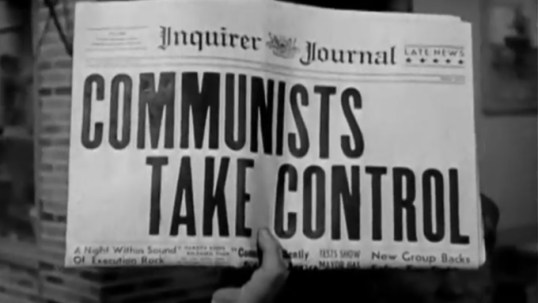
Well, here’s what the newspaper says:
That’s right! The communists have taken control and apparently, it only took them a few hours to do it. The airman somehow slept through the whole thing. It really does make me wonder whether he’s someone who I really want in an important position when it comes to defending this country. Sleeping through a communist coup takes a lot of effort.
Fear not, though. There’s a twist ending. I won’t spoil it, other than to say that it makes about as much sense as a member of the Air Force sleeping through a communist coup. You can watch it for yourself:
On the one hand, this film is pure propaganda. On the other hand, authoritarianism has become very popular lately and not just among communists. This short film may be heavy-handed but it probably seems a bit less heavy-handed today than it did just a few years ago. In the film, the enemy is communism. In real life, the enemy is anyone who would say that freedom of speech and thought should be curtailed. It’s true that they always have what sounds like a good reason for sacrificing freedom, whether it be to protect the workers or to protect the children or to make the world a safer place. But, in the end, the main goal is to make sure that only one voice can be heard.
Watch this short film on a double bill with the original Red Dawn. What a great way to celebrate May Day.
After having been arrested in front of his wife and daughter, football player-turned-criminal Casey Rhodes (Beau Mirchoff) has been sent to prison. In the same prison is Rhodes’s nemesis, former Detective James Knight (Bruce Willis). Knight has been imprisoned for murdering the two villains from Detective Knight: Rogue, finally answering the age-old question of what happens to an action hero after the end credits roll. In prison, both men meet Ricky Conlan (Paul Johansson), a former convict who is now a chaplain. Conlan is big on encouraging everyone in prison to set aside their differences and come together as one big community of sinners seeking redemption.
Meanwhile, as Christmas approaches, New York City finds itself under siege. Terrorists are dressing up like Santa Claus and robbing banks, chanting “Ho! Ho! Ho!” as they do so. Their leader alternates between handing out candy canes and tossing live grenades at people. He becomes known as The Christmas Bomber and he announces that he’s only robbing the banks to get back at the 1%. He’s a revolutionary, you see.
He’s also a prison chaplain. That’s right, Ricky Conlan is the Christmas Bomber and he’s decided that Casey is going to be newest member of his operation! He even stages a jailbreak, releasing the entire population of Riker’s onto the streets of New York. The only prisoner who voluntarily chooses not to escape is Detective Knight. Impressed by his refusal to escape when he had the chance, NYPD Capt. Anna Shea (Miranda Edwards) arranges for Detective Knight to be released from prison so that he can head up the search for Conlan and the commie Santas.
Meanwhile, Knight’s partner, Eric Fitzgerald (Lochlyn Munro), has traveled to New York to help out with the investigation. In the previous movie, when we last saw Detective Fitzgerald, he was in the hospital after having been shot by Casey Rhodes. Fitzgerald may be in a wheelchair now but he’s still good with a gun and he also mentions that the doctors think that he should be able to walk again by Memorial Day. Fitzgerald doesn’t let being in a wheelchair prevent him from investigating and confronting New York’s power brokers, including the oily mayor (John Cassini).
Detective Knight: Redemption was one of the films that Bruce Willis filmed shortly before the announcement that he would be retiring from acting. Though he’s definitely the main attraction here and he still looks convincing firing a gun during the film’s finale, Willis’s screen time is limited and it’s also obvious that a stand-in was used for a few of the scenes that involved his character. There are a handful of fleeting moments where we get to see some hints of the wiseguy charisma that was Willis’s trademark but, for the most part, Detective Knight is written to be a man of few words. When he made this film, Willis still had his screen presence but it’s still difficult to watch with the knowledge that he was struggling with his health during filming.
With Willis largely sidelined, it falls to Munro, Johansson, and Mirchoff to keep the action moving and all three of them prove themselves to be up to the challenge. Johansson, in particular, is so wonderfully over-the-top in his villainy that it’s impossible not to be entertained whenever he’s onscreen. The film’s plot does have a few interesting twists. Conlan presents himself as being a revolutionary who is dedicated to bringing down the 1% but Casey eventually realizes that, much like Die Hard‘s Hans Gruber, he’s ultimately just a greedy thief. Conlan’s gang is a mix of hardened escaped prisoners who are looking for revenge on the system and confused kids who quickly discover that the revolution is a lot scarier than they thought it would be. The story may sometimes be too quick to ask the viewer to suspend their disbelief but the plot moves quickly and, just as he did with GasolineAlley, director Edward Drake doesn’t allow the film’s low budget to prevent him from choreographing a few impressive action scenes.
Ultimately, of course, the main reason to see Detective Knight: Redemption is that it features a bunch of Santa Clauses chanting “Ho! Ho! Ho!” while robbing banks. Who can resist that?
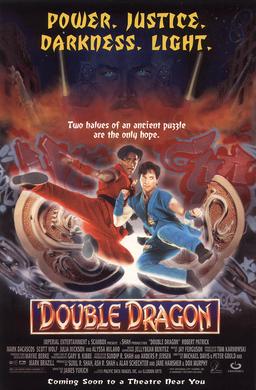
The future looks a lot like a cheap music video. Due to repeated earthquakes, California is now an island and Los Angeles has been left in ruins. The city has been renamed New Angeles, even though the correct name would have been Nuevos Angeles but whatever. The important thing is that city is now a mess. The police allow the gangs to run rampant at night in return for not running rampant during the day. The nightly news, which is anchored by George Hamilton and Vanna White, is full of stories about the federal government refusing to send any more aid to California, despite the fact that Jerry Brown is the Vice President. For some reason, Andy Dick plays the weatherman and gives continual updates on the smog and rain.
Despite the fact that the city is the most dangerous place on Earth, Satori Imada (Julia Nickson) still makes the time to drive her teenage sons, Billy (Scott Wolf) and and Jimmy Lee (Mark Dacascos, who was clearly not a teenager when this film was shot) to and from their karate tournaments. However, that might all end because Sartori possesses half of a magic medallion and the evil Koga Shuko (Robert Patrick, looking oddly like Sugar Ray’s Mark McGrath) has the other half. Satori gives her half of the medallion to Billy and tells him that he and his brother must keep it out of the hands of Shuko.
That’s not going to be easy because Shuko not only has control of the local gangs but also the police. Fortunately, rebel leader Marian Delario (Alyssa Milano) is willing to help out the Lee brothers. It all leads to a lot of fights, a lot of running, some campy humor, and stiffly delivered dialogue. For whatever reason, the filmmakers decided that the way to make this marital arts film a success would be to push accomplished martial artist Mark Dacascos into the background and instead focus on Scott Wolf, who spends most of the movie looking like he’s either confused by the plot or terrified as to what Double Dragon might do to his career.
Yeah, this movie is pretty stupid and the plot is pretty much impossible to follow. And yet, it is oddly entertaining in its own weird way. If you ignore the story and just focus on the visuals, it can actually be kind of fun. Look at all the bright colors. Look at Robert Patrick, with his goat-tee and his 90s pop star hair. Look at Alyssa Milano, who, surprisingly, seems to actually be in on the joke. Look at all of the Mad Max-inspired fashion choices. From a purely visual point of view, New Angeles is a huge improvement on Los Angeles. Along with the film visuals, the film is also worth watching just so one can witness just how over-the-top Robert Patrick goes in his performance. I don’t normally think of Patrick as being someone who chews the scenery but, in this film, he gives into every cartoonish impulse that he has and it’s actually a lot of fun to watch. There’s not a moment of subtlety to be found in either his performance or Alyssa Milano’s and thank the Angels for that. Finally, I have to appreciate the fact that the film’s main message appears to be that the government and all other forms of civil authority are basically useless. Not even Vice President Jerry Brown can be bothered to help out the people of New Angeles. That pretty much tells you all that you need to know.
In the end, Double Dragon is not a particularly good film but it’s fun in its own deeply dumb way.
Welcome to Retro Television Reviews, a feature where we review some of our favorite and least favorite shows of the past! On Sundays, I will be reviewing the made-for-television movies that used to be a primetime mainstay. Today’s film is 1971’s See The Man Run! It can be viewed on YouTube!
Two criminals have kidnapped the 18 year-old daughter of Dr. Thomas Spencer (Eddie Albert). They call the number that they have for Dr. Spencer and they tell the man that answers that they are going to kill his daughter unless he pays them a large amount of money.
What the criminals don’t know is that Dr. Spencer has recently changed his phone number and his old number was given to a struggling actor named Ben Taylor (Robert Culp). When the kidnappers call, Ben has just gotten out of bed and he’s still a bit too groggy to explain to them that they have the wrong number. Though he suspects that the whole thing might be an elaborate prank, he decides to call the real Dr. Spencer and tell him about the phone call. However, when the doctor answers, Ben does such a bad job of explaining the situation that Dr. Spencer thinks that Ben is the kidnapper. Begging Ben not to hurt his daughter, Dr. Spencer says that he’ll pay anything and that he won’t even call the police.
This gives Ben and his wife, Joanne (Angie Dickinson), an idea. When the kidnappers call back, Ben pretends to be Dr. Spencer. After the kidnappers tell Ben the amount of money that they want, Ben then calls Dr. Spencer and, pretending to be the kidnapper, relays the message but he also adds an extra $50,000 to the ransom demand. Ben and Joanne’s plan is to collect the ransom from Dr. Spencer, take their cut, and then deliver the ransom to the kidnappers.
It’s a complicated plan and, throughout the course of the day, both Ben and Joanne have their moments of doubt. But they stick with it, because Joanne wants the money and Ben wants the chance to not only prove himself as an actor but to also show Joanne that he’s not the loser that she insists that he is. Complicating matters, though, is that Dr. Spencer’s wife (June Allyson) has called the police without telling Dr. Spencer. Though Dr. Spencer doesn’t know it, the cops are determined to be there when he hands off the ransom to the man who claims to have his daughter.
Clocking in at a briskly-paced 73 minutes, See The Man Run is an enjoyable thriller, one that is full of unexpected twists and which features a fierce performance from Angie Dickinson and a rather poignant one from Robert Culp. Culp is convincing rather he’s playing a kidnapper, a doctor, or just an out of work actor who doesn’t realize that he’s gotten in over his head. As smart as he may be, Ben cannot escape from his own insecurities and his fear of being betrayed. It all leads to a diabolically clever surprise ending, one that proves that you can run only so far before you stumble.
Welcome to Retro Television Reviews, a feature where we review some of our favorite and least favorite shows of the past! On Sundays, I will be reviewing the made-for-television movies that used to be a primetime mainstay. Today’s film is 1971’s The Feminist and The Fuzz! It can be viewed on YouTube!
At first glance, Jane Bowers (Barbara Eden) and Jerry Frazer (David Hartman) don’t have much in common.
Jerry is a cop, though he’s attending night school with the hope of someday becoming a lawyer. Jerry is an old-fashioned law and order man. He expects the law to be followed. He’s also the type who definitely believes that there are clear differences between men and women. As he explains it, there are some thing that men are just better at. Jerry is dating Kitty (Farrah Fawcett), who works as a waitress at the local Playboy Club.
Dr. Jane Bowers is a pediatrician and a proud feminist, one who takes it personally when a cop like Jerry refuses to give her a parking ticket just because she’s a woman. She wants to be treated as an equal in all matters. She’s dating Wyatt Foley (Herb Edelman), an attorney who still lives with his mother and who constantly goes out of his way to let everyone know that he’s an ally. Jane’s best friend is Dr. Debby Inglefinger (Jo Anne Worley), who has decided that it’s time to lead a protest at the Playboy Club.
The only thing that Jerry and Jane have in common is that they both desperately need an apartment but apparently, apartments were not easy to find in San Francisco in the early 70s. Fortunately, a hippie (Howard Hesseman) has just been evicted from his apartment because the landlord (John McGiver) didn’t like the fact that he was constantly having overnight guests. Jane and Jerry both end up at the apartment at the same time, with Jane getting offended by Jerry’s refusal to give her a traffic ticket. (Jerry makes the mistake of saying that he’s going to let her off “with a warning.” He wouldn’t give a warning to a man! Seriously, though, who in their right mind would actually demand a ticket? Those things cost money.) Even though they take an instant dislike to each other, Jane and Jerry still decide to pretend to be husband and wife so that they can rent the apartment together. With their busy schedules, they figure that they’ll never have to see each other. They won’t even know the other is around.
Of course, it doesn’t work out like that. Jane allows Debby to hold a consciousness raising meeting at the apartment. (Future director Penny Marshall appears as a participant.) Meanwhile, Jerry lets a prostitute (Julie Newmar) stay at the apartment, just to keep her off of the streets for the night. The landlord is getting suspicious. So, for that matter, is Jane’s father (Harry Morgan). And, as you probably already guessed, Jerry and Jane are falling in love.
With its hippies and its militant feminists and its jokes about the Playboy Club, The Feminist and the Fuzz is a film that practically yells, “1971!” Unfortunately, script’s attempt to turn the film’s rather predictable plot into a Neil Simon-style jokefest never quite works. The “humorous” dialogue feels forced and the film’s 75-minute run time doesn’t do it any favors, as we never really have the time to get to know Jerry or Jane as human beings. Instead, they just remain “The Fuzz” and “The Feminist.” As a result, it’s not that easy to care about whether or not they actually get together. Some of the supporting performances are amusing. Barbara Eden manages to avoid turning Jane into a caricature of a humorless activist but poor David Hartman is stiff as a board and in no way convincing as a veteran cop.
The main thing I took away from this movie is that the Playboy Clubs were exceptionally tacky. Way back in 2011, NBC actually tried to air a drama series that took place at a Playboy Club in the 60s. (This was when every network was trying to come up with the next Mad Men.) The pilot started with creepy old Hugh Hefner assuring the viewers that, “Everybody who was anybody wanted to be a member of the club.” I mean, seriously? What a strange world.
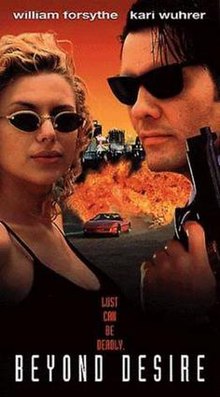
1995’s Beyond Desire tells the story of Ray Patterson (William Forsythe). He’s spent the last 14 years in jail, convicted of a murder that he says he didn’t commit. He likes to sing. He’s obsessed with Elvis. He claims that he doesn’t know how to drive because he’s been in prison for the last 14 years but he appears to be in his mid-40s so you have to kind of wonder if maybe Ray just wants other people to drive him around. After all, Elvis never drove himself.
Perhaps because everyone is sick of listening to him as he sings Amazing Grace in his cell, Ray is released from prison. Since he was serving his time in Nevada, this means that Ray now has to walk down a desert road and hope that someone gives him a ride. Fortunately, for Ray, a woman named Rita (Kari Wuhrer) pulls up in fancy red car and asks him where he’s going. Rita explains that she’s always had a fantasy about picking up someone who has just been released from prison. Ray accepts her offer of a ride and soon, they’re at a desert motel, engaging in saxophone-scored, Vaseline-on-the-lens softcore sex. Ray may have forgotten how to drive but apparently, he didn’t forget everything during those 14 years he spent in prison. If nothing else, this film reveals more of William Forsythe than most viewers probably ever thought they’d see.
Soon, Ray and Rita are head to Vegas. Of course, it turns out that Rita wasn’t quite honest about why she picked up Ray. Rita is a high-priced escort and she works for a local crime boss named Frank (Leo Rossi). Frank wants Ray to reveal the location of some stolen money. Ray, meanwhile, feels that Frank is the key to clearing his name and catching the real murderer. At first, it seems like everyone is just manipulating everyone else but Rita and Frank do eventually end up falling in love. Can their love survive bullets and hints of betrayal?
Like many 90s crime films, Beyond Desire is one of those films that was obviously made to capitalize on the success of Quentin Tarantino. The characters of Ray and Rita are such obvious copies of True Romance‘s Clarence and Alabama that the film comes close to turning into a self-parody. Ray is a big Elvis fan and occasionally quotes lyrics at inopportune times. The soundtrack itself is full of Elvis songs, though the budget apparently wasn’t big enough to actually get the rights to any of Elvis’s recordings. Instead, we get cover versions, the majority of which feel rather wan. The film emphasizes the garish glitz of the Vegas Strip but none of the quirky beauty of it. Las Vegas, an adult playground sitting in the desert, is pure Americana. That was something that was captured by Francis Ford Coppola in The Godfather, Martin Scorsese in Casino and David Lynch in Twin Peaks: The Return. The film uses Vegas as a convenient backdrop but it has nothing to say about the location itself.
Like the majority of road movies, the film tends to meander a bit. Ultimately, the road leads to nowhere. That, in itself, is not necessarily a problem. The same could be said of Tony Scott’s True Romance or any number of films directed by Wim Wenders. Unfortunately, this film wasn’t directed by Tony Scott or Wim Wenders. Instead, it was directed by the guy who did Halloween 5 and the end result is a film that, even when taken as a purely stylistic exercise, still feels rather empty. It’s a shame because William Forsythe shows off a lot of quirky, bad boy charm in the role of Ray and Kari Wuhrer make Rita into a far more complex and conflicted character than one might expect. But, unfortunately, the film itself just doesn’t live up to their performances.
Welcome to Retro Television Reviews, a feature where we review some of our favorite and least favorite shows of the past! On Sundays, I will be reviewing the made-for-television movies that used to be a primetime mainstay. Today’s film is 1975’s The Secret Night Caller! It can be viewed on YouTube!
Though the show pretty much guaranteed that he would forever be a part of the American pop cultural landscape, Robert Reed was not a fan of The Brady Bunch. Onscreen, Reed played Mike Brady, the stern patriarch who always knew the right thing to do and who, as a result, was named father of the year by the local chamber of commerce. (Of course, even though she was responsible for him getting the reward, Mike still grounded Marcia for sneaking out to mail in his nomination forms.) Offscreen, Reed was notoriously difficult, complaining that the scripts for the show were juvenile and shallow. Reed was correct and it should be noted that all of the actors who played the Brady kids have said that Reed never took out his frustration on the cast and actually became a bit of a surrogate father to all of them. Still, you have to wonder what Reed was expecting when he signed up for a show that was created by the man responsible for Gilligan’s Island.
The Brady Bunch was cancelled in 1974, temporarily setting Robert Reed free from the burden of playing Mike Brady. (Of course, he would later return to the role in The Brady Bunch Hour and we all know how that turned out.) One of the first post-Brady movies that Reed starred in was The Secret Night Caller.
In this film, Reed plays a seemingly mild-mannered IRS (booo!) agent named Freddy Durant. Freddy has a good career and a nice home but he’s deeply unsatisfied. He barely communicates with his wife, Pat (Hope Lange). He freaks out over his teenage daughter, Jan (Robin Mattson), wearing a bikini. He fantasies about hitting on almost every woman that he sees. He hangs out at a strip club and, when he’s really feeling unsatisfied, he makes obscene phone calls! Because this is a made-for-TV movie from the 70s, we never actually get to hear what Freddy says on the phone but he manages to disgust and/or horrify everyone who has the misfortune to answer his call. He even calls a woman who works in his office, scaring Charlotte (Arlene Golonka) so much that she subsequently has an auto accident. Unfortunately, for Freddy, one of his victims, a stripper named Chloe (Elaine Giftos), recognizes his voice and tries to blackmail him. Freddy’s life is falling apart. Can his psychiatrist (played by Michael Constantine) help him put it all back together again?
Freddy Durant is obviously meant to come across as being the exact opposite of Mike Brady. (Of course, many of us who have seen The Brady Bunch have our suspicions about what Mike was actually doing in his office….) Whereas Mike Brady was the perfect father, Freddy is cold, distant, and repressed. Reed is convincingly uptight as Freddy and he’s surrounded by a fine supporting cast, including Sylvia Sidney as his disapproving mother-in-law. That said, it’s still impossible to watch this show without thinking to yourself, “There’s Mike Brady making an obscene phone call.” That’s the difficulty of typecasting unfortunately. For all of his efforts to escape the shadow of the Brady Bunch, it’s impossible not to associate Robert Reed with the show, even when he’s talking dirty on the phone.
In the 1992 film, My Cousin Vinny, two college students from New York City, Bill Gambini (Ralph Macchio) and Stan Rothstein (Mitchell Whitfield), make the mistake of driving through Alabama. The two students stop off at a convenience store. When the clerk is subsequently shot dead during a robbery, Bill and Stan are arrested for the crime. The viewers know they’re innocent. Bill and Stan know they’re innocent. But the entire state of Alabama seems to be determined to send Bill and Stan to prison for life.
Fortunately, Bill’s cousin, Vinny (Joe Pesci, star of Half Nelson), is a lawyer. Unfortunately, he just recently passed the bar exam and he has yet to actually try a case. Still, Vinny and his fiancée, Mona Lisa Vito (Marisa Tomei), come down to Alabama. Vinny takes the case, lying to the judge (Fred Gwynne) about his qualification as a trial attorney. Vinny is momentarily impressed when the prosecutor (Lane Smith) shares with him all of the files about the case. “It’s called disclosure, dickhead!” Lisa snaps at him, revealing that she actually has more common sense than Vinny. That becomes increasingly important as Vinny tries to keep Bill and Stan from spending the rest of their lives in prison.
To be honest, considering how much I complain about stereotypical portrayals of the South, I really shouldn’t like My CousinVinny as much as I do. Almost every character in the film is a stereotype to some extent or another, from the farmers and rednecks who take the witness stand to Fred Gwynne’s no-nonsense judge who rules that Vinny is in contempt of court because he’s wearing a leather jacket. Fortunately, though, the Southern stereotypes don’t bother me because both Vinny and Lisa are New York stereotypes. Just as the judge and the townspeople seem to confirm every prejudice that someone like Vinny would have against the South, Vinny seems to be the epitome of everything that people in the South dislike about the North. When Vinny first shows up on the scene, he’s loud and brash and obnoxious. But, as the film progresses, Vinny reveals himself to not only be a better attorney than anyone was expecting but he also calms down and adjusts to the more relaxed pace of life in the country. Just as Vinny reveals himself to be not as bad as everyone originally assumed, both the Judge and the prosecutor are also allowed to reveal some hidden depths. Neither one is the cardboard authority figure that viewers might expect. The Judge does sincerely want justice to be done and the prosecutor sincerely wants to keep the county safe, even if he is prosecuting two innocent men. Just as Vinny learns not to be too quick to judge them, they learn not to be too quick to judge Vinny. The end message is that everyone is innocent until proven guilty and deserves a fair hearing, whether in a court of law or just in the courts of public and private opinion. It’s not a bad message. In fact, it’s one that more than a few people could still stand to learn today.
Of course, the best thing about the film is Marisa Tomei, who not brings a lot of energy to the film but whose hair is amazing and whose clothes are to die for. Tomei won an Oscar for her performance in My Cousin Vinny, a victory that was so controversial that there were unfounded rumors that presenter Jack Palance had read the wrong name by mistake. (As we all learned a few years ago when Warren Beatty and Faye Dunaway actually did read the wrong winner, the accountants aren’t going to let anyone get away with that.) Watching the film last night, it was obvious to me that Tomei deserved that Oscar because Lisa is the heart of the film. Pesci, Gwynne, and Lane Smith are all give good performances but, without Marisa Tomei’s performance, My Cousin Vinny would ultimately just be another culture clash comedy. A lesser actress would have just played Lisa as being a stereotype. But Tomei turned Lisa into the most believable and sincere character in the film. While Lisa won the case, Tomei saved the movie.
(And needless to say, I’m a fan of any movie that features a Lisa saving the day.)
My Cousin Vinny holds up as an enjoyable film. Watch it the next time you’re losing faith in humanity.
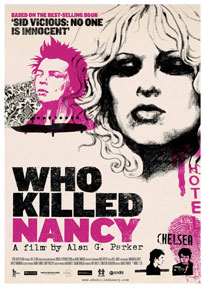
On October 12th, 1978, a 20 year-old, heroin addict named Nancy Spungeon was discovered dead in the bathroom of her room at the Chelsea Hotel. Nancy was best-known for being the girlfriend of Sid Vicious, the bassist of the Sex Pistols. The police arrested Vicious and charged him with second degree murder. Vicious initially said that he couldn’t remember what had happened the previous night because he had been knocked out on barbiturates. While being interrogated, Vicious changed his story and said that he and Nancy had an argument during the night but that he hadn’t meant to kill her when he stabbed her. Later, Vicious said that Nancy fell on the knife but Vicious was such a heavy drug user that many felt it was doubtful he had any real memory of anything that might have happened that night. After pleading not guilty, Vicious was released on $50,000 bail but he was sent right back to Riker’s after assaulting Todd Smith (brother of Patti Smith) at a nightclub. At Riker’s Vicious went through a detox program before being once again released on bail. Vicious died of a heroin overdose the night after he was released.
Who Killed Nancy? is a documentary about Sid and Nancy’s relationship and Nancy’s death. The film features interviews with friends and cotemporaries of the couple. (Glen Matlock is the only former Sex Pistol to be interviewed, though Malcolm McLaren is heard in archival footage.) Sid Vicious comes across as being a deeply damaged individual with no impulse control. Listening to some of the things that Vicious did before finding fame as the sneering face of punk rock, it is easy to believe that, as much as he did love Nancy, he was also capable of losing his control and killing her. Glen Matlock’s flatmate describes how he was traumatized for life by watching Sid strangle a stray cat. Others describe Sid as being childlike and almost innocent, a shy virgin until he met Nancy. But anyone who could strangle an animal has obviously got some screws loose.
However, the documentary also makes a convincing argument that, even if he was capable of impulsive violence, Vicious was so wasted on the night of Nancy’s death that he couldn’t have even lifted a knife, much less stabbed someone with it. The documentary suggests that Nancy was murdered by one of the many drug dealers who were coming in-and-out of the couple’s hotel room. Unfortunately, due to his own public image, it was easy for the press and the public to assume that Sid committed the crime and, suicidal after Nancy’s death, it was easy for Sid to convince himself that he must have been responsible. If the documentary is correct about Sid’s innocence, at least one person got away with murder. It’s an interesting documentary. You do have to feel bad for Nancy. Even in death, none of the interviewees seems to be willing to say anything nice about her. After all these years, she is still being blamed for Sid Vicious’s downfall but, as this documentary makes clear, Sid was probably doomed whether or he met Nancy or not.
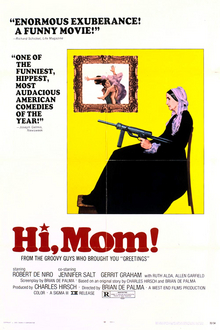
Released in 1970, Hi, Mom!, tells the story of Jon Rubin (played by a 26 year-old Robert De Niro). The somewhat spacey and kind of creepy Jon has just returned to New York City from Vietnam. After moving into a run-down apartment building and meeting the building’s superintendent (Charles Durning), Jon is hired to direct a pornographic film by producer Joe Banner (Allen Garfield). Jon’s idea to simply point his camera at his building and to film his neighbors as they go about their day. As quickly becomes apparent, Jon is mostly just looking for an excuse to watch and film Judy Bishop (Jennifer Salt).
Also living in the building is Gerrit Wood (Gerrit Graham), who is first seen triumphantly putting posters of Che Guevara and Malcolm X up in his apartment. Gerrit is a freshly-minted political radical and the leader of a group of performance artists who put on a show called Be Black, Baby, in which the white audience members are forced to wear blackface and are then chased, attacked, and assaulted by black actors wearing whiteface. (Gerrit himself is white.) Jon is hired to play the police officer who beats and arrests the members of the audience at the end of the performance. Of course, eventually, the real police show up….
An attempt at an episodic counter-culture comedy, Hi, Mom is definitely a product of the time in which it was made, both in its style and its thematic content. Today, it’s best-known for being one of Brian De Palma’s early independent films and for featuring Robert De Niro in one of his first starring roles. De Palma and De Niro aren’t exactly the first names that come to mind when one thinks about comedy and Hi, Mom shows that there’s a good reason for that. As both a screenwriter who felt he had something important to say and a young director who was obviously eager to show off everything that he could do with a camera, Brian De Palma simply cannot get out of his own way. Scenes are needlessly sped up. Scenes are pointlessly slowed down. The musical cues are obvious. The dialogue is often so broad that it comes across as being cartoonish. One gets the feeling that De Palma didn’t trust the audience to get the jokes so he went overboard to make sure everyone knew when to react. All of the pointless camera trickery serves the same purpose that a laugh track would on an old sitcom. Interestingly enough, the only sequence that really works as satire is the Be Black, Baby sequence and that’s because De Palma directs it in a semi-documentary fashion. De Palma gets out of his own way and allow the sequence to develop a natural rhythm. (Of course, seen today, the scene will bring to mind the upper class white liberals who pay money to have an activist lecture them about their privilege while having their friends over for dinner.)
As for Robert De Niro, he gives a typically nervy performance, one that feels like a dry run for his later work in Mean Streets, Taxi Driver, and King of Comedy. Despite the reputation of those films, there are some genuinely funny moments to be found in all of them. Most of them, like the classic Taxi Driver conversation between De Niro’s Travis and Peter Boyle’s Wizard, are funny because of how people react to De Niro’s obviously unhinged characters. Both Taxi Driver and King of Comedy got mileage out of having normal people try to deal with De Niro’s unstable characters. In Hi, Mom, everyone is equally wacky and, as such, De Niro doesn’t really have anyone to play off. No one is really reacting to anything, De Niro-included. (There is some spark to his scenes with Charles Durning and Allen Garfield but even those scenes seem to drag on forever.)
On the plus side, Hi, Mom! is was shot on the actual streets of New York City, guerilla-style. (A “Re-Elect Mayor Lindsay” sign in the background confirms that the film was made on location in 1969.) When De Palma isn’t getting in his own way with all of his fancy camera tricks, he manages to capture so memorably bleak images of New York City. Hi, Mom! presents New York as being a dirty, crime-ridden, and menacing city but it also captures the odd grandeur of urban decay. At its best, Hi, Mom! captures the love/hate relationship that many seem to have New York City. The city feels both alive and dangerous at the same time. Hi, Mom! is too uneven to work as a sustained satire but, as a documentary about New York at the end of the turbulent 60s, it’s worth watching.
I should mention that this was not the first time that De Palma and De Niro teamed up. Indeed, De Niro was De Palma’s muse even before he met Martin Scorsese. Hi, Mom! was a loose sequel to an earlier De Palma/De Niro film called Greetings. (Like many of De Palma’s future films, both Greetings and Hi, Mom! were originally rated X but later re-rated R.) De Palma and De Niro, of course, would both go onto have long Hollywood careers. (They would later reunite for The Untouchables, a big-budget spectacle of a film that’s about as far from the grungy Hi, Mom! as one can get.) De Palma’s career has had its ups and downs but, as of late, many of his films have been positively reevaluated. As for De Niro, he can finally kind of play comedy. That said, I’d rather watch Hi, Mom than Dirty Grandpa.





 Through the Shattered Lens