When his innocent son, Ted (David Sharpe), is accused of committing a murder, Lex Crane (Walter Long) turns him over to Texas Ranger Jack Haile (Jack Randall) because he knows that Jack will make sure that Ted gets a fair trial. Lex says that he and his men are accused of every crime that happens in the area, even though they’re always innocent. Jack understand and respects Lex as a man and a father. But when someone shoots and kills Ted, Lex and his men set out for revenge. The twist? Lex has a twin brother named Buck (also played by Walter Long) and the two brothers hate each other.
Most poverty row westerns blend into each other but Man’s Country stands out as an intelligent and well-acted western. Even though the twin twist is undoubtedly an overdone one, Man’s Country does a good job with it and Walter Long gives such a good performance that both Lex and Buck emerge as individual, identifiable characters. Jack Randall may not have been the greatest of the old western actors but he’s believable as the tough but fair Texas Ranger. There’s enough western action for fans of the genre but, for once, the plot is interesting enough that it might hold the attention of other watchers as well.
Of course, this is a Poverty Row western so Charles King does appear as one of the bad guys. He gets into a fist fight, like he almost always did. I wonder how many onscreen punches Charles King actually threw over the course of his career in the westerns. It had to have been a lot.
Happy 52nd Birthday to Bollywood actor Hrithik Roshan!
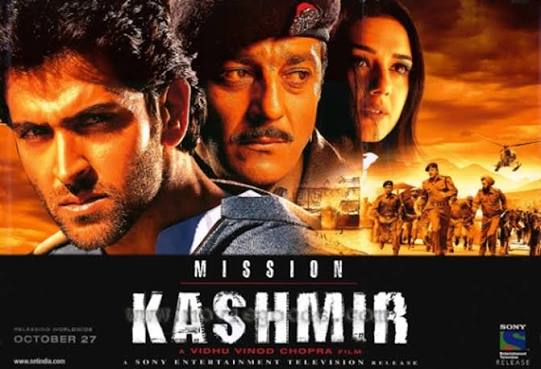
Around the turn of the century, I first became aware of the films being made in Bollywood, India’s Hindi-language film industry. It was then I noticed that the film MISSION KASHMIR was for sale at the Best Buy in Little Rock, AR. I figured that this must be a pretty good film to find itself manufactured, packaged, and being sold all the way over here in Central Arkansas. That was also around the time that I first signed up for Netflix. Not yet a streaming giant, Netflix was just a service for renting movies through the mail. I immediately put MISSION KASHMIR in my queue so I could check it out. This was only my third Bollywood experience, behind the very good films DIL SE (1998) and ASOKA (2001). I remember being fired up about the chance to see some new actors and discover a Hindi action film. Although not completely satisfying, I did find MISSION KASHMIR to be an enjoyable experience.
The plot finds Inspector Khan (Sanjay Dutt) living the good life. He has a beautiful wife (Sonali Kulkarni), a good son, lives in a beautiful house, and gets paid to periodically kick the posteriors of some bad Indians. Unfortunately, his success in his professional life has had some bad side effects. One particularly bad guy has put out the word that any doctor who treats Inspector Khan, or his family, will be killed, and as one scene proves, this guy is a man of his word. Next thing you know, Khan’s son falls and hits his head. Tragically, the boy dies because all of the doctors refuse to help him until it is already too late.
Seeking revenge, his face covered by a black ski mask, Khan tracks down the men responsible and viciously kills them all, including the innocent father, mother, and daughter of a family being held captive by the bad guys. The only survivor is the young son of the slaughtered family, Altaaf, who has terrifying dreams of the black-masked killer of his family. Inspector Khan, who feels extreme guilt over what he has done, allows his wife to talk him into bringing the boy to their house rather than allowing him to spend his childhood in an orphanage.
Life is just starting to get good again when Altaaf figures out that the killer of his family was actually his new father, Khan. After first pausing to try to kill Khan unsuccessfully, Altaaf takes off, not to be heard from again for 10 years. When Altaaf finally shows back up, he has turned into heartthrob Hrithik Roshan, is under the control of a psycho terrorist (played by Jackie Shroff) who has a plan to bomb the heck out of Kashmir, and has a new laundry list of goals in life:
Use childhood sweetheart for terror purposes even though I still love her – check!
Use kung fu training to good action effect – check!
DESTROY INSPECTOR KHAN AT ALL COSTS!!! – ??????
I’ll let you discover the results of goal number four.
Before I go into my thoughts on MISSION KASHMIR, I want to note that while the film is set against the backdrop of the Kashmir conflict, it mostly uses that setting for its story of personal melodrama and high-octane action. I am no expert on the region’s complex politics, so this review focuses only on what I think of the movie itself, with no added political commentary.
As a movie, MISSION KASHMIR has a lot of good things going for it. First and foremost, I am a fan of action films, and I was looking for some good action scenes. This film did not disappoint in that department. From the MATRIX-like introduction to Altaaf’s adult persona to the final attempts to thwart the master terrorist’s plot, the action is presented in a highly stylized manner. Wirework kung fu, slow-motion carnage, and a hero wielding a massive missile launcher aimed at bad guys make for a pleasant viewing experience in my book.
Secondly, the film features some good performances. Sanjay Dutt’s portrayal of Inspector Khan is commanding, and I found myself really pulling for his character. It is hard not to be sympathetic to a guy who endures as much as he does here. This was the first time I had seen Hrithik Roshan in a film. With his matinee idol good looks, Roshan was emerging as a major star of Hindi cinema, even challenging Shah Rukh Khan, the reigning megastar of Bollywood. Roshan gives a solid performance as the grown-up Altaaf and is especially strong in the action scenes. The other major performance comes from Preity Zinta, who plays the girl Altaaf loved as a child and still loves as a man. I had seen her before in DIL SE and really like the naturalistic, best-friend, girl-next-door vibe she brings to her roles, albeit a very beautiful girl next door. It is easy to see why Altaaf has always loved her. Finally, as with the other Bollywood films I have seen, this movie is just beautiful to look at. I think the greatest cinematography of landscapes in the world is being done in India.
I do have a couple of complaints with MISSION KASHMIR. First, clocking in at over two and a half hours, the movie is too long. The story could have been made into a very exciting ninety-minute film. As it is, the movie seems to drag in places, with the insertion of songs and sequences that do not add much to the proceedings. There were times I found myself thinking, “OK, I get it. He really loves her. Now let’s move on with it,” or “Not another song…” Secondly, I felt that some of the songs were simply not appropriate for what was happening on the screen. For example, there is one peppy little dance number that leads directly into a horrific tragedy. Granted, the scene is effective for the surprise element, but when the film should have been building action and suspense, it instead throws in this routine, which took me out of the movie for a bit. These are the only real complaints I had.
Overall, I did enjoy MISSION KASHMIR. The movie is filled with strong action sequences, along with good performances from a talented cast. Although it overstays its welcome in certain areas, I still recommend this film and give it a 7 out of 10.
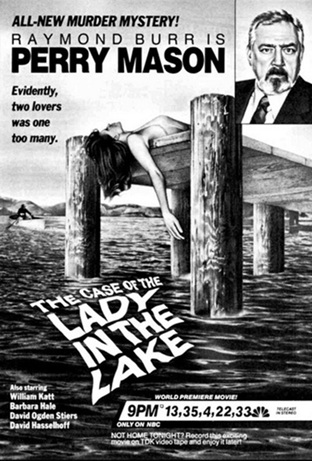
Fifteen years ago, the sister of Sara Wingate (Doran Clark) was murdered at a lake near the family home. Traumatized, Sara had a nervous breakdown. It was only when she married Billy Travis (David Hasselhoff), a former tennis player, that Sara started to get over her fear of the lake. When Sara disappears while walking along the lake, Billy is arrested and charged with murdering her. Because Perry’s is an old friend of Sara’s uncle (John Ireland), he takes the case. If you’re going to get arrested for murder, you better hope one of your relatives knows Perry Mason.
This movie wasn’t bad. It had a twist at the end, which I saw coming but which was still unique for the Perry Mason movies. The actual guilty party is pretty obvious but the mystery wasn’t as important as usual in this one. The supporting cast was pretty good, though David Hasselhoff seemed to be too calm for someone accused of murder. As Perry, Raymond Burr uses his cane again and leans against something whenever he has to stand up. Della jokes that Perry won’t be skiing anymore. Most of the action falls to Paul Drake, Jr. (William Katt), who gets beaten up even more than usual but who also gets to be the big hero in the end.
This was the last Perry Mason film for both William Katt and David Ogder Stiers, who played the district attorney. I’m going to miss both of them. William Katt’s hair was huge in this one and I was really looking forward to seeing how much bigger it could get.
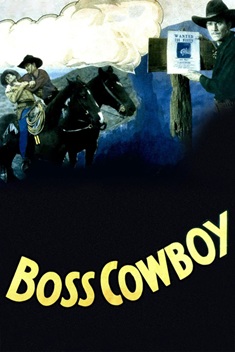
Boss Cowboy takes place in the 30s but it’s very much a western. One car shows up and telephone poles dot the countryside but almost everyone in the movie rides a horse. The Nolans and the Rosses are two ranching families. Both families are losing cattle. Nolan foreman Dick Taylor (Buddy Roosevelt) suspects that the culprit is the Ross foreman, Jack Kearns (George Cheseboro) and he’s right. Kearns is ripping off both families. Complicating Taylor’s effort to stop Kearns are his romantic feelings towards Mary Ross (Frances Morris), who is visiting from “back east.” Sally Nolan (Fay McKenzie) is also visiting and running joke is her handing off her small dog to a ranch hand named Slim (Alan Holbrook).
No apparent relation to either Teddy or FDR, Buddy Roosevelt was a respected stunt man who tried his hand at starring in a few westerns, Unfortunately, Buddy Roosevelt wasn’t much of an actor, which is painfully apparent while watching him in Boss Cowboy. He’s fine when he’s riding a horse and pulling a gun but when he has to speak, it’s difficult to watch. As bad as Buddy Roosevelt’s acting was, he was not the worst actor in Boss Cowboy. That honor was split between Frances Morris and Fay McKenzie. Boss Cowboy is pretty dull. Every scene drags and there are plenty of awkward silences while the cast tries to remember their lines.
Though he wasn’t much of an actor, Buddy Roosevelt remained in a demand as a stunt man throughout the 40s. In the 50s and 60s, he was kept busy playing townsmen in shows like The Life and Legend of Wyatt Earp. In 1962, he made his final film appearance in The Man Who Shot Liberty Valance. He then retired to Colorado, where he did at age of 75 in 1973. In all, his Hollywood career spanned 46 years, from 1916 to 1962.
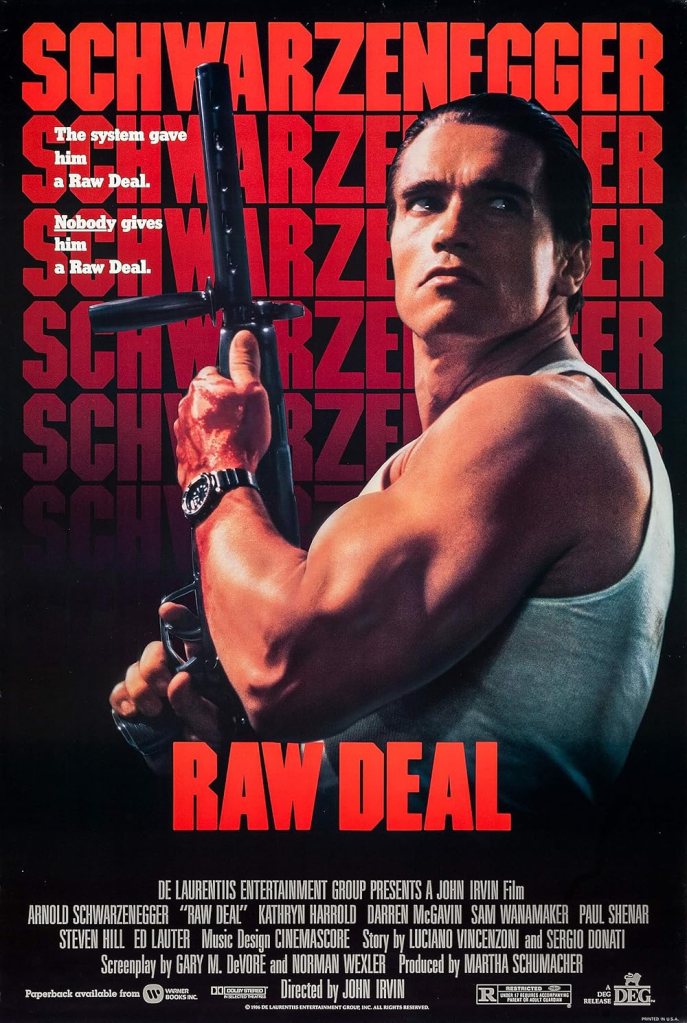
There is a point in every Arnold Schwarzenegger fan’s journey where they eventually circle back to Raw Deal and go, “Wait, how did this one slip through the cracks?” Set between Commando and Predator, this 1986 action vehicle often feels like the red-headed stepchild of Arnold’s golden era: a half-forgotten mob thriller dressed up as a one-man-army shoot-’em-up, with an undercover plot that keeps tripping over itself. Before Arnold was secret agent Harry Tasker in True Lies, he was already workshopping that whole undercover persona as former FBI man Mark Kaminski in Raw Deal. There is something strangely compelling about watching him play at being slick, whether he is posing as “Joseph Brenner” in mob circles or later reinventing himself as a suburban-family-man-turned-super-spy. Yet for all its clumsiness, tonal whiplash, and baffling choices, Raw Deal settles into that sweet, trashy groove where “this is bad” and “this is kind of awesome” blissfully merge. It is, in the purest sense, a guilty pleasure.
The setup is straightforward on paper. Arnold plays Mark Kaminski, a former FBI agent pushed out of the bureau for beating a suspect who assaulted and murdered a child, now stuck as a small-town sheriff in North Carolina with an unhappy, alcoholic wife and a life that feels like exile. His shot at redemption comes when his old FBI buddy Harry Shannon (Darren McGavin) recruits him for an off-the-books vendetta: infiltrate the Chicago mafia responsible for Shannon’s son’s death and tear them apart from the inside, in exchange for a possible path back into the bureau. Kaminski fakes his death, rebrands himself as “Joseph Brenner,” and sets out to worm his way into the organization run by boss Luigi Patrovita (Sam Wanamaker), while juggling mob politics, double-crosses, and a steady escalation of gunfire.
What makes the Kaminski era so weirdly fascinating is how hard the film leans on Arnold as a suave operator when his natural screen charisma is more brute-force than smooth-talking. In Raw Deal, he stalks through nightclubs and mob hangouts as an “undercover” tough guy, and you can almost see the movie trying to stretch him into a more traditional cool-gangster mode even as his sheer physicality keeps breaking the illusion. That tension carries right into True Lies, where the humor finally acknowledges how absurd it is to treat this gigantic Austrian bodybuilder as a low-key spy. The seeds of Harry Tasker’s double life are there in Kaminski: the awkward attempts at suave posturing, the undercover role-play, and the sense that the film is constantly asking the audience to accept him as something more than just the gun-toting tank he so effortlessly embodies. That tonal tug-of-war is kind of a mess, yet it’s also exactly why the movie is weirdly fun to revisit.
As an action piece, Raw Deal is very hit-or-miss, but when it hits, it goes all in on 80s excess. Director John Irvin stages a number of shootouts, but the standout sequence is the gravel pit massacre where Kaminski tears through mob soldiers with Mick Jagger’s “(I Can’t Get No) Satisfaction” blaring on the soundtrack, turning what should be a grim set piece into something closer to a music video about vengeance. The climactic assault on Patrovita’s casino base is another high point, with Kaminski stalking room to room, methodically mowing down henchmen in suits as the film abandons any pretense of undercover subtlety and embraces straight-up carnage. These moments are absurdly over the top, but they’re the reason the film lingers in the memory more than some “better” constructed movies from the same era.
The problem is that the film around those set pieces often feels oddly slack. For a movie with such a simple premise—ex-cop goes undercover in the mob—Raw Deal somehow manages to tangle itself in muddled plotting and underdeveloped subplots. Roger Ebert complained that the story is so basic it should be impossible to screw up, yet the movie still finds ways to make motivations cloudy and relationships confusing, especially when it comes to FBI leaks and why certain hits are happening. There are scenes, like the cemetery assassination setup, that should be loaded with emotional and narrative clarity but instead play as strangely opaque, leaving viewers wondering less “What will happen next?” and more “What exactly is going on?”
Despite the narrative wobbling, the cast gives the film more personality than it probably deserves. Schwarzenegger is still in that phase where his acting is limited but his screen presence is undeniable, and Raw Deal leans into that presence by letting him oscillate between stoic enforcer and deadpan comedian. He is not as effortlessly iconic here as he is in The Terminator or Predator, but he has a grounded gruffness in the early scenes as the weary small-town sheriff, and a playful swagger once he shifts into mob-infiltrator mode. The movie’s tonal confusion sometimes works in his favor: when he drops a ridiculous line in the middle of a supposedly serious undercover situation, it breaks the film’s self-seriousness in a way that oddly makes it more enjoyable.
On the supporting side, Darren McGavin brings a welcome dose of worn-out moral anguish as Harry Shannon, a man consumed by grief and desperate enough to go rogue, while Sam Wanamaker’s Patrovita and Paul Shenar’s lieutenant Max Keller give the mob side just enough theatrical menace to keep things lively. Kathryn Harrold’s Monique—Patrovita’s associate and Kaminski’s sort-of ally—is more underwritten than she should be, but she adds a smoky, world-weary charm to an otherwise thin role, bringing a touch of noir-vibe melancholy to a film that mostly cares about bullets. The dynamic between Kaminski and Monique hints at a more emotionally grounded movie lurking underneath, one that never fully arrives but peeks through in their quieter moments.
Visually and stylistically, Raw Deal fits comfortably into the mid-80s action aesthetic: slightly grimy urban backdrops, neon-lit nightclubs, smoky gambling dens, and anonymous industrial sites where bad guys go to die. John Irvin, better known for dramas and war films, occasionally tries to inject a more grounded tone, but the movie keeps undercutting that with comic-book logic and stylized violence, making it feel as if two different films are wrestling for control. On one level, that is a flaw; on another, that disjointed energy is part of what gives Raw Deal its “so off it becomes its own thing” quality, especially when watched now with decades of ironic distance.
Critically, the film was not well-loved on release, and its reputation has never really recovered in a mainstream sense. It holds a low Rotten Tomatoes score and only middling numbers on Metacritic, with reviewers at the time describing it as muddled, clichéd, and cheap compared to other action fare. Yet audience reactions have always skewed a bit warmer, with CinemaScore polling showing a respectable “B” grade and plenty of fans over the years framing it as an uneven but entertaining entry in Schwarzenegger’s catalog. The distance of time has turned Raw Deal into one of those movies where people admit its flaws freely but still find themselves rewatching it, chuckling at its corniness and vibing with its shootouts.
As a guilty pleasure, Raw Deal works because it is simultaneously too serious and not serious enough. It wants to be a gritty mob infiltration story but keeps indulging in gleefully excessive violence and dumb jokes; it dreams of being a tight cop thriller but never quite musters the narrative discipline. Yet that tension gives it a peculiar charm: it is a film that fails to be the sleek genre picture it might have been, but succeeds as a scrappy time capsule of 80s action sensibilities, carried by Arnold’s charisma and a few standout set pieces.
Viewed today, Raw Deal is hard to defend as “good” in any conventional sense, especially when measured against Commando’s pure cartoon energy or Predator’s lean genre perfection. But as a late-night watch, beer in hand, half-laughing at the dialogue while leaning forward during the gravel pit and casino shootouts, it absolutely delivers the specific pleasure it promises. The system may have given Mark Kaminski a raw deal, but for Arnold fans willing to embrace something messy, loud, and gloriously dated, this film still feels like a trashy little win
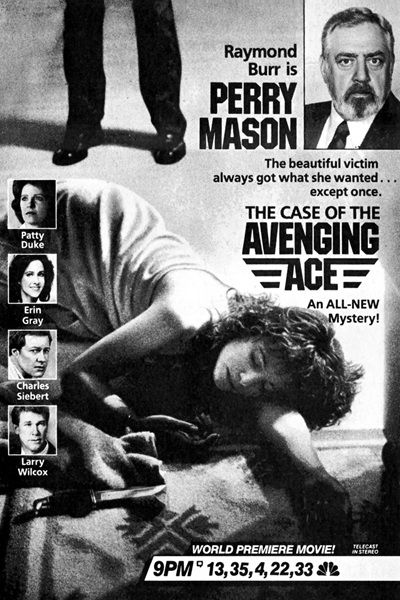
Back when Perry Mason (Raymond Burr) was a judge, he rejected the appeal of Kevin Parks (Larry Wilcox), an Air Force colonel who was accused of stalking and killing Amy Beth Sawyer (Dotty Coloroso). Even though Perry had his doubts, he did not find any legal grounds for an appeal. In the present day, when Parks is accused of killing a new witness who could have provided him with an alibi, Perry agrees to represent Parks in court and tries to prove that Parks was not guilty of either murder.
This movie was much more complicated than the typical Perry Mason movie but it was a good change of pace and the mystery itself kept me guessing. I was sure I knew who the murderer was and I turned out I was wrong. Perry’s guilt about turning down Kevin Parks’s original appeal added a new dimension to the movie and it was interesting to see Perry doubting himself, even if it was just for a few minutes.
Again, Raymond Burr spent most of this movie either sitting or leaning against something. Even unwell, he still gave a good performance and his chemistry with Barbara Hale was as charming as ever. Paul Drake, Jr. (William Katt) did the leg work and got involved in a few good chases. The only thing more interesting than the mystery was Paul’s hair, which gets bigger and bigger each movie.
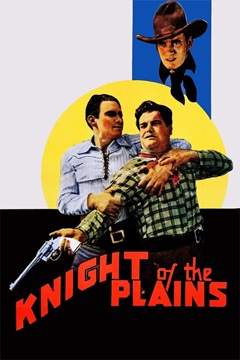
Clem Peterson (Richard Cramer) has a plot to force all of the ranchers in the valley to give up their land. He gives a phony land claim to Carson (John Merton), who presents himself as being a Mexican nobleman. In a situation like this, you need a singing cowboy and luckily, there’s one nearby. Fred (Fred Scott) and Fuzzy (Al St. John) get involved after their cattle are stolen by Clem and his men. Fred not only fights to save the ranchers but he also sings a song or two.
Singing cowboy films are always strange. Cowboys who ride horses and pull guns and get into fistfights should not also be tenors. Fred Scott looks convincing on a horse and he has one heck of a fistfight towards the end of the movie but he’ll also start singing at the drop of a hat and it just doesn’t feel right. John Wayne did a few singing cowboy films early in his career and he could usually pull it off. Fred Scott wasn’t much of an actor and had a forgettable screen presence. He had a good voice, though.
This film was produced by Stan Laurel, of Laurel and Hardy fame. Always read those credits. You never know who you might find.
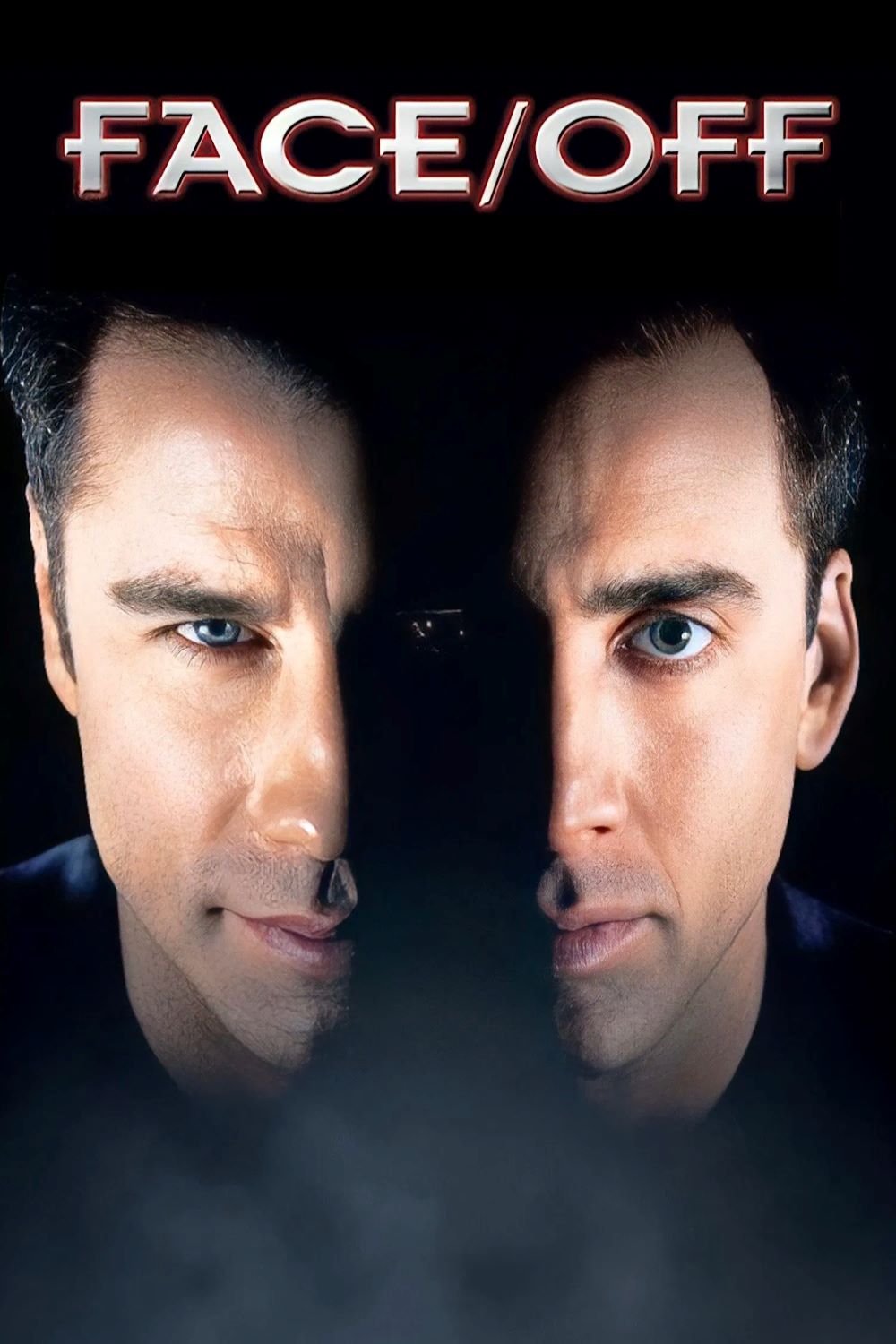
“It’s like looking in a mirror. Only… Not.” — Castor Troy with Sean Archer’s face
Face/Off is one of those late‑90s action movies that feels like it escaped from an alternate universe where “too much” is a compliment, not a warning label. It is bigger than it needs to be, sillier than the premise probably deserves, and yet somehow more emotionally earnest than most modern blockbusters. The result is a film that swings hard between breathtakingly good and gloriously ridiculous, and that tension is exactly what makes it worth revisiting.
At its core, Face/Off is a story about two men who literally become each other, but it works because it never treats that concept as a small thing. John Travolta’s Sean Archer is an FBI agent consumed by grief after the death of his young son, while Nicolas Cage’s Castor Troy is a theatrical terrorist who seems to enjoy being evil as a kind of performance art. The sci‑fi hook—cutting off their faces and swapping them—does not remotely pass a reality test, but the movie leans into the idea with such conviction that you either roll with it or get left behind in the opening act.
The big selling point is the acting showcase baked into that swap. Watching Travolta play a supposedly buttoned‑up lawman unraveling inside the body of a flamboyant villain, while Cage dials his madness into something deceptively controlled, gives the film a strange, theatrical energy. There is a real pleasure in tracking how each actor steals little gestures and rhythms from the other, so scenes become layered: what you’re seeing on the surface and who you know is “underneath” the borrowed face are constantly at odds.
That identity confusion isn’t just a gimmick; it gives the film some surprising emotional weight. Archer’s grief isn’t window dressing—his obsession with bringing down Troy comes from the trauma of losing his son, and the face swap forces him to confront who he’s become in that tunnel‑vision pursuit. Meanwhile, Troy, once inside Archer’s life, plays “family man” in a way that’s both gross and unnervingly intimate, manipulating Archer’s wife Eve and daughter Jamie with a mix of faux tenderness and predatory charm.
Joan Allen, as Eve, quietly grounds all this insanity. Her character spends a good chunk of the film being gaslit on a level that would break most people, yet Allen plays her with a subdued intelligence that makes the eventual moment of realization feel earned instead of convenient. Dominique Swain’s Jamie gets more of a stock “rebellious teen” setup, but the way Troy‑as‑Archer slithers into her life gives some scenes a genuinely uncomfortable edge, underlining how invasive the villain’s masquerade really is.
Of course, this is a John Woo movie, so the drama is constantly fighting for space with balletic gunfights and slow‑motion chaos. The action is elaborate and stylized, full of dual pistols, flying bodies, and highly choreographed carnage that feels closer to a violent dance than a grounded firefight. Whether it is the prison escape with its magnetic boots or the church shootout framed with doves and religious imagery, Woo stages set pieces as big operatic crescendos, not just plot checkpoints.
That operatic tone is both a strength and a weakness. On the one hand, the heightened style matches the bonkers premise, letting the movie exist in a kind of hyper‑reality where emotions and bullets fly with the same intensity. On the other hand, the sheer excess sometimes undercuts the more serious beats, as if the film can’t decide whether it wants to be a heartfelt story about grief and identity or the wildest action comic you have ever flipped through.
The script occasionally gestures at deeper themes but rarely lingers on them. Archer’s time in a secret off‑the‑books prison hints at broader commentary about state power and dehumanization, yet the movie mostly uses the setting as a backdrop for an escape sequence rather than exploring what it means. Similarly, Troy’s infiltration of Archer’s family brushes against ideas about how easily trust and intimacy can be weaponized, but the story is more interested in cranking up tension than really unpacking that psychological damage.
Where the writing truly shines is in the mechanics of the cat‑and‑mouse relationship. The film keeps finding new ways to twist the knife, whether it’s Archer stuck in Troy’s body trying to convince former enemies he’s changed sides, or Troy using Archer’s authority to erase evidence and tighten the trap. Some of the most satisfying scenes are the quieter confrontations where both men have to stay in character in front of others while aiming verbal daggers at each other, maintaining the illusion even as their hatred escalates.
Still, Face/Off is not exactly a model of restraint or logic, and that’s where some fair criticism comes in. The science of the face swap is nonsense even by sci‑fi standards, and the movie’s attempts to hand‑wave voice, body shape, and mannerisms require a level of suspension of disbelief that will be deal‑breaking for some viewers. On top of that, the third act piles on so many stunts and reversals that fatigue can set in; not every action beat feels necessary when the emotional arc has already hit its key notes.
There is also the question of tone in how the film treats violence and trauma. The opening murder of Archer’s son is genuinely brutal, and the later manipulation of his family taps into real discomfort, yet the movie often snaps back into cool‑shot mode a moment later, as if unsure how long it wants to sit with pain. That tonal whiplash can make it hard to fully buy into the emotional stakes, because the film keeps reminding you it is here, first and foremost, to put on a show.
Despite those flaws, Face/Off has aged in a strangely resilient way. In an era where many big action movies flatten actors into interchangeable cogs in a CG machine, there’s something refreshing about how much personality this film allows its leads to display, even when they’re chewing the scenery. The movie’s excess becomes part of its charm: it feels handcrafted in its madness, a spectacle built around big performances rather than just big effects.
Face/Off is neither a straightforward masterpiece nor a disposable guilty pleasure; it lives in a messy, entertaining space between those extremes. The film delivers memorable performances, inventive set pieces, and a surprisingly sincere emotional throughline, but it also leans on ludicrous science, tonal inconsistency, and overindulgent action. If you can accept its central absurdity and meet it on its own heightened wavelength, it remains a wild, engaging ride that showcases what happens when star power, genre bravado, and unfiltered style crash into each other at full speed.
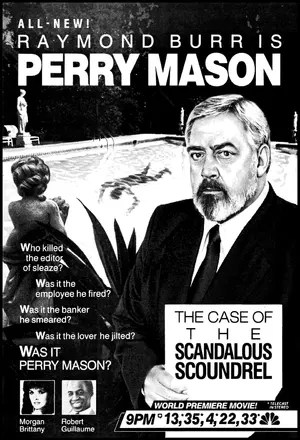
Sleazy magazine publisher Harlan Wade (Robert Guillaume) has made a lot of enemies through his scandal sheet. He just published a story suggesting that Perry Mason (Raymond Burr) and Della Street (Barbara Hale) are more than just friends. Well, duh! Everyone knows Perry and Della are in love! Perry still wants to sue him but then Harlan turns up dead in his swimming pool. It would have been interesting if Perry had been a suspect but instead the police arrest Michelle Benti (Susan Wilder), a reporter who was recently fired by Wade. Because Michelle is the ex-girlfriend of Paul Drake, Jr. (William Katt), Perry defends her in court.
This is another case of someone close to the Mason crew being accused of murder. The D.A. should know better than to arrest anyone who knows Perry, Della, or Paul. Michelle first appeared in The Case of the Shooting Starbut she was played by a different actress. It’s still good that, for once, the series actually acknowledged one of Paul’s ex-girlfriends. I worry about Paul and the way he falls in and out of love.
This one had a good mystery and a really memorable supporting cast. Morgan Brittany, Yaphet Kotto, Wings Hauser, and George Grizzard all played potential suspects. I liked that this was one of those mysteries where the victim went to a party before he died and everyone there threatened to kill him at some point. This movie also featured one of the better courtroom confessions. Raymond Burr uses a cane in this episode and is usually filmed either sitting down or leaning against something for support. Even though Burr obviously wasn’t feeling well, it’s nice to see him and Barbara Hale share some sweet scenes together.
Who sent Della flowers, champagne, and perfume? Watch to find out!
It’s strange to hear Leslie Nielsen drop an F bomb.
That was my main though I watched Camouflage. Leslie Nielsen plays a hard-boiled private detective named Jack Potter who reluctantly takes on an apprentice named Matty McKenzie (Lochlyn Munro). Mostly to get Matty, a failed stage actor, out of his hair, Jack sends him to handle a minor case in the small town of Beaver Ridge. The minor case becomes a major case when it becomes clear that a murder is being planned.
Camouflage starts out like a typical Leslie Nielsen mockbuster, with Nielsen providing a ridiculous, Frank Drebin-style narration. But the film itself develops into a dark comedy where Matty finds himself in a small town where everyone’s got secret. Nielsen gives an almost-serious performance as Potter, playing him as a cynic with a tragic backstory and little patience for his protegee. There’s a tonal imbalance between the moments of broad comedy and the more serious moments and the film doesn’t work as a result but it is interesting to see a post-Airplane! Leslie Nielsen playing things relatively straight.
One interesting thing about Camouflage is that it was written by Billy Bob Thornton and Tom Epperson but, in the final cut, the screenplay is credited to Reginald Perry. (The small town setting is one that Thornton used frequently in his scripts and it’s easy to imagine him playing the role of Jack Potter in alternate version of this film.) Camouflage reportedly sat on the shelf for quite a while before it was finally given a release and Nielsen’s narration often feels like it was something that was added in post-production to try to both bring the disjointed film together and to draw in the Naked Gun fans. I have a feeling the story behind this film is probably more interesting than the film itself.
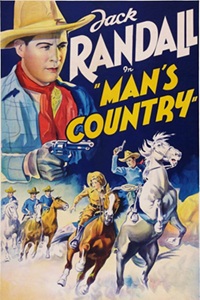 When his innocent son, Ted (David Sharpe), is accused of committing a murder, Lex Crane (Walter Long) turns him over to Texas Ranger Jack Haile (Jack Randall) because he knows that Jack will make sure that Ted gets a fair trial. Lex says that he and his men are accused of every crime that happens in the area, even though they’re always innocent. Jack understand and respects Lex as a man and a father. But when someone shoots and kills Ted, Lex and his men set out for revenge. The twist? Lex has a twin brother named Buck (also played by Walter Long) and the two brothers hate each other.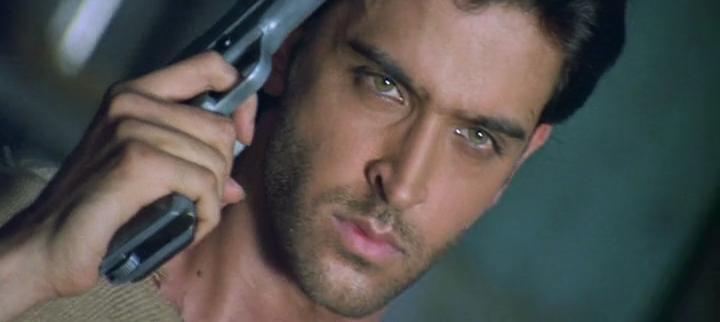

 Through the Shattered Lens