Book Review: Runaway by R.L. Stine


Tired of being used as a test subject by a mad scientist and feeling guilty about an accident that caused the death of two of her friends, telekinetic Felicia Fletcher has run away!  After using her powers to escape from the pervy dude who gave her a ride, Felecia ends up in Shadyside.  She not only get a job as a house sitter on Fear Street but she also enrolls in high school and gets a job at the Burger Basket…

Wait, what?

Now, the whole telekinetic thing is pretty cool and I cheered a little when she caused the pervy guy’s car to crash.  I mean, if you’ve got the power to do that, why not?  But who runs away from home just so they can enroll in high school and get a job working at a fast food restaurant?  I mean, it just seems like there’s more that she could do, especially considering that she has super powers.  Along with going to school and finding a low-paying job, Felecia also develops a crush on her classmate and co-worker, Nick.  Unfortunately, Nick is dating Zan.  Zan doesn’t appreciate the new girl trying to move in on her man.  Felecia’s main concern, though, is making sure that no one discovers that she’s a runaway.  SO WHY DID YOU ENROLL IN HIGH SCHOOL AND GET A JOB UNDER YOUR REAL NAME, FELECIA!?

Seriously, Felecia might have telekinesis but she obviously has no common sense.

Soo, Felecia is getting strange letters from someone who claims to know who she is.  Someone also breaks into her house, a crime that Felecia can’t report without running the risk of being discovered.  Felecia tries to control her powers while also discovering who is stalking her.

Even by the standards of R.L. Stine, the plot is fairly incoherent but the fact that Felecia has psychic powers (and, with the exception of Nick, pretty much zero friends) adds a new wrinkle to all of the usual Stine melodrama.  Felecia has a lot to deal with, from avoiding the police to avoiding her crush’s girlfriend to avoiding the people searching for her to avoiding her Fear Street stalker.  In fact, Felecia has so much to deal with that it’s impossible not to like and root for her.  I might not have telekinesis but I could still relate to Felecia’s desire to just have one normal, relaxing day in her life.  I liked that Felecia was trying to regain control of her life and there’s a pretty cool scene where The Burger Basket basically explodes.  This was definitely one of the better Stine books that I’ve read this month.

Book Review: The Fire Game by R.L. Stine


Jill, Andrea, Diane, Max, and Nick want get out of taking a superhard Geography test.  What can they possibly do, since apparently into not an option to study or to track down someone who has a copy of the test from last year?

If you said accidentally start a fire in the school library so that the test gets cancelled, congratulations!  You could be the star of an R.L. Stine novel!

The day after the fire, school is still a bore.  Our group of friends, who are all gymnasts for some reason, want to get out of class so that they can hang out with Gabe, the supercool new kid who has an odd fascination with burning things.  What’s the best way to get out of school?  How about blowing up the boy’s bathroom?  Not only does that cause classes to get canceled but everyone now gets to hang out on Fear Island!

R.L. Stine’s 1991 book, The Fire Game, is all about people like to set fires.  Admittedly, the book doesn’t really go into the reasons why these people are so obsessed with fire.  For the most part, it’s just something that they do because they’re not imaginative to come up with any other way to skip school.  (Has no one ever heard of faking not feeling well?  When I was in high school, all I had to do was say the word “cramps” and the gym teacher would practically escort me off campus and tell me not to come back for a week.  It’s not that difficult.)  Anyway, eventually a house burns down on Fear Street and all the members of the Fire Club are like, “Wait!  We didn’t do that!”  It looks like someone is trying to frame the arsonists!

The main problem with this book is found in the last sentence of this paragraph.  Yes, the Fire Club is, more or less, innocent of burning down that house and killing the homeless man who was living inside.  But, they’re still a group of people who DELIBERATELY SET FIRES!  It’s like, “Okay, it sucks you’re being framed for that one fire but how about all the ones you actually started?”  Not a single lesson is learned and usually, I’m in favor of that but in this case, our heroes are actually doing something that could kill someone or something.

Still, even if there’s absolutely no one to really root for in this book, it’s hard not to be a little impressed by the fact that R.L. Stine felt that gymnastics and pyromania would be a natural combination.  Though the majority of the book is Stine on autopilot, arsonist gymnasts is at least an interesting concept.  Plus, Arsonist Gymnasts sounds like it would be a great band name.

Book Review: Truth or Dare by R.L. Stine


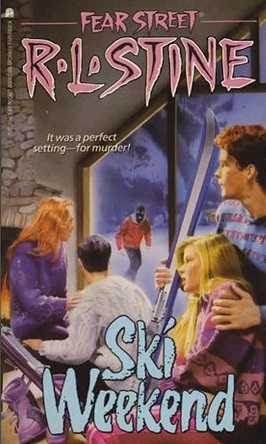
In this 1995 book from R.L. Stine, a group of wealthy teenagers decide to take a vacation from Fear Street and Shadyside High.  They decide to spend the weekend skiing but, once they reach their mountain lodge, they end up getting hit by a blizzard.  They’re going to be trapped inside for a day or two.  Because the storm took out all the phone lines (and since this book is from the age when everyone was dependent on a landline), they are cut off from the world.  If anything bad happens in the cabin, there will be no way to get help.  If anyone is driven to kill someone else, there will be no way to call the police.

Now, if I was in that situation, I would probably try to pass the time in the safest and least dramatic way possible.  I mean, if you’re going to be stuck with a group of people for a day or two, you should probably try not to do anything that could cause anyone to lose their temper.  The best thing to do is try to have fun and not obsess on the situation.  However, since this is an R.L. Stine book, everyone decides to play Truth or Dare.

Great idea!  Nothing bad has ever happened as a result of playing Truth or Dare!

Though I played it a few times and I always managed to survive, Truth or Dare is still a strange game to me.  First off, why wouldn’t you just automatically take the dare?  But, beyond that, there’s this weird assumption that everyone is just automatically obligated to follow the rules of Truth or Dare, even if it means hurting someone.  Inevitably, anyone playing Truth or Dare is going to have at least one deep dark secret that they are going to get asked about, something like: “Did you cheat on your partner?”  And instead of just saying, “No,” even if the answer is “Yes,” they always reply, “I’ll take a dare instead.”  Well, just the fact that you took a dare at that point is pretty much the same thing as answering yes.  There’s really no way to win this game, other than to lie whenever you’re asked a question that could potentially lead to you being murdered.  But that would mean breaking the rules of Truth or Dare!  It would apparently be better to die.  I guess it’s all about ethics.

Anyway, not surprisingly, the game of Truth or  Dare does lead to someone being murdered.  They get a hatchet in the back and the killer leaves it there to be discovered by the rest of the group.  AGCK!  This killer isn’t messing around.  Anyway, you can probably guess where all this leads.  The initial suspect looks guilty but is actually innocent.  The killer is the person that most people would least expect.  Stine mentions that chair lift enough times that you just know it’s going to be the setting for the climax of the story.  It’s a typical R.L. Stine novel but it is one that teaches an important lesson.  For the love of all things good and decent, do not play Truth or Dare!

Book Review: Spooky Texas by S.E. Schlosser


If you’re going to be in Texas this Halloween and you want to spend the holiday at a location that might be haunted …. well, as I’ve said many times on this site, I don’t believe in ghosts, werewolves, vampires, or anything else so I won’t be of much help there.  Probably the best recommendation that I can make is that you drive out to Marfa, set up a lawn chair in the desert, and wait for the Marfa Lights to appear.  The Marfa Lights have been appearing for decades, hovering over the town of Marfa.  Boring, reality-based people claim that it’s just an atmospheric phenomena.  Others claim that it’s either ghosts or maybe a UFO visitation.

Marfa itself is in the desert of west Texas.  (Giant was filmed in Marfa.)  As of late, it’s become as well-known for being an artists colony as for its paranormal reputation.  A few years ago, 60 Minutes did a breathless story on all the artists who were moving to Marfa and not once were the Marfa Lights mentioned.  Several minutes were devoted to Prada Marfa but not a single second to the Marfa Lights.  Don’t get me wrong, of course.  I would much rather the town be known for its artists than its UFOs but still, you have to wonder how a show could spend twelve minutes talking about Marfa without mentioning the lights.  Am I suggesting that there’s some sort of government cover-up going on?  No, I’m not.  That would be dumb.  I’m just suggesting that 60 Minutes, which is apparently a show that only exists so that elderly reporters have something to do after they lose their nightly news gig, might be out-of-touch.

Fortunately, the book Spooky Texas has chapters on the Marfa Lights and twenty-four other paranormal stories that take place in Texas.  Admittedly, some of the detail mentioned in the stories did seem a bit odd to me.  (For some reason, the author of this book seems to be under the impression that it snows a lot in west Texas.)  But, despite that, it’s a fun read and it’s full of inspiration for both the aspiring horror writer and the Texan who is just looking for some place creepy to hang out on Halloween.  If you can’t go to Marfa and if you can’t find any of the ghosts that are rumored to haunt the Alamo, I would suggest going to Fort Worth and searching for the Gray Lady.  Or, if you really want to live dangerously, go down to Laredo and listen for a crying woman.  Just don’t get too close!

Novel Review: Night Games by R.L. Stine


“What the Hell was that!?” I said, as I read the final line of Night Games.

First published in 1996, Night Games is another one of those R.L. Stine books in which a group of otherwise law-abiding, wholesome American teenagers decide to live every teenager’s fantasy and have some fun by harassing one of their teachers.  (No, Lisa Marie, I loved all of my teachers!  Yeah, I hear you but I don’t believe you.)  Mr. Crowell seems like a nice enough guy but he’s constantly giving Lenny a hard time so all of Lenny’s friends decide that it’s time to play some “night games” with Mr. Crowell.  At first, this is limited to breaking into Mr. Crowell’s house at night and moving stuff around and stealing an item or two.  But then Mr, Crowell dies and our narrator, Diane, has to figure out if he was murdered by her ex-boyfriend or her current boyfriend.  At no point does it ever seem to occur to Diane that, in an ideal world, she wouldn’t have a history of dating boys who are capable of murder.

Anyway, the only special thing about this book is the final twist and I’m going to reveal it because, otherwise, this is going to be a short review.  So, consider this to be your SPOILER ALERT.  (I have to admit that every time I type the words “spoiler alert,” I lose a little respect for myself and even more respect for the people who demand that such warnings be used even for a book that is 26 years old.)  Anyway, it turns out that Lenny, despite his temper, is not the murderer.  Instead, the murderer is Spencer and Spencer …. well, Spencer’s a ghost.  He’s come back from the dead just to make Diane’s life difficult.  He starts to strangle Diane but Diane hugs him and apologizes to him for not being a better friend.  Spencer is conquered by love and his spirit is set free.  Yay!  All of Diane’s friends are happy but what they don’t realize is that Diane is now a ghost and now she’s plotting to get  revenge on all of them!

That’s actually not a bad ending.  Diane’s friends were really annoying so they deserve what’s coming to them.  Still, it’s interesting that Diane automatically became an evil ghost as opposed to a mournful ghost or a philosophical ghost or a confused ghost.  She died and she immediately embraced the dark side.  Agck!

Now, that’s scary!

Book Review: The Scandalous History of the Roman Emperors by Anthony Blond and Laura Blond


Who were the scariest people in the Roman Empire?

According to this book, which was first published in 1994, it was the Emperors.  The Scandalous History of the Roman Emperors takes an enjoyably gossipy and occasionally disturbing look at the first six emperors of the Roman Empire, from Julius Caesar to Nero.  By analyzing the words of Roman historians and occasionally reading between the lines, Anthony Blond makes a good argument that the most powerful men in the ancient world were, for the most part, an incredibly petty group of neurotic people.  Julius Caesar emerges as a pompous blowhard who probably owed most of his reputation to the circumstances of his death.  Augustus is motivated less by strategic genius and more by his fear of never escaping his uncle’s shadow.  Tiberius starts out strong, just to end up a paranoid mess on the Isle of Capri.  Caligula is a spoiled brat.  Claudius emerges as a casually cruel man who used his infirmities as a way to keep his enemies off guard.  And finally, Nero is portrayed as a frustrated artist whose subsequent reputation for cruelty may have been overstated by biased historians.  The emperors are portrayed as being flawed humans who all, even Caligula, had potential to do good but who were ultimately corrupted by a society that treated them like Gods while also constantly plotting their downfall.

Laura Blond contributes chapters about life in ancient Rome. A chapter which examines a day in the life of a Roman citizen reveals not only the grandeur of Rome but also all the details that would have made me frightened to walk barefoot through the city.  If you think the erratic emperors were frightening, just try to get through the chapter about Roman eating habits!  Agck!

It makes for compulsive and occasionally gossipy reading.  I’m a history nerd and I’m fascinated by the Roman Empire so I loved it.

Book Review: The Confession by R.L. Stine


What would you do if your friend confessed to committing a murder?

That’s the dilemma that is at the heart of R.L. Stine’s 1996 YA horror novel, The Confession.

No one at Shadyside High likes Al.  He used to be kind of nice but, as of late, he’s been dressing in all black, drinking beer, and picking fights.  Plus, he’s got a really bad habit of blackmailing his friends.  Al is the type who will sell you the answers to a test and then threaten to tell everyone that you were cheating unless you keep him supplied with cash.  (Fortunately, my sister was a year ahead of me so I could just go through her old tests if I needed the answers in advance.)  Al is a real jerk and no one is that upset when he turns up dead and with a rollerblade stuffed in his mouth!

Who killed Al!?  Well, nerdy Sandy tells his friends that he did it.  At first, everyone’s okay with the idea of covering for Sandy because it’s not like Al was a nice guy and Sandy did promise not to kill anyone else.  But then Julie (who also discovered Al’s body) starts to have nightmares about Sandy and she finds it difficult to keep covering for him every time that she speaks to the police.  Julie also notices that Sandy has been acting a little bit differently since confessing to the murder.  Sandy seems to be a little bit more aggressive now, almost as if he might want to try to kill someone again….

AGCK!

Listen, if I was in Julie’s shoes …. well, I don’t know what I’d do.  On the one hand, I have always been against murder and violence in general.  On the other hand, Al was a real jerk and it was kind of obvious that he would have eventually ended up killing someone if someone hadn’t gotten to him first.  I would not want to be the person who sent a friend to death row.  So, in this case, R.L. Stine came up with a plot that actually made me think.  At the same time, he also added a last-minute twist that let almost all of the characters off the hook.  I guess that’s to be expected.  I mean, we’re talking R.L. Stine here, not Dostoevsky,  Still, I was a bit disappointed with the final few pages of the book.  Things worked out …. BUT AT WHAT COST?

Again, there was no cost.  This is R.L. Stine.  All the trauma in the world is worth it as long as you’re dating a cute guy and speaking in quips by the end of the book.  That, after all, is the appeal of Fear Street.

Book Review: Laid Cregar: A Hollywood Tragedy by Gregory William Mank


Ah, poor Laird Cregar.

Cregar was born in Philadelphia in 1913 and spent a good deal of his youth in England.  That was where he first appeared, as a child actor, with the Stratford-Upon-Avon theatrical troupe and it was also where he developed the English accent that would serve him well later in life.  Cregar once said that, from the age of eight, all he wanted to do was be on stage.

For most of the years that followed, Cregar never stopped performing.  Cregar went from acting on stage to eventually making his way to Hollywood.  He first appeared on the big screen in 1940 and he went on to appear in 16 films. He appeared in nearly every genre of film, from comedy to film noir to even a western.  As frequent viewers of TCM can tell you, he played a surprisingly charming devil in 1943’s Heaven Can Wait.  But he was probably best-known for playing a mysterious man who might be Jack the Ripper in 1944’s The Lodger and for his role as the possibly mad pianist, George Henry Bone, in Hangover Square, obsessively playing the piano while his room burned down around him.  Sadly, that will be his final role.

Cregar was an actor who had the talent to be a leading man but, because he weighed over 300 pounds, he found himself used as a supporting player in Hollywood.  He was a character actor who yearned to be a romantic star and who feared he would be forever typecast as a villain.  Perhaps because Cregar disliked playing villains, his villains often seemed to be conflicted about their actions.  (Indeed, there was a vulnerability to Cregar that made it difficult not to feel some sympathy for his characters.)  Determined to change his image, Cregar embarked on a crash diet that was aided by amphetamines.  He lost over a 100 pounds but he also put his health in jeopardy.  On December 9th, 1944, Cregar died after suffering a heart attack.  He was 31 years old.  His friend Vincent Price delivered the eulogy at Cregar’s story.  Cregar’s final film, Hangover Square, was released four months after he died.

Gregory William Mank’s biography, Laird Cregar: A Hollywood Tragedy, not only tells the story of Cregar’s short life but it also examines how Cregar took his frustrations and his insecurities and used them in his performances.  In Mank’s biography, Cregar comes across as being a kind and generous man who wanted so desperately to be a star that it destroyed him.  The book serves as not only an examination Cregar and his talent but an indictment of a studio system that set very rigid rules for who could and who couldn’t be a star.  The book also features details about Cregar’s extensive and successful stage career.  If you’re a history nerd like me, you’ll appreciate all of the detail that Mank goes into while discussing who co-starred with Cregar and their subsequent careers.  Mank explores Cregar’s childhood and his career.  The resulting biography pays tribute to a star who deserved better.

Book Review: The Face by R.L. Stine


In this 1996 R.L. Stine novel, Martha is a popular high school student with a problem.

Ever since she was involved in a mysterious accident, she has had amnesia!  Her friends have been told not to tell her too much about what happened because it’s important that she remember it all on her own.  Her friends agree to not tell her about what happened and, if you know anything about teenagers, you know how good they are not gossiping and keeping secrets.  Martha’s recovery is in good hands!

Martha keeps having flashes of memory, all of which involve some sort of drama that occurred at a cabin between her and her friends.  And whenever Martha tries to calm her nerves by drawing, her hands instinctively draw a picture of a boy who she doesn’t even know, a teenager with a scar over his eyebrow!  (OH MY GOD, A SCAR!  That’s always bad news in any book written by R.L. Stine.  Personally, I think scars are sexy and mysterious.  In Stine’s books, they’re almost always a sign of anti-social behavior.)  Sometimes, Martha discovers that she’s drawn the boy’s face without even realizing that she was drawing at the time.  That’s weird.  Like, how would you not realize that you were drawing?

Anyway, I was really hoping that it would turn out that Martha had been given a hand transplant and her new hands belonged to a murderer or something and now Martha was sleepwalking and strangling people with her new murder hands!  But, to be honest, that’s more of a Christopher Pike type of thing than an R.L. Stine thing.  Instead, this is another R.L. Stine book where the lead character starts to get menacing phone calls and then eventually, she discovers that it’s because all of her friends are keeping secrets and cheating on each other.  There is one surprisingly violent decapitation and some nonsense about hypnotism.  If there’s anything that I’ve learned from R.L. Stine, it’s that hypnotism is very easy to learn.  Despite a promising premise, this is pretty much a standard R.L. Stine rush job, one that efficiently hits all of the expected notes without digging too deep into the characters or the story.

Perhaps the most disappointing thing about this book is that the Face itself never comes to life.  From the cover, I figured that the drawing would actually start to move its lips and speak and totally freak Martha out.  I mean, the cover literally says, “He had something to tell her …. from beyond the grave.”  But once again, a talking picture is probably more of a Christopher Pike thing than an R.L. Stine thing.  I really should have read more Christopher Pike this October.  Oh well.  Live and learn!

Book Review: Nostradamus Predicts The End Of The World by Renee Noorbergen


In the year 2010, I was at Half-Price Books when I came across an old paperback called Nostradamus Predicts The End Of The World.  The book was full of the cryptic prophecies of the French astrologer Nostradamus, along with interpretations of that what those predictions actually meant.  The book argued that, by using those interpretation, once could come up with a chronological narrative of the next great world war.  The book predicted that World War III was going to break out in the 90s, that New York was going to be destroyed in 1999, and that the world, as we knew it, would be over with around the year 2000.  Once I saw that the world has apparently ended ten years ago, my sense of humor demanded that I buy the book.

Since that time, a few people have told me that I shouldn’t laugh at stuff like this and that, just because the dates were wrong, that doesn’t mean that it’s not going to happen.  Some have pointed out that the passage in which Nostradamus predicted a nuclear bomb hitting New York in 1999 could have just as easily been a prediction of 9/11 and that perhaps Nostradamus either misinterpreted the date or maybe it was originally meant to happen in 1999 but got pushed back a few years or …. well, there’s always a reason, isn’t there?  My argument, of course, is that the only time that Nostradamus gives a date for any of his predictions, he was wrong.  It’s probably not coincidental that Nostradamus picked a date that was so far in the future, he wouldn’t have to worry having to explain himself.

The thing with Nostradamus though is that his “prophecies” were so vaguely written that they could pretty much be interpreted to mean anything.  Indeed, it seems like a compelling argument could be made that his prophecies were actually meant to keep him in favor with the wealthy and royal patrons who subsidized his life.  Much of what he wrote works as Rorschach test.  Readers are going to find what they’re looking for.

For instance, the author of Nostradamus Predicts The End of the World was apparently looking for a battle-by-battle history of the Third World War.  For the author, that was found in Nostradamus’s prophecies.  The book argues that conflict in the Middle East would lead to a World War between the U.S., Russia, and China and that apparently only Australia would be spared.  Towards the end of the book, the author fixates on a red-haired general who apparently referred to in several of Nostradamus’s prophecies.  One wonders why Nostradamus would specifically tell us the year that New York was going to be destroyed and why Nostradamus would, as some have claimed, warn about an evil German leader named “Hister” but while leaving vague the identity of the general who is going to be the key to saving the world.  Indeed, what even is the point of being able to see into the future if you’re going to be so deliberately vague in your reporting that no one is going to know what you’re talking about?

Interestingly enough, even though it’s been over 22 years since the date that Nostradamus the world would end, there are still people posting his prophecies online and saying that he predicted everything from Trump to COVID to AOC.  Never stop believing, I guess.