Embracing the Melodrama Part II #4: The Struggle (dir by D.W. Griffith)


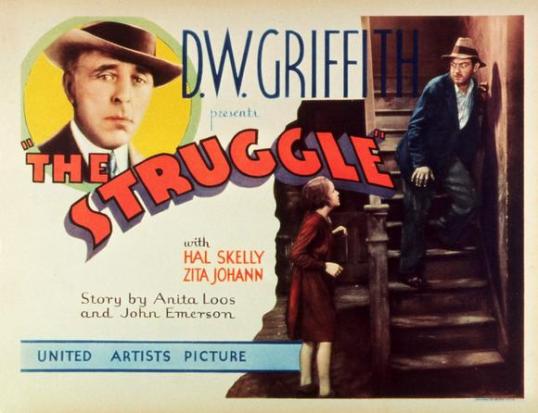
The Struggle

Like a lot of the films directed by cinematic pioneer D.W. Griffith, the 1931 film The Struggle is currently available on Netflix.  As a result of his direction of the film Birth of the A Nation, Griffith is a controversial historical figure but it cannot be denied that he was one of the most ambitious, talented, and innovative of the silent filmmakers.  Unfortunately, like a lot of the great figures of silent film, he did not survive the transition to sound.  Griffith directed two sound films.  Abraham Lincoln is overly theatrical while The Struggle … well, bleh.

The Struggle tells the story of a married couple whose marriage is threatened by the husband’s alcoholism.  Florrie (Zita Johann) only agrees to marry Jimmie (Hal Skelly) on the condition that he stop drinking.  And, for several years, Jimmie doesn’t touch a drop of liquor.  But, under pressure at work and struggling to support his family, Jimmie finally breaks down, steps into a speakeasy (this film was made during prohibition), and has a drink.  Soon, Jimmie is a full-blown alcoholic, wandering the streets of New York while little school children shout, “He’s a beggin’ bum!” at him.  Will Jimmie’s life be turned around as the result of hearing a sermon the radio?  Or will he just keep drinking himself to death?

This was the last film on which Griffith was credited as being director.  (Reportedly, he was an uncredited co-director on San Francisco.)  It’s obviously a heart-felt work but, outside of the harrowing shot-on-location scenes of the unshaven Jimmie stumbling down the streets of the Bronx, the film is too overly theatrical and the performances are too stiff and unconvincing to really work.  Griffith was still a visual stylist but, watching The Struggle, it’s obvious that he never learned how to work with speaking actors.  As well, dialogue that would have worked on a title card came across as being over-the-top and preachy when actually uttered aloud.

That said, The Struggle has some interesting historic value, especially for those of us who tend to take the Libertarian point of view when it comes to the war on drugs.  The Struggle opens with a scene that is set at a garden party in 1911.  We listen to various conversations being held at each table.  Two people debate whether the Biograph Girl is named Mary Pickford or Mary Packard.  A man declares that Woodrow Wilson will never be President because he’s a college professor.  (This is all the 1931 equivalent of that scene in Titanic where Billy Zane says that a painting was done by “Somebody Picasso.  I’m sure nothing will ever become of him….”)  Suddenly, scandal hits the garden party as it’s discovered that a woman has had too much to drink and is now drunk.  Everyone at the party, on their own, shuns the woman and she is properly shamed.

The film jumps forward to 1923.  Prohibition is now the law of the land and we find ourselves in a speakeasy.  The thing that we immediately notice is that there are a lot more people in the speakeasy than were at that garden party and every single one of them is drunk.  And, since liquor in now illegal, it’s no longer being bought from safe and trustworthy sources.  Instead, it’s now being brewed in a back room.  One bootlegger holds up a bottle of prohibition liquor and announces it to be poison before then sending it out to be drunk by the Jimmies of the world.

The film’s point, of course, is that community is a lot better when it comes to policing itself than the government is.  The Struggle may not be a great film but it certainly has the right message.
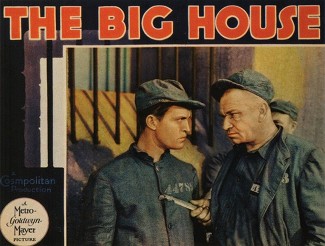
Embracing the Melodrama Part II #3: The Big House (dir by George Hill)


The_Big_House_film_poster

The 1930 Best Picture nominee The Big House opens with a black Model T car slowly pulling up to the front of a large and imposing prison.  Handcuffed in the back seat of the car is a handsome, nervous-looking young man named Kent (Robert Montgomery).  Kent is led into the prison where he is forced to hand over all of his possessions to a grim-looking guard.  We find out that Kent has been convicted of manslaughter, the result of hitting someone while driving drunk.  For the next ten years, this prison (which, we’re told, was designed to house 1,800 but actually holds 3,000) will be Kent’s home.

Kent finds himself sharing a cell with two lifers.  Butch (Wallace Beery) is a coolly manipulative sociopath who alternatively counsels and abuses Kent.  Meanwhile, Morgan (Chester Morris) tries to protect Kent and even helps him get his cigarettes back from Butch.  These three prisoners represent the three faces of prison: Butch is the unrepentant criminal who is actually more at home in prison than in the “real” world.  Morgan is the former criminal who has changed his ways but who is apparently destined to spend the rest of his life paying for his poor decisions.  And Kent is the young man who has to decide if he’s going to be like Butch or if he’s going to be like Morgan.  The Big House makes the still-relevant argument that the American prison system is more likely to turn Kents into Butches than into Morgans.

When the film began, I assumed that Kent would be the main character but actually, he’s secondary to most of the action.  From the moment he first shows up, Kent is not particularly sympathetic and he becomes steadily less likable as the film progresses.  Instead, the film is more focused on the always-scheming Butch and the regretful Morgan.  While Morgan makes plans to escape from captivity and ends up falling in love with Kent’s sister (Leila Hyams), Butch spends his time plotting ways to take over the prison.  For his performance as Butch, Wallace Beery won an Oscar but, seen today, it’s obvious that the film’s heart and soul belongs to Chester Morris’s Morgan.

Like a lot of films from the period, The Big House feels undeniably creaky when viewed through modern eyes.  The Big House was made at a time when Hollywood was still trying to make the transition from silent to sound films.  As such, the film’s pacing is slower than what contemporary audiences are used to and a few of the performances are undeniably theatrical.  I can honestly say that I’m never been more aware of how much I take for granted nonstop background music than when I watch a movie from the early 30s.

That said, once you’ve adapted to the different aesthetic, The Big House holds up fairly well.  Director George Hill films the prison like a town in a German expressionist horror film and Chester Morris’s performance remains sympathetic and compelling.  If the plot seems familiar, it’s important to remember that The Big House is the film first introduced a lot of the clichés that we now take for granted.

The film’s best moments are the ones that deal not with Kent, Butch, and Morgan but instead just the ones that show hordes of prisoners — all anonymous and forgotten men — going about their daily life.  It’s during those scenes that you realize just how many people have been crammed into one tiny space and why that makes it impossible for prison to reform the Kents of the world.

Gandhi once said that the true value of any society can be determined by how that society treats its prisoners and The Big House certainly makes that case.

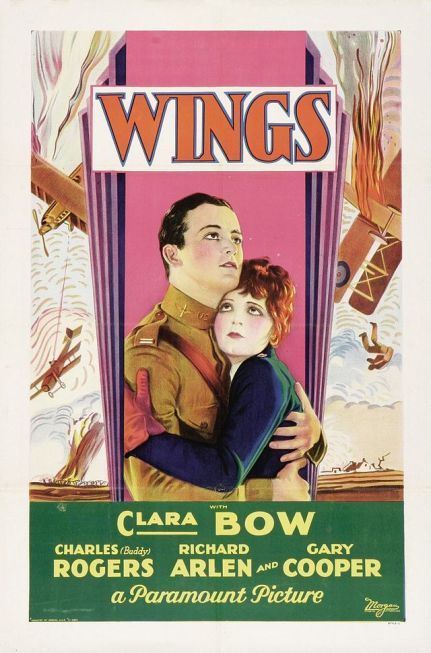
Embracing the Melodrama, Part II: Wings (dir by William Wellman)


Wings

As I mentioned in my previous review, Sunrise may have won the 1927 Oscar for Unique and Artistic Production but the official winner of the first Academy Award for Best Picture was the silent World War I romantic melodrama, Wings.  Wings is one of those films that doesn’t seem to get much respect from contemporary critics, many of whom are quick to dismiss the film as being corny and clichéd.  It’s not unusual to see Wings cited as being the first example of the Academy honoring the wrong film.

Wings tells the story of David Armstrong (Richard Arlen) and Jack Powell (Charles “Buddy” Rogers), who both live in the same small town and who are both in love with the pretty but self-centered Sylvia (Jobyna Ralston).  Sylvia, meanwhile, is in love with the wealthy David but, when Jack asks for a picture of her, she gives him one that she had been planning to eventually give to David.  Meanwhile, Mary (Clara Bow), who is literally the girl next door, pines for Jack.

When World War I breaks out, both Jack and David join the Air Force.  At first they’re rivals but, under the pressure of combat and the threat of constant death, they become friends.  When David flies, he has a tiny teddy bear to bring him luck.  Jack, meanwhile, has Sylvia’s picture.  Meanwhile, their tentmate — Cadet White (Gary Cooper) — insists that he doesn’t need any good luck charms and promptly suffers the consequences for upsetting God.

Meanwhile, Mary has joined the war effort and is driving an ambulance around Europe.  Will Mary ever be able to convince Jack that they belong together?  Will David ever catch the legendary German pilot, Kessler?  Perhaps most importantly, will this new bromance be able to survive both war and the charms of Clara Bow?  And finally, will anyone be surprised when all of this leads to a tragic conclusion with an ironic twist?

Wings has got such a bad reputation and is so frequently dismissed as being the first case of the Academy picking spectacle over quality that I was actually shocked when I watched it and discovered that Wings is actually a pretty good movie.  Yes, it is totally predictable.  Every possible war film cliche can be found in Wings.  (From the minute that handsome and confident Gary Cooper announced that he didn’t need any lucky charms, I knew he was doomed.)  And yes, the film does run long and it does feature a totally out-of-place subplot involving a character played by someone named El Brendel (who was apparently a popular comedian at the time).  This is all true but, still, Wings works when taken on its own terms.

Here’s the thing with Wings: the aerial footage is still impressive (all the more so for being filmed without the benefit of CGI) and both Charles “Buddy” Rogers and Richard Arlen are handsome and appealing in a 1927 silent film sort of way.  In fact, the entire film is appealing in a 1927 silent film sort of way.  This is a time capsule, one that shows what films were like in the 20s and, as a result of the combat scenes, also provides a hint of what lay in the future for the film industry.  Most importantly, Wings features Clara Bow, who has been my silent film girl crush ever since I first saw It.  Whether she’s attempting to flirt with the clueless Rogers or hiding underneath her ambulance and shouting curses at the Germans flying above her, Clara brings a lot of life to every scene in which she appears.

If you’re a film historian, Wings is one of those films that you simply have to see and, fortunately for you, it’s actually better than you may have been led to think.

It’s currently available on Netflix.


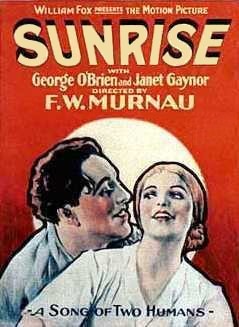
Embracing the Melodrama, Part II: Sunrise (dir by F.W. Murnau)


Sunrise_vintage

Last year, I published 60 film reviews under the heading of Embracing the Melodrama.  Embracing the Melodrama was one of the first review series that I had ever done and I had so much fun doing it that I figured, “Why not try it again?”

In other words, welcome to Embracing the Melodrama, Part II!

Over the next three weeks, I will posting, in chronological order, 128 reviews of films that embrace the melodrama.  As before, these reviews will be in chronological order and they will include everything from Oscar winners to grindhouse exploitation to made-for-television dramas.  It should be fun!

And, considering that we’re talking about 128 reviews here, it should at least help me make a dent in my goal to see every single movie that has ever been made.

Let’s start things off by taking a quick look at the 1927 silent film, Sunrise.  Directed by German expressionist F.W. Murnau, Sunrise is widely considered to be one of the greatest films ever made and for once, popular opinion is correct.  The film tells a simple story.  The Woman From The City (Margaret Livingston) takes a vacation out in the country.  (We know she’s dangerous because she wears black lingerie.)  She stands outside of a farmhouse and whistles.  Soon, the Man (George O’Brien) steps out of the farmhouse and joins the Woman.  Inside the farmhouse, the Wife (Janet Gaynor) can only dream of what life was like when she and the Man first fell in love.

The Man and the Woman meet at the edge of the lake and kiss as the moon shines down on them.  They’re having an affair, though the film — in its dream-like way — leaves it ambiguous as to just how long the affair has been going on.  (Indeed, the film almost seems to suggest that The Woman has sprung from the Man’s subconscious, a creation of his darkest desires.)  The Woman wants the Man to murder his wife and come back to the city with her.  At first, the Man refuses but, as the Woman talks to him, he starts to visualize the city.  And, make no mistake about it — the city that the man visualizes is a scary place that resembles the dreamworld of The Cabinet of Dr. Caligari.  But, at the same time, it’s also a lot more fun than the farm.

Now, you may be wondering why this familiar sounding tale is considered to be one of the best films of all time.  The story itself is simple and deliberately allegorical.  The film is less about the story and more about how Murnau tells it.  Murnau fills the screen with hauntingly surreal images that are both beautiful and frightening at the same time.  When the title cards appear on-screen, the lettering literally fades in and out and adds to the entire movie’s dream-like feel.  Watch the scene below where the Woman first suggests killing the Wife and the Man visualizes the city:

Infatuated with the Woman, the Man plans to drown the Wife but, at the last minute, has a change of heart.  The Wife, however, flees to the city herself.  The Man follows her and attempts to win back her love.  The city itself changes when the Man and the Wife are in it together.  What seemed dark and threatening under the influence of the Woman is now revealed to be fun and vibrant.  The film transforms from being an early example of film noir to being a screwball comedy.

How many other films can you think of that feature both a murderous femme fatale and a drunk pig?

And yet, as much joy as the Man and the Wife find in the city, both the farm and the Woman await their eventual return.  And there’s a storm coming…

Interestingly enough, at the first Oscar ceremony, two awards were given for Best Picture of the year.  The first award — for Outstanding Production — went to Wings, a big budget action spectacular about World War I.  The other award — for Unique And Artistic Presentation — went to Sunrise.  I’ve read a lot of speculation about which film the Academy meant to name the best of the year but, to me, it’s fairly obvious that the Academy meant for Outstanding Production to honor the year’s big blockbusters while Unique and Artistic Presentation would honor the “art” films.

And, to be honest, I think that, way back in 1928, the Academy had the right idea.  Why should they only give out one award for best picture, as if all films can be judged by only one standard?  Why not give out separate awards for the best comedy or the best thriller or the best film made for a certain amount of money?  Why not bring back the Oscar for Unique and Artistic Presentation?

For whatever reason, the Academy discontinued the Unique and Artistic Presentation Award after the 1st ceremony and, in the future, only one film would be named best of the year.  Since Outstanding Production eventually become known as Best Picture, Wings has been immortalized as the first film to win best picture.

And, nothing against Wings, but the Academy would have been smarter to have gone with Sunrise.  Certainly, it would have won them the respect of future film students.

You can watch Sunrise below!

Here! It’s a Gift!


PCAS

Here’s the new trailer for The Gift, in which it appears that Jason Bateman and Rebecca Hall end up getting stalked by some guy named Gordo.  This could be good or it could be bad, it’s hard to tell from the trailer.

On the one hand, the story looks rather generic and predictable and has a Boy Next Door feel to it.  (“Oh!  A first edition!“)  It looks like it would be a fun Lifetime movie but maybe not quite as memorable when seen on the big screen.

But Jason Bateman, Rebecca Hall, and Joel Edgerton!  Seriously, that’s a great cast!

I’m going to see it just to see if I can finally bring myself to forgive Bateman for being so mean to Juno.


Here’s the Promo for Fear The Walking Dead!


So, as you probably heard, AMC is doing a spin-off of The Walking Dead.  It’s going to be called Fear the Walking Dead, which is not exactly the greatest title that I’ve ever heard.

(Seriously, Fear the Walking Dead sounds like it should be the title of a low-budget, Asylum-produced mockbuster version of  The Walking Dead...)

But, despite that imperfect title, Fear the Walking Dead is still highly anticipated by Walking Dead fans.  (Is Chris Hardwick going to host Talking Fear?)  Apparently, it’s going to be a prequel, dealing with the early days of the zombie outbreak and maybe it will even offer up some clues as to why it all happened in the first place.  Even better, it’s going to take place in Los Angeles so we won’t have to deal with any dodgy accents.

Here’s the first promo for Fear the Walking Dead.  It aired last night during the Walking Dead‘s season finale.  It really doesn’t tell us much about the show itself but, at the same time, it does have a nicely ominous feel.

Film Review: Going Clear: Scientology and The Prison of Belief (dir by Alex Gibney)


tom cruise 2-1

Going Clear: Scientology and the Prison of Belief is one of the most genuinely creepy documentaries that I’ve ever seen.

Going Clear, which premiered on HBO earlier tonight, created a stir at Sundance earlier this year.  Based on a book by journalist Lawrence Wright and directed by veteran and award-winning documentarian Alex Gibney, Going Clear is both a history and an expose of the notoriously secretive church of Scientology.  Featuring interviews with 8 former members of the church (including actor Jason Beghe and Crash director Paul Haggis), there’s a lot of information to be found in Going Clear but most reviews seem to concentrate on the picture that the documentary paints of two of Scientology’s top celebrity adherents, John Travolta and Tom Cruise.

And yes, there is a lot of speculation and, in Cruise’s case, accusations about the two men to be found in Going Clear.  But, honestly, Going Clear is about a lot more than just celebrity gossip.  Ultimately, it’s a disturbing portrait of a cult that uses the facade of glamour to hide a culture of abuse, exploitation, and paranoia.  It’s easy to laugh at Scientology because, by this point, we all know about evil lord Xenu and we’ve all seen that South Park episode.  We’ve seen The Master, which featured Philip Seymour Hoffman as an almost likable charlatan.  Going Clear, however, makes a very convincing case that Scientology may be silly but it’s also nothing to laugh about.

The film opens with the story of L. Ron Hubbard, who is portrayed as being a pathological liar who channeled his need to tell stories into a prolific career as a pulp novelist.  We hear an intriguing story about Hubbard’s brief friendship with occultist and scientist Jack Parsons.  When Hubbard writes a self-help book called Dianetics, a mix of pseudo-science and pseudo-psychology, he launches the movement that will eventually become known as Scientology.

And, for the first 40 minutes of this film, it’s still easy to be rather dismissive of Hubbard.  When he’s seen in archival footage, he’s a ludicrous but deceptively non-threatening figure, a con artist who got lucky.  In fact, when he first appeared and started talking about his “beliefs,” my first reaction was to marvel at how perfectly Philip Seymour Hoffman captured Hubbard’s voice and mannerisms.

But, as Hubbard attracted more and more followers and became more and more powerful, it became apparent that Hubbard was much more than just a flamboyant con artist.  We hear about how he grew increasingly paranoid.  We hear about how schemed to destroy his enemies and just how easy it was to become one of those enemies.  We hear how he eventually retreated onto a boat where his followers obeyed his every whim.  Worst of all, we hear about how he kidnapped his youngest child and then taunted his wife by telling her (falsely) that he had the child killed and cut into little pieces.

Perhaps one of the creepiest scenes in the film is when Scientology’s second-in-command, David Miscavige, is seen announcing the 1987 death of L. Ron Hubbard.  Dressed in what looks like a military uniform and speaking in perhaps the smarmiest tones ever, Miscavige announces that Hubbard has gone on to another state of being and then salutes a rather ludicrous picture of Hubbard dressed like an admiral.  If Going Clear portrays Hubbard as being mentally ill, the portrait that emerges of Miscavige is far more disturbing.

Indeed, the film can be split into two parts.  If the first part is about Hubbard’s Scientology, the second part is about the organization under the direction of David Miscavige.  The majority of the people interviewed in the film were members under David Miscavige and all of them tell stories about a greedy and secretive organization that uses its tax-exempt status to essentially act outside the law.  Stories are told of mental mind games, physical abuse, and constant harassment.  In one of the documentary’s most haunting scenes, Sylvia Taylor (who was John Travolta’s former publicist) tells how she was forcefully separated from her baby and sent to work in a forced labor camp.

But, as disturbing as the interviews may be, the actual footage of David Miscavige himself is almost as unsettling.  Though Miscavige, Travolta, and Cruise all refused to be interviewed by the film, Going Clear is full of archival footage.  We see Miscavige speaking at a series of Nuremberg-style rallies and we listen as Miscavige give speeches that could just as easily pass for a Joel Osteen sermon.  When Miscavige announces that the IRS has recognized Scientology as a religion, he does so at a rally and finishes by reminding the huge and well-dressed crowd that their donations will now be tax-deductible. We see Scientology recruitment videos, which all feature clean-cut white kids with permanent and robotic smiles across their faces.   Much like the earlier footage of Hubbard, it would be silly if it wasn’t for what we know about the organization.

One reoccurring theme to be found in Going Clear is just how much Scientology values and exploits celebrity.  Yes, the film does explore Scientology’s relationship with both John Travolta and Tom Cruise.  The film goes so far as to portray Travolta as essentially being a prisoner of Scientology blackmail, a high-profile hostage who will never leave the church because the church knows too much about his private life.

And while it’s hard not to feel some sympathy for Travolta, it’s far more difficult to feel sorry for Tom Cruise.  Before I saw Going Clear, I always assumed that Cruise was just another actor with a strange belief.   In Going Clear, however, Tom Cruise is portrayed as being a knowing participant in Scientology’s abuses.  As Scientology’s most famous member, Cruise is waited on hand-and-foot by adherents who, we’re told, make 30 cents an hour.

Much like David Miscavige, Cruise refused to be interviewed for the documentary but he’s ultimately undone by archival footage.  We watch Cruise salute both Miscavige and a portrait of Hubbard.  We watch him give a self-congratulatory speech that sounds just as smarmy as anything we’ve heard from Miscavige.  Perhaps worst of all, as far as Cruise’s credibility is concerned, we watch a video of Cruise vacantly laughing as he explains what Scientology means to him.

(What’s ironic, of course, is that for all the extra benefits that Cruise gets as a Scientologist, it’s pretty much destroyed his career.  Edge of Tomorrow was one of the best movies of 2014 but, at this point, who wants to spend two hours with a Scientologist?)

The film ends with a look at how Scientology deals with people who leave the church.  All 8 of the film’s interview subjects have chosen to leave the church and all 8 of them have been harassed and threatened as a result.  And, whenever one is tempted to laugh off the craziness of Scientology, they should remember the footage of several Scientologist thugs conducting a surveillance operation on the house and family of a former member.

A portrait of abuse, brainwashing, and greed, Going Clear is a documentary that everyone should see.

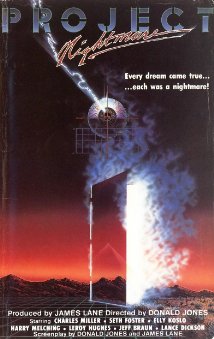
The Daily Grindhouse: Project Nightmare (dir by Donald M. Jones)


Project Nightmare

Earlier tonight, the Late Night Movie crew and I watched Project Nightmare, an obscure little film from 1987.  (Actually, it would be more correct to say that the film was released in 1987.  Judging from the clothes, the cars, and the hair, the film was actually made at some point in the 70s.)

The best word that I can think to describe Project Nightmare would be weird.  This is just a weird and trippy movie.

The film opens with Gus (Charles Miller) and John (Seth Foster), two friends who played football in college and who are now in the air conditioning business together.  Gus is insecure and angst-ridden.  John is confident and spends almost the entire movie with his shirt becoming progressively more and more unbuttoned.  Gus and John go on a camping trip.  As the film opens, they are both running from something that they think attacked their camp site.  They’re not quite sure what it was and their descriptions remain frustratingly vague.  Even when their mysterious pursuer comes near, we never get a clear look at it.  Instead, we just hear buzzing on the soundtrack while the sky changes colors.

Gus and John come across a house sitting in the middle of nowhere.  Inside the house is Marcie (Elly Koslo).  Marcie doesn’t have a telephone but she does have a bottle of Scotch.  As Gus and John drink, they sit on the floor because Marcie doesn’t appear to have any furniture in their house.  Their conversation is stiff and oddly stilted and we’re left to wonder if this is the result of bad acting or if it’s just another sign of the film’s overall surreal atmosphere.  Gus admits that he wants to sleep with Marcie and then proceeds to tell her a long and confusing story about why he and John are such good friends.  John, meanwhile, dreams of a little boy running in a cemetery while a priest makes unintelligible sounds.

The next morning, as the two men leave the house, we hear a howling wind and yet none of the surrounding plant life appears to be swaying.  Was this just bad filmmaking or was it another example of the director trying to create a sense of unease?  It’s not an easy question to answer but I’m willing to give director Donald Jones the benefit of the doubt.

The two men walk.  A mysterious light pursues them.  They come across a man sitting in a car.  Gus and John get in the car.  The man lays down in the back seat and promptly dies.  They drive back to Marcie’s house and manage to get Marcie to come outside right before the entire house vanishes.  Eventually, they somehow come across an airplane sitting in the middle of the desert.  Gus gets in the plane and flies away, leaving John and Marcie behind.  Both Marcie and the car vanish.  John wanders alone.

And then the movie really starts to get weird…

How weird?  I mean weird as in a character finding a pyramid in the middle of the desert.  I mean weird like a room where a woman dances in slow motion while a group of shadowy men applaud.  I mean weird like a big floating head that taunts those below it…

I mean weird.

And here’s another odd thing about Project Nightmare.  I’ve done a google search, I’ve read what it says on the imdb, and there is next to no information out there about how this film came to be.  As I previously stated, the film was obviously made nearly a decade before it was actually released.  Director Donald Jones served a director, writer, and editor on this and three other films but hasn’t had a film released since 1993.  Meanwhile, the film’s cast is also similarly obscure.

Project Nightmare is an enigma.  Everything about this film — from the obscure storyline to the miniscule budget to the unnatural dialogue to the stiff acting — comes together to create an otherworldly viewing experience.  And that’s why you simply must watch it at least once!  Whether it was meant to be or not, Project Nightmare is something of a surrealistic masterpiece.

And guess what?

It’s on YouTube!

Watch it now before it gets taken down.


Here’s the Trailer for Southpaw!


PCAS

So, if you’ve ever really wanted to watch Jake Gyllenhaal get the crap beat out of him, you’ll probably enjoy the trailer for Southpaw.  Judging from the preview, Jake is apparently playing a boxer who gets beat up a lot and who loses his wife and nearly loses his daughter.  Jake really did deserve an Oscar for Nightcrawler.  Southpaw doesn’t look like an Oscar contender but it does look like another chance to Jake to prove his versatility and encourage us all to forget his unfortunae starring turn in the terrible Love and Other Drugs.

Here’s the Official Teaser Trailer for SPECTRE!


Spectre

Oh my God, y’all — JAMES BOND IS COMING BACK!

Seriously, I may have bitched and whined about the generic title and the generic teaser poster of the latest James Bond film but, when you get right down to it, how can you not be excited by the prospect of a new Bond film?

SPECTRE is going to have some pretty big shoes to fill, considering that 2012’s Skyfall was one of the best Bond films ever, as well as being the film that finally convinced a lot of people (including me) that Daniel Craig actually could be a credible 007.

Will SPECTRE be as good as Skyfall or will it be another Quantum of Solace?  When the film was first officially announced, I was cautiously optimistic, largely because of the fact that Sam Mendes was returning as the film’s director.  (It’s interesting that Mendes has both directed one of the best Bond films and one of the worst best picture winners.  Seriously, American Beauty sucks.)

Well, today, the first teaser for SPECTRE was released and you know what?  It actually looks pretty promising.  Judging from the trailer, it appears that SPECTRE will follow up directly on the events at the end of Skyfall and it will involve secrets from Bond’s past.  It’s a surprisingly low-key trailer, one that hints that SPECTRE may be even more of a moody film that Skyfall.