More Of Bronson’s Best: Mr. Majestyk (1974, directed by Richard Fleischer)


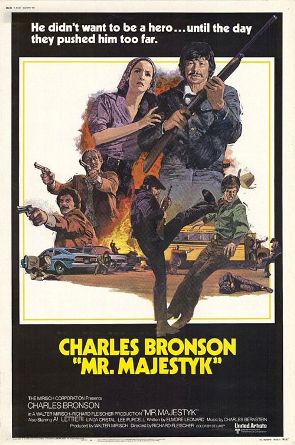
Mr_Majestyk_movie_posterWhat happens when you combine the great tough guy writer Elmore Leonard with the great tough guy actor Charles Bronson?

You get Mr. Majestyk, one of Bronson’s finest films.

Vince Majestyk (Bronson) may be a former U.S. Army Ranger instructor and a decorated Vietnam vet but now that he has returned home to Colorado, all he cares about is running his watermelon farm.  With a lucrative harvest approaching, Majestyk hires a group of unionized Mexican migrant workers, led by the fiery Linda Chavez (Linda Cristal), to pick his crops.  When a local criminal named Bobby Kopas (Paul Koslo) shows up and demands that Majestyk hire his drunken crew instead, Majestyk does what Bronson does best.  He gives Kopas an ass-kickin’ beat down.

After Kopas charges him with assault, the local police arrest Majestyk and, despite his request that he be allowed three days to finish harvesting his crop, Majestyk is thrown in jail.  Also in the jail is a Mafia hitman named Frank Renda (Al Lettieri).  Renda may be a tough guy but nobody’s tougher than Vince Majestyk.  When Renda’s associates attempt to hijack a prison bus, Majestyk ends up hijacking it instead.  Majestyk plans to hold Renda hostage until the police agree to give him his three days of freedom so he can get back to his farm.  Renda even offers to pay him off but Majestyk doesn’t care about his money.  He just cares about melons.

Because he was the only 1970s action star who could be believable as both a decorated combat veteran and a no-nonsense watermelon farmer, Charles Bronson is the only actor who could have brought Mr. Majestyk to life.  Before he became an actor, Bronson worked for a living.  From the age of ten until he enlisted in the Army, Bronson worked in the Pennsylvania coal mines, earning one dollar for each ton of coal that he mined.  Though Bronson was never a great actor, his legitimately working class background allowed him to bring an authenticity to a role like Vince Majestyk that most other actors would have lacked.  When Bronson says that all he cares about is bringing in the harvest on time, you believe him just as much as you believe him when he’s beating up Paul Koslo or hijacking a prison bus.

The rest of the cast is full of good 1970s actors who have never really been given their due.  Al Lettieri may be best known for playing Sollozzo in The Godfather but he also does a good job as Frank Renda.  Paul Koslo plays another one his sleazy villains here and does a great job as Bobby Kopas.

Mr. Majestyk was directed by Richard Fleischer but, with its colorful characters, working class hero, and modernized brand of frontier justice, the film is clearly the work of Elmore Leonard. Though Mr. Majestyk is credited as being based on a novel by Leonard, Leonard actually wrote the screenplay before the novel.

The combination of Elmore Leonard and Charles Bronson makes Mr. Majestyk one of the best action films of the 1970s.

majestyk_rifle


Bronson’s Best: The Stone Killer (1973, directed by Michael Winner)


Stone_killerAfter tough New York detective Lou Torrey (Charles Bronson) lands in hot water for shooting and killing a teenage cop killer, he moves to Los Angeles and gets a job with the LAPD.  Working under an unsympathetic supervisor (Norman Fell), saddled with an incompetent partner (Ralph Waite), and surrounded by paper pushing bureaucrats, Torrey still tries to uphold the law and dispense justice whenever he can.  When a heroin dealer is murdered while in Torrey’s custody, Torrey suspects that it might be a part of a larger conspiracy, involving mobster Al Vescari (Martin Balsam).

Vescari is plotting something big.  It has been nearly 40 since the “Sicilian Vespers,” the day when Lucky Luciano, Frank Costello, and Busy Siegel killed all of the original mafia dons at the same time.  Viscari has invited mafia leaders from across the country to attend a special anniversary dinner.  During the dinner, all of Vescari’s rivals will be assassinated.  To keep things a secret, Vescari will not be using any of his usual hitmen.  Instead, he has contracted a group of mentally unstable Vietnam vets, led by Lawrence (Stuart Margolin).

Charles Bronson has always been an underrated film star.  His legacy has been tarnished by the cheap films he made for Cannon and, unlike Clint Eastwood, he never got a chance to really take control of his career and reinvent his image.  But during the 1970s, not even Clint Eastwood was a more convincing action star than Charles Bronson.  Bronson may have never been a great actor but he was an authentic tough guy with a physical presence that dominated the screen.

It was during this period that Bronson made his first four movies with director Michael Winner.  Though Death Wish and The Mechanic are the best known, The Stone Killer may be the best.  Tough, gritty, and action-packed with a great car chase, The Stone Killer was filmed on location in Los Angeles and some of the best parts are just the scenes of Bronson awkwardly interacting with the local, California culture.  If you have ever wanted to see Charles Bronson deal with a bunch of hippies, this is the film to see.  The Stone Killer also has more of social conscience than the usual 70s cop film, with Bronson’s character not only condemning excessive police brutality but also his racist partner.

(Ironically, Bronson and Winner would follow The Stone Killer with Death Wish, a film that many critics condemned as being racist and which suggested that the police were not being brutal enough.)

The other thing that sets The Stone Killer apart is that it has a great cast, featuring several actors who would go on to find success on television.  Balsam, Fell, and especially Waite and Margolin are all great.  Keep an eye out for a very young John Ritter, playing one of the only cops in the film who is not portrayed as being either corrupt or incompetent.

Though it may not be as well-known as some of his other action films, The Stone Killer is one of Bronson’s best.

“DAMN YOU, KENNEDY!”: Assignment — Kill Castro (1980, directed by Chuck Workman)


7d9oDL3Y5kupCGgUsR6Jh5ZU1KfOne of my earliest memories of staying up late and watching cheesy movies on local television was the sight of Robert Vaughn standing on a beach and cursing, “Damn you, Kennedy!”  An echo effect kicked in, making the line: “Damn you, Kennedy Kennedy Kennedy Kennedy Kennedy!”

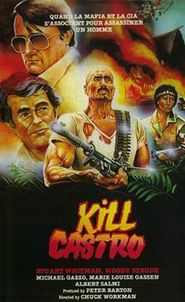
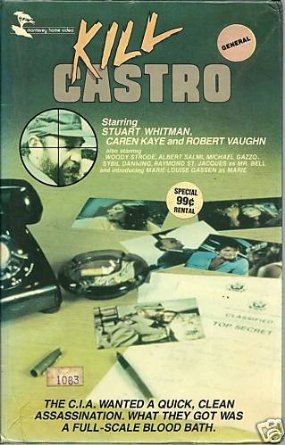
The name of the movie was Assignment — Kill Castro and sometimes it seemed like it came on every other night.  The movie started with a title crawl that was so lengthy and so set the tone for the entire film that I feel it is worth quoting in its entirety:

From 1961, the year of the Bag of Pigs to today, the Government of the United States has been embroiled in a series of events which have continually led our nation to crisis after crisis and to the brink of war.

ASSIGNMENT — KILL CASTRO, a true story is one of the most confusing and frustrating historical events that might have led to a world power showdown.  It happened yesterday!  It happened today!  It can happen again!

Names of persons and places have been changed to protect the individuals who were called upon to aid their country and in doing so placed their lives in jeopardy.

“I WILL GIVE ALL FOR THE LOVE OF MY COUNTRY … RIGHT OR WRONG! — G.W. Bell, Chief of Carribean (sic) Operations, Central Intelligence Agency”

This motion picture is dedicated to all people who desire to live in a free democratic society.

Robert Vaughn plays Hud, a former CIA agent who was involved in the original Bay of Pigs invasion.  When the mysterious Mr. Bell (Raymond St. Jacques) and a gangster named Rossellini (Michael V. Gazzo) agree to finance an operation to kill Fidel Castro, Hud recruits a Key West bar owner named Tony (Stuart Whitman) to take him to Cuba.  However, Mr. Bell and Rossellini are just using Hud to secretly smuggle heroin into Florida and, much like John F. Kennedy in 1961, they are planning on abandoning him on the beaches of Cuba.

The main problem with Assignment — Kill Castro is that we already know that Hud is not going to succeed in his mission because Fidel Castro is still alive and probably still bragging about how he sent Tony Montana to Miami.  The other problem is that the movie does not make any damn sense.  That title crawl was not kidding when it said the story was confusing and frustrating.  Everyone is so busy double-crossing everyone else that it is hard to keep track.  There has to be a simpler way to get heroin into Florida.  Surprisingly, this incoherent movie was written and directed by the legendary editor, Chuck Workman, the same Chuck Workman who puts together those montages for the Oscars.

Kill Castro does have a good cast, though none of them are at their best.  Along with Whitman, Vaughn, St. Jacques, and Gazzo, the cast includes Woody Strode, Albert Salmi, and Sybil Danning (whose last name is misspelled Daning in the end credits).  Fidel Castro plays himself and the film’s ending is provided by cannibal turtles.

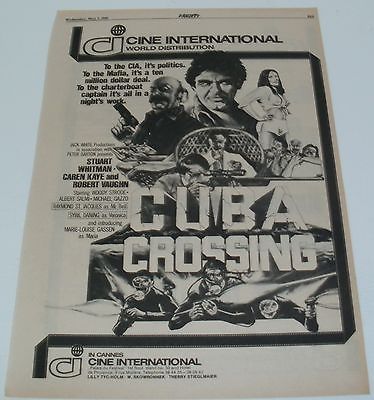
Assignment — Kill Castro was just one of the many titles that this movie was released under.

51-brX2eGmL._SY445_

It was also known as Cuba Crossing,

STUART-WHITMAN-CUBA-CROSSING-MOVIE-ADVERT-FULL-PAGE

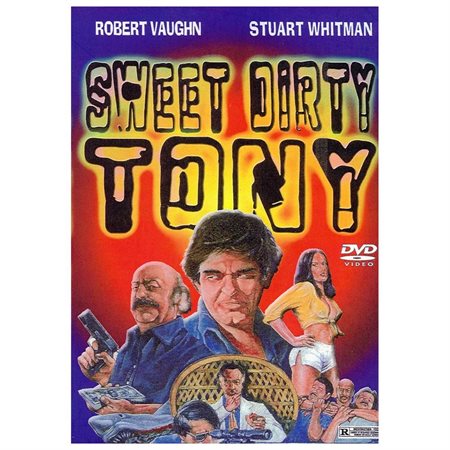
Key West Crossing, The Mercenaries, and my personal favorite, Sweet Dirty Tony.

55706564

You Say You Want A Revolution: Power Play (1978, directed by Martyn Burke)


PowerPlay1978

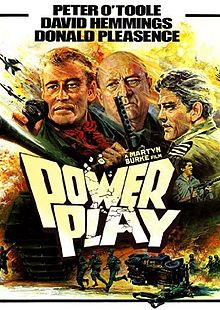
When I was 16, I would spend every weekend down at a small, used video store that was a few blocks away from my house.  One afternoon, I was looking for a video to rent when I came across a battered VHS box.  On the front of the box, Peter O’Toole smoked a cigar and sat on top of a tank.  The back cover described the film as being about revolution and promised exciting action.  A critic was quoted as saying that the movie was “an intelligent political thriller!”  Because I was obsessed with politics, that caught my attention.  I rented the movie, took it home, and watched it twice.

The name of the movie was Power Play.

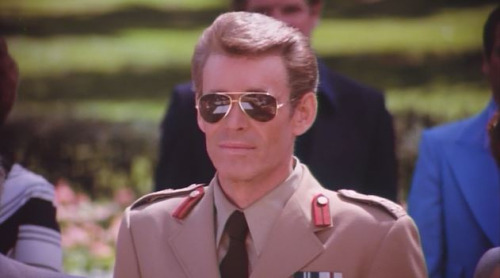
In an unnamed Eastern European country, a corrupt and despotic dictator rules with an iron hand.  Dissidents are regularly arrested and executed.  Corrupt government officials live in luxury while the rest of the country is trapped in poverty.  After a friend’s daughter is tortured and murdered by the secret police, Colonel Narriman (David Hemmings) teams up with Dr. Rosseau (Barry Morse) to plot a coup.  In order to the overthrow the government, the conspirators have to hide their plans from Blair (Donald Pleasence), the sadistic head of the secret police, and convince Colonel Zeller (Peter O’Toole) to join them and bring his tanks over to their side.

power

Power Play may be forgotten today but it made a big impression on me when I first watched it.  Power Play not only showed what it was like to live in a totalitarian society but also attempted to realistically portray what it would take to overthrow a dictatorship.  Power Play spends as much time on the plotting of the revolution as it does on the revolution itself, with special attention given to Rousseau’s attempts to secure international support for the coup.  David Hemmings is great in the main role and Donald Pleasence is Himmleresque as Blair.  Even Peter O’Toole’s infamous 1970s hamminess seems appropriate for the character of Col. Zeller.  Power Play is a must see for aspiring revolutionaries every where.

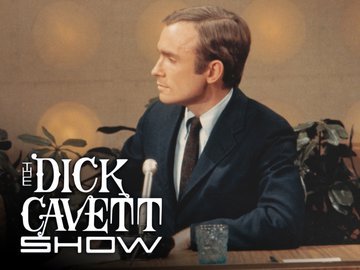
Incidentally, Power Play opens with one of the conspirators being interviewed by Dick Cavett, meaning that Power Play can be added to Annie Hall and A Nightmare On Elm Street 3: Dream Warriors on the list of films in which Dick Cavett has played himself.

the-dick-cavett-show

When McQueen Met Ibsen: An Enemy of The People (1978, directed by George Schaefer)


What happened when famed action star Steve McQueen met playwright Henrik Ibsen?

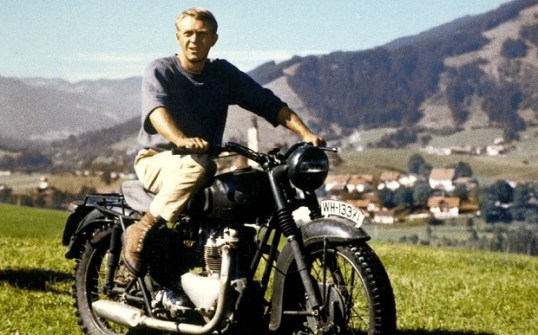
Here’s Steve McQueen in The Great Escape:

Steve McQueen In The Great Escape

This is Steve McQueen in Bullitt:

Steve McQueen in Bullitt

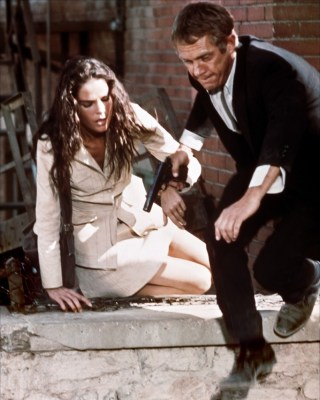
Here’s Steve McQueen with his future wife, Ali MacGraw, in The Getaway:

Steve McQueen in The Getaway

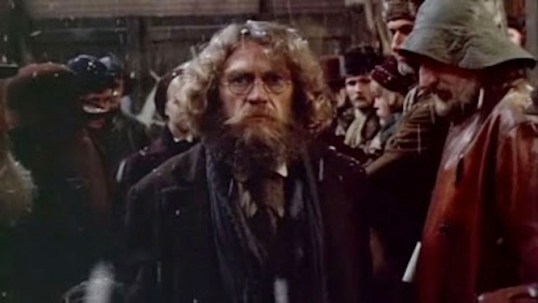
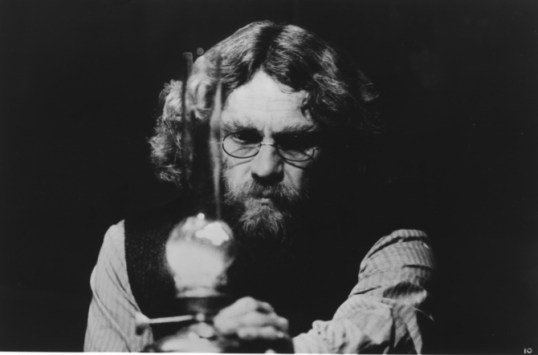
And finally, here’s Steve McQueen starring in An Enemy of the People:

Steve McQueen in Enemy of the People

In the four years between appearing in the Oscar-nominated The Towering Inferno and starring in An Enemy of the People, McQueen notoriously turned down several high-profile projects.  He turned down the lead role in Sorcerer because director William Friedkin would not write a role for MacGraw.  He turned down the lead role in Steven Spielberg’s Close Encounters of The Third Kind because he felt that he would not be able to cry on cue.  (When Spielberg offered to take out the crying scene, McQueen replied that it was the best scene in the script.)  Francis Ford Coppola could not afford his salary and McQueen missed out on the chance to play Capt. Willard in Apocalypse Now, a role he would have been perfect for.

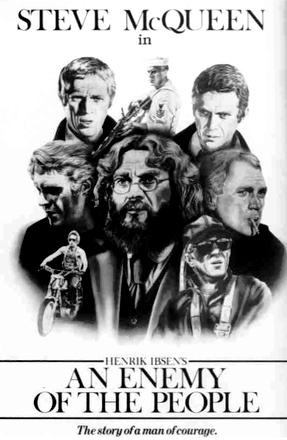
AnEnemyOfThePeople_posterInstead, after a four years absence, McQueen returned to the screen in one of the least expected films of his career.  Based on Arthur Miller’s adaptation of Henrik Ibsen’s original play, An Enemy of the People featured McQueen playing Dr. Thomas Stockmann, a scientist who discovers that his town’s local spring has been polluted by a tannery.  When Stockmann reveals his findings, the town turns against him and his family.  Stockmann has to decide whether to give into pressure from the town or to stay true to his principles.

As a star who was best known for playing stoic men of action, Steve McQueen was the last actor that anyone expected to appear in a film based on an Ibsen play.  McQueen also insisted on playing the role with a heavy beard and a stocky build, making him virtually unrecognizable on-screen.  Warner Bros. had no idea how to advertise An Enemy of The People so they didn’t.  After a year of sitting on the shelf, An Enemy of the People was given a limited run in a few college towns.  Many critics assumed that McQueen deliberately made an uncommercial movie just to get out of his contract with Warner Bros but, according to both Ali MacGraw and Marshall Terrill’s Steve McQueen: An American Rebel, McQueen was actually very enthusiastic about making An Enemy of the People and extremely disappointed when it was not a success.  After the film failed to find an audience, Steve McQueen returned to appearing in action films and westerns.

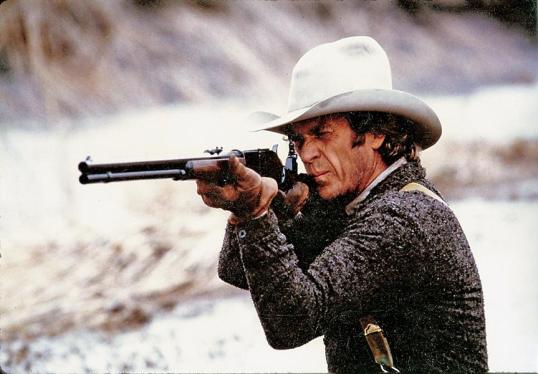
Steve McQueen in Tom Horn (1980)

Steve McQueen in Tom Horn (1980)

I recently saw An Enemy of the People on TCM and I thought it was slow and didactic.  (It did not help that An Enemy of the People is Ibsen’s weakest play.)  Especially in the beginning, there are a few scenes where McQueen struggles to hold his ground against co-stars Charles Durning and Richard Dysart, both of whom had far more theatrical experience.  But McQueen gets better as the film goes on and proves that his deceptively casual approach can still be effective even when he is playing an intellectual who chooses to make his point with his words instead of his fists.  He does a good job handling Ibsen’s notoriously wordy speeches.  By the end of the movie, the idea of Steve McQueen in an Ibsen play no longer seems strange at all.

After An Enemy of the People, McQueen would only make two more movies before dying of cancer at the age of 50.  Based on his performance as Dr. Stockmann, I believe that if McQueen had not died, he would have aged into being a great actor, in much the same way as Clint Eastwood.  It’s unfortunate that McQueen never got that chance.

bfi-00o-4ni

Everybody Goes Home!: P.O.W. The Escape (1986, directed by Gideon Amir)


Pow_the_escape_posterP.O.W. films were all the rage in the 1980s.  For a country just starting to get back its confidence, refighting the Vietnam War onscreen was a way to deal with the lingering trauma of that conflict.  In Rambo: First Blood Part II, Sylvester Stallone asked, “Do we get to win this time?” and for a while, the answer was yes.  By sending action stars like Stallone and Chuck Norris to rescue American soldiers still being held captive in Asia, we would win this time (if only in our dreams).

P.O.W.: The Escape (also known as Behind Enemy Lines and Attack Force ‘Nam) is one of the many P.O.W. films that was produced by Menahem Golan and Yoram Globus during their legendary time at Cannon Films.  In place of their usual star, Chuck Norris, P.O.W.: The Escape stars David Carradine as Col. James Cooper.  Cooper is a U.S. Airborne commando who, in 1973, is sent to North Vietnam on a special missions to rescue the soldiers behind held in a POW camp.

Why has Cooper been selected for this mission?

As one officer puts it, “Aside from being the best, he’s got one rule and it’s never been broken.  Everybody goes home!”

When the rescue mission goes awry, Cooper is himself captured and sent to the POW camp.  He gets his fellow prisoners back into fighting shape and, when the cowardly Sparks (Charles R. Floyd) challenges his leadership, Cooper reminds him of who the senior officer in charge is.  When the camp commandant, Vinh (Mako), offers to help Cooper escape in return for Cooper helping Vinh reach the United States, Cooper simply responds with his name, rank, and serial number.  When Vinh threatens to kill the prisoners unless Cooper helps him, Cooper agrees on one condition: “Everybody goes home!”

When Sgt. Johnston (played by perennial action sidekick, Steve James) learns of the plan, he argues that “Everybody goes home is a slogan, not a religion!”

“Speak for yourself,” Cooper replies.

Even, if like Sparks, they betray you and run off with a cache of gold, the religion of Everybody Goes Home means that no one gets left behind.  Even if it means having to trek through the jungle and going over a waterfall in a canoe, everybody goes home.  That is something that Sparks only comes to realize as he watches a prostitute undress and starts to have flashbacks to earlier scenes in the movie.  Suddenly, Sparks understands that everybody goes home and it gives him an opportunity for some last minute redemption.

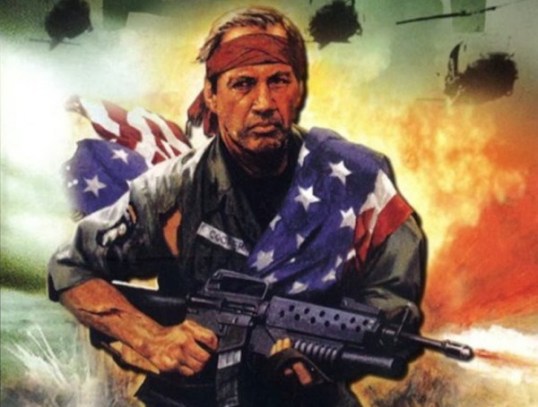
Even though it is not as well-known as Missing in Action or First Blood Part II, POW: The Escape is enjoyably mindless entertainment in the legendary Cannon style.  As the world’s least likely paratrooper, David Carradine gets to show off some sweet kung fu moves.  By the end of the movie, Carradine is literally wearing an American flag.  Nothing about POW: The Escape is subtle but what’s important is that “Everybody goes home!”

ATTACK-FORCE-NAM-1986-600x455

It’s Better Than Last Stand: X-Men: Apocalypse (2016, directed by Bryan Singer)


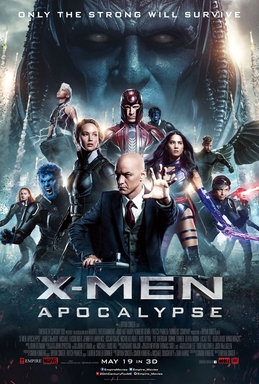
X-Men_-_ApocalypseIt is easy to forget what a big deal the first X-Men movie was in 2000.  At a time when Joel Schumacher was still the industry’s go-to director for super hero films, X-Men announced that films based on comic books did not have to be campy, silly, stupid, or feature Alicia Silverstone.  When X-Men was first released, critics and audiences were surprised to see a comic book film that was intelligent, well-acted, and actually about something.

The only people who were not shocked were those of us who grew up reading the X-Men books.  We already knew that the X-Men was about more than just heroes with super powers and flashy costumes.  We knew that the battles within the pages of the X-books were always meant to serve as a metaphor for racism and real-world prejudice and, since many of us felt like outcasts and mutants ourselves, we related to the characters.  We already knew that Magneto was often a sympathetic villain while Prof. X was not always a likable hero.  We knew that almost every battle that the X-Men fought came down to the question of whether or not different types of people could peacefully co-exist.  Unlike the critics, we were not shocked by X-Men‘s subtext.  Instead, we were just happy that Bryan Singer did not fuck things up.

All of the comic books films that have followed have owed a debt to critical and commercial success the first X-Men movie.  Without that success, there would probably have never been a Dark Knight trilogy or even an MCU.
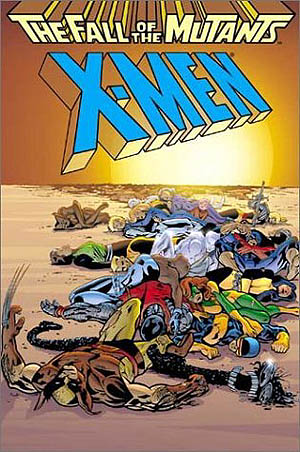
FallofmutantsThe success of X-Men has also led to a 16 year-old franchise of movies about mutants and their struggle to live in a world that fears them.  X-Men: Apocalypse is the 9th installment in that franchise and it is based on the Fall of the Mutants storyline, which ran through several Marvel comics in 1988.

Continuing the pattern set by X-Men: First Class and X-Men: Days of Future Past, Apocalypse takes place in the past, back when Charles Xavier was still James McAvoy and Magneto was still Michael Fassbender.  (Unlike Days of Future Past, neither Patrick Strewart nor Ian McKellan makes an appearance.)  The year is 1983.  Ronald Reagan is President.  The Cold War still rages.  The music is better than it is today.  Xavier is running his school for gifted mutants youngsters.  Magneto is living, under an assumed name, in Poland.  Magneto is married and has a young daughter and as soon as I saw them, I knew they were going to die.  Magneto’s family never survives.

In Egypt, an ancient and powerful mutant named En Sabah Nur (Oscar Isaac) is awakened after being entombed for centuries.  Readers of the comic books will immediately recognize En Sabah Nur as Apocalypse.  Planning to destroy the world so that he can rebuild it in his own image, Apocalypse recruits his four horseman — Storm (Alexandra Shipp), Angel (Ben Hardy), Psylocke (Olivia Munn), and Magneto.  Apocalypse also wants to recruit Xavier to his side but Prof. X still believes that humans and mutants must learn to co-exist.
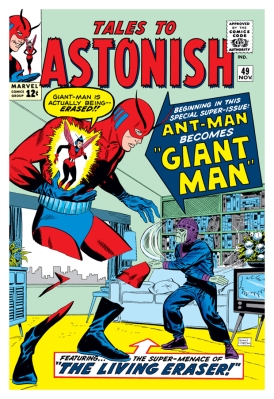
livingeraser1What’s interesting is that, even though Fassbender and McAvoy share a few scenes, this is the first X-Men film to not feature any sort of debate between Xavier and Magneto.  Magneto, one of the greatest comic book villains of all time, is actually a little boring here and, without those debates, Apocalypse lacks the subtext that distinguished the best of the previous X-Men films.  The emphasis is less on what it means to be an outsider and more on defeating Apocalypse.  Unfortunately, Apocalypse is a great character in the comic books but he does not translate well into film.  Unlike Magneto, who has several good and justifiable reasons for not trusting humanity, the film version of Apocalypse is portrayed as being pure evil and little else.  His plan to destroy the world never makes much sense and he is almost as bland as Dr. Doom in the latest Fantastic Four reboot.  Apocalypse could be any villain from any comic book movie that has been released over the past 16 years.  He could just as easily be the Living Eraser.

Apocalypse is also an origin story, showing how the modern incarnation of the X-Men first came to be.  We meet young versions of Scott Summers, Jean Grey, and Nightcrawler (played by Tye Sheridan, Sophie Turner, and Kodi Smit-McPhee) and Wolverine (Hugh Jackman) makes a brief appearance that feels like it was mostly included to set up the character’s third stand-alone film.  Jennifer Lawrence, Nicholas Hoult, and Evan Peters also return in the roles of Mystique, the Beast, and Quicksilver.  Peters is featured in the movie’s coolest scene, though that scene is basically just a redo of Days of Future Past‘s coolest scene.

hqyqxvfnbce8jfpwptqn

(There’s also a blink-or-you’ll-miss-it cameo from Dazzler, which I guess means that Marvel’s disco queen will eventually be appearing on movie screens.)

X-Men: Apocalypse is not as good as either First Class or Days of Future Past but it’s still better than The Last Stand.  (Since Apocalypse takes place in 1983, Scott and Jean go to see Return of the Jedi and talk about how the third film of any franchise always sucks.)  It’s entertaining but, without an interesting villain or any sort of examination of what it really means to be an outcast,  Apocalypse is also forgettable in a way that X2 and Days of Future Past never were.  As a lifelong fan of the X-Men, I could not help but be disappointed.

Plus, this movie needed more Deadpool! (Note: Deadpool is not in X-Men: Apocalypse.)

Plus, this movie needed more Deadpool! (Note: Deadpool is not in X-Men: Apocalypse.)

One thing that especially bothered me is that Days of Future Past ended with Xavier promising to explain to Wolverine why he, Scott, and Jean were all still alive despite having been killed in The Last Stand.  If you were hoping Apocalypse would clear that up, don’t hold your breath.  I guess that question will remain unanswered until the 10th film.

Speaking of which, First Class was set in the 1960s and Days of Future Past largely took place in the 70s.  Apocalypse is an 80s movie so the next installment should be set in the early 90s.  Will Scott be listening to Nirvana or will he be playing air guitar to November Rain?  I guess we’ll have to wait to find out!

x-men-apocalypse1

Happy Birthday, Bob Dylan!


“All I can do is be me, whoever that is.” — Bob Dylan

Bob Dylan not only revolutionized music but he was also responsible for one of the first music videos.  The video for Subterranean Homesick Blues originally appeared at the start of D.A. Pennebaker’s documentary, Don’t Look Back.  It was filmed in  May 8th, 1965 in the alley behind the Savoy Hotel in London and, as Bob flips those cue cards, keep an eye out for both songwriter Bob Neuwirth and the poet Allen Ginsberg in the background.

Happy birthday to Bob Dylan, who is 74 years old today.

Airport Reading: Your Favorite Band Is Killing Me by Steven Hyden


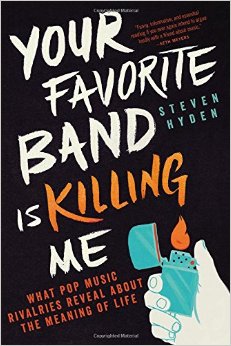
51y-hABo2ML._SY344_BO1,204,203,200_Today, I have flown from Baltimore to Chicago and, after a three-hour layover at O’Hare, from Chicago to Atlanta.  Now I have to wait two hours until I board a plane to Dallas.  Luckily, I have a good book to read.

Steven Hyden’s Your Favorite Band Is Killing Me takes a look at some famous pop music rivalries and what they may or may not reveal about the meaning of life.  Hyden examines 19 different rivalries, everyone from Oasis vs. Blur to Neil Young vs. Lynard Skynard to the Smashing Pumpkins vs. Pavement, Beatles vs. the Rolling Stones and, naturally, Roger Waters vs. everyone else in Pink Floyd.  And, of course, he also writes about Biggie vs. Tupac because, as he puts it, that’s the only rivalry that he “was required by law to write about in this book.”

The best chapter, in my opinion, is Hyden’s look at the rivalry between Jimi Hendrix’s legacy and Eric Clapton’s continued existence.  He asks a very important question: If Hendrix had lived and was currently living the life of Eric Clapton, would we still consider Jimi to be the greatest guitar God of all time?  A close second to the Hendrix/Clapton chapter is Hyden’s look at the rivalry between Nirvana and Pearl Jam.  Hyden makes a convincing argument that not only did Kurt Cobain never really grow to like Pearl Jam but that Bruce Springsteen really does not like Chris Christie that much either.

Steven Hyden’s an opinionated guy and, reading the book, I have disagreed with him almost as much as I’ve agreed.  But he is also a very good writer and he definitely knows his music.  Your Favorite Band Is Killing Me has made this day of airports and flying bearable.  I highly recommend it!

The Movie That Nearly Killed The Godfather: The Brotherhood (1968, directed by Martin Ritt)


Brotherhood_1968Once upon a time, Paramount Pictures released a movie about an Italian-American organized crime family.

It was a self-styled epic that used the Mafia as a metaphor for both business and politics.  The movie mixed scenes of violent death with family and community ceremonies.   The main mafioso was played by a famous actor who was a big box office draw in the 1950s and another character, a war hero who was initially reluctant to get involved in the family business, was played by an up-and-coming young actor.   The majority of the movie took place in New York but there were several scenes that were set in Sicily.

It may sound like The Godfather but actually, it was The Brotherhood, a film that flopped so badly that Paramount executives nearly passed on the chance to make a movie out of Mario Puzo’s bestselling novel.  According to Peter Biskind’s The Godfather Companion, Francis Ford Coppola frequently cited The Brotherhood as being exactly the type of movie that he did not want to make while he was directing The Godfather.

Kirk Douglas, who both produced and starred, plays Frank Ginetta.  Frank, an old-fashioned and honorable mobster, is hiding out in Sicily with his wife, Ida (Irene Pappas).  Frank knows that a rival gangster, Jim Egan (Murray Hamilton), has put a price on his head.  When Frank’s brother, Vinnie (Alex Cord), shows up in Palermo, Frank is overjoyed at first.  But Ida reminds him, “They’re going to send someone.”

Most of the film is taken up with flashback to Frank and Vinnie’s old life in New York.  When Vinnie returns from serving in the army, he marries Emma Bertolo (Susan Strasberg), the daughter of Don Bertolo (Luther Adler who, as a stage actor and director, served as an early mentor to the future Don Corleone, Marlon Brando).  Frank grew up idolizing their Sicilian father and, at first, he is happy when Vinnie announces that he wants to enter the “family business.”  But then Vinnie starts to side with non-Sicilian gangsters like Egan and Sol Levin (Alan Hewitt).

The scenes in Sicily work the best, with Frank unsure as to whether or not Vinnie has arrived to visit or to murder him.  But the scenes in New York are such a mess that it took me a while to realize that they were even supposed to be flashbacks.  It is hard to keep track of how much time has passed from scene to scene and Alex Cord and Kirk Douglas are two of the most unlikely brothers imaginable.

The main problem with The Brotherhood is that it is impossible to watch it without thinking about The Godfather.  The Brotherhood has much in common with The Godfather but it has none of its authenticity and does not come close to matching its epic scale.  Kirk Douglas tries his best and puts a lot of effort into talking with his hands but he is miscast from the moment he first appears.  Robert Evans once said that he chose Coppola to direct The Godfather because he wanted to “smell the pasta.”  The Brotherhood was directed by Martin Ritt and you never smell the pasta.

The Brotherhood is an interesting footnote in the history of The Godfather but ultimately, it’s an offer you can refuse.

1374000145_4