When McQueen Met Ibsen: An Enemy of The People (1978, directed by George Schaefer)


What happened when famed action star Steve McQueen met playwright Henrik Ibsen?

Here’s Steve McQueen in The Great Escape:
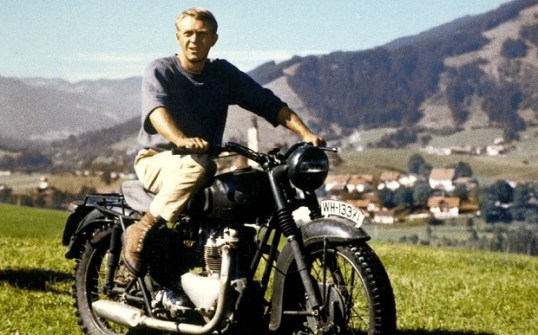
Steve McQueen In The Great Escape

This is Steve McQueen in Bullitt:

Steve McQueen in Bullitt

Here’s Steve McQueen with his future wife, Ali MacGraw, in The Getaway:
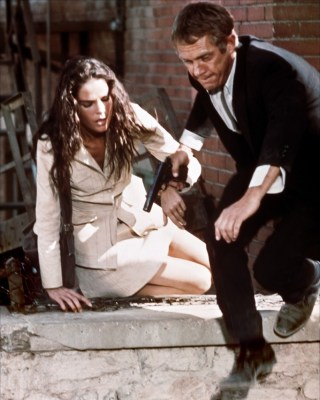
Steve McQueen in The Getaway

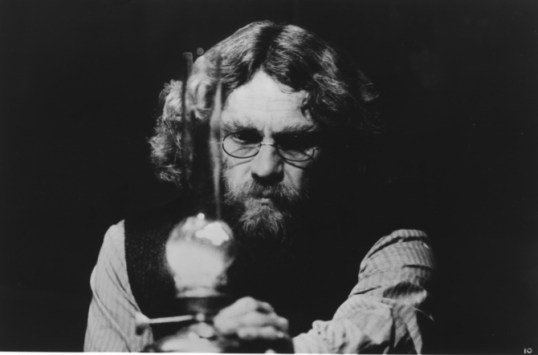
And finally, here’s Steve McQueen starring in An Enemy of the People:
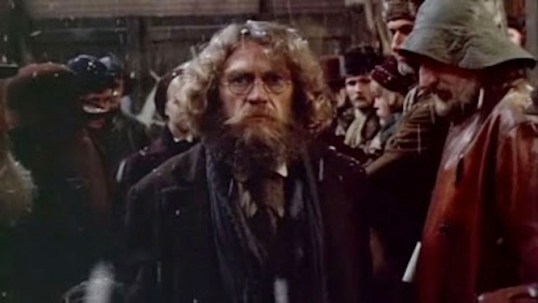
Steve McQueen in Enemy of the People

In the four years between appearing in the Oscar-nominated The Towering Inferno and starring in An Enemy of the People, McQueen notoriously turned down several high-profile projects.  He turned down the lead role in Sorcerer because director William Friedkin would not write a role for MacGraw.  He turned down the lead role in Steven Spielberg’s Close Encounters of The Third Kind because he felt that he would not be able to cry on cue.  (When Spielberg offered to take out the crying scene, McQueen replied that it was the best scene in the script.)  Francis Ford Coppola could not afford his salary and McQueen missed out on the chance to play Capt. Willard in Apocalypse Now, a role he would have been perfect for.
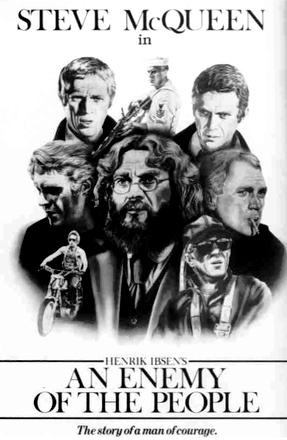
AnEnemyOfThePeople_posterInstead, after a four years absence, McQueen returned to the screen in one of the least expected films of his career.  Based on Arthur Miller’s adaptation of Henrik Ibsen’s original play, An Enemy of the People featured McQueen playing Dr. Thomas Stockmann, a scientist who discovers that his town’s local spring has been polluted by a tannery.  When Stockmann reveals his findings, the town turns against him and his family.  Stockmann has to decide whether to give into pressure from the town or to stay true to his principles.

As a star who was best known for playing stoic men of action, Steve McQueen was the last actor that anyone expected to appear in a film based on an Ibsen play.  McQueen also insisted on playing the role with a heavy beard and a stocky build, making him virtually unrecognizable on-screen.  Warner Bros. had no idea how to advertise An Enemy of The People so they didn’t.  After a year of sitting on the shelf, An Enemy of the People was given a limited run in a few college towns.  Many critics assumed that McQueen deliberately made an uncommercial movie just to get out of his contract with Warner Bros but, according to both Ali MacGraw and Marshall Terrill’s Steve McQueen: An American Rebel, McQueen was actually very enthusiastic about making An Enemy of the People and extremely disappointed when it was not a success.  After the film failed to find an audience, Steve McQueen returned to appearing in action films and westerns.
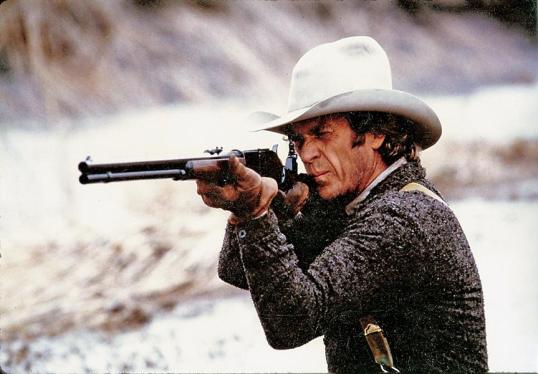
Steve McQueen in Tom Horn (1980)

Steve McQueen in Tom Horn (1980)

I recently saw An Enemy of the People on TCM and I thought it was slow and didactic.  (It did not help that An Enemy of the People is Ibsen’s weakest play.)  Especially in the beginning, there are a few scenes where McQueen struggles to hold his ground against co-stars Charles Durning and Richard Dysart, both of whom had far more theatrical experience.  But McQueen gets better as the film goes on and proves that his deceptively casual approach can still be effective even when he is playing an intellectual who chooses to make his point with his words instead of his fists.  He does a good job handling Ibsen’s notoriously wordy speeches.  By the end of the movie, the idea of Steve McQueen in an Ibsen play no longer seems strange at all.

After An Enemy of the People, McQueen would only make two more movies before dying of cancer at the age of 50.  Based on his performance as Dr. Stockmann, I believe that if McQueen had not died, he would have aged into being a great actor, in much the same way as Clint Eastwood.  It’s unfortunate that McQueen never got that chance.
bfi-00o-4ni

Everybody Goes Home!: P.O.W. The Escape (1986, directed by Gideon Amir)


Pow_the_escape_posterP.O.W. films were all the rage in the 1980s.  For a country just starting to get back its confidence, refighting the Vietnam War onscreen was a way to deal with the lingering trauma of that conflict.  In Rambo: First Blood Part II, Sylvester Stallone asked, “Do we get to win this time?” and for a while, the answer was yes.  By sending action stars like Stallone and Chuck Norris to rescue American soldiers still being held captive in Asia, we would win this time (if only in our dreams).
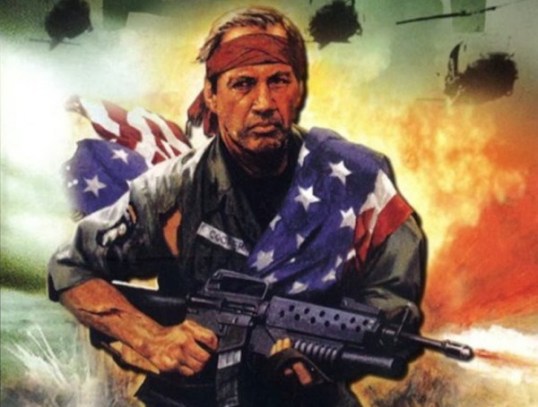
P.O.W.: The Escape (also known as Behind Enemy Lines and Attack Force ‘Nam) is one of the many P.O.W. films that was produced by Menahem Golan and Yoram Globus during their legendary time at Cannon Films.  In place of their usual star, Chuck Norris, P.O.W.: The Escape stars David Carradine as Col. James Cooper.  Cooper is a U.S. Airborne commando who, in 1973, is sent to North Vietnam on a special missions to rescue the soldiers behind held in a POW camp.

Why has Cooper been selected for this mission?

As one officer puts it, “Aside from being the best, he’s got one rule and it’s never been broken.  Everybody goes home!”

When the rescue mission goes awry, Cooper is himself captured and sent to the POW camp.  He gets his fellow prisoners back into fighting shape and, when the cowardly Sparks (Charles R. Floyd) challenges his leadership, Cooper reminds him of who the senior officer in charge is.  When the camp commandant, Vinh (Mako), offers to help Cooper escape in return for Cooper helping Vinh reach the United States, Cooper simply responds with his name, rank, and serial number.  When Vinh threatens to kill the prisoners unless Cooper helps him, Cooper agrees on one condition: “Everybody goes home!”

When Sgt. Johnston (played by perennial action sidekick, Steve James) learns of the plan, he argues that “Everybody goes home is a slogan, not a religion!”

“Speak for yourself,” Cooper replies.

Even, if like Sparks, they betray you and run off with a cache of gold, the religion of Everybody Goes Home means that no one gets left behind.  Even if it means having to trek through the jungle and going over a waterfall in a canoe, everybody goes home.  That is something that Sparks only comes to realize as he watches a prostitute undress and starts to have flashbacks to earlier scenes in the movie.  Suddenly, Sparks understands that everybody goes home and it gives him an opportunity for some last minute redemption.

Even though it is not as well-known as Missing in Action or First Blood Part II, POW: The Escape is enjoyably mindless entertainment in the legendary Cannon style.  As the world’s least likely paratrooper, David Carradine gets to show off some sweet kung fu moves.  By the end of the movie, Carradine is literally wearing an American flag.  Nothing about POW: The Escape is subtle but what’s important is that “Everybody goes home!”

ATTACK-FORCE-NAM-1986-600x455

It’s Better Than Last Stand: X-Men: Apocalypse (2016, directed by Bryan Singer)


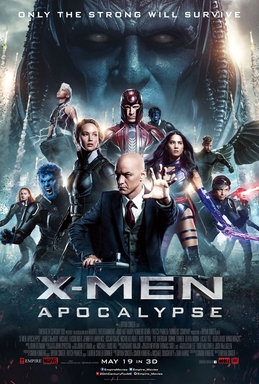
X-Men_-_ApocalypseIt is easy to forget what a big deal the first X-Men movie was in 2000.  At a time when Joel Schumacher was still the industry’s go-to director for super hero films, X-Men announced that films based on comic books did not have to be campy, silly, stupid, or feature Alicia Silverstone.  When X-Men was first released, critics and audiences were surprised to see a comic book film that was intelligent, well-acted, and actually about something.
The only people who were not shocked were those of us who grew up reading the X-Men books.  We already knew that the X-Men was about more than just heroes with super powers and flashy costumes.  We knew that the battles within the pages of the X-books were always meant to serve as a metaphor for racism and real-world prejudice and, since many of us felt like outcasts and mutants ourselves, we related to the characters.  We already knew that Magneto was often a sympathetic villain while Prof. X was not always a likable hero.  We knew that almost every battle that the X-Men fought came down to the question of whether or not different types of people could peacefully co-exist.  Unlike the critics, we were not shocked by X-Men‘s subtext.  Instead, we were just happy that Bryan Singer did not fuck things up.

All of the comic books films that have followed have owed a debt to critical and commercial success the first X-Men movie.  Without that success, there would probably have never been a Dark Knight trilogy or even an MCU.

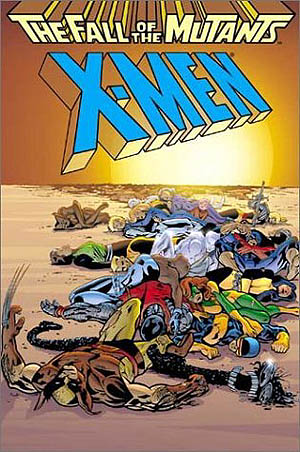
FallofmutantsThe success of X-Men has also led to a 16 year-old franchise of movies about mutants and their struggle to live in a world that fears them.  X-Men: Apocalypse is the 9th installment in that franchise and it is based on the Fall of the Mutants storyline, which ran through several Marvel comics in 1988.
Continuing the pattern set by X-Men: First Class and X-Men: Days of Future Past, Apocalypse takes place in the past, back when Charles Xavier was still James McAvoy and Magneto was still Michael Fassbender.  (Unlike Days of Future Past, neither Patrick Strewart nor Ian McKellan makes an appearance.)  The year is 1983.  Ronald Reagan is President.  The Cold War still rages.  The music is better than it is today.  Xavier is running his school for gifted mutants youngsters.  Magneto is living, under an assumed name, in Poland.  Magneto is married and has a young daughter and as soon as I saw them, I knew they were going to die.  Magneto’s family never survives.

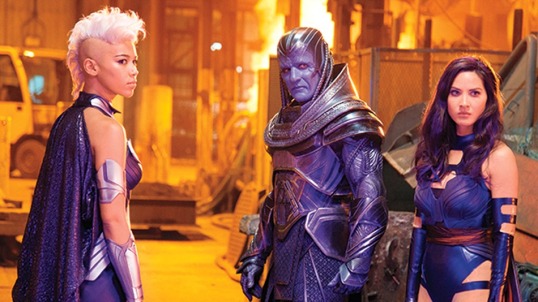
In Egypt, an ancient and powerful mutant named En Sabah Nur (Oscar Isaac) is awakened after being entombed for centuries.  Readers of the comic books will immediately recognize En Sabah Nur as Apocalypse.  Planning to destroy the world so that he can rebuild it in his own image, Apocalypse recruits his four horseman — Storm (Alexandra Shipp), Angel (Ben Hardy), Psylocke (Olivia Munn), and Magneto.  Apocalypse also wants to recruit Xavier to his side but Prof. X still believes that humans and mutants must learn to co-exist.

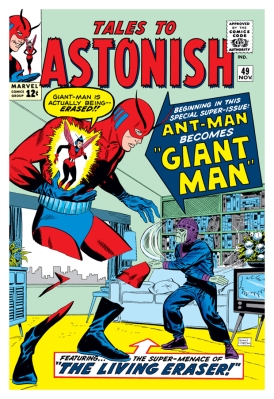
livingeraser1What’s interesting is that, even though Fassbender and McAvoy share a few scenes, this is the first X-Men film to not feature any sort of debate between Xavier and Magneto.  Magneto, one of the greatest comic book villains of all time, is actually a little boring here and, without those debates, Apocalypse lacks the subtext that distinguished the best of the previous X-Men films.  The emphasis is less on what it means to be an outsider and more on defeating Apocalypse.  Unfortunately, Apocalypse is a great character in the comic books but he does not translate well into film.  Unlike Magneto, who has several good and justifiable reasons for not trusting humanity, the film version of Apocalypse is portrayed as being pure evil and little else.  His plan to destroy the world never makes much sense and he is almost as bland as Dr. Doom in the latest Fantastic Four reboot.  Apocalypse could be any villain from any comic book movie that has been released over the past 16 years.  He could just as easily be the Living Eraser.
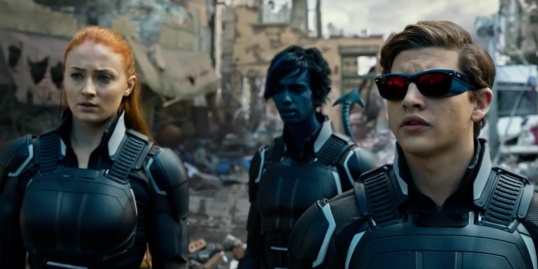
Apocalypse is also an origin story, showing how the modern incarnation of the X-Men first came to be.  We meet young versions of Scott Summers, Jean Grey, and Nightcrawler (played by Tye Sheridan, Sophie Turner, and Kodi Smit-McPhee) and Wolverine (Hugh Jackman) makes a brief appearance that feels like it was mostly included to set up the character’s third stand-alone film.  Jennifer Lawrence, Nicholas Hoult, and Evan Peters also return in the roles of Mystique, the Beast, and Quicksilver.  Peters is featured in the movie’s coolest scene, though that scene is basically just a redo of Days of Future Past‘s coolest scene.

hqyqxvfnbce8jfpwptqn

(There’s also a blink-or-you’ll-miss-it cameo from Dazzler, which I guess means that Marvel’s disco queen will eventually be appearing on movie screens.)

X-Men: Apocalypse is not as good as either First Class or Days of Future Past but it’s still better than The Last Stand.  (Since Apocalypse takes place in 1983, Scott and Jean go to see Return of the Jedi and talk about how the third film of any franchise always sucks.)  It’s entertaining but, without an interesting villain or any sort of examination of what it really means to be an outcast,  Apocalypse is also forgettable in a way that X2 and Days of Future Past never were.  As a lifelong fan of the X-Men, I could not help but be disappointed.

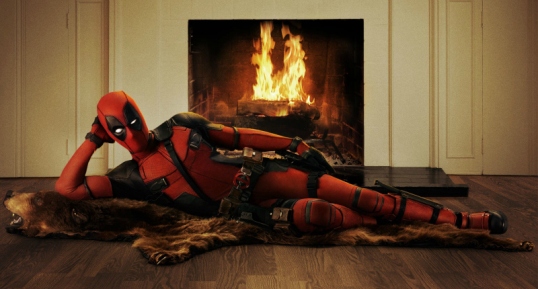
Plus, this movie needed more Deadpool! (Note: Deadpool is not in X-Men: Apocalypse.)

Plus, this movie needed more Deadpool! (Note: Deadpool is not in X-Men: Apocalypse.)

One thing that especially bothered me is that Days of Future Past ended with Xavier promising to explain to Wolverine why he, Scott, and Jean were all still alive despite having been killed in The Last Stand.  If you were hoping Apocalypse would clear that up, don’t hold your breath.  I guess that question will remain unanswered until the 10th film.

Speaking of which, First Class was set in the 1960s and Days of Future Past largely took place in the 70s.  Apocalypse is an 80s movie so the next installment should be set in the early 90s.  Will Scott be listening to Nirvana or will he be playing air guitar to November Rain?  I guess we’ll have to wait to find out!

x-men-apocalypse1

Happy Birthday, Bob Dylan!


“All I can do is be me, whoever that is.” — Bob Dylan

Bob Dylan not only revolutionized music but he was also responsible for one of the first music videos.  The video for Subterranean Homesick Blues originally appeared at the start of D.A. Pennebaker’s documentary, Don’t Look Back.  It was filmed in  May 8th, 1965 in the alley behind the Savoy Hotel in London and, as Bob flips those cue cards, keep an eye out for both songwriter Bob Neuwirth and the poet Allen Ginsberg in the background.

Happy birthday to Bob Dylan, who is 74 years old today.

Airport Reading: Your Favorite Band Is Killing Me by Steven Hyden


51y-hABo2ML._SY344_BO1,204,203,200_Today, I have flown from Baltimore to Chicago and, after a three-hour layover at O’Hare, from Chicago to Atlanta.  Now I have to wait two hours until I board a plane to Dallas.  Luckily, I have a good book to read.

Steven Hyden’s Your Favorite Band Is Killing Me takes a look at some famous pop music rivalries and what they may or may not reveal about the meaning of life.  Hyden examines 19 different rivalries, everyone from Oasis vs. Blur to Neil Young vs. Lynard Skynard to the Smashing Pumpkins vs. Pavement, Beatles vs. the Rolling Stones and, naturally, Roger Waters vs. everyone else in Pink Floyd.  And, of course, he also writes about Biggie vs. Tupac because, as he puts it, that’s the only rivalry that he “was required by law to write about in this book.”

The best chapter, in my opinion, is Hyden’s look at the rivalry between Jimi Hendrix’s legacy and Eric Clapton’s continued existence.  He asks a very important question: If Hendrix had lived and was currently living the life of Eric Clapton, would we still consider Jimi to be the greatest guitar God of all time?  A close second to the Hendrix/Clapton chapter is Hyden’s look at the rivalry between Nirvana and Pearl Jam.  Hyden makes a convincing argument that not only did Kurt Cobain never really grow to like Pearl Jam but that Bruce Springsteen really does not like Chris Christie that much either.

Steven Hyden’s an opinionated guy and, reading the book, I have disagreed with him almost as much as I’ve agreed.  But he is also a very good writer and he definitely knows his music.  Your Favorite Band Is Killing Me has made this day of airports and flying bearable.  I highly recommend it!

The Movie That Nearly Killed The Godfather: The Brotherhood (1968, directed by Martin Ritt)


Brotherhood_1968Once upon a time, Paramount Pictures released a movie about an Italian-American organized crime family.

It was a self-styled epic that used the Mafia as a metaphor for both business and politics.  The movie mixed scenes of violent death with family and community ceremonies.   The main mafioso was played by a famous actor who was a big box office draw in the 1950s and another character, a war hero who was initially reluctant to get involved in the family business, was played by an up-and-coming young actor.   The majority of the movie took place in New York but there were several scenes that were set in Sicily.

It may sound like The Godfather but actually, it was The Brotherhood, a film that flopped so badly that Paramount executives nearly passed on the chance to make a movie out of Mario Puzo’s bestselling novel.  According to Peter Biskind’s The Godfather Companion, Francis Ford Coppola frequently cited The Brotherhood as being exactly the type of movie that he did not want to make while he was directing The Godfather.

Kirk Douglas, who both produced and starred, plays Frank Ginetta.  Frank, an old-fashioned and honorable mobster, is hiding out in Sicily with his wife, Ida (Irene Pappas).  Frank knows that a rival gangster, Jim Egan (Murray Hamilton), has put a price on his head.  When Frank’s brother, Vinnie (Alex Cord), shows up in Palermo, Frank is overjoyed at first.  But Ida reminds him, “They’re going to send someone.”

Most of the film is taken up with flashback to Frank and Vinnie’s old life in New York.  When Vinnie returns from serving in the army, he marries Emma Bertolo (Susan Strasberg), the daughter of Don Bertolo (Luther Adler who, as a stage actor and director, served as an early mentor to the future Don Corleone, Marlon Brando).  Frank grew up idolizing their Sicilian father and, at first, he is happy when Vinnie announces that he wants to enter the “family business.”  But then Vinnie starts to side with non-Sicilian gangsters like Egan and Sol Levin (Alan Hewitt).

The scenes in Sicily work the best, with Frank unsure as to whether or not Vinnie has arrived to visit or to murder him.  But the scenes in New York are such a mess that it took me a while to realize that they were even supposed to be flashbacks.  It is hard to keep track of how much time has passed from scene to scene and Alex Cord and Kirk Douglas are two of the most unlikely brothers imaginable.

The main problem with The Brotherhood is that it is impossible to watch it without thinking about The Godfather.  The Brotherhood has much in common with The Godfather but it has none of its authenticity and does not come close to matching its epic scale.  Kirk Douglas tries his best and puts a lot of effort into talking with his hands but he is miscast from the moment he first appears.  Robert Evans once said that he chose Coppola to direct The Godfather because he wanted to “smell the pasta.”  The Brotherhood was directed by Martin Ritt and you never smell the pasta.

The Brotherhood is an interesting footnote in the history of The Godfather but ultimately, it’s an offer you can refuse.

1374000145_4

More Pure 80s Hokum: The Park Is Mine (1985, directed by Steven Hilliard Stern)


The_Park_Is_Mine_VideoCoverTommy Lee Jones is Mitch, a troubled Vietnam veteran who has just lost his job and who can not convince his ex-wife to let him spend any time with his kids.  One day, Mitch receives a letter from Mike, a friend who has recently committed suicide.  In the letter, Mike explains that he has been stashing weapons and explosives in Central Park.  Before he discovered that he had cancer, Mike had been planning to take over the park as a symbolic protest against government bureaucracy.  Now that Mike is dead, it is now Mitch’s job to declare, “The park is mine!”

When Mitch takes over the park, he announces that he does not want to hurt anyone.  Instead, he wants everyone in New York to spend some time to thinking about their lives.  “There’s a lot of people like me, who don’t feel like they have any control over their lives,” he says, “Think about how you treat people and how you want to be treated.”  Meanwhile, he will be camping out in the park for 72 hours and anyone who tries to come after him runs the risk of getting shot or blown up.   Then he orders everyone to vote for Bernie Sanders and make America great again.  Or at least he would if this film had been made today, instead of in 1985.

Deputy Mayor Dix (Peter Dvorsky) is so evil that he makes Ghostbusters‘s Walter Peck look reasonable.  Dix is personally offended that Mitch has taken over Central Park.  He is so offended that he is even willing to first call out the National Guard and then hire foreign mercenaries to sneak into the park and track Mitch down.

Reporter Valerie Weaver (Helen Shaver) also sneaks into the park so that she can interview Mitch.  When Mitch captures her, he shouts at her, “GET NEKKID!”  No, it’s not that type of movie.  Mitch just wants to make sure that she’s not carrying any weapons on her.  (The Park Is Mine was made for HBO.  Even in the 80s, HBO understood the importance of getting nekkid.)

One of my favorite things about The Park Is Mine is that, after he goes to all the trouble to paint his face and dress up in camouflage, Mitch still spends the entire movie wearing a blue Yankees cap that would make him an easy target for anyone with a scope.

The Park Is Still Mine

My other favorite thing is that, after Mitch asks everyone to think about how they treat people, a crowd of people gathers outside the park.  When a reporter interviews them, a burly man with a hockey mullet and dressed in denim steps up and says, in a perfect Canadian accent, “My name is Elton Costanza.  I’m from Queens!”

theparkismine_frame11-970x728

I’m not sure if Elton Costanza is meant to be related to George Costanza.  He does look like he could be a distant cousin.

The rest of the film’s depiction of New York City is about as plausible as Elton’s accent.  For a film taking place in New York in the 80s, the streets are too clean and the people are too friendly.  Even when that crowd shows up to support Mitch, they are the most polite crowd that anyone could hope for.  That may be because. though The Park Is Mine takes place in New York, it was filmed in Toronto.

The Park is Mine is both thoroughly implausible, totally heavy handed, and stupidly entertaining. Tommy Lee Jones is one of the few actors who can actually sell a line like, “The park is mine!” and Yaphet Kotto provides good support as a policeman who is sympathetic to Mitch.  Peter Dvorsky is all too believable as the ultimate example of heartless bureaucracy.  The most interesting thing about The Park Is Mine is that it comes down, without a hint of ambiguity, on the side of a domestic terrorist.  That probably would not be allowed to happen today.  In fact, the entire film feels like a relic of a past age, a celebration of an individualistic philosophy that America once embraced but, ever since the trauma of 911, has been in the process of abandoning.  If Mitch was unhappy with America in the 80s, imagine how he would feel about the Patriot Act, NSA spying, too big to fail bailouts, and campus safe spaces.

Like Let’s Get Harry, The Park Is Mine is pure 80s hokum that deserves a nostalgic DVD release.

Hopefully, one with Tommy Lee Jones providing commentary.

The Park Is Definitely Mine

Pure 80s Hokum: Let’s Get Harry (1986, directed by Alan Smithee)


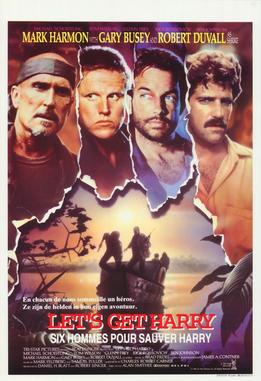
Lets-get-harry-movie-poster-1986-1020362350Let’s Get Harry opens deep in the jungles of Columbia.  The newly appointed American Ambassador (Bruce Gray) is touring a newly constructed water pipeline when suddenly, terrorist drug smugglers attack!  The Ambassador, along with chief engineer Harry Burck (Mark Harmon, long before NCIS), is taken hostage.  Drug Lord Carlos Ochobar announces that both the Ambassador and Harry will be executed unless the U.S. government immediately releases Ochobar’s men.  However, the policy of the U.S. government is to not negotiate with terrorists.  As grizzled mercenary Norman Shrike (Robert Duvall) explains it, nobody gives a damn about a minor ambassador.
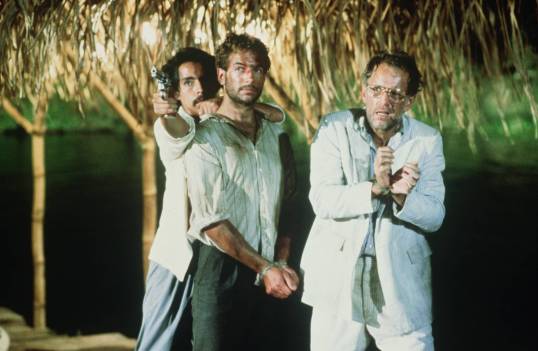
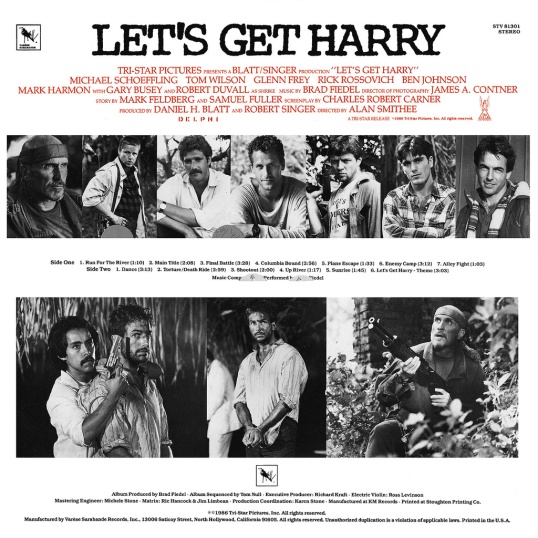
Nobody in a small blue-collar town in Illinois gives a damn about the ambassador either.  But they do give a damn about their friend Harry!  When its obvious that the bureaucrats up in Washington are not going to do anything, Harry’s younger brother, Corey (Michael Shoeffling, Sixteen Candles), decides that he and his friends are going to go to Columbia themselves and get Harry!  Helping him out are Bob (Thomas F. Wilson, Back to the Future), Kurt (Rick Rossovich, Top Gun), Spence (Glenn Frey!), and Jack (Gary Busey).  If Jake Ryan, Biff Tannen, Slider, Buddy Holly, and the guy from the Eagles who wasn’t Don Henley can’t get Harry, then who can!?

There were a lot of these “American rescue mission” movies made in the 80s, everything from Uncommon Valor to The Delta Force to the Rambo films.  Plotwise, Let’s Get Harry adds little to the genre.  It’s about as simplistic and implausible as a Donald Trump campaign speech.  A bunch of terrorists are holding American hostages and making us all look bad while the establishment refuses to do anything about it?  Don’t worry!  Here come a bunch of heavily armed, no-nonsense American citizens to save the day and make America great again!

letsgetharry_640x360

There are two things that distinguish Let’s Get Harry.  First, Let’s Get Harry is one of the many films to have been credited to Alan Smithee.  From 1968 to 2000, Alan Smithee was the official pseudonym used by directors who wanted to disown a project.  Smithee has been credited as directing everything from Solar Crisis to Morgan Stewart’s Coming Home to The O.J. Simpson Story.  In the case of Let’s Get Harry, Smithee was standing in for veteran director Stuart Rosenberg (probably best known for Cool Hand Luke).  Rosenberg originally only planned for Mark Harmon to be seen only at the end of the film, much like Matt Damon in Saving Private Ryan.  When TriStar Pictures demanded extra scenes featuring Harmon being taken and held hostage, Rosenberg took his name off the film.

(Before Rosenberg signed on to direct, Let’s Get Harry started out as a Sam Fuller project and he received a story credit on the film.  With the exception of some of the scenes with Harmon, which may have been shot by a different director, Rosenberg’s direction was adequate but Let’s Get Harry really does cry out for a director like Sam Fuller.)

Secondly, there is the cast, which is a lot more interesting than would be typically found in a low-budget, 80s action film.  Not surprisingly, by respectively underplaying and overplaying, Duvall and Busy give the two best performances.  Meanwhile, lightweight Mark Harmon gives the worst.  Perhaps because of the conflict between Rosenberg and the studio over his character, Harmon spends the entire movie looking lost.

lgh

As an exercise in patriotic wish fulfillment, Let’s Get Harry is pure 80s hokum.  It may be dumb but it is also entertaining.  After all, any film that features not only Robert Duvall, Gary Busey, and Ben Johnson, but also Glenn Frey is going to be worth watching.  Let’s Get Harry has never been released on DVD and is currently only available on VHS.  Somebody needs to do something about this.

Let’s get Harry on DVD!

lgh2

Worst of the Worst: Mad Dog Time (1996, directed by Larry Bishop)


Mad_dog_time_4841Remember how, in the 1990s, every aspiring indie director tried to rip off Quentin Tarantino by making a gangster film that mixed graphic violence with quirky dialogue, dark comedy, and obscure pop cultural references?  That led to a lot of terrible movies but not a single one (not even Amongst Friends) was as terrible as Mad Dog Time.
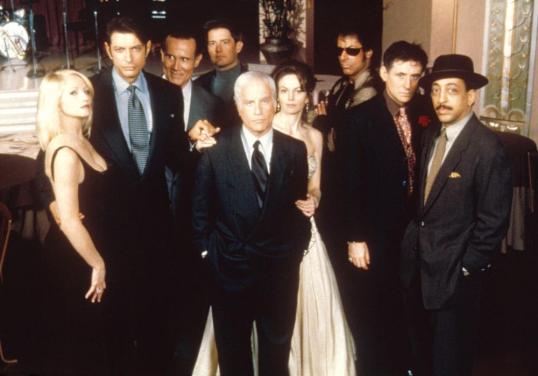
That Mad Dog Time was terrible should come as no surprise.  Most directorial debuts are.  What made Mad Dog Time unique was the sheer amount of talent that was assembled and wasted in the effort to bring this sorry movie to life.  As the son of Joey Bishop, director Larry Bishop was Hollywood royalty and was able to convince several ridiculously overqualified actors to play the thinly drawn gangsters and rouges who populated Mad Dog Time.  Much like the Rat Pack movies that his father once starred in, Larry Bishop’s debut film was full of familiar faces.  Some of them only appeared for a few seconds while others had larger roles but they were all wasted in the end.  Hopefully, everyone was served a good lunch in between filming their scenes because it is hard to see what else anyone could have gotten out of appearing in Mad Dog Time.

Mob boss Vic (Richard Dreyfuss) has just been released from a mental hospital.  With the help of his main enforcer, Mick (Jeff Goldblum), and a legendary hitman named Nick (Larry Bishop, giving not only the worst performance in the film but also the worst performance of the 1990s), Vic is going to reassert his control over the rackets.  Vic also wants to find his former mistress, Grace Everly (Diane Lane) but he doesn’t know that Grace is now with Mick and that Mick is also having an affair with Grace’s sister, Rita (Ellen Barkin).

(Grace and Rita are the Everly Sisters!  Ha ha, between that and all the rhyming names, are you laughing yet?)

Anka and Byrne

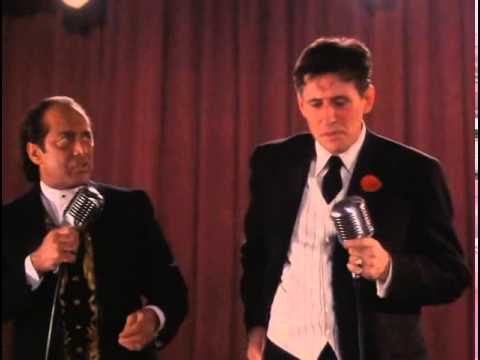
Ben London (Gabriel Byrne) has taken over Vic’s nightclub and, while singing My Way with Paul Anka, tells Vic that he should take an early retirement because he’s a paranoid schizophrenic.  Before he can deal with Ben, Vic has to kill all of his other rivals, all of whom are played by actors like Michael J. Pollard, Billy Idol, Kyle MacLachlan, Gregory Hines, and Burt Reynolds.  The bodies start to pile up but Jimmy the Undertaker (Richard Pryor, looking extremely frail in one of his final roles) is always around to make sure that everyone gets a proper burial.

And there are other cameos as well.  Joey Bishop is the owner of a mortuary.  Henry Silva is wasted as one the few gangsters to stay loyal to Vic.  Christopher Jones, who previously co-starred with Larry Bishop and Richard Pryor in Wild In The Streets before dropping out of a society, plays a hitman who pretends to be Nick Falco.  Even Rob Reiner shows up a limo driver who talks too much.

Almost every poorly paced scene in Mad Dog Time plays out the same way.  Three or more men confront each other in a room.  Hard-boiled dialogue is exchanged for an interminable length of time until someone finally gets shot.  You would think, at the very least, it would be watchable because of all the different people in the cast but none of the actors really seem to be into it.  Richard Dreyfuss and Jeff Goldblum resort to smirking through their scenes while Gabriel Byrne often appears to be drunk.  Whenever he’s in a scene, Burt Reynolds seems to be trying to hide his face and it is hard to blame him.  There were many terrible movies released in the 90s but none were as bad as Mad Dog Time.

Let’s Play Hardcore Henry (2016, directed by Ilya Naishuller)


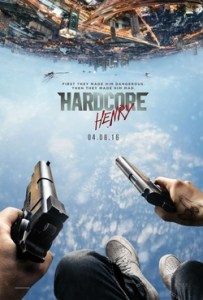
Hardcore_(2015_film)If you ever wondered whether a movie would ever be able to capture the excitement of watching a total stranger silently play an uninspired video game, Hardcore Henry is here to answer your question.

Filmed with a GoPro Hero 3 camera that used a specially-built rig that could be worn as a mask, Hardcore Henry is an action film that, from beginning to end, is told from a first-person perspective.  You are Henry.  When the film starts, you are having a dream where Tim Roth calls you a “pussy.”  When you wake up, a beautiful woman named Estelle (Haley Bennett) says that you are her husband and that you have amnesia because of a horrible accident.  You also lost your left arm and left leg but Estelle replaces your missing limbs with cybernetic ones.  Just before Estelle can give you a new voice, the laboratory is attacked by a telekinetic albino named Akan (Danila Kozlovsky), leaving you as mute at GTA III‘s Claude.  You spend the rest of the movie running through the streets of Moscow, trying to rescue Estelle and getting advice and side missions from Jimmy (Sharlto Copely).  Jimmy was my favorite part of the movie because every time he was killed, he would return in a different version.  Cocaine Jimmy was the best of the Jimmys.

There are a few times when the stunt work is awe-inspiring but too often watching Hardcore Henry felt like watching a Let’s Play video on YouTube, the only difference being that at least the YouTube vid would have featured a joke or two.  The problem is not that Hardcore Henry feels like a video game.  The problem is that doesn’t feel like a good video game.  It feels like a clichéd and uninspired first person shooter, right down to the scenes were Estelle and Jimmy train you on how to use your new abilities and weapons.  (When Henry visits a brothel, it’s as if he figured out how to unlock the hidden rooms in Grand Theft Auto: San Andreas.)  If Hardcore Henry had a plot that was as interesting as the first person gimmick, it would be a great action film.  But, as it is, Hardcore Henry is just an intriguing experiment that does not really work.