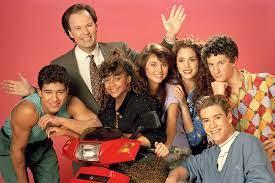
Guilty Pleasure No. 52: Saved By The Bell 3.21 “No Hope With Dope” (dir by Don Barnhart)


Saved By The Bell is the show that will not die.

Saved By The Bell started out in 1989, airing on NBC on Sunday mornings.  The show followed the adventures of Zack Morris, AC Slater, Screech, Jessie Spano, Kelly Kapowski, and Lisa (hey!) Turtle as they navigated their way through Bayside High.  It’s bit of an odd show, in that there was no real continuity and Zack was a designated hero who often came across as being a young sociopath.  Zack and his friends were rich and, with the notable exception of Jessie, apolitical.  The only time they all, as a group, cared about anything was when there was an oil spill near the duck pond that was just because Zack had befriended one of the ducks.  The humor was goofy but the acting was occasionally better than it had any right to be.  (Mario Lopez was the cast MVP.)

Saved By The Bell had a loyal audience when it originally aired but it owes it popularity to syndication.  When I was in high school and college, Saved By The Bell always seemed to be playing somewhere.  I have friends who scheduled their day around, though none of them will admit it now.  As I sit here writing this, Saved By The Bell can currently be viewed on about a dozen different streaming services and there’s currently a very self-aware reboot streaming on Peacock.  Reruns of this show will probably be outlive us all.  There’s no escaping the Bell.

Interestingly enough, for all of the show’s cultural cachet, there are really one three episodes of Saved By The Bell that are really “must-see.”  The first one, of course, was the infamous episode where Jessie got hooked on sugar pills and ended up shouting, “I’m so excited!” when Zack tried to get her to wake up.  The second one was the episode where Zack passed out in his garage and dreamt about the future of his band, Zack Attack.  (“Friends forever.  It’s an nice idea.”)  And finally, there’s the “No Hope With Dope” episode.

First airing in 1991 (on November 30th, to be exact), “No Hope With Dope” feels like a time capsule.  Big-time movie star Johnny Dakota (played by Eddie Garcia) comes to Bayside and, after Zack leads the students in an anti-drug rap song, Johnny decides to shoot his latest anti-drug PSA at the high school.  This not only gives Jessie a chance to once again tell everyone about her sugar pill addiction (which I’m sure everyone at the school was sick of hearing about) but it also gives Zack, Slater, and Screech the excuse to become amateur narcs.  When they discover a joint in a Bayside bathroom, they immediately accuse Scud, who is wearing a Slayer t-shirt and is therefore the number one suspect.  Scud reveals that he only smokes cigarettes because, when it comes to marijuana, “Not even I’m that dumb!”  Slater still destroys Scud’s cigarette because cigarettes can kill too.

However, at a big movie star party, Zack and Kelly are offered a joint by — OH MY GOD! — Johnny Dakota!  Though Johnny doesn’t actually try to force the death weed on the two of them after they initially refuse it, Zack and Kelly are so disgusted by Johnny’s actions that they leave the party.  The Bayside Gang announces that they cannot sanction Johnny’s buffoonery.  (“The reputation of Bayside was at stake!” Jessie says.)  Johnny gets mad and leaves.

Watching this episode today, most viewers will probably say, “BUT IT WAS JUST A JOINT!”  Seriously, it’s not like Johnny was snorting coke in Mr. Belding’s office or shooting heroin in the school’s locker room or anything similar to that.  Johnny was only doing something that, today, is legal in many states and probably will be legal in every state by the time 2030 rolls around.  And yet, everyone at Bayside acts so shocked to discover that someone who is apparently the biggest film star in the world occasionally smokes weed.  The way that Zack and the gang react to marijuana in 1991 in comparison to how most people react to it in 2022 is one of the things that makes this episode such a guilty pleasure.  It’s a time capsule with a laugh track.

(Of course, one reason why “No Hope With Dope” became such a popular episode is that much of the show’s later audience was probably high when they first saw it.)

Anyway, Johnny’s gone and Bayside is still eager to make an anti-drug PSA.  Fortunately, Mr. Belding has a friend at NBC!  It turns out that the then-president of the network went to school with Mr. Belding!  He agrees to come to Bayside and share with everyone his hit new idea for the fall season: Don’t.  Do. Drugs.  He also does the old, “Maybe I could produce a TV show about a bunch of rich high school kids …. nah, it would never work!” joke.  “Come back and visit any time,” Jessie tells him.  Yeah, Jessie, I’m sure that’ll happen….

The show ends with the Bayside “No Hope With Dope” PSA and these few minutes are what transforms this episode into a true cultural landmark.  Watch it below and be sure to note that, when Screech pops out of the locker, there’s a picture of John Lennon smoking a joint on the door.

Previous Guilty Pleasures

  1. Half-Baked
  2. Save The Last Dance
  3. Every Rose Has Its Thorns
  4. The Jeremy Kyle Show
  5. Invasion USA
  6. The Golden Child
  7. Final Destination 2
  8. Paparazzi
  9. The Principal
  10. The Substitute
  11. Terror In The Family
  12. Pandorum
  13. Lambada
  14. Fear
  15. Cocktail
  16. Keep Off The Grass
  17. Girls, Girls, Girls
  18. Class
  19. Tart
  20. King Kong vs. Godzilla
  21. Hawk the Slayer
  22. Battle Beyond the Stars
  23. Meridian
  24. Walk of Shame
  25. From Justin To Kelly
  26. Project Greenlight
  27. Sex Decoy: Love Stings
  28. Swimfan
  29. On the Line
  30. Wolfen
  31. Hail Caesar!
  32. It’s So Cold In The D
  33. In the Mix
  34. Healed By Grace
  35. Valley of the Dolls
  36. The Legend of Billie Jean
  37. Death Wish
  38. Shipping Wars
  39. Ghost Whisperer
  40. Parking Wars
  41. The Dead Are After Me
  42. Harper’s Island
  43. The Resurrection of Gavin Stone
  44. Paranormal State
  45. Utopia
  46. Bar Rescue
  47. The Powers of Matthew Star
  48. Spiker
  49. Heavenly Bodies
  50. Maid in Manhattan
  51. Rage and Honor

Film Review: Lost Horizon (dir by Charles Jarrott)


“Friends forever.  It’s a nice idea.”

With those words, the late Casey Kasem closed out the infamous “Rockumentary” episode of Saved By The Bell.  In this episode, Zack Morris fell asleep in his garage while waiting for his high school friends to arrive for band rehearsal.  While he was asleep, he dreamt about becoming a superstar as the result of Zack Attack’s hit song, Friends Forever.  Later, of course, Zack was led astray by a publicist who tried to sell him as being a “male Madonna.”  Zack didn’t care about the fame.  He was more concerned that the music and the lights at his concert were so excessive that the audience couldn’t even hear his lyrics.  Because, seriously, when you’re coming up with banger lyrics like “We’ll be friends forever/yes we will,” you want to make sure that they can clearly be heard.

It’s easy to make fun of the band and the show but that doesn’t make Casey Kasem’s words any less true.  Friends forever.  It is a nice idea.  It’s also a totally unrealistic and implausible idea.  People grow apart.  People develop new interests.  People move to different towns.  Sometimes, people just decided that they need to take a little break from the same old thing.  Instead of demanding that people remain friends forever, it would perhaps be more realistic to encourage people to enjoy and treasure the time that they have in the present.  But, to be honest, entertainment is not about that type of reality.  No one wants to hear, “Be friends until you get bored.”  Instead, they want to hear “Friends forever!”  It’s a simple idea and the simple ideas are the ones that usually bring us the most comfort.

Take the idea behind Shangri-La, for instance.  Shangri-La was a utopia that was hidden away in the Himalayas.  It was a place where there was no war, no greed, and everyone was in nearly perfect health.  It was a place where it was common for people to live to be well over a hundred years old.  It’s a place where people literally can be friends forever.  And while the place does have one very big drawback — i.e., once you decide to stay there, you can’t return to the outside world for even so much as a brief visit — it’s still easy to see why this idealized existence would appeal to many people.

The lamasery of Shangri-La was first introduced in a 1933 novel called Lost Horizon.  Written by James Hilton, Lost Horizon told the story of a group of westerners who, fleeing from a political uprising in India, find themselves in Shangri-La.  That the novel’s portrayal of a peaceful utopia hidden away from the “modern world” proved to be popular should not come as a surprise.  In 1933, the world was still recovering from the Great War.  Much of Europe was still in ruins, both economically and physically.  The combination of the First World War and the Spanish Flu pandemic had shaken everyone’s faith in the future.  Even as a group of idealistic activists, industrialists, and politicians tried to make war illegal, Mussolini seized power in Italy.  Spain was on the verge of civil war.  In Germany, a fanatical anti-Semite named Adolf Hitler had managed to move from being a fringe politician to being named chancellor.  The U.S. was suffering from the Great Depression.  Even the UK was so mired in political turmoil that it was no longer a reliable bulwark against chaos.  To the readers who were having to deal with all of that on a daily basis, the idea of Shangri-La was an inviting one.

(One of those readers was Franklin D. Roosevelt, who named his presidential retreat Shangri-La.  Years later, Dwight Eisenhower would rename Shangri-La after his son and it’s remained Camp David ever since.)

Not surprisingly, the book’s success led to it being adapted for the movies.  Frank Capra took the first crack at it, release his film version in 1937.  At the time, Capra’s adaptation was the most expensive film to have ever come out of Hollywood.  (It cost $1.6 million dollars!)  It also underperformed at the box office, nearly bankrupting Colombia Pictures.  Even though the film itself was nominated for Best Picture of the year, it still took five years for the film to earn back its cost.  Because Colombia edited the film to shorten its lengthy running time, Capra sued the studio and the end result was that everyone involved lost a good deal of money.  Considering all of the bad luck that befell the first production, one might wonder why Hollywood would even risk making a second version of the film.  And indeed, it would be several decades before any major studio attempted to bring Hilton’s novel back to the screen, despite the fact that the idea behind Shangri-La was probably looking more attractive with each crisis-filled day.

Ross Hunter

In 1973, producer Ross Hunter was sleeping on a mountain of cash.  Well, perhaps he wasn’t but a look at some of the films that he had produced would definitely suggest that he could have if he had so chosen.  Hunter started his career producing melodramas that starred Rock Hudson and were often directed by Douglas Sirk.  He was the type of producer who understood that importance of glitz and glamour, especially with the film industry facing a new competitor named television.  In the 60s, he made films that were totally out-of-touch with the turmoil of the decade but which still appealed to middle-aged viewers who wanted an escape from the hippies and the assassins.  In 1970, he scored his biggest hit of all time when he produced Airport.  As dull as that film seems to us today, it was the biggest hit of 1970 and it also gave birth to the disaster genre.  (It was also the only Ross Hunter production to be nominated for Best Picture.)

It was after the success of Airport that Ross Hunter decided to produce a remake of Lost Horizon.  Following the approach that he used in Airport he gathered an all-star cast.  In fact, George Kennedy appeared in both Airport and Lost Horizon!  Joining Kennedy were Oscar nominees Sally Kellerman, John Gielgud, Charles Boyer, Peter Finch, and Liv Ullmann.  Michael York, fresh off of Cabaret, and Olivia Hussey, who was best-known for playing Juliet in the wildly successful 1968 version of Romeo and Juliet, were cast as rebellious lovers who tried to escape the paradise of Shangri-La.  Larry Kramer, the future playwright and political activist, was hired to write the script.  Charles Jarrott, who specialized in big, glossy films and who had been nominated for Best Director for his work on Anne of a Thousand Days, was brought in to direct.  And Burt Bacharach was enlisted to write the song because, on top of being a literary adaptation with an all-star cast, Lost Horizon was also going to be a musical.

What could go wrong?

What indeed.

The 1973 version of Lost Horizon opens with an endless aerial view of the Himalayas.  In the background, singers sing about peace and love.  “There’s a lost horizon/waiting to be found/where the sound of guns/don’t pound in your ears/anymore,” the singers repeat several times, as if to hammer home the fact that the audience is not about to get Burt Bacharach at his best.

When the opening credits finally end, we find ourselves at an airport.  A very non-musical protest has broken out.  The characters in the film describe it as a revolution but instead, it just looks like a bunch of confused extras standing on a landing strip.  When it comes to an epic film like this, it’s always a good idea to see what the extras are doing.  In a good film, the extras will actually be a part of the world onscreen and you won’t even think of them as being a crowd of paid performers.  In a bad film, like this one, they’ll all stand around in a perfectly organized group and they’ll all do the exact the same thing at the same time, like shaking their fists at a plane.

Despite all of the “drama” at the airport, one airplane does manage to take off.  On the plane are the Conways, diplomat Richard (Peter Finch) and his younger brother, George (Michael York, whose blond prettiness suggests that there’s not a chance he could share any DNA with the much more rough-hewn Peter Finch).  There’s also a Newsweek photographer named Sally Hughes (Sally Kellerman), who pops pills and who suffers from a pronounced case of ennui.  She describes her job as “taking pictures of the headless so that people with heads can look at them in magazines while getting their hair done.”  (Damn, Newsweek apparently used to be  really messed up publication!)  Sam Cornelius (George Kennedy) is an engineer and an embezzler.  And finally, there’s Harry Lovett (Bobby Van), who introduces himself to everyone as being “Harry Lovett, the comedian.”  Harry was playing an USO show when the revolution broke out and apparently, he was abandoned in the country because his act was so bad.  Is the film suggesting that, in 1973, the United States would actually abandon a citizen in a dangerous, war-torn country?  I hope someone impeaches that President Nixon!

Our heroes may think that they’re escaping to freedom but it turns out that the plane is actually being hijacked!  One thing leads to another and eventually, as happens in all good musicals, the plane cashes in a remote area of the Himalayas.  At first, it seems like our heroes are done for but, fortunately, they’re discovered by Chang (the very British John Gielgud) and a group of Shangri-La monks.  Chang leads the party through the snowy mountains and eventually, they arrive at what appears to be a Disney resort but what we’re told is actually Shangri-La, a tropical paradise that sits in the middle of one of the most dangerous places on Earth!

Shangri-La has something for everyone:

Sally gets off drugs and discovers a library that, oddly enough, has every book ever written even though no one knows where Shangri-La is, none of the inhabitants can leave the area without running the risk of rapidly again, and Amazon wasn’t a thing in 1973.

Sam discovers a gold mine but, realizing that money doesn’t matter, he instead uses his engineering skills to help out the farmers of Shangri-La.  It really didn’t appear that the farmers of Shangri-La needed any help but whatever, I guess.  As long as Sam is happy.

Harry Lovett becomes a big star as the children of Shangri-La love his comedy.  Children are well-known for their lack of taste when it comes to comedy.

Richard not only falls in love with the local teacher (Ingmar Bergman’s muse, Liv Ullman) but he also meets the High Lama (the very French Charles Boyer).  It turns out that the High Lama is finally going to die and that he’s determined that Richard is the man who is destined to take over Shangri-Law, despite the fact that Richard has only recently arrived and isn’t even a Buddhist.

In fact, almost everyone is so happy that they start to sing and dance!  It takes 50 minutes for the film to reach its first big musical number.  Unfortunately, there’s a reason why most successful film musicals open with a big number instead of holding off on it.  It’s important to, early on, get the audience used to the idea that they’re watching a film set in a world where it’s perfectly common for people to break out into song.  From West Side Story to La La Land, good musicals have understood the importance of bringing the audience in early.  Lost Horizon waits until everyone has gotten used to the film being a somewhat rudimentary adventure/disaster film before suddenly springing the singing and the dancing on everyone.  It’s a bit jarring.  It wouldn’t matter, of course, if the songs were any good but again, this was not Burt Bacharach’s finest moment.

Unfortunately, one member of the group doesn’t want to stay in Shangri-La and dance and sing.  George Conway does not want to be friends forever.  Instead, he’s fallen in love with the local librarian, Maria (Olivia Hussey).  Maria dreams of seeing New York and London.  George is determined to grant her wish, despite being told that Maria is nearly as old as John Gielgud and will start to age as soon as she leaves Shangri-La.  Richard feels an obligation to accompany his brother.  Needless to say, things don’t go well.  (As Michael York would later put it himself, “There is noooo sanctuary….”)  Will Richard be able to find his way back to Shangri-La?

“Let’s not go to Camelot, ’tis a silly place,” King Arthur famously declared in Monty Python and the Holy Grail.  Lost Horizon suffers the opposite problem.  While Lost Horizon’s Shangri-La is occasionally a silly place, it’s usually just an incredibly boring place.  One can’t help but feel that Maria has a point, regardless how much time Sally spends singing about her hatred of the New York night life.  The film’s downfall is that it argues for Shangri-La being viewed an ideal without making Shangri-La into any place that you would want to visit.  Add in the anemic songs and the confused performances and Charles Jarrot’s inability to maintain any sort of compelling pace and you have a film that’s too dull to really even qualify as a fun bad film.  It’s just bad.

That said, much like friends forever, Shangri-La is a nice idea.

Happy 2022 From All The Writers (and the Cat) at the Shattered Lens!


It’s a new year.  Meh!

(Meh, by the way, is the way that cats say, “Yay!”)

You did it!

You survived 2021!

Though my expression may remains neutral and unimpressed, please know that I am very proud of you.

2021 was a year when humans everywhere proved that they should just be quiet and let cats run the planet.  Well, 2021 is over now.  It’s 2022 and hopefully, everyone will try to do better over the upcoming 12 months….

Of course, they probably won’t.  I mean, they never do.  I’ve been telling humans to do better for close to 13 years now and it still doesn’t seem to make any difference.  People don’t listen to the cats and that is their loss.  This is going to be a crazy year, because the humans in America are having an election in November and it seems like 60% of them have already climbed up to the top of the tree and decided to try to jump back down to the patio without even bothering to estimate the distance of their fall!  Cats know better, whereas humans always end up with broken bones and sprained ankles.  Not only do the humans have elections to worry about that, but there’s also the risk of runaway inflation, social media drama, bad weather, and the danger of vampire wombats.  Seriously, if you haven’t started to prepare for the vampire wombats, I don’t know what to tell you.  You better get started!

So you know what?

When the outside world gets too insane or annoying or whatever, we want to provide a place for you to escape.  This year, the TSL is 12 years old and the Shattered Lens humans have got a lot planned!  They’re going to make 2022 a great, great year, even with the danger of the vampire wombats.

So, remember — when things get crazy and when everything just seems to be too weird to deal with, TSL is here for you!

Here’s what we have to look forward to in 2022: the Oscars!  New films from some of your favorite human directors!  Even more debate about the the MCU!  Arleigh and Lisa will undoubtedly disagree about Avatar 2!  A thousand streaming services!  More Baby Yoda memes!  Pam and Tommy!  Cyrano!  Cannes!  Sundance!  Theme months!  Vampire wombats!  Embracing the Melodrama!  Back to School!  Shattered Politics!  18 Days of Paranoia!

Welcome to 2022!  Let’s make it great one and, when in doubt, look to the cats for wisdom!  If cats ran the country, there were be no war.  There would be no vampire wombats.  In fact, there would be no government.  In fact, it would probably work better as a sitcom than a reality.  Cats already run the world. You can have your government and your wombats and all the rest.  Just leave the music and the movies and all of the streaming services for the cats. It’s not too much to ask.

Anyway, here’s hoping that all of you have a great 2022!  As the cat likes to say, “Meh.”

8 Shots From 8 Films You Should Watch In 2022


4 Or More Shots From 4 Or More Films is just what it says it is, 4 shots from 4 of our favorite films. As opposed to the reviews and recaps that we usually post, 4 Shots From 4 Films lets the visuals do the talking!

Today is the start of a new year and it’s also a day to start thinking about which film you’re going to discover over the course of the next 12 months!  Below are my suggestions for 8 films that, if you haven’t already watched them, you should definitely make time to watch before 2023 rolls around!

8 Shots From 8 Film For 2022

It (1927, dir by Clarence Badger, DP: H. Kinley Martin)

The Rules of Game (1939, dir by Jean Renoir, DP: Jean Bachelet)

Portrait of Jennie (1948, dir by William Dieterle, DP; Joseph H. August)

Chappaqua (1966, dir by Conrad Rooks, DP: Etienne Becker, Robert Frank, and Eugene Schufftan)

An American Hippie in Israel (1972, dir by Amos Sefer, DP: Ya’ackov Kallach)

Strange Behavior (1981, dir by Micahel Laughlin, DP: Louis Horvath)

The Two Orphan Vampires (1997, dir by Jean Rollin, DP: Norbert Marfaing-Sintes)

A Field in England (2013, dir by Ben Wheatley, DP: Laurie Rose)

6 Classic Trailers For January 1st, 2022


Well, it’s the first day of a new year and that means that it’ time for me to bring back a feature that was once quite popular on this site, Lisa Marie’s Favorite Grindhouse and Exploitation Film Trailers.  This is where I just share six trailers, sometimes all dealing with the same thing and sometimes not.  Unfortunately, because there’s only so many trailers available on YouTube, you’ll probably see a few trailers listed more than once.  It can’t be helped but no matter!  Trailers are fun and hopefully, watching a few of them will be an enjoyable way for you to start your day or your week or whatever.  I certainly enjoy them!

Since it’s the start of a new year and I already shared a music video for The Hustle, I figured I would continue that disco theme now.  Below are 6 trailers that will hopefully leave you dancing!

  1. Thank God It’s Friday (1978)

Considering that this film won an Oscar and was released by a major studio and featured both Jeff Goldblum and future Oscar nominee Debra Winger in the cast, it may seem odd to include this trailer in a feature about exploitation film previews.  But seriously, just watch the movie!  Yes, Last Dance is great but otherwise, this movie is pure drive-in gold.

2. Skatetown USA (1979)

“The greatest story ever rolled!”  Check out Patrick Swayze, playing a bad guy.  Swayze made his film debut here and, when he became a star, he actually tired to buy the rights to the film to keep anyone from ever seeing it again.  Honestly, though, it’s not that bad.  The music’s good.  Some of the routines are fun.  Swayze smolders with intensity.  Put on your skates and dance!

3. Roller Boogie (1979)

At the same time that Patrick Swayze was dominating Skatetown USA, Linda Blair was teaching a nation how to roll, dance, and love.

4. Disco Godfather (1979)

Of course, the disco wasn’t always a safe place.  Even in the 70s, it was a dangerous world out there.  Fortunately, Rudy Ray Moore was around to keep the peace and prevent the dancers from getting hooked on PCP.  “Put your weight on it, put your weight on it, put your weight on it!”

5. Can’t Stop The Music (1980)

You can’t stop the music …. no matter how much you try!  This was an attempt at a Village People movie.  It apparently didn’t really go very well.  I’ve never actually seen the film, though I suppose I’ll have to watch it someday.

6. Xanadu (1980)

Heh …. on YouTube, this is listed as being “A Gene Kelly movie.”  Yeah, Gene Kelly is one of the stars but I still don’t know if I’d necessarily call this “A Gene Kelly movie,” in the same way that I might use the label for Singin’ In The Rain or An American In ParisXanadu was one of the last of the big disco movies and it’ll live forever, though perhaps not in the way that it was originally intended to.

6 Things That I Am Looking Forward To In January


Ah, January.

Traditionally, as far as pop culture goes, January doesn’t get much respect.  If a studio has a film that they knew isn’t going to be a hit with critics or audiences, January is where they usually dump it.  The same can often be said of publishers.  Everyone is so busy getting caught up on what they missed during the last few months of the previous year, chances are that they won’t notice a few bombs dropped on the cultural landscape.  That’s the theory anyways.

But, you know me!  I’m an optimist.  And I remain convinced that, even in January, there are things to which we can look forward,  And here’s six of those things!

(Why six?  Because Lisa doesn’t do odd numbers.)

  1. Morbius

Morbius stars Jared Leto as a “living vampire” and it’s scheduled to be released at the end of January.  This seems like one of those comic book adaptations that could be fun in a goofy sort of way.  The whole question is whether or not Jared Leto will take himself too seriously in the title role.  I’m hoping that he will.

2. Scream

Is it Scream or is it Scream 5?  On the one hand, this film is being promoted as a “reboot” of the series but, at the same time, it’s also being described as a direct sequel to Scream 4, with Courtney Cox, David Arquette, and Neve Campbell all returning.  Personally, I’m expecting to be disappointed but I’m still interested in seeing for myself.  Scream opens on January 14th.

3. Sundance Film Festival 2022

Sudance!  Hey, who doesn’t love Sundance?  Over the past few years, it seems as if at least one Sundance hit always emerges as an Oscar contender.  Minari was a hit at Sundance, for instance.  Brooklyn was first discovered at Sundance.  It’s always tempting to kind of make fun of Sundance because it really is indie filmmaking at its most Hollywoodish but it’s still the first important event of the year in cinema.  This year, Sundance will run from January 20th to January 30th.

4. Sinclair Lewis Is In The Public Domain

As of today, the work of Sinclair Lewis is now in the public domain!  So, I’ll be looking forward to new cinematic versions of Babbitt, Main Street, Arrowsmith, and It Can’t Happen Here!  Get on it, Asylum!

5. Awards Season Continues

Yay!  We’re now about to enter the actual important part of Awards Season.  The Guilds will be announcing their picks for the best of 2021.  As far as precursors go, the Guilds are far more useful than the critics groups.  Of course, sometimes the guilds mislead us.  Remember when everyone thought Deadpool was going to get a best picture nomination?  Thanks a lot, Producers Guild!

6. Grammy Awards

Actually, I don’t care about the Grammy Awards but I needed something to list in the sixth slot.  What can I say?  It’s January!  Anyway, I know that some people are looking forward to the Grammy Awards and there will undoubtedly be some sort of silly twitter controversy about the ceremony so I guess we can all get behind that.  The Grammy Awards are scheduled to be handed out on January 31st.

What are you looking forward to in January?  Anything? Nothing?  Let us know.

Artwork of the Day: Just A Picture Of A Park In The Rain


by Erin Nicole

Happy New Year!

I know that this is a simple picture, especially considering that it’s the first artwork of the day of 2022.  I took it at the Shops at Legacy in Plano, Texas on one rainy afternoon.  I got soaked taking the picture but I think it was worth it.  It’s a picture that anyone could have taken but it’s also a picture that fill me with hope and peace, which is what we should all start the new year with.  Looking at this picture reminds me that there will always be storms but they will be temporary.  And sometimes, the rain can be beautiful.

Music Video of the Day: The Hustle by Van McCoy (dir by ????)


“Do the Hustle!”

And may all the scolds go to Hell!

Well, it’s a new year and what better way to ring it in than by dancing and celebrating the Hustle?  Van McCoy’s The Hustle is a song that’s been heard by anyone who has ever watched a movie about the disco era.  It’s pretty much appeared on almost every soundtrack ever compiled.  If it’s a disco film, you’re going to hear The Hustle.  It’s a song that just makes you think about dancing, disco balls, and cocaine.  Lots and lots of a cocaine.  From what I understand, copies of this song were originally sold with their own souvenir coke spoons.  That may or may not be true but you get the idea.

Interestingly enough, the dance came before the song.  Van McCoy was at Adam’s Apple, a New York City nightclub, in 1975 when he saw that the patrons were dancing a new dance that they called The Hustle.  He was so taken with the dance that he wrote a song about it.  He had three lyrics and a beat you could dance to and that was all he needed to create the soundtrack of the late 70s.  The Hustle was a hit and it came to define an era.  Sadly, it was an era that McCoy himself would not survive.  He died of a heart attack in 1979, while in New Jersey.  He was only 39 years old.

The video below was released in 2010 and, as you can tell, it was made up by clips of McCoy performing the song on various shows.  You can debate whether this is a legitimate music video or just a compilation.  That’s fine, though.  We’re all about debate here at the Shattered Lens!  Ultimately, what is truly important is that it’s a good song and it’s a new year!  It’s 2022!  Get out there and dance!  Get out there and do the hustle!  And you know what!?  Don’t be afraid to use exclamation points!  You’ve earned them and you’ve earned the right to use them as much as you want!

Personally, I think the attitudes of the 1920 and the 1970s are about to make a comeback.  (Actually, the comeback has already started but only a few people are willing to acknowledge it.  That will change soon.)  After the past few years, people want to have a good time.  They want to dance.  They want to move to wherever the music takes them.  The past few years have been dominated by people demanding that everyone else be as miserable as they are.  You may not know it from reading twitter.  You may not know it from watching the news.  But most people want to enjoy themselves.  Most people want to pursue their own pleasures and their own happiness in their own way.  The 2020s are going to have a lot more in common with the 1920s and the 1970s than there are with the 1960s and the 2010s.  Old Joe and Young Greta and the moralistic social media scolds can wag their fingers all they want.  People are ready to do the hustle.

Enjoy!

Scene That I Love: A New Year In Cuba From The Godfather, Part II


Happy New Year!

Well, the clock has now struck midnight on the West Coast and that officially means that it is 2022 in the United States!  It’s a new year, which means that we have another chance to get things right or, at the very least, not repeat the mistakes of the previous year.

I’m looking forward to 2022 for a number of reasons.  We’ve got a lot planned here at Through the Shattered Lens.  So, what better way to start things off than by sharing a scene that I love from one of the greatest and most important films of all time, 1974’s The Godfather Part II?

The scene below takes place on New Year’s Eve.  The scene starts in 1958 and it ends in 1959.  Michael Corleone (Al Pacino) and his brother Fredo (John Cazale) are in Havana at the invitation of Hyman Roth (Lee Strasberg).  Roth know that Cuba could be a gold mine for the American mob but Michael, from the start, realizes that the country’s corrupt government is on the verge of collapse.  Tragically, it’s also in Havana that Michael realizes that Fredo betrayed him to his enemies.

On December 31st, 1958, as the corrupt and wealthy celebrate a new year in Havana, the communist rebels ride into the city.  While the President of Cuba prepares to announce that he will be fleeing the country, Michael confronts his brother and tells him that he knows the truth.  Later, as they both attempt to flee the country, Michael and Fredo see each other on the streets.  Fredo runs from Michael, refusing his offer to help.  Though Fredo would eventually return to the family, the film’s ending revealed Fredo’s first instinct was the correct one.

Much of the scene below is based on fact.  The Cuban government did fall on New Year’s Eve and Fidel Castro and his rebels did triumphantly ride into Havana on January 1st.  Before Castro came to power, the Mafia did have a major stake in Cuba and reportedly quite a few mobsters were in Havana when Castro took over.  Meyer Lansky (on whom the film’s Hyman Roth was based) was one of the many mob officials who were rumored to have caught the last flight off of the island.  Seeking to be the only mob boss in his country, Castro did force the Mafia out of Cuba, which led to an alliance between organized crime and the CIA to try to overthrow Castro.  At the time that The Godfather Part II was released, the details of the CIA and the Mafia’s attempts to assassinate Castro were just starting to be revealed to the public.  As powerful as the scene below is today, it probably resonated even more with audiences in 1974.  In 1974, this was all still recent history and it undoubtedly brought to mind the still-fresh national trauma of the assassination of the Kennedy brothers.

Beyond the historical significance of the scene below, it also features brilliant work from two actors who will forever be linked together, Al Pacino and the late John Cazale.  Cazale and Pacino first met while they were both working off-Broadway, years before Mario Puzo even started writing the novel that would become The Godfather.  They were close friends and, along with co-starring in The Godfather films, they also played bank-robbing partners in Dog Day Afternoon.  Tragically, John Cazale died of cancer at the age of 42.  He only appeared in five films, every one of which was nominated for Best Picture and one could argue that the Academy’s failure to nominate Cazale for either Dog Day Afternoon or Godfather Part II is one of the most unforgivable oversights in Oscar history.

That said, it’s a new year.  Save the arguing for later.  Here’s a scene that I love: