
by Erin Nicole
“Hell is empty and all the devils are here.”
The Tempest (William Shakespeare)
by Erin Nicole
“Hell is empty and all the devils are here.”
Weird movie, this one.
The 1989 film, Wicked Stepmother, was Bette Davis’s final film. She was cast as Miranda, an enigmatic woman who meets and marries a man named Sam (Lionel Stander). Sam’s daughter, Jenny (Colleen Camp) and her husband, Steve (David Rasche), are stunned to come home from a vacation just to discover Miranda living in their house. Miranda chain-smokes, despite Jenny and Steve asking her not to. Miranda cooks and eats meat, despite Jenny being a vegetarian. Miranda brags about her sex life which freaks Jenny out even though I suppose really old people do occasionally have sex. When it becomes apparent that Miranda is a witch who seduces and shrinks her victims, Jenny decides that something must be done.
Wicked Stepmother was not only Bette Davis’s last starring role but it was also the last production that she ever walked out on. Early on in filming, she announced that she didn’t like the script, she didn’t like the way she was being filmed, and that she didn’t like the director, venerable B-move maestro Larry Cohen. For his part, Cohen said that Davis left the movie because she was in bad health but she didn’t want to announce that to the world. In Cohen’s defense, Davis does appear to be rather frail in the movie and often seems to be having trouble speaking. (Davis has a stroke a few years before appearing in Wicked Stepmother.) Davis died just a few months after Wicker Stepmother was released so I tend to assume that Cohen was correct when he said that the main reason Davis left the film was because of her health. That doesn’t mean the script wasn’t bad, of course. But, in the latter part of her career, Davis appeared in a lot of badly written movies. She did Burnt Offerings, afterall.
Regardless of why she left, Davis’s absence did require that Wicked Stepmother work around her character. But how do you do that when Bette Davis was literally the title character? This film’s solution was to bring in Barbara Carrerra as Priscilla, Miranda’s daughter. It turns out that Miranda and Priscilla both inhabit the body of a cat but only one of them can use the body at a time. So, when Priscilla is in the cat, Miranda is among the humans. When Miranda is in the cat, Priscilla is …. well, you get the idea. In the film, Priscilla leaves the body of the cat and then refuses to reeneter it because “I’m having too much fun.” So, whenever we see the cat glaring in the background, we’re meant to assume that we’re actually seeing Miranda in the background.
Got it?
Now, believe it or not, the whole thing with the cat is probably the least confusing thing about Wicked Stepmother. Jenny can’t convince Steve that Miranda and Priscilla are actually witches. Steve actually has sex with Pricilla and is shocked when Priscilla starts to turn into a cat but the whole incident is never mentioned again and Steve quickly goes from being an adulterous jerk to a loyal husband. Sam goes on a game show and, with Priscilla’s help, wins a lot of money even though the questions that he answered were so simple that he shouldn’t have needed the help of a witch’s spell. (“Who won the election of 1876?” is one question. The correct answer, by the way, is Rutherford B. Hayes. Screw you, Samuel Tilden.) Jenny gets some help from a cop, a private detective, and a priestess of some sort. The whole thing ends with a big magical battle that involves Barbara Carrera mouthing pre-recorded Bette Davis dialogue.
None of it makes any sense. The special effects are incredibly cut-rate. It’s hard not to regret that Bette Davis didn’t go out on a better film. And yet, when taken on its own terms, Wicked Stepmother itself is oddly likable. Colleen Camp is sympathetic as Jenny, which is saying something when you consider that Jenny is written to be a humorless vegetarian. Lionel Stander appears to be having fun as Sam. Larry Cohen was a good-enough director that, even though he couldn’t save the film from its own bad script and miniscule budget, the movie itself is never boring. It’s cheap and stupid but its watchable in the same way that Michael Scott’s Threat Level Midnight was watchable. It may not be particularly good but you just can’t look away.


by Erin Nicole
I was in Arkansas, looking for a certain grave, when I discovered that I was not alone. The deer stayed long enough for me to get a picture and then ran along. This picture is a reminder that there is beauty even among sadness.
What’s an Insomnia File? You know how some times you just can’t get any sleep and, at about three in the morning, you’ll find yourself watching whatever you can find on cable or Netflix? This feature is all about those insomnia-inspired discoveries!
Oh Lord.
So, if you were having trouble getting too sleep last night, you could have turned over to one of the many Showtime channels you could have watched the 2006 film, Ira & Abby.
I doubt it would have helped though. Ira & Abby is one of those extremely cutesy little love stories where a neurotic guy meets a quirky woman and they spend the entire film having so many easily solved relationship problems that it’ll drive your anxiety through the roof just watching them.
Ira (Chris Messina) is the son of two psychologists (Judith Light and Robert Klein). Ira is planning on becoming a psychologist himself and, of course, he’s in therapy. At the start of the film, his therapist tells him that he’s beyond help and that he needs to do something spontaneous for once. Ira takes this to mean that he should go the gym.
At the gym, Ira meets Abby (Jennifer Westfeldt), who is quirky and universally beloved by everyone who meets her. (Westfeldt also wrote the script, which …. might explain a little.) Abby has a positive attitude and lives with her musician parents (Fred Willard and Frances Conroy). After Ira sees Abby somehow talk a mugger out of robbing everyone on a subway car, he decides that they have to get married. Free-spirited Abby agrees.
Marriage follows! Complications follow! Annulment and remarriage and more follows! Everyone ends up seeing a different therapist while, at the same time, Ira’s mom has an affair with Abby’s dad. And yes, it eventually does end with every character in the film gathering in one room and taking part in a giant therapy session. It’s exhausting to watch, largely because it just seems like all of the problems could be solved by people not being stupid or foolishly impulsive. Ira is neurotic to the point of no longer being sympathetic. Abby is so perfect and wonderful that you soon get sick of her and her positive attitude. Even Ted Lasso would tell her to turn it down a notch.
The most frustrating thing about the movie is that it features good actors like Chis Messina but it goes out of its way to sabotage them every chance that it gets. Out of the large and impressive cast, only Fred Willard and Judith Light manage to transcend the script. I would have loved to have watched a movie just about their characters.

Previous Insomnia Files:
On August 1st, 1981, MTV premiered. Over the course of 24 hours, 116 unique music videos were played on MTV. Yes, there was a time when the M actually did stand for music.
The 95th video to premiere on MTV was the video for Turn It On Again, by Genesis. Though the video wad largely performance clips, the song’s lyrics, dealing as they did with a man who was addicted to watching TV, predicted the future of MTV.
Enjoy!
The First Videos Shown on MTV:

Tonight, for our horror on the lens, we have the twentieth episode of the 2nd season of Friday the 13th: The Series!
In tonight’s episode, an obsessive weirdo named Howard (well-played by Martin Neufeld) uses a curse antique to try to get close to a rock star named Angelica (played by real-life rock star, Vanity).
This episode originally aired on May 1st, 1989. Happy May Day, I guess.
It looks le more fighting and feuding and shooting and driving in the country.
How many of these movies does Neal McDonough make in a year?
Here’s the trailer for Red Stone:
Are you scared of clowns?
I’ve never really had much of a problem with clowns, beyond the fact that some of them really do need to learn how apply lipstick without getting it all over their face. That said, two years ago, I watched the 2016 horror film, Terrifier, on Netflix and I now totally understand why some of my friends are totally terrified of the grinning men in the white makeup. I mean, I will send a Pennywise GIF to my clownphobic friends without even worrying about what damage I may or may not be doing to their mental well-being but I can guarantee you right now that I will never send any of them a picture of Art the Clown.
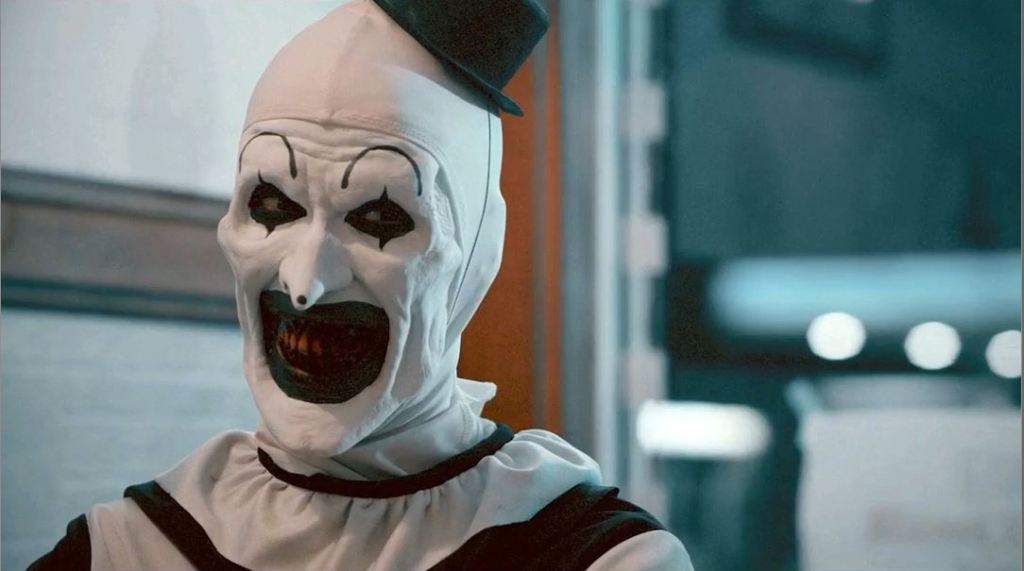
Art (who is played by David Howard Thornton) is the clown at the center of Terrifier and, as you can tell from looking at the picture above, he’s not exactly a clown that you want to meet in the middle of the night. Unfortunately, over the course of the film, several innocent people do just that. There’s the homeless woman who meets him in an abandoned building. There’s the two drunk girls who, after leaving a Halloween party, make the mistake of laughing at Art. There’s the owner of the pizzeria who makes the mistake of kicking Art out of his establishment. Art, it turns out, doesn’t deal well with rejection. It also turns out that Art can turn just about anything into a deadly weapon. (We also later learn that Art just happens to have a chainsaw. Agck!)
Art doesn’t speak. We never learn where Art came from and why he insists on killing everyone that he meets. This lack of motivation makes Art a very scary clown indeed. We can only assume that he kills because he’s evil and, being a creature of pure evil, there’s really no way to reason with him or to rationalize his actions. Art is pure chaos released into the world and, as a result, he’s terrifying. If nothing else, Terrifier is a film that lives up to its name.
Director Damien Leone made Terrifier with a budget of a $100,000 and he uses that low budget to his advantage. The deserted building where Art stalks the majority of his victims is a genuinely atmospheric location and, even if they were done cheaply, the gore effects are disturbingly nightmarish. Fortunately, Leone gets some good performances from his cast, which makes the film all the more frightening. David Howard Thornton has enough presence to make Art the Clown intimidating, even when he’s just standing still and staring at nothing. As the film’s “final girl,” Samantha Scaffidi gives a likable and relatable performance. Wisely, the film neither turns her into a super warrior nor a simpering fool. Instead, she’s just a normal person trying to survive the night, much like those of us watching the film in what we hope is the safety of our own home.
Terrifier is an effectively scary little slasher film. It’s not for everyone, of course. It’s a film for horror fans and it has little interest in reaching out to people who don’t normally enjoy the genre. The violence is brutal and the film doesn’t shy away from gore. Those of you who easily fall prey to nightmares may want to stay away. As for those of you who are scared of clowns …. well, Terrifier will prove the correctness of your phobia. Seriously, if clowns scare you, don’t watch this movie. It’ll be safer for you just to watch It again….

A few years ago, I found a slightly beat-up copy of John Russo’s novelization of Night of the Living Dead at Half-Price Books. Of course, I immediately purchased it. From my own knowledge of the making of George Romero’s classic horror movie, I knew that John Russo was the one who came up with an idea involving zombies which led to Romero writing a story outline for Night of the Living Dead which Russo then turned into the film’s screenplay.
I also knew that Romero and Russo had a falling out of sorts after the success of Night of the Living Dead. With the film in the public domain as the result of a screw-up on the part of the movie’s distributor, there was some controversy over who had the rights to the original’s story. That’s one reason why the titles of Romero’s subsequent zombie films (i.e., Dawn of the Dead, Day of the Dead, Land of the Dead, and the rest) were all about “the Dead” as opposed to “the Living Dead.” Russo’s subsequent zombie-themed work (i.e. Return of the Living Dead) featured the term “Living Dead” and was also sold as a sequel to the original Night of the Living Dead.
With all that in mind, I was curious to see what Russo’s novelization would be like. What extra information would the book contain about the characters? Would there be any extra details that were cut from the film? How about an alternate ending? It’s been known to happen. (Check out the novelization for Halloween if you want to see how much a novelization can differ from the film that inspired it.)
Well, it turns out that novelization of Night of the Living Dead is pretty much a straight recreation of the film. We do learn a bit more about just how bad a relationship Barbara has with her brother Johnny. And it’s firmly established that Ben was a truck driver before the dead came back to life. Otherwise, it’s pretty much just the movie in novel form. We don’t learn much about the characters that we didn’t already know. Harry is still stubborn and cowardly. Ben is still the designated hero who manages to get everyone killed through his own stubbornness. Barbara is still catatonic for most of the book. (I know some would complain about Barbara being so passive but her stunned disbelief is perhaps the most realistic part of the film and the novel. That’s how most of us would react to going through what she’s just been through.) Russo is a good writer and he does a good job capturing the tension in that little house. The final few chapters — which recreate the film’s downbeat ending — are particularly well-done. But there’s not much in the book that isn’t also in the movie.
One interesting thing about the novelization is that it was originally published in 1974, six years after the release of Night of the Living Dead. Was it written in an attempt to help establish that Russo and/or Romero owned the rights to the film? Or did it just take the publisher that long to realize that they’re might be a market for a novel based on the film? Who knows?
The book doesn’t add much to the overall story but I’m still glad I’ve got a copy, You can never have enough Night of the Living Dead memorabilia.
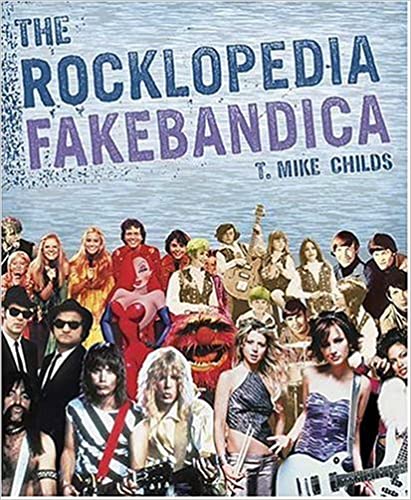
Have you ever asked yourself, “Who was the imaginary band that sang that song that doesn’t actually exist in that fictional movie that I watched back in 2004?”
Well, fear not! The Rocklopedia Fakebandica can answer all of your fake band questions. This is a reference books that is solely devoted to fictional bands from the movies and from television. It may not be complete (because it was published 2004 and I don’t there’s ever been an updated edition) but it’s still pretty damn entertaining. California Dreams? They’re in here. Zack Attack? They get an entry. Of course, Rex Manning gets a mention but so does Berko, the musician who encouraged Gina to sing her heart out on the roof of Empire Records! Stillwater, the band from Almost Famous and not the recent Matt Damon film, is represented, along with a listing of the bands that the members were in before coming together. Spinal Tap gets an entry, of course. So does 4Skore, the boy band that Hank Hill thought was “kind of like Doo Wop” on King of the Hill.
It’s a fun book, written in an enjoyably sarcastic manner. Most fake bands aren’t that good and T. Mike Childs has no fear of calling them out. Take that, Zack Attack!
Incidentally, this one of the many books in my collection that I originally found at Recycled Books of Denton, Texas. Be sure to support your used bookstores. This not a book that I would have found if I was just searching on Amazon. This is a book that I found because I went down to a used bookstore and I walked up and down the aisles, seeing what they had available. I saw it, I was intrigued by the title, I pulled it off shelf, I smiled as I skimmed through it, and I bought it and, in the years since, it’s provided me with a lot of entertainment. Support physical media. Support book stores. You’ll miss them if you don’t.
 Through the Shattered Lens