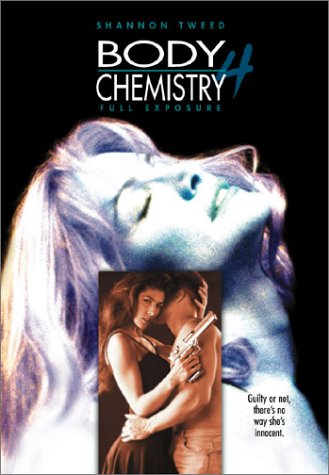
After five years of kinky sex and murder, the Body Chemistry franchise ended with Body Chemistry 4: Full Exposure.
Like the third film, Full Exposure was directed by Jim Wynorski and produced by Andrew Stevens. Shannon Tweed stepped into the role of murderous Dr. Claire Archer, replacing Shari Shattuck. Shannon Tweed was always one of the most talented of the actresses who regularly appeared on what was then nicknamed Skinemax. It wasn’t just that Tweed always seemed to being give it her all in her films’ frequent sex scenes. Tweed also had the look and style of an old-fashioned femme fatale. It was easy to imagine her trading sultry quips with Alan Ladd or Tom Neal. This made Tweed perfect for the role of Claire Archer and her performance was a noticeable improvement on Shari Shattuck’s. It’s just too bad the rest of the film was such a snoozefest.
In Full Exposure, after getting away with three murders in the first two BodyChemistry films, Claire has finally been arrested. She is on trial for killing Alan Clay (Andrew Stevens) at the end of the third film. However, she has a hotshot lawyer named Simon Mitchell (Larry Poindexter) and she is soon up to her old tricks, having sex with Simon in his office, a parking garage, and an elevator. Simon’s aide, Lane (Marta Martin), has come across proof of Claire’s crimes but Claire has a plan to take care of that. She always does.
Full Exposure starts out as a typical Body Chemistry film, with neon-lit sex scenes, but it quickly get bogged down in lengthy courtroom sequences. In the previous three films, Claire at least had some sort of motivation but here, it’s never clear why she would try to destroy her lawyer’s life during the trial instead of waiting until he had, at least, gotten her off the hook. Tweed is a perfect Claire but the rest of the cast is just going through the motions. Though Claire once again got away with murder, there were no more chapters to her story after this one. The Body Chemistry franchise managed to do a lot with a very thin premise but Full Exposure shows, that by the fourth film, there was no where left to go.
Sherlock Holmes has long been a favorite literary character of mine. As a youth, I devoured the Sir Arthur Conan Doyle stories, marveling at the sleuth’s powers of observation and deduction. I reveled in the classic Universal film series starring Basil Rathbone and Nigel Bruce as Holmes and Watson, and still enjoy them today. I read Nicholas Meyer’s 1974 novel “The Seven-Per-Cent Solution” as a teen, where a coked-out Holmes is lured by Watson to Vienna to have the famed Sigmund Freud cure the detective of his addiction, getting enmeshed in mystery along the way. I’d never viewed the film version until recently, and while Meyer’s screenplay isn’t completely faithful to his book, THE SEVEN-PER-CENT SOLUTION is one of those rare instances where the movie is better than the novel.
This is due in large part to a pitch-perfect cast, led by Nicol Williamson’s superb performance as Sherlock. We see Holmes at his worst…
It may not be a “cool” thing to admit, but I’ll let you in on a little secret — it’s okay to just want to feel good once in awhile.
It is, after all, a hopelessly fucked-up world that we live in right now : our nuclear arsenal is in the hands of an unhinged, delusional madman who is clearly cracking under the strain of a job he probably didn’t even want and is in no way even mature enough to handle; a lunatic religious zealot is eagerly waiting in the wings to succeed him when he undoubtedly crashes and burns; our closest international allies seem to be inexorably lurking toward a barely-rebranded fascist nationalism themselves; rising global temperatures and sea levels probably threaten our future even more than the would-be despots do — if you think about too hard, it can all seem pretty hopeless.
Hollywood probably wore the term “re-imagining” to death even before comics did, but if we want to be brutally honest, it’s a word that’s become flat-out cringeworthy across all media by this point, and not without good reason. To “re-imagine” something, after all, means that time and effort that could go into actually imagining something new is going into updating an existing idea, and there’s also an implication, at the very least, that affixes itself to the notion that the original (often beloved) idea itself is in need of some touch-up work. The track record of “re-imaginings” is a pretty lousy one in the funnybook medium, of course — many a promising, or even established, creative career has been sidetracked by attempting pointless re-vamps of characters and concepts that originated in the minds of Kirby, Eisner, Ditko, Kurtzman and the like that had literally no chance to come anywhere near…
I said I would try to get every genre of music I could into Black History Month.
Here we have the hardcore punk band Bad Brains. They’ve been around for a long time now. They started out in 1976 as a jazz fusion band before migrating to Hardcore Punk. They released their self-titled debut album in 1982. There are some good songs on that album, but the one of special note is Banned in D.C., which was based on an unofficial ban put on them in clubs in 1979 in Washington, D.C. I’m kind of surprised since the all-black proto-punk band Death only didn’t have their record released in the early-to-mid-70s because they refused to change their name. That was it. It would get released decades later, but I’ll leave it to you to watch the movie A Band Called Death (2012).
Then again, the mostly white hardcore punk band Dead Kennedys took endless flack all the way up to Tipper Gore, among many others, so it’s believable. What isn’t believable, but is true, is that Dead Kennedys would perform under their actual name at my high school in the early-80s. I thought it was a myth until numerous people who had been there told me stories about that night. That’s a story I will have to look into more detail at some point.
If the director of this music video sounds familiar, then that’s because he also directed Hunger Strike by Temple Of The Dog and a couple of videos for Alice In Chains. One has to wonder what the conversation was between the band and Rachman:
Bad Brains: We’ll take one part Smells Like Teen Spirit, two parts Jeremy, and feel free to sprinkle in a little Faith No More and Living Colour.
Rachman: You got it!
I’m not complaining. You can see the same sort of thing with their video for the song God Of Love. The group was inspired by musicians like Black Sabbath and Bob Marley. They even got their name from the Ramones song Bad Brain. So why not draw on the music videos of bands they no doubt help to inspire. Makes sense to me.
“When it comes to dying for your country, it’s better not to die at all!”
— Paul Baumer (Lew Ayres) in All Quiet On The Western Front (1930)
Tonight, I watched the third film to ever win the Oscar for Best Picture, the 1930 anti-war epic, All Quiet On The Western Front.
All Quiet On The Western Front opens in a German classroom during World War I. Quotes from Homer and Virgil, all exalting heroism, are written on the blackboard. The professor, a man named Kantorek (Arnold Lacy), tells his all-male class that “the fatherland” needs them. (It’s all very patriarchal, needless to say.) This, he tells them, is a time of war. This is a time for heroes. This is a time to fight and maybe die for your country. He beseeches his students to enlist in the army. The first to stand and say that he will fight is Paul Baumer (Lew Ayres). Soon, almost every other student is standing with Paul and cheering the war. Only one student remains seated. Paul and the others quickly turn on that seated student, pressuring him to join them in the army. That seated student finally agrees to enlist, even though he doesn’t want to. Such is the power of peer pressure.
A year later, a visibly hardened Paul returns to his old school. He’s on furlough. He’s been serving in a combat zone, spending his days and nights in a trench and trying not to die. He’s been wounded but he hasn’t been killed. He can still walk. He can still speak. He hasn’t gone insane. He is one of the few members of his class to still be alive. (That student who didn’t want to enlist? Long dead.) When Kantorek asks Paul to speak to his new class, Paul looks at the fresh-faced students — all of whom have just listened to Kantorek describe the glories of war — and Paul tells them that serving in the army has not been an adventure. It has not made him a hero. The only glory of war is surviving. “When it comes to dying for one’s country, it’s better not to die at all!” Kantorek is horrified by Paul’s words but he needn’t have worried. The students refuse to listen to Paul, shouting him down and accusing him of cowardice and treason.
(This scene is even more disturbing today, considering that we live in a time when accusations of treason and calls for vengeance are rather cavalierly tossed around by almost everyone with a twitter account.)
What happened between those two days in the classroom is that Paul saw combat. He spent nights underground while shells exploded over his head. He watched as all of his friends died, one by one. One harrowing night, spent in a trench with a French soldier who was slowly dying because of Paul stabbing him, nearly drove Paul insane. In the end, not even his friend and mentor, Kat (Louis Wolheim), would survive. From the first sound of bombs exploding to the film’s haunting final scene, the shadow of death hangs over every minute of All Quiet On The Western Front. By the end of it all, all that Paul has learned is that men like Kantorek and the buffoonish Corporal Himmelstoss (John Wray) have no idea what real combat is actually like.
All Quiet On The Western Front may be 87 years old but it’s still an incredibly powerful film. There are certain scenes in this pre-code film that, after you watch them, you have to remind yourself that this film was made in 1929. I’m not just talking about a swimming scene that contains a split second of nudity or a few lines of dialogue that probably wouldn’t have made it past the censors once the production code started to be enforced. Instead, I’m talking about scenes like the one where a bomb goes off just as a soldier attempts to climb through some barbed wire. When the smoke clear, only his hands remains. And then there’s the sequence where the camera rapidly pans by soldier after soldier falling dead as they rush the trenches. Or the scene where Paul literally watches as one of his friends, delirious and out-of-his-mind, suddenly dies. Or the montage where a pair of fancy boots is traded from one doomed soldier to another, with each soldier smiling at his new boots before, seconds later, laying dead in the mud. Or the harrowing scene where Paul tries to keep a French soldier from dying.
All Quiet On The Western Front remains a powerful film. It’s perhaps not a surprise that, when it briefly played in Germany, the Nazis released live mice in the theaters to try to keep away audiences. (Both the film and the book on which it was based were later banned by the Nazi government.) Sadly, we’ll never get to see All Quiet On The Western Front the way that it was originally meant to be seen. A huge hit in 1930, All Quiet On The Western Front was rereleased several times but, with each rerelease, the film was often edited to appease whatever the current political climate may have been. Over the years, much footage was lost. The original version of All Quiet On The Western Front was 156 minutes long. The version that is available today is 131 minutes long. But even so, it remains a harrowing and powerful antiwar statement.
With all due respect to both Wingsand Broadway Melody, All Quiet On The Western Front was the first truly great film to win the Oscar for Best Picture. Sadly, it remains just as relevant today as when it was first released.
In Body Chemistry III, Jim Wynorski and Andrew Stevens take over the venerable franchise and things quickly get meta.
Alan Clay (Andrew Stevens, who also produced) is a TV director who wants to make serious films about the environment but his producer, Bob (Robert Forster), is only interested in exploitation films. His wife, soap opera star Beth Chaney (Morgan Fairchild). wants Alan to direct her in a great role but Alan tells her, “I’m not a creative artist, Beth! I’m a TV director who specializes in women-in-jepordy thrillers!” That should make Alan the perfect choice to make a movie about Claire Archer.
Having gotten away with murdering both of her two previous lovers and her boss at the radio station, Dr. Claire Archer (Shari Shattuck, replacing Lisa Pescia) is now hosting her own TV talk show, Looking At You With Claire Archer. She has also written a best-selling textbook called Sex and Violence and Vice Versa. Her former colleague, Freddie (Chick Venerra, taking over the role played by Dave Kagen in the first film), has quit the sex research game is now a screenwriter. He wants to write a script about Claire but he can not convince her to sign over the rights to her story. Maybe a night with Alan can change her mind.
Claire’s soon up to her old tricks. Alan wants to break it off with her, Freddie is figuring out that Claire is a murderer, and Beth wants to play her in the movie.
Featuring no one from either of the two original Body Chemistry films (even when Freddie sees a picture of Big Chuck from Part 2, an anonymous extra has replaced Morton Downey, Jr) and shot in Jim Wynorski’s signature “drop your top,” straight-to-video style, Body Chemistry 3 is a deliberate parody of the genre. It’s easy to recognize Robert Forster’s Bob as being a stand-in for Body Chemistry‘s executive producer, Roger Corman while Freddie is the most obnoxious screenwriter since the one Tim Robbins killed in The Player. All of that makes Part 3 more interesting than the first two Body Chemistry films. If the sultry Lisa Pescia had returned to play Dr. Archer, it might even be a classic. Shari Shattuck gives a game performance but lacks the demented intensity that Pescia brought to the role.
For tomorrow’s movie a day, Wynorski and Stevens return but Shannon Tweed takes over the role of Claire Archer in Body Chemistry 4: Full Exposure.
What’s an Insomnia File? You know how some times you just can’t get any sleep and, at about three in the morning, you’ll find yourself watching whatever you can find on cable? This feature is all about those insomnia-inspired discoveries!
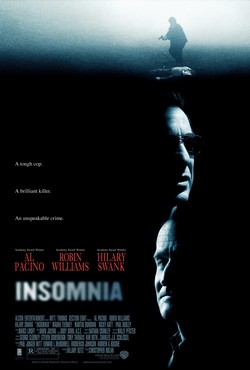
Last night, if you were up at 2 in the morning, you could have turned over to Starz and watched the atmospheric 2002 mystery, Insomnia.
I have to admit that I’m cheating a little bit by including Insomnia in a series about obscure films that you might find on cable late at night. While Insomnia does seem to often turn up during the early morning hours, it’s hardly an obscure film. A remake of an acclaimed Norwegian film, it not only stars three Oscar winners (Al Pacino, Robin Williams, and Hilary Swank) but it was directed by Christopher Nolan. Insomnia got a lot of attention when it was first released in 2002. But, doing an insomnia file about a movie that’s actually about insomnia was just too good of an opportunity to pass up.
I should also mention that I didn’t have insomnia last night. I was up because I currently have a cold and I watched Insomnia in a feverish and congested haze. And yet I couldn’t help but feel that, somehow, that was actually the ideal way to watch Insomnia. With its ominous atmosphere and Nolan’s eye for the surreal, Insomnia plays out like a semi-lucid fever dream.
A teenage girl has been murdered in a small Alaskan fishing village. The chief of police (played by the great character actor Paul Dooley) asks his former LAPD partner, Will Dormer (Al Pacino), to come to Alaska and help with the investigation. Accompanying Dormer is his partner and friend, Hap Eckhart (Martin Donovan).
Dormer has issues that go far beyond anything happening in Alaska. He’s burned out and he’s plagued by rumors that, in the past, he was a crooked cop. He’s being investigated by Internal Affairs and, shortly after they arrive in Alaska, Eckhart admits that he’s been given immunity as part of a deal to testify against Dormer. While pursuing the suspected murderer through the Alaskan fog, Dormer fires his gun. When the fog clear, Dormer discovers that he’s killed Eckhart. Was it an accident or did Dormer intentionally shoot his partner? Not even Dormer seems to know for sure. He lies and says that the murderer shot Eckhart.
Working with a local detective (Hilary Swank), Dormer tries to solve the Alaska murder, with the knowledge that, once he does, he’ll have to return to Los Angeles and he’ll probably be indicted. Because of the midnight sun, night never falls in Alaska and, tortured by guilt, Dormer cannot sleep. Add to that, the murderer knows that Dormer shot Eckhart. And now, he’s calling Dormer and cruelly taunting him.
Who is the murderer? His name is Walter Finch. He’s a writer and, in a stroke of brilliance, he’s played by none other than Robin Williams. To me, Robin Williams’s screen presence always carried hints of narcissism and self-destruction. Even in comedic roles, there was a transparent but very solid wall between Williams the audience. When he was shouting out a thousand words a minute and rapidly switching from one character to the next, it always seemed as if it was all a technique to keep anyone from figuring out who he really was. In Insomnia (and, that same year, in One Hour Photo), Robin Williams reveals an inner darkness that he rarely showed before or after. Finch may possess Williams’s trademark eccentric smile and nervous voice but, underneath the surface, he’s an empty shell who views human beings as being as disposable as the characters in his paperback novels.
Christopher Nolan takes us directly into the heads of these two enemies, with shots of the desolate Alaskan landscape seeming to perfectly capture the inner desolation of two minds destroyed by guilt and paranoia. (Neither Finch nor Dormer is capable of connecting with the world outside of his damaged psyche.) As seen through Nolan’s lens, Alaska becomes as surreal and haunting as one of the dream landscapes from Inception.For those of us who found both The Dark Knight Rises and Interstellar to be so bombastic that they verged on self-parody, Insomnia is a nice reminder that Nolan doesn’t need a pounding Han Zimmer score to make a great movie. With Insomnia, Nolan gives us not bombast but a deceptively low-key and atmospheric journey into the heart of darkness.
Ironically, for a film about two men who cannot sleep, Insomnia will haunt your dreams.
It’s nice and simple. I like the use of the white dimension as I refer to it as when I see it in music videos. I wouldn’t be surprised if director Paula Greif was familiar with ABBA music videos because this does remind me of their white dimension videos in terms of the arrangement of people and the direction their heads are facing. My favorite part is how it bookends itself with the flower. At the beginning it is being handed by a child to an adult, and at the end of the video, the child hands it back to the adult.
According to Wikipedia, this song was voted in 2009 as the “85th Greatest One-Hit Wonder of the 80s” by VH1. It’s also worth noting that the album this song is from called Conscious Party was produced by Chris Frantz and Tina Weymouth of Talking Heads/Tom Tom Club.
Greif appears to have directed around 20 videos and produced a couple of them. Something particularly interesting about her credits is that she did enough with Duran Duran that she even has a page devoted to her on a Duran Duran fan Wiki.
Laura Israel and Glenn Lazzaro edited this video. She appears to have worked on about 15 music videos. All but one of them was either directed or co-directed by Greif. Israel went on to work as an editor on things such as Africa Unite: A Celebration of Bob Marley’s 60th Birthday (2008). She has also directed two documentaries called Windfall (2010) and Don’t Blink – Robert Frank (2015).






 Through the Shattered Lens