Here are the 10 Semi-finalists for The Best Visual Effects Oscar!


Guardians of the Galaxy

Earlier today, the Academy announced the 10 semi-finalists for this year’s Oscar for Best Visual Effects.

Not on the list: Noah, Exodus, Edge of Tomorrow, or April Rain.

Here’s what made the cut:

Captain America: The Winter Soldier

Dawn of the Planet of the Apes

Godzilla

Guardians of the Galaxy

The Hobbit: Battle of the Five Armies

Interstellar

Maleficent

Night at the Museum: Secret of the Tomb

Transformers: Age of Extinction

X-Men: Days of Future Past

BW and CA

Terminator: Genisys (Official Trailer)


983792_828630217177092_2451992593817557827_n

I’m not sure if the 5th Terminator film is a prequel or a sequel. Time travel and paradoxes and all that jazz sure make it difficult to figure that out.

Now, what we do know is that Terminator: Genisys (whoever came up with that title should be shot) will take things even farther than the first film which is suppose to kickoff a divergent timeline that makes the first four films a moot point.

So, this means that Terminator: Genisys may be both prequel and sequel, but also a reset of the whole franchise. See what I mean about confusing.

Here’s to hoping that screenwriters Laeta Kalogridis and Patrick Lussier have a better handle on all this jumbled time travel and resetting stuff.

Terminator: Genisys is set for July 1, 2015 release date.

Bond 24 Officially Named “Spectre” in Announcement.


If you’re a long time reader of Through the Shattered Lens, you’re probably aware that we’re all fans of the Bond franchise in some way. Around the release of Skyfall, we collectively reviewed every single Bond film. The project – spearheaded by our own Lisa Marie Bowman – was quite the success with each writer taking a film and showcasing their love (or displeasure for it). To date, I consider that our best  “Avengers” moment.

Today, the Announcement for the next film in the series was made at the legendary Pinewood Studios. Director Sam Mendes introduced audiences to the 24th film, “Spectre”, which already seems interesting given the history of the evil group in Bond canon. I guess this means Quantum is no more, was a small piece of a larger puzzle, or perhaps it’s grown into something bigger? We’ll have to wait and see, but it’s up to speculation. Lee and I were actually talking about that yesterday. We do know that the production will take 007 from London to Mexico City, among other locations.

All of the actors were on hand, including new members Christoph Waltz (Django Unchained, Inglorious Basterds), Monica Bellucci (Malena, The Matrix Reloaded), and Lea Seydoux (Mission: Impossible -Ghost Protocol, Blue is the Warmest Color). Returning are Daniel Craig as James Bond, Ralph Finnes as M, Penny Dreadful’s Rory  Kinnear as Tanner, Ben Whishaw (Layer Cake, Cloud Atlas) and Naomie Harris (Ninja Assassin, Mandela: Long Walk to Freedom) as Moneypenny.

Although Roger Deakins won’t be on hand for the Cinematography, its okay (though he’ll be missed). Hoyt Van Hoytema is taking over the reigns. Between Spike Jonze “Her”,  “Interstellar” and “Birdman”, Hoytema knows what he’s doing.

Even Aston Martin threw their keys into the ring with the new DB10, to celebrate their 50 year relationship with Bond. 10 copies were made exclusively for the film and we hope Mendes leaves them in better condition than 007 usually does.

Production starts next Monday and the film is on track for release next November.

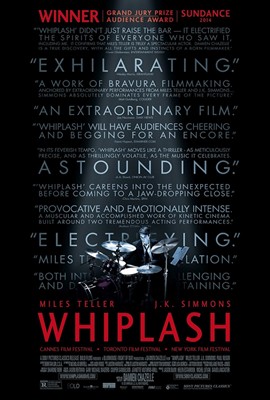
Film Review: Whiplash (dir by Damien Chazelle)


Whiplash_poster

I really only need five words to review Whiplash:

J. K. Simmons kicks ass.

He so seriously does.  The deep-voiced character actor, beloved by fans of Allstate Insurance, Spider-Man, Jason Reitman, and the Coen Brothers alike, has been memorable so many times in the past that it’s easy to take him for granted.  However, with Whiplash, he proves himself to be not just a distinctive screen presence but to be a brilliant actor as well.  There’s a lot of good things about Whiplash but, ultimately, it’s Simmons who makes the film something more than just another promising indie film.

Simmons plays Terrence Fletcher, the legendary and feared conductor of the Schaffer Conservatory jazz band.  (We’re told that Shaffer Conservatory is the best music school in the country.  Of course, in a real life, the best music school in the country is located at University of North Texas, where I studied Art History but still enjoyed occasionally listening to the One O’Clock Lab Band.)  As played by Simmons, Fletcher is both a genius and a sadist.  When he talks about music, he does so with a passion that makes it impossible not share his love for all that jazz.  When he conducts his band, he does so with a cruelty that makes you question if the music is worth the cost of the emotional stability of the people playing it.  When he hears that someone is out of tune, he responds by reducing a musician to tears.  When he says, “Not my tempo,” it’s both a critique and a threat.  The fact that he’s creative and quick-witted with his insults does nothing to lessen the pain that they cause.

Fletcher’s latest protegé/victim is a talented 19 year-old drummer named Andrew (Miles Teller).  Andrew shares Fletcher’s love for jazz but nothing can prepare him for the lengths that Fletcher will go to manipulate him.  Whether it means insulting Andrew’s father (Paul Reiser) or casually threatening to give Andrew’s spot away to another drummer, Fletcher’s nonstop and often viscous criticism makes Andrew a better drummer but also threatens to destroy his sanity.

Director and screenwriter Damien Chazelle understands that those of us in the audience have seen literally hundreds of films about intense teachers and the students that they teach.  Chazelle cleverly manipulates all of our expectations.  The minute that we expect Fletcher to say something encouraging or to reveal himself to actually be a compassionate mentor, Simmons instead barks out another insult or regards Andrew with a withering glare.  And, as we wait for Andrew to stand up to Fletcher or prove his mentor wrong, we are instead forced to admit that Fletcher’s approach does seem to be working.

When, towards the middle of the film, Andrew crashes his car while rushing to a jazz competition and then attempts to play the drums with both blood on his suit and a broken hand, you can’t help but both admire his determination and fear where that determination is going to take him.

As I said at the beginning of this review, there’s a lot of good things about Whiplash.  As you might expect for a film about jazz, it has a great soundtrack.  Miles Teller gives a great lead performance, one that may be overshadowed by J.K. Simmons but which — along with his work in The Spectacular Now — indicates that Teller is an actor to watch.  (We’ll just forget the fact that he was also in Project X.)  Some of the film’s best moments don’t even involve J.K. Simmons, instead they’re just scenes of Teller obsessively drumming until his hands are bloody.

But, ultimately, it is J.K. Simmons who truly elevates this film.  Simmons makes Fletcher into a truly fascinating villain, one who constantly leaves you guessing.  By the end of the film, you may not like Fletcher but you definitely can not get him out of your head.

Ultimately, the success of Whiplash stands as a tribute to the talent of J.K. Simmons.

“Shaft” #1 Brings Blaxploitation Bad-Ass To The Printed Page


4252960-01a

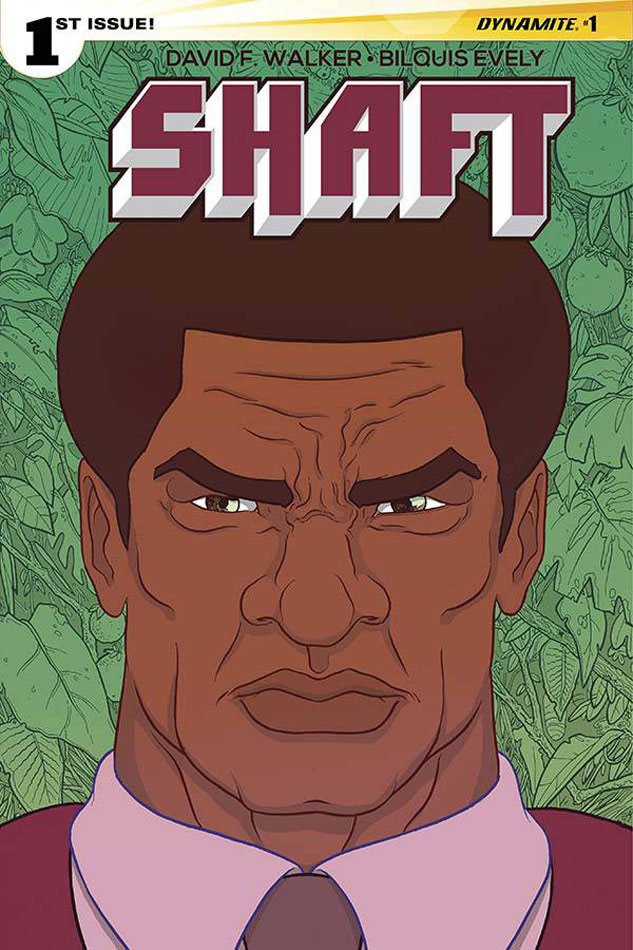
Right off the bat, I should probably apologize for the misleading headline here — Dynamite Entertainment’s Shaft #1 (the first of a six-part series) isn’t “bringing blaxploitation bad-ass to the printed page” so much as it’s bringing it back to the printed page, given that “the black private dick that’s a sex machine to all the chicks” actually started out life not on the silver screen, but in a series of pulp novels by the legendary Ernest Tidyman. And it’s probably down to the fact that Tidyman’s widow owns the copyright to the character of John Shaft that we even have this new spin-off comic at all, seeing as how negotiating a licensing rights deal with her is probably a lot easier than dealing with, say, MGM. Even so — am I the only one who’s surprised that this comic even exists?

I mean, when I think of licensed properties making the leap to the four-color world, I think Star WarsStar TrekBattlestar Galactica. Heck, this week Boom! Studios even released the first issue of a new Escape From New York ongoing monthly, and that didn’t exactly come out of left field in my estimation, but this? A comic based on a cult blaxploitation hero who “peaked” about 40 years ago in terms of his popularity? I gotta say, I didn’t see that one coming at all.

4253652-01b

Still, I’m glad it’s here, and in the hands of writer David F.Walker and artist Bilquis Evely, Tidyman can rest easy in his grave — they seem to know what they’re doing every bit as much as Gordon Parks and Richard Roundtree did when they translated the urban adventures of “the cat who won’t cop out when there’s danger all about” onto celluloid. Is this a good comic? Damn right.

Walker (who’s also penning a six-part Shaft prose story available by scanning QR codes included in the printed versions of each of the comics) has opted to go the “prequel” route here, taking us back to 1968 when a newly-returned-from -Vietnam John Shaft is trying to make a go of it an as Brooklyn-based amateur boxer. We learn a lot about our main character’s backstory here — certainly more than we ever did in the film — and I have to say that all the revelations we’re served ring very true indeed to the Shaft we’ve always known, while somehow being at least modestly surprising at the same time. The fact that Walker is able to convey all this info with a sparse and breezy prose style is an added plus, and while the main through-line of the plot is a pretty simple one — Shaft is ordered to throw a fight, what’s he gonna do about it? — that doesn’t mean the impact of our guy John’s decision, predictable as it may be, has any less of an impact on readers. He’s headed for big trouble, and I’m looking forward to it already.  This first issue is pure table-setting, to be sure, but where’s the harm in that? Set the table nicely enough and I’ll want to stick around for the meal.

4253651-01c

The art from Evely, whose prior work I confess to being unfamiliar with, can also be fairly categorized as “not flashy, but certainly effective.” It’s pretty simple and straightforward, but displays a kind of professionalism and eye for craft that were more common in the comics of 1971 — the year that Shaft hit theaters — than they are today. It suits the subject and time period quite well and invests the  reader in the proceedings rather than alienating you with so much of the unskilled “flashier” art we find in, say, the average DC “New 52” comic. The panels in this book  look good without sacrificing realism and plausibility along the way, and  are more concerned with drawing you in than bowling you over. All in all, a job very well done.

4253650-01d

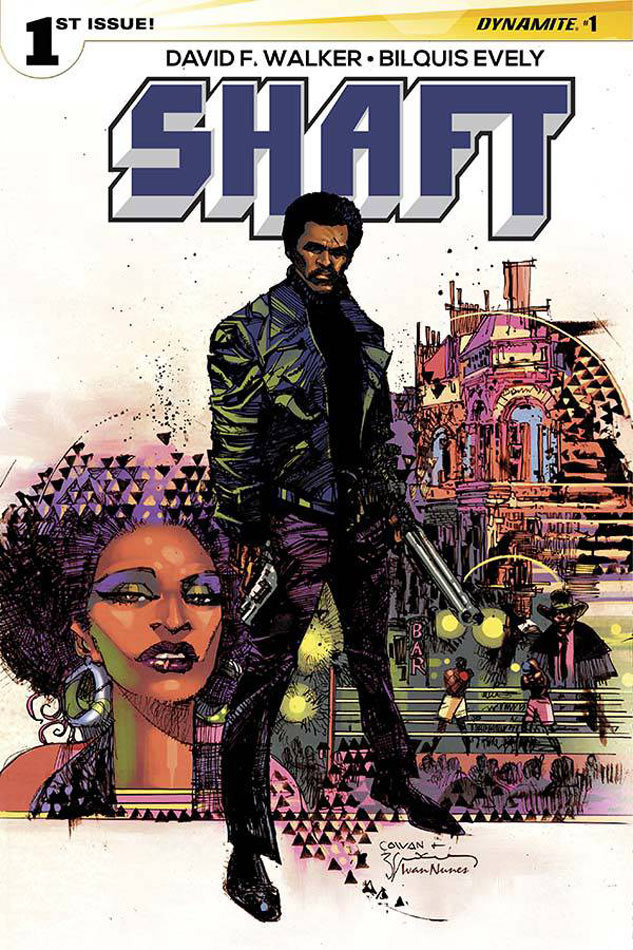
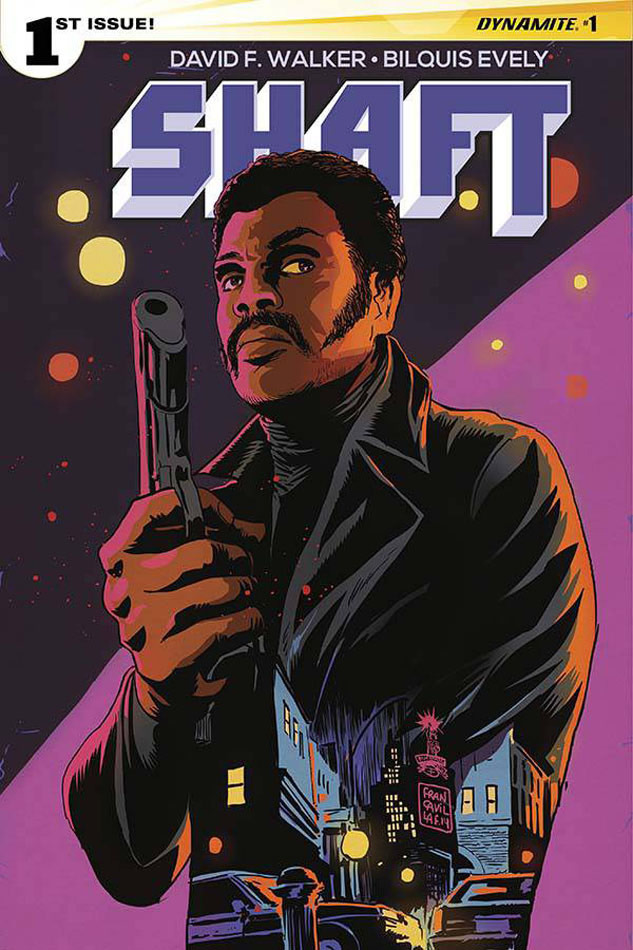
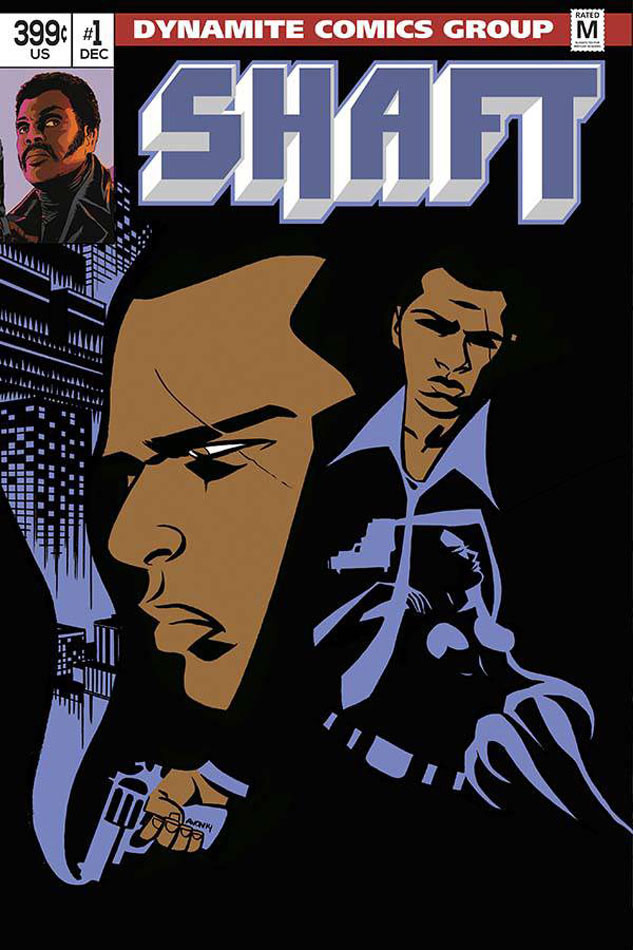
As with pretty much all Dynamite first issues, Shaft #1 has hit the stands with about a bajillion different variant covers. I’ve included my four favorites with this review (by Denys Cowan and Bill Sienkiewicz, Francesco Francavilla, Michael Avon Oeming, and Ulises Farinas, respectively), and while they all portray a more Richard Roundtree-looking Shaft than Evely does in his interior pages (well, except for the one by Farinas, since that’s not Shaft at all, but the bad guy of the story), you really can’t argue with the awesome-ness of any of them. I opted for the Francavilla cover since I always opt for Francavilla covers, but I was sorely tempted by the main Cowan/Sienkiewicz one, as well. Any way you go, though, you can’t lose — either with what’s on the outside of the book or what’s in it. This is the John Shaft we’ve always known, but shown in a whole new light that I think almost all fans will appreciate.


Review: Panopticon – Roads to the North


Two years removed, Kentucky has left a unique long-term impression in my mind. For all of the excitement over an authentic and well-crafted mingling of traditional Appalachian folk and black metal–the term “blackgrass” got tossed around a lot–I honestly don’t remember how most of the songs went. This is because Kentucky‘s message managed to trump its sound. I remember the old man talking about organizing strikes against the coal company. I remember Sarah Ogan Gunning’s boldly defiant calls to overthrow capitalism. I think of settlers slaughtering Indians, mountains blown into dust, rivers running black with pollution, grim-faced miners broken in body but never in spirit, a modern generation abandoning everything their ancestors worked so hard to accomplish… That is my memory of Kentucky.

Chase the Grain

I can’t detach myself from Kentucky enough to appreciate Roads to the North as an independent entity. That’s probably fine. I had never heard of Panopticon before Austin Lunn nailed his bloody heart to his sleeve in 2012, and that identity will persist through my perception so long as it remains true. Roads to the North has no explicit message, no lyrics sheet, no spoken tracks or American folk covers. But it has Kentucky, and because of that every song takes on a deeper, more robust meaning than it might have otherwise.

It would be interesting to know what a folk/black metal fan unfamiliar with Panopticon takes from this album. Does the music alone stand far above and beyond the norm? I like to think it does. The album incorporates some entirely unexpected but highly effective melodic death metal moments, especially in the opening track “The Echoes of a Disharmonic Evensong”. This track also gives us perhaps Lunn’s best incorporation of fiddle directly into black metal to date. “The Long Road Part 2: Capricious Miles” transitions out with a long and enthralling jazzy progressive rock chill reminiscent of mid-era Opeth. The whistle in “Where Mountains Pierce the Sky” sounds nothing like what we’re used to out of the European scenes, harkening instead to a western indigenous sound I have only heard from some obscure Mexican folk metal bands. “The Long Road Part 1: One Last Fire” is an unconventional six minute acoustic bluegrass piece that feels more like something straight out of Lunn’s imagination than Appalachia.

The intensity hops around so suddenly that Roads to the North may feel disjointed at first, but the stark contrasts are never forced. Because you don’t always see them coming, they are striking rather than cliche. Lunn performs each of the album’s myriad instruments better than a lot of people who specialize in only one, and there aren’t many producers on the black metal market that can compare to Colin Marston. He has a knack for subtlety that is hard to come by in the scene. I absolutely love the way the tremolo emerges around 30 seconds into “Chase the Grain”, for instance. It’s so soft that you feel its effect on the song as a whole long before your brain consciously recognizes it.

Norwegian Nights

But I suppose I don’t really care about the finer musical details of Roads to the North, and that is why I found this album so difficult to review. This music is only a gateway. Like an engaging book, you never notice that it is well written. Roads to the North is not the guided tour we found on Kentucky. It leaves us be to explore where the feelings take us within the context of the world Lunn has already shown us. Those paths can be rocky. It’s not the glorified past of so many European pagan metallers. The should-be eternal is tainted. The land is marred. It’s the introspective melancholy Americana of Bob Dylan and Tom Waits, and your heart goes out to so many things that you can never hope to save.

Lie beneath a cold blanket and watch the mountains sleep. The train rolls by every hour, as I wake and dream. The woods and the hills–faces so dear to me. Frozen lakes, flatland snow, where I’m called I’ll go. Such still quiet, then the whistle echoes. My fragile sleep torn from me, as many other things will be.

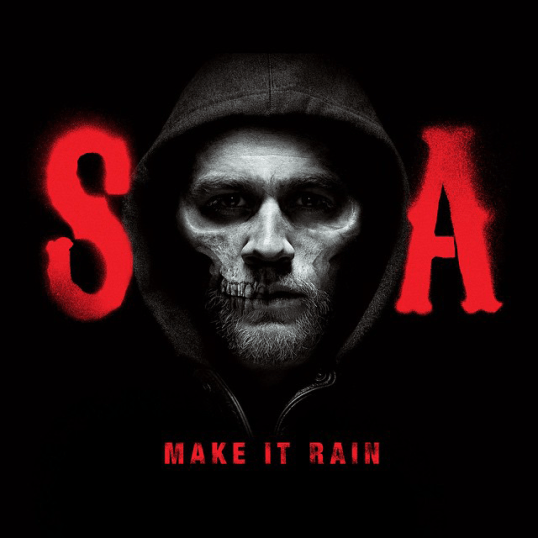
Song of the Day: Make It Rain from Sons of Anarchy (by Ed Sheeran)


B3X7gZVIIAEx88j.png large

Tonight was the penultimate episode of Kurt Sutter’s Sons of Anarchy on FX. It was an episode that truly earned it’s label of being a modern Shakespearean tragedy (a label many shows have been given but rarely live up to). It also unfolded like some of the best Coppola and Scorsese gangland epics with accounts being settled in disturbing, bloody fashion.

SAMCRO was a group that for some reason legion of fans have taken a ride with and despite the man downs the show took with it’s many highs people didn’t get off the ride (or couldn’t). They wanted to see how this outlaw band of brothers and their loved ones will survive (or who will survive) to the end.

We now know that three more names have been struck off the show’s ledger. With one more episode left in the series it’s either going to go out in a blaze of glory or end in a whimper.

To make tonight’s episode even more memorable we got to listen to Ed Sheeran drop his latest song that perfectly encapsulates the events of Sons of Anarchy tonight and all the way back to the beginning.

Make It Rain

When the sins of my father
Weigh down in my soul
And the pain of my mother
Will not let me go

Well I know there can come fire from the sky
To purify pure as the canes
Even though
I know this fire brings me pain
Even so
And just the same

Make it rain
Make it rain down low
Just make it rain
Make it rain

Make it rain
Make it rain down low
Just make it rain
Make it rain

And the seed needs the water
Before it grows out of the ground
But it just keeps on getting hotter
And the hunger more profound

Well I know there can come tears from their eyes
But they may as well be in vain
Even though
I know these tears bring me pain
Even so
And just the same

Make it rain
Make it rain down low
Just make it rain
Make it rain

Make it rain
Make it rain down low
Just make it rain
Make it rain

Make it rain x8

And the seas are full of water
That stop by the shore
Just like the riches of grandeur
That never reach the port

So let the claps fill with thunderous applause
And let thy death be the veins
And fill the sky
With all that they can drop
When it’s time
To make a change

Make it rain
Make it rain down low
Just make it rain
Make it rain

Make it rain
Make it rain down low
Just make it rain
Make it rain

Make it rain x4

Make it rain
Make it rain down low
Just make it rain
Make it rain

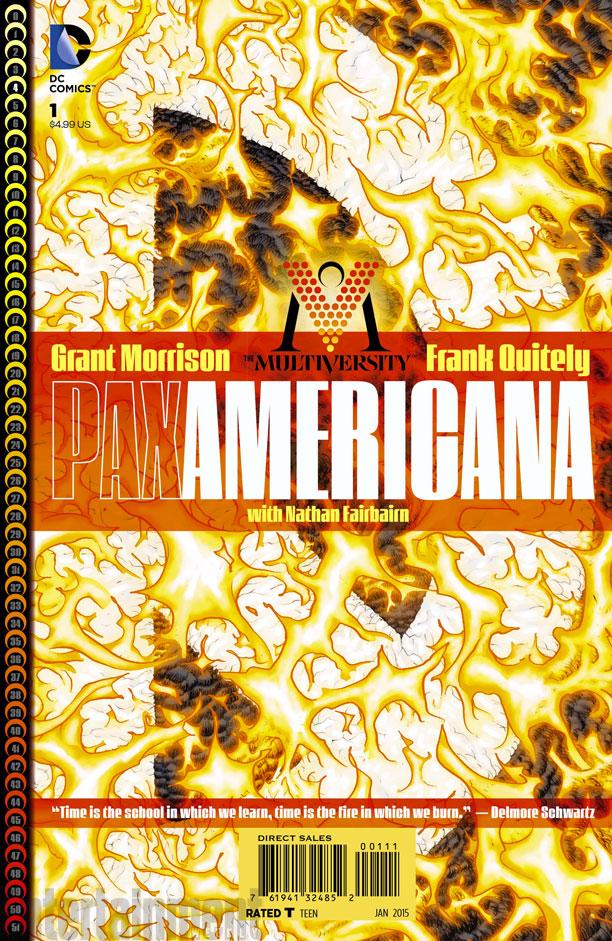
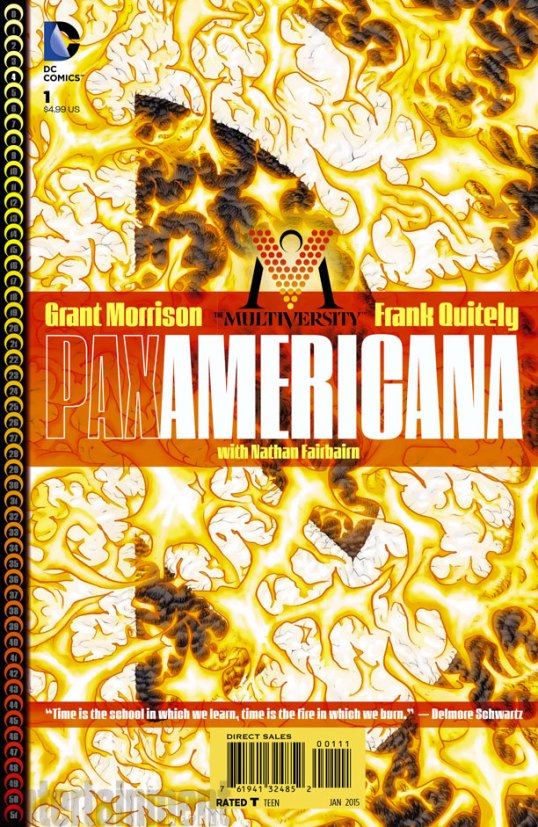
“The Multiversity : Pax Americana” #1 Is The Comic Of The Year — No Question


MULTIVERSITY-Cv4-05

Understand — it’s not like me to make grandiose pronouncements like “such-and-such is the movie of the year,” “such-and-such is the comic of the year,” etc. It’s pretty damn hard to pinpoint something as being the best offering in any given medium when one person, obviously, can’t see or read everything that’s out there — and it’s probably doubly stupid to engage in such hyperbole before the year is even over.

And yet — that’s exactly what I’m doing right here, and with full confidence. That’s because the latest issue of Grant Morrison’s The Multiversity has no chance of being topped, barring a miracle of some sort. It’s just. That. Fucking. Good.

1-1

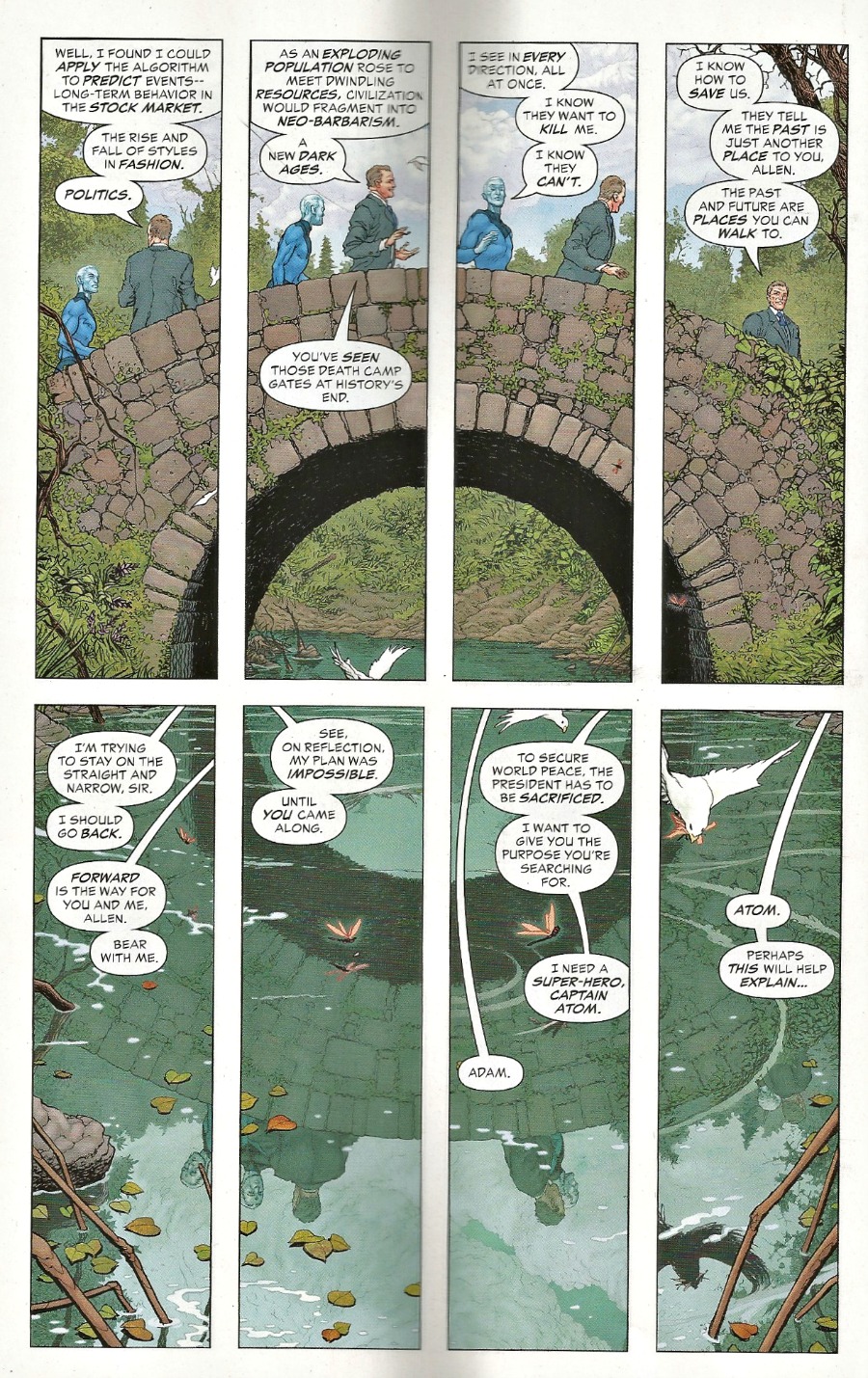
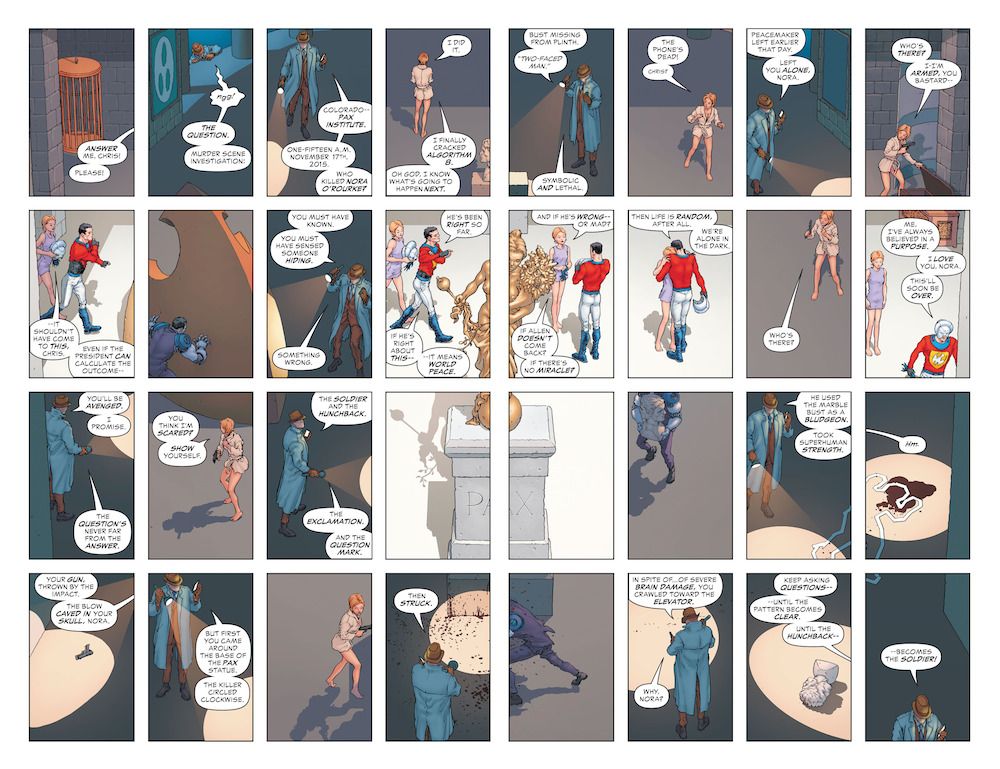
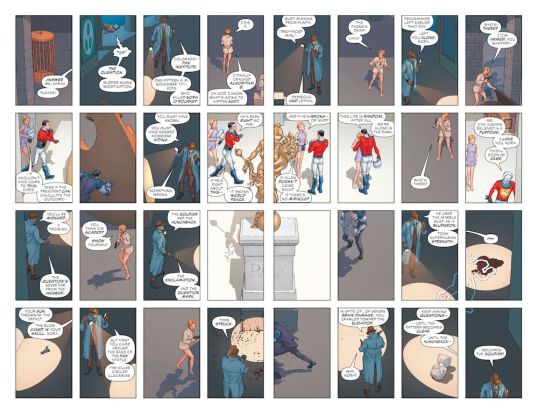
For those not familiar with the basic premise of what’s going on with The Multiversity, it’s an eight-issue mini-series from DC written by Morrison and illustrated by a bevy of the industry’s top talents — in this case,  his frequent collaborator Frank Quitely, who absolutely outdoes himself here. Yeah, okay, all his stuff’s awesome to behold, but his work  on Pax Americana leaves even his much-celebrated turns on Flex MentalloBatman And Robin, and All-Star Superman so far behind in the dust it’s not even funny. Just look at that spectacular page reproduced above and you’ll know that not only is Quitely rendering images here with amazing detail and care, he’s also pushing the boundaries of the comics page in terms of how narrative structure flows visually. I haven’t seen an artist on a “Big Two” project tell a story this hermetically sealed, with its own unique and perfectly logical, yet also expressive and evocative,  language since Dave Gibbons created the singular look and feel of the Watchmen “universe” nearly 30 years ago.

And hey, it’s no coincidence that we bring up Watchmen here since Pax Americana has been referred to, more than once, as “Morrison’s Watchmen,” and for good reason.  Each self-contained issue of The Multiveristy takes place on one of DC’s “parallel Earths,” with a slowly-unfolding, meta-fictional, ” comic within a comic” premise (nothing new for our guy Grant there, he’s been busting the fourth wall ever since his days on Animal Man) binding them all together in ways not fully understood yet given that we’re only halfway through the series, and this time out we’re on Earth-4, the Earth populated by the Charlton comics “Action Heroes” that DC acquired in the early ’80s and that Alan Moore famously first intended to utilize as his principal characters in he and Gibbons’ seminal work.  Morrison famously hates Watchmen, and takes every available opportunity to say so, and so the “intrigue factor” here is pretty high in terms of comics fans wanting to see how he’d handle essentially the same characters.
MCPAX-SMP-2

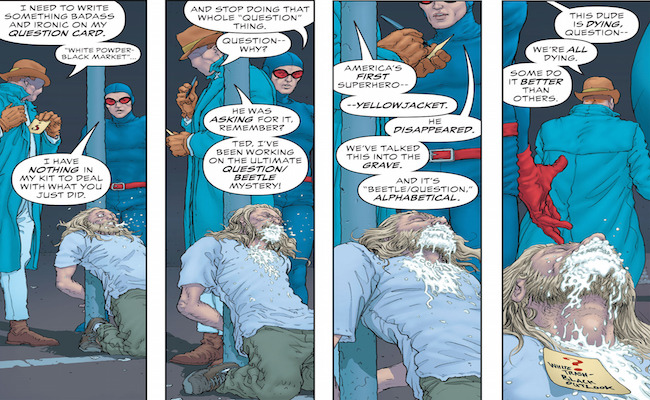
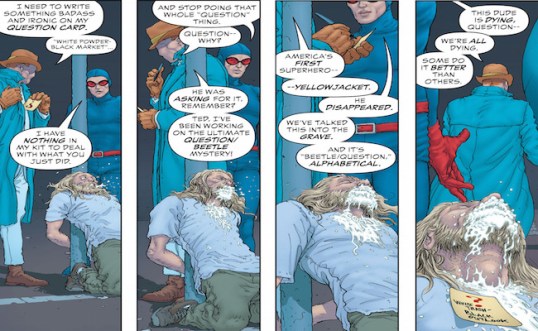
I say “essentially the same” because, of course, Moore and Gibbons weren’t allowed to use the Charlton characters in the end, and so quick stand-ins were devised — The Question became Rorschach, Blue Beetle became Nite Owl, Nightshade became Silk Spectre, Peter Cannon, Thunderbolt became Ozymandias, Peacemaker became The Comedian, and Captain Atom became Dr. Manhattan. DC had “other plans” (most of which amounted to a hill of beans) for the “real” characters at the time, but in the “New 52” universe they’ve all been shelved indefinitely and so Morrison is free to use the original versions here — with the exception of Peter Cannon, whose copyright has reverted back to his creator, Pete Morisi.

The Watchmen similarities don’t end with the principal characters the story is based around, though — Pax Americana also employs a tight, dense story structure that plays around freely with timelines and often employs mirror images of the same scene told from multiple perspectives, such as in the astonishing two-page spread above. Rest assured, it all makes perfect sense, but odds are you won’t catch it all on the first reading unless you’re, I dunno, Stephen Hawking or something.
1447_multiversity_pax_americana_1_splash

And that’s part of the joy of a book like this, isn’t it? Make no mistake — if you’re not willing to invest a few hours, at least, of your time (not to mention $4.99 of your hard-earned money) into what Morrison and Quitely (along with colorist supreme Nathan Fairbairn, who imbues the world of Earth-4 with a distinctive palette all its own) have created here, you’re short-changing yourself, because this is a story that reveals more and more about itself with each successive re-read. As you continue to peruse its contents you’ll be able to glean which instances are integral to a full understanding of the complex proceedings and which are just clever structural gimmicks employed by the author to impress you, but it wouldn’t be a good mystery story — and Pax Americana is, in fact, a great mystery story, centered around the most consequential murder any society can endure, that of its leader — without a few red herrings being thrown into the mix. Heck, Morrison even takes a fun, albeit admittedly cheap, shot at his arch-enemy, Mark Millar, by deftly deconstructing the most pivotal sequence of Wanted and essentially copying it note-for-note while turning it on its ear at the same time, and has a bit of fun at the expense of the scene with Sally and Laurie Jupiet/Juspeczyk in Watchmen #2, as well. Gratuitous? Sure, but it works.

The other ballsy move Morrison makes here is in asking the same fundamental question with his story that Moore and Gibbons did with Watchmen in terms of when is it right to sacrifice the few for the (supposed) good of the many, who “gets” to make that call, and how do they arrive at their decision? Granted, it’s a weighty theme that can’t be grappled with as comprehensively in one 40-page comic as it can in 12 separate 30-page comics, but I give him credit for essentially finding a way to tell multiple (hmmmm — a multiversity?) of stories here at once, given that there’s more going on in this one issue than most comics with a standard “A to Z” linear narrative manage to pack into a year’s worth of their pages, and by utilizing the same characters (again, essentially) that Watchmen used to deal with the same (again, essentially) themes and concepts, Morrison and Quitely aren’t so much aping Moore and Gibbons as they are answering them.

None of which is to say that Pax Americana is going to make people forget about Watchmen any time soon. Or even that it’s “as good” as Watchmen. Again, it’s much shorter, for one thing — but it’s certainly as intricate, arguably even moreso, certainly as demanding, and in the end, certainly as revelatory, at least for those with the patience to give it the detailed attention it both deserves and rewards (as an added plus, you needn’t even be invested in the other Multiversity comics to get on board with this one, it reads just fine on its own).

The comic of the year? Yeah, I can say that pretty easily — even though there’s a bunch of other stuff I haven’t read, and the year’s not over yet.

Here Are The 15 Semi-Finalists For The Best Documentary Feature Oscar!


Dune

Earlier today, the Motion Picture Academy announced the 15 semi-finalists for the Academy Award for Best Documentary Feature.  These 15 movies were selected from 134 eligible documentaries.  Next month, of course, 5 final nominees will be selected from the 15 possibilities listed below.

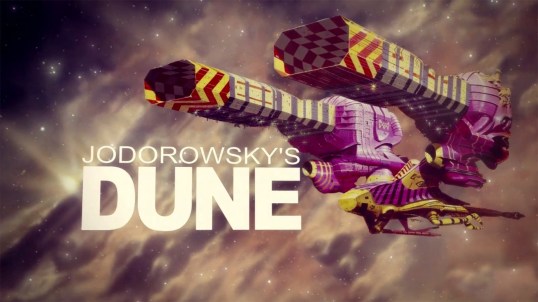
Unfortunately, I have only seen four of the movies listed below: Art and Craft, Finding Vivian Maier, Jodorowsky’s Dune, and Life Itself.  

And they’re all more than worth making the effort to see!

Here are the 15 semi-finalists!

“Art and Craft,” Purple Parrot Films
“The Case against 8,” Day in Court
“Citizen Koch,” Elsewhere Films
“CitizenFour,” Praxis Films
“Finding Vivian Maier,” Ravine Pictures
“The Internet’s Own Boy,” Luminant Media
“Jodorowsky’s Dune,” City Film
“Keep On Keepin’ On,” Absolute Clay Productions
“The Kill Team,” f/8 filmworks
“Last Days in Vietnam,” Moxie Firecracker Films
“Life Itself,” Kartemquin Films and Film Rites
“The Overnighters,” Mile End Films West
“The Salt of the Earth,” Decia Films
“Tales of the Grim Sleeper,” Lafayette Film
“Virunga,” Grain Media

A Most Violent Year Is A Most Unexpected National Board Of Review Winner!


A Most Violent Year

The National Board of Review has spoken!  They named their picks for the best of 2014 earlier today and — to the shock of many (especially me) — they picked JC Chandor’s crime drama A Most Violent Year as the best film of the year!

I love surprises!

Now, a lot of us were expecting A Most Violent Year to be an Oscar contender, with practically everyone expecting Jessica Chastain to either be nominated for best actress or supporting actress.  (The NBR named her best supporting actress.)  But I think a lot of us were expecting to see the NBR select Boyhood, Birdman, or maybe Selma.

Also of note is that Clint Eastwood won best director for American Sniper, which appears to be coming on strong as a potential Oscar nominee as well.

(Also of note: Foxcatcher was totally ignored by the NBR.)

Here are the NBR winners!

BEST PICTURE
“A Most Violent Year”

BEST DIRECTOR
Clint Eastwood, “American Sniper”

BEST ACTOR (TIE)
Oscar Isaac, “A Most Violent Year”
Michael Keaton, “Birdman”

BEST ACTRESS
Julianne Moore, “Still Alice”

BEST SUPPORTING ACTOR
Edward Norton, “Birdman”

BEST SUPPORTING ACTRESS
Jessica Chastain, “A Most Violent Year”

BEST ORIGINAL SCREENPLAY
Phil Lord and Christopher Miller, “The Lego Movie”

BEST ADAPTED SCREENPLAY
Paul Thomas Anderson, “Inherent Vice”

BEST ENSEMBLE
“Fury”

BEST ANIMATED FEATURE
“How to Train Your Dragon 2”

BEST FOREIGN LANGUAGE FILM 
“Wild Tales”

BEST DOCUMENTARY
“Life Itself”

SPOTLIGHT AWARD
Chris Rock for writing, directing, and starring in “Top Five”

BREAKTHROUGH PERFORMANCES
Jack O’Connell, “Starred Up” and “Unbroken”

DEBUT DIRECTOR
Gillian Robespierre, “Obvious Child”

WILLIAM K. EVERSON FILM HISTORY AWARD
Scott Eyman

FREEDOM OF EXPRESSION
“Rosewater”
“Selma”

BEST PICTURE NOMINEES (alphabetical)
“American Sniper”
“Birdman”
“Boyhood”
“Fury”
“Gone Girl”
“The Imitation Game”
“Inherent Vice”
“The Lego Movie”
“Nightcrawler”
“Unbroken”

BEST FOREIGN LANGUAGE NOMINEES (alphabetical)
“Force Majeure”
“Gett: The Trial of Vivian Amsalem”
“Leviathan”
“Two Days One Night”
“We Are the Best!”

BEST DOCUMENTARY NOMINEES (alphabetical)
“Art and Craft”
“Jodorowsky’s Dune”
“Keep On Keepin’ On”
“The Kill Team”
“Last Days in Vietnam”

BEST INDEPENDENT FILMS (alphabetical)
“Blue Ruin”
“Locke”
“A Most Wanted Man”
“Mr. Turner”
“Obvious Child”
“The Skeleton Twins”,
“Snowpiercer”,
“Stand Clear of the Closing Doors”
“Starred Up”
“Still Alice”