44 Days of Paranoia #10: The Intruder (dir by Roger Corman)


For today’s entry in the 44 Days of Paranoia, we take a look at one of the most underappreciated films of all time, Roger Corman’s 1962 look at race relations, The Intruder.

Despite the fact that he’s regularly cited as being one of the most important figures in the development of American cinema, Roger Corman remains an underrated director.  Many critics tend to focus more on the filmmakers that got their start working for Corman than on Corman himself.  When they talk about Roger Corman, they praise him for knowing how to exploit trends.  They praise him as a marketer but, at the same time, they tend to dismiss him as a director.

I would suggest that those critics see The Intruder before they presume to say another word about Roger Corman.

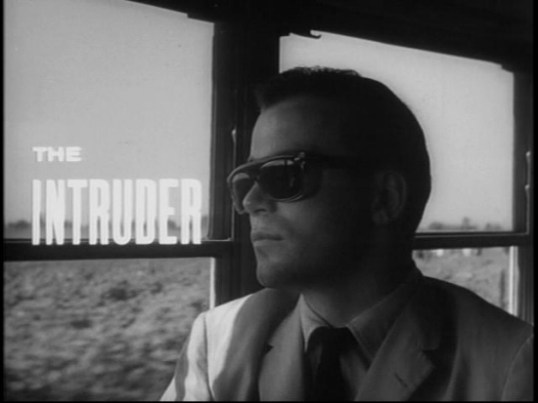
The Intruder opens with a young, handsome man named Adam Cramer sitting on a bus.  The first thing that we notice about Cramer is that he’s wearing an immaculate white suit.  The second thing we notice is that he’s being played by a very young (and, it must be said, rather fit) William Shatner.

I know that many people will probably be inclined to dismiss The Intruder from the minute they hear that it stars William Shatner.  Based simply on Shatner’s presence, they’ll assume that this film must be very campy, very Canadian, or both.  Well, they’re wrong.  Shatner gives an excellent performance in this film, bringing to life one of the most evil characters ever to appear on-screen.

Adam Cramer, you see, is a representative on a Northern organization known as the Patrick Henry Society and he’s riding the bus because he’s heading to a small Southern town.  The high school in that town has just recently been desegregated and Cramer’s goal is to make sure that no black students attend class.  As Cramer explains it, he’s a “social worker” and his goal is to help preserve Southern society.

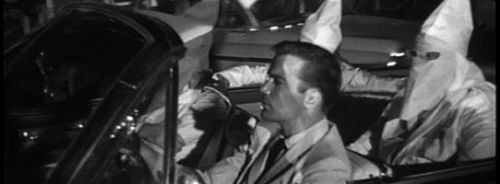
To achieve this goal, Cramer partners up with the richest man in town, Verne Shipman (who is played, rather chillingly, by Robert Emhardt).  With Verne’s sponsorship, Cramer gives an inflammatory speech in the town square and then later returns with a group of Klansmen.  As opposed to recent films like Django Unchained (which scored easy laughs by casting Jonah Hill as a Klansman and playing up the group’s ignorance), The Intruder presents the Klan as figures that have stepped straight out of a nightmare, making them into literal demons who appear at night and disappear during the day.  In a genuinely disturbing scene, the Klansmen set a huge cross on fire.  As the flames burn behind him, Cramer seduces the wife of a local salesman.

intruder-shatner-klan

After Cramer delivers his speech, the local black church is blown up and a clergyman is killed.  The editor of the town newspaper — who, before Cramer showed up, was opposed to desegregation — changes his mind and publishes an editorial strongly condemning Cramer.  Cramer’s mob reacts by nearly beating the editor to death.  Realizing that he’s losing the power to control the mob that he created, Cramer frames a black student for rape which leads the film to its powerful and disturbing conclusion.

Particularly when compared to other films that attempted to deal with race relations in 1962, The Intruder remains a powerful and searing indictment of intolerance and a portrait of how demagogues like Adam Cramer will always use fear, resentment, and ignorance to build their own power.  Corman filmed The Intruder on location in Missouri and used a lot of locals in the cast.  Judging from the disturbing authenticity of some of the performances that Corman got from some of these nonprofessionals, it’s not unreasonable to assume that quite a few of them agreed with everything that Adam Cramer was saying.

As opposed to most films made about the civil rights era in America, The Intruder doesn’t shy away from showing the ugliness of racism.  The Intruder casually tosses around the N word (and yes, it is shocking to not only hear Shatner use it but to see him smile as he does so) but, unlike a lot of contemporary films, it does so not just to shock but to show us just how naturally racism comes to the film’s characters.  The scene in which Verne repeatedly strikes a black teenager who failed to call him sir is also shocking, not just for the violence but because of how nobody seems to be particularly surprised by it.  As a result, The Intruder is not necessarily an easy film to watch but then again, that’s the point.  The hate on display in The Intruder should never be easy to watch.

The Intruder was written by Charles Beaumont, who also wrote several classic episodes of The Twilight Zone.  I think it can be argued that The Intruder represents the best work of Beaumont, Corman, and Shatner.  Unfortunately, but not surprisingly, The Intruder was the only film directed by Roger Corman to not be a box office success.

However, in a world where people are patting themselves on the back for sitting through The Butler, The Intruder is an important film that deserves to be seen now more than ever.

intruder (1962) title capture

6 Trailers For Which To Be Thankful


With Thanksgiving late but approaching, what better time to offer up another edition of Lisa Marie’s Favorite Grindhouse and Exploitation Film Trailers?

Enjoy!

1) The Great Texas Dynamite Case (1976)

2) Unholy Rollers (1974)

3) Eat My Dust (1976)

4) Stingray (1978)

5) The Explosive Generation (1961)

6) Skatetown USA (1979)

(Yes, I’ve shared this one before but I just happen to like it.)

What do you think, Trailer Kitty?

thanksgiving-cat-is-not-happy

It’s The 2014 Independent Spirit Nominations!


46-frances-ha

The nominees for the 2014 Independent Spirit Awards were announced earlier today.  While the Spirit noms aren’t exactly the most accurate of Oscar precursors (and the rules of Indie Spirit Awards are pretty much specifically designed to honor the type of low-budget films that are often ignored by the Academy), more than a few of the Spirit nominees are usually remembered when the Oscar nominations are announced.

The winners will be announced, by Patton Oswalt, on March 1st.

Myself, I’m just happy to see Frances Ha and Upstream Color’s Shane Carruth nominated.

Best Feature:
“12 Years a Slave”
“All Is Lost”
“Frances Ha”
“Inside Llewyn Davis”
“Nebraska”

Best Director:
Shane Carruth, “Upstream Color”
J.C. Chandor, “All is Lost”
Steve McQueen, “12 Years a Slave”
Jeff Nichols, “Mud”
Alexander Payne, “Nebraska”

Best Screenplay:
Woody Allen, “Blue Jasmine”
Julie Delpy, Ethan Hawke and Richard Linklater, “Before Midnight”
Nicole Holofcener, “Enough Said”
Scott Neustadter & Michael H. Weber, “The Spectacular Now”
John Ridley, “12 Years a Slave”

Best Female Lead:
Cate Blanchett, “Blue Jasmine”
Julie Delpy, “Before Midnight”
Gaby Hoffman, “Crystal Fairy”
Brie Larson, “Short Term 12″
Shailene Woodley, “The Spectacular Now”

Best Male Lead:
Bruce Dern, “Nebraska”
Chiwetel Ejiofor, “12 Years a Slave”
Oscar Isaac, “Inside Llewyn Davis”
Michael B. Jordan, “Fruitvale Station”
Matthew McConaughey, “Dallas Buyers Club”
Robert Redford, “All Is Lost”

Best Supporting Female:
Melonie Diaz, “Fruitvale Station”
Sally Hawkins, “Blue Jasmine”
Lupita Nyong’o, “12 Years a Slave”
Yolonda Ross, “Go for Sisters”
June Squibb, “Nebraska”

Best Supporting Male:
Michael Fassbender, “12 Years a Slave”
Will Forte, “Nebraska”
James Gandolfini, “Enough Said”
Jared Leto, “Dallas Buyers Club”
Keith Stanfield, “Short Term 12”

Best First Feature:
“Blue Caprice”
“Concussion”
“Fruitvale Station”
“Una Noche”
“Wadjda”

Best First Screenplay:
“In a World,” Lake Bell
“Don Jon,” Joseph Gordon-Levitt
“Nebraska,” Bob Nelson
“Afternoon Delight,” Jill Soloway
“The Inevitable Defeat of Mister and Pete,” Michael Starrbury

John Cassavetes Award:
“Computer Chess”
“Crystal Fairy”
“Museum Hours”
“Pit Stop”
“This Is Martin Bonner”

Best Cinematography:
Sean Bobbit, “12 Years a Slave”
Benoit Debie, “Spring Breakers”
Bruno Delbonnel, “Inside Llewyn Davis”
Frank G. DeMarco, “All Is Lost”
Matthias Grunsky, “Computer Chess”

Best Editing:
Shane Carruth & David Lowery, “Upstream Color”
Jem Cohen & Marc Vives, “Museum Hours”
Jennifer Lame, “Frances Ha”
Cindy Lee, “Una Noche”
Nat Sanders, “Short Term 12”

Best Documentary:
“20 Feet From Stardom”
“After Tiller”
“Gideon’s Army”
“The Act of Killing”
“The Square”

Best International Film:
“A Touch of Sin”
“Blue Is the Warmest Color”
“Gloria”
“The Great Beauty”
“The Hunt”

Robert Altman Award (given to a film’s director, casting director and ensemble cast)
“Mud”

Piaget Producers Award:
Toby Halbrooks & James M. Johnston
Jacob Jaffke
Andrea Roa
Frederick Thornton

Someone to Watch Award:
“My Sister’s Quinceanera,” Aaron Douglas Johnston
“Newlyweeds,” Shake King
“The Foxy Merkins,” Madeline Olnek

Truer Than Fiction Award:
“A River Changes Course,” Kalvanee Mam
“Let the Fire Burn,” Jason Osder
“Manakamana,” Stephanie Spray & Pacho Velez

44 Days of Paranoia #9: They Saved Hitler’s Brain (dir by David Bradley)


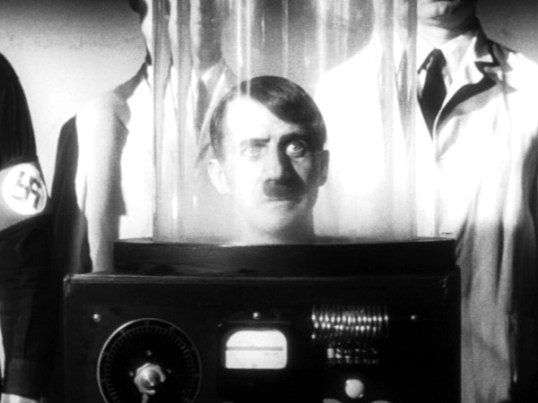
hitlerbrain6

When I started the 44 Days of Paranoia, I said that I was going to not only look at some of the best conspiracy-themed films but some of the worst as well.  With that promise in mind, today’s film is 1963’s They Saved Hitler’s Brain.

Beyond what’s obvious from the film’s title, what exactly is They Saved Hitler’s Brain about?

Your guess is as good as mine.

The film starts with a Mr. Van Pelt, who is a top official at the Central Intelligence Division.  It turns out that Mr. Van Pelt is also a part of a shadowy conspiracy that operates out of the South American country of Mandoras.  The conspiracy is developing a poison named as “G-gas” but a scientist named Dr. Bernard has developed an antidote to G-gas.  So Van Pelt orders his henchmen to blow up Dr. Bernard in his car.

Van Pelt then assigns two CID agents to investigate Dr. Bernard’s death.  Vic Gilbert is a real man’s man who is upset at having to work with a woman.  Toni Gordon wears an extremely short miniskirt, demands to be taken seriously as a CID agent, and — well, that’s about the extent of her characterization.  Anyway, Vic and Toni spend some time exchanging some cutesy dialogue and reading a lengthy dossier about Mandoras.  It turns out that Mandoras is full of Nazi war criminals which, of course, brings us back to the film’s title.

Also, it turns out that Dr. Bernard told his colleague, Dr. Coleman, about the antidote.  So, Van Pelt sends his henchmen to kidnap Coleman but fortunately, Toni just happens to be driving by at the same time that Coleman is kidnapped.  Toni follows the henchmen and Coleman to Van Pelt’s secret hideout.  The henchmen spot Toni and end up shooting her as she flees to a phone booth but not before Toni manages to call Vic.

Vic then shows up and discovers that Van Pelt is a traitor.  Fortunately, Toni isn’t quite dead yet so she manages to shoot Van Pelt before she expires but then Vic dies anyway, the result of driving his car into a power station.

And then, suddenly, an entirely new movie begins!

That’s right — They Saved Hitler’s Brain is one of those films that was essentially created by editing two unrelated movies together.  All of the Vic and Toni footage was apparently filmed in the late 60s by a bunch of students at UCLA who were hired by the film’s distributor to lengthen the original 1963 film so that it could be sold into television syndication.  Considering that the original film (which was titled Madmen of Mandoras) was a thorough mess, the addition of the equally confusing prologue serves to make They Saved Hitler’s Brain into one of the most completely incoherent films ever made.

Anyway, the “second” part of They Saved Hitler’s Brain deals with Coleman’s daughter and her boyfriend (who, we find out, is yet another CID agent) going down to Mandoras and searching for her father.  It turns out that the government of Mandoras has been secretly taken over by a bunch of Nazi war criminals who take their order from — wait for it — Hitler’s Brain!

It turns out that Hitler’s head has been preserved in a jar and, despite no longer having a body, he’s still capable of plotting, ordering people about, and dramatically rolling his eyes.  From his hiding place in Mandoras, he’s come up with Plan G, a scheme that will allow him to conquer the world.  Unless, of course, the CID can stop him…

(Were the filmmakers worried about getting sued by the CIA?  Seriously, CID just doesn’t have the same ring to it…)

Now, I have to admit that I have a soft spot for terrible films like They Saved Hitler’s Brain.  There are a lot of bad movies out there but there are only a few movies that are so bad that they’ve managed to become classics of ineptitude.  To the filmmakers behind movies like They Saved Hitler’s Brain, I would say that if you can’t take pride in making one of the best films ever made, why not take some pride in making one of the worst?

You can judge for yourself below.

44 Days of Paranoia #8: Three Days of the Condor (dir by Sydney Pollack)


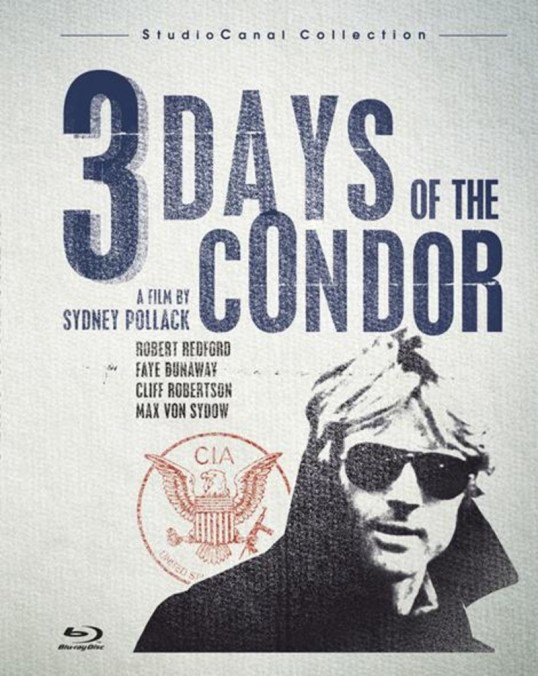
3DaysofTheCondor

When I first decided that I wanted to do the 44 Days of Paranoia, I went on Facebook and I asked my movie-loving friends to name some of their favorite conspiracy-themed films.  As the replies came flooding in, one thing that I quickly noticed was that a lot of them were naming films that had been made in the 1970s.

Usually, when I think about the 70s, I tend to assume that everyone in Texas was smoking weed in a high school parking lot, everyone in New York was snorting cocaine in Studio 54, and everyone in America was dancing nonstop.  And, to be honest, that doesn’t sound too bad to me.  If the 70s were just ten years straight of Dazed and Confused and Saturday Night Fever, then I would be the first one to hook up with anyone who could build a time machine.

However, the 70s were apparently also a very paranoid time.  When one looks over the most acclaimed and best-remembered films of the 70s, one is struck by the feeling that nobody trusted anyone and all official institutions were suspect.

Case in point: 1975’s Three Days of the Condor.

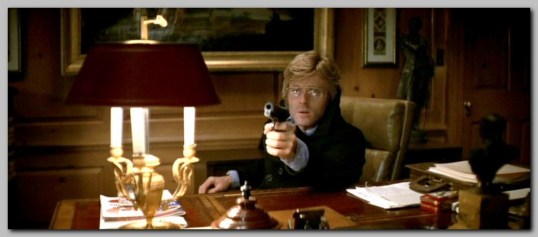
Robert Redford plays Joe Turner, a mild-mannered guy who works for the American Literary Historical Society in New York City.  The Society, however, is a CIA front and Turner’s job is to read cheap spy novels and analyze them to see if any real intelligence leaks might be found between the lines.  As the film opens, Turner arrives late for work.  He jokes with the chain-smoking secretary, shares a few curt words with his superior Martin, and flirts with fellow researcher Janice.  Then, Joe goes to lunch and, while he’s gone, Max Von Sydow shows up with a bunch of killers and guns down everyone else at the safe house.

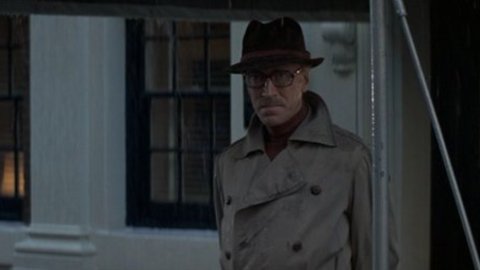
Max Von Sydow's courtly killer

Max Von Sydow’s courtly killer

The scene in which Von Sydow calmly kills all of Joe’s co-workers is one of the most disturbing that I’ve ever seen.  As directed by Sydney Pollack, the film’s violence comes in short, brutal bursts that are all the more nightmarish for lacking any of the flashy choreography that we, as viewers, have been conditioned to expect whenever we’re confronted by violent death on-screen.  Pollack also makes good use of Von Sydow’s kindly eyes and courtly manner, letting us know that, for him, murder is just a job.  Even though we’ve only spent a few minutes with Joe’s co-workers, we’ve still grown to like them and that makes Von Sydow’s matter-of-fact attitude all the more disturbing.

(It’s been a few days since I saw the film and I have to admit that I’m still haunted by the close-up of the burning cigarette still held in the dead secretary’s hand or the way that Martin’s toupee falls off his head after he’s shot.  Small as these details may seem, they stick in the mind and create a sickening feeling of life interrupted.)

When Joe returns from lunch, he finds all of his co-workers dead.  Fleeing the safe house, Joe calls the New York regional director of the CIA, Higgins (Cliff Robertson).  Higgins arranges for Joe to meet up with another agent and to be taken to safety.  However, when Joe arrives for the meeting, the other agent attempts to kill him.

Realizing now that the CIA specifically hit its own safe house and is now looking to kill him, Joe ends up kidnapping Kathy Hale (Faye Dunaway), a neurotic photographer, and forcing her to hide him while he desperately tries to figure out why he’s been targeted.

Thanks largely to Sydney Pollack’s thoughtful direction, Three Days of the Condor is an excellent, exciting, and thought-provoking thriller and, despite having been released close to 40 years ago, it features one major plot that’s probably even more relevant today than when the film was first released.  Redford and Dunaway both give excellent performances but the film really belongs to Max Von Sydow’s menacing and charming assassin.  Most of today’s “action” filmmakers could learn a lot from watching Three Days of the Condor.

end_office

44 Days of Paranoia #7: Beyond the Doors (dir by Larry Buchanan)


beyondthedoorsomrfrfgrg

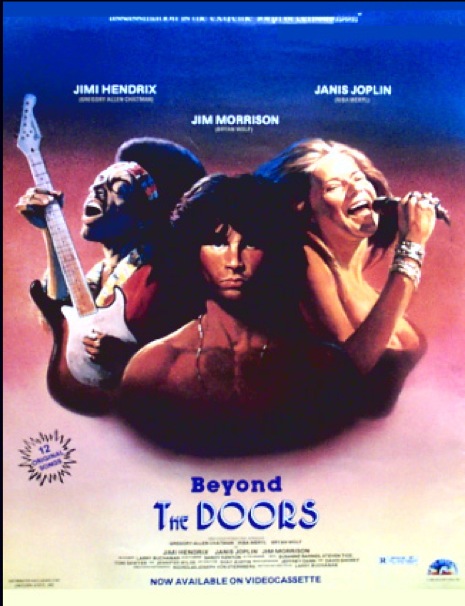
While I was researching The Trial of Lee Harvey Oswald last week, I came across another film directed by Larry Buchanan.  Beyond the Doors (also known as Down On Us) sounded like one of those truly odd films that I simply had to see for myself.  Fortunately, it turned out that this rare and hard-to-find movie was available (in 13 parts!) on YouTube.

First released in either 1983 or 1984 (sources vary), Beyond the Doors tells the story of a FBI agent who, as the film begins, is out hunting with two friends who proceed to gun him down.  Staring down at the agent’s dead body, one of the assassins sneers, “Rock and Roll is dead.  Long live Rock and Roll.”  The agent’s son then goes through his father’s files and discovers that, during the late 1960s and early 70s, his father was responsible for murdering “the three pied pipers of rock and roll” — Jimi Hendrix, Janis Joplin, and Jim Morrison.  The film then enters into flashback mode and we discover both why the U.S. government was determined to kill Hendrix, Joplin, and Morrison and how exactly they attempted to do it.

What can I say about Beyond the Doors?  If The Trial of Lee Harvey Oswald seemed oddly respectable for a Larry Buchanan film, Beyond the Doors reminds us of why Larry Buchanan remains a cult figure for bad film lovers.  Everything that Buchanan is known for is present in this film: unknown actors playing real-life characters, melodramatic dialogue, one set continually redecorated to look like a dozen different rooms, and plenty of conspiracy theories.   As is typical of a Larry Buchanan film, it was shot with a lot of ambition but next to no money or actual talent.  Hendrix, Morrison, and Joplin are played by lookalikes who give performances that don’t so much resemble their real-life counterparts as much as they seem to literally be Wikipedia entries brought to life.  Hendrix worries that he’s sold out to the man, Joplin questions what fame’s all about, and Morrison makes pretentious observations.  Buchanan couldn’t actually afford the rights to any songs from Joplin, Hendrix, or the Doors so instead, the soundtrack is full of music that’s designed to sound as if it could have been written by one of the “three pied pipers of rock and roll” even though it wasn’t.  (And yes, the end result is just as silly as it sounds.)  In short, Beyond the Doors is one of those films (much like Tommy Wiseau’s The Room) that is so amazingly bad and misguided that it becomes perversely fascinating.

In short, it’s a film that, like me, you simply have to see for yourself.

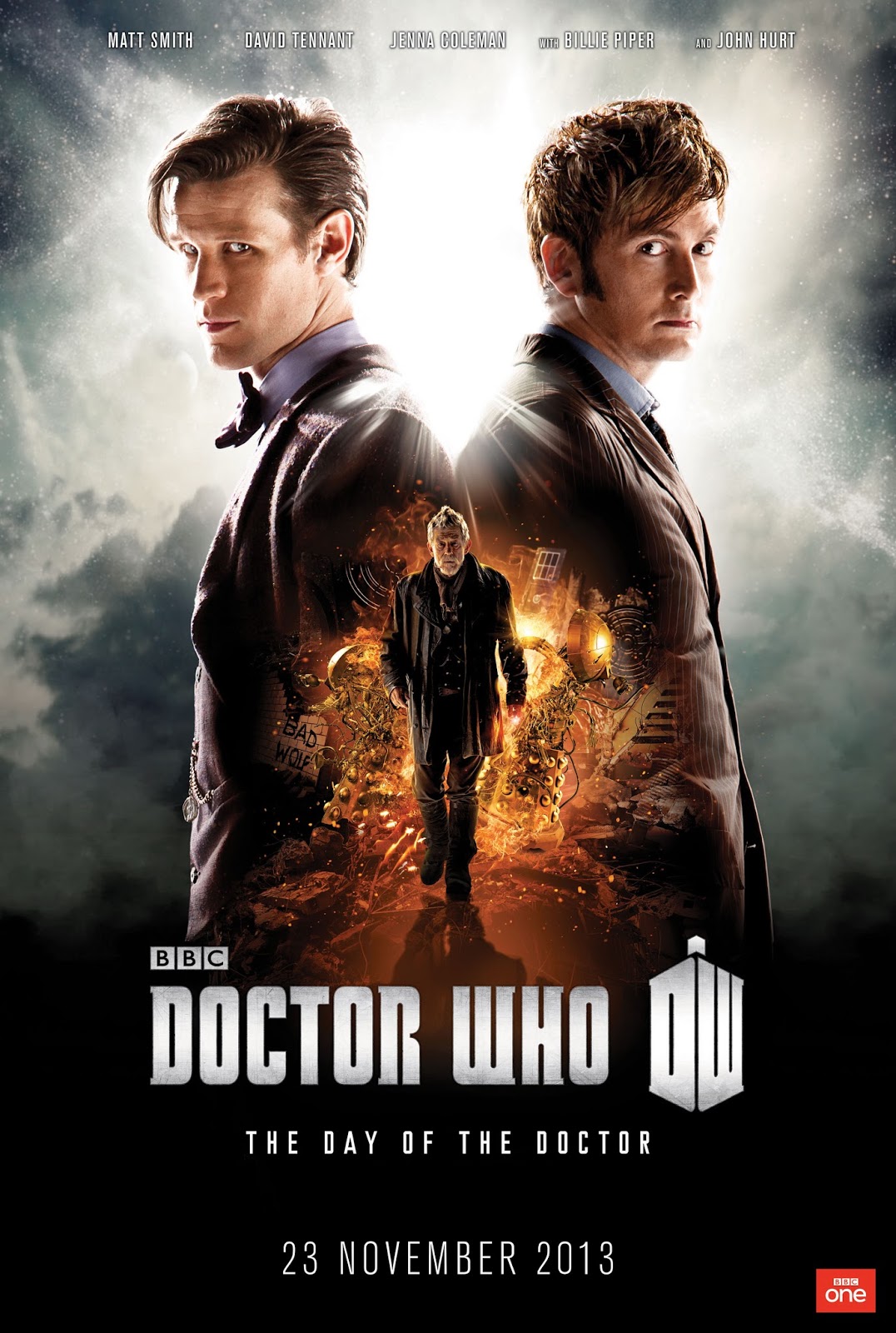
Trash TV Guru : “The Day Of The Doctor” — The “Doctor Who” 50th Anniversary Special


4753398-high-doctor-who


First off, a couple of disclaimers : this is one of those reviews that’s going to pre-suppose a fair amount of knowledge about the BBC’s Doctor Who  from the outset, so if you’re not at the very least a casual viewer of the show, you’re going to feel pretty lost right from the word go. So, ya know — newbies beware. Secondly, it’s well-nigh impossible, at this point, to discuss The Day Of The Doctor without indulging in some pretty serious “spoiler talk,” so if you’re part of the legion of “spoiler police” that apparently have nothing better to do than troll around the internet looking to play seagull (fly in, make a lot of noise, shit all over everything, and fly back out) with any review that gives away any plot points whatsoever, now would be a good time fuck directly off. Major “spoilers” do, in fact,  abound here, so — you’ve been warned.

Now, with all that out of the way —

For those of us who have been “Whovians” for a long time, the 50th anniversary really has been something of a “pinch me, I gotta be dreaming” type of year, hasn’t it? Especially for us sad souls who stuck with fandom during the so-called “wilderness years” between 1989 and 2005, when the 30th anniversary gave us the debacle that was Dimensions In Time, the 35th anniversary gave us — well, nothing, I guess — and the 40th anniversary essentially went unnoticed, even by us, because we were all too busy speculating about what the  just-announced-at-the-time new series would end up looking, feeling, and being like.

Our only frames of reference, then, for how the BBC would celebrate a major anniversary with the show as a going concern were the 10th, 20th, and 25th anniversaries. For the tenth, there wasn’t much by way of hoopla and tie-in merchandising and the like, but we did get The Three Doctors (why I’m saying “we” here I have no idea, as I was barely two years old at the time and had never, to my knowledge at least, seen the show — but whatever), which was not only the first big “reunion story,”  but a pretty cracking good adventure, as well, that introduced the now-legendary figure of Omega into the Who mythos.

For the 20th, it has to be said that the Beeb pulled out all the stops. For one splendid year there they seemed to be willing to acknowledge that this creaky little cheap show that they tried their best to keep out of the public eye really was a genuine global phenomenon despite their best efforts to make it anything but, and we got a slew of anniversary-themed books, toys, magazines, posters — you name it.

And there was Longleat. Ah, yes, Longleat. Fandom’s own Woodstock. The biggest single Doctor Who-related event ever, tales of it still abound — and, like fish stories, grow with each re-telling — to this day. I wasn’t there. I was a 12-year-old kid in the US. But  we heard about it,  even without the benefit of instantaneous online communication. It sounded great then. It sounds even better now. Memories, real or imagined, of Longleat frankly eclipse anything else as far as the 20th anniversary is concerned, especially since the special 90-minute “reunion story” we all got to see, The Five Doctors, was a rather tepid affair at best.

I’ll tell you what, though — warts and all, The Five Doctors was a key moment for American fans for one simple reason : we got to see it first. That’s’ right, us poor yanks, who had yet to see William Hartnell, Patrick Troughton, or, in most cases, even Jon Pertwee reruns — we sad former colonists who had been subsisting on a diet of the same Tom Baker and Peter Davison stories over and over again ad infinitum — we got the anniversary special a matter of hours before it was shown on its own native soil. There was a quiet message being sent here — try as the suits at the BBC might to present an image on the home front as a broadcasting organization that specialized in period costume dramas and in-depth news (remember when there was such a thing?), internationally, they knew which side their bread was buttered on. Doctor Who was their number one worldwide property, and the booming American fan market was where the action was. Let’s just not tell the folks back in the UK, shall we?

Following on from that, though, something curious happened — more or less immediately after admitting that an international breakthrough was taking place, with a Doctor Who  convention going on, quite literally, every weekend in one major American city or other, Auntie Beeb suddenly remembered that the show was an embarrassment. At the very same moment that an ever-hungrier North American fan base was clamoring for more Who, the powers that be decided to give us less. In these days before mass-released DVD or even VHS, a famished fan can only subsist on the same set of re-runs over and over again for so long, and the BBC effectively killed its own golden goose by putting the show “on hiatus” for 18 months — then giving us drastically shortened seasons when it did, in fact, quietly return.

As a result, the 25th anniversary was a complete disaster, both at home and abroad. Very little recognition was given to the occasion from official quarters, and the “special story” broadcast to commemorate what should have been a proud milestone instead was a limp little Cybermen three-parter called Silver Nemesis that essentially followed the exact same plotline as the recently-concluded (and far superior) Remembrance Of The Daleks, only with different villains.

All in all, it was an anniversary well worth forgetting.

Fast forward a quarter century and things couldn’t be more different. Doctor Who is the shit, as far as the BBC is concerned. This is is a new iteration of Who, of course, broadcast by a new BBC that, for good or ill,  has its eye more on its balance sheets than its purported reputation.  Fans around the world are lapping it up, Who-themed merchandise is ubiquitous, and the money machine is rolling. Of course the 50th anniversary is going to be the biggest multi-media juggernaut the BBC has ever undertaken, what do you think they are — stupid?

Full disclosure — I’m something of a curmudgeon when it comes to Doctor Who. I miss the days when the cracks showed and the creaks could be heard. I loved the inventiveness that the Philip Hinchcliffes and Robert Holmeses and Barry Lettses and Malcolm Hulkes (among too many others to mention) were forced to either find or fall back on to make silk purses out of sow’s ears. I loved the first season of the new series, to be sure, but it’s been leaving me feeling increasingly unimpressed ever since. Under Russell T. Davies’ stewardship, I felt it became bland and formulaic. Under Steven Moffat’s.  it’s become bland, formulaic, and overly impressed with itself.

But never once did I consider throwing in the towel and walking away. No sir (or madam). You always keep hope alive for the home team.

And so here we all are — November 23rd, 2013, exactly 50 years to the day from the broadcast of An Unearthly Child, and all of us, everywhere around the world, get to see The Day Of The Doctor, the culmination of an entire year of set-to-overdrive mass-marketing, at exactly the same time.

But was it any good?  And, furthermore, are we all still a bit too giddy to even care?

Well, having watched it twice now, I feel the time has come to give it at least something  of a fair-minded analysis, even if the glow of the occasion hasn’t faded entirely just yet.

day-of-the-doctor-batch-b-6


Indications were that we would probably very well be in for a monumental-type story that would shake the foundations of everything we knew and shake up the Etch-A-Sketch all over again. After intense months of speculation, the Night Of The Doctor mini-“webisode” (and thank you thank you for bringing  back Paul McGann !) confirmed that John Hurt was, indeed, a “missing Doctor” that none of us had known about before — furthermore, he was no ordinary Doctor, he was “The War Doctor,” whatever that means. We figured there would be Daleks. We knew David Tennant and Billie Piper were returning. We assumed we’d be plunged back into the Time War — and, once it was announced that Eleventh Doctor Matt Smith would be departing come the Christmas special, we guessed that we might finally get some inkling as to what his (far too heavy-handedly) forthcoming demise at a place called Trenzalore was all about.

We got some of that. And something else that we probably weren’t expecting, as well — an accessible, “stand-alone” story featuring the return of fan- favorite monsters the Zygons. For a time, at any rate.

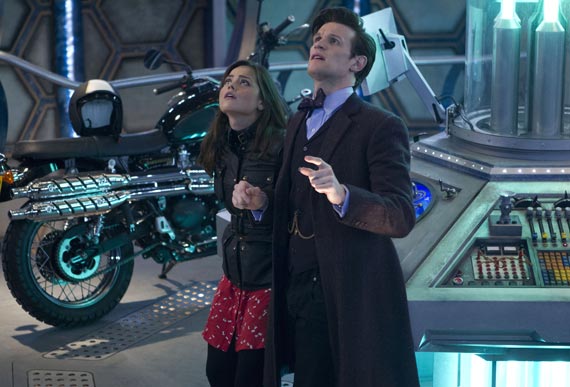
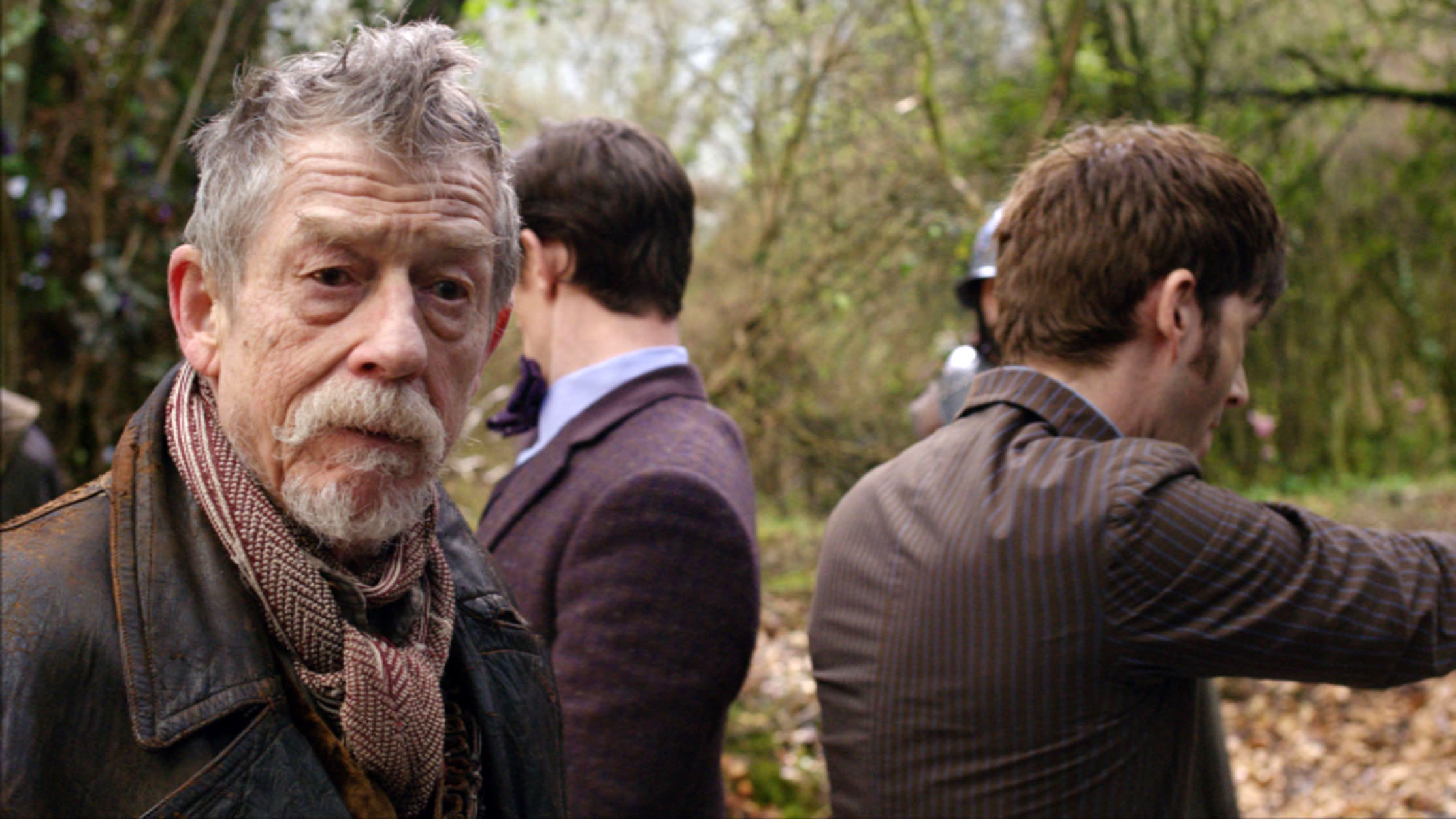
There’s some rather bland set-up material (that once again bastardizes the memory of U.N.I.T., this time doubling the insult by throwing The Brigadier’s daughter into the mix) with Smith and current companion Clara (played by Jenna Coleman) at the outset, then we do, in fact, go back into the Time War with John Hurt’s War Doctor, then we get re-introduced to Billie Piper (not, mind you, as Rose Tyler — in fact, she seems to still think she’s working on The Secret Diary Of A Call Girl here), and then, after cribbing much of the basic multi-Doctor story set-up idea from both The Thee Doctors and The Five Doctors, writer/head honcho Steven Moffat takes a turn and gives us a somewhat nifty standard-issue Zygon -invasion story that pretty much works, even if he did rip the core idea straight from Grant Morrison’s old Doom Patrol story “The Painting That Ate Paris.” No real harm in that, mind you — Doctor Who has often been at its best when liberally “borrowing” from other works.

Then, though, things do go a bit pear-shaped (again). After lots of fairly successful three-Doctor banter, some good, old-fashioned breaking out of jail cells (that were never locked, but that’s another story), some running around in corridors (yes!), and some nifty little doppleganging that should adequately thrill n’ chill the kiddies in the audience (and ,okay, some of us grown-ups, as well), Moffat does something — I dunno. Curious, I guess, if you’re being generous, and stupid and/or lazy if you’re not.

After spending over 40 minutes bringing the human/Zygon confrontation to a head, getting them all in a room, and employing a very nifty conceit to flat-out force them to negotiate, he drops the whole story. We never find out how it ends. And we’re back in Time War territory again. Only this time with a bigger Deus Ex Machina at the center of it than even anything RTD ever gave us — a big Hellraiser-box-on-steroids with a gleaming red button that the Doctor can push to just end everything.

And he does. Or did. But he doesn’t anymore.
Doctor Who – 50th Anniversary Special - The Day of the Doctor


Look, we all know that this show has strayed pretty far from its roots. “You can’t change history, Barbara! Not one line!” has given way to a new “philosophy” of “time can be re-written.” But this, well — let’s just say that the very events that gave birth to the Ninth (or I guess that should now be Tenth) Doctor, Christopher Eccelston, and in turn his successors in the role — well, they’re just no more. The past seven seasons of the show? Well, I guess they still happened — but now, apparently, not the way we saw them. At least not anymore. And the Doctor is most certainly no longer the “Last Of The Time Lords.”

So — what does it all mean? Shit, I dunno. Gallifrey still exists. In a painting.  It never stopped existing (except, ya know, when it did). And whereas the entire history of Doctor Who is based on the concept of a Time Lord running away from home (even though that mythology was developed nearly a decade after the show first aired) — a point that was re-emphasized in The Five Doctors with Fifth Doctor Peter Davison”s famous “Why not? That’s how it all started!” line — now we’re told that the Doctor is going “where I’ve always been going — back home.”

So, ya know, all that Trenzalore stuff we’ve been building up to? Forget all that. It’s Gallifrey or bust now, folks!

I guess all this should be exciting — and maybe, on paper, it is. I like being thrust into unknown waters as far as Doctor Who goes. Even though I’m a bit of a self-admitted sad old traditionalist, as stated earlier. In the days when all we had going were the Eighth Doctor BBC novels, Lawrence Miles’ much-maligned Interference, which basically set all of Who continuity on its ear (for a time, at any rate) excited me. And all this could well do the same — if I had more confidence in the current show-running regime to get things right. Which I don’t. Buuuuuuttttt —

They did get some things here right, unquestionably. The “old school” opening shots in  black and white, complete with vintage theme music, were marvelous. The direction by Nick Hurran was energetic, pacy, and cinematic (in a good way) throughout. The Three Doctors redux portion of the story, with John Hurt functioning as a William Hartnell stand-in, was a joy to watch. Clara seems to be coming along nicely as a companion and was essential to the proceedings here without overshadowing them — as Davies had a tendency to do with Rose, in particular.  And as for that ending —
doctor-who-day-of-the-doctor-nov-17-13


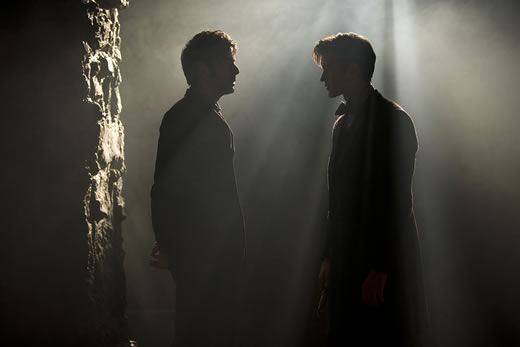
Okay, it was about as subtle as a neo-Nazi march through downtown Tel Aviv in broad daylight, I’ll grant you — Clara : The curator wants to see you. The Doctor (sitting, as Clara exits) : Okay. A curator. I’d like to be a curator. I’d be a good curator. Curators are cool. I should retire one day. Maybe I’ll be a curator when I retire. Yes, that’s it, I’ll retire and be a curator. In fact, I bet in some “timey-wimey” way I’ve already done that. And this curator guy who’s about to talk to me, shit, who are we kidding? It’s me. Or another of me, at any rate. It’s Tom Baker. He’s here. In the building.  That’s Tom Baker standing right behind me — but still : it was. Tom Baker. Standing right behind him. And yes,  the dialogue was trying too hard to be mysterious and momentous and came off instead as clumsy, but cone on, people. There he was. The Doctor. My Doctor. And I deserve to smile for the rest of the day for that reason alone. And so do you.

So who knows? Maybe a partial changing of the guard is all that’s in order here. Maybe Moffat just needs to scrap all the baggage that’s hanging on Matt Smith — baggage that, okay, “The Moff” himself put there, but let’s not nitpick here — and start fresh with Thirteenth (did I get that right?) Doctor Peter Capaldi, who actually makes his brief debut in this story in another very cool (if, yeah, very gimmicky) moment. Maybe a re-write of the last seven-plus seasons is just what — sorry! — the Doctor ordered. Maybe it’ll be good for him to go home again. If — and only if — once that’s all over,  he follows the best advice his Ninth (excuse me, I guess that’s Tenth) persona ever gave : “run for your life!”

I’ve been waiting a good few years now for Doctor Who to relieve itself of the burden of its own excesses and get back to the strength — and dare I say beauty — of its core premise, as so splendidly told in Mark Gatiss’ awe-inspring TV movie (and the real highlight of the 50th anniversary so far) An Adventure In Time And Space — a mysterious traveler making his way through the the past, the present, and the future of the whole,  entire universe in a rickety old blue police box that’s bigger on the inside than it is on the outside. That, right there, is all we’ve ever needed.

The Day Of The Doctor did enough , glaring flaws notwithstanding, to make most any fan — including this one — feel more than just a little bit giddy throughout, and I’m reasonably thankful for that,  but it came up short in terms of re-setting the table in the kind of fundamental fashion I’m still hoping to see. It rattled the cupboards, and that’s a good first step, but we’ll have to see where and how the pieces fall after the Christmas special, which has rather stolen its thunder as the big “event” piece of Doctor Who for the year. We seem to be heading straight into the heart of Who mythology and continuity for one last (I hope, at any rate) big blow-out. So, yeah — let him go home again. If that’s what he needs to do to run away.

After all, that’s how it all started.
 

44 Days of Paranoia #6: JFK (dir by Oliver Stone)


JFK-John-F-Kennedy-DVD-Yon-OLIVER-STONE__76044126_0When I first decided to do this series of reviews of conspiracy-themed films, I knew that I would eventually have to review the 1991 Oliver Stone film JFK.

JFK is one of those films that continues to divide audiences.  Those who think that John F. Kennedy was killed by a conspiracy tend to love this film and are given to describing JFK as being “one of the most important films ever made.”  Those who believe that Lee Harvey Oswald was the lone assassin dismiss Stone’s film as being left-wing propaganda.  Just check out  the message board at the imdb if you need evidence of just how worked up people get over this film and its subject matter.

It seems that very few of the people who criticize or praise JFK ever review it as a work of cinema.  Instead, they focus on the film’s politics.  If I criticize the film for wasting the talents of Sissy Spacek or featuring one of Kevin Costner’s least interesting performances then I’m running the risk of having to deal with angry conspiracy theorists telling me that I need to open my eyes to the reality of American history.  On the other hand, if I praise Tommy Lee Jones’s wonderfully decadent turn as one of the film’s conspirators, chances are that someone is going to accuse me of being a naive leftist.

Then again, perhaps that reaction is to be expected.  Oliver Stone is one of our most political and least subtle filmmakers.  His movies are specifically designed to challenge the status quo.  For that reason, it’s not surprising to discover that Stone considers JFK to be the best of all of his films.

JFK is based (rather loosely, some claim) on the true story of New Orleans District Attorney Jim Garrison (played by Kevin Costner) and how, in 1967, he charged businessman Clay Shaw (played by Tommy Lee Jones) with being a part of a conspiracy to kill John F. Kennedy.  Shaw was eventually acquitted and both Jim Garrison and his investigation remain controversial to this day.

JFK courts controversy immediately with its portrayal of Jim Garrison.  I’ve read several accounts of the Garrison investigation and the one thing that they all seem to agree on is that Jim Garrison was a flamboyant, bigger-than-life figure who enjoyed publicity.  Even among those who believe that Garrison uncovered some valuable evidence as a result of his investigation, there is a good deal of ambiguity about Garrison’s motives.  However, in Stone’s film, Jim Garrison is played by Kevin Costner and is portrayed as being an incorruptible, all-American idealist.  It’s not that Costner gives a bad performance.  Instead, it’s just a rather uninteresting one, especially when one compares Costner’s Garrison to some of the stories about the real-life Garrison.

However, as the film unfolds, it becomes obvious that Stone is using Costner’s blandness to the film’s advantage.  Over the course of three hours, JFK slowly peels back layers of secrecy and cover-ups and reveals the shadow world that, according to Stone, lurks underneath everyday reality.  Costner’s Garrison might not be interesting but he is a stable presence.  He anchors the film, giving us someone to relate to while the film itself grows more and more bizarre.

While Costner’s might give the least interesting performance of his career in this film, the same cannot be said of the rest of the cast.  JFK is full of familiar faces, many of whom are only on-screen for a few minutes but all of which play an important role in creating Stone’s shadow universe.  Kevin Bacon, Gary Oldman, Joe Pesci, Michael Rooker, Donald Sutherland, and Tommy Lee Jones; they all have small roles but every single one of them makes an undeniable impression.  Whether you agree with the film’s conclusions are not, it’s impossible not to enjoy JFK for the chance to spot a bunch of familiar faces giving memorably bizarre performances.

But ultimately, its impossible to review JFK without considering the film’s conclusions.  JFK makes the case that John F. Kennedy was killed as the result of a massive right-wing conspiracy that involved the military, business interests, the CIA, the FBI, anti-Castro Cubans, and the mafia.  By the end of the film, the question becomes less who killed JFK and more who didn’t kill JFK.

Myself, I’m not going to claim to be enough of an expert on the Kennedy assassination to argue whether JFK is accurate or if it’s just propaganda.  However, as a film reviewer, I can say that it’s a very well-made and powerful film but it’s also one of those films that works better the first time you see it than the second time.

The first time you see it, the film overwhelms you.  It leaves you convinced that yes, there was a conspiracy and yes, everyone was involved and yes, Jim Garrison was right!  It convinces you so thoroughly that you end up using exclamation points, just to make sure everyone knows how convinced you are.

However, with each subsequent time that you view JFK, you became a bit more aware of just how manipulative and one-sided it truly is.  You become a bit more aware of the technique underneath the outrage and, if you’re a smart film watcher, you remember that JFK is a recreation as opposed to being a historical document.  You become more and more aware that Stone approached the material with a destination in mind and, like any good director, he has specifically shaped the material to make sure that you reach that destination at the end of the journey.

That was certainly my experience with JFK.  I first saw it in high school and it convinced me that JFK was the victim of a conspiracy.  Then, when I was in college, I watched it for a second time and, though I still believed the film’s conclusions, I also found myself much more aware of how the film’s length and Stone’s direction were designed to beat the audience into submission.  When I saw the film a third time, I found myself resenting the film’s manipulative nature and, as a result, I found it a lot more difficult to accept Stone’s conclusions.

However, when I rewatched the film last night for this review, I was surprised to discover that JFK actually holds up pretty well.  It’s still way too long (and, unlike a lot of other reviewers, I am not impressed by the droning speech that Costner delivers at the end of film) and Stone’s lack of subtlety does backfire on a few occasions.  However, perhaps because I was finally watching the film as entertainment as opposed to judging the film on its political or historical merits, I discovered that JFK is a watchable and entertaining film, one that does a pretty good job of making Stone’s case.  If nothing else, it’s worth watching just for the chance to see the wonderfully snarky performances of Tommy Lee Jones, Kevin Bacon, and Gary Oldman.

Perhaps the best thing that I can say about JFK is that its the type of film that will inspire smart people to do their own research and come to their own conclusions, which may or may not be the same conclusions that Oliver Stone reaches.

And, honestly, isn’t that the most that we can ask of any film?

JFK

Scenes I Love: Drive Angry


DriveAngry3D

“Gentlemen, aim for their tires.”

Drive Angry came out in early 2011 and it was one of those films which everyone thought was going to flop and flop hard. It did flop like a dying carp on a desert dune, but it was also one of the most fun flicks of the year. People just didn’t get what the film was about and trying to do. I, for one, was of the minority that got “it”.

This film starring Nicolas Cage going the subdued crazy route had so many funny and WTF sequences that it was difficult just to pick one, but pick one I shall.

I think the sequence where William Fichtner’s supernatural bounty hunter, The Accountant, chasing and assisting the undead John Milton on his vengeance ride against a Satanic cult leader, and to the tune of the KC and The Sunshine Band’s “That The Way (I Like It)” classic song was a major favorite. It emphasized just how over-the-top Drive Angry turned out to be, but in a fun and hilarious way. William Fichtner just chews the scenery in this scene. I also like how Tom Atkins, himself a veteran of grindhouse flicks, matches Fichtner chew for chew.