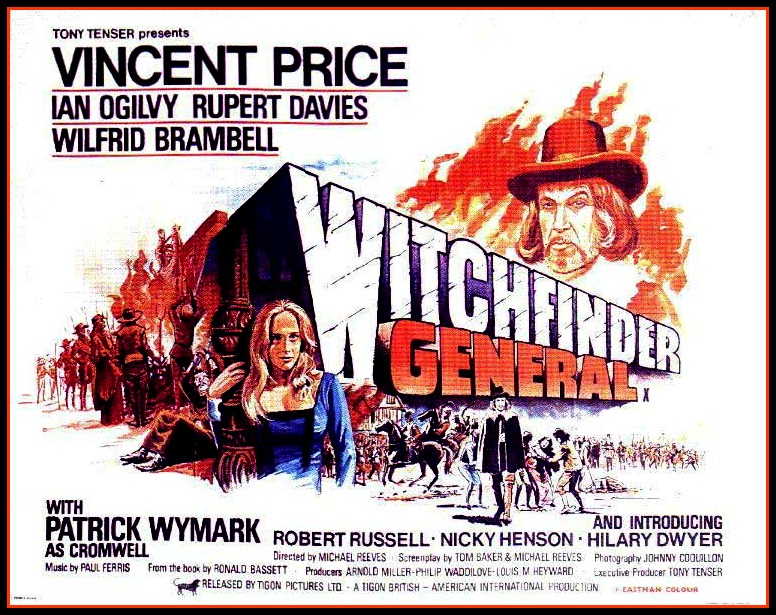
The late 1960’s saw a major shift in horror films. There have always been horror films which had an inordinate amount of gore and violence, but were always relegated to the niche cinemas which catered to horror exploitation films. In 1968 it all changed with the release of George A. Romero’s Night of the Living Dead. Not only did this film graphically show gore and violence on the screen it also paired it with a well-told story. Another film which became infamous the very same year for it’s portrayal of torture, rape and sadism on the screen was British filmmaker Michael Reeves’ horror film, Witchfinder General.
Witchfinder General starred horror icon Vincent Price in the title role as Matthew Hopkins who was tasked as the Witchfinder General by the Cromwell government during the English Civil War of the 17th-century. His Hopkins would travel the region of East Anglia (Cromwell-controlled territory) rooting out witchcraft and sorcery wherever they might be found. Assisting him in this task is the thuggish, brute Stearne (played by Robert Russell) who relished in torturing suspected witches in towns the two visit. It’s during one such visit to the town of Brandeston, Suffolk that Hopkins and Stearne begin a sequence of events which would pit them against the soldier Richard Marshall (who also happens to fight on the same side as Hopkins and Stearne) whose fiancee and her uncle became the latest victims of the Witchfinder General’s sadistic methods of rooting out confessions.
The film as a horror has less to do with the supernatural, but more of the hypocritical horror which begets a political environment where powerful men contest for more power and uses fear and the superstitious ignorance of a populace to cement their power. In this amoral vacuum comes in the opportunistic Matthew Hopkins who uses the power given to him by his government to not just do his duty to eradicate witchcraft but also abuse it for his own personal (and as seen in the film a way to sate his own personal lusts) gain. It’s this hypocritical nature of who was suppose to be a Puritanical and righteous agent of God which emphasizes the true historical horror of religion and politics becoming one and the same.
Vincent Price as Matthew Hopkins was at the top of his game in Witchfinder General. He gives his role not just an air of superiority over everyone he meets and deals with, but he also makes Hopkins’ truly an amoral character who sees nothing wrong in taking advantage of his position and actually feels like he deserves the desperate attentions of those willing to do anything to save their loved ones from his machinations. Robert Russell as his licentious and sadistic assistant Stearne also does a great job in portraying an individual who might seem brutish and thuggish, but who was also more honest with is situation than his master. It makes for an interesting pair despite their roles being the film’s prime antagonists.
The film more than truly earned the outcry it received upon it’s release in 1968 as scenes of torture and sadism was extreme for a British horror film industry so used to the Gothic sensibilities of the Hammer Films of the era. Graphic depictions of burnings, torture and drowning were done not to seem gratuitious or to cater to the burgeoning gorehound crowd of the era, but done so matter-of-factly that they seem even more horrific.
The Witchfinder General really helped usher in the death of gothic horror which dominated the genre with the Hammer Films in the UK and the Edgar Allan Poe films of Roger Corman in the US. The film continues to impress new generations of horror fans and is still considered by older fans of the genre as one of the best horror films ever made. For some the film might look dated due to the acting (most of the actors of the era were stage actors first and film ones second) and the effects work, but they also fail to look at the film in context of the era and how even by today’s standard it would still shock those not well-versed in the genre of horror. They definitely don’t make horror films like this anymore and that’s a shame on many levels.
I’m watching one of my favorite movies, Walk Hard, on Comedy Central right now. One of the highlights of the film for me is when Dewey Cox goes to India and meets “the Beatles.” I love the way everything in this scene parodies every single music biopic ever made.
Let’s start things out with this film from 1988. I haven’t seen this film but the trailer has a certain silly charm to it and how can’t you enjoy the use of the fake lightning special effect? Plus, those finger nails screeching across the car — Agck! Freaky.
This is one of my favorite movies. Basically, a bunch of hippies take some really powerful acid in 1968 and then, eight years later, they end up having the worst flashback ever! To say that Zalman King gives an “interesting” performance as the film’s hero is a bit of an understatement.
“Jamie Lee Curtis is…Hitch.” Well, that would probably explain why she was destined to end up hitchhiking. Seriously, parents — give it some thought before you give your child any old name. Anyway, Road Games was director Richard Franklin’s follow-up to Patrick and it’s one of the better slasher films of the early 80s.
Oh my God, this looks like a bad movie. The trailer, however, is just so silly and kinda endearing in the way that it seems to desperately be saying, “No, it’s not as bad as it looks! Look — we have ice people!”
“Remember, remember the fifth of November, the gunpowder treason and plot. I know of no reason why the gunpowder treason should ever be forgot.”
Alan Moore’s decision to want his name off the final credits for the film adaptation of V for Vendetta now makes sense. Moore has had a hate/hate relationship with Hollywood and the film industry in general. They’ve taken two of his other works in The League of Extraordinary Gentlemen and From Hell. and bollocks’d them up (to borrow a term used quite a bit in V for Vendetta). Outside of Watchmen, Alan Moore sees V for Vendetta as one of his more personal works and after reading the screenplay adaptation of the graphic novel by The Wachowski Brothers his decision afterwards was to demand his name be removed from the film if it was ever made. Part of this was his hatred of the film industry for their past mistakes and another being his wish for a perfect adaptation or none at all. Well, V for Vendettaby James McTeigue and The Wachowski Brothers is not a perfect film adaptation. What it turns out to be is a film that stays true to the spirit of Moore’s graphic novel and given a modern, up-to-the-current news retelling of the world’s state of affairs.
V for Vendetta starts off with abit of a prologue to explain the relevance of the Guy Fawkes mask worn by V throughout the film and the significance of the date of the 5th of November. I think this change in the story from the source material may be for the benefit of audiences who didn’t grow up in the UK and have no idea of who Guy Fawkes was and what his Gunpowder Plot was all about. The sequence is short but informative. From then on we move on to the start of the main story and here the film adheres close enough to the source material with a few changes to the Evey character (played by Natalie Portman) but not enough to ruin the character. Caught after curfew and accosted by the ruling government’s secret police called Fingermen, Evey soon encounters V who saves her not just from imprisonment but rape from these so-called Fingermen.
Right from the start the one thing McTeigue and The Wachowski Brothers got dead-on was casting Hugo Weaving as the title character. Voice silky, velvety and sonorous, Weaving infuses V with an otherworldly, theatrical personality. Whether V was speaking phrases from Shakespeare, philosophers or pop culture icons, the voice gave a character who doesn’t show his face from behind the enternally-smiling Guy Fawkes mask real life. I’d forgiven the makers of this films for some of the changes they made to the story and some of the characters for keeping V as close to how Moore wrote him. Once V and Evey are thrown in together by the happenstance of that nightly encounter their fates became intertwined. Portman plays the reluctant witness to V’s acts of terrorism, murders and destruction in the beginning, but a poignant and emotionally powerful sequence to start the second half of the film soon brings Evey’s character not much towards V’s way of doing things, but to understanding just why he’s doing them. This sequence became the emotional punch of the whole film and is literally lifted word for word from the graphic novel. This is the sequence in the film which should resonate the loudest for most people whether they buy into the rest of the film or not.
The rest of the cast seemed like a who’s who of the British acting community. From Stephen Rea’s stubborn and dogged Chief Inspector Finch whose quest to find V leads him to finding clues about his government’s past actions that he’d rather not have found. Then there’s Stephen Fry’s flamboyant TV show host who becomes Evey’s only other ally whose secret longings have been forbidden by the government, but who’s awakened by V’s actions to go through with his own form of rebellion. Then there’s John Hurt as High Chancellor Adam Sutler who’s seen chewing up the scenery with his Hitler-like performance through Big Brother video conferences (an ironic bit of casting since John Hurt also played Winston Smith in the film adaptation of the Orwell classic 1984). I really couldn’t find any of the supporting players as having done a bad job in their performances. Even Hurt’s Sutler might have seemed over-the-top to some but his performance just showed how much of a hatemonger Sutler and, in the end, his Norsefire party really were in order to stay in power.
The story itself, as I mentioned earlier, had had some changes made to it. Some of these changes angered Moore and probably continues to anger his more die-hard fans. I count myself as one of these die-hards, but I know how film adaptations of classic literary works must and need to trim some of the fat from the main body and theme of the story to fully translate onto the silver screen. The Wachowski Brother’s screenplay did just that. They trimmed some of the side stories and tertiary characters from the story and concentrated on V, Evey and Inspector Finch’s pursuit of both the truth of V and his own journey in finding that truth. This adaptation wa much closer to how Peter Jackson adapted The Lord of the Rings. As a fan of Moore I understood why he was unhappy with the changes, but then Moore was and still is an avowed perfectionist and only a perfect adaptation would do.
Critics on both sides of the aisle have called V for Vendetta revolutionary, subversive, daring to irresponsible and propagandist. All because the film dares to ask serious questions about the nature and role of violence as a form of dissent. But the granddaddy question the film brings up that has people talking is the question: terrorist or freedom fighter? Is V one or the other or is he both? Make no mistake about it, V for all intents and purposes is a terrorist if one was to use the definition of what a terrorist is. The makers of this film goes to great lenghts to describe throughout the film just how Sutler and his Norsefire (with its iconic Nazi-like imagery and extreme fundamentalist Christian idealogy) party rose to power in the UK. Partly due to what seemed like the failed US foreign policy and its subsequent and destructive decline as a superpower and the worldwide panic and fear it caused as a result. V for Vendetta also ask just who was to blame for allowing such individuals to rule over them. V has his reasons for killing these powers-that-be, but he also points out that people really should just look in the mirror if they need to know who really was to blame. For it was the population — whose desire to remain safe and have a semblance of peace — gave up more and more of their basic liberties and rights for a return to order. If one was to look at the past 100 years they would see that it’s happened before. There was the regime of Pol Pot in Cambodia, Milosevic’s Greater Serbia, and the king of the hill of them all being Adolf Hitler and his Nazi Inner Circle.
Another thing about V for Vendetta that will surely talked about alot will be the images used in the film. Not just images and symbols looking so much like Nazi icons, but images from the events of the past decade which have become symbols of oppression and censorship. The film shows people bound and hooded like prisoners from Abu Ghraib. The reason of the war on terror used time and time again by Sutler to justify why England and its people need him and his group to protect them by any means necessary. V for Vendetta seems like a timely film for our current times. Even with the conclusion of the film finally accomplishing what Guy Fawkes failed to do that night of November 5th some 400 plus years ago, V for Vendetta doesn’t give all the answers to all the questions it raises. I’m sure this would be something that’ll frustrate them some audiences. So much of people who go to watch thought-provoking films want their questions answered as clearly as possible and all of them. V for Vendetta doesn’t answer them but gives the audience enough information to try and work it out themselves.
In final analysis, V for Vendetta accomplishes in bringing the main themes of Alan Moore’s graphic novel to life and even does it well despite some of the changes made. It is a film that is sure to polarize the extreme left and right of the political pundits and commentators. But as a piece of thought-provoking and even as a politically subversive film, V for Vendetta does it job well. It is not a perfect film by any respect, but the story and message it tries to convey in addition to its value as a piece of entertainment mor than makes up for its flaws. Alan Moore and his followers might not love and approve of this film, but it doesn’t mean the film in and of itself wasn’t a good one. Sometimes calls for literal adaptations of beloved works or no adaptation at all also becomes a form of creative oppression and censorship.
Well, we all knew it would have to end someday and now, it’s over. The Harry Potter film series, which began way back in 2001, is concluding right now in a theater near you. On Friday night, me, Jeff, my sister Erin, and our friend Evelyn went down to the AMC Valley View and we saw Harry Potter and the Deathly Hallows, Part 2.
The cinematic story of Harry Potter is over and yes, I did cry as I watched it end. I didn’t just cry because of the movie, though the movie itself is one of the best of the year and it has one of those wonderful endings that just makes it impossible to remain dry-eyed. No, I cried because — with this film — an era of my life is truly over.
When the first Harry Potter film came out, I was only 16 and still trying to deal with the fact that I had been diagnosed as being bipolar just a few weeks earlier. I felt alone and broken and destined to spend the rest of my life on the outside looking in. The three hours that I spent watching Harry Potter and the Sorcerer’s Stone were three hours when I didn’t have to worry about suddenly bursting into tears and having everyone around me worrying about whether or not I was actually taking my hated medication. For three hours, I could escape to another world where those who were different were celebrated precisely because they were different. For three hours, I could imagine that just maybe I had a special purpose for existing too and maybe I had benevolent wizards and witches looking out for me too. And I’m sorry if all that sounds trite in retrospect but, when you’re 16 and you think you’re too damaged to love, anything that gives you hope and pleasure in the present is a precious treasure.
Over the years, I eventually came to realize that being bipolar was hardly a curse and, as I matured and grew up and discovered new things, there was always a Harry Potter film either playing or about to come out. Whether I was escaping high school, graduating college, or dealing with just every good or bad thing that makes up life, Harry Potter — this character who I first met (in book form) when I was 13 — was always there. So, at the risk of sounding overdramatic, the end of Harry Potter is the end of a chapter of my life.
One final personal note: As I watched Harry Potter and the Deathly Hallows, Part Two, I had three dolls (or action figures, as boys insist on calling them) in my purse. These dolls — Harry, Hermione, and Ron — came out around the same time as the second Harry Potter film and my mom (who collected dolls) ordered them off of Ebay three years ago, shortly before she entered the hospital for the final time. Now, my mom was not a huge fan of the Harry Potter series but she knew that I loved it and that’s why she made those dolls her final gift to me.
And those are some of the reasons why I found myself crying as I watched the finale of Harry Potter. However, there’s another reason why I cried and that’s that this is just a great film and the perfect conclusion to the series.
Essentially, Harry Potter and the Deathly Hallows, Part Two starts up immediately after the conclusion of Part One. Dobby is dead, Lord Voldemort (a wonderfully neurotic Ralph Fiennes) and the Death Eaters are intent on destroying everything, and Severus Snape (Alan Rickman, wonderful as always) is in charge of Hogwarts. After spending the first part of Deathly Hallows as fugitives, Harry Potter, Ron Weasley, and Hermione Granger (Daniel Radcliffe, Rupert Grint, and Emma Watson) return to Hogwarts to take a final stand against Voldemort. Things end in a surprisingly bloody battle (this film is not for children) that leaves several characters dead and ultimately reveals that one wizard wasn’t the saint we always assumed he was while another is revealed to be the secret hero of the entire series.
Let’s get one question out of the way right now: will non-Harry Potter fans be able to follow this film? Uhmmm…no. Sorry. Then again, why would a non-Harry Potter fan be at a film called Harry Potter and The Deathly Hallows Part Two anyway? I mean, seriously, if you’re just going to film because everyone else is doing it than who are you to bitch anyway? This is what you non-Harry Potter fans need to do. Stop reading this review. Go watch the previous Harry Potter films. Watch them in order. Take your time because Deathly Hallows is going to be in theaters for a while. And then, once you’ve become immersed in the story, go see how it all concludes. And then come back here and read rest of this review.
Okay, so is everybody up to date?
Cool.
One of the more interesting features of the Harry Potter series is that so many different directors (each with his own definite, individual style) have been involved in bringing these films to the screen. Among Harry Potter fans, hours can literally be spent debating the merits (and weaknesses) of Chris Columbus, Alfonso Cuaron, Mike Newell, and David Yates. My own theory is that each director was perfectly suited for each film he directed. The audience-friendly vision of Chris Columbus was what the first two films needed, just as Prisoner of Azkaban needed Cuaron’s far darker vision and Mike Newell’s attention to character made Goblet of Fire one of the best of the Harry Potter films. And while David Yates may not be as well-known (or critically acclaimed) as Newell or Cuaron, he brings exactly the right tone to Harry Potter and the Deathly Hallows, a perfect combination of spectacle and humanity. It is to Yates’ credit that the scenes in which the characters simply talk to each other are just as compelling as the dramatic sequences where Voldemort and the Death Eaters attack Hogwarts. Yates understands that this material could easily come across as silly or childish and to his credit, he never allows the audience to simply dismiss this film as a lot of blathering about wands and CGI magic. As opposed to other directors who have given us summer blockbusters, Yates takes his film seriously.
And, fortunately, so does his cast.
One of the great pleasures of the Harry Potter series is that it’s given American audiences the chance to discover (and rediscover) some of the great British character actors and a lot of them show up (some for only a matter of minutes) here in the finale. Maggie Smith, Jim Broadbent, Julie Walters, Robbie Coltrane, Gary Oldman, John Hurt, David Thewlis, Emma Thompson, and Jason Isaacs all put in appearances. Kelly MacDonald has a great scene playing a ghost, Helena Bonham Carter is perfect as the evil Bellatrix Lestrange, and Alan Rickman is brilliantly ambiguous as Severus Snape. (And yes, Snape’s actions are explained in this film and yes, I did cry.)
Ralph Fiennes plays so many villains that I now find myself expecting him to show up killing people in every movie I see. He’s like a British Christopher Walken. Still, it’s easy to take an actor like Fiennes for granted. For the entire Harry Potter series to work, Lord Voldemort can’t just be an ordinary villain. He’s got to be the sum total of all things evil and deadly. You’ve got to believe that people would be scared to speak his name. Great heroes need a great villain and Fiennes’ Voldermort is a great villain.
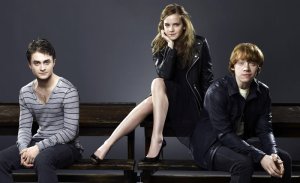
Ultimately, however, the true credit for the success of the Harry Potter series belongs to three actors who have literally grown up on the movie screen — Daniel Radcliffe, Rupert Grint, and Emma Watson. The producers are fortunate indeed that the cute kids that they cast over a decade ago have all grown up to be talented, attractive, and likable actors. If the first part of Harry Potter and the Deathly Hallows seemed to showcase both Grint and Watson (almost to Radcliffe’s expense), part 2 is most definitely centered on Harry Potter. That doesn’t mean that Watson and Grint aren’t good in this film. They are and they get to share one of the best movie kisses of 2011. (As well, for those who keep count, Grint says “Bloody Hell,” three times in the film.) But, for obvious reasons, this film is all about Harry and Radcliffe’s performance as Harry. It’s a challenge for Radcliffe and it’s a challenge that he more than succeeds at conquering. As the film ended, I realized that I was sad to know that the adventures of Harry Potter were done but I was excited to see what the future will hold for Radcliffe, Grint, and Watson.
Incidentally, Harry Potter and the Deathly Hallows Part 2 has been released in both 3-D and 2-D. We saw the 3-D version and if you have any knowledge of how I feel about 3-D (and how motion sick I tend to get while watching 3-D films) then that should show you just much I love the Harry Potter series. I loved it so much that I was even willing to overlook my hatred of 3-D. The 3-D here (which was added after the film has already been filmed) doesn’t really add much to the movie. There were a few cool moments where I was all like, “Look, I can reach out and grab a piece of Voldemort,” but otherwise, the 3-D was a negligible factor as far as the overall film was concerned.
Still, there was one interesting thing about the 3-D. The theater we saw the movie in was half-way empty. At the same time, the neighboring theater — in which the 2-D version was playing — had a line of people waiting to get in. They were not only waiting to see the 2-D version, they were waiting to see a showing that wouldn’t even begin until a full 90 minutes after the 3-D version started. I mention this because, in the wake of Avatar, so many people have taken it for granted that 3-D is the future of movies and soon, as long as a film is in 3-D, we won’t have to worry about the difficult stuff like an interesting plot or compelling characters. However, 3-D has become an overexposed gimmick. For every film like Cave of Dreams that uses 3-D to craft an actual artistic statement, there’s a 1,000 films like Priest which use 3-D just because it’s an easy way to trick sucks into spending an extra dollars to see a crappy film.
What so many filmmakers seem to forget is that the majority of film goers are not looking for 3-D. We’re just looking for a good film. And sometimes — like with Harry Potter and the Deathly Hallows — we get lucky and we find a great film.
(Oh, and one last thing: I know everyone always expects me to claim to be just like Hermione but actually, I’ve always related more to Ginny Weasley. Like her, I’m the youngest of four siblings, I’ve got red hair, and I always get my man, in the end.)
Walt Disney Pictures has finally released the first official trailer for their upcoming sci-fi, action-adventure film John Carter (film was originally titled John Carter of Mars). The film is based on the Edgar Rice Burroughs novel, A Princess of Mars, which would go one to become the first in Burroughs’ Barsoom series.
The film will star Taylor Kitsch (last seen in X-Men Origins: Wolverine as Gambit) in the title role and Lynn Collins (also from Wolverine as Silver Fox) as the aforementioned princess from the original novel. John Carter looks to be a mixture of live-action and fully-realized CGI characters who make up some of the inhabitants of Mars.
It will be interesting how Disney will market this film with little to no big stars and with a director more known for directing Pixar animated films like Finding Nemo and Wall-E in Andrew Stanton.
John Carter is set to have a March 9, 2012 release date.
If there’s one film which genre fans have been up in arms about being remade it would be John Carpenter’s The Thing. It’s one of those films which just continues to gain a loyal and zealous following despite being a major flop in the box-office when it was first released in 1982. One way producers were able to drop the remake idea was just to set a film as a prequel to the Horror Master’s classic sci-fi horror.
Using a screenplay by Eric Heisserer (which used elements from Ronald D. Moore’s own script for a possible prequel/sequel), 2011’s The Thing will be a prequel set on the ill-fated Norwegian Antarctic Research Station. Dutch-filmmaker Matthijs van Heijningen, Jr. will be doing the directing duties with Mary Elizabeth Winstead, Joel Edgerton and Ulrich Thomsen leading a cast half of which are Norwegian.
The film has been in production since March 2010 and was suppose to have a 2010 October release date. Problems either with the film’s post-production or just problems within Universal Pictures shelved the film for almost a year.
The Thing definitely looks to use Carpenter’s Steadicam and minimalist-style and the trailer shows scenes that seemed lifted right out of Carpenter’s own film. Maybe it was how the trailer was cut, but it also seemed to have more jump-scares than the ’82 classic. Some people will never accept this film even without seeing the final product. I, who consider Carpenter’s film one of the best films ever made in that era, will give this film a look-see before making a final judgement. I thought remaking Dawn of the Dead was going to be a disaster, but that film more than lived it to it’s predecessor and was very good on its own merits. I hope Matthijs van Heijningen, Jr.’s prequel also does just as well.
The Thing is set to have an October 14, 2011 release date.
If there’s one type of genre film I always will end up watching (sometimes to my regret if they turn out to be awful) it will be the apocalyptic-themed film. It doesn’t matter if the apocalypse about to hammer down on the planet in the film is nuclear war, some cosmic event, zombies, the Rapture, etc. As long as the world is in the brink of snuffing out I will watch it.
To find out last year that Steven Soderbergh was going to make his next big project just such an apocalyptic film was exciting. He was to take the worldwide, multi-subplot storyline and a huge cast like he did with Traffic and substitute an lethal pandemic virus for the drug war. It’s cast was to include Matt Damon, Marion Cotillard, Kate Winslet, Gwyneth Paltrow, Laurence Fishburne, John Hawkes and Jude Law to name a few. The film was going to be filmed around the world to truly give it that international feel to it.
Contagion will have a release date of September 16, 2011 and if any film really could benefit from a really great viral marketing it would be this.
In 2009, we saw the first film in what Warner Bros. hoped would be the start of a new film franchise in Guy Ritchie’s Sherlock Holmes starring Robert Down, Jr. in the titular role with Jude Law playing his intrepid assistant, Dr. Watson. The film did quite well in the box-office that a sequel was greenlit right away and here we are just five months from the premiere of the follow-up film, Sherlock Holmes: A Game of Shadows.
The first film introduced the character of Sherlock Holmes to the public who really didn’t know much of the iconic character. That film also introduced the one person who would become Holmes equal in intellect and deductive reasoning but without the moral center: Dr. James Moriarty. This arch-foil for Holmes is to be the main antagonist for the sequel and whoever decided to cast Jared Harris in the role of the good Dr. Moriarty should get a raise. Harris has always been one of those character actors who disappears into his roles in every film he has done but never seem to get any glory. Hopefully, once people have seen him in A Game of Shadows, this will change and he joins the likes of Mark Strong, Anthony Hopkins and others who toiled in relative obscurity until finally hitting it big as a charming villain in a major film.
New to the sequel will be Noomi Rapace just fresh off of her stand-out role as Lisbeth Salander in the film adaptation trilogy of Stieg Larsson’s Millenium Trilogy. Also, joining the returning cast is Stephen Fry as Sherlock’s brother Mycroft Holmes. The film, as shown in the trailer, looks to ramp up the action and bring Holmes and Watson on a whirlwind tour of Europe.
Sherlock Holmes: A Game of Shadows is set for a December 16, 2011 release date.
If there was ever a Marvel Comics character who was perfectly suited to star in a grindhouse film it would be Frank Castle aka The Punisher. He’s a character who takes the term anti-hero past its limits and who makes other film vigilantes seem like sissy, choir boys. In December 2008 Lionsgate released a sort of reboot of The Punisher by Jonathan Hensleigh and starring Thomas Jane in the titular role. This time around the role of Frank Castle goes to Ray Stevenson (The Other Guys, Thor, Kill the Irishman) with German-filmmaker Lexi Alexander taking on the director’s reins.
Punisher: War Zone takes much of the characters in the film from story-arcs found in the Marvel Knight’s Punisher MAX series which took the character and his stories into a darker realm of violence. This latest film definitely owes much of it’s darker and more violent tone from that comic book line while at the same time creating a look which brings to mind the garish and over-the-top grindhouse action films of the early 80’s. The film quickly establishes who the Punisher is and what motivates him to take on and kill (heavy emphasis on kill) the criminal underworld of the city. In an opening sequence that probably out-violences every other film released in 2008, the Punisher wipes out a gathering of mobsters in every bloody way as possible. Blood and gore flows and splatters a-plenty in the first 10-15 minutes of this film.
There’s a semblance of a story which involves Castle mistakenly killing an undercover FBI agent which causes him a momentary crisis of conscience, but it really doesn’t last too long as there are more criminals to kill, main and blow up. If there’s one thing the Punisher knows how to do best it’s those three things. Ray Stevenson in the title role doesn’t get to emote much, but does a great job in showing the characters ice-cold ruthlessness paired with a sort of dead-man walking persona which rings true to how the Punisher has been written up of late. His Frank Castle is dead inside and only when he’s the Punisher does he even show any sort of life (even if it’s the barest hint). His foil this time around brings one of the Punisher’s earliest arch-enemies in the disfigured mobster (caused by the Punisher) Jigsaw (played with over-the-top campy relish by Dominic West). Where Castle is deadly serious to the point of morbidity his opposite was all garish with a liberal dose of crazy.
Punisher: War Zone really dispenses with any complexities to it’s plot and just finds reasons and excuses for the Punisher to go on another killing spree against criminals that for some it might not be enough. As a lover of grindhouse and exploitation films what this film offers was enough and really goes a long way in entertaining in such an 80’s fashion. It’s a film that revels in its violent absurdities and campy storytelling. Even the acting by all in the film passes the line of campy and into a sort of Looney Tunes level which makes the extreme violence and gore of the killings more cartoonish than realistic. This was a film that celebrated it’s grindhouse roots from the actors, the filmmakers all the way down to it’s cinematographer and art directors. It’s disposable entertainment and it knows it so doesn’t bother to try and hide that fact and just tries to entertain in every manner possible and then some.





 Through the Shattered Lens