Film Review: Stay Hungry (dir by Bob Rafelson)


In the 1976 film Stay Hungry, Jeff Bridges plays Craig Blake.

When we first meet Craig, he doesn’t have much of a personality, though we still like him because he’s played by Jeff Bridges.  Living in Alabama, he’s a young rich kid who, after the death of his parents, divides his time between his nearly empty mansion and his country club.  Craig suffers from a good deal of ennui and seems to spend a lot of time writing letters to his uncle in which he promises that he’s going to eventually get his life together.  Craig eventually gets a job at a real estate firm that is managed by Jabo (Joe Spinell).  We know that the real estate firm is shady because Joe Spinell works there.

Craig is assigned to handle the purchase of a small gym so that he can eventually close the place and allow it to be torn down to make room for an office building.  However, Craig soon falls for the gang of colorful eccentrics whose lives revolve around the gym and bodybuilder Joe Santo (Arnold Schwarzenegger, who gets an “introducing” credit, even though this was his fourth film).  The friendly Franklin (Robert Englund) is Santo’s “grease” man.  Anita (Helena Kallianiotes) is tough and can kick anyone’s ass.  The receptionist, Mary Tate (Sally Field), is a free spirit with whom Craig soon falls in love.  In fact, the only less than likable person at the gym is the former owner, Thor Erickson (R.G. Armstrong), a heavy-drinking perv who has a hole in the floor of his office that he uses to peek down at the women’s locker room.

There’s not much of a plot here.  Instead, the film plays out in a rather laid back manner, with Santo befriending Craig and showing him the joy of embracing life.  Arnold Schwarzenegger actually won an award (well, a Golden Globe) for his performance here and it must be said that he’s very good as the gentle and easy-going Santo.  Because he’s huge and he’s Schwarzenegger, we expect him to be intimidating.  Instead, he’s a soft-spoken guy who is quick to smile and who doesn’t even get upset when he finds out that Mary Tate and Craig are now involved.  There’s even a surprising scene where Joe Santo picks up a fiddle and starts playing with a bluegrass band.  Schwarzenegger is so likable here that it’s easy to wonder where his career might have gone if he hadn’t become an action star.  Even early in his career (and when he was still speaking with a very thick accent), Schwarzenegger shows off a natural comic timing.  He’s fun to watch.

In fact, he’s so much fun that the rest of the film suffers whenever he’s not onscreen.  The cast is full of talented people but the film’s loose, plotless structure keeps us from truly getting too invested in any of them.  (Santo is training for Mr. Universe so at least he gets an actual storyline.)  Sally Field and Jeff Bridges are cute together but their romance is never quite as enchanting as it seems like it should be.  The main problem with the film is that, when it ends, one still feels like Craig will eventually get bored with the gym and return back to his mansion and his country club.  One doesn’t get the feeling that Craig has been changed so much as Craig just seems to be slumming for the heck of it.

There are charming moments in Stay Hungry.  I’m a Southern girl so I can attest that the film captured the feel of the South better than most films.  If you’re a Schwarzenegger fan, you have to see this film because it really does feature Arnie at his most charming and natural.  Unfortunately, despite all that, the film itself never really comes together.
Film Review: Bronco Billy (dir by Clint Eastwood)


In 1980’s Bronco Billy, Clint Eastwood plays Billy McCoy.

Billy is an aging cowboy, a trick-shooter who owns Bronco Billy’s Wild West, a traveling circus that has definitely seen better days.  Bronco Billy and his friends travel the country, going from small town to small town and putting on a show.  Billy is definitely the star and the highlight of each show is him shooting balloons and tossing a knife while his female assistant is strapped on a revolving disk.  Unfortunately, Billy’s latest assistant flinches and gets a knife in her leg.  Billy needs a new assistant and, wouldn’t you know it, Antoinette Lily (Sondra Locke) needs a job!

Antoinette is a runaway bride.  She married John Arlington (Geoffrey Lewis), not because she loved him but because she needed to get married by the time she turned 30 or she would lose her inheritance.  After the ceremony but before the wedding night, Antoinette fled.  The police assume that John murdered her and promptly arrest him.  John, suspecting that his wife is still alive, pleads insanity so that he can avoid the electric chair.

As Billy’s assistant, Antoinette challenges the way that Billy has always done the show, often to such an extent that you really have to wonder why she sticks around.  Since this is a Clint Eastwood film, there a bar brawl where Billy rescues her from being assaulted by a couple of rednecks.  Unfortunately, Antoinette’s arrival coincides with a string of accidents and other unfortunate incidents.  The other members of the show start to suspect that Antoinette might be bad luck.  Myself, I’m not superstitious and I don’t think that people can bring bad luck.  I think people make their own luck.  However, it’s hard to overlook the fact that Antoinette finds out that her husband is facing the death penalty due to her disappearance and her reaction is to basically shrug it off.  Sondra Locke gives a rather flat performance was Antoinette, suggesting none of the quirkiness necessary to make her anything more than a very childish and very self-centered person.  Antoinette is a role that demands the eccentricity of a young Sissy Spacek or Shelley Duvall or even Beverly D’Angelo, who did such a good job in Every Which Way But Loose.  Sondra Locke gives a boring performance and it drags down the film.

That said, there is a lot to like about Bronco Billy.  In many ways, this film feels like Clint Eastwood’s take on a Robert Altman film.  The plot is episodic and casual and the best scenes are the ones the emphasize the members of the circus as being a family of misfits.  (Indeed, one reason why Locke’s performance feels so jarringly wrong is because both she and Antoinette never seem to be interested in the other members of the show.)  Billy may be their leader and their main attraction but every member of the show plays a role in keeping Billy’s Wild West alive.  Scotman Crothers, Sam Bottoms, Bill McKinney, Dan Vadis, and Sierra Pecheur all give likable performances that bring the film’s world to life.  The film becomes about more than just the aging Billy trying to find his place in a changing world.  It’s a film about a group of people who have come together to form their own community and, by the end of the movie, it’s a community that you can’t help but love.  In many ways, this film features both Eastwood the director and Eastwood the actor at his gentlest and most humanistic.  Billy and his show bring the old west to a new America and, in the end, you’re happy they did.

Film Review: The Outlaw Josey Wales (dir by Clint Eastwood)


Towards the end of 1976’s The Outlaw Josey Wales, Josey (played by Clint Eastwood) says, “I guess we all died a little in that damned war.”

He’s referring to the American Civil War and the film leaves you with no doubt that Wales knew what he was talking about.  A farmer living in Missouri, Josey Wales wasn’t involved in the Civil War until a group of guerillas, the Redlegs, raided his home and killed his family.  Seeking vengeance, Wales joined the Bushwackers, a group of Confederate guerillas that were led by the infamous “Bloody Bill” Anderson.  After Anderson’s death and the South’s surrender, Senator James H. Lane (Frank Schofield) offers amnesty to any of the Bushwackers willing to surrender and declare their loyalty to the United States.  Fletcher (John Vernon), the leader of the surviving Bushwackers, thinks it’s a good idea and his men eventually agree to surrender.

Everyone except for Josey Wales.

Fletcher tells Josey that he’ll be an outlaw and that Lane will send his men to capture and execute him.  “I reckon so,” Josey Wales replies.  It’s not that Josey was particularly a fan of the Confederate cause.  Instead, having lost his family and his home and having seen hundreds of men killed, Josey no longer cares.  He’s got a death wish, something that becomes apparent when he later sneaks over to Lane’s camp and discovers that the leader of the Redlegs, Terrill (Bill McKinney), has been made a captain in the Union Army.  The surrendering Bushwackers, with the exception of Fletcher and a young man named Jamie (Sam Bottoms), are gunned down as they swear allegiance to the United States.  Joey springs into action, hijacking a Gatling gun and mowing down soldiers.  It’s a suicidal move and Josey appears to be willing to die, until he sees that Jamie has been wounded.  Josey and Jamie go on the run, pursued by soldiers and bounty hunters.

It sounds like the start of typical Clint Eastwood film and, make no mistake about it, The Outlaw Josey Wales features everything that most people have come to expect from Eastwood.  Josey Wales is an expert shot, often firing two guns while charging forward on his horse.  Josey has a way of words, explaining the purpose of getting “plain man dog mean” and telling a bounty hunter that there are better ways to make a living.  The main difference, though, is that Josey is no longer seeking revenge.  He’s lost his family and his home and he knows nothing is going to bring them back.  He sought revenge during the Civil War and saw so many people killed that, much like Jimmy Stewart in Broken Arrow, he just wants to disappear from civilization.

The problem is that men like Lane and Terrill have no intention of letting Josey Wales disappear.  The sociopathic Terrill sees it as almost being his God-given duty to kill Josey Wales and anyone else that he dislikes.  The bounty hunters are also after Josey Wales.  As Fletcher explains it, bounty hunting is the only way that many former soldiers can make money and feed their families.  As Josey moves through the southwest, his legend grows.  Every town that Josey stops in, he hears stories about the growing number of men that he has supposedly killed.

Josey also discovers that he can’t do it all alone.  He soon finds himself as a part of a new family, a collection of misfits that don’t have a home in Senator Lane’s America.  Lone Waite (Chief Dan George) is an elderly Cherokee man who suggests that Josey head for Mexico.  Little Moonlight (Geraldine Keams) is a Navajo woman who Josey rescues from two bounty hunters.  Sarah Turner (Paula Trueman) and her granddaughter, Laura Lee (Sondra Locke), are rescued from Comancheros.  Josey negotiates the release of two of Sarah’s ranch hands and befriends Chief Ten Bears (Will Sampson) while doing so.  Slowly, Josey comes out of his shell and starts to embrace life once again.  Josey goes from searching for death to searching for peace.

It’s one of Eastwood’s best films, ending on a note of not violence but instead sad regret.  It’s not only a portrait of a man learning to embrace life but it’s also a portrait of a country trying to figure out how to come back together after the bloody savagery of the Civil War.  Some, like Fletcher and Josey, want to move on.  Others, like Terrill, don’t have an identity beyond fighting and killing.  Eastwood gives a good performance but, as a director, he gives every member of the cast a chance to shine.  If you only know John Vernon as Dean Wormer from Animal House, his sad-eyed performance here will be a revelation.

Originally, The Outlaw Josey Wales was meant to be directed by Phillip L. Kaufman but Eastwood felt that Kaufman was taking too long to set up his shots and worrying about details that really didn’t matter.  Reportedly, while Kaufman was away from the set, spending hours searching for a historically-correct beer bottle to be used in a bar scene, Eastwood directed the scene himself and then convinced producer Robert Daley to fire Kaufman and allow Eastwood to direct the film.  (Kaufman also objected to the script’s anti-government subtext but seriously, that’s pretty much the subtext of every film that Eastwood has ever been involved with.)  The DGA later instituted a rule that, on productions in which the director was fired,  the replacement could not be a member of his crew or an actor in the cast but that was too late to help out Kaufman.

(Rumor has it that another reason Kaufman was fired was because he and Eastwood both “liked” Sondra Locke.  This was the first of six films that Eastwood and Locke would do together.)

To be honest, I think it worked out in the film’s favor.  It’s a little surprising that someone other than Eastwood was ever considered as director to be begin with, so perfectly does the story and the lead character fit with Eastwood’s persona.  Eastwood captures both the beauty of the untouched land and also the bloody violence of combat.  In many ways, this film almost feels like a prequel to UnforgivenThe Outlaw Josey Wales is Eastwood at his best.

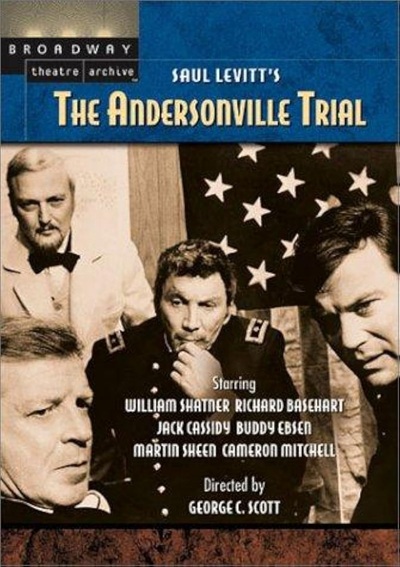
On Stage On The Lens: The Andersonville Trial (dir by George C. Soctt)


1970’s The Andersonville Trial takes place in one muggy military court room.  The year is 1865.  The Civil War is over but the wounds of the conflict are still fresh.  Many of the leaders of the Confederacy are still fugitives.  Abraham Lincoln has been dead for only a month.  The people want someone to pay and it appears that person might be Captain Henry Wirz (Richard Basehart).

Originally born in Switzerland and forced to flee Europe after being convicted of embezzlement, Henry Wirz eventually ended up in Kentucky.  He served in the Confederate Army and was eventually named the commandant of Camp Sumter, a prison camp located near Andersonville, Georgia.  After the war, Captain Wirz is indicted for war crimes connected to his treatment of the Union prisoners at the camp.  Wirz and his defense counsel, Otis Baker (Jack Cassidy), argue that the prison soon became overcrowded due to the war and that Wirz treated the prisoners as well as he could considering that he had limited resoruces.  Wirz points out that his requests for much-needed supplies were denied by his superiors.   Prosecutor Norton Chipman (William Shatner) argues that Wirz purposefully neglected the prisoners and their needs and that Wirz is personally responsible for every death that occurred under his watch.  The trial is overseen by Maj. General Lew Wallace (Cameron Mitchell), the same Lew Wallace who would later write Ben-Hur and who reportedly offered a pardon to Billy the Kid shortly before the latter’s death.  Wallace attempts to give Wirz a fair trial, even allowing Wirz to spend the trial reclining on a couch due to a case of gangrene.  (Agck!  The 19th century was a scary time!)

The Andersonville Trial started life as a 1959 Broadway production.  On stage, George C. Scott played Chipman, an experience he described as difficult because, even though Chipman was nominally the play’s hero, Wirz was actually a much more sympathetic character.  When the play was adapted for television in 1970, Scott returned to direct.  Admittedly, the television version is very stagey.  Scott doesn’t make much effort to open up the play.  Almost all of the action is confined to that courtroom.  We learn about the conditions at Fort Sumter in the same way that the judges learned about the conditions.  We listen as the witnesses testify.  We listen as a doctor played by Buddy Ebsen talks about the deplorable conditions at Fort Sumter.  We also listen as a soldier played by Martin Sheen reports that Wirz has previously attempted to suicide and we’re left to wonder if it was due to guilt or fear of the public execution that would follow a guilty verdict.  We watch as Chipman and Baker throw themselves into the trial, two attorneys who both believe that they are correct.  And we watch as Wirz finally testifies and the play hits its unexpected emotional high point.

As most filmed plays do, The Andersonville Trial demands a bit of patience on the part of the viewer.  It’s important to actually focus on not only what people are saying but also how they’re saying it.  Fortunately, Scott gets wonderful performances from his ensemble cast.  Even William Shatner’s overdramatic tendencies are put to good use.  Chipman is outraged but the play asks if Chipman is angry with the right person.  With many of the Confederacy’s leaders in Canada and Europe, Wirz finds himself standing in for all of them and facing a nation that wants vengeance for the death of their president.  Wirz claims and his defense attorney argues that Wirz was ultimately just a soldier who followed orders, which is what soldiers are continually told to do.  The Andersonville Trial considers when military discipline must be set aside to do what is morally right.

Admittedly, when it comes to The Andersonville Trial, it helps to not only like courtroom dramas but to also be a bit of a history nerd as well.  Fortunately, both of those are true of me.  I found The Andersonville Trial to be a fascinating story and a worthy production.

Scalplock (1966, directed by James Goldstone)


In this comedic western, gambler Benjamin Calhoun (Dale Robertson) wins big in a poker game.  Not only does he walk away with several thousand dollars but he also now owns his own railroad, the BP;S&D.  Calhoun celebrates the biggest win of his career by tossing ten dollar bills at the townspeople, recruiting a worshipful young assistant (Bob Random), and commandeering a private railcar that belongs to wealthy Burton Standish (John Anderson).  In the car, he finds Marta Grenier (Diana Hyland), a “working woman,” who has been hired to provide company for Standish.

Calhoun and Marta ride off to check out Calhoun’s new railroad.  What he discovers is that the railroad that he won is not only not completed but the workers are striking because they haven’t been paid in two weeks.  The quick-thinking Calhoun offers to make all of the workers part-owners of the railroad.  With construction once again starting, Calhoun tries to figure out how to keep his new business open.  He also meets a strong-headed storekeeper named Joanna Royce (Sandra Smith).

When Standish finally shows up, it turns out that he was originally planning on buying the BP;S&D.  Will Calhoun hold onto the railroad and honor the promise he made to the workers or will he sell out to Standish?

For all the talk about completing the railroad, Scalplock ends with most of the work undone.  That’s because Scalplock was a pilot for The Iron Horse, a television series that lasted for two seasons in the 60s.  Scalplock (and The Iron Horse) is mostly a showcase for Dale Robertson, a low-key but always convincing actor who specialized in westerns.  Usually, Robertson was cast as an upstanding citizen and law enforcement agent.  In Scalplock, he’s playing the type of genial rogue that James Garner played on Maverick and later in The Rockford Files.  Robertson is likable in Scalplock and even convinces us that Calhoun would choose his workers over a quick payday.  Fan of the genre will enjoy Scalplock, as long as they don’t get too invested in witnessing that last track of rail laid into the ground.

Dale Robertson, who started his career in the 40s, continued to act through the 90s, though usually as a guest star instead of a series lead.  Robertson eventually retired to Oklahoma where he owned a ranch that was home to over 200 horses.  He passed away in 2013 at the age of 89.

Retro Television Reviews: The Alpha Caper (dir by Robert Michael Lewis)


Welcome to Retro Television Reviews, a feature where we review some of our favorite and least favorite shows of the past!  On Sundays, I will be reviewing the made-for-television movies that used to be a primetime mainstay.  Today’s film is 1973’s The Alpha Caper!  It  can be viewed on YouTube!

After years of faithful service and hard work, parole officer Mark Forbes (Henry Fonda) is on the verge of mandatory retirement.  He’s spent his entire career playing by the rules and taking orders and helping recently released criminals go straight.  For all of his service, all he’s gets is a small party and a cheap retirement gift.

Still, Mark is on the job when he gets a call that one of his parolees, Harry (Noah Beery, Jr.), is currently in the middle of a stand-off with the cops.  Mark goes to the crime scene, where he discovers that Harry was trying to rob a warehouse full of weapons.  He also discovers that Harry is dying, as the result of being shot by the police.  Before Harry passes, he tells Mark that he and three other ex-cons were plotting to steal a shipment of gold bars.

Mark decides to carry out Harry’s plan.  Working with Mitch (Leonard Nimoy), Tudor (Larry Hagman), and Scat (James McEachin), Mark comes up with a plan to rob the armored cars that are going to be transporting the gold.  While Tudor and Scat are quick to join up with Mark, Mitch is a bit more hesitant.  In the end, though, they all decide to work together.  The plan they come up with is a clever one but its main strength is that it’s being spearheaded by Mark, a man who no one would ever expect to commit a crime.  No one but his colleague and friend, Lee (John Marley), that is.

I watched The Alpha Caper last night, with my friend Phil, Janeen, and Spiro.  To be honest, I selected the film because the title led me to suspect that it would be a science fiction film of some sort.  I was a little surprised when it turned out to be a crime thriller but I was even more surprised by just how good the film itself turned out to be.  Cleverly plotted and well-acted by the entire cast (and featuring a scruffy Leonard Nimoy playing a role that’s about as far from the coldly logical Mr. Spock as one can get), The Alpha Caper is an entertaining crime film but it’s also surprisingly poignant.  Mark is someone who feels that he’s lived his entire life without taking a single risk and, as a result, he has nothing to show for it.  He compares his situation to the mythical Kilroy of “Kilroy was Here” graffiti fame.  Kilroy will always be remembered, even though no one is really sure who he was.  Mark fears that he’s destined to be forgotten.  The robbery is Mark’s way of announcing that “Mark Forbes was here.”  The film ends on a surprisingly touching, if rather bittersweet, note.

The Alpha Caper originally aired on ABC on October 6th, 1973.  It was apparently meant to be a pilot for an anthology show that would be called Crime.  The series wasn’t picked up but, two years later, The Alpha Caper was theatrically released in Italy.  Today, it can be seen on YouTube.  Like Mark Forbes and Kilroy, the film has not been forgotten.

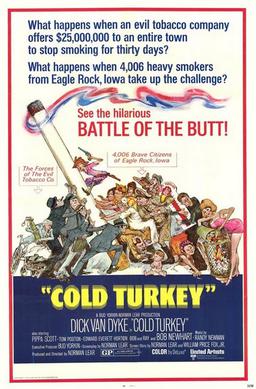
Film Review: Cold Turkey (dir by Norman Lear)


The 1971 satire, Cold Turkey, is the film that boldly explores just how much into the ground one joke can driven.

It’s a film that imagines what would happen if a big tobacco company decided to try to improve its image by giving people an incentive to quit smoking.  In the real world, of course, they ended up funding Truth.org and coming up with anti-smoking commercials that were so lame that they would make viewers want to go out and buy a pack of cigarettes just to spite the self-righteous people lecturing them during the commercial breaks.  In the film, however, Marwen Wren (Bob Newhart) comes up with the idea of offering to pay 25 million dollars to any community that can completely stop smoking for 30 days.

Wren figures that no large group of people will be able to just give up smoking for a month.  Not in 1971!  However, Wren didn’t count on the single-minded determination of the Rev. Clayton Hughes (Dick Van Dyke).  Hughes is the stern and self-righteous minister of Eagle Rock Community Church in Eagle Rock, Iowa.  He knows that Eagle Rock could really use that money so he sets off on a crusade to convince all 4,006 of the citizens of Eagle Rock to take the pledge to quit smoking.

As I said at the start of this review, Cold Turkey is pretty much a one-joke film.  The joke is that everyone in the movie — from the tobacco company execs to the citizens of Eagle Rock to Rev. Hughes — is an asshole.  They start the film as a bunch of assholes and, once they try to quit smoking, they become even bigger assholes.  Soon, everyone in town is irritable and angry.  The only people happy are the people who never smoked in the first place, largely because they’ve been set up as a sort of paramilitary border patrol.  Even though his anti-smoking crusade lands him on the cover of Time, Rev. Hughes is also upset because he started smoking right before it was time to quit smoking.  He deals with his withdraw pains through sex and frequent glowering.

Wren is concerned that the town of Eagle Rock might actually go for a full 30 days without smoking so he attempts to smuggle a bunch of cigarettes into the town and then runs around with a gigantic lighter that looks like a gun.  It’s a storyline that doesn’t really go anywhere but then again, you could say that about almost all of the subplots in Cold Turkey.  There’s a lot of characters and there’s a lot of frantic overacting but it doesn’t really add up too much.  Storylines begin and are then quickly abandoned.  Characters are introduced but then never do anything.  For a while, It seems like the film is at least going to examine the Rev. Hughes’s totalitarian impulses but no.  Those impulses are clearly there but they’re not really explored.

If I seem somewhat annoyed by this film, it’s because it really did have a lot of potential.  This could have been a very sharp and timeless satire but instead, it gets bogged down in its own frantic storytelling and the film’s comedy becomes progressively more and more cartoonish.  By the end of the movie, the President shows up in town and so does the military and it all tries to achieve some Dr. Strangelove-style lunacy but the film doesn’t seem to know what it really wants to say.  It seems to be setting itself up for some sort of grandly cynical conclusion but instead, it just sort of ends.  One gets the feeling that, at the last minute, the filmmakers decided that they couldn’t risk alienating their audience by taking the story to its natural conclusion.

Admittedly, while watching the film, I did find myself comparing Hughes and his bullying mob to the same people who are currently snapping at anyone who suggests that maybe the Coronavirus lockdowns were a bit excessive.  It’s easy to think of some modern politicians and media figures who probably would have had a great time in Eagle Rock, ordering people around and shaming anyone who wants a cigarette.  But otherwise, Cold Turkey was just too cartoonish and one-note to really work.

Shattered Politics #46: Used Cars (dir by Robert Zemeckis)


Used_Cars_film_poster

“Do you think we like being associated with the President of the United States?  I mean, we run an honest business here!” —

Jeff (Gerrit Graham) in Used Cars (1980)

As a film lover, I’ve sat through so many disappointing commentary tracks that, when I come across one that’s actually fun and informative, it causes me to like the film even more.  One of the best commentary tracks that I’ve ever heard was the one that Robert Zemeckis, Bob Gale, and Kurt Russell recorded for the DVD release of the 1980 comedy Used Cars.

The film — which was an early credit for both director Zemeckis and screenwriter Gale — tells the story of two rival used car lots.  The bad guy car lot is owned by Roy L. Fuchs (Jack Warden).  The good guy car lot is owned by Roy’s brother, Luke Fuchs (also played by Jack Warden).  The top salesman at the good guy car lot is Rudy Russo (Kurt Russell).  The film shows what happens when Luke dies and Rudy tries to prevent Roy from taking over the lot.

The commentary track is distinguished by just how much Zemeckis, Gale, and Russell seem to truly enjoy watching and talking about the film.  Kurt Russell, in particular, has an incredibly engaging laugh and his sense of fun is contagious.  However, for me, the most interesting part of the commentary track came when Bob Gale explicitly compared Rudy Russo and Luke’s daughter (played by Deborah Harmon) to Bill and Hillary Clinton and then even starts to do a surprisingly good imitation of Bill’s hoarse Arkansas accent.

What made it interesting was that the comparison was absolutely correct.

Politicians are salesmen.  Much as politicians will say anything to get your vote, the salesmen in Used Cars will say and do anything to get your money.  Politicians sell promises that are too good to be true.  Rudy Russo and Roy L. Fuchs do the same thing, claiming that their used cars are just as good and safe as a car that’s never been owned before.

In fact, one of the major plotlines in Used Cars is that Rudy is plotting to make the move from selling cars to buying votes.  There’s a vacancy in the state senate and Rudy is planning on running for the seat.  All he has to do is come up with the $10,000 necessary to buy the nomination from the local political machine. (I imagine it would be more expensive to buy a nomination today.)  Luke agrees to loan Rudy the money but, before he can, Luke goes on a test drive with a former race car driver.

The driver works for Luke’s evil brother, Roy.  Roy knows that Luke has a heart condition and he specifically sends over that driver to give Luke a fatal heart attack.  Just as Rudy is trying to sell a car to a costumer who is skeptical about whether or not he should pay an extra fifty dollar for something he doesn’t want (“$50.00 never killed anyone!” the customer insists), Luke staggers into the office and dies.

(The shocked customer agrees to pay the extra fifty dollars.  Ever the salesman, Luke grabs the fifty before he dies.)

With Luke dead and his estranged daughter nowhere to be seen, Roy is next-in-line to take over Luke’s car lot.  So, Rudy hides the body and tells everyone that Luke is down in Florida.  Both he and his fellow salesman, the hilariously superstitious Jeff (Gerrit Graham), conspire to make as much money as possible before anyone discovers the truth.

How do they do it?  Illegally, of course!

First off, they break into the broadcast of a football game and do an ad.  Then, they use strippers to attract customers.  And finally, Rudy comes up with his master plan, interrupting a televised address from the President of the United States.

“You can’t fuck with the President!” Jeff says.

“Hey, he fucks with us…” Rudy responds.

Seriously, I love Rudy.

In fact, I really liked Used Cars.  It’s a good combination of broad humor and clever satire and both Kurt Russell and Gerrit Graham give such likable performances that you can ignore the fact that they’re both playing total jerks.  (In fact, I would argue that one reason that we love Rudy is because he’s so honest about being so crooked.)  Not every scene worked perfectly.  The scene where Rudy and Jeff interrupt that football game goes on forever and, after a spokesmodel’s dress is ripped off, becomes so uncomfortable to watch that it actually takes the film a while to recover.  But then, after that, you get the interruption of the President’s speech.  You get Jeff freaking out over whether or not red cars or unlucky.  You get some fun driving school humor.  And, of course, you get a cute dog that can do tricks and helps to sell cars.  The film recovers and, ultimately, Used Cars is a celebration of small businesses everywhere.

And you know what?

I really hope Rudy did make it into the state senate.

We need more Rudy Russos in government.

And we really need more commentary tracks featuring Kurt Russell!