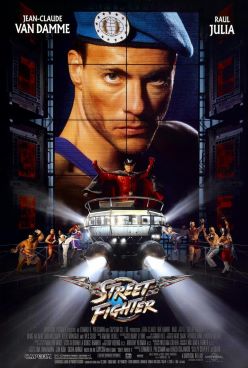
Street Fighter (1994, directed by Stephen E. de Souza)


What does the M. stand for in M. Bison?

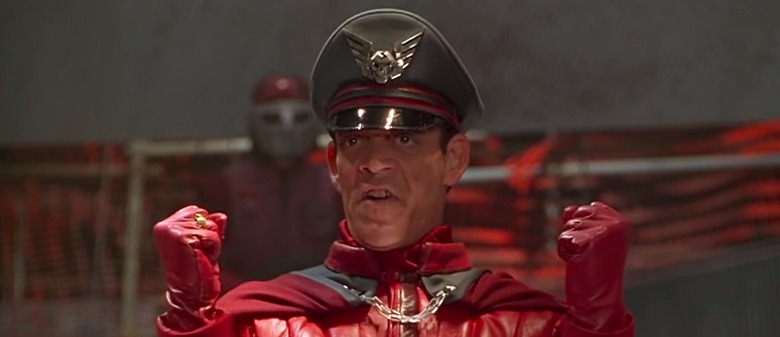
Originally, it was supposed to stand for Mike but my theory is that it stands for Marvelous because how else can you describe Raul Julia’s performance as the villain of Street Fighter?  Julia was dying of stomach cancer when he played Bison, a condition reflected by his gaunt appearance.  But Julia still obviously threw himself into every scene, delivering every melodramatic line as if it was the most important piece of dialogue that he had ever been trusted with delivering.  As a film, Street Fighter is an overedited mess that features one of Jean-Claude Van Damme’s worst performances.  Raul Julia saves it, though.  He gets some of the worst lines and transforms them into the best lines through sheer determination.  That man could have read the phone book and made it interesting.

Jean-Claude Van Damme is Col. Guile in this early video game adaptation.  This isn’t one of Van Damme’s better performances.  He doesn’t really play the Guile from the game.  Instead, he’s just Van Damme with a blue beret and an American flag on his bicep.  Far better are Damian Chapa as Ken and Bryon Mann as Ryu, even though neither gets to do as much as a fan of the game would want them to.  Ming-Na Wen is a promising Chun Li but, instead of focusing on her fighting skill, the movie gets bogged down in trying to set her up for a sequel that would never come.  Are you a fan of Cammy?  Don’t get excited because all Kylie Minogue does is ask Guile if he’s okay.  I did like Wes Studi as Sagat and Gregg Rainwater and Peter Tuiasosopo as T. Hawk and Honda but it still feels like only Raul Julia gives a performance that can compete with the video game version of his character.

There were four editors credited for Street Fighter and maybe that explains why the fights are a mess and the plot is impossible to follow.  It’s a video game adaptation and I don’t demand much but I would like to know who is winning each fight.  The film’s visual scheme, meant to duplicate the look of the game, showed some promise but the editing gave the movie a frantic feel that made it difficult to really appreciate the production design.

There’s never really been a good Street Fighter film but I still think it could happen with the right cast and crew.  If Mortal Kombat could (eventually) be turned into a decent movie, why not Street Fighter?  I still don’t think anyone will ever top Raul Julia as M. Bison, though.  Raul Julia made you believe in Pax Bisonica!

“And peace will reign and all humanity will bow to me in humble gratitude.” — M. Bison

The Unnominated #13: Heat (dir by Michael Mann)


Though the Academy of Motion Picture Arts and Sciences claim that the Oscars honor the best of the year, we all know that there are always worthy films and performances that end up getting overlooked.  Sometimes, it’s because the competition too fierce.  Sometimes, it’s because the film itself was too controversial.  Often, it’s just a case of a film’s quality not being fully recognized until years after its initial released.  This series of reviews takes a look at the films and performances that should have been nominated but were, for whatever reason, overlooked.  These are the Unnominated.

First released in 1995, Heat is one of the most influential and best-known films of the past 30 years.  It also received absolutely zero Oscar nominations.

Maybe we shouldn’t be too surprised that Academy — especially the Academy of the 1990s — didn’t shower the film with nominations.  For all of its many strengths, Heat is still a genre piece, an epic three-hour crime film from director Michael Mann.  It’s a film about obsessive cops and tightly-wound crooks and it’s based on a made-for-TV movie that Mann directed in the late 80s.  While the Academy had given a best picture nomination to The Fugitive just two years before, it still hadn’t fully come around to honoring genre films.

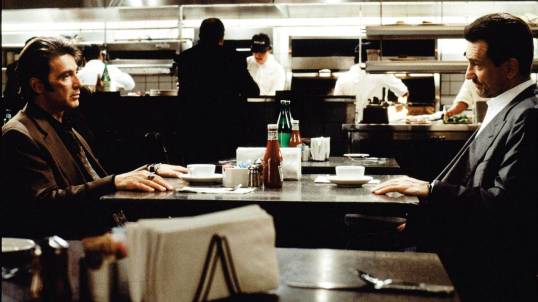
And yet one would think that the film could have at least picked up a nomination for its editing or maybe the sound design that helps to make the film’s signature 8-minute gun battle so unforgettable.  (Heat is a film that leaves you feeling as if you’re trapped in the middle of its gunfights, running for cover while the cops and the crooks fire on each other.)  The screenplay, featuring the scene where Al Pacino’s intense detective sits down for coffee with Robert De Niro’s career crook, also went unnominated.

Al Pacino was not nominated for playing Vincent Hanna and maybe we shouldn’t be too surprised at that.  Pacino yells a lot in this movie.  When people talk about Pacino having a reputation for bellowing his lines like a madman, they’re usually thinking about the scene where he confronts a weaselly executive (Hank Azaria) about the affair that he’s having with Charlene (Ashley Judd), the wife of criminal Chris Shiherlis (Val Kilmer).  And yet, I think that Pacino’s performance works in the context of the film and it’s often forgotten that Pacino has quite scenes in Heat as well.  Pacino’s intensity provides a contrast to Robert De Niro’s tightly controlled career criminal, Neil McCauley.  McCauley has done time in prison and he has no intention of ever going back.  But, as he admits during the famous diner scene, being a criminal is the only thing that he knows how to do and it’s also the only thing that he wants to do.  (“The action is the juice,” Tom Sizemore says in another scene.)  If any two actors deserved a joint Oscar nomination it was Pacino and De Niro.  In Heat, they’re the perfect team.  Pacino’s flamboyance and De Niro’s tightly-controlled emotions come together to form the heart of the picture.

No one from the film’s supporting cast was nominated either, despite there being a wealth of riches to choose from.  Ashley Judd and Val Kilmer come to mind as obvious contenders.  Kilmer is amazing in the shoot-out that occurs two hours into the film.  Ashley Judd has a killer scene where she helps her husband escape from the police.  Beyond Judd and Kilmer, I like the quiet menace of Tom Sizemore’s Michael Cheritto.  (Just check out the look he gives to an onlooker who is getting a little bit too curious.)  Kevin Gage’s sociopathic Waingro is one of the most loathsome characters to ever show up in a movie.  William Fichtner, Jon Voight, Danny Trejo, and Tom Noonan all make a definite impression and add to Michael Mann’s portrait of the Los Angeles underworld.  In an early role, Natalie Portman plays Hanna’s neglected stepdaughter and even Amy Brenneman has some good moments as Neil’s unsuspecting girlfriend, the one who Neil claims to be prepared to abandon if he sees “the heat coming.”

I have to mention the performance of Dennis Haysbert as Don Breedan, a man who has just been released from prison and who finds himself working as a cook in a diner.  (The owner of the diner is played by Bud Cort.)  Haysbert doesn’t have many scenes but he gives a poignant performance as a man struggling not to fall back into his old life of crime and what eventually happens to him still packs an emotional punch.  For much of the film’s running time, he’s on the fringes of the story.  It’s only by chance that he finds himself suddenly and briefly thrown into the middle of the action.

Heat is the ultimate Michael Mann film, a 3-hour crime epic that is full of amazing action sequences, powerful performances, and a moody atmosphere that leaves the viewer with no doubt that the film is actually about a lot more than just a bunch of crooks and the cops who try to stop them.  Hanna and McCauley both live by their own code and are equally obsessed with their work.  Their showdown is inevitable and, as directed by Michael Mann, it takes on almost mythological grandeur.  The film is a portrait of uncertainty and fear in Los Angeles but it’s also a portrait of two men destined to confront each other.  They’re both the best at what they do and, as a result, only one can remain alive at the end of the film.

I rewatched Heat yesterday and I was amazed at how well the film holds up.  It’s one of the best-paced three-hour films that I’ve ever seen and that epic gunfight is still powerful and frightening to watch.  Like Martin Scorsese’s Casino, it was a 1995 film that deserved more Oscar attention than it received.

Heat (1995, dir by Michael Mann, DP: Dante Spinotti)

Previous entries in The Unnominated:

  1. Auto Focus 
  2. Star 80
  3. Monty Python and The Holy Grail
  4. Johnny Got His Gun
  5. Saint Jack
  6. Office Space
  7. Play Misty For Me
  8. The Long Riders
  9. Mean Streets
  10. The Long Goodbye
  11. The General
  12. Tombstone


Film Review: The Doors (dir by Oliver Stone)


I like The Doors.

That can be a dangerous thing to admit, about both the band and Oliver Stone’s 1991 film.  Yes, both the band and the film could be a bit pretentious.  They both tended to go on for a bit longer than necessary.  They were both centered around a guy who wrote the type of poetry that I used to love back in my emo days.  It’s all true.

But, with The Doors as a band, I find that I can’t stop listening to them once I start.  Even if I might roll my eyes at some of the lyrics or if I might privately question whether any blues song really needs an organ solo, I can’t help but love the band.  They had a sound that was uniquely their own, a psychedelic carnival that brought to mind images of people dancing joyfully while the world burned around them.  And say what you will about Jim Morrison as a poet or even a thinker, he had a good voice.  He had the perfect voice for The Doors and their rather portentous style.  From the clips that I’ve seen of him performing, Morrison definitely had a stage presence.  Morrison died young.  He was only 27 and, in the popular imagination, he will always look like he’s 27.  Unlike his contemporaries who managed to survive the 60s, Morrison will always eternally be long-haired and full of life.

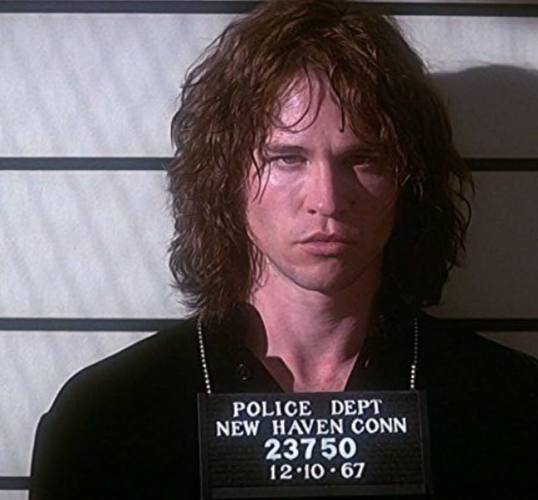
As for The Doors as a movie, it’s definitely an Oliver Stone film.  It’s big.  It’s colorful.  It’s deliberately messy.  Moments of genuinely clever filmmaking and breath-taking visuals are mixed with scenes that are so heavy-handed that you’ll be inspired to roll your eyes as dramatically as you’ve ever rolled them.  Stone loved the music and that love comes through in every performance scene.  Stone also loves using Native Americans as symbols and that can feel a bit cringey at times.  Why would Jim Morrison, whose was of Scottish and Irish ancestry, even have a Native American spirit guide?  At its best The Doors captures the chaos of a world that it’s the middle of being rebuilt.  The 60s were a turbulent time and The Doors is a turbulent movie.  I’ve read many reviews that criticized The Doors for the scene in which Morrison gets involved in a black magic ceremony with a journalist played by Kathleen Quinlan.  I have no idea whether or not that scene happened in real life but the movie is so full of energy and wild imagery that the scene feels like it belongs, regardless of whether it’s true or not.  Stone turns Jim Morrison into the warrior-artist-priest that Morrison apparently believed himself to be and the fact that the film actually succeeds has far more to do with Oliver Stone’s  enthusiastic, no-holds-barred direction and Val Kilmer’s charismatic lead performance than it does with Jim Morrison himself.

The Doors spent several years in development and there were several actors who, at one time or another, wanted to play Morrison.  Everyone from Tom Cruise to John Travolta to Richard Gere to Bono was considered for the role.  (Bono as Jim Morrison, what fresh Hell would that have been?)  Ultimately, Oliver Stone went with Val Kilmer for the role and Kilmer gives a larger-than-life performance as Morrison, capturing the charisma of a rock star but also the troubled and self-destructive soul of someone convinced that he was destined to die young.  Kilmer has so much charisma that you’re willing to put up with all the talk about opening the doors of perception and achieving a higher consciousness.  Kilmer was also smart enough to find the little moments to let the viewer know that Morrison, for all of his flamboyance, was ultimately a human being.  When Kilmer-as-Morrison winks while singing one particularly portentous lyric, it’s a moment of self-awareness that the film very much needs.

(When the news of Kilmer’s death was announced last night, many people online immediately started talking about Tombstone, Top Gun, and Top Secret.  For his part, Kilmer often said he was proudest of his performance as Jim Morrison.)

In the end, The Doors is less about the reality of the 60s and Jim Morrison and more about the way that we like to imagine the 60s and Jim Morrison as being.  It’s a nonstop carnival, full of familiar faces like Kyle MacLachlan, Michael Madsen, Crispin Glover (as Andy Warhol), Frank Whaley, Kevin Dillon, and a seriously miscast Meg Ryan.  It’s a big and sprawling film, one that is sometimes a bit too big for its own good but which is held together by both Stone’s shameless visuals and Val Kilmer’s charisma.  If you didn’t like the band before you watched this movie, you probably still won’t like them.  But, much like the band itself, The Doors is hard to ignore.

Film Review: A Dog’s Way Home (dir by Charles Martin Smith)


I’ll admit it right now.  I’ve never really been a dog person.

That’s the way it’s been my entire life.  According to my sisters, I was bitten by a dog when I was two years old.  Needless to say, I don’t remember that happening but that still might explain why, when I was growing up, I was scared to death of dogs.  Seriously, if I was outside and I heard a dog barking or if I saw a dog running around loose (or even on a leash), I would immediately start shaking.  It didn’t help that, for some reason, I always seemed to run into the big dogs that wanted to jump and slobber all over me.  (“Don’t be scared,” one dog owner shouted at 10 year-old me, “that’ll just make him more wild,” as if it was somehow my responsibility to keep his dog under control.)

As I grew up, I become less scared of dogs but they still definitely make me nervous.  I still cringe when listening to the barking and I still reflexively step back whenever I see a big dog anywhere near me.  Now that I know more about dogs, I have to admit that I feel a little bit guilty about not liking them more.  Knowing that dogs actually blame themselves for me not liking them is kind of heart-breaking and I have been making more of an effort to be, if nothing else, at least polite to the canines who lives in the neighborhood.  That said, I’m a cat person and I’ll always be cat person.  Cats don’t care if you like them or not nor do they blame themselves if you’re in a bad mood, which is lot less of an emotional responsibility to deal with.

With all that in mind, I have to say that I still enjoyed A Dog’s Way Home.  It’s a family film that was released last January, dealing with an adorable dog named Bella.  Bella (whose thoughts are heard courtesy of a Bryce Dallas Howard voice-over) is raised underneath an abandoned building by a cat.  (“Mother cat!” Bella shouts as the audiences goes, “Awwwwwww!”)  When the building is demolished by an unscrupulous businessman, Bella is adopted by Lucas (Jonah Hauer-King).  Lucas works at the VA and Bella is soon a hit with everyone from the patients to Lucas’s mom (Ashley Judd).  In fact, the only people who don’t love Bella are the corrupt animal control people.  They not only declare Bella to be a pit bull but they also say that it’s illegal for her to live in Denver.

In order to keep the city of Denver from putting Bella down, Lucas and his mom make plans to move to a suburb.  However, until they can move, they arrange for Bella to stay at friend’s house, 400 miles away.  Bella doesn’t understand what’s happening.  She just wants to get back home to Lucas.  And, when she hears someone utter the words “go home,” this leads to Bella attempting to do just that.  Escaping from her temporary home, Bella spends the next two years making her way to her real home.

Along the way, of course, Bella has adventures.  For instance, she discovers that humans really suck sometimes.  When a cougar is killed by hunters, Bella adopts and raises the cougar’s child.  (Bella calls her “Little Kitten” and then, after a few months pass, “Big Kitten.”)  She also discovers that sometimes, humans can be okay, like when she’s temporarily adopted by a couple who love her but who just aren’t Lucas.  And, when she’s temporarily the property of a homeless man, Bella learns about the comfort that a pet can bring to someone in need….

There’s nothing surprising about the film but it’s well-done and, like Bella itself, blessed with a genuinely sweet nature.  (I started crying about five minutes into the film and I teared up several times afterwards.)  Though the corrupt animal control officers seem like they stepped out of a bad Disney film from the 60s, the rest of the cast does a pretty good job of bringing some needed sincerity to even the most sentimental of scenes and it’s impossible not to be touched by Bella’s determination to return to Lucas.  It’s a sweet movie, one that can be enjoyed even by someone who isn’t much of a dog person.

What Lisa Marie and the Snarkalecs Watched Last Night #78: Battledogs (dir by Alexander Yellen)


On Saturday night, the Snarkalecs and I watched the SyFy original movie, Battledogs.  (Also watching was a mentally unstable moron from Buffalo, NY named Michael Conklin.  But more about him later…)

Battledogs

Why Were We Watching It?

Because we’re snarkalecs and that’s what snarkalecs do.

What Was It About?

Donna Voorhees (Ariana Richards) is a nature photographers who visits our friend to the north and gets bitten by a Canadian lycanthrope.  When she returns to New York, she ends up transforming into a werewolf  herself and manages to kill nearly everyone at JFK Airport.  Everyone that she doesn’t kill is infected with the werewolf virus.

Donna and the rest of the infected are captured by the military.  Under the watch of the sinister Lt. Gen. Monning (Dennis Haysbert), the infected are doped up with tranquilizers and left to aimlessly wander around a prison.  With the help of a sympathetic major (Craig Sheffer) and a scientist (Kate Vernon), Donna and the rest of the infected escape the prison and soon New York is overrun by werewolves.

Meanwhile, the U.S. President (Bill Duke) spends a lot of time sitting out in the middle of Central Park and looking depressed…

What Worked?

Battledogs was produced by the Asylum.  As soon as I saw the words “The Asylum Presents…” at the beginning of the opening credits, I knew that Battledogs was going to be a lot of fun.

Battledogs was surprisingly well-cast.  While Craig Sheffer made for a dull hero, Dennis Haysbert was a great villain.  Admittedly, he was one of those villains who spent the whole movie talking about his plans as opposed to actually carrying them out but, fortunately. Haysbert has a great voice.  Haysbert turned Lt. Gen. Monning into a genuinely menacing character.

The scenes in which the tranquilized infected wander about in a daze had a nicely surreal feel to them.  While watching them, I actually compared them to a similar scene from Jean Rollin’s Night of the Hunted.  That’s probably going a bit too far but still, they were handled very well.

On a final note, Bill Duke plays perhaps the most ineffectual president in the history of ineffectual presidents.  Speaking as someone who has little faith in governmental authority, I found Duke’s performance to be the most realistic part of the film.

What Did Not Work?

Oh, I suppose there are things I could complain about.  I could point out that the film may have been set in New York but it was obviously (and I do mean obviously) filmed in Canada.  (Actually, no, it was not!  As Mike Conklin so politely points out in the comments below, Battledogs was filmed in Buffalo and yes, a look at the imdb does confirm that this film — despite seeming very Canadian, was indeed filmed in New York.  I apologize for the careless error. — LMB)   There were also a few plot holes that I could talk about if I felt like being nit-picky.

But you know what?

There is nobody worse than someone who would actually get nit-picky about an Asylum film.  Asylum Films are made for audiences who have a sense of humor and their “flaws” are ultimately a very intentional part of the fun.  The Asylum makes fast-paced, unpretentious films for people who want to be entertained for 90 minutes.  You know what you’re going to get when you see “The Asylum” name and, unlike most major studio films, Asylum films can be counted on to deliver exactly what they promise.  This film promised battle dogs and it delivered.

Therefore, the entire film worked.

“Oh my God!  Just like me!” Moments

To be honest, despite featuring not one but two female leads, Battledogs was a pretty masculine film.  The emphasis was definitely on people either shooting guns or beating each other up.  That’s not necessarily a criticism because, if New York was overrun by werewolves, I imagine there was be a certain amount of societal breakdown.  However, the fact of the matter is that I’m scared of guns and the only fights I’ve ever been in have involved a lot of hair-pulling and little else.  As a result, there really weren’t any “Oh my God!  Just like me!” moments in Battledogs.

That said, Ariana Richards’ character reminded me of my sister, the Dazzling Erin, because they’re both talented photographers.

Lessons Learned

Apparently, the best way to avoid being killed in a nuclear blast is to jump into the Hudson River right when the bomb goes off.  In today’s unpredictable world, that’s a good thing to know.

Scenes I Love: The Shootout from Michael Mann’s “Heat”.


The shootout in Michael Mann’s “Heat” (1995) remains one of the best ever filmed, in my opinion. Mann himself even tried topping it in Miami Vice (which is good in it’s own right), but this scene (which occurs some minutes in) is so loved, Rockstar Games actually developed a mission in Grand Theft Auto 4 to mimic it.

A group of bank robbers, led by Neal McCauley (Robert DeNiro) finally take down their score, only to find that the police squad out to get them has been tipped off. The video starts as the robbery begins. Vincent Hanna (Al Pacino), along with his team arrive just as the crew is coming out of the bank with the money. The rest is mayhem, with the gunfire sounds echoing all around. Elliot Goldenthal’s score for the piece sets the tone for the robbery, a piece called Force Marker (along with Brian Eno).

What I wouldn’t give to catch this in a theatre somewhere. Enjoy.