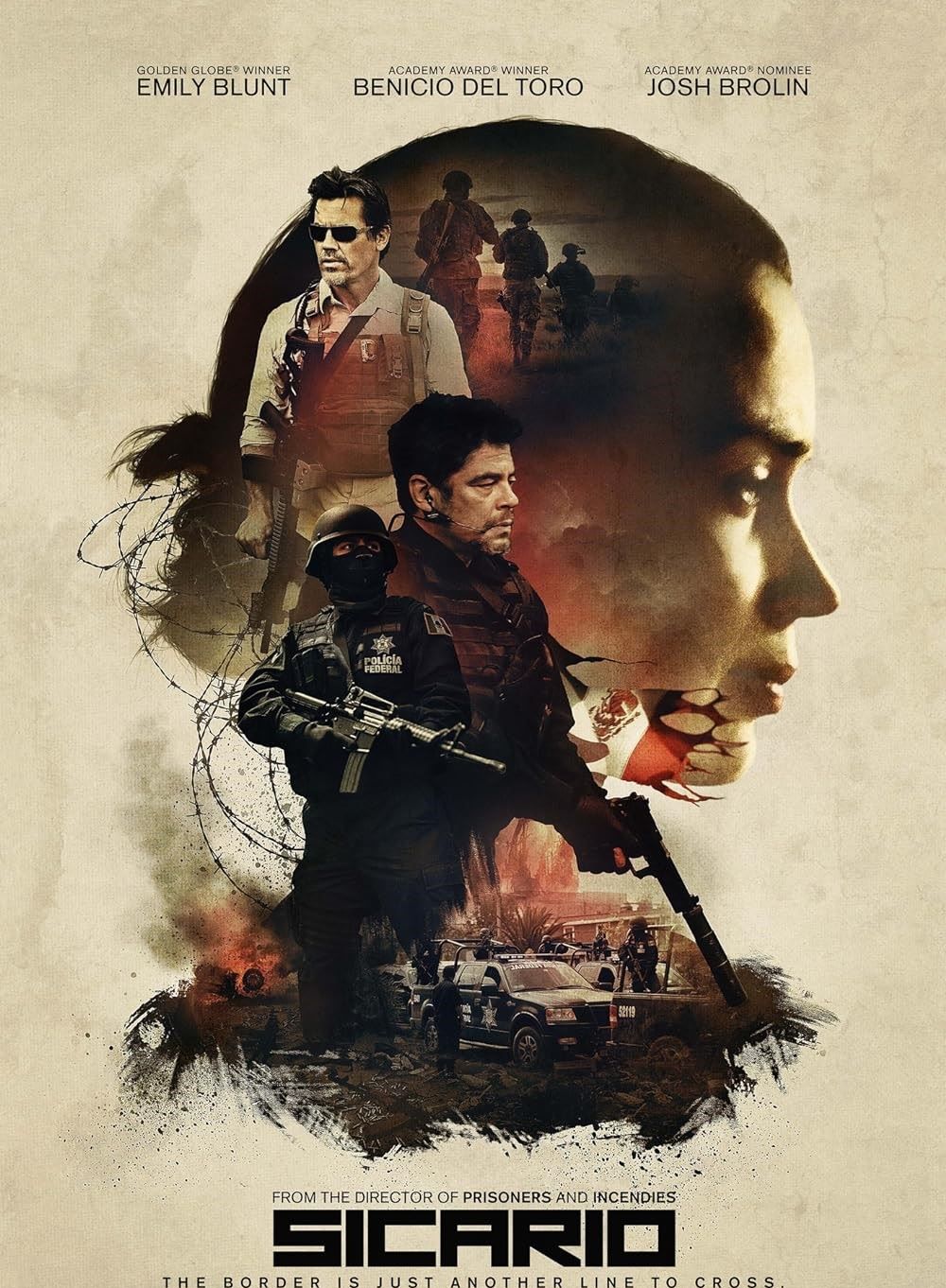
Review: Sicario (dir. by Denis Villeneuve)


“You should move to a small town where the rule of law still exists. You will not survive here. You are not a wolf. And this is the land of wolves now.” — Alejandro

Sicario is one of those thrillers that doesn’t just try to get your pulse up; it wants to leave you sitting there afterward, uncomfortable and a little hollowed out. Set in the murky world of the U.S.–Mexico drug war, it follows an idealistic FBI agent pulled into a “by any means necessary” operation and slowly realizing she’s basically a pawn in a much bigger, much uglier game. It’s not a movie about slick heroes taking down bad guys so much as a slow, grim spiral into the realization that the system is rigged on every level, and that’s where the film is both at its most impressive and its most uncompromising. Overall, it leans heavily positive as a piece of craft—beautifully shot, superbly acted, tightly directed—and its refusal to blink at where its story logically leads is a big part of what gives it power.

The basic setup is simple enough: Kate Macer, played by Emily Blunt, is an FBI agent used to doing things by the book, raiding cartel safe houses in Arizona with her partner Reggie. After a grisly opening operation that turns up corpses hidden in the walls and a deadly booby trap, she’s recruited into a joint task force helmed by Josh Brolin’s Matt Graver, a flip‑flop‑wearing CIA type who treats international borders and legal constraints as suggestions. The team’s official mission is to go after a cartel lieutenant, Manuel Díaz, but very quickly Kate realizes she’s only being told a fraction of what’s really going on. The more she pushes for answers, the more obvious it becomes that Matt and his mysterious associate Alejandro (Benicio Del Toro) are running their own agenda and using her badge and presence as cover.

From the start, Denis Villeneuve frames this story as a descent, and he does it by locking us into Kate’s perspective for most of the film. We’re as confused and kept in the dark as she is: we don’t fully know why the team is crossing into Juárez, why everyone is so tense at the border, or what the deeper objective is besides “disrupt the cartel.” That choice pays off in a huge way during the film’s standout sequences, whether it’s the convoy inching through traffic surrounded by armed federales or the nighttime tunnel infiltration lit by thermal and night‑vision photography. Those scenes aren’t just “cool action beats”; they’re engineered to make you feel boxed in and outmatched, like violence could erupt at any second and no one really has control. Even when nothing is technically happening, you can feel the nerves jangling under the surface.

One of the most striking things about Sicario is how it weaponizes space. The way the film uses its wide, open desert vistas isn’t just pretty scenery—it adds this creeping, suffocating dread to everything, as if the characters are tiny figures swallowed up by forces they can’t hope to understand or control. Those long shots of trucks threading their way across the landscape, or helicopters gliding over seemingly endless scrub, make the world feel vast, ancient, and totally indifferent to whoever’s spilling blood on it today. In those moments, the movie almost channels a kind of Lovecraftian horror, the same cosmic, indifferent menace that Cormac McCarthy managed to weave through his Westerns, where the land itself feels old, hostile, and utterly unmoved by human morality or suffering. It’s not supernatural, but that sense of something bigger, colder, and permanent presses down on every decision these characters make.

Roger Deakins’ cinematography is a huge part of why that dread lands so well. The desert is captured in these wide, ominous skyline shots with tiny vehicles creeping along the horizon, giving Sicario a sense of menace that feels baked into the environment. Even the daylight scenes feel threatening, all washed‑out heat and harsh sun flattening everything into a kind of moral no‑man’s‑land. Then the movie flips into night, and suddenly you’re plunged into infrared and silhouettes, which fits perfectly with the story’s obsession with secrecy and invisible lines being crossed. This is one of those films where you could watch with the sound off and still feel the tension just from how the images are composed, but the use of space and light also nudges the movie into that McCarthy‑adjacent territory where the West is less a backdrop and more a silent, malevolent presence.

The performances match that level of craft. Emily Blunt plays Kate as tough and competent, but not in a superhero way—she’s brave, but she’s also human, constantly trying to reconcile what she’s seeing with what she believes law enforcement is supposed to be. You can see the frustration mounting as she keeps demanding clarity and hitting a wall of smirks, deflections, and “you’ll understand later.” Benicio Del Toro, meanwhile, walks off with the film as Alejandro, this quiet, haunted figure who initially seems like just another operative but reveals layers of trauma and ruthlessness as the story goes on. The script is smart about keeping his backstory mostly hinted at until late in the film, which makes it all the more chilling when you finally see what he’s really there to do. Josh Brolin is the third pillar, playing Matt as casually flippant on the surface but utterly cold about collateral damage, the kind of guy who laughs through briefings because he already knows the moral lines are going to be erased.

On a thematic level, Sicario is very much about complicity and the idea that in this particular “war,” there are no clean hands. Kate comes in thinking she’s going to help nail cartel leadership through some kind of legal, targeted operation; what she slowly figures out is that the task force is really trying to destabilize one cartel to empower another, consolidating power into a more “manageable” single organization. That logic—“create one devil we can deal with instead of many we can’t”—is chilling, and the movie doesn’t really offer a comforting counterargument. Instead of pulling back or softening that stance, it commits to showing what that philosophy looks like in practice, all the way to the bitter end. By the time Alejandro reaches his personal endgame and we see what “justice” looks like in this world, any illusions about moral clarity are gone, and the film refuses to apologize for following that line through.

Where some films might hedge their bets or try to inject a last‑minute note of optimism, Sicario is deliberately straight‑backed about where its story logically leads. The CIA needs Kate’s FBI status to legitimize their operation on U.S. soil, but they don’t actually want her input; she’s there to sign off and be lied to, not to shape policy. Every time she pushes back—like when she tries to build a traditional case after the task force raids a cartel‑connected bank—she’s shut down because “that’s not what this mission is.” Even the brief subplot with the corrupt local cop Silvio is there to underline how the drug war trickles down: this isn’t just cartel bosses and shadowy agents, it’s working‑class people pulling double duty as mules because they’re desperate, and they end up as expendable as anyone else. Rather than treating that as background noise, the movie leans into the bleak implications and lets them sit with you.

The same goes for Kate’s arc. Some viewers see the film as sidelining its female lead in the third act, shifting the narrative fully over to Alejandro just when things are coming to a head. Structurally, that is what happens: the viewpoint tilts from Kate’s confused horror to Alejandro’s mission, and she becomes more of a witness than an active participant. But that shift feels of a piece with the movie’s overall approach—she has been outmaneuvered and used from the start, and Sicario isn’t interested in pretending otherwise just to deliver a more empowering or conventionally satisfying ending. There’s something bracing about the way the film sticks to its guns here; it says, “this is the world we’ve shown you for two hours, and this is how someone like Kate gets treated in it,” and then follows through.

All of this could have tipped into empty cynicism if the film didn’t feel so precise and purposeful. Jóhann Jóhannsson’s score, all pounding, low‑end rumble and ominous strings, practically turns the highway scenes into horror set‑pieces; it feels like the sound of something massive grinding forward that you can’t stop. Villeneuve keeps the pacing deliberate but never sluggish, using long stretches of quiet to make the explosions of violence feel random and brutal instead of exciting. Even small scenes, like Kate’s attempted hookup with a local cop who turns out to be on the cartel payroll, are staged to underline how deeply compromised everything is. There’s no safe space, no “off the clock” moment where the larger conflict doesn’t intrude, and the movie doesn’t pretend there is just to make you feel better walking out.

If you go into Sicario looking for a clean, cathartic crime thriller where the good guys outsmart the bad guys, you’ll probably come away irritated or even angry. The movie’s whole point is that those categories don’t really apply in this corner of the world, and it’s committed enough to that idea that it never gives you an easy out. But if you’re up for something more sobering—an incredibly well‑crafted, morally grim look at the drug war with standout work from Blunt, Del Toro, Brolin, Deakins, and Villeneuve—it’s a pretty exceptional ride. Its worldview is harsh, but it’s also coherent and honestly pursued, and that level of conviction is a big part of why the film lingers. It may not be the kind of movie you “enjoy” in a traditional sense, but it’s one that sticks with you, and in this genre, that counts for a lot.
Playing Catch-Up With 6 Quickie Reviews: The Big Game, The Connection, Graduation Day, McFarland USA, Taken 3, and War Room


Here are 6 more reviews of 6 other films that I watched this year.  Why six?  Because Lisa doesn’t do odd numbers, that’s why.

The Big Game (dir by Jalmari Helander)

In The Big Game, Samuel L. Jackson plays the President of the United States and you would think that fact alone would make this film an instant classic.  Unfortunately, this film never really takes advantage of the inherent coolness of Samuel L. Jackson playing the leader of the free world.  When Air Force One is sabotaged and crashes in the wilderness of Finland, President Jackson has to rely on a young hunter (Onni Tommila) from a group of CIA agents disguised as terrorists.  Tommila does a pretty good job and the scenery looks great but at no point does Samuel L. Jackson says, “Check out this executive action, motherfucker,” and that’s a huge missed opportunity.  As for the rest of the film, it takes itself a bit too seriously and if you can’t figure out the big twist from the minute the movie starts, you obviously haven’t seen enough movies.

The Connection (dir by Cedric Jiminez)

Taking place over the 1970s, the French crime thriller tells the largely true story of the efforts of a French judge (played by Jean Dujardin) to take down a ruthless gangster (Gilles Lellouche) who is the head of one of the biggest drug cartels in the world.  The Connection run for a bit too long but, ultimately, it’s a stylish thriller that does a very good job of creating a world where literally no one can be trusted.  Dujardin, best known here in the States for his Oscar-winning role in The Artist, does a great job playing an honest man who is nearly driven to the point of insanity by the corruption all around him.

Graduation Day (dir by Chris Stokes)

Hey, it’s another found footage horror film!  Bleh!  Now, I should admit that this horror film — which is NOT a remake of that classic 1980s slasher — does have a fairly clever twist towards the end, that goes a long way towards explaining a lot of the inconsistencies that, up until that point, had pretty much dominated the film.  But, even with that in mind and admitting that Unfriended and Devil’s Due worked wonders with the concept, it’s still hard to feel any enthusiasm about yet another found footage horror film.

McFarland USA (dir by Niki Caro)

McFarland USA is an extremely predictable but likable movie.  Kevin Costner plays a former football coach who, while teaching at a mostly Latino high school, organizes a cross country team that goes on to win the state championship.  It’s based on a true story and, at the end of the film, all of the real people appear alongside the actors who played them.  There’s nothing about this film that will surprise you but it’s still fairly well-done.  Even Kevin Costner, who usually gets on my last nerve, gives a good performance.

Taken 3 (dir by Olivier Megaton)

Bryan Mills (Liam Neeson) is back and he’s killing even more people!  Fortunately, they’re all bad people but you really do have to wonder what type of dreams Bryan has whenever he goes to sleep.  In Taken 3, Bryan’s wife (Famke Janssen) has been murdered and Bryan has been framed.  He has to solve the case and kill the bad guys while staying one step ahead of the police (represented by a bored-looking Forest Whitaker).  Neeson does all of his usual Taken stuff — the intense phone conversation, the steely glare, and all the rest — but at this point, it has literally been parodied to death.  If you’re into watching Liam Neeson kill ugly people, Taken 3 will provide you with adequate entertainment but, for the most part, it’s but a shadow of the first Taken.

War Room (dir by Alex Kendrick)

I saw the War Room in Oklahoma.  It was being shown as part of a double feature with The Martian, of all things!  Anyway, this film is about an upper middle class family that hits rock bottom but they’re saved by the power of prayer!  Lots and lots of prayer!  Seriously, this film almost qualifies as “prayer porn.”  Anyway, the film was badly acted, badly written, incredibly heavy-handed, and ran on way too long but, on the plus side, it did eventually end.

Film Review: Sicario (dir by Denis Villeneuve)


Sicario_poster

If you told me that I had to describe the new film Sicario in just one word, that word would be “overwhelming.”

And then I’d get really mad at you for making me sum up my feelings about Sicario in only one word.  Sicario is a great film, one of the best of the year so far.  It’s a film that works as both an exciting thriller and an examination of the grim reality of the Mexican Drug War.  It’s a film that may anger you and it certainly won’t leave you feeling very optimistic as far as the endless, corrupt, and unwinnable war on drugs is concerned.  And, ultimately, it is a very overwhelming viewing experience, one that quite literally left me breathless.

And what’s frustrating is that I really can’t tell you as much about Sicario as I might want to.  Sicario is a film about secrets and, if I reveal even one secret, I risk messing up the experience of watching the film for you.  And that’s something that I would never want to do because Sicario is a film that deserves and needs to be seen and experienced.  And this is a film that you should go into with as little advanced knowledge as possible.

So, I’m going to ask you trust me here.  I’m going to ask you to believe me when I tell you that Sicario is a great film but that I can’t tell you the exact reasons why.  It’s a film that comes at you disguised as being a typical action film and then it sets about defying every single expectation that you might have.  I have been so conditioned by watching so many action films that I constantly found myself assuming that I knew what would happen next.  And, nearly every time, Sicario proved me wrong.

Here’s what I can tell you.  Kate Marcer (Emily Blunt) is a FBI agent who, after discovering an Arizona house that is full of dead bodies, is assigned to a joint task force that has been tasked with taking down a Mexican drug lord.  Kate finds herself working for Matt Graver (Josh Brolin), who works for a government agency that he consistently refuses to name.  Idealistic and naive, Kate is shocked by Graver’s ruthless methods and confused as to why she’s even been assigned to work with him.  (Kate continually complains that Graver’s operation seems to have no purpose and that his methods are often illegal.  Graver usually just smirks in response.)  Also working with Graver is the enigmatic Alejandro (Benicio Del Toro), a Columbian lawyer who says few words and is surprisingly good with a gun.

Up until the film’s final 30 minutes, we see nearly the entire story through Kate’s eyes.  And, much like Kate, we spend much of the film confused.  We struggle to figure out just what exactly it is that Graver is trying to accomplish and just how exactly Alejandro fits into his plans.  Emily Blunt gives a great performance as Kate but, at the same time, the film cleverly subverts our expectations about what we expect to happen with her character.  After all, we’ve seen Looper.  We’ve seen Edge of Tomorrow.  And when Sicario begins, we have every reason to expect that this is going to be another film where Emily Blunt is going to kick everyone’s ass.  And, make no doubt about it — Emily Blunt does get to kick some ass in this film but this film suggests that, in the end, it doesn’t matter if you kick everyone’s ass.  Certain things just cannot be changed.

And then there’s Josh Brolin, who is wonderfully glib as Matt Graver.  You distrust him as soon as he appears on-screen but he still remains a compelling enigma.  But, ultimately, this film belongs to Benicio Del Toro.  If there was any doubt that Del Toro is one of the greatest actors working right now, Sicario should dispel it.  When we first meet Alejandro, he seems like he’s just a burned out shell of a man.  We look at him and we assume certain things about his character and we think we know exactly what is going to happen with him.  At first, Del Toro gives such a quiet and introverted performance that it’s almost easy to forget about him.  But then, as Sicario reaches its violent and thought-provoking conclusion, Del Toro suddenly steps forward and take over the entire film.  Even after we learn his big secret, Alejandro (and Del Toro) continues to surprise us.  It’s a great performance and it will be a great injustice if Del Toro is not, at the very least, nominated for an Academy Award.

Along with Del Toro, the other great stars of the film are cinematographer Roger Deakins and the director, Denis Villeneuve.  Villeneuve may not be a household name but he’s one of the best directors working today.  He’s a filmmaker who can use the conventions of genre (the action genre in this film, the mystery genre in Prisoners) to tell a story about how people are living now and why things are the way that they are.  (In many ways, Denis Villeneuve is Steven Soderbergh without all the pretentious affectations.)  Villeneuve’s skill as a director is on full, thrilling display in four separate set pieces, each of which is full of heart-pounding tension and sudden violence.  As for Roger Deakins, he captures images of Mexico and the south Texas that feel almost alien in their ominous beauty.

Sicario is one of the best films of the year.  See it!

Shattered Politics #83: Milk (dir by Gus Van Sant)


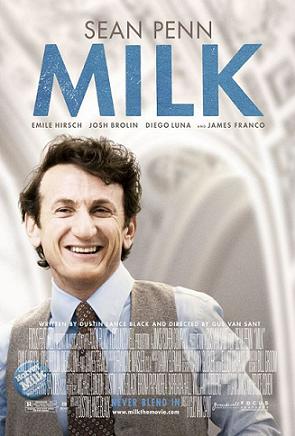
Milkposter08

For the past three weeks, I have been in the process of reviewing, in chronological order, 94 films about politics and politicians.  It’s a little something that we call Shattered Politics.

And while I’ve had a lot of fun doing it, it does worry me a bit that I may have made the Shattered Lens into a far more cynical site to visit.  That’s largely because I don’t trust politicians or the government in general and, despite the fact that we started off with Abraham Lincoln and Mr. Smith Goes To Washington, the majority of the films that I’ve reviewed have reflected that fact.

So, in order to combat that cynicism, I’m going to recommend a film from 2008 that, despite being a biopic about a politician, is actually rather inspiring.  I am, of course, talking about the 2008 best picture nominee, Milk.

Milk tells the story of Harvey Milk who, in 1977, became the first openly gay man to be elected to a major public office.  Now, just consider that.  Up until 38 years ago, nobody who was openly gay had been elected to public office.  Nowadays, the idea of an out gay man or a lesbian running for public office is only shocking to a dwindling minority of homophobes.  Even down here Texas, which everyone up north always smugly assumes to be so intolerant, nobody is surprised when a gay or a lesbian not only runs for office but wins as well.  Sheriff Lupe Valdez has served as sheriff of Dallas Country for over ten years and, though she’s been controversial, none of that controversy has concerned her sexuality.  Meanwhile, Annise Parker has served three-terms as mayor of Houston, making Houston the biggest city in America to have an openly gay mayor.

However, before Lupe Valdez could be sheriff or Annise Parker could be mayor, Harvey Milk had to serve on the San Francisco Board of Supervisors.

Milk follows Harvey (Sean Penn, who won an Oscar for his performance) and his much younger boyfriend, Scott (James Franco) from the moment they first meet in New York to when they moved to San Francisco in 1970.  We see how Harvey first found fame as a neighborhood activist and how he challenged both the political and gay establishment of San Francisco in his campaigns for political office.  When he finally wins a seat on the Board of Supervisors, he does so at the cost of his relationship with Scott.  He enters into another relationship with the self-destructive Jack (Diego Luna), which ends tragically.

By winning office, Harvey becomes a spokesman for gays everywhere.  When a sinister state senator (Denis O’Hare) attempts to pass a bill that would forbid gays from teaching school, Harvey leads to opposition.  And, while Harvey’s career continues to rise, the career of another supervisor — Dan White (Josh Brolin) — plummets.

Elected at the same time as Harvey, Dan is an uptight former cop.  Though he and Harvey originally strike a somewhat awkward friendship (Harvey is the only supervisor to come to the christening of Dan’s child), Dan soon comes to resent Harvey.  (At one point, Harvey suggests that Dan might be closeted and Brolin’s tightly coiled performance certainly implies that Dan is repressing something.)  Eventually, Dan shoots and kills both the mayor (Victor Garber) and Harvey.

Though the film ends in violence and anger, it also ends with hope.  Though Harvey may be dead, the activists that he inspired are there to carry on.

Because the film was directed by a gay man, written by a gay man, and tells the story of a gay man, Milk is often dismissed, even by critics who liked it, as just being a gay film.  But, actually, it is a film that should inspire anyone who has ever felt like they’ve been pushed into the margins of our national culture.  By the film’s end, Harvey Milk has emerged as not just a gay hero but as a hero to anyone who has ever been told that their voice does not matter.  When Harvey says, repeatedly, “You’ve got to give them hope,” it’s hope for all of us.

Film Review: Argo (dir. by Ben Affleck)


When I made out my list of my 26 favorite films of 2012, Argo came in at number 19,  I think that Argo is a likable, funny, and frequently exciting film.  Not only does it feature some of Ben Affleck’s best work as a director (though I still think Affleck has yet to top Gone, Baby, Gone) but also some of his best work as an actor.  If The Town left my skeptical about Affleck’s film-making talents, Argo made me a believer again.  That said, while I think that Argo is a good film, I don’t think it’s a great film but that opinion definitely places me in both the minority of filmgoers and, since my sister Erin considers Argo to be the best film of 2012, Bowmans as well.

Based on a true story, Argo takes place in 1979.  The Shah of Iran has been overthrown and the American embassy in Tehran is overrun by Islamic militants.  Over 50 Americans are taken hostage but six embassy workers manage to escape and end up hiding in the home of the Canadian ambassador (Victor Garber).  The U.S. State Department has to find a way to get the six of them out of Iran before the militants discover their existence.

It’s up to CIA agent Tony Mendez (played, of course, by Ben Affleck) to come up with a better plan than attempting to smuggle bicycles into Iran.  Mendez’s scheme is to team up with a Hollywood makeup artist (John Goodman) and a B-movie producer (Alan Arkin) and to convince the Iranian government that he and the 6 embassy workers are actually a film crew and that they’re in Iran not on a rescue-and-escape mission but instead to scout locations for a science fiction film called Argo.

Argo, for the most part, works.  As a director, Affleck manages to deftly juggle both comedy and suspense.  The scenes where Arkin and Goodman teach Affleck how to be a Hollywood phony are frequently hilarious, while the scenes in Iran are effectively tense and claustrophobic.  The film is full of little period details that ring true and I’m still shocked that Argo didn’t receive an Oscar nomination for either Best Costume Design or Best Production Design.  The wide lapels on Ben Affleck’s suits may not have been as flamboyant as the costumes in Les Miserables but, like the costumes in Les Mis, the very sight of them not only transported us to a different time but made that time plausible as well.

As you might expect from an actor-turned-director, Affleck gets good performances from his entire cast.  Goodman and Arkin are both sympathetic as recognizable Hollywood types and Bryan Cranston has a few good scenes as a fellow CIA agent.  While the 6 hostages are all pretty much interchangeable, they are still all well-cast and sympathetic.

That said, when I saw the film, it was hard to escape the feeling that the first half of the film (in which the embassy workers hid out at the Ambassador’s house while Affleck, Arkin, and Goodman worked on promoting their fake film) was dramatically more interesting and compelling than the far more conventional second half.  Once Affleck actually reaches Tehran, Argo becomes a rather predictable, if still well-made and exciting, movie.  Perhaps that’s why, as much as I enjoyed Argo, the film didn’t make as much of an impression of me as a film with a more challenging narrative would have.  Ultimately, Argo tells the true story of people in tremendous danger but the film itself feels very safe.

Argo is one of the most acclaimed films of 2012 and it’s been nominated for 7 Oscars, including Best Picture.  To just about everyone’s surprise, Ben Affleck was not nominated for best director.  While I personally would not have nominated either Argo or Affleck, the fact of the matter is that the reason Argo has received so much acclaim is because of Affleck’s work behind the camera.  Argo is such a director’s film that it’s next to impossible to argue that Argo‘s one of the best films of the year without also arguing that Affleck is one of the best directors of the year.  Hence, Affleck’s lack of a nomination does feel like a definite snub.  Even speaking as someone who was not as enthralled with Argo as much as everyone else, I would still have nominated Affleck long before I wasted a nomination on Benh Zeitlin for relying too much on a hand-held camera while filming Beasts of the Southern Wild.

While the Academy may have snubbed Affleck, the Hollywood Foreign Press Association did not.  Earlier this night, Affleck won the Golden Globe for best director and Argo won best picture.  (Though, I have to say, I find myself wondering if my friend Jason Tarwater was right when he suggested that the notorious starfuckers of the HFPA honored Argo mostly because they wanted to hang out with the film’s co-producer, George Clooney.)  Given the fact that it’s been over 20 years since a film won Best Picture without receiving a nomination for Best Director, Affleck and Clooney might just have to be happy with the universal acclaim.

Review: Kung Fu Panda 2 (dir. by Jennifer Yuh Nelson)


In 2008, Dreamworks Animation released what many had thought was one of their animated films. Some even went so far as to consider it on the same level as many of the Pixar animated offerings. This was high praise indeed and the praises from critics was awarded by public acclaim as Kung Fu Panda became an instant classic for Dreamworks Animation. It wasn’t a huge surprise that a sequel was quickly greenlit by the studio and now three years has passed and that sequel has finally come out. Kung Fu Panda 2 does one of those rare feats in film-making where it surpasses it’s original predecessor in all things. This was a sequel that was able to take what made the first one so fun and thrilling and build on it without losing the charm that made it so beloved in the first place.

Kung Fu Panda 2 brings back the Dragon Warrior Po (Jack Black returning in the role of the big fat panda) as he continues to live his dream of having become the Dragon Warrior and fighting evil, bandits and criminals with his fellow kung fu masters, the Furious Five. Instead of the film highlighting Po’s size as a detriment and keeping him a buffoonish character like in the beginning of the first film this sequel actually makes him an equal of his heroes, if not, surpassing them. This is a refreshing change since the writers could’ve easily banked on Po as a character who bungled and stumbled his way through most of the film.

This film was a continuation of Po’s journey as a hero which the first film was just the first step. Despite being a kung fu master in his own right his culture becomes threatened by a villain even more devious than the first film’s Tai Lung. Lord Shen (voiced by Gary Oldman) is the mad peacock heir to Gongmen City who has found an ultimate weapon through fireworks that he plans to defeat kung fu and conquer all of China. Kung fu is everything to Po and he journeys with the Furious Five to confront Lord Shen and stop his plans before it’s too late.

It’s during this journey that Po learns more about his true past and where he truly comes from. The sequences where Po’s adopted goose father tells of Po’s past was some of the best animations Dreamworks has done and I’d say surpasses some of Pixar’s own work. After seeing this film I’m sure many kids and some adults would want themselves their very own baby panda. Who would’ve thought that baby pandas sounded like human babies when they cried. It’s knowing his past that Po must now learn to find his inner peace if he’s to ever go beyond just being a kung fu master.

Kung Fu Panda 2 was actually quite a dark film in places as themes of genocide, destructive march of technology against nature, difficulties of adopted children finding their true origins and many others. That’s not to say that this sequel wasn’t fun to watch. The action took the kung fu fight scenes from the first film to a whole new level, but without turning it into all flash and no substance. It’s during some of the thrilling fight sequences that we see Po truly become part of the Furious Five and even affection from some of it’s members. It would be interesting to see how a third film would explore the growing relationship between Po and certain striped-feline.

The story gets a much needed infusion of creative help from one Guillermo Del Toro who served as creative producer. His inclusion in the film’s development was probably why the film had a much darker and serious tone in addition to the charm it continued from the first film. If there was anyone in Hollywood who knows how to further develop a character through a Campbellian hero’s journey then it’s Del Toro. If Dreamworks Animation is able to keep Del Toro on hand to further treat their other projects then it will be quite a coup for the studio.

The animation in this film is a step above the first film and anything Dreamworks Animation has ever done. With each passing year and release it looks like Dreamworks Animation has been able to come to the same level of animated work Pixar has set with their own projects. While I’m sure there’s no animosity between animators fo the two houses there probably is some sort of friendly rivalry which helps push both studios to improve on their animation work. All this means is that the public wins out in the end as we’re treated to better animated features from both Dreamworks and Pixar. It’s a good thing that Dreamworks Animation has also improved their storytelling with each new film that they’re not being called the weaker films when compared to Pixar’s latest.

In the end, Kung Fu Panda 2 more than lives up to it’s predecessor and actually surpasses it in every way. This sequel’s animation and use of stereoscopic 3D was some of the best in CG animation to date. It had a story that continued to explore and build the characters from the first film that they’ve gone beyond simple, basic animated characters but fully realized and complex individuals. Even the ending scene in the film which definitely sets-up a third film doesn’t seem tacked on but looks like something that would further continue Po’s hero’s journey. Sequels and milking of a franchise usually don’t sit well with serious film fans, but this franchise seems to be doing it correctly and using each new film to further an epic tale. Here’s to hoping we see Po and his Furious Five friends back for more in the coming years.

Kung Fu Panda 2 (Super Bowl TV Spot)


Here’s another tv spot to air during Super Bowl XLV and this time around it’s the one for the upcoming sequel to Dreamworks Animations very popular and successful Kung Fu Panda.

This one using that Queen arena anthem chant from “We Will Rock You”. The 30-second ty spot shows more action with the requisite panda shenanigans from Jack Black’s character.

Kung Fu Panda 2 is one sequel I’m definitely hyped to see as the first film I ended up watching over and over and over and over and over again. The film comes out on May 26, 2011.

Kung Fu Panda 2: The Kaboom of Doom teaser trailer


One of my favorite films of 2008 was an animated film and it wasn’t from Pixar. I’m talking about the Dreamworks Animation release for the summer of the year that was awesome in its very awesomeness. The film I talk of is Kung Fu Panda. It was a film that was fun and more than just a bit inspiring for its message of persevering through obstacles and doubts to achieve one’s dream. That was what I got out if it anyway in addition to what the little ones got which was THE big, fat panda (voiced by the panda-looking one himself Jack Black) doing kung fu in all its awesomeness and bodacity.

It will take another three years before such awesomeness and bodacity returns to the silver screen and in awesome and bodacious 3D. This summer of 2011 will see the return of the Dragon Warrior himself, Po as he must confront a new danger in the form of Gary Oldman voicing some perpetuator of evilness and douchebaggery on the simple talking animals peasants.

Now, time for some kung fu staring contest!