Retro Television Review: Fantasy Island 5.21 “The Big Bet/Nancy and the Thunderbirds”


Welcome to Retro Television Reviews, a feature where we review some of our favorite and least favorite shows of the past!  On Tuesdays, I will be reviewing the original Fantasy Island, which ran on ABC from 1977 to 1984.  Unfortunately, the show has been removed from most streaming sites.  Fortunately, I’ve got nearly every episode on my DVR.
This week, it’s the last Julie episode.

Episode 5.21 “The Big Bet/Nancy and the Thunderbirds”

(Dir by Cliff Bole, originally aired on May 1st, 1982)

Because I’ve got a cold and I’ve still got a lot to do for the holidays, I’m only going to do a mini-review for this episode.  It’s not a very good episode so the less time spent talking about it, the better.

  • I knew this episode wasn’t going to be my cup of tea when Julie was the one who greeted Mr. Roarke as he stepped out of his office.  That’s nothing against Wendy Schaal, the actress who played Julie.  It’s just that the episodes in which Julie helps out Roarke are never as good as the Tattoo episodes.  Ricardo Montalban and Wendy Schaal just didn’t have the same type of entertaining chemistry as Montalban and Herve Villechaize.
  • I think a huge part of the problem with Julie is that she is Roarke’s goddaughter and spends a lot of time looking up to him and treating him like a father figure.  Tattoo and Roarke were, more or less, equals and they could relate to each other on a much more honest and, by the standards of the show, realistic fashion.
  • As for the fantasies, neither one is very interesting.
  • Mary Ann Mobley plays Nancy Carsons, who was adopted and raised by an Indian chief.  Nancy]s fantasy is to fulfil the Chief’s prophecy and conquer a thunderbird.  Apparently, only by doing this can Nancy prevent the tribe from falling apart when the Chief dies.  The problem is that the thunderbird is a mythological bird who does not exactly exist.
  • However, there is a squadron of airplanes known as the Thunderbirds and they’re visiting Fantasy Island.  Can Nancy, who is a licensed pilot, fly one of those plans and kind of make the prophecy come true?
  • Of course, she does!  And she also falls in love with Major Wood (Patrick Wayne) so, not only is the Tribe saved but Nancy will now be doing even more flying.
  • If the Thunderbirds fantasy was just kind of bland, the “Big Bet” fantasy is downright offensive, with Corky Daniels (John James) making a bet with his co-workers that he can have sex with Playpen model, Judy Moreau (Lydia Cornell).  Judy just happens to be on the Island, accompanied by Playpen published Hugh Hefner Al Henshaw (Edd Byrnes).
  • Corky tells Judy a lot of lies to get her to fall for him.  When Judy finds out about the bet, she’s so upset that she …. sleeps with Corky anyways.  But then Corky doesn’t tell his friends about sleeping with Judy and loses the bet which proves to Judy that he really does love her.
  • Now, let’s give credit where credit it due.  Both Roarke and Julie tell Corky that he’s being a sexist pig.  I always like it when Roarke gets offended with his guest’s because Montalban always seemed to enjoy playing up Roarke’s anger.  Mr. Roarke comes across as being the perfect host but you don’t want to get him mad.
  • Corky and Judy leave the Island together.  Judy should have tossed Corky in the lagoon.

We’ve got one episode left in season 5.  I checked and it’s a Tattoo episode, which means this week’s episode was Julie’s grand finale.  Unfortunately, it’s not really much of a finale.  Julie’s sudden presence on the Island was never really adequately explained, though it was kind of nice to be reminded that there’s always a lot taking place on the Island and Roarke doesn’t always have time to oversee every little thing.  I suppose Roarke probably has many assistants who we rarely see.

Because of the holidays, this is my final Fantasy Island review of 2024.  I will resume reviewing Fantasy Island on January 7th!
Late Night Retro Television Review: CHiPs 3.1 and 3.2 “Roller Disco”


Welcome to Late Night Retro Television Reviews, a feature where we review some of our favorite and least favorite shows of the past!  On Mondays, I will be reviewing CHiPs, which ran on NBC from 1977 to 1983.  The entire show is currently streaming on Prime!

This week, season three begins with a classic episode!

Episode 3.1 and 3.2 “Roller Disco”

(Dir by Don Weis, originally aired on September 22nd, 1979)

It’s the roller disco episode!

From the moment that I first announced that I would be watching and reviewing CHiPs for this feature, people have been telling me about the legendary roller disco episode.  Having finally reached it, I can say that it lived up to the hype.  You’re not likely to see anything more 70s than the third season premiere of CHiPs.

Now, this was a two-hour episode so there were actually quite a few subplot going on, all of which were typical CHiPs storylines.  In no particular order:

  1. A kid named Mark (Bobby Rolofson) is roller skating around the beach and idolizing three criminals.  Can Baker show him that the good guys always win?
  2. The three criminals are Lita (Helena Kallianiotes), Ty (Fred Williamson), and Romo (Jim Brown).  Lita sets up the targets.  Ty and Romo steal their purses and their wallets and then escape on roller skates.  Ty and Romo are tired of breaking the law.  Lita demands that they continue to steal.  Eventually, it falls to Baker and Ponch to arrest them.
  3. Carlin (Larry Linville) and Franco (Larry Storch) continually cause accidents on the highway.
  4. Rock star Jimmy Tyler (Leif Garrett) is so tired that he sleeps through one of those accidents.  Looking to break free from his well-meaning but overbearing manager (Bill Daily), Jimmy decides to manage his own affairs while staying at Jon Baker’s apartment.

There’s a lot going on but the main plotline is Ponch trying to find celebrities to take part in the annual highway patrol fund raiser.  Even with his big smile, Ponch struggles to charm the celebs.  He pulls over Ed McMahon at one point but fails to recognize him until McMahon drives off.  Gatraer tells Ponch that police work comes first but also tells him that he has to find celebrities.  Gatraer’s been giving Ponch a hard time ever since the first season.  Some things never change.

Fortunately, Jimmy feels guilty for overstaying his welcome at Baker’s apartment and he makes it up to Baker and Ponch by asking his celebrity friends to take part in the fund raiser.  It’s time for a roller disco with the stars!

It all leads to this classic scene:

I recognized a few of the stars, though certainly not all of them.  I recognized Victor French because I’ve been reviewing Highway to Heaven.  I’ve also seen enough old sitcoms that I immediately recognized Robert Mandan, who was apparently the best roller skater in Hollywood.  Melissa Sue Anderson, I knew from Happy Birthday To Me.  Cindy Williams, who got two shout-outs, I knew from American Graffiti.  Is it just me or did Nancy Kulp look kind of lost?  Neither Melissa Sue Anderson nor Cindy Williams seemed to want to talk to her.

The roller disco actually goes on for fifteen minutes, which I appreciated.  The show promised a roller disco and it delivered.  It was like stepping into a time machine and traveling to the 70s.  It was a great way to start season three!

Because of the holidays, this is going to be my final CHiPs review of 2024.  My reviews of this show will return on January 6th!

Retro Television Review: Miami Vice 3.11 “Forgive Us Our Debts”


Welcome to Retro Television Reviews, a feature where we review some of our favorite and least favorite shows of the past!  On Mondays, I will be reviewing Miami Vice, which ran on NBC from 1984 to 1989.  The entire show can be purchased on Prime!

This week’s episode took me by surprise!

Episode 3.11 “Forgive Us Our Debts”

(Dir by Jan Eliasberg, originally aired on December 12th, 1986)

Frank Hackman (Guy Boyd) has a date with Florida’s electric chair.  Even though he claims that he’s innocent of killing one of Sonny Crockett’s former partners, Hackman says that he’s guilty of killing others and, having become a Christian while on Death Row, he is prepared to pay the ultimate price.  He even suggests that his execution should be televised.

At first, Sonny is all for Hackman being executed.  But then, a priest calls the Vice Squad and tells them that one of his parishioners confessed to having evidence that could prove that Hackman was actually in Vegas when the murder occurred.  Sonny and the Squad track down Gus Albierro (Val Bisoglio), an auto mechanic who is dying of cancer and who says that he’s telling the truth to clear his conscience.   Not long after Gus talks to Crockett, Gus is executed in his garage.

Convinced that Hackman is innocent, Sonny and Tubbs have one day to find the other person who was with Gus and Hackman in Vegas.  That man turns out to be in the witness protection agency and, at first, he refuses to talk.  Then Crockett takes him outside and beats him up.

Long story short: After having had his head shaved for his date with the electric chair, Hackman’s life is saved and he leaves prison a free man….

Now, up until this point, I felt that this episode was just another rather heavy-handed diatribe against the death penalty.  Miami Vice, as a show, always leaned towards the Left and this episode features two smarmy Florida politicians who are eager to prove how tough they are on crime.  I thought the whole episode was a bit too obvious in its storytelling and I thought my review would focus on the hypocrisy of Miami Vice criticizing the death penalty when almost every episode has ended with the bad guys being taken down in a hail of bullets.

(On a personal note, I’m against the death penalty because I think there is too much of a risk of an innocent person being executed.  But, still, I’m not a fan of heavy-handed storytelling, regardless of whether I agree with the larger point or not.)

But this episode had one final twist waiting up its sleeve.  Hackman steps out of prison and sees Sonny waiting for him.  Sonny is feeling pretty proud of himself.  He saved an innocent man, right?  Wrong!  Hackman proceeds to tell Sonny that he actually did kill Sonny’s former partner and that Gus lied in return for Hackman’s friends sending money to his family.  That guy in witness protection who, at first, refused to testify?  He was working with Hackman, too.

“I won’t need this anymore,” Hackman says, yanking off the cross that was hanging out around his neck.

And that’s how the episode ends!  The bad guys triumph and it’s pretty much all Sonny’s fault!  This was the most cynical episode of Miami Vice yet.  The ending totally took me by surprise and it made me realize that, rather than being a heavy-handed and polemical, this episode was actually extremely clever and perfectly put together.  Just as Hackman fooled Sonny, Miami Vice fooled the viewer (in this case, me).  This turned out to be an excellent episode and certainly the best of season 3 so far.

Because of the holidays, this is my last Miami Vice review of 2024.  My reviews of Miami Vice will resume on January 6th, 2025!

Late Night Retro Television Review: Degrassi High 1.4 “Dream On”


Welcome to Late Night Retro Television Reviews, a feature where we review some of our favorite and least favorite shows of the past!  On Sunday, I will be reviewing the Canadian series, Degrassi High, which aired on CBC and PBS from 1989 to 1991!  The series can be streamed on YouTube!

Love is in the air …. for some.

Episode 1.4 “Dream On”

(Dir by John Bertram, originally aired on November 20th, 1989)

I hate bullies.

Sadly, bullies are a part of life and they have been since the start of recorded history.  I imagine that even cavemen had their own versions of bullies and nerds.  Bullies deal with their own insecurities by picking on outsiders.  Most people hate bullies but they keep quiet when they see bullying because the unspoken threat is that, if they speak up, they could be the next one to be targeted.  That’s especially true in high school.

Degrassi High has its own set of bullies.  The episode features Tabi (Michele Johnson-Murray), who has decided to spend all of her time standing in front of the ninth grade lockers and refusing to allow the niners to use them.  When Kathleen and Melanie walk by Tabi, Tabi sprays her hairspray in Melanie’s eyes.  That’s not just rude but it’s also potentially dangerous.  Kathleen is usually not a particularly likable character but, when she finally stood up to Tabi at the end of this episode and yelled at her to get away from the lockers, I wanted to cheer.  Kathleen stands up to Tabi and a stunned Tabi walks away, saying something about niners being crazy but surrendering nonetheless.  Yay, Kathleen!

Where did Kathleen find the confidence to stand up to Tabi?  In this episode, she finally gets a boyfriend!  Scott Smith (Byrd Dickens) is an 11th grader with a really ugly mustache.  Looking at Scott, one can automatically smell the beer and see a future in which he spends all of time getting drunk at hockey games.  That said, he seems to like Kathleen and he encourages her to try out for the school play.  He even escorts her across the quad, which Tabi and her friend Dwayne previously declared to be off-limits for anyone in the ninth grade.  Kathleen has a boyfriend and there’s no way this could go wrong, right?  I mean, it’s not as if the Degrassi franchise has a long history of episodes in which insecure girls end up with older boyfriends who turn out to be abusive, right?

Meanwhile, Arthur has a crush on Caitlin and he’s overjoyed when he overhears Caitlin talking about how she’s getting tired of dating Joey, who is insensitive and only cares about his “dumb band.”  However, it turns out that Caitlin is not interested in Arthur.  Instead, she likes Claude, who has a goat-tee and is massively concerned about the environment.  Claude (pronounced “Klohd” because he’s either really pretentious or he’s from Quebec and maybe both) invites Caitlin to a French movie.

“Do you know Jean-Luc Godard?” Claude asks.

“No, does he go here?” Caitlin replies.

It’s okay.  When I was fourteen, I didn’t know who Jean-Luc Godard was either.  That said, I am old enough now to know that Godard’s post-70s films were not exactly date material.  Maybe Claude is asking her to a showing of Breathless.  Still, I think Claude should have waited for a Truffaut and a Lelouch film to come to town.

My point is that Claude is kind of a douchebag.  It’s obvious to everyone but Caitlin but sometimes, relationships are like that.  That’s especially true when there’s an age and educational difference.  I can understand Caitlin liking Claude, even if Claude seems pretty annoying to everyone else.  But I can’t see this relationship ending well.

Oh well — at least Joey has time to work on the band!  We all know from watching Degrassi: The Next Generation that Joey’s future lies in selling cars, not playing the keyboards.

And don’t worry about Arthur.  He may get his heart-broken in this episode but the actor apparently had a growth spurt between Degrassi Junior High and Degrassi High and he now basically towers over everyone in the cast.  No one is ever going to bully Arthur again.

Next week, the drama continues!


Retro Television Review: Homicide: Life On The Street 1.9 “Smoke Gets In Your Eyes”


Welcome to Retro Television Reviews, a feature where we review some of our favorite and least favorite shows of the past!  On Sundays, I will be reviewing Homicide: Life On The Street, which aired from 1993 to 1999, on NBC!  It  can be viewed on Peacock.

This week, season one comes to a close.

Episode 1.9 “Smoke Gets In Your Eyes”

(Dir by Wayne Ewing, originally aired on March 24th, 1993)

It’s another day in Baltimore.

While the rain falls and the cold wind blows, Detectives Howard and Felton investigate another murder and, for once, it’s Detective Howard who is getting distracted and irritable.  Felton lights a cigarette.  The witnesses all light cigarettes.  The uniformed cops light cigarettes.  The medical examiner looks over a body and lights a cigarette.  Howard bites into a celery stick.  To his horror, Felton realizes that Howard is trying to quite smoking and, therefore, she is going to be Hell to work with until she eventually gives up.  Howard swears that she’s not going to give up,  She’s dating State’s Attorney Ed Danvers and he’s not a huge fan of smoking.  Howard later assures Pembleton that sex with Danvers is so mind-blowing that it’s worth giving up cigarettes.

Bayliss is trying to give up cigarettes as well.  He’s doing it for his health.  (Sorry, Danvers!)  His attempt to go smoke-free lasts for a day or two.  He gives in while on a stake-out with Howard, Pembleton, and Felton.  Bayliss is so desperate to bum a cigarette that detectives nearly miss capturing their suspect.

Meanwhile, Lt. Giardello is shocked to discover that the upper flood of the building, the floor right above his department, has been closed for asbestos removal.  No one bothered to tell the detectives that they were working in a toxic environment.  Actually, with all the cigarette smoke, I doubt they would have noticed.  As always, Yaphet Kotto’s performance was one of the highlights of this episode.  Both his outrage over the asbestos and his joy about having found something to hold over the head of Captain Barnfather were wonderful to watch.

Finally, Munch and Bolander investigate the death of a 14 year-old boy who was beaten to death as a part of a gang initiation.  Fortunately, the members of the gang are not very smart.  One suspect confesses all that he knows after Munch and Bolander hook him up to what they claim is an atomic-powered lie detector that causes sterility.  (It’s actually the xerox machine.)  The head of the gang turns out to be a snot-nosed, middle class kid who says that the murder was an act of kindness.  A disgusted Bolander ends the episode, sitting in a bar and talking about how American society destroyed Elvis.  The bartender is played by a bemused John Waters.

This episode was originally meant to be the final episode of season one.  NBC, not wanting to end the first season on such a downbeat note, instead decided that Night of the Dead Living should be the finale, despite the fact that moving the episodes around caused all sorts of continuity problems.  For the purpose of the site, I’m reviewing the episodes in the order that they were meant to be shown.  So, for us, this is indeed the season finale.

And what a dark way to end the season!  But it also feels like the right way to end season one.  In its first season, Homicide was not an optimistic series.  The murder of Adena Watson went unsolved.  Bolander is alone and still pining for his ex-wife.  No matter how many murders are solved, there’s always another one right around the corner.  The first season of Homicide would have been downright depressing if not for the sense of humor of the detectives.  It was gallows humor, of course.  But it was very much needed.

Season one featured some great episodes (Three Men and Adena, the pilot, Night of the Dead Living) but it faltered towards the end.  Bolander’s relationship with Carol was never as interesting as the show’s writers seemed to think and the whole plotline with Chris Thormann getting shot went for an at least one episode more than necessary.  But still, the first season was challenging and frequently compelling.  It was also very low-rated.  Homicide came close to being canceled after the first 9 episodes.  When it did return for a second season, it was only given four episodes in which to prove itself.

We’ll start looking at those four episodes next week.

Late Night Retro Television Review: Check It Out! 2.22 “Put Your Best Face Forward”


Welcome to Late Night Retro Television Reviews, a feature where we review some of our favorite and least favorite shows of the past!  On Saturdays, I will be reviewing the Canadian sitcom, Check it Out, which ran in syndication from 1985 to 1988.  The entire show is currently streaming on Tubi!

This week, season two of this show finally comes to an end.

Episode 2.22 “Put Your Best Face Forward”

(Dir by Alan Erlich, originally aired on March 22nd, 1987)

The second season of Check It Out! ends by revealing a little bit more about the origin story of Howard Bannister.

Howard’s stint at hotel management school has been mentioned several times throughout the series.  In this episode, he is upset because his reunion is coming up and he’s the only members of his graduating class to have not made a success of himself.  One of his classmates owns several motels.  Another manages a popular bed and breakfast.  Lester Pinkus (Alan Jordan) has had the most success of all.  He is the manager of a 5-star luxury hotel.  Meanwhile, Howard is just the manager of a small grocery store in Canada.

Howard explains to Edna that he was always at the top of his class but somehow, he flunked the final exam.  Lester, who was previously always at the bottom of the class, got the highest score on his final and received a great job right out of school.  With the reunion coming up, Howard is feeling inadequate.  When he sees that Lester still looks young and happy, Howard decides to take Lester’s advice and get a facelift.

Or, at least, that’s Howard’s plan until he actually meets the doctor (Jack Northmore) and learns what a facelift entails.  The doctor explains he’ll be peeling back Howard’s entire face and then breaking his nose. Agck!  Howard faints and goes to his reunion with a black eye.

(For the record, there was a time when I was determined to get a nose job but then I considered that I had inherited my nose from my mom and it would be disrespectful to do anything to it.  Big Nose Crew forever!)

At the reunion, Lester accepts an award for all of his success.  He then announces that he doesn’t feel like he can accept the award because he cheated on the final.  He stole Howard’s exam paper, put his name on it, and turned it in as his own.  As such, Howard was actually the one who got the best score on the exam while Lester was the one who should have flunked.  Lester says that he’s happy now because he’s rich, successful, and has a newly cleared conscience.

I have to admit that made me laugh.  Howard’s life sucks and it’s all because of Lester.  Lester’s girlfriend throws champagne in his face and then leaves him.  Howard thanks Lester’s girlfriend so Edna throws champagne in Howard’s face and season two comes to an end.

What a strange show.  Edna learns why Howard is so miserable and instead of offering him any sympathy over the fact that he’s doomed to spend the rest of his life as a grocery store manager, she throws champagne at him and accuses him of cheating.  Howard can’t win but that’s okay because Howard really isn’t that likable of a character.

Season two was …. well, yes, it was inconsistent and frequently downright bad.  But the show occasionally showed some sparks of life, usually when the focus was on the supporting cast.  Jeff Pustil, Kathleen Laskey, Aaron Schwartz, and especially Gordon Clapp were able to generate some laughs, even from the weakest of material.  The season season suffered because Howard’s personality seemed to change from episode-to-episode.  It’s hard to root for a guy who doesn’t behave in a consistent manner.

Will the third and final season be an improvement?  We’ll start finding out next week!

Lisa Marie’s Week Television: 12/1/24 — 12/7/24


I watched the classic holiday specials this week!

In order of quality (from best to not-quite-as-good-as-its-reputation), I watched:

  1. A Charlie Brown Christmas Special (Apple+)
  2. How The Grinch Stole Christmas (NBC)
  3. Frosty the Snowman (NBC)
  4. Rudolph The Red-Nosed Reindeer (NBC)

I have to admit that Rudolph has always left me feeling anxious.  I think it’s because Santa kind of comes across as being a jerk in that one.  The main message seems to be the Santa is a harsh taskmaster and the other reindeer are all jerks.  Poor Rudolph!

That said, I will always be happy to watch Charlie Brown learn the true meaning of Christmas.  And the Grinch remains a true classic, thanks to Boris Karloff.  Frosty always makes me cry, largely because I’ve lived a life largely bereft of snow.  In the end, I enjoy watching all four of those specials because it’s a part of my holiday tradition, just like Santa Claus Conquers The Martians, A Christmas Story, Miracle on 34th Street, and It’s A Wonderful Life!

The other thing that I’ve been watching this week is an 80s miniseries called Amerika, which imagines what our country would be like if it was ruled by communists.  It would be pretty bad, what with the combination of oppressive politics, drab clothing, and mandatory struggle sessions.  Then again, it’s also really not that much different from America today.  Anyway, Amerika is interesting but it’s also 13 hours long and, as of this writing, I’ve got five hours to go.  (It’s on YouTube.)  So, I guess I’ll write more about it next week!

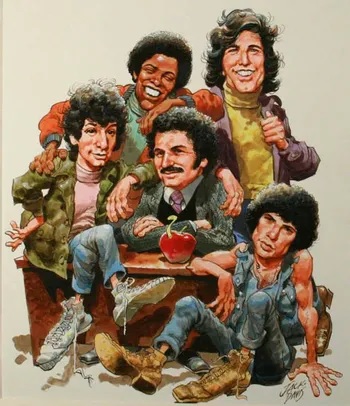
Retro Television Review: Welcome Back, Kotter 4.10 “Washington’s Clone”


Welcome to Retro Television Reviews, a feature where we review some of our favorite and least favorite shows of the past!  On Saturdays, I will be reviewing Welcome Back Kotter, which ran on ABC  from 1975 to 1979.  The entire show can be purchased on Prime.

This week, Washington gets an admirer.

Episode 4.10 “Washington’s Clone”

(Dir by Norman Abbott, originally aired on November 11th, 1978)

Arthur (Ron Dennis) is a nerdy student who worships Freddie and desperately wants to be a Sweathog.  When Freddie tells Arthur that he’s too smart and clean-cut to be a Sweathog, Arthur reacts by dressing like Washington and trying to act just like Washington.  At first, the Sweathogs are amused and Washington is slightly flattered.  But then Washington discovers that Arthur is stealing watches and selling them in the school courtyard.  Washington tells Arthur that Sweathogs don’t commit crimes, which is certainly a change from the first season of the show.

After Julie tells Washington that Arthur’s grades are slipping and he’s throwing away his future, Washington goes to Barbarino for advice.  The audience goes crazy for Babarino’s cameo but I have to admit that I cringed the whole time.  I don’t like the idea of Barbarino working in the hospital.  Every time Barbarino makes an appearance, he’s making life difficult for a patient.  In this case, he spends so much time thinking about Washington’s problem that he doesn’t realize he’s spilling food all over a hungry man in a hospital bed.  It was nerve-wracking to watch and not particularly funny.

(Again, in all fairness, it’s hard for me to see any scene set in a hospital room without thinking about my Dad.  So, your mileage may vary as far as Barbarino’s cameo is concerned.  For me, it still hits too close to home.)

Eventually, Washington and the other Sweathogs dress up like members of a street gang (which, again, is what the Sweathogs were supposed to be during the first two seasons of the show) and they tell Arthur that he’s going to have to help them attack Mr. Woodman in order to become a Sweathog.  (Uhmm …. this seems like a bad idea.)  Arthur says he has no problem with that but, in the end, he defends Woodman when the Sweathogs pretend to attack him.  Arthur goes back to being himself and somehow the Sweathogs are not expelled.  Julie tells them that she “can’t believe I’m saying this,” but she’s mildly impressed with how they handled Arthur.  Julie is even bitchier without Gabe around than when he was forcing her to listen to his jokes.

Indeed, Gabe does not appear in this episode and there’s no reference made to where he might be.  You would think that, being vice-principal, he would be the one who would be talking to Arthur about his grades.  Gabe Kaplan, of course, was not on the show because he was upset that the network and their refusal to allow the Sweathogs to graduate high school.  In-universe, one can only guess that Gabe Kotter just doesn’t like to come out of his office.

For a fourth season episode, Washington’s Clone wasn’t bad.  Ron Dennis’s performance as Arthur made me smile.  The fact that he was dramatically shorter than Washington made his attempts to imitate Washington a lot more humorous than they would have been otherwise.  Lawrence Hilton-Jacobs gave a good performance as Washington, even if his sudden concern about following the law went against everything that the show had previously established about the character.  This episode was amusing (with the exception of Barbarino’s cameo) and Horshack didn’t say much.  You can’t complain about that.

Late Night Retro Television Review: Friday the 13th: The Series 2.20 “Mesmer’s Bauble”


Welcome to Late Night Retro Television Reviews, a new feature where we review some of our favorite and least favorite shows of the past! On Fridays, I will be reviewing Friday the 13th: The Series, a show which ran in syndication from 1987 to 1990. The show can be found on YouTube!

This week, things get dark.

Episode 2.20 “Mesmer’s Bauble”

(Dir by Armand Mastroianni, originally aired by May 1st, 1989)

Howard Moore (Martin Neufeld) is the latest in a long line of nerdy Friday the 13th villains.  With his long hair, unwashed appearance, and crazy eyes, Howard is an easy target for some of the less compassionate citizens of Canada.  Of course, Howard doesn’t help things by having a totally creepy personality.  He works in a vinyl record store, where he offers up unsolicited music advice to the teenage customers, the majority of whom giggle awkwardly whenever he’s nearby.  Howard is obsessed with a singer named Angelica (Vanity) but there’s no way Howard could ever actually meet her.

Or at least, that’s the case until he finds Mesmer’s Bauble.  Having once belonged to the inventor of hypnotism, this crystal pendant grants Howard anything that he asks for, as long as he first uses it to hypnotize people and then kill them.  (It turns out that merely looking at the pendant is enough to send someone into a hypnotic trance.)  As with so many Friday the 13th villains, Howard quickly comes to love having the power to kill people.  I’ve always felt that the majority of this show’s villains are basically addicts.  Instead of being addicted to drugs, they’re addicted to the rush of power that comes with using a cursed antique to get what they want.  That’s certainly the case with Howard.

At first, Howard thinks that he wants Angelia to love him.  He kills both her publicist and her manager in order to get closer to her.  But, once he’s finally close to her, Howard apparently realizes that he actually wants to be Angelica.  In an effectively nightmarish sequence, Howard and Angelica’s body appear to merge into one.  Howard literally turns into Angelia while Angelica presumably withers away into nothingness.  Howard is now Angelica, which will undoubtedly upset Ryan, who has bought two tickets for Angelica’s latest show.

It’s up to Micki and Ryan to recover the pendant and they manage to do so in the most anticlimactic way possible.  They go to Angelica/Howard’s concert and Micki grabs the pendant while Angelica/Howard is singing.  Without the pendant, Angelica dissolves into Howard and then a panicked Howard is promptly electrocuted on stage.

Howard’s dead but so are a lot of other people.  At the shop, Micki and Ryan confess to Jack that they feel that they failed because so many people died before they got the pendant.  Jack shrugs and basically tells them “that’s life.”  What a dark ending!  Actually, it was rare that Friday the 13th didn’t end on a dark note.

This was an effectively creepy episode, one that worked because of just how dark it allowed things to get.  Even Jack pointed out that the pendant’s powers didn’t always make sense, which made it even more dangerous in the hands of someone like Howard.  There were a few loose ends.  I found it a bit odd that there wasn’t a bigger public reaction to a famous black woman turning into an ugly white guy and then dying in front of a crowded club.  In fact, the show left it a bit unclear as to what actually happened to Angelica after Howard transformed into her but I’m going to guess it was nothing good.  In the end, though, this episode was effectively macabre.

Retro Television Review: St. Elsewhere 1.4 “Cora and Arnie”


Welcome to Retro Television Reviews, a feature where we review some of our favorite and least favorite shows of the past! On Fridays, I will be reviewing St. Elsewhere, a medical show which ran on NBC from 1982 to 1988.  The show can be found on Hulu!

This week’s episode made me cry.

Episode 1.4 “Cora and Arnie”

(Dir by Mark Tinker, originally aired on November 23rd, 1982)

While orderly Luther (Eric Laneuville) practices his karate moves in the hallway and anesthesiologist Vijay (Kavi Raz) composes a letter to his family in India and Dr. Fiscus continues his sex-only relationship with Kathy Martin, four patients learn about life and death at St. Eligius.

One of them is an unnamed man (Lionel Mark Smith) who comes in with a complaint of backpain.  Fiscus examines him and discovers that the man has been shot in the back.  The man announces that he’s on parole and he doesn’t feel like going back to prison.  Fiscus offers to admit him under an assumed name but the man says he already gave his real name to the front desk.  The man tries to leave the hospital but collapses from pain and blood loss.  Later, when the man wakes up, Fiscus tells him that the bullet has been removed and he’ll be fine.  The man says he won’t be fine because he’s going to go back to prison as soon as he leaves the hospital.

Meanwhile, Kathleen McAllister, who has been in a coma ever since Andrew Reinhardt set off a bomb at a bank, finally dies.  Reinhardt, when he’s informed of the news, sneers.  He doesn’t care that she died.  He’s all about the class struggle.  (If this show was made today, he’d have thousands of followers on Bluesky.)  When Dr. Beale tries to examine him to determine if he’s mentally ill, Reinhardt spits in his face.  Reinhardt is convinced that nothing will ever happen to him but, after Kathleen dies, he’s informed that he’s being taken to prison.  As Reinhardt is rolled out of his hospital room, Kathleen’s husband (Jack Bannon) appears in the hallway and shoots him dead.

George (Bernard Behrens) and Lillian Rogers (Anne Gerety) are tourists who are visiting Boston.  When Lillian faints in her hotel room, George rushes her to the hospital.  Lillian says she’s feeling fine but she still goes through a series of tests to determine why she fainted.  In the end, the tests are inconclusive.  No one can figure out why she fainted so she’s told to just see her family doctor when she returns home.  When George and Lillian check out of the hospital, they are presented with the bill for all the tests.  George freaks out when he sees that he’s being charged …. $1,380.90!

Now, admittedly, that is $1,380.90 in 1982 money.  If George received the same bill today, it would be for $4,517.10.  Still, considering all the tests that Lillian had done, that seems remarkable cheap, even by today’s standards.  My father died in August and the majority of his medical costs were covered by insurance but his estate is still receiving bills from various hospitals, specialists, and ambulance services.  I’ve been told that the same thing happened when my mom passed away in 2008.  (Personally, I think if someone dies while in your care, you’ve forfeited your right to be paid.)  By today’s standards, having to pay less that $5,000 feels like a bargain!

Finally, and most heart-breakingly, Dr. Morrison takes care of a homeless woman named Cora (Doris Roberts), who comes into the hospital with her companion, Arnie (James Coco).  Due to a head injury, Arnie is almost childlike.  While Cora learns that a case of gangrene is going to kill her unless she gets her foot amputated, Arnie repeatedly asks, “Can we go now?”  In the end, Cora chooses not to have the surgery, leaving the hospital with Arnie.  As she explains to Dr. Morrison, someone has to take care of Arnie and she can’t do that with just one foot.  When Morrison tells Cora that she’s probably going to die in a year, Cora shrugs and says it won’t be any great loss.

OH MY GOD!  Seriously, I was in tears at the end of this episode.  The Cora and Arnie story had the potential to be a bit too schmaltzy for its own but Doris Roberts and James Coco both gave such incredibly moving performances that I couldn’t help but get emotionally involved in their plight.  And I understood why Cora made the decision that she did.  Having been rejected by both her family and society, Cora knew that there wouldn’t be anyone around to take care of her after the operation.  So, she decided to accept things the way that they were and spend her last year with the one person who didn’t judge her, Arnie.  (I’m getting teary-eyed just writing about it.)  Playing out against all the other petty dramas going on at the hospital, this storyline was emotionally devastating.

This was a powerful episode.  Watching it, I understood why St. Elsewhere is so often described as being one of the best medical shows of all time.