Retro Television Review: Miami Vice 4.14 “Baseballs of Death”


Welcome to Retro Television Reviews, a feature where we review some of our favorite and least favorite shows of the past!  On Mondays, I will be reviewing Miami Vice, which ran on NBC from 1984 to 1989.  The entire show can be purchased on Prime!

I saw the title of this week’s episode and I immediately called my sister….

Episode 4.14 “Baseballs of Death”

(Dir by Bill Duke, originally aired on February 19th, 1988)

“Watch this with me,” I told Erin, “it’s a baseball episode!”

“It is?” Erin asked.

“Look at the title!”

I was excited.  I always like to find things that I can watch with my sister and, as we all know, she loves baseball.  She certainly loves baseball more than she loves tv shows about bombs that blow up when you step on them.

Unfortunately, it turned out that this episode was not about baseball.  Instead, it featured a bunch of bombs that blow up when you step on them.  According to this episode, those bombs are known as baseballs.  Sorry, Erin!  Honest mistake….

Misleading title aside, this is a really good episode.  It features Tony Plana as a Chilean diplomat who is trying to buy a shipment of weapons, including the explosive baseballs.  Plana is a chilling villain.  In fact, he’s the first villain of season 4 to actually feel dangerous.  When we first meet him, he’s coldly executing the girlfriend of a tabloid reporter.  Plana’s lack of emotion as he kills and plots to kill feels like a throwback to the soulless sociopaths who made the first season’s rogue gallery.  A very young Oliver Platt shows up as an arms dealer and his nerdy confidence adds to some comedy to what is an otherwise fairly grim episode.  Just as with Plana’s cold villainy, Platt’s cheerful amorality felt like a throwback to the first season.

Indeed, this entire episode felt like a return to what the show used to be.  After a season that’s involved televangelists, bull semen, UFOs, and Crockett getting married to Sheena Easton, it was nice to see an episode that actually felt like an episode of Miami Vice.  Director Bill Dule gave this episode a stylish and, at times, almost surrealistic feel.  Crockett was back to be a cynic.  Castillo stared at the floor and spoke through clenched teeth while Switek actually got to put his phone-tapping skills to good use.  In the end, Tony Plana may have been the villain but, in old school Miami Vice style, the majority of the blame was still put on the U.S. government.  The episode even ended with an exciting boat chase.  All this episode needed was Phil Collins on the soundtrack and it could have passed for something from the first two seasons.

Season 4 has been uneven but this episode felt like classic Vice.  Erin thought the episode would have been better with actual baseballs and I agree with her that the title was misleading.  That said, this was still an enjoyable throwback to what the show used to be.
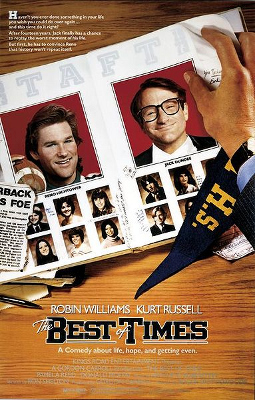
The Best Of Times (1986, directed by Roger Spottiswoode)


For years, banker Jack Dundee (Robin Williams) had been haunted by a pass that he dropped in high school.  The pass was perfectly thrown by quarterback Reno Hightower (Kurt Russell) but Jack couldn’t bring it in and, as a result, Taft High lost to its rival, Bakersfield.  Adding to Jack’s humiliation is that he now works for The Colonel (Donald Moffat), a confirmed Bakersfield fan who also happens to be Jack’s father-in-law.  When Jack visits a “massage therapist” (Margaret Whitton) and tells her about his problems, she suggests that he needs to replay the game.  Getting everyone interested in replaying the game is not easy.  No one wants to be humiliated a second time and Reno, who now fixes vans for a living, fears the he’s lost his edge.  Jack dresses up in the Bakersfield mascot’s uniform and vandalizes the town.  Finally, everyone is ready for the game.  Now, it’s a matter of town pride.

The Best of Times is a likable comedy about getting older and wishing you could have just one more chance to be young again and to have your entire future ahead of you.  Jack is haunted by that one dropped pass, feeling that it has cast a cloud over his entire life.  Reno is still a town hero but he’s struggling financially and in debt to Jack’s bank.  Replaying the game isn’t going to fix their lives but it is going to give them one last chance to relive their former glory and maybe an opportunity to learn that, even if they are getting older, they’re still living in the best of times.  The world that these two men live in is skillfully drawn and believable, with character actors like Moffat, M. Emmet Walsh, R.G. Armstrong, and Dub Taylor adding to the local color.  Jack and Reno’s wives are played by Holly Palance and Pamela Reed and they are also strong and well-developed characters.  Finally, Robin Williams and Kurt Russell are a strong comedic team.  Russell is perfectly cast as the aging jock and Williams gives one of his more restrained performances as Jack, allowing us to see the sadness behind Jack’s smile.

The stakes aren’t particularly high in The Best Of Times.  It’s just a football game between some middle-aged men looking to regain their youth.  But the story sticks with you.

Film Review: Noriega God’s Favorite (dir by Roger Spottiswoode)


Everyone’s an expert on the Panama Canal nowadays.

Largely, that’s a result of President-elect Donald Trump openly musing about taking the canal back from Panama.  As soon as Trump uttered those words, every self-appointed pundit on every social media site in existence immediately jumped over to Wikipedia and skimmed over the articles on Panama, the Panama Canal, and Teddy Roosevelt.  Then, after Jimmy Carter died, those same people jumped onto Wikipedia and skimmed articles about Carter selling the canal to Panama for a dollar and the controversy that followed.  For weeks, it has been impossible to look at Twitter or Bluesky or even Mastodon without seeing someone giving their opinion on the canal, the 1989 American invasion of Panama, and the connection between the CIA and Manuel Noriega, the man who served as Panama’s military dictator for most of the 80s before being deposed and tossed into prison for being a drug smuggler.

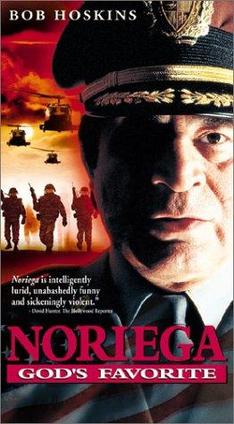
Myself, I know better than to get my information from Wikipedia.  Instead, I get my information from movies.  For that reason, I attempted to educate myself on Panama and the canal by watching 2000’s Noriega: God’s Favorite.

Directed by Roger Spottiswoode, Noriega: God’s Favorite opens with a title card informing us of the story so far.  Manuel Noriega was born in the slums of Panama.  He grew up in poverty and was shunned because his mother was not married to his father.  Noriega spent his youth doing whatever he had to do in order to survive.  He was clever and ruthless but it wasn’t until he entered the Panamanian National Guard that he was able to really use those skills to his advantage.  Noriega became a CIA asset and worked his way through the ranks.  In 1983, with the support of American intelligence, Noriega became the de facto dictator of Panama, even though he never officially held any sort of title or executive position.

The film follows Manuel Noriega (Bob Hoskins) over the course of his final years as Panama’s dictator.  He’s portrayed as being a ruthless man who often pretends to be a buffoon in order to get his enemies to underestimate him.  He works with the CIA but still passes along intelligence to Fidel Castro (Michael Sorich), who is seen hitting on Noriega’s wife (Denise Blasor) during a visit to Cuba.  Noriega presents himself as a family man while having a number of mistresses.  He claims to an ally in the United States’s War on Drugs while attending cocaine-fueled parties.  He presents himself as being a pragmatist while actually being very superstitious.  A CIA agent (Edward Ellis) wins Noriega’s trust by manipulatively interpreting Bible verses for him.  When an army officer (played by Nestor Carbonell) tries to lead a coup against Noriega, he can only watch helplessly as Noriega personally executed all of his co-conspirators, going so far as to even chop off one man’s hands.  By the end of the scene, Noriega is drenched in blood but he’s undeniably happy.  Everyone knows that Noriega is an impulsive and dangerous dictator but the CIA allows him to stay in power until he starts to become an inconvenience.  Once Noriega’s notoriety starts to overshadow his usefulness, the U.S. promptly invades and Noriega’s power crumbles around him.

Bob Hoskins might seem like a strange choice to play a South American dictator but he does a good job in Noriega, playing the title character as being both a charismatic dictator and also an overgrown child who has never gotten over the struggles of his youth.  (Early on in the film, he is seen getting treatments to smooth his pockmarked skin, an indication that all the power in the world can’t cure lifelong insecurity.)  In the end, Noriega has much in common with the gangster that Hoskins played in The Long Good Friday.  Noriega is ruthless enough to become powerful but he ultimately falls victim to his own hubris.  When you’re in charge of something as valuable as the Panama Canal, the last thing you should do is anger the country that built it.

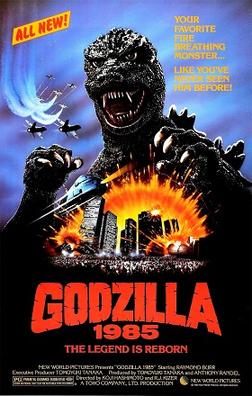
Horror Film Review: Godzilla 1985 (dir by R.J. Kizer and Koji Hashimoto)


Nine years after The Terror of Mechagodzilla, Godzilla finally returned to Japanese movie screens in The Return of Godzilla!

One year later, Raymond Burr joined him when The Return of Godzilla was released in the United States as Godzilla 1985.

The film’s plot is a simple one, though it does have an interesting subtext.  Godzilla is once again roaming the planet and, after spending the last few years as humanity’s champion, he is once again destroying everything in his path.  (This is a rare later Godzilla film that features only Godzilla.  Mothra, Rodan, Ghidorah, and that weird armadillo that always used to follow Godzilla around, none of them are present.  The son of Godzilla is not mentioned, to the regret of no one.)  Looking to prevent a mass panic, the Prime Minister of Japan tries to cover up the news of Godzilla’s return.  But when a Russian submarine is destroyed by Godzilla and the Russians blame the Americans and bring the world to the verge of atomic war, the Prime Minister is forced to reveal the truth.  The Super X, an experimental new airplane, is deployed to take Godzilla out but it turns out that Godzilla is not that easy to get rid of.

Now, as I said, there is an interesting subtext here.  If the first Godzilla films were all about the trauma of Hiroshima and Nagasaki, this version of Godzilla is all about being trapped between the whims of two super powers.  For the most part, Godzilla only attacks Japan.  At the time this movie came out, he had been attacking Japan for nearly 30 years and the rest of the world was content to allow Japan to deal with the consequences alone.  However, when Godzilla sinks that Russian sub, both the Russians and the Americans blame each other and bring the world to the brink of annihilation.  Japan, like the rest of the world, finds itself caught in the middle.  In the end, it’s up to Japan to not only defeat Godzilla but to keep the Americans and Russians from blowing up the rest of the world.  Godzilla may be bad, this movie tells us, but he’s nowhere near as bad as the idiots with all of the atomic missiles.

Of course, when The Return of Godzilla came to America, extra scenes were shot to make it clear that America had Japan’s back.  For that reason, Raymond Burr returns as journalist Steve Martin.  Martin is called in to share his first-hand knowledge of what Godzilla is capable of.  One has to wonder who thought that was a good idea as Martin basically comes across as being a grouchy crank who just wants to tell everyone to get off his lawn.  As opposed to the first Americanized Godzilla film, which was edited to make it appear as if Burr was actually talking to characters from Gojira, Godzilla 1985 just features a lot of scenes of Burr staring at a screen in the Pentagon and making ominous comments about what Godzilla is capable of doing.  It’s a wasted cameo but I guess the film’s American distributors didn’t have faith that Godzilla could pull in the audiences on his own.

Fortunately, Raymond Burr’s time-consuming cameo can’t keep this film from being a lot of fun.  It’s a Godzilla film, after all.  Godzilla stomps on a lot of buildings and breathes a lot of fire and wisely, the film doesn’t wait too long before allowing him to go on his rampage.  After spending several films as an almost comic character, this film reminds audiences that Godzilla was always meant to be frightening.  Of course, lest anyone take this film too seriously, the size of the Super X changes from scene to scene, depending on which miniature was being used.  Godzilla loses his temper and falls into a volcano but there’s never any doubt that he’ll be back.  You can’t stop Godzilla!

Previous Godzilla Reviews:

  1. Godzilla, King of the Monsters (1958)
  2. Godzilla Raids Again (1958)
  3. King Kong vs Godzilla (1962)
  4. Mothra vs. Godzilla (1964)
  5. Ghidorah: The Three-Headed Monster (1964)
  6. Invasion of the Astro-Monster (1965)
  7. Godzilla vs. The Sea Monster (1966)
  8. Son of Godzilla (1967)
  9. Destroy All Monsters (1968)
  10. All Monsters Attack (1969)
  11. Godzilla vs Hedorah (1971)
  12. Godzilla vs Gigan (1972)
  13. Godzilla vs Megalon (1973)
  14. Godzilla vs Mechagodzilla (1974)
  15. The Terror of Mechagodzilla (1975)
  16. Cozilla (1977)
  17. Godzilla vs. Mothra (1992)
  18. Godzilla vs. Destoroyah (1995)
  19. Godzilla, Mothra, and King Ghidorah: Giant Monsters All-Out Attack (2001)
  20. Godzilla (2014)
  21. Godzilla: Planet of the Monsters (2017)
  22. Godzilla, King of the Monsters (2019)
  23. Godzilla vs Kong (2021)
  24. Godzilla Minus One (2023)

Retro Television Reviews: Miami Vice 1.11 “Give a Little, Take a Little”


Welcome to Retro Television Reviews, a feature where we review some of our favorite and least favorite shows of the past!  On Mondays, I will be reviewing Miami Vice, which ran on NBC from 1984 to 1989.  The entire show is currently streaming on Tubi!

Tonight’s episode is a reminder that you don’t mess with Miami Vice!

Episode 1.11 “Give a Little, Take a Little”

(Dir by Bobby Roth, originally aired on December 7th, 1984)

Oh my God, this episode…. this episode put me through an emotional ringer.  After two episodes that were somewhat light and airy, Give A Little, Take A Little is a return to  the dark and surreal storytelling that was Miami Vice’s signature style.

Things start out on an energetic note, with a montage of Miami nightlife set to the tune of Tina Turner singing You Better Be Good To Me.  For once, Gina (Saundra Santiago) and Trudy (Olivia Brown) are seen before Crockett and Tubbs, this time purchasing appropriately trashy (but stylish) outfits for their undercover prostitution sting.  When Crockett and Tubbs are finally seen, they’re heading over to see their informant, Noogie (Charlie Barnett).  The very high and very talkative Noogie tells them about a warehouse that is being used by a dealer.

At the warehouse, Crockett and Tubbs find a nervous watchman, Bob Rickert (Lenny Von Dohlen).  The obviously terrified Bob explains that he’s just watching the warehouse for an old college friend of his.  When Tubbs and Crockett open up a box and yank out several bags of pills, Bob admits that he knows his friend is a drug dealer but Bob also insists that he’s never sold any drugs in his life.  Sonny takes sympathy on Bob and, after Bob gives them the name of his friend, he allows Bob to go home to his wife.

Bob’s friend is Sally Alvarado (a very young and smoldering Michael Madsen).  After the expected car chase, Crockett and Tubbs arrest him.  However, Alvarado’s lawyer — Richard Cain (Terry O’Quinn, of future Stepfather and Lost fame) — demands that Crockett reveal the name of his confidential source.  (When Crockett meets with the lawyer, he insists on calling him, “Dick.”)  The judge at Alvarado’s trial agrees that Alvarado has a right to know who has accused him of being a drug dealer and she orders that Crockett name his informant.  When Crockett refuses, Crockett goes to jail.

Meanwhile, Gina and Trudy are working at Club Ocho, which is owned by Cinco (Tony Plana).  They are both pretending to be sex workers who have just moved down to Miami from Philadelphia.  Cinco sends them out to work the streets, where they are picked up every night by their fellow Miami Vice detectives, Switek and Zito.  When Cinco’s boss, Lupo Ramirez (the great Burt Young), spots Gina at the Club, he promotes her to working directly for him.  When Ramirez comes to suspect that Gina might be an informant, he invites her to his house late at night for a meeting and, off-screen, he rapes her.

Crockett is released from jail, despite having not named his informant.  He assumes that Lt. Castillo called in a marker but Castillo instead reveals that Bob felt so guilty about Sonny being in jail that he went to Cain and confessed to being the informant.  He also agreed not to testify against Alvarez.  While Sonny was still sitting in jail, Sally Alvarez was released from prison.

That night, Noogie introduces Sonny and Tubbs to another informant, Trick Baby (Henry Sanders).  Impressed that Crockett went to jail to protect an informant, Trick Baby tells Sonny and Tubbs that Sally Alvarez is Ramirez’s second in command.  He also reveals that Ramirez is sending Cinco to kill Gina.

Back at her apartment, Gina is being comforted by Trudy when Cinco shows up.  Fortunately, Crockett and Tubbs show up at well.  A chase and gunfight leads to Cinco being seriously wounded.  Cinco promises that, if he lives, he’ll testify against Alvarez and Ramirez.

At Club Ocho, Alvarez is watching as Switek makes his debut as a stand-up comedian.  Switek’s act is terrible but it provides the cover needed for Crockett and Tubbs to arrest Alvarez.  After being told that Cinco has ratted him out, Alvarez agrees to rat out Ramirez.

The next morning, Gina and Trudy show up at Ramirez’s mansion.  Gina draws her gun and tells Ramirez that he’s under arrest.  Ramirez, who is holding the knife that he was using to make his breakfast, laughs and smugly says that Gina can’t arrest him after what “we’ve shared.”

And….

GINA SHOOTS HIM!

HELL YEAH!

Seriously, that was one of the most satisfying moments that I’ve experienced since I started watching this show.  It’s also a reminder of how different the cops on Miami Vice were from most of the other cops who showed up on crime shows in the 80s and 90s.  Just when you’re expecting Gina to sigh, lower her gun, and read Ramirez his rights because she’s a cop and a cop has to obey the law, she shoots him.  And since Ramirez was dumb enough to act like a smug jackass while holding a knife, the shooting will undoubtedly be ruled as being justified.

This was an emotional episode and not always easy to watch but it all built to a powerful conclusion.  While I did spend a lot of time playing “spot the famous guest star,” I was even happier that this episode finally gave Miami Vice‘s often neglected supporting cast to show what they could do.  John Diehl, Olivia Brown, Michael Talbott, and especially Saundra Santiago all got their chance to shine in this episode.

Next week, Giancarlo Esposito plays a drug dealer decades before Breaking Bad.

Late Night Retro Television Reviews: Gun 1.6 “Father John”


Welcome to Late Night Retro Television Reviews, a feature where we review some of our favorite and least favorite shows of the past!  On Tuesdays, I will be reviewing Gun, an anthology series that ran on ABC for six week in 1997.  The entire show is currently streaming on Tubi!

Tonight, we finish up Gun!

Episode 1.6 “Father John”

(Dir by Jeremiah S. Chechik, originally aired on May 31st, 1997)

Father John, the final episode of Gun, is also one of its worse.  The only thing keeping it from being the absolute worst is that Robert Altman directed that episode that dealt with the country club presidency and then there was that episode with Daniel Stern as the guy having an elaborate Hollywood fantasy and, of course, there was last week’s episode with Kirsten Dunst…. actually, now that I think about it, of the six episodes of Gun that were produced, Father John is in the top 3 but only by default.

The episode stars Fred Ward as John Farragut, a newspaper columnist who is also a recovering alcoholic and who is always struggling to keep up with his alimony payments to his ex-wife, Joyce (Brooke Adams).  John doesn’t have much faith in the world but he has always worshiped his Uncle John, a priest for whom he was named.  When Uncle John dies, nephew John is shocked to discover that his uncle not only died with a lot of money hidden away in his room but that he also owned the pearl-handled gun that appears in every episode of this series.  What secrets were being hidden by Uncle John!?

Nephew John sets out to find out.  At first, he assumes that his Uncle must have been having an affair with a woman named Gloria (Angela Alvarado) but he then comes to learn that Gloria (whose real name is Gabriella) is a refugee who was rescued from a sex trafficking ring by his uncle.  Uncle John had the gun to protect Gabriella and now, it’s time for his nephew to continue to protect her.

It sounds pretty straight-forward and, to be honest, there really aren’t any unexpected twists in this episode.  That said, the episode itself is incredibly overwritten.  We not only get to watch as living John tries to solve a very simple mystery but, even worse, we have to listen to his narration as he tells us the details of what he’s doing.  Of course, we can already see what he’s doing so it all feels a bit redundant.  The narration itself is so hard-boiled that it feels almost like a parody of the detective genre and I found myself wondering why anyone would want to read anything written by a man whose narration is essentially a collection of clichés.  John Farragut is the type of guy who says, “If you sleep with dogs, you wake up with fleas,” as if he think he’s the first person to ever come up with it.  Surprisingly, Fred Ward is very much miscast as John Farragut.  With his weathered face and his weary tone, it’s hard to buy Ward as someone who 1) still hero-worships anyone and 2) would still be crying about having never met his father.  Farragut appears to be nearly 50 and he’s still whining about stuff that most people get over or have figured out by the time they graduate college.  Farragut’s actions often only make sense if you accept that idea that he is impossibly naïve about the world and that’s not the feeling one would ever get from a character played by Fred Ward.

With this episode, Gun ends on a boring note but, then again, it was never a particularly exciting series to begin with.  For all the notable actors who appeared in Gun, it’s hard to think of any stand-out episodes or performances.  If I had to rank the episodes, it would go something like this:

  1. Ricochet 
  2. Columbus Day
  3. Father John
  4. The Hole
  5. The Shot
  6. All The President’s Women

That’s not a very impressive list, to be honest.  Gun perhaps would have worked better if there had been some sort of continuity as far as the gun itself was concerned.  Perhaps the show would have worked if there had been a feeling of the gun following a natural journey from owner to owner.  Instead, it just randomly showed up in each story and sometimes, it was important and, far more often, it was just a prop.  The show certainly had nothing to say about American gun culture.  It was an uneven show.  The opening credits featured U2 covering Happiness Is Warm Gun and Bono’s overbaked interpretation of the lyrics felt appropriate for this show’s flashy but shallow style.

Next week, there will be a new show in this time slot.  What will it be?  Uhmmmm …. ask me next week.

October True Crime: The Case of the Hillside Stranglers (dir by Steve Gethers)


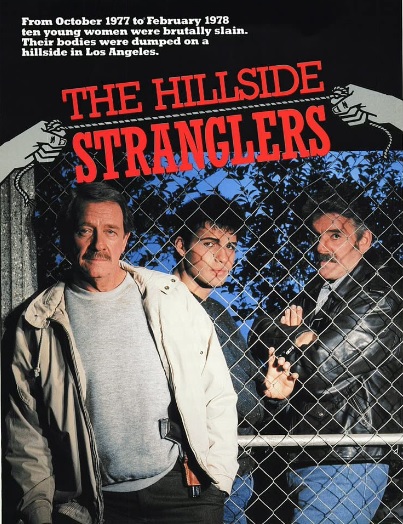
1989’s The Case of the Hillside Stranglers is based on the killing spree of Angelo Buono and Kenneth Bianchi, two cousins who terrorized Los Angeles in the late 70s.  Buono owned his own garage and aspired to be a tough and macho pimp.  Bianchi was an aspiring police officer who supported himself as a security guard.  Over the course of just five months, they murdered ten women.  They probably would never have been caught if not for the fact that Buono eventually tired of Bianchi and kicked him out of his house.  Bianchi moved up to Washington where he committed two murders on his own.  When he was arrested, he attempted to convince the cops that he was suffering from dissociative identity disorder and that the murders were committed by his other personalities.

The Case of the Hillside Stranglers starts with the murder spree already in progress.  Buono is played by Dennis Farina while Bianchi is played by a very young Billy Zane.  Both of them are well-cast, with Farina especially making an impression as a misogynistic bully who thinks that he is untouchable.  (In real life, Farina spent 18 years as a Chicago cop and, watching his performance in this film, it’s hard not to get the feeling that he had to deal with more than one guy like Angelo Buono over the course of his time on the force.) For all of their cockiness, the film emphasizes that neither Angelo nor Kenneth were particularly clever.  The fact that they got away with their crimes for as long as they did was largely due to a combination of luck and witnesses who did not want to get involved.  Early on in the film, one woman who is harassed and nearly abducted by Buono and Bianchi refuses to call the police afterwards because she doesn’t want to relive what happened.

That said, the majority of the film actually focuses on Bob Grogan (Richard Crenna), the tough veteran detective who heads up the Hillside Strangler taskforce and who becomes so obsessed with tacking down the elusive killers that he soon finds himself neglecting both his family and his own health.  Whenever we see Grogan trying to enjoy any quality time with his children, we know that his beeper is going to go off and he’s going to have to search for a telephone so that he can call into headquarters.  (Remember, this film was set in the 70s.)  His children are a bit miffed about it, which I can understand though I really do have to say that his son, in this film, really does come across as being a brat.  (“Just ignore it, Dad,” he says, as if there aren’t two serial killers murdering innocent people in the city.)  The recently divorced Grogan pursues a tentative romance with a woman (played by Karen Austin) who, at one point, decides to investigate Angelo on her own.  Crenna, not surprisingly, is sympathetic as Grogan.  The film works best as an examination of what it does to one’s soul to spend all day investigating the worst crimes that can be committed.  Grogan gets justice but, the film suggests, he does so at the sacrifice of his own peace of mind.

It’s a well-made and well-acted film, one that will probably appeal more to fans of the police procedural genre as opposed to those looking for a grisly serial killer film.  In real life, Bianchi is serving a life sentence and Angelo Buono died in prison.  And the real Bob Grogan?  He appeared in this movie, slapping the handcuffs on Billy Zane.

In the Line of Duty: A Cop For The Killing (1990, directed by Dick Lowry)


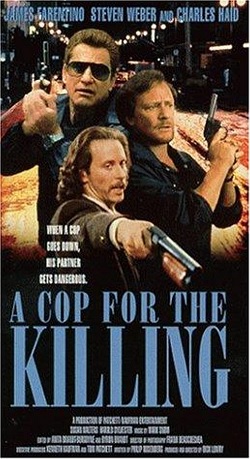
When an undercover narcotics operation goes wrong, a veteran cop (Charles Haid) is killed.  While the cop’s killer goes on trial, the members of the undercover squad struggle to deal with their feelings about what has happened.  The head of the squad (James Farentino) struggles with how much emotion he can show while still remaining a leader.  As his ex-wife puts it, he’s so busy staying strong for everyone else that he hasn’t been able to deal with his emotions.  Meanwhile, the dead cop’s partner (Steve Weber) has the opposite problem and starts to take dangerous risks on the job.  When it looks like the killer might get a plea deal from the district attorney, both Farentino and Weber are forced to come to terms with Haid’s death and their own feelings of anger and guilt.

In the early 90s, there was several “In the Line of Duty” films made for NBC.  They were all based (often loosely) on true stories and they dealt with members of the law enforcement who died while on the job.  The best known of these was probably Ambush in Waco, which went into production while the Branch Davidian siege was still ongoing.

A Cop For The Killing was the second of the In The Line of Duty films.  Unlike the later films in the series, it didn’t deal with a nationally-known case.  Instead, it just focused on one squad of cops and how the death of a member of the squad effected them.  With its ensemble of familiar television actors and Dick Lowry’s efficient but not particularly splashy direction, it feels more like a pilot than an actual movie.  Even though this film features the cops opening up about their feelings, there’s not much to distinguish it from other cop shows of the period.  If someone digitally replaced Steven Weber with Fred Dryer, it would be easy to mistake A Cop For The Killing for a two-hour episode of Hunter.  As with all of the In The Line of Duty films, there are a few scenes designed to show the comradery of the members of the squad but it again all feels too familiar to be effective.  Before Charles Haid dies, he and Steven Weber hang out at a bar and wrestle.  After Haid dies, Weber hangs out at a strip club that’s safe for prime time.  Judging from 90s television cop shows, undercover detectives were solely responsible for keeping most strip clubs profitable.

The cast is adequate.  Farentino is believable as the emotionally withdrawn commander.  Charles Haid makes the most of his limited screen time.  Tony Plana plays a smug drug lord who smiles even when he’s being booked.  It takes a while to adjust to Steven Weber playing a serious role but his courtroom meltdown is the movie’s highlight.  In The Line of Duty: A Cop For The Killing may not have led to a television series featuring Farentino and Weber taking down the bad guys but it did lead to another In The Line of Duty movie that I will take a look at tomorrow.

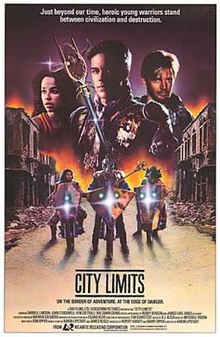
Cinemax Friday: City Limits (1984, directed by Aaron Lipstadt)


Fifteen years into the future, a plague has wiped out almost everyone legally old enough to drink and it has instead left behind a post-apocalyptic hellscape dominated by teenagers.  Tired of living in the boring desert, Lee (John Stockwell) hops on his motorcycle, puts on a skull mask, and drives to a nearby city.  He hopes to join the Clippers, one of the two gangs that is fighting for control of the city.  However, the Clippers aren’t as easy to join as Lee thought they would be.  As well, an evil corporation (led by Robby Benson of all people) is manipulating the two gangs as a part of a plan to take over the city and also the world.

City Limits is one of those films that would probably be totally forgotten if it hadn’t been featured on an episode of Mystery Science Theater 3000.  It’s a good episode but, unfortunately, it’s also led to City Limits getting a reputation for worse than it actually is.

City Limits is a dumb, low-budget movie that was made to capitalize on the success of films like Mad Max.  The plot is impossible to follow, too many scenes are shot in the middle of the night, and Robby Benson is somehow even less intimidating as the villain as you would expect him to be.  (All of Benson’s scenes take place in the same bare office and feature him sitting at a desk.  It probably took a day at most for Benson to do all of his scenes.)  Even with all that in mind, though, City Limits is a fun movie, especially if you can turn off your mind, just relax, and not worry about trying to make it all make sense.  John Stockwell is a likably goofy hero and, Benson aside, the film has got a surprisingly good supporting cast, including Rae Dawn Chong, Kim Cattrall, Tony Plana, Darrell Larson, and even Kane Hodder in a blink-and-you’ll-miss-him type of role.  James Earl Jones wears a big fur coat and blows people up.  He also narrates the film, which automatically elevates everything that happens.  Some of the action scenes are exciting.  Fans of people shouting insults while riding motorcycles will find a lot to enjoy in City Limits.  And, finally, there are a few genuinely funny moments.  I loved that the gangs borrowed all of their plans for old comic books.

City Limits is stupid but entertaining, whether you’re watching it on your own or with Joel and the Bots.


Love On The Shattered Lens: An Officer and a Gentleman (dir by Taylor Hackford)


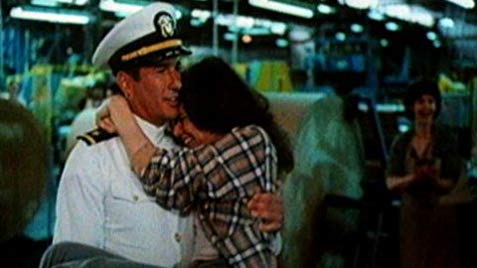
Almost everyone knows that one scene from the 1982 film, An Officer and a Gentleman.  You can probably guess which scene it is that I’m talking about.  It’s been parodied and imitated in so many other shows and movies that it’s one of those pop cultural moments that everyone has “seen” even they haven’t actually watched it.  It’s the scene where….

I AIN’T GOT NOWHERE ELSE TO GO!

What?

I AIN’T GOT NOWHERE ELSE TO GO!

I know, Mayo, I’m getting to that!  Let me tell everyone about the iconic factory scene first, okay?

I AIN’T GOT NOWHERE ELSE TO GO!

Uhmmm …. right.  Where was I?  Oh yeah, it’s the scene where Debra Winger is working in a factory and a youngish Richard Gere suddenly shows up and he’s wearing a white uniform and he picks her up and carries her out of the factory while all of her coworkers cheer.  Meanwhile, that Up Where We Belong song starts to play on the soundtrack.  Even though, up until recently, I had never actually sat down and watched An Officer and a Gentleman, I certainly knew that scene.

Last Friday, I noticed that I had An Officer and a Gentleman saved on the DVR and I thought to myself, “Well, I might as well go ahead and watch it and find out what else happens in the movie.”  Add to that, I only had three hours of recording space left on the DVR so I figured I could watch the movie and then delete it and free up some space….

I AIN’T GOT NOWHERE ELSE TO GO!

Goddammit, Mayo, be quiet!  I’m getting to it!

Anyway, I watched the film and I discovered that it’s actually about a lot more than just Richard Gere getting Debra Winger fired from her job at the factory.  It’s also about how Zack Mayo (the character played by Richard Gere) hopes to make something of himself by graduating from Aviation Officer Candidate School so that he can become not only a Navy pilot but also an officer and a gentleman.  His father (Robert Loggia) is an alcoholic, his mother committed suicide when Mayo was a child and Mayo …. well, I’ll let him tell you himself.

I AIN’T GOT NOWHERE ELSE TO GO!

That’s right.  Mayo has not got anywhere else to go.

I AIN’T GOT NOWHERE ELSE TO GO!

Ain’t is not a word, Mayo.

As you may have already guessed, we know that Mayo doesn’t have anywhere else to go because there’s a scene where he continually yells, “I ain’t got nowhere else to go!” over and over again.  He yells it after being forced to do a thousand push-ups and sit-ups by his drill sergeant, Foley (Louis Gossett, Jr.)  Foley thinks that Mayo doesn’t have the right attitude to be either an officer or a gentleman.  Mayo is determined to prove him wrong.

I AIN’T GOT–

Oh give it a rest, Mayo!

Debra Winger plays Paula.  Paula is a townie.  She lives in a dilapidated house with her parents.  Her friend, Lynette (Lisa Blount), dreams of marrying a Naval officer and getting to travel the world.  Lynette gets involved with Mayo’s friend, Sid Worley (David Keith).  Foley warns both Sid and Mayo to stay away from the townie girls because they’re not to be trusted.  That turns out to be true in Lynette’s case but Paula’s love provides Mayo with the strength that he needs to believe in something more than just himself.

I AIN’T–

Yes, you do have some place to go, Mayo!  That’s the point of the whole goddamn movie!

Anyway, watching An Officer and a Gentleman, I was kind of surprised to discover that it’s actually two movies in one.  It’s a traditional army training film, one in which Richard Gere is whipped into shape by a tough drill sergeant.  It’s also a film about life in an economically depressed small town, where the only hope of escape comes from marrying the right aviation officer candidate.  As a military film it’s predictable if occasionally effective.  As a film about small town life, it’s surprisingly poignant.  An Officer And A Gentleman doesn’t pull any punches when it comes to depicting just how little life in the town has to offer to people like Paula and Lynette.  They have spent their entire lives being told they can either work in a factory for minimum wage and get drunk on the weekend or they can land a man who will hopefully take them away from all that and give them something more to look forward to than cirrhosis of the liver.  Lynette has accepted that as being her only option.  While Paula dreams of escape, she dreams of escaping on her terms.  She may fall in love with Mayo but she’s not going to pretend to be someone that she’s not just to keep him around.

Though he’s evolved into a good character actor, Richard Gere was remarkably blank-faced when he was younger and his performance as Mayo alternates between being bland and shrill.  However, Debra Winger brings a welcome edge to her role.  She plays Paula as someone who knows she’s stuck in a dead end existence.  She’s not happy about it but, at the same time, she’s not going to surrender her principles in order to escape.  She holds onto her ideals, even though she appears to be stuck in a crappy situation and that’s something that Mayo learns from her.  In the end, Paula saves Mayo just as surely as the Navy does.  And, just as Paula saves Mayo, Winger saves the movie.

I AIN’T GOT NOWHERE ELSE TO GO!

Oh, shut the Hell up, Mayo.  Go pick up Paula and carry her off to a better life….