Quick Review: One Battle After Another (dir. by Paul Thomas Anderson)


I had a moment in the theatre that felt like an inside joke shooting over my head. In the scene, our villain is given in invitation to a club, which caused my audience to snicker and chuckle. That was the only slightly uncomfortable moment I had with Paul Thomas Anderson’s latest, One Battle After Another. Did they all know something I didn’t?

One Battle After Another, is incredibly impressive from start to finish. It may be one of the first few films I’ve watched this year to give Ryan Coogler’s Sinners a run for it’s Awards Season money (which is a short list that only currently includes Zach Cregger’s Weapons and maybe Pierre Perifel’s The Bad Guys 2). The film reaches heights of craziness and comedy that’s on par with some of the Coen Brothers best works (there’s a lot of The Big Lebowski in it), while still being serious and tense enough to find yourself worrying about all of these characters and their possible outcomes. Much like Pynchon’s and Anderson’s Inherent Vice, it’s got a good mix of seriousness and comedy. I scooped it up the moment it hit digital and have watched it about 3 more times since then (though not as much as my locked-in film for the year, William Freidkin’s Sorcerer, a discovery that’s been a comfort food rewatch for stressful days). 

Based off of Thomas Pynchon’s novel “Vineland”, One Battle After Another is the story of Bob Ferguson (Leonardo DiCaprio, Once Upon a Time in Hollywood) an alcohol addled stoner that just wants to get through the day. There was a time when Bob was involved in dangerous and violent acts when he was with the group “The French 75”. but he puts this behind him after the birth of his daughter, Willa (Chase Infiniti, TV’s Presumed Innocent). Willa doesn’t fully believe all of her father’s stories, and perceives him as a waste of space. It all takes a turn when an old enemy, Captain Steven J. Lockjaw (Sean Penn, reuniting with Anderson from Licorice Pizza) puts them in his crosshairs. Can Bob keep Willa safe while being almost completely lost? In the end, beyond the violence and the images that reflect some of today’s times, my takeaway was that it was just a story about parenthood. Some rise up for the challenge, and others shirk the responsibility. It’s a Dad trying to climb out of the hole he put himself in to protect his daughter. I feel that’s an honorable thing, even if some of the actions to get there may not be right or “on the level”. 

From a production standpoint, One Battle After Another is rich with scenes and sequences that shift between classic steady shots to kinetic one shots. Michael Bauman, who was also the cinematographer for Licorice Pizza, has some amazing camera work here, especially in the film’s third act. For a film that runs about 2 hours and 40 minutes, it’s a smooth flowing film. There’s a classic line by David Lynch (Bless the Maker and his film stock) in the Fabelmansregarding the use of the horizon that really gets put to the test in One Battle After Another. It’s a sequence that on the big screen really felt amazing, and makes me regret not catching the film in the 70 MM format. 

The performances are fantastic all around and it’s so surprise that most of this cast are up for the Golden Globes next January. DiCaprio plays Bob like a mix of Jeff Lebowski meets Jack Burton, kind of just stumbling through it all. He carries it easily and throws himself full force into the role. As great as he is in all this, everyone else from Teyana Taylor’s (Coming 2 America) fiery Perfidia Beverly Hills to Benecio Del Toro (Sicario) calm as hell Sensei (who picked up the most audience applause) kind of steal the show here. Even Alana Haim was good to see there, though she doesn’t have that big of a part this time around. It’s Sean Penn’s Steven J. Lockjaw that comes off wild and crazy. He did a fantastic job with the character, though I’m not sure I want him to actually win anything. That role really was wicked, which is perhaps a testament to how good he was. 

The only element of the movie I had a problem with was the music. Radiohead’s Jonny Greenwood, who’s scored most of Anderson’s films, has some strange melodies in the film. Some come across sounding like the Wicked Witch of the West in the Wizard of Oz, but I will say it does make sense for most of the movie. Jon Brion (Magnolia) also has two great pieces of music for the film that aren’t on the movie’s soundtrack. They can be found if you search for them. 

Overall, I truly enjoyed Paul Thomas Anderson’s One Battle After Another. I really have to work on going through the rest of his films, like Boogie Nights and Phantom Thread at some point.
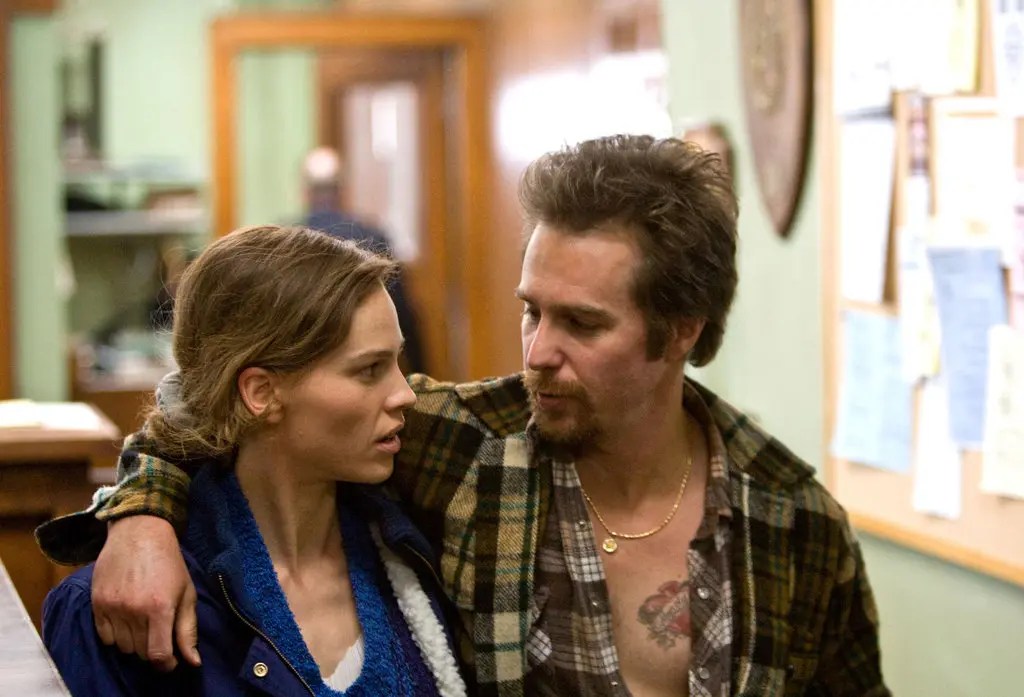
CONVICTION (2010) – Hilary Swank and Sam Rockwell star in the real-life story of a sister who saves her brother from a wrongful conviction!


My wife and I love movies based on real-life stories. We were looking for something to watch this afternoon on the MAX app and came across their “Real Life Dramas” section. One of the movies we saw listed was CONVICTION (2010) starring 2-time Oscar winner Hilary Swank. My wife loves Hilary Swank so we decided to give it a spin.

Betty Anne Waters (Hilary Swank) watches as her brother Kenny (Sam Rockwell) is convicted of the murder of Katherine Brow on May 21st, 1980 in Ayer, Massachusetts and sentenced to life in prison. Even though she knows he’s a troublemaker, Betty Anne is convinced that he’s not a murderer, so she gives up everything in her life to try to prove his innocence, especially after she learns that he tried to kill himself while in custody. Her husband (Loren Dean) divorces her and takes their kids with him. This doesn’t stop her. She goes back to school, eventually making her way to law school for the sole purpose of helping to exonerate her brother. In a positive turn of events, Betty Anne realizes that the new field of DNA testing could be the key to overturning her brother’s conviction. She contacts attorney Barry Scheck (Peter Gallagher) from the “Innocence Project” who assists those who believe DNA testing can help overturn previous convictions. Will Betty Anne finally be able to prove Kenny’s innocence, or will he have to spend the rest of his life in jail for a crime she doesn’t think he’s capable of committing?

Movies like CONVICTION are such an interesting watch for me, especially since we can know how these stories play out with a simple google search. When I see a movie is based on a real story, I purposefully avoid the facts of the actual events so I can see the events depicted on screen without my own internal bias taking front and center. I enjoyed watching how the events unfolded in CONVICTION. Hilary Swank and Sam Rockwell are such good actors, and I appreciate the work they put in here. I don’t pretend that everything depicted on screen is exactly how it was in real life, but I do believe that the actors portray the essence of truth, and I must admit to a tear in my eye when that truth is finally acknowledged for Kenny Waters at the end of the film. I also enjoyed telling my wife that the director of CONVICTION is Tony Goldwyn, the bad guy in the blockbuster film, GHOST. I just thought that was kind of cool, and so did she.

The real truth of Betty Anne Waters and Kenny Waters is ultimately bittersweet, but their story is both a testament to, and an indictment of, the American judicial system. As a person who truly loves our country, I think it’s important to realize that things aren’t always perfect, even in the United States of America!

See the trailer for CONVICTION below:

Lisa Marie Reviews An Oscar Nominee: King Richard (dir by Reinaldo Marcus Green)


The Slap.

Oh lord, the Slap.

I have to admit that I was hesitant about reviewing the 2021’s King Richard because the last thing that I wanted to do was talk about the moment that Will Smith slapped Chris Rock at the 2022 Oscar Ceremony.  That moment has been talked about and written about to death.  The last thing I want to do is rehash it but The Slap has actually overshadowed the Oscar that Smith won that night.  As King Richard was specifically made to win Smith that Oscar, the Slap has become a part of the film’s story.

For those who need to be reminded, Chris Rock was brought out on stage to introduce the presenters for Best Documentary Feature.  Rock did some material, which largely consisted of making jokes about the nominees in the audience.  Myself, I actually remember being a bit annoyed when Rock started in with his jokes because the ceremony was already boring enough without having to spend however long listening to Chris Rock go on about how Penelope Cruz losing Best Actress meant that Javier Bardem would be in trouble if he won Best Actor.  I had actually stopped paying attention when Rock made his now famous joke about Jada Pinkett Smith starring in G.I. Jane 2.  I did not see Pinkett role her eyes at Will when Will laughed.  I heard Rock say, “Uh-oh, here comes Richard,” but I initially missed the slap.  I hard the audience gasp.  I looked at the screen and I saw Smith yelling at Rock but the audio had been cut.  I had to go on YouTube to see an unedited clip of what happened.

Making the moment even more awkward was the knowledge that Will Smith would soon win his first Oscar for King Richard.  On Twitter, there were rumors that Smith had been escorted out of the theater but those turned out to be false.  After Smith was announced as the winner for Best Actor, I sat there and thought, “Oh no, he’s going to invoke God, isn’t he?”  Smith went on stage and promptly invoked God.

We all know what happened next.  For two weeks straight, the Slap discourse was nonstop.  Will Smith was described as being a bully, though I can only guess what we would have said about him if he hadn’t done anything in response.  (“Would you slap Chris Rock if he made fun of me?” I asked Jeff at one point.  Wisely, he promised he would.)  A lot of people predicted that Will Smith would never work again which, in retrospect, was a pretty stupid thing to predict.  America has forgiven its celebrities for a lot worse than just being a jackass at an awards ceremony.  Smith’s career has recovered just fine.  Quite frankly, no one is going to look at the trailer for a new Bad Boys or Men In Black movie and say, “But Will Smith slapped Chris Rock on national television.”

In the end, the most interesting thing about the Slap is that, before Chris Rock made that comment about Jada, the Oscars were supposed to be Will Smith’s greatest night.  From the minute the first trailer for King Richard dropped, it was obvious that the film was going to be the one the won Will Smith an Oscar.  It didn’t even matter whether or not he gave a good performance, though he does give a good one in the film.  The Academy will often decide that it’s an actor’s time and it was obvious that was what had been decided as far as Will Smith was concrned.  Will Smith had been a star for a long time.  He had made a lot of people a lot of money.  Before the Slap, the public perceived him as being a likable and goofy guy.  It was time to reward him.  From the start of 2021, everyone knew that Will Smith would be getting his Oscar.  For The Academy, it was also a chance to make up for not nominating him for his adequate if not particularly memorable performance 2015’s Concussion.  Smith not getting nominated for that film was often (incorrectly, I would argue) considered to be the starting point of the whole “#Oscarssowhite” movement.  (Personally, I would say the movement’s roots could actually be traced to Ava Duvernay not being nominated for directing Selma.)  Along with everything else, honoring Will Smith would be a way for the Academy to say, “See?  We learned our lesson!”

Will Smith does give a good performance in King Richard, playing Richard Williams, the father of Venus and Serena Williams (played, respectively, by Saniyya Sidney and Demi Singleton).  Smith does a good job of capturing both Richard’s stubbornness and his anger but, even importantly, he makes you believe that, as obsessed as he is with his daughters becoming champions, their will-being is still his main motivation and concern.  Richard and his daughters may go from practicing on dangerous courts at night to practicing at an exclusive Florida training center but, through it all, Richard always looks after his daughters.  Like 2024’s Saturday Night, this is a film where it’s important that the audience already knows what the future is going to hold for its main characters.  The coaches played by Tony Goldwyn and Jon Bernthal may not agree with Richard’s decision to keep his daughters out of the juniors tournaments but those of us watching know that Richard’s right and, as a result, we’re on his side.  Richard can be cantankerous and difficult.  We understand why his wife (Aunjanue Ellis-Taylor) get frustrated with him.  But, the important thing is that we know that he will be vindicated and Will Smith has such a likable screen presence that we root for Richard even when he’s acting like a jerk.

King Richard is not a bad sports films, though I do think there were other films more deserving of a Best Picture nomination in 2021.  (The Tragedy of MacBeth comes to mind.)  It’s unfortunate that Smith’s performance (which was so much better than his work in Concussion) will probably forever be linked to The Slap.  As for the film itself, it lost Best Picture to another heartwarming film, CODA.

Film Review: Plane (dir by Jean-François Richet)


Brodie Torrance (Gerard Butler) is a pilot for Trailblazers Airlines.  When he arrives for his flight from Singapore to Honolulu, he is not thrilled to discover that one of his passengers is going to be the recently captured fugitive, Louis Gaspare (Mike Colter).  However, that soon turns out to be the least of his problems as his plane ends up flying straight into a storm.  With the plane damaged, Brodie is forced to land on an island.  Unsure of how long it’s going to take the airline to find the plane, Brodie heads into the jungle to find help.  Accompanying him is Louis, who turns out to be the not that bad of a guy at all.

Unfortunately, there are some actual bad guys on the island.  In fact, it turns out that the island is controlled by Datu Junmar (Evan Dale Taylor), a vicious terrorist who is implied to be connected to ISIS.  Junmar and his men plan to take the passengers and crew hostage.  In New York, a mysterious man named Scarsdale (Tony Goldwyn) has arranged for a group of mercenaries to travel to the island and rescue the crew and the passengers.  However, it’s not clear whether the mercenaries are going to make it to the island in time.  Can Brodie defeat the terrorists and help everyone escape from the island?

Fortunately, Brodie Torrance may just be a pilot who works for an admittedly third tier airline but he’s also Gerard Butler.  From the minutes we first see Brodie, we know that there’s probably more to him than just flying commercial planes.  And indeed, it does turn out that Brodie knows how to throw a punch.  He also knows how to fire a weapon and how to run someone over on a landing strip.  Again, he’s Gerard Butler.  Gerard Butler really doesn’t get enough credit for being an actor who is believable as both an action hero and a normal human being.  Someone like Dwayne Johnson is always credible when he’s fighting someone or shooting a weapon or delivering a one liner but it’s always difficult to picture him as someone who goes to the mall or gets his oil changed every year or who does anything else that feels remotely like everyday life.  Gerard Butler, on the other hand, is credible whether he’s punching out a villain or shopping at a grocery store.  He’s the everyday action hero and Plane makes good use of his talents.

Plane is a simple and admirably straight-forward film.  Brodie lands on an island that’s full of terrorists.  Brodie has to defeat the terrorists and escape from the island.  There aren’t a lot of unnecessary complications or attempts to fool the audience into thinking that Plane is something more than it is.  Instead, Plane embraces its status as an action movie and it tells its story in a brisk 107 minutes.  It’s entertaining and it’s undemanding and, even though it was released way back in January, it’s a good film for the summer months.  In the past, straight-forward, well-made action films were so common that we took them for granted.  Today, in this age of bloated, CGI-heavy cinematic universes, messy continuities, and movies that often run closer to three hours than 90 minutes, a film like Plane is a cause for celebration.

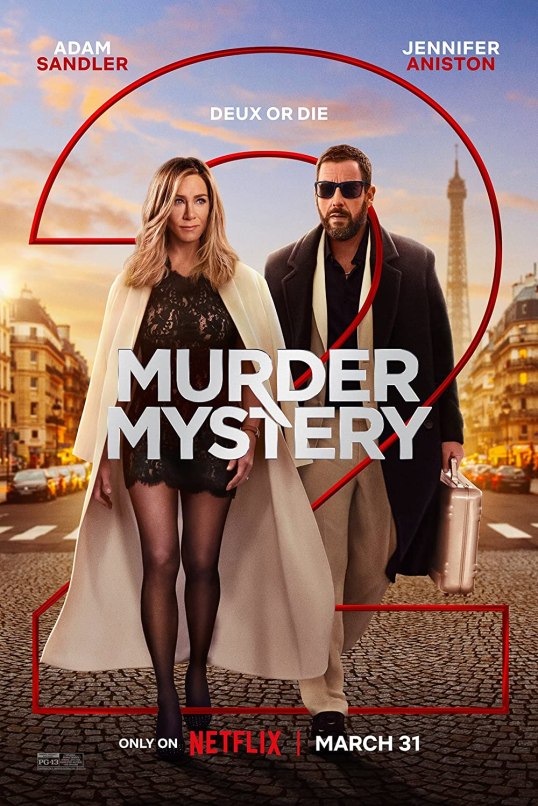
Film Review: Murder Mystery 2 (dir by Jeremy Garelick)


Four years ago, Nick and Audrey Spitz (Adam Sandler and Jennifer Aniston) solved a convoluted murder mystery and became minor celebrities.  Nick quit his job with the NYPD.  Audrey quit her job as a hairdresser.  They opened up their own private detective agency.

Unfortunately, as a narrator explains to us at the start of Murder Mystery 2, things haven’t gone smoothly for Nick and Audrey.  They’ve struggled to establish themselves as detectives.  In fact, Nick doesn’t even have a P.I. license because he has yet to pass the exam and he balks at having to actually study criminology.  While Audrey tries to convince him to, at the very least, read a book on kidnapping, Nick is more concerned with coming up with cute business cards.  His big idea to combine the traditional business card with floss and a razor.  Personally, I wouldn’t want to use a business card to take care of my teeth but maybe that’s just me.

When Nick and Audrey are invited to an exclusive wedding, it’s a chance for them to reacquaint themselves with Vikram (Adeel Akhatar) and Colonel Ulenga (John Kani), both of whom were featured in the first Murder Mystery.  When Vikram is kidnapped and one of his bodyguards is murdered, it’s a chance to Nick and Audrey to once again prove that they’re capable of solving a crime.  When former MI6 agent-turned-security consultant Captain Miller (Mark Strong) literally emerges from the sea and takes over the investigation, it’s a chance to Audrey to meet one of her heroes and for Nick to get a little jealous.  And when the action moves to France, it’s an excuse for the film’s cast and crew to hang out in Paris for a few weeks.

I enjoyed the first Murder Mystery, which was a surprisingly sweet and funny comedy that showcased Sandler and Aniston’s chemistry while also make good use of Sandler in one of his more likable comedic roles.  Like all Sandler characters, Nick may be something of a manchild but he’s not deliberately destructive.  He means well.  The first film’s mystery was enjoyably convoluted and a lot of the humor came from just how out of place Sandler and Aniston were in an Agatha Christie-style whodunit.

Murder Mystery 2, unfortunately, it not quite as much fun as the first film.  A huge part of the problem is that Nick and Audrey are no longer amateur detectives who are both shocked and secretly thrilled to be solving an actual murder.  Now, they’re professional (if somewhat incompetent) detectives.  The first film had a sweet subtext about Sandler trying to prove that he was as good a detective as thought he was.  He had something to prove, to both his wife and to himself.  In the second film, the emphasis is more on action than humor.  Suddenly, Sandler and Aniston are engaging in high-speed car chases and battles atop the Eiffel Tower.  It all feels a bit mechanical and, much as with his direction of The Binge, director Jeremy Garelick often seems to just be going through the motions.

On the plus side, Sandler and Aniston still have their chemistry and both of them still know how to make an otherwise corny joke work.  Jennifer Aniston gets to wear a lot of really pretty outfits and Adam Sandler gets a memorable scene where he tries to convince himself that he can jump over a moat.  There’s a genuinely funny moment towards the end of the film, when a character unrelated to the mystery randomly shows up and interrupts a tense showdown.  Even though I wish the film had done a bit more with character, Mark Strong also seems to be having parodying his own image.  There are moments of Murder Mystery 2 that are actually pretty amusing, though I think chuckled more than I actually laughed out loud.  Ultimately, though, Murder Mystery 2 is rather forgettable.

Favorite Son (1988, directed by Jeff Bleckner)


During a reception on the steps of U.S. Capitol, an assassin kills Contra leader Col. Martinez (Geno Silva) and seriously wounds Sen. Terry Fallon (Harry Hamlin), an up-and-coming politician from Texas.  An eager media catapults Fallon to national stardom and the beleagued President (James Whitmore), who is facing a tough reelection bid, is pressured to replace the current vice president (Mitchell Ryan) with Fallon.

The FBI only assigns two of their agents to investigate the assassination, a sure sign that someone wants the investigation to just go away.  Nick Mancuso (Robert Loggia) is a crusty, hard-drinking veteran agent whose career is nearly at an end.  David Ross (Lance Guest) is his young and idealistic partner.  When Mancuso and Ross discover that Martinez was injected with the HIV virus just two days before the assassination, it becomes obvious that there is a bigger conspiracy afoot.  It all links back to Sally Crain (Linda Kozlowski), who is Fallon’s legislative aide and also his lover.  (Fallon has a wife but she’s locked away in a hospital.)  Sally has an interest in bondage, as Ross soon finds out.

Favorite Son was originally aired as a 3-night, 4 and a half-hour miniseries.  It was later reedited and, with a running time of less than two hours, released theatrically overseas as Target: Favorite Son.  As a miniseries, Favorite Son is an exciting conspiracy-themed film that is full of scheming, plotting, interesting performances, and pungent dialogue.  Target: Favorite Son, on the other hand, is disjointed and, unless you know the original’s plot, almost impossible to follow.  If you’re going to watch Favorite Son, make sure you see the original miniseries.  My mom taped it off of NBC when it originally aired.  That was the only way that I was able to originally see the film the way that it meant to be seen.  The entire miniseries has also been uploaded, in three parts, to YouTube.

Hopefully, the original miniseries will get an official release someday because it’s pretty damn entertaining.  Harry Hamlin isn’t really dynamic enough for the role of Fallon but otherwise, the movie is perfectly cast.  Robert Loggia is so perfect for the role of Nick Mancuso that it almost seems as if the character was written for him.  (Loggia did later star in a one-season drama called Mancuso, FBI.)  Linda Kozlowski seems to be destined to be forever known as Crocodile Dundee’s wife but her performance as Sally shows that she was a better actress than she was given credit for.  The supporting cast also features good performances from Jason Alexander, Ronny Cox, Tony Goldwyn, John Mahoney, Kenneth McMillian, Richard Bradford, and Jon Cypher.

Favorite Son may be over 30 years old but it’s still relevant today.  In the third part, John Mahoney gives a speech about how American voters are often willfully ignorant when it comes to what’s going on behind the scenes in Washington and it’s a killer moment.  Melodramatic as Favorite Son may be, with its portrayal of political chicanery and an exploitative national media, it’s still got something to say that’s worth hearing.


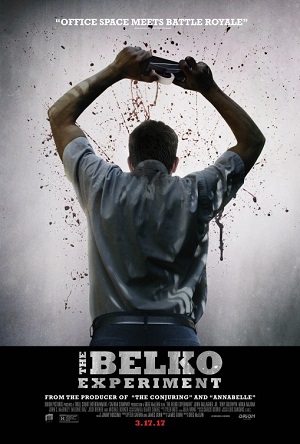
Horror Film Review: The Belko Experiment (dir by Greg McLean)


How far would you go if all you had to do was follow orders?  That is the question posed by The Belko Experiment.

A violent and disturbingly plausible social satire/horror film, The Belko Experiment was released into theaters on March 17th.  It was one of the best films of the first half of 2017 but, as so often happens whenever a genre film subverts the traditional narrative, The Belko Experiment is also one of the most overlooked films of 2017.  It got mixed reviews, with most critics focusing on the fact that the script was written by James Gunn.  (Though Gunn may be best known for directing Guardians of the Galaxy, his non-MCU work has always  been distinguished by a subversive, often transgressive sensibility.)  A few critics dismissed it as being just another lurid celebration of violence, showing once again that you can always count on certain mainstream critics to unfairly categorize any film that doesn’t neatly fit into their preconceptions.  Yes, The Belko Experiment is violent.  And yes, it is gory and sometimes hard to watch.  However, to dismiss The Belko Experiment as merely being that latest entry in the torture porn genre is to totally miss the point.

Mike Milch (John Gallagher, Jr.) is one of the many employees of Belko Industries.  He’s a nice enough guy.  In fact, if I worked for Belko Industries, Mike would probably be one of my favorite co-workers.  He’s friendly.  He’s funny.  He’s not unattractive.  He’s kind of a less smirky version of The Office‘s Jim Halpert.  I’d want to be his friend.  Since Belko’s offices are located in a remote area of Colombia, I would want to make all the friends that I could.

(Early on in the film, we’re informed that every employee of Belko Industries has been required to get a tracking device implanted at the base of their skull.  They’re told that this is because there’s always the risk that one of them will be kidnapped by drug traffickers.  Of course, as the film plays out, we discover that it’s actually for a totally different reason.)

When The Belko Experiment begins, it’s a day like any other.  People show up for work. Some people actually do work.  Some people slack off.  Everyone tries to look busy whenever the boss, Barry Norris (Tony Goldwyn), wanders by.  The maintenance workers (Michael Rooker and David Dastmalchian) do their thing.  A few employees sneak up to the roof of the office building and get high.  Everyone tries to avoid Wendell Dukes (John C. McGinely), a pervy executive.  The security guard (James Earl) watches the door.  The newest employee (Melonie Diaz) learns about her new job and coworkers.

Of course, there are a few strange things.  Some new security guards have shown up and they don’t appear to be particularly friendly.  They turn away all of the locals who work at the office, only allowing in the American employees.  Everyone agrees that it’s strange but, instead of thinking about it too much, they just keep going about their day.

Then, the steel shutters slam down, effectively sealing the building off.

Then a voice (Gregg Henry) demands that they select two co-workers to die.  When the employees of Belko Industries refuse (with several dismissing the whole thing as being a tasteless prank), tracking devices start to randomly explode until four employees are dead.  The voice goes on to say that, unless 30 employees are killed in the next two hours, 60 people will be randomly killed…

Some of the co-workers refuse to kill their friends but many more do not.  And soon, even those who refused to take part in the murders, are forced to start killing just to keep from being killed themselves…

The Belko Experiment wastes no time in establishing that anyone can die at any moment.  It doesn’t matter how funny you were a few seconds ago or how likable you may be.  If the unseen voice decides to flip your switch, that “tracking device” will explode and it’ll take your head with it.  And, even if the unseen voice doesn’t get you, your coworkers might.

That, by itself, would be disturbing enough.  However, The Belko Experiment ultimately succeeds as a work of horror because it illustrates a truth that many people would prefer to ignore.  When the employees of Belko Industries start to kill each other, it feels all too plausible.  Culturally, human beings are conditioned to follow orders.  We like to have an authoritarian around to tell us what to do.  It’s a good way of avoiding responsibility for our own actions.  (“I was following orders.”  “I was following protocol.”  “I’m just doing my job.”)  As The Belko Experiment demonstrates, most people would never dream of hurting someone else … unless they were ordered to do so.  The characters in The Belko Experiment start the movie as individuals but, as the experiment unfolds, all quirks and differences vanish.  All that is left are drones who slavishly do what they’re told.

Making the nightmare scenario feel all the more believable is a large and strong cast of familiar faces.  As the closest thing that this film has to a hero, John Gallagher, Jr. is likable and you find yourself hoping that he’ll somehow manage to survive all of this with his humanity intact.  Tony Goldwyn brings some interesting shades to his role while John C. McGinley is memorably creepy as Wendell.  Micheal Rooker, Abraham Benrubi, Sean Gunn, Josh Brener, Melonie Diaz, Brent Sexton, and Adria Arjone all shine in smaller roles.  To be honest, you really don’t want to see any of these people suffer, which makes their inevitable fate all the more disturbing.

The Belko Experiment is ultimately a portrait of how easily people can be persuaded (or ordered) to surrender their humanity.  It’s the exact mentality that we currently see everyday, with people willingly becoming slaves to one ideology or another and then tossing around terms like “treason” whenever anyone dares to do something other than obey.  It’s the exact mentality that leads to people accusing you of being “selfish” when you refuse to surrender your right to self-determination.  Our real-life Belko Experiment has been going on for several years now and it doesn’t appear to be ending anytime soon.  This movie is frightening because it’s real.

http://www.youtube.com/watch?v=AJ0x3OS4ML0

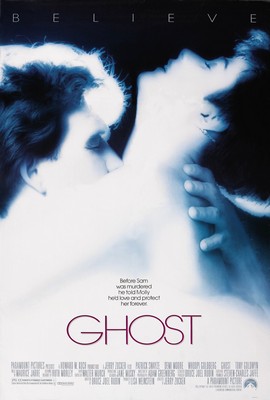
Embracing the Melodrama Part II #85: Ghost (dir by Jerry Zucker)


Ghost_(1990_movie_poster)Along with it being a part of my series of melodramatic film reviews, there are actually two reasons why I recently watched Ghost.

First off, this 1990 film was nominated for best picture and it’s long been my goal to watch and review every single film ever nominated for best picture.

Secondly, my Aunt Kate absolutely loves this movie.  Ever since she first found out that I obsessively love movies, she has recommended that I watch this movie.  And she hasn’t been alone.  A lot of people both in and outside of my family have recommended this film to me.  And, since I tend to be a bit of a contrarian know-it-all, I originally assumed that any film loved by that many people had to be terrible.  However, because I love mi tia, I decided to watch Ghost.

I have to admit that I started to laugh when I saw Demi Moore sitting at her pottery wheel because I’ve seen that scene parodied in so many different TV shows and movies.  As soon as a shirtless Patrick Swayze sat down behind her and joined his hands to hers to help shape a ceramic phallic symbol, I started to giggle.  As Unchained Melody played in the background, I wanted to be snarky.  But then I realized something.  If you can manage watch the scene without comparing it to all the parody versions, it actually works.  Patrick Swayze looked good and he and Demi Moore had the type of amazing chemistry that more than made up for the fact that neither one of them was a very good actor.  (That said, Patrick was very good at projecting decency and Demi was very good at crying and that’s really all that Ghost required.)  And, if the scene has proven easy to parody, that doesn’t change the fact that it’s a very sincere scene.  It’s so sincere that it’s even willing to risk coming across as being silly.

Of course, the entire film isn’t just Demi, Patrick, and a pottery wheel.  There’s also Whoopi Goldberg as a fake medium-turned-real-medium and Tony Goldwyn as the best friend who turns out to be a sleazy villain.  And, of course, there’s the cartoonish demons who pop up every once in a while so that they can literally drag the recently deceased down to Hell.

Sam Wheat (Patrick Swayze) is the world’s most unlikely New York City-based banker.  He owns a beautiful apartment with his girlfriend Molly (Demi Moore) but he has commitment issues.  He can’t bring himself to say that he loves Molly.  Instead, he just says, “Ditto.”  And, from the minute he first utters those words, you know that his habit of saying “Ditto,” is going to be an important plot point.  Anton Chekhov told us that any gun introduced during the first chapter must be fired by the third chapter.  Ghost tells us that any “Ditto” uttered during the first 10 minutes must be repeated by the end of the first hour.

Sam’s best friend and co-worker is Carl (Tony Goldwyn).  At the start of the film, Sam and Carl have a sweet bromance going and some of the best scenes are just the two of them acting like guys.  (There’s a fun little scene where they freak out a group of strangers on an elevator.)  Goldwyn is so likable as Carl that it’s actually genuinely upsetting to discover that he’s arranged for Sam to be murdered.  (Why?  It all involved a lot of financial stuff that basically went right over my head.  Greed is not only the root of all evil but it leads to narrative confusion as well.)  When Sam dies, he comes back as a ghost but nobody can see him but his fellow ghosts.  Vincent Schiavelli has a great cameo as a very angry subway ghost who teaches Sam how “life” works when you’re dead.

(Of course, Schiavelli isn’t on screen for too long because he’s almost too angry for the world of Ghost.)

Eventually Sam discovers that only one living person can communicate with him.  Oda Mae Brown (Whoopi Goldberg) is a fake medium who is just as shocked as anyone to discover that she can speak with the dead.  Whoopi won an Oscar for her performance here and she’s certainly does bring some needed humor and life to Ghost.  With Swayze, Moore, and Goldwyn all giving extremely and sometimes overly dramatic performances, you’re happy to have Whoopi there.

Ghost is designed to appeal to your emotions and it succeeds in doing just that.  If you look at the film logically, you’re missing the point.  In many ways, the film is undeniably silly but I still got some tears in my eyes when I heard that “Ditto.”


44 Days of Paranoia #30: Nixon (dir by Oliver Stone)


For our latest entry in the 44 Days of Paranoia, we take a look at Oliver Stone’s 1995 presidential biopic, Nixon.

Nixon tells the life story of our 37th President, Richard Nixon.  The only President to ever resign in order to avoid being impeached, Nixon remains a controversial figure to this day.  As portrayed in this film, Nixon (played by Anthony Hopkins) was an insecure, friendless child who was dominated by his ultra religious mother (Mary Steenburgen) and who lived in the shadow of his charismatic older brother (Tony Goldwyn).  After he graduated college, Nixon married Pat (Joan Allen), entered politics, made a name for himself as an anti-communist, and eventually ended up winning the U.S. presidency.  The film tells us that, regardless of his success, Nixon remained a paranoid and desperately lonely man who eventually allowed the sycophants on his staff (including James Woods) to break the law in an attempt to destroy enemies both real and imagined.  Along the way, Nixon deals with a shady businessman (Larry Hagman), who expects to be rewarded for supporting Nixon’s political career, and has an odd confrontation with a young anti-war protester who has figured out that Nixon doesn’t have half the power that everyone assumes he does.

Considering that his last few films have been W., Wall Street: Money Never Sleeps, and SavagesI think it’s understandable that I’m often stunned to discover that, at one point in the distant past, Oliver Stone actually was a worthwhile director.  JFK, for instance, is effective propaganda.  Nixon, which feels a lot like an unofficial sequel to JFK, is a much messier film than JFK but — as opposed to something like Savages — it’s still watchable and occasionally even thought-provoking.  Thanks to Hopkins’ performance and, it must be admitted, Stone’s surprisingly even-handed approach to the character, Nixon challenges our assumptions about one of the most infamous and villified figures in American history.  It forces us to decide for ourselves whether Nixon was a monster or a victim of circumstances that spiraled out of his control.  If you need proof of the effectiveness of the film’s approach, just compare Stone’s work on Nixon with his work on his next Presidential biography, the far less effective W.

(I should admit, however, that I’m a political history nerd and therefore, this film was specifically designed to appeal to me.  For me, half the fun of Nixon was being able to go, “Oh, that’s supposed to be Nelson Rockefeller!”)

If I had to compare the experience of watching Nixon to anything, I would compare it to taking 10 capsules of Dexedrine and then staying up for five days straight without eating.  The film zooms from scene-to-scene, switching film stocks almost at random while jumping in and out of time, and not worrying too much about establishing any sort of narrative consistency.  Surprisingly nuanced domestic scenes between Anthony Hopkins and Joan Allen are followed by over-the-top scenes where Bob Hoskins lustily stares at a White House guard or Sam Waterston’s eyes briefly turn completely black as he discusses the existence of evil.  When Nixon gives his acceptance speech to the Republican Convention, the Republican delegates are briefly replaced by images of a world on fire.  Familiar actors wander through the film, most of them only popping up for a scene or two and then vanishing.  The end result is a film that both engages and exhausts the viewer, a hallucinatory journey through Stone’s version of American history.

Nixon is a mess but it’s a fascinating mess.

Other Entries In The 44 Days of Paranoia 

  1. Clonus
  2. Executive Action
  3. Winter Kills
  4. Interview With The Assassin
  5. The Trial of Lee Harvey Oswald
  6. JFK
  7. Beyond The Doors
  8. Three Days of the Condor
  9. They Saved Hitler’s Brain
  10. The Intruder
  11. Police, Adjective
  12. Burn After Reading
  13. Quiz Show
  14. Flying Blind
  15. God Told Me To
  16. Wag the Dog
  17. Cheaters
  18. Scream and Scream Again
  19. Capricorn One
  20. Seven Days In May
  21. Broken City
  22. Suddenly
  23. Pickup on South Street
  24. The Informer
  25. Chinatown
  26. Compliance
  27. The Lives of Others
  28. The Departed
  29. A Face In The Crowd

Film Review: The Mechanic (dir. by Simon West)


A few years ago, I declared that January should just be renamed Statham because seriously, Jason Statham was in like almost every single freaking movie released that month.  Seriously, it was like every time I turned on the TV, there was yet a new commercial featuring Jason Statham in some movie that I had absolutely no desire to see.  “Oh look,” I’d say, “that’s Jason Statham swinging a sword.  Oh, now he’s driving a car really fast.  Oh, wow, now Jason Statham’s looking off to the side and squinting…”

Well, this January, Jason Statham is only starring in one film and it might be the best of his career.  At the very least, it’s the first time I’ve been able to kind of see the guy’s appeal as a film star.  That film is The Mechanic and it opened this week.

In the Mechanic, Jason Statham plays a contract killer.  He’s known as a mechanic because he “fixes” problems.  After Statham’s mentor (Donald Sutherland) is killed, Statham takes the man’s son (Ben Foster) under his wing and starts to teach Foster the tools of the trade.  However, unlike the cool and detached Statham, Foster is a jittery and angry psychopath.  However, despite their differing approaches, they are forced to work together when the same man (Tony Goldwyn) who ordered Sutherland’s murder decides to come after them.

As I stated before, I’ve never quite gotten the appeal of Jason Statham as an actor.  In fact, as Jeff and I waited for the film to start, I said, “I’ve never really gotten Jason Statham.”  As soon as I said that, this woman sitting in front of us turned around in her seat and I swear to God, she rolls her eyes at me in this way that said, “Bitch, please.  Like Jason Statham would ever give your raggedy ass a second look.” 

I proceeded to narrow my eyes in a way that said, “You best be watching what you say, you nasty ass ho.”

She cocked her head in a way that said, “Oh, no you didn’t!”

I flared my nostrils in a way that said, “Oh yes, I did, you hootchie ass skank…”

She leaned forward as if to say, “Gurl, you need to get Jesus in your life…” 

I smirked as if to say, “Jesus?  What does Jesus have to do with this?”

Before she could answer, the movie started.

Anyway, what was my point?  Oh yes, Jason Statham.  In the past, I’ve never gotten his appeal but in this film, I did.  For the first time, I saw him as something other than just an expressionless English guy.  Statham is athletic but, unlike a lot of other action movie stars, he’s not so ludicrously muscle-bound that you can’t believe him as some guy you might run into out on the street.  Previously, I just thought that Statham was a bad actor but, with the Mechanic, I realized that, whereas other actors act with their eyes and their voice, Statham acts with his body.  You look at Statham with his constant scowl and his cold eyes and you believe that he could kill someone in real life as well as in the movies.  Statham is perfectly cast as a professional killer and The Mechanic wisely doesn’t try to suggest that the character is anything more than just a very disciplined sociopath.  Much like the best pulp heroes, Statham’s mechanic is a hero by default.  He’s a bad guy but everyone else in the movie is worse.

Also, there’s a scene about ten minutes into the film where Statham, fresh from killing a drug lord, changes clothes in a linen closet and as soon as he removed his shirt, I said, “Oh, I see the appeal now.”

Playing opposite of Statham, Ben Foster gives another one of his intense performances.  Throughout the film, Foster is perpetually on the verge of exploding and his typically high energy performance provides a nice contrast to Statham’s typical nonperformance.  He’s the Eli Wallach to Statham’s Clint Eastwood.  However, Foster doesn’t just rely on theatric for his character.  Instead, he gives a complex, multi-faceted performance as a character who, in the hands of a lesser actor, could have just been your average psychopath.  He even manages to win some sympathy for a character who, on paper, wouldn’t seem to deserve it.  Even more importantly, he brings out the best in Statham in a way that previous co-stars like Sylvester Stallone couldn’t. 

Director West keeps the action moving quickly without ever letting the movie degenerate into just a collection of over-the-top set pieces.  When the film does break out into action, West handles it like a pro and, as spectacular as the action may get, he still manages to keep things in the realm of the believable.  However, West also invests the film with a dark, almost grim atmosphere that fills every scene with a feeling of impending doom and growing paranoia.

The Mechanic is a fast-paced, unapologetic thriller that, in its way, ultimately becomes a masterpiece of the pulp imagination.   It’s very easy to imagine this as an Antonio Margheriti film from the early 80s, starring David Warbeck and Giovanni Lombardo Radice in the Statham and Foster roles.  Both director West and the cast deserve to be applauded for making a grindhouse film for the 21st Century.