Today would have been the 91st birthday of Tom Laughlin, the independent film pioneer who gave the world Billy Jack.
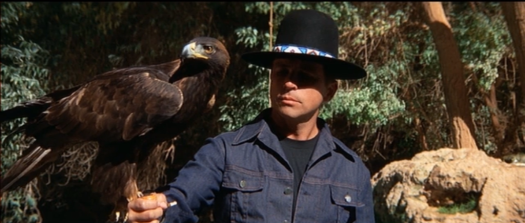
In honor of the day of his birth, here’s a scene that I love from Billy Jack. The townspeople think that they can get away with humiliating the students from the Freedom School. Well, Billy Jack’s got something to say about that and, as always, it starts with him taking off his shoes.
Monday would have been the 90th birthday of Tom Laughlin, the actor who revolutionized independent American cinema through his Billy Jack films.
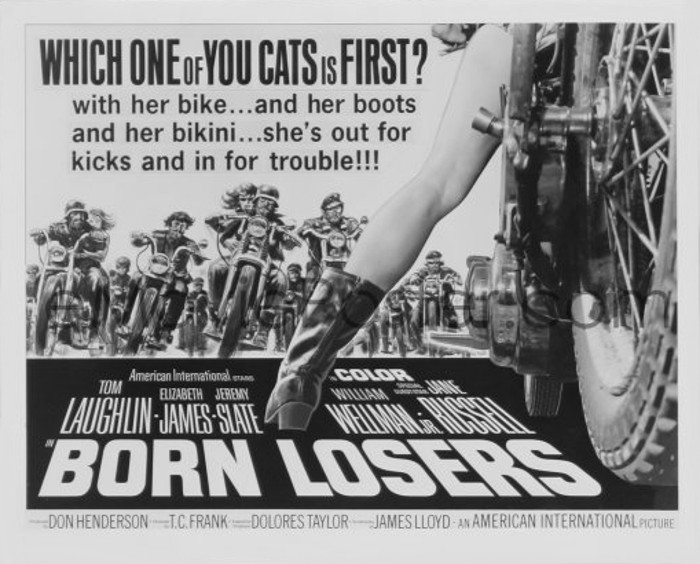
In four films, Laughlin played Billy Jack, an American Navajo, a former Green Beret, a veteran of the Vietnam War, a hapkido master, and a man who just protects children and other living things. When he first appeared in 1967’s TheBornLosers, he was protecting a woman from bikers. In 1971’s BillyJack, he was protecting the Freedom School from ignorant townspeople. In 1974’s TheTrialofBillyJack, he was …. well, in that film, Billy Jack did a little bit of everything but the National Guard still ended up destroying the Freedom School. Finally, in 1977’s BillyJackGoesToWashington, Billy was appointed to the United Stated Senate because what else are you going to do with someone who has killed a tremendous amount of people over the course of three films?
(Of course, in Senator Jack’s defense, they were all bad people.)
Laughlin not only starred as Billy Jack but he also directed all four of the films and, starting with BillyJack, he also handled the distribution of them. A huge box office hit, BillyJack is considered to be a seminal counter culture film. The other three films are a bit less acclaimed and TrialofBillyJack is often cited as one of the most pretentious and self-indulgent films ever made. But, regardless of their individual artistic merits, all of the Billy Jack films share an appealing mix of sincerity and silliness. Laughlin was a good actor and, visually, he was a stronger director than he was often given credit for. Some of the shots in the original Billy Jack are breath-taking. At a time when even self-styled progressive films still portrayed women in the most condescending and demeaning way possible (check out GettingStraight or R.P.M., if you dare), the BillyJack films were as much about Jean (played by Delores Taylor, Laughlin’s wife and creative partner), the founder of the Freedom School, and her beliefs, as they were about Billy Jack and his struggles to accept pacifism. If nothing else, the Billy Jack films featured actual conversations and debates about actual ideologies and philosophies, as opposed to the usual shallow Hollywood politics. Unfortunately, Laughlin was also a heavy-handed storyteller and a terrible editor. TheTrialofBillyJack goes on for three hours.
And yet, of all the BillyJack films, TheTrialofBillyJack is my favorite. It’s just so weird that it’s hard not to like it. It’s a film that doesn’t really work but, at the same time, you can’t help but appreciate all the effort that was put into it. Whatever else you might be able to say about him and his films, it’s obvious that Tom Laughlin truly did think that the movies could make a difference. There’s an aching sincerity to Laughlin’s work that pretty much cannot be found in the majority of today’s films.
In honor of Laughlin’s birthday and his legacy, here’s a scene that I love from TheTrialofBillyJack. In this scene, Billy goes on a vision quest and experiences the Three Levels. I would be lying if I said I really followed much of the logic in the scene but at least we get to see Billy hit a hippie professor. Billy also smacks Jesus, which isn’t cool but Jesus shows exactly how to handle that type of belligerence and hopefully, he provides a lesson for us all.
Learn about the Three Levels, with Billy Jack. And be sure to spare a thought for the hard work of Tom Laughlin.
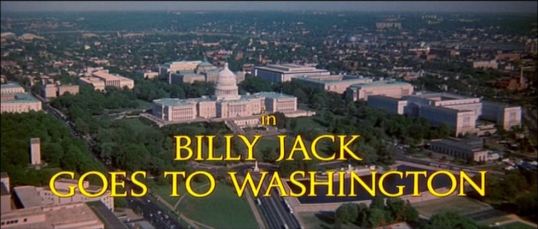
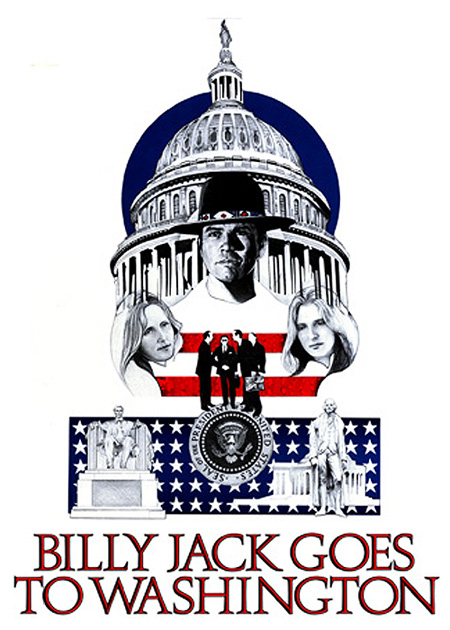
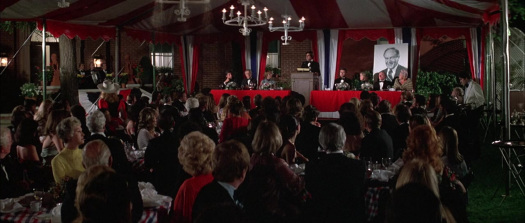
Billy Jack, hero of the oppressed, goes up against an enemy he can’t wrap his head around – the politicians of Washington, D.C. in BILLY JACK GOES TO WASHINGTON, the final chapter in the Billy Jack saga. I know I harped on the fact that the last film, THE TRIAL OF BILLY JACK , didn’t contain enough action, and this one has even less, but I liked this film better. It’s a remake of Frank Capra’s 1939 classic MR. SMITH GOES TO WASHINGTON (Capra’s son is the producer), retooled for the modern era and casting Tom Laughlin’s Billy Jack character in the Jimmy Stewart role. You’d think a forty-plus year old political film would be dated, but truth to tell, not a lot has changed since then… if anything, it’s gotten worse.
When Senator Foley has a heart attack and croaks, the powers-that-be look for a patsy to replace him…
The last time we saw BILLY JACK , he was being hauled off to jail – and raking in about 60 million bucks at the box office! The eponymous hero of the surprise 1973 indie hit struck a chord with young audiences disillusioned with the Establishment’s endless wars and crushing their hobnail boots on the throats of dissidents (like I always say, the more things change…), and cheered as Billy Jack struck karate blows and Hapkido kicks in the cause of freedom. A sequel was inevitable, with Tom Laughlin returning as star/director/co-writer (along with wife Delores Taylor, who plays Jean) in a film loaded with political and spiritual philosophies designed to open those young moviegoers’ hearts and minds (not to mention wallets!).
But while BILLY JACK (and its predecessor, BORN LOSERS ) are fun flicks, THE TRIAL OF BILLY JACK suffers from that dreaded disease many filmmakers are prone to…
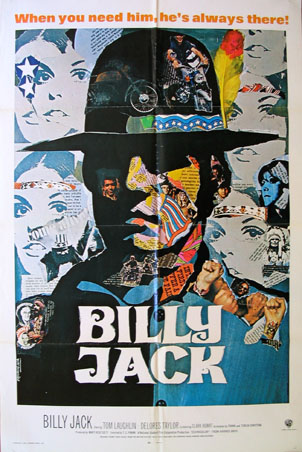
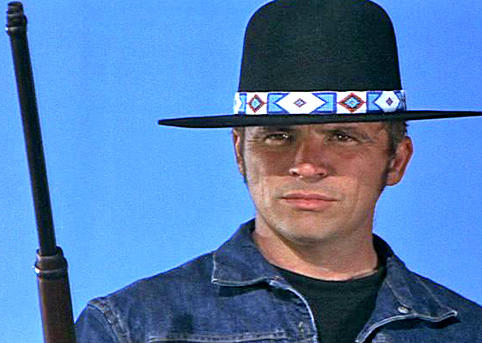
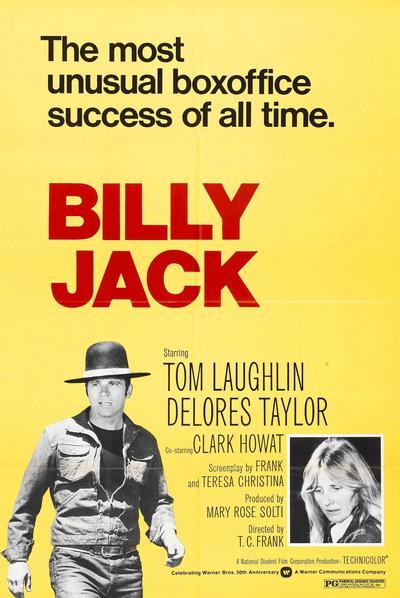
When last we saw Billy Jack, he was dismantling a brood of outlaw bikers in BORN LOSERS . This time around, he’s taking on a whole town’s worth of rednecks as Tom Laughlin’s half-breed ex-Green Beret returns in BILLY JACK, the wildly popular film that combines action with social commentary, and helped kick off the martial arts craze of the 70’s.
BILLY JACK almost never saw the light of day, as Laughlin’s financing was shut off by American-International Pictures. 20th Century-Fox then picked it up, but didn’t think it deserved to be released, so Laughlin went the indie route, under the banner of National Student Film Co. in 1971. Poor distribution and poor reviews caused the film to tank, but the good folks at Warner Brothers saw something in it, and gave it a national release two years later. Young audiences of the day flocked to it in droves, cheering as Billy Jack…
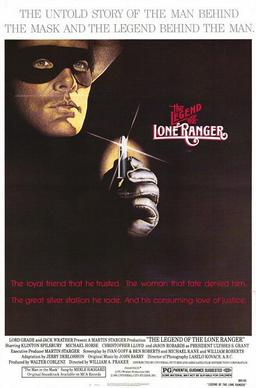
Long before he found fame playing Deputy Hawk on Twin Peaks, Michael Horse made his film debut in one of the most notorious box office flops of all time, The Legend of the Lone Ranger.
Michael Horse played Tonto, the young Comanche who rescues his childhood friend, John Reid (Klinton Spilsbury), and nurses him back to health after Reid has been attacked and left for dead by the notorious outlaw, Butch Cavendish (Christopher Lloyd). Reid was a civilian, accompanying a group of Texas Rangers led by his older brother, Dan (John Bennett Perry). When Cavendish attacked, John was the only survivor. John wants to avenge his brother’s death but first, Tonto is going to have to teach him how to shoot a six-shooter and how to ride his new horse, Silver. Finally, John is ready to don the mask and becomes the Lone Ranger. It’s just in time, because Cavendish has kidnapped President Grant (Jason Robards).
An even bigger flop than the more recent Lone Ranger film starring Armie Hammer and Johnny Depp, The Legend of the Lone Ranger failed for several reasons. For one thing, the film has a major identity crisis. The violence is not for kids but most of the dialogue and the performances are. For another thing, it takes forever for John Reid to actually put on the mask and become the Lone Ranger. By the time the William Tell Overture is heard, the movie is nearly over.
It was made to capitalize on the same type of nostalgia that previously made Superman a hit and, just as Superman introduced the world to Christopher Reeve, The Legend of the Lone Ranger introduced the world to a football player turned actor, named Klinton Spilsbury. Unfortunately, the world did not want to meet Klinton Spilsbury, whose blank-faced performance was so bad that James Keach was brought in to dub over all of his dialogue. Spilsbury did not help himself by reportedly acting like a diva during the shooting, demanding constant rewrites, and getting into bar brawls offset. Of the two actors who made their screen debuts in The Legend of the Lone Ranger, Michael Horse has worked again. Klinton Spilsbury has not.
When The Legend of the Lone Ranger went into production, the film’s producers made the incredibly boneheaded move of getting a court injunction barring Clayton Moore (who had played the role on TV) from wearing his Lone Ranger uniform is public. Since the semi-retired Moore was living off of the money that he made appearing as the Lone Ranger at country fairs and children’s hospitals, this move was a public relations disaster. (For his part, Moore filed a counter suit and continued to make appearances, now wearing wrap-around sunglasses instead of his mask.) Moore refused to appear in a cameo and spent much of 1981 speaking out against the film.
Finally, the main reason that Legend of The Lone Ranger flopped was because it opened on the same Friday as a little film called Raiders of the Lost Ark.
The character Billy Jack, star of the wildly popular 1971 film (and its two sequels), made his debut in this 1967 exploitation flick about a sociopathic biker gang and the lone man who stands up to them. Tom Laughlin, a minor figure in Hollywood at the time who had appeared in GIDGET and THE DELINQUENTS, conceived the character way back in 1954. Unable to get his original screenplay produced, he and co-star Elizabeth James banged out this motorcycle drama and he was given the opportunity to direct by American International Pictures, always on the lookout to make a quick exploitation buck.
The Born Losers are a degenerate gang of outlaw bikers terrorizing the small town of Big Rock. Ex-Green Beret Billy Jack, a half-breed Indian back from ‘Nam, saves a local kid from getting an ass kicking by breaking out his rifle, winds up the one locked up and given 120 days in jail or $1,000…
Now, it may seem strange to think of someone like Billy Jack being appointed to the U.S. Senate. Over the course of the previous three films in the franchise, Billy had been shot in the back, shot in the leg, arrested for murder, convicted of manslaughter, and then shot by the National Guard. In Billy Jack and The Trial of Billy Jack, Billy goes as far as to state that he does not feel the laws of the United States apply to him.
And then, when you consider that the three previous films all featured old, rich, white guys plotting to kill Billy, you would be justified in wondering how he would ever find himself appointed to serve in the senate.
But it happened!
And we’ve got a movie to prove it.
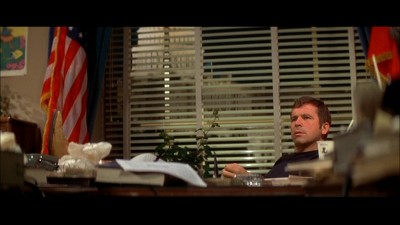
Directed by and starring Tom Laughlin, Billy Jack Goes To Washington is actually a remake of Mr. Smith Goes To Washington.(To the film’s credit, it’s honest enough to actually give credit to Mr. Smith‘s screenwriters in the opening credits.) What’s remarkable is just how faithful a remake Billy Jack Goes To Washington actually is. All the scenes made famous by Jimmy Stewart — the scene where the newest member of the Senate attempts to introduce his first bill, the scene where he’s shocked to discover that Sen. Paine (played here by E.G. Marshall) takes orders from Boss Bailey (Sam Wanamaker), the scene where cynical Saunders (Lucie Arnaz) tells the senator that he should leave Washington, and, of course, that famous filibuster — are all faithfully recreated here. The only difference, of course, is that it’s no longer idealistic Jimmy Stewart proving himself to be incredibly naive about politics. Instead, it’s a former Green Beret, half-Indian, judo master named Billy Jack.
Tom Laughlin was a good actor, which is something that’s often overlooked by reviewers writing about the Billy Jack films. As flawed as The Trial of Billy Jack may have been, Tom Laughlin was a compelling enough presence that the film itself remains a compulsively watchable 3-hour mess. Laughlin had a very authoritative presence. You looked at him and you knew that he knew what he was doing. He was someone who you automatically wanted on your side, a natural born leader who knew how to get things done. However, in Billy Jack Goes To Washington, Laughlin attempts to play Billy Jack as the type of naive neophyte who would be shocked to discover that politicians are corrupt. But surely, after spending three films being harassed by every authority figure in America, Billy would have already realized that. There’s nothing about Laughlin’s screen presence that suggests he could ever be that innocent.
And that’s the main problem with Billy Jack Goes To Washington. For the film to have any chance of working, you have to forget everything that you’ve learned about Billy Jack over the previous three films. However, if you haven’t seen any of the other Billy Jack films, then you probably wouldn’t be watching Billy Jack Goes To Washington in the first place.
Of course, since this is a Billy Jack film, there are a few scenes that were nowhere to be found in Mr. Smith Goes To Washington. For instance, Saunders’s husband is murdered when he threatens to reveal the truth about Bailey’s operation. Later, Billy, Jean (Delores Taylor), and Carol (Teresa Laughlin) are confronted by a gang of Bailey’s assassins and, for the only time in the entire movie, Billy goes through that whole routine where he takes off his boots while slowly speaking and then kicks everyone’s ass. (Jean and Carol get to join in the ass-kicking as well and good for them!)
And, of course, there’s the scene where Billy, Jean, and the kids from the Freedom School (who are apparently now known as Billy’s Raiders) have a meeting with two liberal social activists. It’s an interesting scene because it was clearly unscripted and it has a naturalistic feel to it that’s lacking from the rest of the film. However, that does not mean that it’s a particularly good scene. If I learned anything from Billy Jack Goes To Washington, it’s that self-righteous activists in 1977 were just as boring as self-righteous activists in 2015.
And yet, as I’ve said about all of the other Billy Jack films, I can’t bring myself to be too hard on Billy Jack Goes To Washington. Again, it all comes down to sincerity. It’s clear that Laughlin and Taylor felt they were making a difference with their films and that sincerity comes through in a way that makes Billy Jack Goes To Washington a likable, if rather inept, film.
Billy Jack Goes To Washington ran for a week in one theater in 1977 and was reportedly such a box office disaster that it couldn’t get a wider release. (In a commentary track that he recorded for the film’s DVD release, Laughlin suggests the film was the victim of shadowy government forces.)* While Laughlin and Taylor would later try to make The Return of Billy Jack, that film was left uncompleted at the time of Laughlin’s death. So, the last time that filmgoers would see Billy Jack, he would still be U.S. Sen. Billy Jack.
And really, that’s the perfect ending for the saga of Billy Jack. Starting out as a loner who protected a small California town from a biker gang to eventually becoming the protector of the Freedom School to finally embracing both non-violence and his love for Jean, Billy Jack earned himself a happy ending.
Having now watched and reviewed all four of the Billy Jack films, all I can do is say thank you to Delores Taylor and the spirit of Tom Laughlin. It was great ride.
—-
* To be honest, the commentaries that Laughlin and Taylor recorded for the Billy Jack films are actually very informative and interesting. Laughlin actually had a far better sense of humor than you might guess from some of the movies he directed.
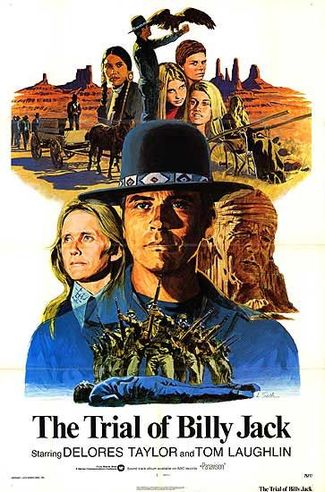
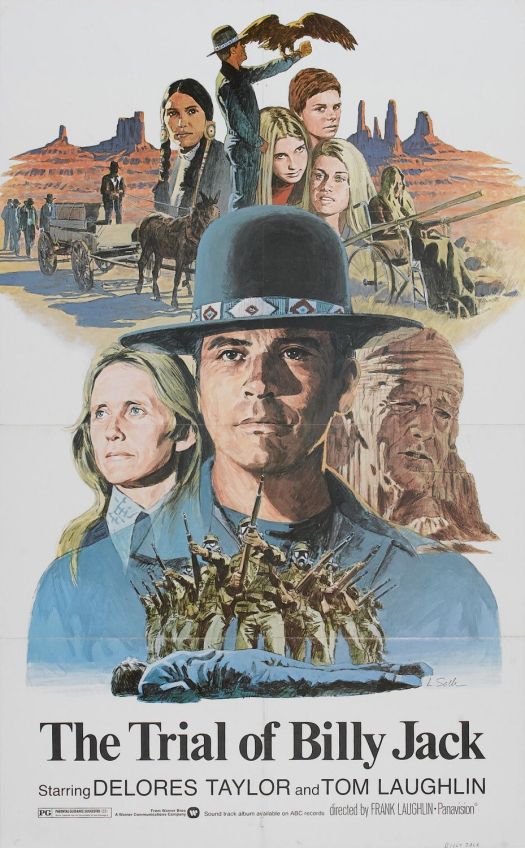
For the past week, I’ve been in the process of reviewing 94 films about politicians and, to a lesser extent, politics. I’ve recently taken a look at Born Losers and Billy Jack, the first two segments in the cinematic life of future U.S. Sen. Billy Jack. Today, I’m taking a look at the third part of the Billy Jack saga, 1974’s The Trial of Billy Jack!
I have to admit that, when you’re watching these first three films, it’s a little hard to see how Billy Jack is ever going to end up in the U.S. Senate. After all, The Born Losers ended with Billy getting shot in the back by an overeager deputy sheriff. Billy Jack ended with Billy shooting at the National Guard and then getting arrested for murder. And then, in Trial of Billy Jack, Billy gets released from prison but promptly kills yet another member of the Posner family and then eventually, the National Guard shows up (again!) and ends up gunning down at least half of the students at the Freedom School.
If I didn’t already know that Trial would be followed up Billy Jack Goes To Washington, I think I’d be justified in being a little pessimistic about Billy’s future.
But anyway, let’s talk about The Trial of Billy Jack. After the surprise box office success of Billy Jack, Tom Laughlin and Delores Taylor set about to make a sequel that would not only revisit the themes of Billy Jack but which would touch on literally every single other political issue of the day as well. The result is a three-hour mess of a film that, despite the excessive length and a generally preachy tone, remains oddly watchable.
Despite the film’s title, the actual Trial of Billy Jack only takes up a few minutes of screen time. The prosecution lays out its case, which is that Billy Jack killed Bernard Posner. The defense calls Billy to the stand and, instead of asking him about the events that led to Bernard’s death (i.e., the fact that Bernard was a rapist and that Billy caught him with a 13 year-old girl), they instead allow Billy to give his opinions on the political issues of the day. And, since this film was released in 1974, we get a lengthy flashback to the Vietnam War where we see Billy refusing to take part in a civilian massacre.
And then Billy Jack is sent to prison. And it’s actually quite some time before he shows up in the film again. This actually took me by surprise because, when it comes to people directing films starring themselves, I’m more used to the narcissistic style of Norman Mailer. But, in Laughlin’s case, he was actually willing to stay off-screen for close to an hour and allow the film to focus on Jean (Delores Taylor) and the Freedom School.
And that is one reason why I can never be as critical of the Billy Jack films as maybe I should be. They really are such sincere films. Laughlin was willing to stay off-screen and allow the film to be about the issues and for that he should be commended. However, at the same time, Laughlin was not only the best actor in most of the Billy Jack films. He was also usually the only good actor in the films as well. So, while you respect Laughlin for not being a narcissist, you also kind of wish that maybe the film could have been more about him and less about the students at the Freedom School (which, to judge from the performances in this film, did not have much of a drama department).
When I reviewed Billy Jack, I mentioned that, if anything could cause me to transform from being the politically moderate girl that you all know and love to being a right-wing extremist, it would be having to spend any amount of time with the smug and self-righteous students at the Freedom School. Well, by the end of the first half of The Trial of Billy Jack, I had spent so much time with those students that I was on the verge of ordering a Sarah Palin bumper sticker to put on my boyfriend’s car.
(Fortunately, Billy Jack got out of jail before I went that far but seriously…)
Of course, they’re not just students at the Freedom School anymore. No, in the Trial of Billy Jack, the Freedom School suddenly has the power and resources to launch its own independent television station. The kids are now crusading journalists. They’re first expose is on a local businessman who repossessed a woman’s furniture after she failed to make the payments and … well, wait a minute. Is that really an expose? When you’re paying something off, aren’t you supposed to keep up with the payments? If the students were trying to raise money to help the woman pay off her bills, that would be one thing. But, instead, their expose seems to be that if you break a contract, there will be consequences. Uhmmm…
BUT ANYWAY! Best not to think too much when the powers of crusading righteousness are on display!
We also discover that one of the students has invented a machine that will tell you whether or not someone on television is lying. Which again … what? I mean, that’s a pretty powerful machine but it’s just kind of mentioned and then never really brought up again….
And then, for some reason, the students hold a big carnival in town and demand to know why the national media isn’t down there covering it.
Listen, this film is occasionally confusing. It’s not three hours long because it’s an epic or anything. Instead, it’s three hours long because, apparently, Tom and Delores just stuck every thought they ever had into the script. Some of those thoughts — like the TV lie detector — are abandoned as soon as they are brought up. Other thoughts — like the National Guard showing up and shooting up the Freedom School — are returned to over and over again.
Fortunately, Billy does eventually get out of jail and returns to the Freedom School. Again, he finds himself debating non-violence with Jean and he also finds himself being harassed by yet another evil Mr. Posner (Riley Hill). However, during the film’s undeniable high point, Billy goes on a vision quest. He sees a bearded professor type and smacks him. Then he sees Jesus Christ and smacks him too.
No, I’m not making that up!
However, Jesus forgives Billy and Billy learns that nonviolence is the way to go. But then the National Guard shows up and starts shooting up the Freedom School and…
(Actually, what’s funny is that one of the National Guardsmen is played by William Wellman, Jr., who also played an evil biker named Child in The Born Losers. I like to think that, after the events of Born Losers, Child cleaned up his act, got married, had a baby, and then joined the Guard. And then he ended up shooting up the Freedom School, little realizing that his old enemy Billy Jack was just a few miles away “gettin’ hassled by The Man.”*)
Like I said, The Trial of Billy Jack is a mess but I’m still going to recommend because it really is a one-of-a-kind mess. It’s one of those films that everyone should sit through at least once. Full of pretentious dialogue, half-baked political posturing, and some of the most preachy end titles ever seen, The Trial of Billy Jack ultimately stands as a tribute to the determination of Tom Laughlin to both preach to the already converted and to preserve his own unique vision.
And you know what?
Good for him! The Trial of Billy Jack may not be a good film but at least it’s a film that refuses to compromise.
Both Tom Laughlin and Billy Jack would return three years later in Billy Jack Goes To Washington!
“Go ahead and hate your neighbor; go ahead and cheat a friend. Do it in the name of heaven; you can justify it in the end. There won’t be any trumpets blowin’ come the judgment day On the bloody morning after, one tin soldier rides away”
— From One Tin Soldier, the theme song of Billy Jack (1971)
Yesterday, we took a look at The Born Losers, the first film to ever feature the character of future U.S. Senator Billy Jack. The Born Losers ended with former Green Beret-turned-gun-toting-pacifist Billy Jack (played, of course, by Tom Laughlin) saving the girl, killing the bad guy, and getting shot in the back by the police. As Born Losers ended, we were left to wonder whether Billy would survive his wounds or would he just be another victim of the establishment.
Well, audiences had to wait five years to find out.
When Laughlin returned to the role in 1971’s Billy Jack, it was revealed that not only had Billy Jack lived but he was now residing in a cave with his wise Native American grandfather. Billy still had little use for civilization but he would occasionally emerge from his cave. Sometimes, it was to protect wild mustangs from being hunted the evil Old Man Posner (Bert Freed) and his sociopathic son Bernard (David Roya). Other times, it was to protect the Freedom School and, even more importantly, the Freedom School’s founder, Jean (played by Laughlin’s wife, Delores Taylor).
The local townspeople viewed the Freedom School with suspicion and whenever the students went into town, they would be harassed by Bernard and his friends. Fortunately, the students could always count on Billy to show up, say a few angry words, and then lose control. Billy may have been a liberal but he was no pacifist. Jean, however, fully embraced nonviolence and she always made it clear that she wasn’t comfortable with Billy providing her kids with a violent example.
Finally, both Jean and Billy’s convictions were put to the test. First off, the bigoted townspeople tried to close the school. Then, Jean was raped by Bernard. And finally, Billy found himself barricaded in an old mission, surrounded by police and national guardsmen. Even as Jean pleaded with Billy to lay down his weapons and to peacefully surrender, Billy made it clear that he was willing to die for his beliefs.
And, as the film ended, you would never guess that Billy Jack would eventually become a member of the U.S. Senate. But, in just a few years, that’s exactly what would happen in Billy Jack Goes To Washington!
Now, of course, Billy Jack is ultimately a product of its time and that’s both a blessing and a curse. To be honest, if anything could transform me from being the socially liberal, economically conservative girl that you all know and love into a card-carrying right-wing extremist, it would be having to spend any time with the students at the Freedom School. They are all so smugly convinced of their own moral superiority that the townspeople almost start to look good by default. Whether they’re attending improv class or disrupting a meeting at town hall, the majority of the students come across like a bunch of rich kids from the suburbs, playing hippy and slumming by hanging out with poor minorities. As you watch them, it’s difficult not to suspect that most of them are going to get bored with rebelling after a year or two and eventually end up growing up to be just like their parents.
Fortunately, the film is saved by the pure sincerity of Laughlin and Taylor. For all the attention that the film gets for the scenes of Billy Jack beating people up, the most compelling scenes are the ones where Jean and Billy Jack debate nonviolence. There’s an honesty and a passion to these scenes, one that proves that Laughlin and Taylor, as opposed to so many other self-styled counterculture filmmakers, were actually serious about their beliefs. Billy Jack is an essential film, not only as a time capsule of the era in which it was made but also as one of the few films to actually make a legitimate attempt to explore what it truly means to embrace nonviolence.
Billy Jack is also a historically important film. When American Independent Pictures withdrew from the production, Laughlin took Billy Jack to 20th Century Fox. When 20th Century Fox looked at the completed film and did not know how to market it, Laughlin distributed the film himself, without the support of a major studio. And, despite what all of the naysayers may have predicted, Billy Jack was a huge hit.
And every indie filmmaker since owes a huge debt of gratitude to Tom Laughlin.

 Long before he found fame playing Deputy Hawk on Twin Peaks, Michael Horse made his film debut in one of the most notorious box office flops of all time, The Legend of the Lone Ranger.