Cleaning Out The DVR: And Now For Something Completely Different (dir by Ian MacNaughton and Terry Gilliam)


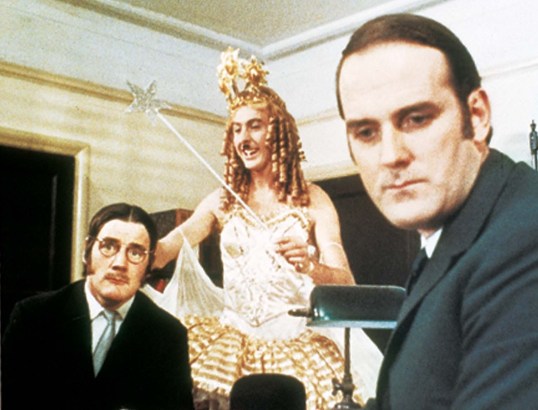
A tall, dark-haired British man sits behind a desk that is rather oddly sitting in the middle of a field.  He wears a dark suit and he looks quite serious as he says, “And now, for something completely different….”

Cut to a short film about a man with a tape recorder up his nose, followed by another short film about man who has a tape recorder up his brother’s nose.

A Hungarian man tries to buy cigarettes while using an inaccurate English phrasebook.  The publisher of the phrasebook is later brought before the court.

Poor old Arthur Pewty goes to marriage counseling and can only watch impotently as the counselor seduces his wife.  Having filed to stand up for himself, Pewty is crushed by 16-ton weight.

A self-defense instructor teaches his students how to defend themselves when they are attacked by a man with a banana.

A loquacious man in a pub says “nude nudge” and “wink wink” until his drinking companion is finally forced to slam down his drink.

A man who sees double recruits a mountaineer to climb the two peaks of Mt. Kilimanjaro.  Hopefully, they’ll be able to find last year’s expedition, which was planning on building a bridge between the two peaks.

There’s bizarre, almost Dadaist animation, featuring classic works of art interacting with cartoonish cut-outs.

Uncle Sam appears to explain how communism is like tooth decay.  A toothpase commercial explains how taking care of your teeth is like racing a car.  A motor oil company shows how it can destroy darkness and grim.

A prince dies of cancer but the spot on his face flourishes until it falls in love and moves into a housing development.

A man tries to return a dead pigeon.  The store clerk insists the pigeon is merely stunned and then sings about wanting to be a lumberjack.

A general complains that things have gotten much too silly.

The narrator appears randomly, announcing, “And now for something completely different….”

Okay, okay, you get the idea.  First released in 1971, And Now For Something Completely Different was the first film to be made featuring all of the members of Monty Python’s Flying Circus.  It was their initial attempt to break into the American market, a collection of surreal sketches that they had previously performed on television for the BBC.  Unfortunately, at the time, no one in America really knew who Monty Python was and the film failed at the box office, to the extent that many in the UK advised against Monty Python even allowing their program to later air on PBS because it was felt that Americans just wouldn’t get it.  Of course, Americans did eventually get it.  The show remains popular to this very day.  Countless Americans are convinced that they can speak in a perfectly convincing British accent, as long as they’re quoting a line from Monty Python.  The previous 4th of July, when the town band played John Philip Sousa’s Liberty Bell, I saw hundreds of people stamping down their feet at the end of it.  As for And Now For Something Completely Different, it was re-released in 1974 and became a bit of a cult favorite in the States.

That said, the members of Monty Python were never particularly happy with the film.  They were convinced to make the film by Victor Lownes, who was the head of Playboy’s UK operation.  Lownes, however, alienated the members of the group by trying to exert control over the material.  He particularly objected to the character of Ken Shabby, a perv who probably had a stash of sticky Playboys back at this flat.  Lownes also put up very little money for the production, meaning that the Pythons had to resort to shooting the film, without an audience, in a deserted factory.  Apparently, even the deliberately cheap-looking special effects of the television show were considered to be too expensive to recreate for the film.  Michael Palin and Terry Jones both later complained that the film itself was series of scenes featuring people telling jokes while sitting behind desks.

Of course, Lownes’s biggest sin was trying to insinuate that he was somehow the Seventh Python.  (One can only imagine how many people were guilty of the sin over the years.  Claiming to be the Seventh Python was probably a bit like claiming to be the Fifth Beatle.)  When Terry Gilliam was animating the film’s opening credits, the names of the cast were shown in blocks of stone.  Lownes insisted that his name by listed the same way.  Gilliam reluctantly acquiesced but then redid the names of the Pythons so that they were no longer in stone.  Fortunately, Victor Lownes would not involved in the subsequent Python films.

All that said, there’s no denying that And Now For Something Completely Different is a funny movie.  I mean, it’s Monty Python.  It’s John Cleese, Michael Palin, Graham Chapman, Eric Idle, Terry Jones and Terry Gilliam, all youthful and at the heights of their considerable comedic talents.  Even if all of the sketches are familiar from the show, they’re still funny and it’s impossible not to enjoy discovering the way that the movie threads them together.  (Combining the Lumberjack song with the dead parrot sketch worked out brilliantly.  “What about my bloody parrot!?” Cleese is heard to shout as Palin walks through the forests of British Columbia.)  Personally, my favorite Python is Eric Idle but I also love any sketch that involves Michael Palin getting on John Cleese’s nerves.  Everyone knows the dead parrot sketch, of course.  But I also like the vocational guidance counselor sketch.  It’s hard not to get caught up in Palin’s excitement as he discusses his lion tamer’s hat.  Almost as wonderful as Palin’s turn as Herbert Anchovy, accountant was Michael Palin’s turn as the smarmy host of Blackmail.  Actually, maybe Michael Palin is my favorite Python.  I guess it’s a tie between him and Eric.

And Now For Something Different has been on my DVR for quite some time.  I’ve watched it several times.  I’m not planning on deleting it any time soon.
6 Good Films That Were Not Nominated For Best Picture: The 1980s


Rob Lowe and Snow White perform at the 1989 Oscars

Continuing our look at good films that were not nominated for best picture, here are 6 films from the 1980s.

Out of the Blue (1980, dir by Dennis Hopper)

After spending several years in the cultural wilderness, Dennis Hopper directed his best film, this downbeat study of a young girl, her junkie mother, and her irresponsible father.  From the film’s first scene, in which Hopper crashes his truck into a school bus to the film’s explosive ending, Out of the Blue is a fascinating trip into the heart of American darkness.  It was definitely too dark for the Academy.

Fast Times At Ridgemont High (1982, dir by Amy Heckerling)

Fast Times would appear to take place in a totally different universe from Out of the Blue.  Still, it’s an unexpectedly intelligent look at growing up in the suburbs and it’s influenced practically every high school film that’s come after.  Plus, this may be the only movie in which Sean Penn was intentionally funny.  Despite good reviews and a cast full of future stars, Fast Times At Ridgemont High received not a single nomination.

Once Upon A Time In America (1984, dir by Sergio Leone)

Sergio Leone’s final film, this epic gangster film might be a look at how America grew and changed over the first half of the 20th Century.  It might be a trenchant critique of capitalism.  It might be an homage to the classic gangster films of the 30s.  Or it might just be a hallucination that Robert De Niro is having while visiting an opium den.  That critics are are still debating just watch exactly this film actually means says a lot about the power of Once Upon A Time In America.  However, because the film was originally released in a severely edited form, Once Upon A Time In America received not one nomination.

Brazil (1985, dir by Terry Gilliam)

Much like Once Upon A Time In America, Brazil is a brilliant film that was betrayed by the studio that distributed it.  Convinced that Terry Gilliam’s satire was too strange for American audiences, Universal Pictures initially released the film in a severely edited version.  Fortunately, Gilliam’s version was eventually released but the controversy undoubtedly hurt Brazil when it came time for the members of the Academy to select their nominees for Best Picture.

The Breakfast Club (1985, dir by John Hughes)

Perhaps the Academy understood just how unfair it was that Anthony Michael Hall had to write the essay while everyone else got either a makeover or a new romance.  For whatever reason, this classic high school film — perhaps the classic high school film — received not a single nomination.

Blue Velvet (1986, dir by David Lynch)

David Lynch was nominated for Best Director but the film itself proved to be just a bit too controversial for the Academy to give it a Best Picture nomination.  David Lynch described this film as being “the Hardy Boys In Hell” and it would have been an uncoventional, though very worthy, nominee for Best Picture.

Up next, in an hour or so, the 90s!


Here’s The French Trailer For The Man Who Killed Don Quixote!


It took a while but Terry Gilliam has finally made his Don Quixote film.

How long is a while?  Try 19 years.  That’s right.  When pre-production started on The Man Who Killed Don Quixtoe, Bill Clinton was President, George W. Bush was governor of Texas, Barack Obama was starting his first team in the Illinois State House, and Donald Trump was a real estate developer.  Shooting started in 2000 with Jean Rochefort and Johnny Depp in the starring roles but was suspended when the production ran out of money.  In 2002, Lost in La Mancha, a documentary about Gilliam’s then-unfinished film, was released.

Gilliam didn’t give up on the film  Over the next couple of years, production was started and stalled a number of times.  Everyone from Robert Duvall to John Hurt to Ewan McGregor was cast in the film at one time or another.  I think most people assumed that the film would never be finished.

Well, those people were wrong.  Gilliam’s dream project has finally be completed, with Jonathan Pryce and Adam Driver in the leading roles.  It would seem now that the film’s biggest challenge is to live up to all the hype and expectation that comes along with having a 19-year pre-production period.

As for right now, the film does not have an American release date but, yesterday, the first trailer for the French market was released.  And here it is!

Never Nominated: 16 Directors Who Have Never Received An Oscar Nomination


It’s a sad fact of life that not everyone who deserves an Oscar gets one.  For instance, Alfred Hitchcock received five nominations for best director but never won once.

That said, at least Hitchcock was nominated!  Some of our greatest directors have never even been nominated!  This list below is hardly exclusive but still, these 16 directors have somehow never been nominated.  Ten of them could still be nominated in the future.  Sadly, for six, the opportunity has forever passed.

  1. Dario Argento

Sadly, Dario Argento will probably never be nominated for best director.  None of his films — even the early, acclaimed work — were typical Oscar films.  But, consider this: Argento is one of the most influential directors of all time.  Regardless of what might be said about some of Argento’s more recent films, his earlier films are classics of their genre.  Deep Red, Suspiria, Inferno, Tenebrae — his work on any of these films would have been worthy of a nomination.

2. Andrea Arnold

This British director is responsible for two of the best films of the past ten years — Fish Tank and American Honey.  She deserved a nomination for both of them (and a win for American Honey).  Hopefully, she will be recognized in the future.

3. Tim Burton

I’m not the world’s biggest Tim Burton fan but he has a fan base that will follow him almost anywhere.  It seems like every year, we hear that Burton has finally made the film that will win him some Oscar recognition.  Remember Big Eyes?  As I said, I’m not a huge Burton fan but, if I was to nominate him, it would probably be for his work on Sweeney Todd.

4. John Carpenter

Carpenter deserved all sorts of nominations for his work in the 70s and the 80s.  Being the rebel that he is, Carpenter will probably never get the Oscar recognition that he deserves.  (He did win an Academy Award for Best Live Action Short.)

5. David Cronenberg

It’s hard to believe that this Canadian director has never been nominated.  While it’s obvious that the Academy would never recognize Cronenberg’s earlier work (even if he did deserve some recognition for that exploding head in Scanners), it still seems like he’s destined to be nominated eventually.

6. Terry Gilliam

Much like Tim Burton, Gilliam sadly seems to be destined to be one of those directors who will have to be content with a devoted fan base.  Sadly, as of late, Gilliam’s become better known for the film projects that were canceled than the ones that were actually produced.  I would have nominated him for Brazil.

7. Werner Herzog

How has Werner Herzog gone his entire career without receiving at least one nomination for Best Director!?  I would nominate him for the chance to hear the acceptance speech alone.

8. Christopher Nolan

Christopher Nolan is another director who I’m shocked to realize has never been nominated.  He certainly deserved a nomination for Inception.  Maybe, just maybe, he’ll finally get some recognition for Dunkirk.

9. Lars Von Trier

With his controversial aesthetic and his talent for offending the masses, Lars Von Trier will never be nominated, no matter how much he might deserve it.

10. Joe Wright

Personally, I think that Joe Wright is responsible for two of the best films of the past ten years, Hanna and Anna Karenina.  Unfortunately, both were left out of their respective best picture races.  Even when Atonement was nominated for best picture, Wright did not receive a corresponding nomination.  Fortunately, with Darkest Hour, Wright will have another chance this year.

Best Director Joe Wright

And here are six directors who are no longer with us.  Sadly, these six will never have a chance to receive their first Oscar nomination:

  1. Mario Bava

Much like Dario Argento, there was never really any chance that the Academy would actually honor Mario Bava.  That’s a shame because Bava truly was one of the greatest directors of all time.  Check out Black Sabbath and Shock for proof.

2. Stanley Donen

It’s hard to believe that Donen wasn’t even nominated for Singin’ In The Rain.

3. John Frankenheimer 

It’s also hard to believe that Frankenheimer never received a nomination.  While he directed his share of bad films, he also directed Seven Days in May, The Manchurian Candidate, Seconds, and Ronin.

4. John Hughes

Not even for The Breakfast Club or Ferris Bueller’s Day Off!  Hughes may have been snubbed by the Academy but his films practically invented an entire genre.

5. Michael Powell and Emeric Pressburger

This directing team was a major influence on Martin Scorsese.  Black Narcissus remains one of the most visually stunning films of all time.  The Red Shoes was nominated for best picture but Powell/Pressburger were snubbed.

6. Nicholas Ray

Everyone knows that Ray directed Rebel Without a Cause.  Personally, I think his work on Bigger than Life was even more worthy of a nomination.

4 Shots From 4 Holiday Films: A Christmas Story, Brazil, Die Hard, Christmas Vacation


4 Shots From 4 Films is just what it says it is, 4 shots from 4 of our favorite films. As opposed to the reviews and recaps that we usually post, 4 Shots From 4 Films is all about letting the visuals do the talking.

4 Shots From 4 Holiday Films

A Christmas Story (1983, dir by Bob Clark)

A Christmas Story (1983, dir by Bob Clark)

Brazil (1985, dir by Terry Gilliam)

Brazil (1985, dir by Terry Gilliam)

Die Hard (1988, dir by John McTiernan)

Die Hard (1988, dir by John McTiernan)

National Lampoon's Christmas Vacation (1989, dir by Jeremiah Chechik)

National Lampoon’s Christmas Vacation (1989, dir by Jeremiah Chechik)

4 Shots From 4 Films: Monty Python’s Life of Brian, Time Bandits, Mona Lisa, Track 29


4 Shots From 4 Films is just what it says it is, 4 shots from 4 of our favorite films. As opposed to the reviews and recaps that we usually post, 4 Shots From 4 Films is all about letting the visuals do the talking.

In 1978, George Harrison co-founded HandMade Films to finance Monty Python’s The Life of Brian.  The company continued to produce films through the 80s and helped to reinvigorate the British film industry.  All of the shots below come from HandMade films and credit George Harrison as executive producer.

4 Shots From 4 Films

Monty Python's The Life of Brian (1979, directed by Terry Jones)

Monty Python’s Life of Brian (1979, directed by Terry Jones)

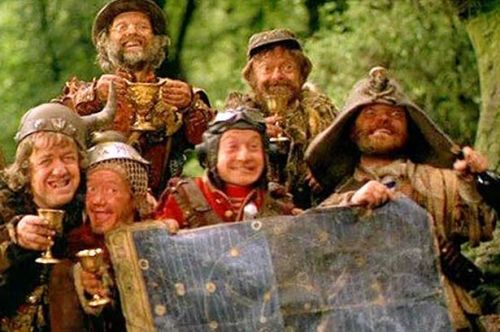
Time Bandits (1981, directed by Terry Gilliam)

Time Bandits (1981, directed by Terry Gilliam)

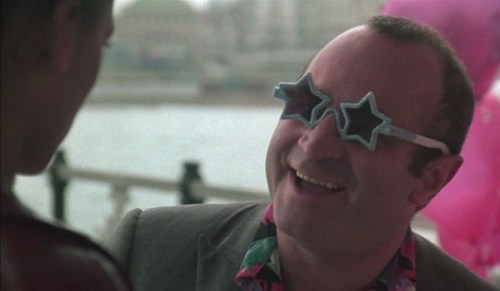
Mona Lisa (1986, directed by Neil Jordan)

Mona Lisa (1986, directed by Neil Jordan)

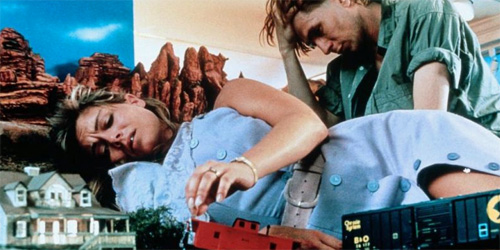
Track 29 (1988, directed by Nicolas Roeg)

Track 29 (1988, directed by Nicolas Roeg)

Trailer: Jupiter Ascending


jupiter1

The Wachowskis, Andy and Lana, have a new film set for release in early 2015. Jupiter Ascending was suppose to come out in 2014, but things happened and now it’s been pushed back for a February 2015 release.

Such a drastic delay in release usually means something major on the negative side of the ledger has occurred and the studio in charge of it’s release have little to no faith in the film. Has Warner Bros. Studios lost faith in the latest Wachowski offering? Is Jupiter Ascending the hot mess that it has been rumored about? Is the grandiose space opera the film is being made out to be making studio exec’s nervous?

So, many questions that most people who like to dwell on the in’s and out’s of filmmaking and the business of making them are probably asking themselves.

My only concern is that the Wachowskis have taken the extra time to make the film they set out to make. They’re one of the few filmmakers who seem to always get to do the sort of dream projects that more successful directors rarely get a chance to or even attempt to try. Whether it’s The Matrix, Speed Racer or Cloud Atlas, the Wachowskis have danced to their own tune and for some reason Warner Bros. continue to give them big-budgets after big-budgets to get their next dream project made into reality.

Here’s to hoping Guardians of the Galaxy being such a huge success will help this upcoming space opera turn it’s February release (usually a place where films go to die) into a new addition to the resurgence of the space opera.

Quick Review: Time Bandits (dir. by Terry Gilliam)


My parents used to have some strange movies growing up. Time Bandits is one of those films that I kind of stumbled on, but grew to be one of my favorite British films. It was my gateway drug to all things Monty Python.

Produced by former Beatle George Harrison and his company, Hand Made Films and running off the success of Monty Python’s Life of Brian, Time Bandits runs off of a simple premise. The Supreme Being once had a map of all the points in time on Earth. A group of his servants steal this map in order to travel through time and use it to plunder various historical figures of their loot. Granted, it’s a strange story, but if you’ve watched anything Gilliam’s done, this film actually works (or did for me when I saw it).

Our story opens with a boy named Kevin (Craig Warnock), who dreams of a more interesting life than the one he shares with his parents while watching tv. One night, a set of little people dressed in steampunk attire climb out of his closet and threaten him bodily harm unless he tells them how to escape his dimension. They manage to locate an exit, only to be pursued by The Supreme Being, who warns them to return the map they’ve stolen from him. If I remember nothing else from this film, that one scene will always stay with me.

The crew, led by Randall (David Rappaport) arrive during Napoleon’s time (played quite convincingly by Ian Holm) and manage to become generals in his army after impressing him with a rendition of “Me and My Shadow”. This, coupled with their size helped out, I’m sure. As thanks for being part of his army, they get Napoleon drunk until he passes out and collect most of his loot before finding another time portal and leaping into Robin Hood’s time. Unfortunately for the Time Bandits, Robin Hood (John Cleese) assumes they’ve arrived to give their ill begotten goods to the poor and promptly gives it all away to them.

In the midst of figuring out their next step, the Bandits run into The Supreme Being again and distract him, giving Kevin a chance to escape on his own. However, when two portals open before him, he chooses the wrong one and ends up in Ancient Greece with King Agememnon (Sean Connery), who adopts Kevin as a Prince. Before he can fully enjoy it, however, the Bandits show up and “free” from the time period he doesn’t belong in.

There’s more to the tale, but let’s just say that the Evil Genius (one of David Warner’s best roles in my opinion – he had a knack for playing bad guys) gets wind of the Map and hatches his own plan to acquire it and use it for nefarious deeds.

The beauty of Time Bandits is the world it creates. Though grounded in real time periods, the fantasy elements are pretty interesting, much like Brazil was. Giants who wear ships on their heads, Ogres and creates with cow skulls for heads make up some of the strange visions Terry Gilliam brings to this story. Overall, it’s a fun and unique tale that’s good for at least a late night viewing, and one that I return to from time to time.