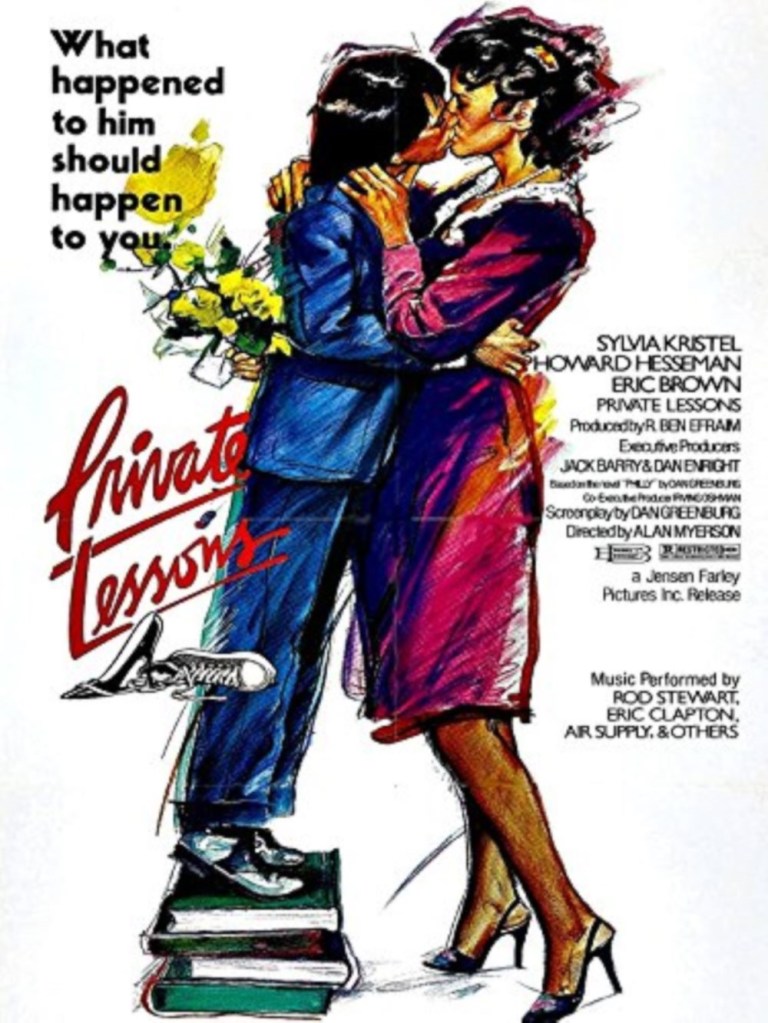
Guilty Pleasure No. 103: Private Lessons (dir. by Alan Myerson)


Private Lessons is that kind of early ’80s sex comedy that feels like a time capsule from when movies could get away with stuff that would never fly today. It’s got this awkward charm mixed with some seriously questionable choices, centering on a horny teenager named Philly who gets schooled in the ways of love by his family’s sultry French housekeeper. The film tries to play it all for laughs and titillation, but it lands somewhere between guilty pleasure and uncomfortable relic.

Philly, played by Eric Brown, is your classic 15-year-old rich kid left home alone for the summer in a sprawling Albuquerque mansion while his dad jets off on business. Dad hires Nicole, this alluring European housekeeper portrayed by Sylvia Kristel—yeah, the Emmanuelle star herself—to keep an eye on things, along with the sleazy chauffeur Lester, brought to life by Howard Hesseman in full sleazeball mode. From the jump, Philly’s got a massive crush on Nicole; he’s peeping through keyholes and fumbling over his words whenever she’s around. It’s all very American Pie before American Pie existed, but with a Euro-sex vibe courtesy of Kristel’s effortless sensuality. She catches him spying one night, strips down without a care, and invites him to touch—Philly bolts like his pants are on fire. You can’t help but chuckle at his panic; Brown’s wide-eyed innocence sells it without overplaying the hand.

The setup builds slowly, which is both a strength and a drag. Philly spills the beans to his buddy Sherman, played with manic energy by Patrick Piccininni, who turns every conversation into a roast session about Philly’s virginity. Their banter is some of the film’s highlights—raw, boyish ribbing that feels authentic to awkward teen friendships. Nicole keeps pushing the envelope: a steamy makeout in a dark movie theater, a goodnight kiss that nearly melts the screen, and finally, a fancy French dinner date where they seal the deal back home. Kristel owns these scenes; her Nicole isn’t just a seductress, she’s got this playful confidence that makes the slow seduction believable. The sex scene itself is tame by today’s standards—soft-focus, lots of sighs—but it’s handled with a wink, pretending to be shocking while delivering the era’s softcore goods.

But here’s where Private Lessons swerves into darker territory and kinda loses its footing. Midway through their romp, Nicole fakes a heart attack and “dies” right on top of Philly. Freaked out, he confesses to Lester, who smells opportunity. Turns out, the chauffeur’s been blackmailing Nicole over her immigration status and hatches a scheme to pin her “murder” on Philly, forcing the kid to cough up a chunk of his trust fund to cover it up. They bury a dummy in the desert, and Lester plays the concerned adult while pocketing the cash. It’s a twist that amps up the stakes, but it also shifts the tone from fluffy comedy to something creepier, leaning hard into moral panic territory. Hesseman chews the scenery as Lester, all smarmy grins and side-eye; he’s the perfect villain you love to hate, but the plot machinations feel forced, like the writers ran out of seduction gags and needed conflict.

Nicole, developing real feelings for Philly amid the con, has a change of heart and spills the truth. Together, they rope in Philly’s tennis coach—Ed Begley Jr. in a quick but fun bit—to impersonate a cop and scare Lester straight. The bad guy panics, gets nabbed trying to flee with the money, and everyone agrees to a truce: no one rats anyone out. Nicole’s “child molestation” (the film’s own loaded term for her role in seducing a minor) and immigration issues stay buried, Lester technically keeps his job, and Nicole splits before Dad returns. It’s a tidy wrap-up that dodges real consequences, which fits the film’s escapist fantasy but leaves a sour taste ethically. The romance fizzles without much payoff; you half-expect a heartfelt goodbye, but it’s more pragmatic than emotional.

Tonally, Private Lessons is all over the map. The first half thrives on its lighthearted horniness—Philly’s fumbling advances, Nicole’s teasing allure, and a very of-its-time soundtrack that pumps up the montages. It’s got that innocent raunchiness of films like Porky’s, where sex is the big mystery and everyone’s in on the joke. Brown holds his own as the lead; at 15, he’s convincingly flustered yet game, making Philly relatable rather than cartoonish. Kristel brings actual star power, turning what could be a one-note vixen into someone with hints of depth—her chemistry with Brown sparks genuine warmth amid the sleaze. Hesseman leans into Lester’s slimeball energy, turning every scene with him into a mix of funny and gross.

That said, the film’s not without flaws, and they’re glaring by modern eyes. The premise is straight-up predatory: a grown woman systematically grooming an underage boy, played for comedy without much self-awareness. It’s the male version of Lolita, but without any critique—instead of examining the situation, it just sort of grins and shrugs. The blackmail plot tries to add intrigue but mostly undermines the fun, turning Nicole from free spirit to reluctant crook. Pacing drags in spots; the relatively short runtime still feels stretched when the seduction stalls so the script can set up the con. And the ending? It papers over everything with a shrug, letting all parties walk free like it’s no big deal. The whole thing feels very much like a product of a moment when taboo could be turned into box-office bait without much pushback.

Visually, it’s a product of its time: glossy ’80s cinematography, plenty of skin but no hardcore edge, and that mansion setting screaming wealth fantasy. Director Alan Myerson keeps it breezy, never letting the comedy get too mean-spirited until Lester’s scheme really kicks in. The score and song choices nail the vibe—upbeat for the flirtations, a bit more tense for the con, always keeping things light even when the story goes to shadier places. It very much feels like something that would play late at night on cable and stick in your memory more as a vibe than as a fully coherent film.

Does it hold up? Kind of, if you’re in a nostalgic mood or digging for ’80s cheese. It’s honest about teen lust without being judgmental, and the performances carry the silly plot. But the power imbalance and the underage angle make it tough to fully endorse—watch with that lens, and it’s more cringe than chuckle. Still, for what it is—a raunchy romp with a surprisingly soft center—Private Lessons delivers just enough to warrant a spin on a bored night. Eric Brown and Sylvia Kristel do a lot of heavy lifting; without their chemistry, this would be forgettable smut instead of a strangely endearing, if deeply problematic, relic. If you’re into retro sex comedies like My Tutor or Zapped!, this one sits comfortably in that same dusty corner of the genre, flaws and all, as a snapshot of looser times that’s best taken with a big grain of salt.

Previous Guilty Pleasures

  1. Half-Baked
  2. Save The Last Dance
  3. Every Rose Has Its Thorns
  4. The Jeremy Kyle Show
  5. Invasion USA
  6. The Golden Child
  7. Final Destination 2
  8. Paparazzi
  9. The Principal
  10. The Substitute
  11. Terror In The Family
  12. Pandorum
  13. Lambada
  14. Fear
  15. Cocktail
  16. Keep Off The Grass
  17. Girls, Girls, Girls
  18. Class
  19. Tart
  20. King Kong vs. Godzilla
  21. Hawk the Slayer
  22. Battle Beyond the Stars
  23. Meridian
  24. Walk of Shame
  25. From Justin To Kelly
  26. Project Greenlight
  27. Sex Decoy: Love Stings
  28. Swimfan
  29. On the Line
  30. Wolfen
  31. Hail Caesar!
  32. It’s So Cold In The D
  33. In the Mix
  34. Healed By Grace
  35. Valley of the Dolls
  36. The Legend of Billie Jean
  37. Death Wish
  38. Shipping Wars
  39. Ghost Whisperer
  40. Parking Wars
  41. The Dead Are After Me
  42. Harper’s Island
  43. The Resurrection of Gavin Stone
  44. Paranormal State
  45. Utopia
  46. Bar Rescue
  47. The Powers of Matthew Star
  48. Spiker
  49. Heavenly Bodies
  50. Maid in Manhattan
  51. Rage and Honor
  52. Saved By The Bell 3. 21 “No Hope With Dope”
  53. Happy Gilmore
  54. Solarbabies
  55. The Dawn of Correction
  56. Once You Understand
  57. The Voyeurs 
  58. Robot Jox
  59. Teen Wolf
  60. The Running Man
  61. Double Dragon
  62. Backtrack
  63. Julie and Jack
  64. Karate Warrior
  65. Invaders From Mars
  66. Cloverfield
  67. Aerobicide 
  68. Blood Harvest
  69. Shocking Dark
  70. Face The Truth
  71. Submerged
  72. The Canyons
  73. Days of Thunder
  74. Van Helsing
  75. The Night Comes for Us
  76. Code of Silence
  77. Captain Ron
  78. Armageddon
  79. Kate’s Secret
  80. Point Break
  81. The Replacements
  82. The Shadow
  83. Meteor
  84. Last Action Hero
  85. Attack of the Killer Tomatoes
  86. The Horror at 37,000 Feet
  87. The ‘Burbs
  88. Lifeforce
  89. Highschool of the Dead
  90. Ice Station Zebra
  91. No One Lives
  92. Brewster’s Millions
  93. Porky’s
  94. Revenge of the Nerds
  95. The Delta Force
  96. The Hidden
  97. Roller Boogie
  98. Raw Deal
  99. Death Merchant Series
  100. Ski Patrol
  101. The Executioner Series
  102. The Destroyer Series

Film Review: The Concorde …. Airport ’79 (dir by David Lowell Rich)


In 1979’s The Concorde …. Airport ’79, Joe Patroni (George Kennedy) finally gets to fly the plane.

The plane is question is a Concorde, a supersonic airliner that can travel faster than the speed of sound.  When we first see the Concorde, it’s narrowly avoiding a bunch of dumbass hippies in a hot air balloon as it lands in Washington, D.C.  The recently widowed Joe Patroni joins a flight crew that includes neurotic Peter O’Neill (David Warner), who says that he has dreams in which he’s eaten by a banana, and suave co-pilot Paul Metrand (Alain Delon).  Because this is an Airport film, Mertrand is dating the head flight attendant, Isabelle (Syliva Kristel).  “You pilots are such men,” Isabelle says.  “It ain’t called a cockpit for nothing, honey,” Patroni replies.

(One thing that is not explained is just how exactly Joe Patroni has gone from being a chief technician in the first film to an airline executive in the second to a “liaison” in the third and finally to a pilot in the fourth.)

The Concorde is flying to Moscow with a stop-over in Paris.  There’s the usual collection of passengers, all of whom have their own barely-explored dramas.  Cicely Tyson plays a woman who is transporting a heart for a transplant.  She gets maybe four or five lines.  Eddie Albert is the owner of the airline and he’s traveling with his fourth wife.  (Of course, he’s old friends with Patroni.)  John Davidson is an American reporter who is in love with a Russian gymnast (Andrea Marcovicci).  Avery Schrieber is traveling with his deaf daughter.  Monica Lewis plays a former jazz great who will be performing at the Moscow Jazz Festival.  Jimmie Walker is her weed-smoking saxophonist.  Charo shows up as herself and gets kicked off the plane before it takes off.

The most important of the passengers is Maggie Whelan (Susan Blakely), a journalist who has evidence that her boyfriend, Kevin Harrison (Robert Wagner), is an arms trafficker.  Harrison is determined to prevent that evidence from being released so he programs a surface-to-air missile to chase the Concorde.  Patroni is able to do some swift maneuvers in order to avoid the missile, which means that we get multiple shots of passengers being tossed forward, backwards, and occasionally hanging upside down as Patroni flips over the plane.  Oddly no one really gets upset at Patroni about any of this and no one seems to be terribly worried about the fact that someone is obviously trying blow up their plane.  Even after the stop-over in Paris, everyone gets back on the Concorde!  That includes Maggie, who could have saved everyone a lot of trouble by just holding a press conference as soon as the plane landed in Paris.

A year after The Concorde came out, Airplane! pretty much ended the disaster genre.  However, even if Airplane! had never been released, I imagine The Concorde would have still been the final Airport film.  Everything about the film feels like the end of the line, from the terrible special effects to the nonsensical script to the Charo cameo and Martha Raye’s performance as a passenger with a weak bladder.  The first Airport film was an old-fashioned studio film standing defiant against the “New Hollywood.”  The second Airport film was a camp spectacular.  The third Airport film was an example of changing times.  The fourth Airport film is just silly.

And, really, that’s the main pleasure to be found in The Concorde.  It’s such an overwhelmingly silly film that it’s hard to look away from it.  For all of its weaknesses, The Concorde will always be remembered as the film that featured George Kennedy opening the cockpit window — while in flight — and shooting a flare gun at another plane.  As crazy as that scene is, just wait for the follow-up where Kennedy accidentally fires a second flare in the cockpit.  “Put that out,” Alain Delon says while David Warner grabs a fire extinguisher.  It’s a silly moment that it also, in its way, a great moment.

The Concorde brings the Airport franchise to a close.  At least George Kennedy finally got to fly a plane.

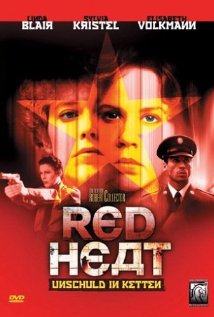
Cinemax Friday: Red Heat (1985, directed by Robert Collector and Ernest Ritter von Theumer)


At the height of the cold war, college student Christine Carlson (Linda Blair, of course) travels to West Germany to  marry her fiancée, Lt. Mike Grainger (William Ostrander).  Mike has spent the last few years in West Berlin but, with his time in the army coming to an end, that means that he will be able to return to the United States with Christine.  The only problem is that Mike doesn’t want to do that.  Instead, Mike has decided to spend a few more years in the army and to put the marriage off for a while.

Christine is so upset that she goes for a walk to clear her head.  Unfortunately, while walking around West Berlin, she witnesses a defector being abducted by the Stasi.  For unclear reasons, the Stasi decided to kidnap Christine as well.  Soon, Christine is in East Berlin, where she’s forced to falsely confess to being a CIA agent.  Christine is sentenced to three years in prison and finally, after 20 minutes of build-up, Red Heat settles into being a typical Women In Prison film.

All of the usual WIP tropes are present.  Sylvia Kristel plays Sofia, the lesbian gang leader who immediately targets Christine.  The political prisoners (like Christine) are preyed upon by the common criminals, some of whom work with crooked guards to maintain order in the prison.  There’s the usual collection of fights, shower scenes, and suicides, all mixed with scenes of Mike trying to get a group together to sneak across the border and rescue his fiancée.  The only thing that really distinguished Red Heat from every other WIP film ever made is that it takes place in a communist-controlled prison so, in between fighting off Sofia and her crew, Christine has to watch propaganda films.

Linda Blair appeared in a lot of films like this and, by the time she made Red Heat, she was clearly getting bored with the genre.  Both Blair and Kristel go through the motions and supply the obligatory nudity but neither one of them really seems to be that into the movie, with Sylvia Kristel especially appearing to be bored.  Both Blair and Kristel were better in other films and, despite the uniqueness of the cold war angle, Red Heat is never as strange or as memorable as Blair’s best WIP film, Chained HeatRed Heat is ultimately for Blair and Kristel completists only.

(In a perfect world, Red Heat would have been made in the 70s with Pam Grier in Blair’s role, Glynn Turman as Mike, Barbara Steele as Sofia, and Sid Haig as one of the guards.  Now that would have been something to see!)

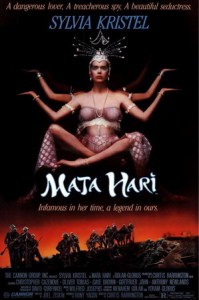
A Movie A Day #312: Mata Hari (1985, directed by Curtis Harrington)


Europe, during World War I.  The beautiful dancer, Mata Hari (Sylvia Kristel), is in love with two different soldiers, one German and one French.  (The soldiers, played by Olivier Tobias and Christopher Cazenove, are also friends though they are now on opposite sides of the Great War.)  Forced into the world of decadent, high class espionage by Frau Doktor (Gaye Brown), Mata Hari sleeps with everyone, shares information with both the Germans and the French, and tries to prevent more people from dying.  Just as in history, Mata Hari ultimately has to face a firing squad but not before taking part in threesomes, voyeurism, and a topless sword fight.
The original Emmanuelle in a Cannon Film based on the life of the famed seductress Mata Hari?  It sounds like it should be great but Mata Hari is mostly dull.  I’ve read that Mata Hari was heavily edited before it was released in the United States so maybe that explains why the film is so choppy and nearly impossible to follow.  I was never sure who Mata Hari was spying for and, after a while, I no longer cared.  Sylvia Kristel is frequently naked, which explains why Mata Hari was once a Skinemax staple, but Kirstel later wrote that she was addicted to both cocaine and alcohol while making Mata Hari and maybe that partially explains why she seems to be so mentally checked out through the entire film.  I don’t blame her.  I checked out too.

One final note: About that topless sword fight, it sounds cooler than it actually is.

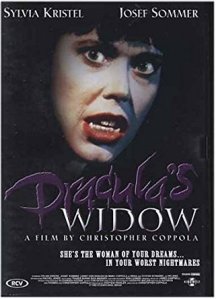
A Movie A Day #97: Dracula’s Widow (1988, directed by Chistopher Coppola)


Since we are looking at and reviewing each and every episode of Twin Peaks, every movie-a-day this month has a Twin Peaks connection.  Today’s entry, Dracula’s Widow, stars Lenny von Dohlen, who played reclusive shut-in Harold Smith on Twin Peaks.
Von Dohlen plays Raymond, the nerdy owner of a Los Angeles wax museum.  When he receives six antique chests from Romania, he does not realize that one of them contains, Vanessa (Sylvia Kristel).  Vanessa is a vampire and soon, she is killing the usual collection of perverts, muggers, and occultists.  She also bites Raymond and turns him into her Renfield.  Under her influence, Raymond even dumps his girlfriend, Jenny Harker (Rachel Jones).

However, Vanessa is not just a vampire.  Vanessa is the wife of Dracula, himself.  When she demands that Raymond take her to her husband, Raymond tells her that Dracula was killed nearly a hundred years ago by Prof. Van Helsing.  (How did Vanessa not already know this?)  Vanessa hunts down and kills Van Helsing’s grandson (Stefan Schnabel) but this brings both her and Raymond to the attention of Inspector Lannon (Josef Sommer).

In the 1990s, Dracula’s Widow was a late night HBO mainstay and it still has a cult following.  I could sit here and count out all the ways that Dracula’s Widow does not make any sense but I’ve got a deadline.  For all of this low-budget movie’s flaws, Dracula’s Widow is saved by the sexy presence of Sylvia Kristel and the atmosphere that can only be provided by neon lighting and a fog machine.  Josef Sommer’s hard-boiled narration, in which he refers to Los Angeles as being Tinsel Town, is another highlight.  As for Lenny von Dohlen, his performance as Raymond feels like a dry run for his turn as Harold Smith.

Dracula’s Widow was the directorial debut by Christopher Coppola, whose uncle Francis would later make Bram Stoker’s Dracula and whose brother, Nicolas Cage, ate a cockroach while making Vampire’s Kiss.

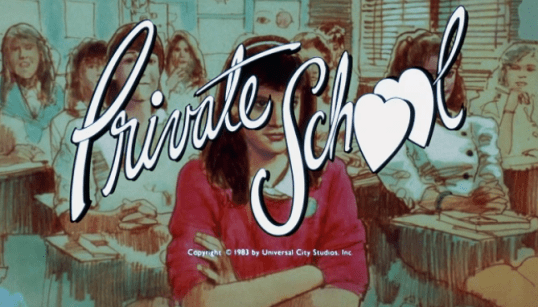
Back to School #29: Private School (dir by Noel Black)


ps-title

In my previous two Back To School reviews, I took a look at two classic teen comedies.  Fast Times At Ridgemont High and Risky Business both used and manipulated the standard teen comedy trappings to tell unusually nuanced stories about growing up.  These are films that used the audience’s familiarity with the genre to tell stories that ultimately challenged the viewer’s preconceived notions and expectations.  Having considered those two films, let us now consider Private School, a film that used all of the standard teen comedy clichés to make a very standard teen comedy.

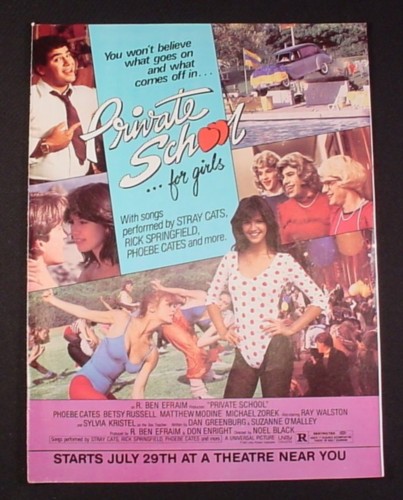
According to the film’s trivia page on the IMDB (how’s that for an authoritative source!?), Private School was “”was supposedly market researched from stem to stern in order to ensure mass teen appeal”.  And it’s true because there’s literally nothing in Private School that you couldn’t find in almost every other teen comedy released in the 1980s.  In fact, Private School often feels like a compilation of clips from other teen comedies.

For instance, the film tells the story of two groups of three.  There’s the three girls who attend Cherryvale Academy: good girl Christine (Phoebe Cates), bad (and rich) girl Jordan (Betsy Russell), and vaguely asexual tomboy Betsy (Kathleen Wilhoite).  And then there’s three guys who attend Freemount Academy.  There’s a fat guy named Bubba (Michael Zorek), a short guy named Roy (Jonathan Prince) and a nice guy named Jim (Matthew Modine).  Bubba is dating Betsy.  Christine is dating Jim.  Jordan is dating no one because she’s too busy trying to steal Christine’s boyfriend.  Roy is also single, largely because adding a fourth girl would throw off the film’s group-of-three dichotomy.

There’s also a lot of boobs, largely because Private School was made to appeal to teenage boys and you really have to wonder how many of them left the theater thinking that all they had to do to get a girl to disrobe was spill some fruit juice on her dress and then suggest that she take it off.  There’s even a scene where Jordan rides a horse naked because — well, why not?

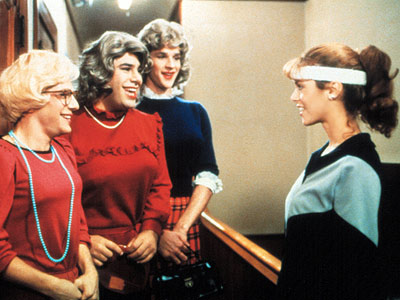
And then there’s an extended sequence where each of the three boys puts on a wig, a red dress, way too much lipstick and then sneak into the girl’s dormitory because cross-dressing is always good for a few easy laughs. Despite their best attempts to speak in falsetto voices,  Jim, Bubba, and Roy make for three of the least convincing women that I’ve ever seen but, to the film’s credit, that’s kind of the point.  It’s a stupid plan that leads to stupid results.

privschool_l

Of course, the film is also full of terrible adult authority figures.  And why not?  It’s not like anyone over the age of 18 was ever going to watch the film.  So, of course, Jordan’s father is going to be lecherous old perv with a trophy wife.  And, of course, all of Cherryvale’s teachers are going to be a collection of spinsters and alcoholics.  In the end, the only adult who isn’t a raging hypocrite is the friendly town pharmacist (played by Martin Mull) who, of course, is mostly present so he can make Jim feel nervous about buying condoms.

And, ultimately, Private School is one of those films that wants to be racy and dirty (in order to appeal to teenage boys) while also being sweet and romantic (in order to appeal to teenage girls).  The main plot revolves around Jim and Christine’s plans to go away for a weekend so that they can have sex for the first time and the film actually handles this pretty well.  Matthew Modine and Phoebe Cates both have a really sweet chemistry.  They’re a really cute couple and you hope the best for them.  But there’s just so many complications, the majority of which could have been avoided by Jim not being an idiot.  It never seems to occur to Jim that maybe he’d finally be getting laid if he wasn’t always doing things like dressing up in drag and trying to sneak into the girl’s dormitory.

That doesn’t necessarily mean that Private School is a terrible film.  As far as boob-obsessed teen sex comedies go, Private School is actually pretty well-done and watchable.  The cast is likable and director Noel Black keeps the action moving.  Even the film’s nominal villain is likable, with Betsy Russell playing Jordan as being more mischievous than spiteful.  But, ultimately, what makes Private School memorable is the fact that it is so predictable, that it does literally contain every single cliché that one would expect to find in a teen comedy.  This is a film so determined to not bring anything new to the genre that it becomes an oddly fascinated study in how to maintain a status quo.

In fact, perhaps the most innovative thing about Private School is the song that plays over the opening credits.  The song — which is called You’re Breakin’ My Heart and is performed by Harry Nilsson — starts with: “You’re breaking my heart/you’re tearing it apart/so fuck you…”

That’s about as close to being subversive as Private School ever gets.

4119046

Lisa Marie Does The Fouke Monster And Five Other Trailers


Isn’t he cute?  That happy little fellow is The Fouke Monster and he’s here because he’s the star of the very first trailer in this week’s edition of Lisa Marie’s Favorite Grindhouse and Exploitation Trailers.

1) The Legend of Boggy Creek (1972)

Before I talk about this trailer, allow me to share a few facts: my family used to live in Fouke, Arkansas!  I’ve been down to Boggy Creek!  I never saw the famous Fouke Monster but I went out looking for him a few times!  Anyway, this is the trailer for The Legend of Boggy Creek, which is a documentary about an apeman that supposedly lives in the area (though, according to Wikipedia, he hasn’t been spotted since ’98 so maybe he drowned or moved to Missouri).  This film is somewhat infamous because it features reenactments of various monster sightings, some of which star people who actually lived in Fouke at the time and who play themselves (and a few of them later sued once the film came out).  It was also the first film directed by Charles B. Pierce, who directed a lot of independent films in Arkansas and North Texas, including the classic The Town That Dreaded Sundown.  Sadly, Pierce passed away last year at the age of 71.

2)  Mean Mother (1974)

This is one of those trailers that I discovered while randomly searching Youtube and, I have to be honest, my first thought was that it was a parody trailer.  But no, after researching the manner, I can say that Mean Mother is a real movie.  It was apparently yet another one of the cinematic offerings of the late Al Adamson.

3) The Night Child (1976)

This Italian film is one of the countless Omen/Exorcist rip-offs that came out in the 70s.  Actually, The Night Child is an indirect rip-off of those two films as it’s actually a rip-off of a previous Italian version of the Exorcist, Beyond The Door.  What I especially love about this trailer is the “Keeping telling yourself, she’s only a child,” line which is obviously meant to recall the “Keep telling yourself, it’s only a movie…” tagline from Last House On The Left.

4) The Young Nurses (1973)

“Meet today’s women…beautiful, liberated, and ready for action!  They’re the young nurses and they’re growing up fast!”  I love the narrator of this trailer.  I’ve heard his voice in several exploitation trailers from the early 70s and he just has a way of delivering the sleaziest lines in the most cheerful, harmless way.  I’d love to know who he was and if he’s still with us.

5) Nosferatu The Vampyre (1980)

Oh.  My.  God.  Okay, I saw this movie a few years ago and I was watching it by myself at 3 in the morning with all the lights off while there was a thunderstorm going on outside and there was this howling wind that kept on making all the windows shake.  I got so scared, it’s not even funny.  This is a remake of the silent classic.  It stars Klaus Kinski, Bruno Ganz, and Isabelle Adjani and was directed by the one and only Werner Herzog.

6) Julia (1974)

“Why don’t you come along and see me this week?  And bring your girlfriend…”  This trailer was specifically designed to promote this film in Australia.  Needless to say, that’s not actually Sylvia Kristel providing the voice over.  

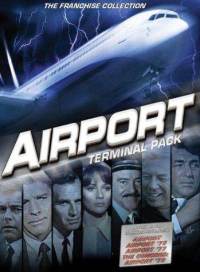
Film Reviews: The Airport Terminal Pack


 Sometimes, you have to be careful which films you choose to watch over the course of the day. 

Such as, last Friday night, I heard the news that Jill Clayburgh had died and I ended up watching An Unmarried Woman.  This, along with the fact that I also watched the Black Swan trailer, led to me dancing around the house in my underwear, en pointe in bare feet, and doing a half-assed pirouette in the living room.  And I felt pretty proud of myself until I woke up Saturday morning and my ankle (which I don’t think has ever properly healed from the day, seven years ago, that I fell down a flight of stairs and broke it in two places) literally felt like it was on fire.  That was my body’s way of saying, “You ain’t living in a movie, bitch.  Deal with it.”

So, come Sunday, I decided to play it safe by watching something that I was sure wouldn’t lead to any imitative behavior on my part.  Since I had previously reviewed Earthquake on this site, I decided that I would devote some time to the movies that started the entire 1970s disaster movie genre — Airport.  Watching Airport led to me watching Airport’s three sequels.

I was able to do this largely because I own the Airport Terminal Pack, a two-disk DVD collection that contains all four of the Airport films and nothing else.  There’s no special features or commentary tracks.  That’s probably a good thing because these films are so extremely mainstream that I doubt the commentary tracks would be all that interesting except to people who love “Me and Jennings Lang had the same lawyer…” style stories.

The movies are a mixed bag of ’70s sexism, mainstream greed, and casts that were described as being “all-star” despite the fact that they featured very few stars.  They’re all worth watching as time capsules of a past time.  Some of them are just more worthy than others.

Below are my thoughts on each individual film in the collection…

Airport (directed by George Seaton)

First released in 1970, Airport was nominated for 10 Academy Awards (including best picture), broke box office records, and started the whole 70s disaster movie trend.  It also has to be one of the most boring, borderline unwatchable movies ever made.  The fact that I managed to sit through the whole thing should be taken as proof that I’m either truly dedicated to watching movies or I’m just insane.  Take your pick.

Anyway, the film is painstakingly detailed account of the every day operations of an airport.  Yeah, sounds like a lot of fun, doesn’t it?  Burt Lancaster runs the airport.  His brother-in-law Dean Martin flies airplanes.  Both of them have mistresses but we’re told that’s okay because Lancaster’s wife expects him to talk to her and Martin’s wife is cool with him fucking around as long as he comes home at night.  I would be tempted to say that this is a result of the film having been made in 1969 and released in 1970 but actually, it’s just an introduction to the sexual politics of the typical disaster film.  Men save the day while women get in the way.  And if you think things have changed, I’d suggest you watch a little film calledf 2012

The only interesting thing about the film is that Lancaster’s mistress is played by Jean Seberg who, ten years earlier, had helped change film history by co-starring in Jean-Luc Godard’s classic film Breathless.  Nine years later, after years of being hounded by the American press and the FBI for her radical politics, Seberg committed suicide.

Airport 1975 (directed by Jack Smight)

As opposed to its predecessor, Airport 1975 is actually a lot of fun in its campy, silly way.  This is the one where a small private plane (flown by Dana Andrews, the star of the wonderful film noir Laura) collides with a commercial airliner.  The entire flight crew is taken out and head stewardess Karen Black has to pilot the plane despite the fact that she’s obviously cross-eyed.  Luckily, since Black is a stewardess, she has a pilot boyfriend who is played by Charlton Heston.  Heston talks her through the entire flight despite the fact that she was earlier seen trying to pressure him into not treating her like an idiot.  Anyway, Heston does his usual clench-jaw thing and if you need a drinking game to go with your bad movie, just take a shot every time Heston calls Black “honey.”  You’ll be drunk before the plane lands.

There’s some other stuff going on in this movie (for instance, Gloria Swanson appears as “herself” and doesn’t mention Sunset Boulevard or Joseph Kennedy once!) but really, all you need to know is that this is the film where Karen Black acts up a storm and random characters keep saying, “The stewardess is flying the plane!?”

Odd trivia fact: Airport 1975 was released in 1974.

Airport ’77 (directed by Jerry Jameson)

In Airport ’77, a group of art thieves attempt to hijack an airplane which, of course, leads to the airplane crashing into the ocean and somehow sinking down to the ocean’s floor without splitting apart.  The crash survivors have to try to figure out how to get to the surface of the water before they run out of oxygen. 

In this case, our resident sexist pilot is Jack Lemmon who has a really ugly mustache.  He wants to marry head stewardess Brenda Vaccarro.  Vaccarro doesn’t understand why they have to get married to which Lemmon responds, “Because I want a wife and kids!”  The film also gives us Lee Grant as a woman who is married to Christopher Lee but who is having an affair with another man.  She also drinks a lot and dares to get angry when she realizes that the airplane is underwater.  While this sort of behavior is acceptable from Dean Martin, Charlton Heston, and Jack Lemmon, the film punishes Lee Grant by drowning her in the final minutes.

Technically, Airport ’77 is probably the best of the Airport films.  The cast does a pretty good job with all the melodrama, the film doesn’t drag, and a few of the scenes manage to generate something resembling human emotion.  (For instance, when the blind piano player died, I had a tear in one of my freaky, mismatched eyes.)  Unfortunately, the movie’s almost too good.  It’s not a lot of fun.  Everyone plays their roles straight so the silly plot never quite descends into camp and the key to a good disaster film is always camp.  This film also has the largest body count of the series, with most of the cast dead by the end of the movie.  (And, incidentally, this film did nothing to help me with my fear of water…)

The Concorde: Airport ’79 (directed by David Lowell Rich)

The last Airport movie is also the strangest.  Some people have claimed that this film was meant to be a satire of the previous Airport films.  I can understand the argument because you look at film like Concorde and you say, “This must be a joke!”  However, the problem with this theory is that there are moments of obvious “intentional” humor in this film (i.e., J.J. from Good Times smokes weed in the plane’s bathroom, another passenger has to go to the bathroom whenever she gets nervous) and none of them show any evidence of the type of wit and outlook necessary to come up with anything this silly on purpose.  Add to that, the film’s story is credited to Jennings Lang, a studio executive.  Studio execs do not take chances.  (Plus, the actual script was written by Eric Roth, who went on to write the amazingly humorless The Curious Case of Benjamin Button).

No, this film is meant to be taken seriously and oh my God, where do I start?

Our pilots are George Kennedy and Alain Delon.  The head stewardess (and naturally, Delon’s girlfiend) is played by Sylvia “Emanuelle” Kristel who, at one point, says, “You pilots are such men!”  “Hey, they don’t call it a cockpit for nothing, honey,” Kennedy replies. 

Meanwhile, Robert Wagner is trying to destroy the Concorde because one of the passengers is his girlfriend who has proof that Wagner has been selling weapons to America’s enemies.  So, he attempts to blow the plane up with a guided missile and when that fails, he sends a couple of fighter planes after them.  Kennedy responds by opening up the cockpit window — while breaking the sound barrier mind you — and firing a flare gun at their pursuers.  

After this, there’s stop over in Paris where Delon arranges for Kennedy to sleep with a prostitute who assures Kennedy that he made love “just like a happy fish.”

The next day, everyone returns to the exact same Concorde — despite the fact that just a day earlier they’d nearly been blown up by a squadron of fighter planes — and take off on the second leg of the flight.  Let me repeat that just to make sure that we all understand what this film is asking us to believe.  After nearly getting blown up by a mysterious squad of fighter planes, everybody shows up the next morning to get on the exact same plane.

Oh, and it never occurs to Wagner’s ex-girlfriend that Wagner might have something to do with all of this.

Now sad to say, Concorde is the one of those films that’s a lot more fun to talk about than to actually watch.  It should be a lot more fun in its badness than it actually is.  Still, the movie has just enough camp appeal to make it fun in a “what the fuck…” sorta way.

And that’s how the Airport series comes to an end.